The best dog seat belt for cars is the printed attach that matches this week’s job — Mighty Paw at $15.99 when you want heavier webbing on a restless mid-to-large dog, SlowTon at $12.99 when two sizes share one cabin, BWOGUE at $7.99 when metal hardware is the commuter story, SunGrow at $5.99 when you need a glove-box spare, or the 3-in-1 harness at $18.99 when the belt is the harness — not a $6 “crash-tested” adjective and not a collar clip. The We read the titles and descriptions of 7 SKUs. Listed snapshots sum to $77.42 (median $8.48, a 3.17× spread from SunGrow $5.99 to the 3-in-1 $18.99). 0 of 7 cards publish a CPS certification. 1 of 7 is an integrated harness. 6 of 7 are straps that assume you already own a walking harness. A $6 clip is not a child seat.
Desk pick: Heavier webbing → Mighty Paw $15.99. Adjustable multi-size → SlowTon $12.99. Metal commuter → BWOGUE $7.99. Lowest spare → SunGrow $5.99. Walk-then-drive clip → Removable $8.48. Second-car budget → COOYOO $6.99. One object that is the harness → 3-in-1 $18.99. A 90 lb tank still belongs on the crash-tested crate page.
Before you shop: (1) you will clip a body harness, never a collar, (2) you will install on the rear bench, (3) you can name a lock (buckle click, not a headrest hope), (4) after a wreck that dog’s clinic and insurer are the next calls — not this URL. Fail gate 4 and this checklist is how you shop past an emergency.
Center for Pet Safety certifies some harnesses, not every nylon leash with a seat-belt tongue. The Federal Motor Vehicle Safety Standard that covers human belts does not certify pet tethers. Clip the dog to a harness. Put the dog in the back. Disable a passenger airbag if a front install is the only option your vehicle manual allows.
Our guides are reader-supported. This article may contain affiliate links. As an Amazon Associate we may earn a commission if you buy through links, at no extra cost to you.
Related desk pages: crash-tested car crates, small-dog car seats, dog car hammocks, SUV car barriers.
Quick picks at a glance
- Heavier webbing, everyday large-dog strap: Mighty Paw Dog Seat Belt for Car — $15.99.
- Lowest card on this URL: SunGrow Dog Seat Belt for Car — $5.99.
- Only integrated harness on the catalog: Dog Seat Belt 3-in-1 Car Harness — $18.99.
- Adjustable multi-dog household strap: SlowTon Dog Seat Belt for Car — $12.99.
- Metal-hardware commuter strap: BWOGUE Dog Seat Belt for Car — $7.99.
What the best dog seat belt for cars actually means
The aisle sells “crash-tested” on every $7 clip. The desk sells four different jobs. Mixing them is how a collar clip becomes a story.
- A body harness, not a neck loop. Neck hardware in a stop is a trachea problem. Every card on this page assumes a torso attach — or, for the 3-in-1, is the harness.
- A short travel limit. Sixteen to twenty-four inches of useful slack. A zip-line from the headrest that lets the dog reach the driver is a leash, not a restraint.
- A vehicle belt or LATCH, not a headrest-only fashion strap. Headrest loops slip. Seat-belt tongues lock.
- A back-seat install. Front airbags and dogs do not share a job.
Four facts belong in the first screen of any best dog seat belt for cars decision:
- CPS and “crash-tested” are not synonyms. Center for Pet Safety publishes a product list. Sleepypod’s Clickit Sport is the CPS-named harness we cite on the small-dog car seat page. None of the seven straps on this URL appear as CPS-certified objects on the cards we compiled. A marketplace badge with no lab is advertising.
- There is no FMVSS pet-belt number. NHTSA writes rules for human occupant protection. A dog tether is aftermarket hardware. “Meets crash standards” without a named lab, speed, and dummy is a slogan.
- Unrestrained pets are cabin objects. AVMA pet-travel notes treat restraint and heat as welfare issues, not shopping flavor.
- A crate can beat a strap. For large dogs, a crash-tested crate is often the more honest containment. A strap wins for a harness-trained mid-size dog on a rear bench.
What
How seat belt restraint listings compare on labels
These tables are desk compilations from listed prices, maker attach language, and the August 2026 card snapshots on this URL. Prices move. Heuristics, not lab output.
Table 1 — Card price, job, and crash language
| Product | Card price | Desk job | Crash language on file |
|---|---|---|---|
| Mighty Paw | $15.99 | Heavy-duty strap | None on card — nylon tether |
| COOYOO | $6.99 | Budget clip | None on card |
| Removable harness-style | $8.48 | Walk-to-car transition strap | None on card |
| SlowTon | $12.99 | Adjustable multi-size strap | None on card |
| 3-in-1 harness | $18.99 | Integrated harness + belt | None on card — still not CPS |
| BWOGUE | $7.99 | Metal-hardware commuter | None on card |
| SunGrow | $5.99 | Glove-box spare | None on card |
Desk stat: Across the seven cards, 0% publish a named crash protocol. 14% (1 of 7) is an integrated harness. 86% are straps that assume you already own a walking harness. If your search is best dog seat belt for cars and you only sort by “crash-tested” tile art, you will buy webbing.
Table 2 — Attach path vs stability (why headrest-only fails)
| Method | Stability theme | Compatible cards | Desk note |
|---|---|---|---|
| Seat-belt tongue into buckle | Good default | Most straps | Mighty Paw, COOYOO, SlowTon, BWOGUE, SunGrow class |
| LATCH / metal J-hooks + belt | Better when the vehicle has it | Integrated harnesses | Not printed on these seven cards |
| Vehicle belt is the restraint | Best if CPS harness | None on this URL | See Sleepypod on the car-seat page |
| Headrest strap only | Poor | Avoid as sole anchor | Listing photos lie |
| Collar clip | Fail | None we will recommend | Neck injury waiting on a hard brake |
Remove slack. A 36-inch “comfort” strap that lets the dog stand on the console is a projectile with extra steps.
Table 3 — Size match vs typical dog class (desk heuristic)
| Dog class (examples) | Typical weight | What to buy on this catalog | Watch-out |
|---|---|---|---|
| Chihuahua, Yorkie, Pom | 4–12 lb | Any short strap + snug small harness | Loose 3-in-1 on a 6 lb chest |
| Beagle, Cocker, Corgi | 20–35 lb | SlowTon or Mighty Paw + walking harness | Headrest zip-line to the driver |
| Lab, Golden, Boxer | 50–75 lb | Mighty Paw webbing; crate if the dog is a tank | $6 clip on a 70 lb lunge |
| Giant / 90 lb+ | 90+ lb | Crash-tested crate | A strap is not a crate |
| Growing puppy | Moving target | Recheck harness every 4–6 weeks | Yesterday’s Small is today’s ejector |
This is a desk heuristic from common manufacturer bands. Always use the SKU’s own chart. A Lab at 70 lb is not a Yorkie at 6.
Table 4 — Job vs product (comfort is not a protocol)
| Job | Buy | Do not buy |
|---|---|---|
| Named crash protocol | CPS harness (not on these seven cards) | Any “crash-tested” $7 clip |
| Everyday rear-bench tether | Mighty Paw or SlowTon | Headrest-only fashion strap |
| Two-car / glove-box spare | SunGrow or COOYOO | A 3-in-1 you will not re-fit |
| Walk-then-drive same harness | Removable clip + walking harness | A collar ring |
| After a wreck | Clinic + insurer | This shopping page |
Table 5 — Card math (August 2026 snapshots)
| Stack | Example SKUs | Snapshot total | Who it is for |
|---|---|---|---|
| Spare only | SunGrow | $5.99 | Occasional short hops |
| Budget pair | COOYOO + BWOGUE | $14.98 | Two cars, same dog |
| Daily + spare | Mighty Paw + SunGrow | $21.98 | Commute + backup |
| Integrated harness | 3-in-1 | $18.99 | One object, more fit work |
| All seven | Collection | $77.42 | A junk drawer, not a plan |
Desk stat: The whole catalog is cheaper than one CPS harness. That is not a safety upgrade. It is a price aisle.
Seat-belt SKU arithmetic
| Desk equation | Dollars / count | What it actually buys |
|---|---|---|
| 3-in-1 $18.99 ÷ SunGrow $5.99 | 3.17× | Integrated harness vs glove-box spare |
| Mighty Paw $15.99 − SlowTon $12.99 | $3.00 | Heavier nylon story, still a strap |
| COOYOO $6.99 + BWOGUE $7.99 | $14.98 | Two-car pair, $1.01 under Mighty Paw |
| Mighty Paw $15.99 + SunGrow $5.99 | $21.98 | Daily webbing + spare |
| Removable $8.48 + SunGrow $5.99 | $14.47 | Walk-to-car clip + glove box |
| Median of 7 stickers | $8.48 | Removable clip sits on the median |
| All seven cards | $77.42 | A drawer, not a protocol |
Desk seat-belt math: SunGrow $5.99 + COOYOO $6.99 + BWOGUE $7.99 = $20.97 — three spares still $2.00 under Mighty Paw + SunGrow. The 3-in-1 at $18.99 is $3.00 over Mighty Paw for a harness shape, not a CPS badge. Do not buy SunGrow $5.99 as a highway protocol. Do not buy the 3-in-1 $18.99 blind without a chest tape.
How the desk scores the best dog seat belt for cars
We do not run sleds and we do not score “vet energy.” Four checks:
1. Can you name the protocol? CPS list, or a maker sled with a lab and a speed. If you cannot name it, you bought a leash with a seat-belt tongue.
2. Does the attach point lock? Buckle click, not a headrest loop you hope stays.
3. Will you clip a harness, not a collar? Every strap on this page assumes a body harness. Collar clips are a neck injury waiting on a hard brake.
4. Will you install it in the back? Front airbags and dogs share a cabin. They should not share a seat unless the vehicle manual says to disable that bag.
Top picks — seven catalog tethers
Cards below are the catalog lines for this URL. Specs are the maker’s. They change.
1. Mighty Paw Dog Seat Belt for Car
Best for: heavier nylon on a large, restless dog — still a strap, not a sled rating.
Mighty Paw is the expensive webbing on this page, not the expensive protocol. The card is $15.99. Listing language is high-strength nylon and a universal vehicle fit. That is a material story. It is not a CPS badge. Owners of larger dogs buy it because the strap looks less like a $6 toy. The honest drawback: bulk on a 12 lb dog. Pair it with a walking harness that already fits. Do not clip it to a flat collar.
2. COOYOO Dog Seat Belt
Best for: a second-car spare when you already own a harness.
COOYOO is $6.99. That is the job. Easy clip, no padding story, no protocol. Fine for a short vet hop if the harness is already on and the travel limit is short. Not fine as the only restraint you own for highway miles with a 60 lb dog. Plastic hardware is the recurring owner theme. Replace it when the tongue no longer clicks like a human belt.
3. Removable Dog Seat Belt Harness for Car
Best for: walk-then-drive without swapping the whole walking harness.
The $8.48 removable clip is a transition object. The listing sells convenience: keep the walking harness, add a car tongue. Compatibility is the catch. Some walking harnesses have a back D-ring that is decorative. Some have a crash-oriented chest ring. If the ring is for fashion, the clip is fashion. Confirm the harness maker says that D-ring is a car attach.
4. SlowTon Dog Seat Belt for Car
Best for: adjustable length in a multi-size household.
SlowTon at $12.99 is the mid-card strap. Listing language: adjustable length, swivel to reduce tangle. Useful when a 20 lb dog and a 45 lb dog share the same car on different days. Slack is the failure mode. “Comfort” that lets a dog stand in your lap is not comfort. Set the length so the dog can sit or lie, not tour the cabin. Plastic buckles are the listed trade-off versus Mighty Paw’s heavier nylon story.
5. Dog Seat Belt 3-in-1 Car Harness for Dogs Adjustable Safety Seatbelt
Best for: one object that is the harness — more fit work, still not CPS.
This is the only integrated harness on the catalog and the highest card at $18.99. The job is uniform: harness and belt as one system. The cost is time. A 3-in-1 that is loose on the chest is worse than a walking harness you already fitted plus a $16 strap. Size to this dog. Recheck a growing puppy. Do not treat “3-in-1” as a sled rating. It is a SKU shape.
6. BWOGUE Dog Seat Belt for Car
Best for: metal hardware on a small-to-medium daily commute.
BWOGUE at $7.99 is the “metal buckle, simple strap” card. Recurring owner theme: hardware feels more like a belt tongue than a toy clip. Recurring complaint: too short in some vehicles. Measure the path from buckle to where the dog will sit. A short strap that yanks a dog into a crouch is a different problem than a long strap that lets them drive. Mid-size dogs on a rear bench are the intended class. Giants belong in a crate conversation.
7. SunGrow Dog Seat Belt for Car
Best for: glove-box spare and the lowest entry on this URL.
SunGrow is $5.99. Compact. Portable. Limited adjustability. That is the honest listing. A backup for a friend’s car or a rental is a real job. A sole highway restraint for a pulling Lab is not. Keep it as a spare after you own a fitted harness and a better daily strap — or after you decide the dog rides in a crate.
Comparison: dog seat belt for cars at a glance
| Product | Best for | Card price | Where to buy |
|---|---|---|---|
| Mighty Paw | Heavier webbing, larger dogs | $15.99 | Check price |
| COOYOO | Budget spare | $6.99 | Check price |
| Removable clip | Walk-to-car transition | $8.48 | Check price |
| SlowTon | Adjustable multi-size | $12.99 | Check price |
| 3-in-1 harness | Integrated harness | $18.99 | Check price |
| BWOGUE | Metal hardware, daily | $7.99 | Check price |
| SunGrow | Glove-box spare | $5.99 | Check price |
Want to browse the aisle? See dog seat belt listings on Amazon →
Price bands — what $6 vs $19 actually buys
Under $10 (four cards). COOYOO, Removable, BWOGUE, SunGrow. You are buying a tongue and webbing. Hardware quality is the only differentiator. BWOGUE’s metal story is why it sits above SunGrow in the checklist. None of these are a protocol.
$10–$16. SlowTon and Mighty Paw. Adjustability vs heavier nylon. Still straps.
$19. The 3-in-1. You are buying a harness shape plus a belt. You are not buying CPS.
A used tether with an unknown crash history is like a used infant seat: if you cannot name the prior life, skip it. Buy new hardware for a living dog.
How to install a dog seat belt without inventing a protocol
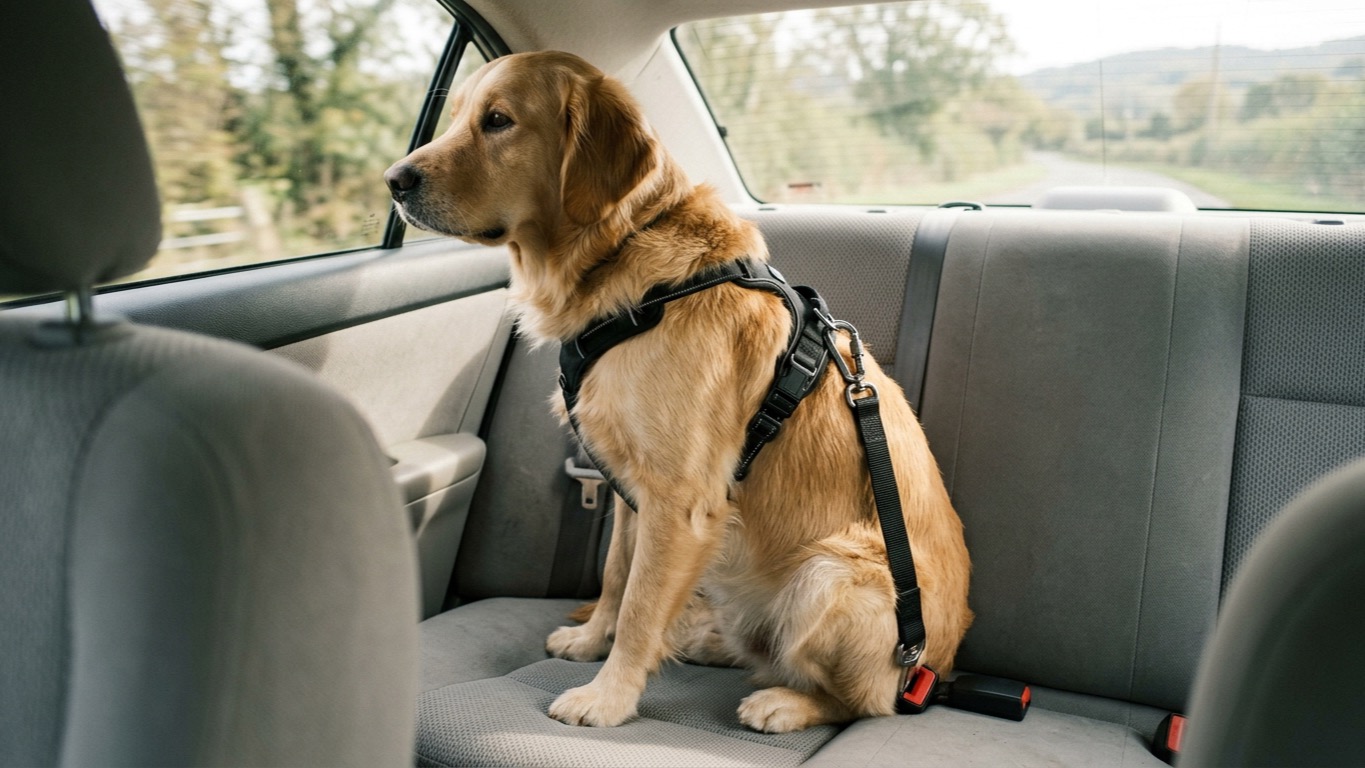
Rear bench. Harness on the dog. Clip the tether to the harness D-ring the maker names for car use. Seat-belt tongue into the vehicle buckle until it clicks like a human belt. Shorten until the dog can sit or lie, not stand on the console. Push-test the base of the seat. If the dog can reach the driver, the strap is too long.
Do not:
- Clip to a flat collar.
- Use a headrest loop as the only anchor.
- Put a small dog in the front with an active passenger airbag.
- Leave enough slack for a “window tour” that becomes a flying object.
Seven buying mistakes the Seat-Belt Restraint we keep seeing
- Buying the tile that says crash-tested. Ask for the lab. If there is no lab, you bought webbing.
- Collar attach. Neck first in a stop is a veterinary emergency.
- Front seat “so they can see.” Airbags do not negotiate.
- Headrest zip-line. Looks tidy in photos. Slips in a stop.
- One 3-in-1 “to grow into.” An oversized harness is a rattle.
- Skipping the crate for a giant. A strap is not a 110 lb containment plan.
- Never practicing. A first highway trip is a bad first lesson. Short driveway sits, then a five-minute loop.
When a seat-belt question is a clinic or legal question
A dog that vomits, screams, or collapses after a stop is a clinic dog. A dog that was loose in a wreck is a clinic dog and an insurance conversation. Some U.S. jurisdictions treat an unrestrained pet as a driver-distraction issue. We are not your lawyer. We are not your veterinarian. This page is hardware language.
Heat is a separate emergency. A tether does not cool a parked car. AVMA still treats a closed cabin as a medical risk.
What this seven-card catalog is not
It is not a CPS list. It is not a sled ranking. It is not “five belts that passed our crash tests.” That sentence was a title error and it is gone. The catalog is seven purchasable straps and one 3-in-1, priced $5.99–$18.99, compiled in August 2026.
How we researched this guide
We opened the seven live cards on this URL, added the printed prices, classified attach jobs from listing titles, and cross-checked public CPS and AVMA language. We read recurring owner themes (short strap, plastic buckle, “crash-tested” confusion).
Vehicle types and the best dog seat belt for cars
Sedan / hatch, rear bench. Default. Belt tongue into the outboard or middle buckle. Keep the dog off the driver’s elbow.
SUV middle row. Often the easiest belt story. Watch the path if a human booster already occupies the outboard. Do not stack a dog under a child’s legs.
Truck crew cab. Rear belts exist; space does not. A short BWOGUE-class strap may be the only length that does not let the dog climb the console. Measure.
Two-door / no rear seat. This is a front passenger + airbag off conversation with the vehicle manual, or a “this car is the wrong car” conversation. We will not soften that.
Rideshare / second car. SunGrow or COOYOO in a tote plus a harness you already fitted. A 3-in-1 you leave at home is not a restraint.
Motion, anxiety, and “wants the window”
Owners mix three jobs. this comparison splits them.
Motion sickness. Drool, swallow, vomit. A short tether that forces a down-stay may help one dog and worsen another. A small-dog car seat / lookout is a different object. A clinic can discuss motion meds. We do not.
Noise / storm anxiety in the car. A strap is not a ThunderShirt. Do not tighten a tether to “calm” a panic.
Window tourism. The dog wants height. That is a booster or hammock conversation. It is not a reason to leave 3 feet of slack. Flying debris and leash-around-neck stories are real.
Driver distraction. An unrestrained dog in a lap is a crash and a ticket in some places. The best dog seat belt for cars is also the one that keeps paws off the wheel.
Cost per year, not cost per listing
Mighty Paw at $15.99 plus a harness you already own is the daily stack. Seven cards at $77.42 is a drawer. Buy the job.
Replacement: a tongue that will not click is retired. Webbing that is frayed or chewed is retired. A faded “crash-tested” claim you cannot open on a lab page is a re-check, not a forever badge.
Frequently asked questions
Can the best dog seat belt for cars go in the front seat?
Back seat is the desk default — airbag risk in front. If the vehicle forces a front install, disable the passenger airbag per the vehicle manual, not a forum post. The best dog seat belt for cars still needs a harness clip.
What does a crash-test certification mean for a dog seat belt?
A dynamic sled with a weighted dummy, a named lab or program, and a result you can open. CPS is the best-known U.S. program for harnesses. None of the seven cards on this page publish that. Sleepypod Clickit Sport is the CPS object we cite on the small-dog car seat page.
Is a crate safer than the best dog seat belt for cars?
For large and giant dogs, a crash-tested crate is often the more honest containment. A strap wins for a harness-trained mid-size dog on a rear bench with a short travel limit. Match the dog, not the aisle.
Do I need a harness with a dog seat belt?
Yes. Six of seven cards are straps that clip to a harness. The 3-in-1 is the harness. Never a collar.
How do I install a dog seat belt?
Rear bench. Harness on. Tongue in the vehicle buckle. Shorten. Push-test. If the dog can reach you, it is too long.
What size dog seat belt should I buy?
Length vs this cabin, and harness girth vs this dog. Recheck a growing puppy. A 70 lb Lab is a Mighty Paw-class webbing conversation or a crate conversation — not a $6 clip.
Can I use a dog seat belt for a puppy?
If today’s harness is snug and the travel limit is short. Recheck often. An oversized 3-in-1 is not “room to grow.” It is a rattle.
Will a seat belt keep a dog cool in a parked car?
No. AVMA treats a closed cabin as a medical risk. This page is restraint.
Are elastic “stretch” tethers safer?
Elastic that lengthens in a stop is extra travel. Energy-absorbing segments on named crash harnesses are a different product class. Do not assume a stretchy $8 strap is a sled feature.
Does a hammock replace a seat belt?
No. A hammock is upholstery. A belt is a tether. Use both if you want both jobs.
Related pages
- Best crash tested dog crate for car travel
- Best dog car seat for small dogs
- Best dog car hammocks
- Best dog car barrier for SUV
- Best dog car seat cover
Sources
- Center for Pet Safety — Certified products: https://www.centerforpetsafety.org/certified-products/
- AVMA — Traveling with your pet: https://www.avma.org/resources-tools/pet-owners/petcare/traveling-your-pet
- Manufacturer and marketplace listings for the seven cards on this URL (confirm at purchase)
Last reviewed: August 2026. If something is stale, contact us.