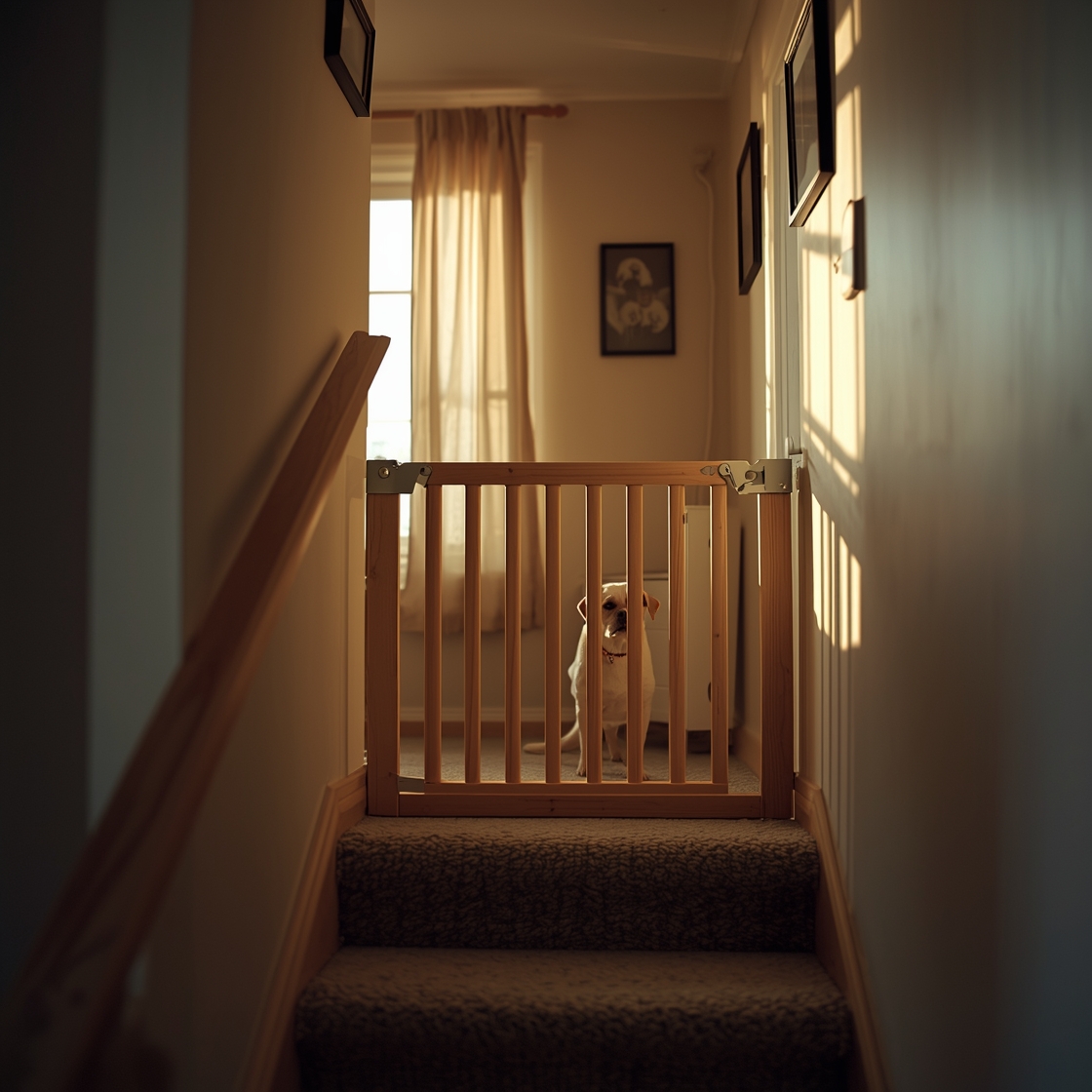

The best pet gate for wide openings is the SKU whose printed max width covers your tape measure — then a mount that does not walk when a dog hits the middle. The seven cards are Cideny Baby Gate Auto Close $45.99, Regalo Safety 30.5"-58" Extra Wide $54.99, keny 29.7"-46" Baby Gate for Stairs $55.24, Reinforced 42" Extra Tall × 80" Wide Retractable $59.95, Ingenuity Multi-Use Decorative Extra Tall Walk-Thru $67.49, Cumbor 30-54" Extra Wide Auto Close $105.99, and Cumbor Extra Wide Baby Gate $144.99. We read current Amazon listing titles and descriptions and scored 7 named SKUs. Listed snapshots ran $45.99–$144.99 (median $59.95, a 3.15× spread). Printed snapshots sum to $534.64. 1 of 7 (14%) prints an 80" retractable span (Reinforced $59.95). 1 of 7 (14%) is a high-sticker extra-wide Cumbor ($144.99). 1 of 7 (14%) is Cumbor 30–54" ($105.99). 1 of 7 (14%) is Regalo 30.5–58" ($54.99). 1 of 7 (14%) is extra-tall walk-through (Ingenuity $67.49). 2 of 7 (29%) are standard-width cards reused from stair aisles (Cideny $45.99; keny 29.7–46" $55.24) — they are not wide-opening heroes. 0 of 7 erase a 10-foot great-room gap without extensions you can actually buy.
Measure the opening. Buy the span. Then buy the mount. A $46 Cideny in a 72-inch pass-through is a joke with a latch.
Hero stat (August 2026): Regalo Extra Wide prints 58" at $54.99 (1.06 in/$). Cumbor 30–54" prints 54" at $105.99 (0.51 in/$). The 80" retractable at $59.95 is 1.33 fabric-in/$ — do not mix fabric inches with steel inches.
Our guides are reader-supported. This article may contain affiliate links. As an Amazon Associate we may earn a commission if you buy through links, at no extra cost to you.
What is the best pet gate for wide openings?
Short answer: the gate whose printed max covers your tape. On this URL that is usually Regalo 30.5–58" at $54.99 for a 48–58" metal span, Cumbor Extra Wide at $144.99 if the current kit reaches past that, or the 80" retractable at $59.95 if you accept fabric. Cideny $45.99 and keny $55.24 are doorway leftovers.

Quick picks at a glance
- Best listed high-sticker extra-wide metal: Cumbor Extra Wide — $144.99. Money is span and frame mass. Confirm the max inches with the extensions in the box.
- Best listed mid extra-wide metal: Cumbor 30–54" Auto Close — $105.99. Printed to 54". Auto-close is convenience, not a lock.
- Best listed width-first value: Regalo Extra Wide 30.5–58" — $54.99. Most printed inches per dollar on a rigid walk-through here.
- Best listed extra-tall walk-through: Ingenuity Multi-Use Extra Tall — $67.49. Height for jumpers. Width may still be a doorway, not a loft.
- Best listed 80" retractable class: Reinforced 42" extra-tall × 80" wide — $59.95. Fabric + rods. Span champion on paper. Not steel inertia.
- Best listed standard leftover (wrong hero): keny 29.7–46" — $55.24. Stair-width card. Fine at 40". Fail at 60".
- Best listed cheapest leftover: Cideny Auto Close — $45.99. Everyday doorway. Not a wide-opening answer.
What current Amazon listings show (Wide-Span, August 2026)
| Job | What actually works | Category | Fail if you skip it |
|---|---|---|---|
| 48–58" hallway / arch | Extra-wide walk-through, extensions in box | Regalo 30.5–58"; Cumbor 30–54" | Cideny / keny as the only SKU |
| 60–80" open plan | Extra-wide metal or 80" retractable | Cumbor Extra Wide; Reinforced 80" | One 46" panel and hope |
| Jumper in a wide pass | Extra-tall first, then span | Ingenuity extra-tall | Short wide gate a whippet clears |
| Standard 30–40" door (wrong URL) | Stair / doorway gate | Cideny; keny | Paying $145 for unused inches |
| Top of a wide stair | Hardware + span | Off this page’s honesty if it is a stair | Pressure mid-span at a landing |
Before you shop: (1) you have a tape-measure number, not “open concept,” (2) the listing’s max width includes the extensions you will receive, (3) a span past ~42" gets a center support or a hardware story — single-panel pressure flexes, that is physics, not a brand review, (4) a dog who already slipped or a toddler who already climbed is a clinic / pediatric problem, not a taller gate. Fail gate 1 and this checklist is how you shop past a return.
Why the best pet gate for wide openings is three objects
Search language mashes three products:
- Extra-wide walk-through metal — Regalo 30.5–58" $54.99; Cumbor 30–54" $105.99; Cumbor Extra Wide $144.99.
- Extra-tall doorway — Ingenuity $67.49. Solves jumpers. May not solve 72 inches.
- Retractable long-span — Reinforced 42" × 80" $59.95. Solves inches. Does not become steel.
Cideny $45.99 and keny $55.24 are doorway leftovers that also appear on the stair URL. They belong in a 36-inch conversation. They are on this page because the platform attached them. This desk will say that out loud.
How this desk scored the best pet gate for wide openings
this comparison uses four visible signals plus the listed sticker:
- Printed max width. 46" (keny) vs 54" (Cumbor mid) vs 58" (Regalo) vs 80" (retractable) vs “extra wide” without a number (Cumbor $144.99 — confirm).
- Class. Rigid walk-through vs extra-tall vs retractable vs leftover standard.
- Price per printed inch where we have both numbers (desk arithmetic below).
- Mount honesty. Mid-span pressure on a 70" opening is a different risk than a 32" hallway.
Price is not a quality grade. Regalo $54.99 printing 58" is a better span story than keny $55.24 printing 46". Cumbor $144.99 is the mass-and-brand sticker.
Want current listings? See extra-wide pet gates on Amazon →
How these products compare on labels and price
| Tool (this URL) | Listed price | Printed span story | Class | Wide-job fit |
|---|---|---|---|---|
| Cideny Auto Close | $45.99 | Not a wide hero | Standard walk-through | Doorway leftover |
| Regalo Extra Wide | $54.99 | 30.5–58" | Extra-wide metal | Best inches/$ here |
| keny 29.7–46" | $55.24 | 29.7–46" | Stair-width metal | Fail past ~46" |
| Reinforced 42×80 retractable | $59.95 | 80" listed | Retractable + rods | Long span, fabric |
| Ingenuity Extra Tall | $67.49 | Doorway / multi-use | Extra-tall walk-through | Jumpers, check width |
| Cumbor 30–54" | $105.99 | 30–54" | Extra-wide auto-close | Mid-wide metal |
| Cumbor Extra Wide | $144.99 | Extra-wide (confirm kit) | High-sticker metal | Biggest rigid sticker |
Desk kit math: Opening 52" → Regalo $54.99 or Cumbor 30–54" $105.99. Opening 70" → Cumbor Extra Wide $144.99 if the kit reaches, or retractable 80" $59.95 if you accept fabric. Opening 36" → Cideny $45.99; you are on the wrong hero SKU if you came here for “wide.” Opening 58" on a budget → Regalo $54.99 before you spend $145.
Inches per dollar (printed max / price, desk only): Regalo 58 / 54.99 ≈ 1.06 in/$. Cumbor 54 / 105.99 ≈ 0.51 in/$. Retractable 80 / 59.95 ≈ 1.33 in/$ — that is fabric inches, not steel inches. Do not mix those units.
The 7 cards on this URL
1. Cideny Baby Gate Auto Close
Best for: a standard doorway when this URL’s leftover card is the opening you actually have.
Listed $45.99. Auto-close class. Same card family as the stair page.
Honest drawback: not a wide-opening product. If your tape says 60 inches, keep scrolling. At a true wide span this is a gap with a latch in the middle.
2. Regalo Safety 30.5"-58" Extra Wide Baby Gate
Best for: the width-first rigid walk-through when 50–58 inches is the real number.
Listed $54.99. Printed 30.5–58". Best inches-per-dollar among the metal cards we can compute.
Honest drawback: extra-wide pressure still flexes in the middle if the walls are soft or the span is at the top of the range. Center support feet (if the SKU has them) are not optional decoration. Confirm hardware options if this sits at a stair.
Check Regalo Extra Wide listings →
3. Ingenuity Multi-Use Decorative Extra Tall Walk-Thru Baby Gate
Best for: a jumper in a doorway-class opening when height is the failure mode, not 80 inches of span.
Listed $67.49. Extra-tall, decorative, walk-through.
Honest drawback: “multi-use” is not “fits a loft.” Measure width separately from height. A tall short gate in a wide opening is still a gap. A short wide gate under a jumper is still a hurdle they already trained for.
4. keny 29.7"-46" Baby Gate for Stairs
Best for: a 30–46" opening when you landed on this URL by accident.
Listed $55.24. Stair-width steel. Same family as the stair page.
Honest drawback: 46" is not a wide opening. Past that number this card is the wrong object. Do not stack two keny gates with a prayer and a gap in the middle unless a maker kit says that is a system.
5. Cumbor Extra Wide Baby Gate
Best for: the high-sticker extra-wide metal when the listing’s current max width covers your tape.
Listed $144.99. Highest sticker on this URL. Frame mass is the story.
Honest drawback: price. “Extra wide” without the inch number in the title is why you open the spec table before you click. Extensions sold separately turn $145 into $180.
Check Cumbor Extra Wide listings →
6. Cumbor 30-54" Extra Wide Baby Gate for Stairs & Auto Close Dog Gate
Best for: a 40–54" span when you want Cumbor metal and auto-close without the $145 sticker.
Listed $105.99. Printed 30–54". Auto-close dog-gate language in the title.
Honest drawback: 54" is not 80". If you need a great-room wall-to-wall, this is still short. Auto-close is not a lock. Stair language in the title does not override hardware-at-the-top if this is also a landing.
7. Reinforced 42” Extra Tall x 80” Wide Retractable Baby Gates with Rods
Best for: the longest printed span on this URL when you accept fabric and will install the rod/hardware story.
Listed $59.95. 42" tall × 80" wide in the title. Retractable + rods.
Honest drawback: retractable fabric bows. An 80" curtain is not an 80" steel wall. Rods help. They do not make this a Cumbor Extra Wide. Good for a long pass you need to open often. Bad as the only stop for a charging 80 lb dog if the cassette is soft-mounted.
Check Reinforced 80" listings →
Flex, center support, and why 60 inches is not 36 inches twice
A gate is a beam. At 36 inches, pressure cups can pretend they are a wall. At 60 inches, the middle is a spring. Dogs hit the middle.
Desk rules (not a lab):
- If the listing shows a center foot or a T-support, use it. Removing it for “clean look” is how extra-wide gates walk.
- Hardware into studs beats a 70-inch tension span on drywall returns.
- Two standard gates with a gap is not a system unless a maker kit joins them. A 2-inch gap is a cat door you did not want.
- Freestanding wood walk-throughs (not on these seven cards) are a different class — they need floor space and they slide if the dog is a pusher.
This desk did not load-cell seven middles.
Worked openings (desk geometry)
Opening A — 52" kitchen-to-dining, tile, two kids, 40 lb dog. Regalo 30.5–58" $54.99. Center support on. Cideny $45.99 does not reach.
Opening B — 54" on the nose. Cumbor 30–54" $105.99 or Regalo $54.99 at the top of its print. Do not buy keny 46".
Opening C — 72" loft, no center wall. Retractable 80" $59.95 or Cumbor Extra Wide $144.99 if the kit lists ≥72". Measure twice. Lofts lie because of baseboard and trim.
Opening D — 40" doorway, jumper. Ingenuity $67.49 for height. You do not need $145 of extra-wide.
Opening E — 36" standard, you searched “wide” because the last gate looked small. Cideny $45.99. Leave this URL.
Opening F — 80" wall-to-wall, rental, no holes. Retractable $59.95 is the honest class. A pressure extra-wide that needs perfect parallel walls will rattle.
Opening G — wide and top of stairs. Span plus hardware. Cumbor 30–54" title says stairs; the mount still has to be hardware at the top.
Opening H — 58" arch with wainscot. Flat, parallel surfaces are the pressure requirement. An arch is a carpenter problem. Hardware or a different furniture plan.
Opening I — 90" great room. None of these seven print 90" on a rigid frame. Retractable 80" is still short. You need a different kit, a wall, or a furniture half-wall. this checklist will not invent a 90" Cumbor.
Opening J — double French doors, 60" pair. Measure the clear opening with doors parked. Door thickness eats inches.
Price bands (what you are actually buying)
| Band | SKUs | What the money buys | What it does not buy |
|---|---|---|---|
| $45–$56 | Cideny $45.99; Regalo $54.99; keny $55.24 | Doorway or true extra-wide value (Regalo) | 80" steel |
| $60–$70 | Retractable $59.95; Ingenuity $67.49 | Long fabric span or extra height | Mid-span steel inertia |
| $100–$150 | Cumbor $105.99; Cumbor $144.99 | Named extra-wide metal | A verified 117" loft |
How to measure a wide opening (the unglamorous half)
- Measure at gate height, not the floor. Baseboards and chair rail change the number.
- Measure left, center, and right if the walls toe in. Use the smallest.
- Subtract for baseboard thickness if the cups sit above the board.
- Write the number on painter’s tape on the wall. Arguments later are how people return gates.
- Check swing: a walk-through in the middle of a 58" span needs clearance for the door leaf.
- Check traffic: grocery bags, a stroller, a crate. A pretty extra-tall with a tiny walk-through is a daily tax.
Retractable vs metal: pick a physics
Metal extra-wide (Regalo, Cumbor): inertia, chew story, walk-through. Heavier. Needs a support story at long span. Looks like a gate.
Retractable 80" ($59.95): disappears. Long printed span. Fabric. Rods. Worse against a charge. Better when humans cross the opening fifty times a day and hate a door in the middle.
Extra-tall (Ingenuity $67.49): jumpers. Not a span product.
Do not buy retractable because it is cheaper per inch and then act shocked when a husky bows it.
How should you choose the best pet gate for wide openings this month?
- Write the tape-measure number at cup height, not the floor.
- Name leftover doorway cards (Cideny $45.99; keny $55.24) as leftovers if the number is past ~46".
- Pick class: extra-wide metal (Regalo $54.99; Cumbor $105.99 / $144.99), extra-tall doorway (Ingenuity $67.49), or 80" retractable fabric (Reinforced $59.95).
- Confirm the listing’s max width includes the extensions in the box.
- Plan a center support or a hardware story past ~42".
- Walk through with a laundry basket before you celebrate.
The useful best pet gate for wide openings purchase is the printed max that covers the tape.
How do you measure for the best pet gate for wide openings?
Measure at gate height. Measure left, center, and right if the walls toe in. Use the smallest. Subtract for baseboard if the cups sit above the board. Write the number on painter’s tape. Check swing for a walk-through leaf on a 58" span. Check traffic: grocery bags, a stroller, a crate.
FAQ
What is the best pet gate for wide openings?
The best pet gate for wide openings is the one whose printed max covers your tape. On this URL: Regalo 30.5–58" at $54.99 is the value extra-wide metal; Cumbor 30–54" at $105.99 and Cumbor Extra Wide at $144.99 are the heavier metal stickers; the Reinforced 80" retractable at $59.95 is the span champion on paper. Cideny $45.99 and keny $55.24 are doorway leftovers.
Will a 46-inch stair gate work in a wide opening?
Only if the opening is ≤46". keny prints 29.7–46". Past that you need Regalo, Cumbor, or the 80" retractable.
Do I need a $145 Cumbor?
Only if the current listing’s width kit matches a span Regalo $54.99 cannot. If you are at 50 inches, Regalo is this comparison's first metal.
Is a retractable gate OK for a wide opening?
The $59.95 80" card is the long-span class here. Fabric + rods. Honest for traffic. Weak as a charge stop if the cassette is soft-mounted.
What about extra-tall vs extra-wide?
Different jobs. Ingenuity $67.49 is height. Regalo $54.99 is width. A jumper in a 70-inch loft may need both classes — this URL does not sell a single SKU that is 80" and extra-tall metal.
Can I use two gates side by side?
Only with a maker-approved joiner. Two Cideny gates and a gap is a cat door.
Reading the listing (the part the photo hides)
The farmhouse photo is 12 feet of oak. The spec block is 54 inches.
Look for:
- Min–max width with extensions included. “Fits up to 80 inches” that needs a $40 kit is not $59.95.
- Number of extension panels in the box.
- Center support mentioned or pictured.
- Walk-through location (center vs side). Side walk-through on a 58" span can be the only sane traffic path.
- Mount: pressure, hardware, or both.
- Height if you have a jumper (Ingenuity class).
- Weight of the box. Extra-wide metal is heavy. That is a clue.
If photos crop the extension diagram, wait or buy a brand with a PDF.
Open-plan myths
“Open concept” is not a dimension. A 48-inch cased opening and a 12-foot great room are different SKUs. Furniture (a sofa back, a console) is a legal half-wall. A gate is for the remaining gap.
Islands: a gate that ends at an island leg needs a custom kit. None of these seven are “island official.”
HVAC returns and vents in the opening: pressure cups on a vent are a rattle and a filter problem.
Dogs who hit the middle
Wide gates fail in the middle. That is the beam.
- Teach a wait beside the walk-through, not a charge at center mesh.
- Do not put the food bowl on the far side of a 70-inch fabric span.
- A second person holding the gate during a party is not a product review. It is a party.
We are not a training academy.
Cats and wide openings
A 2-inch side gap on an extra-wide install is a cat highway. Measure gaps after install. Extra-tall helps jumpers who are dogs; cats treat extra-tall as a suggestion unless the gap story is honest.
Retractable edges are a slip if the cassette does not seal.
Install sequence (desk, not a contractor)
- Tape-measure number on the wall.
- Pick class: leftover doorway vs extra-wide metal vs extra-tall vs retractable.
- Read the current manual for extension order. Wrong order is how people “can’t get to 58 inches.”
- Dry-fit on the floor. Count leftover unused extensions — return them if the listing allows; do not invent a wider opening.
- Install supports. Shake the middle.
- Walk through with a laundry basket. If you climb a bar fifty times a week you will hate the gate.
- Re-torque in a week. Long spans creep.
Maintenance and seasonal walk
Humidity moves wood. A 58" pressure span that was tight in January can walk in August. Re-torque. Extra-wide metal that sits on a wood floor can scuff; felt or maker pads are a household choice.
Retractable fabric: wipe. Do not bleach into a chalky sheet and then blame the dog.
Cumbor-class powder coat chips if you drag it. Two people lift a $145 frame.
Label math examples (desk arithmetic)
52" opening. Regalo $54.99 (58" max) has ~6" of unused print. Cumbor 54" $105.99 is tighter. keny 46" does not fit.
54.5" opening. Cumbor 54" is short. Regalo 58" or Cumbor Extra Wide if the kit lists it. Do not force 54" past the print.
76" opening. Retractable 80" $59.95 has 4" of slack if the print is honest. Cumbor Extra Wide only if the current kit lists ≥76".
Two 36" cased openings in a row. Two Cideny at $45.99 = $91.98 — still less than one $144.99 Cumbor. Right object twice beats one wrong wide SKU.
“I saw 117 inches on a blog.” Not these seven cards. Shop a different kit family or build a half-wall.
Aftercare once the span is up
First week: every adult uses the walk-through, not the climb-over. Climb-over on a 58" extra-wide is how hinges loosen.
Keep chairs away from the dog side. A chair is a step. Ingenuity extra-tall does not cancel furniture.
Photo the extension configuration. In six months you will forget which panel was on the left. The photo is the only “trial” this desk endorses.
Renters and wide openings
Pressure is the renter default. Long spans still need parallel walls. If the loft has one brick side and one drywall return, hardware or retractable-with-rods is the honest class. Ask before you drill. A $145 Cumbor you cannot mount is a heavy return.
Senior dogs and wide kitchen passes
A wide kitchen pass is how seniors get to water. Blocking it with a 30-inch leftover gate they must detour around can be cruel. If the job is “keep the dog out of the kitchen,” a wide gate is correct. If the job is “keep the dog in the room with you,” you may want no gate. this checklist will not shame an open kitchen.
A slip on tile after a detour is a clinic, not a taller Ingenuity.
Internal links and what this URL is not
This page is span class and the seven cards above. Stair mount class: best pet gate for stairs. It is not a building-code rail, not a crate, and not veterinary advice.
Sources this desk actually used
- Live Amazon card snapshots on this URL (titles, prices, printed width language).
- Beam-and-flex common sense: long pressure spans need support. That is not a house test.
- Stair-top hardware language belongs on the stair page even when a Cumbor title says both.
If a maker updates a max width, believe the box.
More worked households
Household K — open living/dining, 64", two goldens. Cumbor Extra Wide $144.99 if the kit reaches; else retractable 80" $59.95 plus a furniture half-wall. Do not buy two keny gates.
Household L — 48" cased opening, small dog. Regalo $54.99 is over-width and fine. Cideny may still fit if the clear is ~36–40"; measure.
Household M — extra-wide and a climber. Horizontal bars are a ladder. Vertical slats help. Retractable is a climb if they get a nail in.
Household N — baby + dog, 56" hall. Regalo $54.99 or Cumbor 54" $105.99. Baby-gate standards (ASTM F1004 family) are still baby standards. A dog is not a toddler.
Household O — outdoor-indoor, slider 72". Retractable $59.95 is the geometry that disappears. Metal extra-wide in front of a slider is a pinch and a trip.
Noise, traffic, and auto-close on a wide span
Auto-close on Cumbor 30–54" ($105.99) and Cideny ($45.99) is a doorway convenience. On a 54" span the leaf is heavier. A slam in a quiet house is a household problem. Stay-open mode (if the SKU has it) matters when you carry a crate through a wide pass.
Ingenuity’s decorative story is looks. Looks are not inches.
What “best pet gate for wide openings” is not
It is not a 36-inch stair leftover. It is not a 117-inch fantasy. It is not a mesh cue (those live on the stair URL as Cupount). It is not a veterinary device.
If the real problem is a dog who cannot be in the room, a gate is a fence. Some dogs climb fences. Height (Ingenuity $67.49) and training sit next to span. We compile listings. We do not train your dog.
Banisters, half-walls, and furniture that is already a gate
A wide opening is sometimes a choice. A sofa back, a console, or a half-wall already splits a great room. The remaining gap is the SKU. Measuring the whole room and then buying Cumbor Extra Wide $144.99 for a 40-inch leftover is how people overpay.
Kitchen islands: none of these seven cards are an “island official” system. A pressure cup on an island end-panel is a scratch and a wobble. A retractable 80" cassette on an island is a geometry project. If the dog’s job is “stay out of the kitchen,” a real door or a dedicated extra-wide in the cased opening (Regalo $54.99 at 52") is cleaner than a 12-foot fantasy span.
Baseboards and chair rail: extra-wide pressure cups that sit on a 4-inch baseboard are not at the width you measured on the floor. Re-measure at cup height. The 3.2× price spread on this URL ($45.99 Cideny to $144.99 Cumbor Extra Wide) does not fix a 2-inch measurement lie.
Walk-through placement on a 58-inch span
Regalo 30.5–58" at $54.99 and Cumbor 30–54" at $105.99 put a door somewhere in a long beam. A center walk-through is pretty in a photo and stupid if your traffic is along one wall (stairs, fridge, slider). A side walk-through can be the only sane laundry path. The listing photo is not your floor plan.
Trip bars on extra-wide easy-step classes are a longer trip than on a 36-inch doorway. At the top of a wide stair, that is two injury modes. Hardware plus the stair page still wins over a pretty 58-inch pressure span.
Chew, rust, and outdoor-adjacent wide passes
A slider to a yard is weather plus a dog who waits in the damp. Powder coat on Cumbor $105.99 / $144.99 will chip if you drag the frame. Retractable fabric at $59.95 will wick. Indoor cards are indoor cards. Do not pretend a 80" retractable is a porch rail.
Chew: horizontal bars are a ladder and a chew toy. Vertical slats help. Mesh is not on this URL’s seven cards (Cupount lives on the stair page). Extra-wide metal still has plastic latch covers. A chewer at the latch is a Cideny-class wear theme even on a $145 frame.
Guests, parties, and the stay-open problem
A 70-inch retractable you leave open “for the party” is not a gate. A $144.99 Cumbor Extra Wide with the walk-through propped is a $145 trip bar. Stay-open mode (if the SKU has it) is for carrying a crate, not for a three-hour open house. If the dog cannot be in the room, crate or close a real door. the listing review will not shame a closed door.
The best pet gate for wide openings is the printed max that covers the tape. Regalo $54.99 at 58" is the value metal. Cumbor $105.99 / $144.99 is the heavier metal. Retractable $59.95 is the 80-inch fabric. Cideny $45.99 is a doorway. Do not make them pretend to be each other.
Last reviewed: August 2026. If something is stale, contact us.