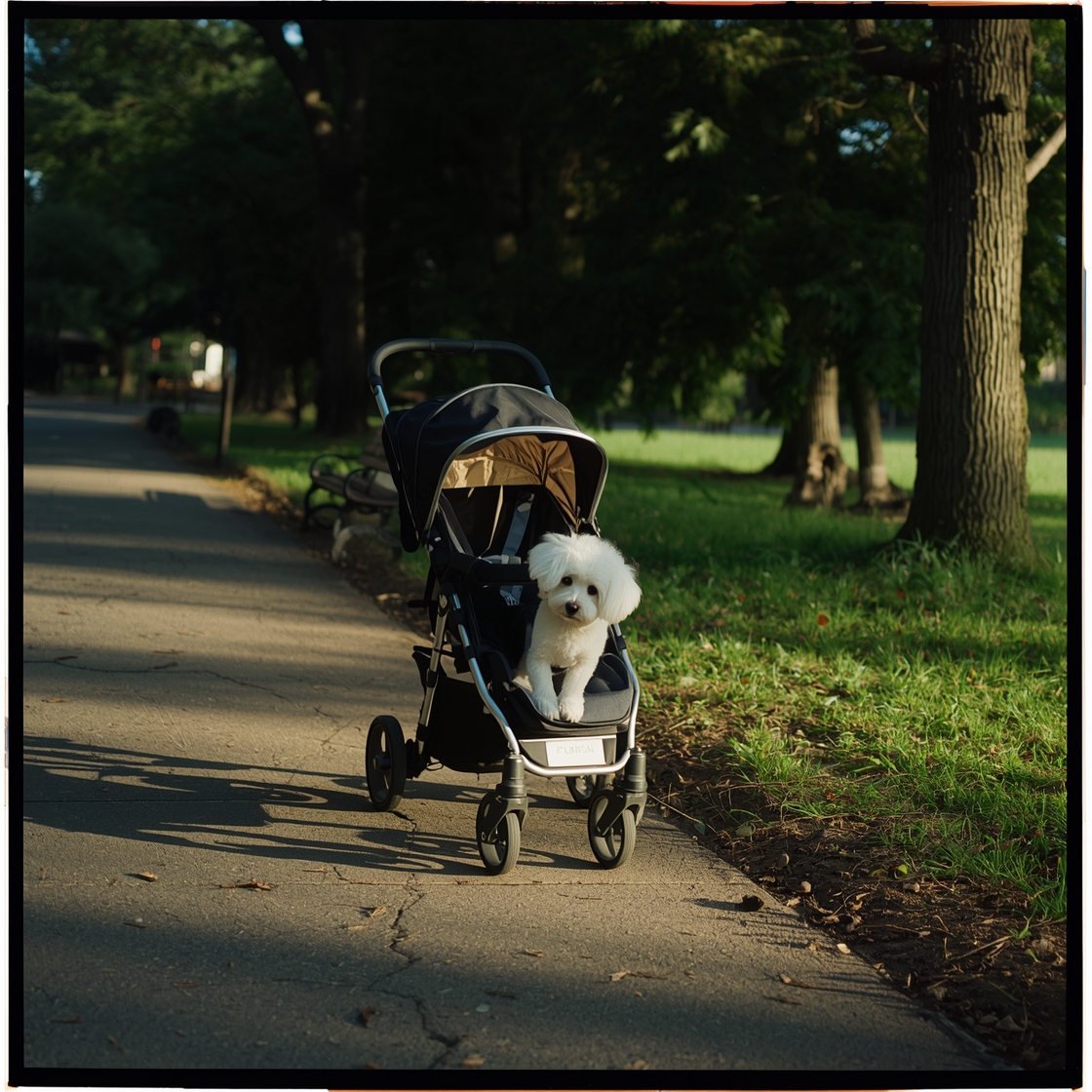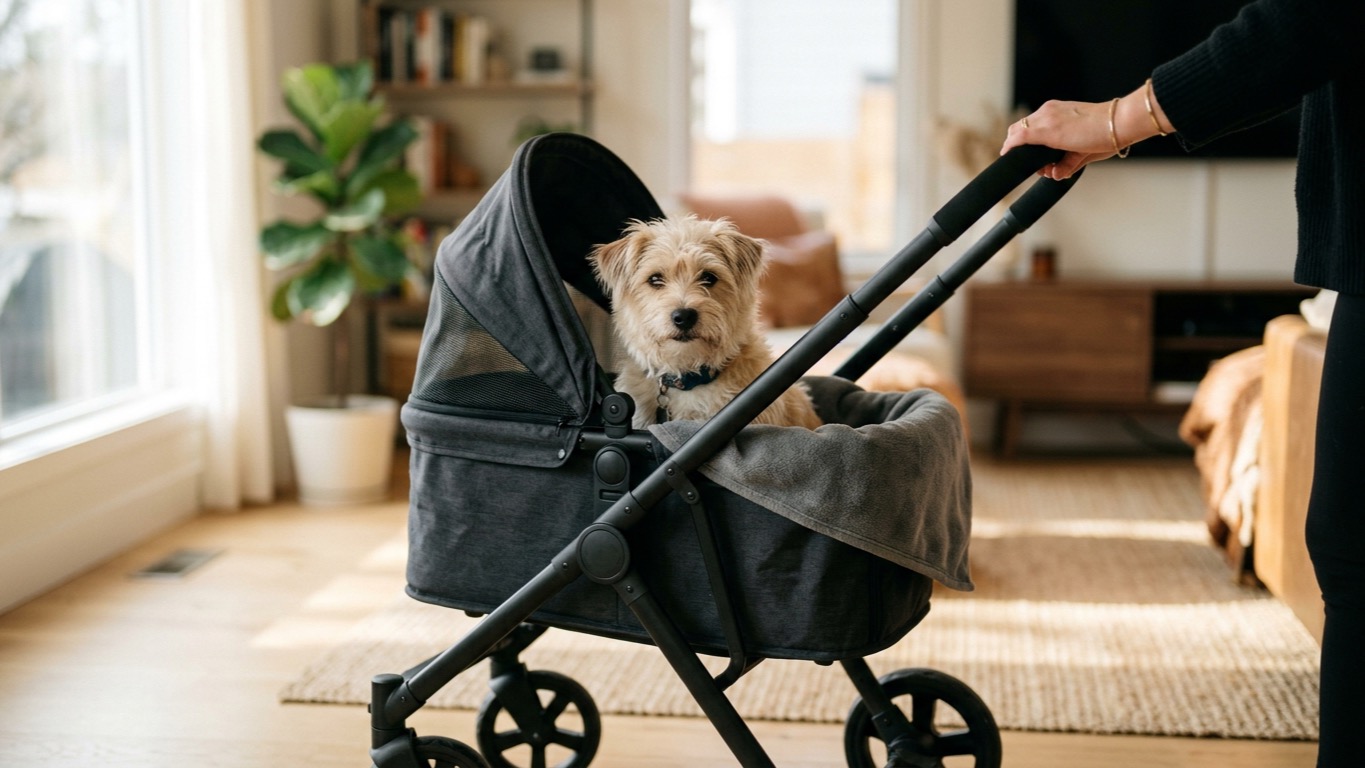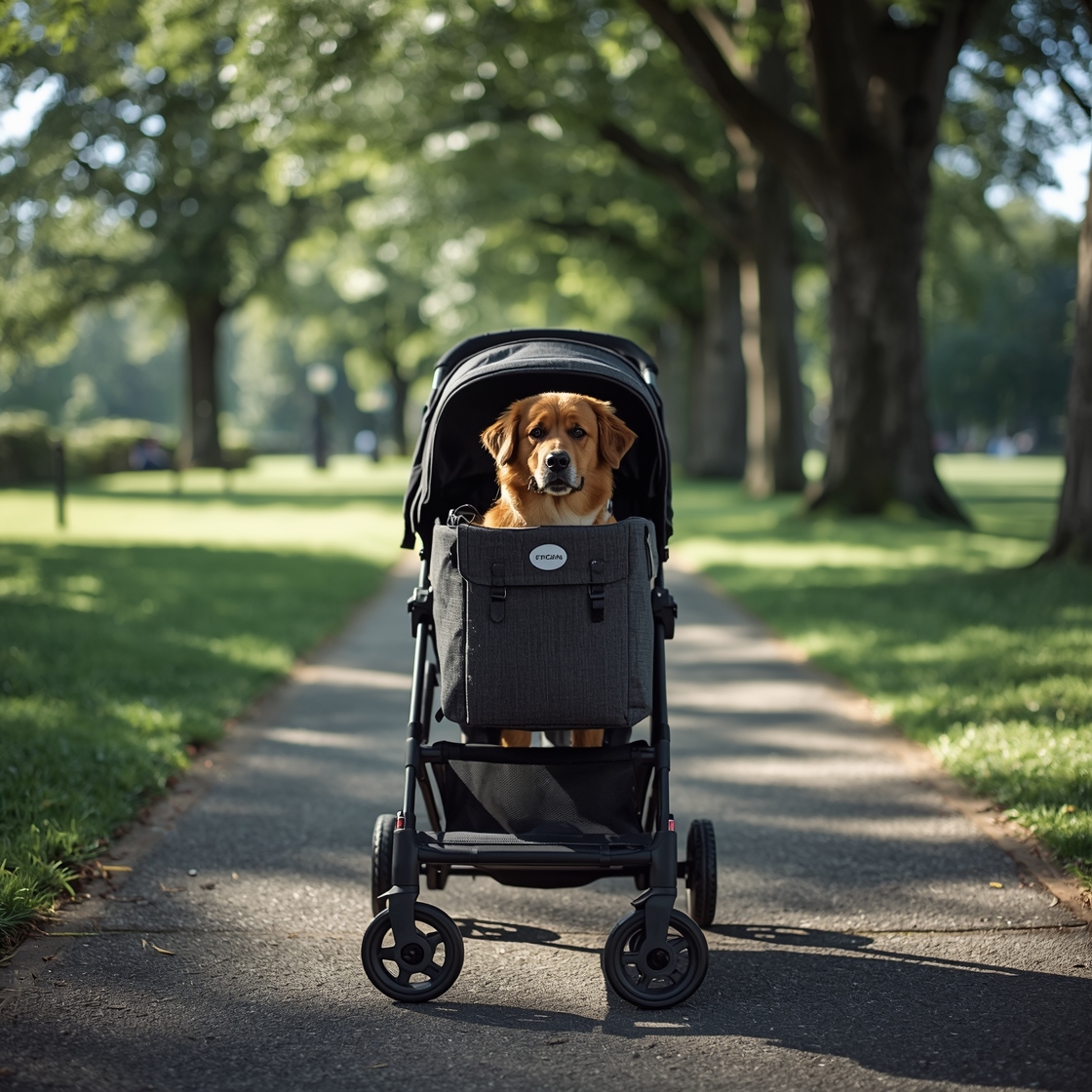
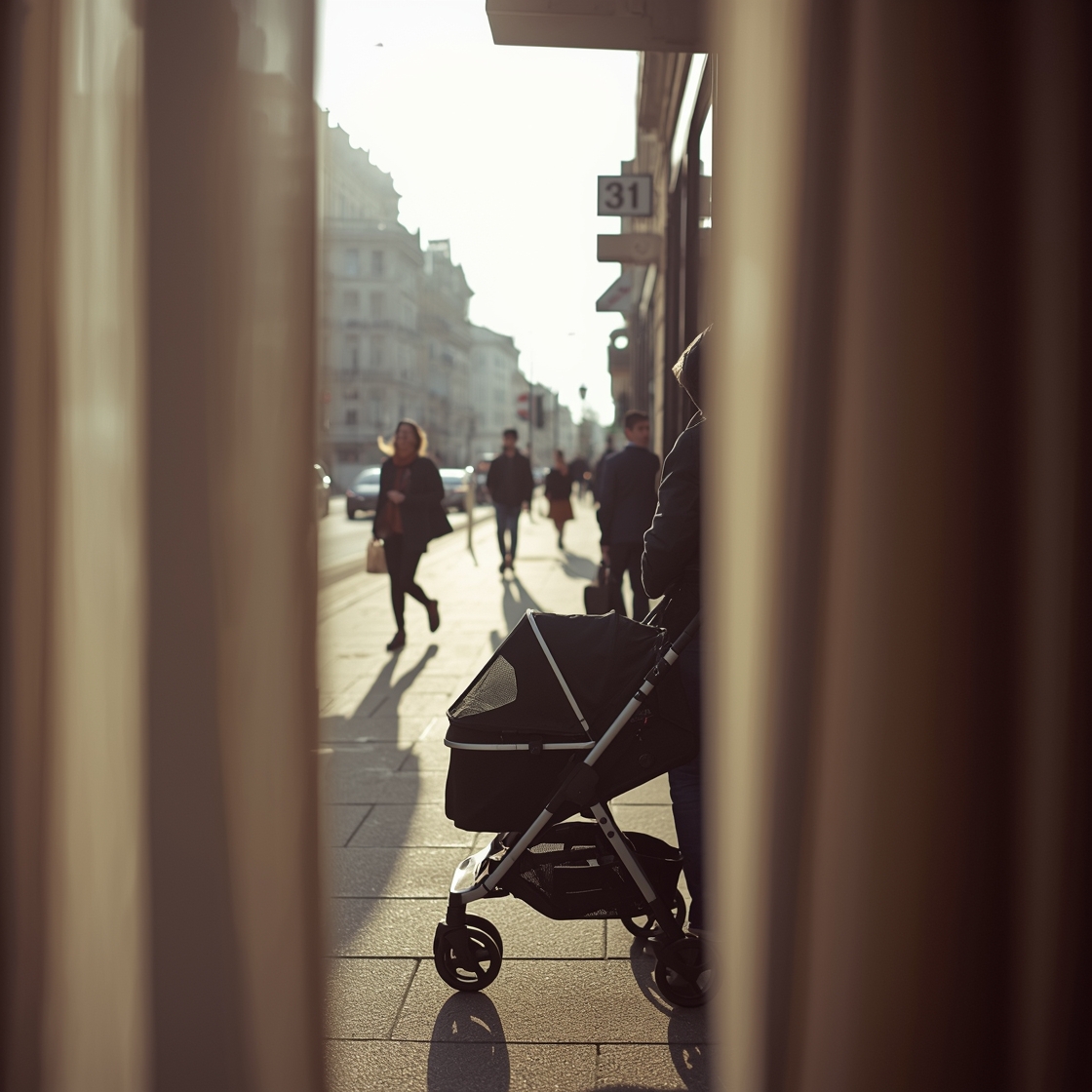
The best pet stroller for city walks is the frame that matches sidewalk width, a fold you can lift, and a cabin the pet actually fits — a budget 3-wheel for flat pavement experiments (KMFurnila $35.93), a double only if two small pets are the job (HCY $48.98), a 33 lb-titled cabin for small/medium (MoNiBloom $57.99), a no-zip Lite when zipperless entry is the constraint (Pet Gear Happy Trails Lite $64.38), a medium/large or 132 lb-titled frame only if the dog is actually that size (unnamed medium/large $109.99; 132 lb aluminum $129.98), an all-terrain only if the city is cracked park path (CANINE CANYON $179.99) — not a 27 lb jogger sold as “lightweight” and not a subway myth about 5 lb frames. We read current Amazon listing titles and descriptions and scored 7 SKUs. Listed snapshots ran $35.93–$179.99 (median $64.38, a 5.01× spread). 3 of 7 (43%) sit under $65. 2 of 7 (29%) print a weight in the title (MoNiBloom 33 lb; 132 lbs Capacity). 1 of 7 (14%) prints 3 Wheel (KMFurnila). 1 of 7 prints Double (HCY). 1 of 7 prints All-Terrain (CANINE CANYON). 0 of 7 print fold inches on the title. 0 of 7 print a crash test. A $36 trike on a 40 lb dog is a hinge story, not a city plan.
Desk pick: Sidewalk experiment, lowest cash → KMFurnila $35.93 (3-wheel; flat pavement only). Two small pets → HCY $48.98 after you measure each floor. Small/medium with a printed 33 lb → MoNiBloom $57.99. Zipperless Lite → Pet Gear $64.38 (median). Dog that will not fit a 12-inch cabin → $109.99 / $129.98 cards only after a cardboard mock. Cracked park path you will actually roll → CANINE CANYON $179.99. Walk on a harness when the body can do the route.
Buy width and lift first. The best pet stroller for city walks fails the same way every time: the axle will not thread a stoop, or you cannot carry the fold up a walk-up.
Our guides are reader-supported. This article may contain affiliate links. As an Amazon Associate we may earn a commission if you buy through links, at no extra cost to you.
Related: small-dog stroller, foldable dog stroller, dog stroller buying guide, large-dog stroller, carrier, hiking backpack. This page is the city constraint: width, fold, lift, heat, stairs.
Quick picks at a glance
- Best listed 3-wheel floor sticker: KMFurnila 3 Wheel Pet Stroller for Dogs and Cats — $35.93. Only 3-wheel title. Sidewalk experiment. Not a daily tank.
- Best listed double: HCY Double Pet Stroller for Cats & Dogs — $48.98. Two-pet token. Confirm two floors vs one wide cabin.
- Best listed printed 33 lb: MoNiBloom Pet Stroller for Small/Medium Dogs and Cats up to 33 lbs — $57.99. Weight in the title. Still mock the floor.
- Best listed no-zip Lite (median): Pet Gear No-Zip Happy Trails Lite Pet Stroller — $64.38. Median. Zipperless + Lite. Sibling of the $115 Happy Trails card on the small-dog URL — different snapshot.
- Best listed medium/large unnamed: Dog Stroller for Medium Dogs & Large Breeds — $109.99. Brandless title. Photo-check cabin and axle.
- Best listed 132 lb token: 132 lbs Capacity Pet Stroller with Aluminum Alloy Frame — $129.98. Capacity in the title. Lift tax. A 132 lb hinge is not a 132 lb city cabin.
- Best listed all-terrain ceiling: CANINE CANYON All-Terrain Pet Stroller for Large & Medium Dogs — $179.99. 5.01× KMFurnila. Park-path class. Café-aisle last.
What current Amazon listings show (City-Stroll, August 2026)
| Signal | What it buys | On this URL | Fail mode |
|---|---|---|---|
| 3-wheel on title | Tight turn language | KMFurnila $35.93 | Tip on a curb cut |
| Double on title | Two-pet job | HCY $48.98 | Two medium dogs in one slogan |
| Printed lb on title | A number you can quote | MoNiBloom 33 lb $57.99; 132 lb $129.98 | 132 lb as a comfort grade |
| No-zip Lite | Fast load, lighter carton language | Pet Gear $64.38 | Assuming Lite = 6 lb empty |
| Medium/large unnamed | Longer cabin if the photo matches | $109.99 card | Buying a word |
| All-terrain | Wheel/suspension language | CANINE CANYON $179.99 | 5× for a café loop |
| Fold inches on title | Closet math | 0 of 7 | Subway myth |
| ASTM F833 on title | Children’s rule | 0 of 7 | Footer “ASTM” as a pet badge |
From the listings: 43% of this aisle is a sub-$65 experiment. 29% prints a weight. 14% is a $180 all-terrain tax. Fold math is still on the listing.
Price — listing snapshot prices we fetched
Street prices from the seven cards as of August 2026.
| Listing | Title class | Snapshot |
|---|---|---|
| KMFurnila 3 Wheel | 3-wheel budget | $35.93 |
| HCY Double | Double | $48.98 |
| MoNiBloom up to 33 lbs | Printed 33 lb | $57.99 |
| Pet Gear No-Zip Happy Trails Lite | No-zip Lite (median) | $64.38 |
| Dog Stroller for Medium Dogs & Large Breeds | Unnamed mid/large | $109.99 |
| 132 lbs Capacity Aluminum Alloy | Printed 132 lb | $129.98 |
| CANINE CANYON All-Terrain | All-terrain ceiling | $179.99 |
Desk stat: KMFurnila $35.93 to CANINE CANYON $179.99 is 5.01×. Pet Gear Lite $64.38 is the median. HCY $48.98 and MoNiBloom $57.99 are a $9.01 pair under the median in different classes (double vs 33 lb). The $109.99 and $129.98 cards are a $19.99 pair in the “bigger dog” cluster. CANINE CANYON $179.99 is 2.80× the median.
City worksheet
| Constraint in front of you | Desk lean on this URL | Do not do |
|---|---|---|
| Flat sidewalk, unsure you will keep it | KMFurnila $35.93 | CANINE CANYON $179.99 |
| Two small pets | HCY $48.98 after two-floor check | Forcing two into MoNiBloom $57.99 |
| Small/medium, want lb on the title | MoNiBloom $57.99 | 132 lb card as a “safer” 20 lb cabin |
| Zipperless, brand you can look up | Pet Gear Lite $64.38 | Merging it with the $115 small-dog Happy Trails |
| Dog too long for a 12 in floor | $109.99 or $129.98 — cardboard first | Title-shopping “large” |
| Cracked park path weekly | CANINE CANYON $179.99 | 5× for terrazzo lobby |
| Walk-up stairs | Fold-and-carry; if you cannot lift, carrier | Rolling an escalator |
| Dog can walk the route | Harness | A cabin as a lifestyle |
| Trail / scramble | Hiking backpack | Any of these seven |
Affiliate disclosure: as an Amazon Associate we may earn from qualifying purchases.
The best pet stroller for city walks is a geometry problem first — unfolded width, folded carton, empty weight, interior floor — not a “top 7 urban” aisle.
Not a vet. Not a stroller lab. This is a desk-research guide.
The useful question is not “which is the best of seven.” It is: what job is this frame doing on a sidewalk, and what did you give up to make it fold?
We read the seven live product cards, listing-stated titles, and snapshot prices. We also read public manufacturer spec sheets and manuals for products that are actually sold as city or compact pet strollers in 2026 (Petique, InnoPet, Pet Gear, Ibiyaya, Tavo), a major-retailer listing for HPZ Pet Lite after the brand’s own Lite product URL returned 404, CPSC’s carriage-and-stroller rule (16 CFR Part 1227 / ASTM F833), CPSC’s current stroller recall list, and the AVMA’s public warm-weather page. Dimensions and weight limits in the sister-SKU section are maker-stated unless we say they come from a retailer listing.
We did not run a 30-day urban rotation. If a claim needs a lab, a vet, or a loaded walk around the block, it is not in this article.
A small-dog stroller and a foldable dog stroller answer the same hardware question from different angles. This page is the city constraint.
First decision: harness and walk, carrier, or stroller
A stroller is extra hardware. Buy it for a job the leash or a bag cannot do.
Stay on a harness and walk when the pet can cover the route, handle pavement temperature, and stay under control in a crowd. A well-fitted harness is the safer default for a dog that can walk: no tipping frame, no closed cabin, no extra empty metal to lift onto a stoop. Use the stroller as a backup, not as a substitute for a body that still wants to walk.
AVMA’s warm-weather page is about the walk itself: go out in cooler hours, skip hot asphalt that can burn paws, bring water, and treat short-nosed and overweight animals as higher-risk on warm days. A stroller does not cancel heat. It can make heat worse if the cabin is zipped shut in sun.
Use a carrier when the trip is short, mostly indoor, or you need stairs. A dog-and-cat carrier or a wheeled travel carrier is the right object for a vet lobby or a terminal. It is the wrong object for twenty city blocks if you cannot carry the loaded weight. A hiking backpack carrier is a trail tool, not a sidewalk buggy.
Use a stroller when the pet should come along and cannot (or should not) walk the whole route: seniors, recovering animals after a vet says so, very small dogs and cats in dense traffic, unvaccinated puppies that still need to see the street, or a second pet you cannot hold. That is a mobility aid. Ask the veterinarian about the medical case. We are not that veterinarian.
Decision framework for the best pet stroller for city walks
City use has six hard edges. Match the frame to the route, not to a “best of” list.
1. Weight limit — and the cabin, not the slogan
Read the pet limit on the maker’s spec table, not the empty frame weight and not a marketing line that disagrees with the table. A limit is a tip-over and hinge number, not a comfort number. Leave margin. Then measure the pet:
- Weight on a scale, not a guess.
- Length, nose to the base of the tail, plus room to turn.
- Standing height to the top of the head or ear tip if the canopy will be closed.
- Width at the shoulders. A 12-inch-wide cabin is a single small animal, not two.
Then read the interior number, not the product carton. Pet Gear’s Happy Trails No-Zip product page lists a 24 × 11 × 22 inch product box; the PG8100NZ manual lists an interior of 24.5 × 12 × 21 inches. Same model family, two printed boxes. Measure a cardboard mock-up of the smaller set before you trust either one.
A 33 lb or 132 lb printed cap does not mean that dog fits a narrow floor. For dogs that simply will not lie in these cabins, use the large-dog stroller guide.
2. Wheel type — sidewalk is not a trail
City pavement is cracked concrete, curb cuts, metal plates, and the occasional cobblestone plaza. That is not a trail, and it is not a jogging path.
What helps on a sidewalk
- Swivel front wheels you can lock straight when you want the frame to track
- Rear brakes you put on every time you stop (Pet Gear’s manuals say this in those words)
- Rubber or EVA treads that do not chatter as loudly as hard plastic on terrazzo
- A wheel diameter large enough to climb a curb cut without hanging the under-basket
What belongs on a different page: 12-inch jogging wheels and a 27-inch-wide stance. Those frames exist (Pet Gear AT3 in the sister section). They are trunk objects, not subway objects. CANINE CANYON $179.99 is the all-terrain card on this URL — still confirm the live axle width.
InnoPet’s City Buggy uses 5-inch EVA wheels for city streets and smooth paths. Petique Glacier lists 6-inch front / 6.5-inch rear. Pet Gear AT3 lists 12-inch EVA tires and a 28.5-inch-wide product box — a park frame, not a café-aisle frame.
3. Fold — closet, trunk, bus, not a slogan
Apartment storage is a length-and-height problem, not a “quick fold” adjective. Write down the folded carton and whether the frame stands by itself. HPZ’s current retailer listing for Pet Lite publishes a 14 × 20 × 22 inch fold. Tavo publishes the Roscoe frame at 12 × 20.6 × 24 inches folded. InnoPet publishes City Buggy folded at 45 × 48 × 28 cm (about 17.7 × 18.9 × 11 inches). Those are the numbers that matter in a studio closet. 0 of 7 cards print a fold on the title.
Stairs and escalators are a carry, not a roll. Pet Gear’s Happy Trails and AT3 manuals say do not use on an escalator or stairs; fold the stroller and carry. If you cannot lift the empty frame plus the pet, this is the wrong tool for a walk-up.
4. Leash attachment — tether the harness, not the collar
Most quality city frames include one or two interior tethers. Clip the tether to a harness, not a collar, before the wheels move. A collar clip is a neck injury waiting on a sudden stop. Pet Gear prints an interior tether on Happy Trails and AT3. InnoPet lists two fastening lines on City Buggy. Petique lists two adjustable seat leashes on Glacier. None of those clips replace a closed cabin on a busy curb.
Do not leave the pet unsupervised in the stroller. Pet Gear’s manuals say that in those words.
5. Weather — mesh is not air-conditioning
An enclosed stroller is a box in the sun. AVMA’s warm-weather page does not mention strollers by name. It does say that if it is hot for you it is hotter for the pet, that short-nosed and overweight animals have a higher exercise risk, and that you should seek emergency care for anxiousness, excessive panting, restlessness, drooling, unsteadiness, abnormal gum or tongue color, or collapse. AVMA also says never leave a pet in a parked car, even in the shade or with windows cracked.
A zipped stroller left on a sunny sidewalk is not a car, and The honest move is still: do not park a pet in a closed cabin and walk away. Keep mesh open in still air. A rain cover without vents is a heat cover.
6. Sidewalk vs trail — pick one job
If the weekly route is sidewalk, curb cut, elevator, café, and a parked car, buy a compact four-wheel city frame (or the 3-wheel experiment at $35.93 if you accept the tip class). If the weekly route is gravel, park trail, or a jogging path, you want larger wheels — and you will pay for that with width and empty weight (CANINE CANYON $179.99 or the AT3 sister SKU). Do not buy a 27 lb jogger because a city article called it “lightweight.” For a broader map of types and budgets, use the dog stroller buying guide.
What “city-safe” does and does not mean
Pet strollers sit in a gap. Human strollers sold in the United States are durable infant products. CPSC’s carriage-and-stroller rule at 16 CFR Part 1227 incorporates ASTM F833 (currently F833-21 for units manufactured after 15 February 2022). That rule is written for children, generally from infancy to about 36 months. It covers parking brakes, static load, stability, restraints, latching, wheel detachment, and related hazards. JPMA — now the Baby Safety Alliance — runs a voluntary verification program built on ASTM standards for juvenile products. That seal is a baby-product signal, not a pet-product badge.
We did not find a pet-specific ASTM stroller performance standard that matches F833. Some pet brands print a generic “ASTM” line on a footer or say a fabric meets juvenile chemical limits. That is not the same as a third-party F833 fold-lock and brake test on the pet frame. Do not treat a pet stroller as JPMA-certified or CPSC-certified unless the maker shows the actual children’s-product certificate — and even then, the test dummy is a child, not a dog.
CPSC’s 2025–2026 stroller actions (B. Childhood and Magic ZC warnings, an AliExpress convertible-stroller recall, a Joolz Aer2 adapter recall) are baby stroller actions. They are not pet-stroller recalls. They are still the right reminder: folding frames pinch, and a travel-system clip that is not fully locked drops whatever is in the cabin. Check SaferProducts.gov for the SKU you own.
Practical hardware that is already on the spec sheet:
- Interior tether clipped to a harness before you roll
- Brakes on when you stop — curb ramps and subway platforms are slopes
- Locks engaged before the pet goes in; keep the pet’s body clear of moving parts
- One pet unless the maker says otherwise
- No hanging grocery bags on the handle (tip geometry)
- No stairs, no escalator with the pet rolled on
- “Car seat” is a marketing mode unless the maker published an independent crash protocol for that SKU
Tavo states that Maeve + Roscoe is safety-tested for car use and benchmarked against UN ECE R129. That is Tavo’s published claim. A booster loop on a Petique or Ibiyaya capsule is not the same claim.
The 7 cards on this URL
1. KMFurnila 3 Wheel Pet Stroller for Dogs and Cats
Best for: the $35.93 3-wheel experiment when the route is flat pavement and you will accept a basic frame.
Listed $35.93. Floor sticker. Only 3-wheel title. Lightweight / occasional-use class. Three-wheel frames can turn tight and tip on a curb cut — lock a front wheel if the listing gives you that lock.
Honest drawback: cheapest is how households learn they needed a four-wheel cabin. If the week is daily, look at Pet Gear Lite $64.38. If the week is park gravel, look at CANINE CANYON $179.99 — or admit the dog should walk.
2. HCY Double Pet Stroller for Cats & Dogs
Best for: the $48.98 two-pet token when two small animals are the actual job.
Listed $48.98. Double in the title. Slim-for-a-double marketing is common; confirm the live unfolded width. Two tethers that can tangle are not a double stroller if the floors are a slogan.
Honest drawback: two medium dogs do not become small because the title says double. If one pet is a 25 lb terrier, measure once.
3. MoNiBloom Pet Stroller for Small/Medium Dogs and Cats up to 33 lbs
Best for: the printed 33 lb at $57.99 when the dog is actually under that and fits the floor.
Listed $57.99. $6.39 under the median. 33 lbs in the title — one of two printed weights. Compact apartment language is listing copy. Not designed for rough terrain is the usual class.
Honest drawback: 33 lb is a hinge rating. A 30 lb dachshund can still be too long. Cardboard the floor.
4. Pet Gear No-Zip Happy Trails Lite Pet Stroller
Best for: the median no-zip Lite at $64.38 when you want a brand with a manual you can actually fetch.
Listed $64.38. Median. No-Zip + Lite + Happy Trails. This is the city-sized Pet Gear tile on this URL. The small-dog page carries a Happy Trails card at $115 — different listing, different snapshot. Do not merge them.
Pet Gear’s Happy Trails No-Zip family (maker page + PG8100NZ manual, sibling of Lite): zipperless entry, elevated paw rest, one-hand fold, rear brakes, interior tether, reversible liner. Product 24 × 11 × 22 inches, 14 lb on some sheets; manual interior 24.5 × 12 × 21 inches; manual pet limit 35 lb on some SKUs. Confirm Lite vs full Happy Trails on the carton you receive. Manual: one pet; no stairs or escalator; brake when parked; do not hang bags on the handle; do not leave the pet unsupervised.
Honest drawback: 14 lb empty (sibling sheet) is not “under 6 lb.” The product carton width is not the axle width you will feel on a stoop.
Check Pet Gear Happy Trails Lite listings →
5. Dog Stroller for Medium Dogs & Large Breeds
Best for: a $109.99 unnamed mid/large only after the live photo shows a floor the dog can lie on.
Listed $109.99. No brand in the title. Roomier-cabin / bulkier-storage class. $45.61 above the median. This is how the aisle sells “large” without a printed inch.
Honest drawback: you cannot quote a maker manual by brand name. If the listing is thin, pay Pet Gear money for a PDF instead, or use the large-dog stroller URL.
Check medium/large dog stroller listings →
6. 132 lbs Capacity Pet Stroller with Aluminum Alloy Frame
Best for: the printed 132 lb at $129.98 when you needed a hinge number and you will still mock the cabin.
Listed $129.98. Aluminum alloy in the title. Heavy-duty / larger-breed marketing. Heavier to lift into vehicles is the class. $65.60 above the median.
Honest drawback: 132 lb is the loudest number on this URL. It is also how people buy a park wagon and then cry on a stoop. City compactness and 132 lb language rarely live in the same axle. Confirm unfolded width.
Check 132 lb capacity listings →
7. CANINE CANYON All-Terrain Pet Stroller for Large & Medium Dogs
Best for: the $179.99 all-terrain ceiling when weekly routes include cracked park path and you can store a wider stance.
Listed $179.99. Highest sticker. 5.01× KMFurnila. All-Terrain + Large & Medium. Suspension / wheel-quality marketing is brand copy.
Honest drawback: this is how a city URL grows a suburban frame. If the week is elevator + café, Pet Gear Lite $64.38 is the median object. If the week is gravel, this card or the AT3 sister SKU is the class — still not a trail backpack.
Check CANINE CANYON listings →
Sister SKUs with maker sheets — not a ranking, not on these cards
These are products we could verify on a manufacturer site or, for HPZ Lite, a major-retailer listing. They are examples, not replacements for the seven cards. Brand names stay plain text. Each product gets one Amazon search link.
Sleepypod does not belong on this list. The brand’s 2026 catalog is crash-tested carriers and harnesses, not a stroller.
Petique Glacier (light compact sidewalk frame)
Where verified: Petique’s Glacier product page.
- Assembled 36.62 × 21.5 × 37.5 inches
- Seat space 24 × 12 × 18 inches
- Front wheel 6 inches, rear 6.5 inches
- Empty weight 11 lb
- Pet limit 45 lb
- 360° rotating front wheel, double rear brakes, two adjustable seat leashes, mesh windows, cup-holder tray, storage basket, patented pee-pad insert
Petique’s site footer says products “Meet SGS, CE, and ASTM Standards.” The Glacier page does not print an F833 report.
Trade-off: a published 11 lb city frame with a genuine compact cabin — and a 45 lb printed cap that will over-promise if you only read the number.
InnoPet City Buggy (purpose-built city buggy)
Where verified: InnoPet’s City Buggy page (UK store).
- Empty weight 5.5 kg (about 12.1 lb)
- Pet limit 11 kg (about 24 lb)
- Interior cabin 62 × 29 × 42 cm (about 24.4 × 11.4 × 16.5 inches)
- Unfolded 84 × 48 × 103 cm
- Folded 45 × 48 × 28 cm
- Wheels 5-inch EVA
- One-handed fold; rain cover sold separately; two-year manufacturer warranty
That is a city cabin: long enough to lie down, narrow enough to thread a doorway. It is not a trail buggy. InnoPet’s merchandising points gravel buyers to Adventure or Comfort ranges. U.S. Amazon stock comes and goes.
Trade-off: the clearest “this is a city buggy” spec sheet we found — with a 24 lb pet cap and a retail footprint stronger in Europe.
Pet Gear Happy Trails No-Zip (sidewalk cabin, full family)
Where verified: Pet Gear’s Happy Trails No-Zip page and the PG8100NZ manual.
This is the city-sized Pet Gear family, not the 27 lb AT3. Use it to read numbers the Lite card may not print. See the $64.38 card write-up above for the live tile.
HPZ Pet Lite (compact travel fold)
Where verified: Amazon listing copy for HPZ Pet Lite (2nd gen). HPZ’s Lite collection page loaded; the specific Lite product URL we tried returned 404. Treat the numbers below as retailer-stated.
- Empty weight 15.6 lb
- Capacity 45 lb total
- Open 28 × 40 × 14 inches front / 20 inches rear
- Folded 14 × 20 × 22 inches
- Cabin floor 13 × 13 inches, expandable to 27 inches long
A 14 × 20 × 22 inch fold is the reason this model shows up in a city article. “Airline-approved small luggage” on a retailer page is not a cabin-pet approval.
Trade-off: the most compact published fold in this sister set — with a maker product URL we could not load.
Ibiyaya HUE-GO (detachable capsule for errands)
Where verified: Ibiyaya’s HUE-GO page.
- Capsule interior 22.5 × 15 × 23 inches
- Unfolded frame 34.5 × 24 × 41.5 inches
- Empty weight 23 lb (capsule 10 lb / frame 13 lb)
- Pet limit 55 lb
- One-hand tri-fold; airless rubber wheels; both ends open 180°
The 15-inch interior width is the first cabin in the sister set that can honestly hold two small pets side by side. Twenty-three pounds empty and a 24-inch unfolded width are not subway-seat numbers. The “car booster” line is Ibiyaya’s.
Petique Newport 3-in-1 (stroller, carrier, car seat)
Where verified: Petique’s Newport product page.
- Stroller 31.50 × 19.29 × 39.37 inches
- Seat space 23.62 × 13.78 × 19.69 inches
- Empty weight 17 lb
- Pet limit 45 lb
Seventeen pounds and a 19-inch-wide box sit between Glacier and HUE-GO. “Car seat” on this page is a mode, not a published crash protocol.
Tavo Maeve + Roscoe (premium travel system)
Where verified: Tavo’s U.S. Maeve + Roscoe page.
- Small Flex carrier: interior 19 × 11.5 × 14 inches, 25 lb pet
- Medium Flex / Rigid: interior 26 × 11.5 × 17 inches, 25–30 lb pet
- Roscoe frame open 35.5 × 20.6 × 42 inches, folded 12 × 20.6 × 24 inches, frame 14.5 lb
- Vehicle base 12.5 lb
- U.S. page starts at $500 for the configuration we fetched
The folded frame is one of the smallest published city packs. The system is not light once you add carrier and base. Tavo’s car claim is the most specific in this set (ECE R129). We still did not run that test.
Pet Gear AT3 No-Zip (heavier sidewalk and park frame)
Where verified: Pet Gear’s AT3 No-Zip page and the PG8350NZ manual.
- Product 35 × 28.5 × 42 inches, 27 lb
- Interior 30 × 13 × 22 inches
- Manual pet limit 75 lb; basket 6 lb; one pet; no stairs or escalator
- 12-inch EVA tires, lockable front wheel
A 28.5-inch-wide, 27 lb frame is a city park tool. It is a poor café-aisle tool. Do not buy it because a city article called Pet Gear “around 5 lb.” The maker’s sheet says 27.
How the desk scored the best pet stroller for city walks
this comparison uses five visible signals plus the listed sticker:
- Price band. Three tiles under $65; one median Lite; two bigger-dog tiles; one $180 all-terrain.
- Printed weight. Two titles (33 lb, 132 lb).
- Job tokens. 3-wheel, double, no-zip, all-terrain.
- Missing fold inches on all seven titles. Steal the carton from the listing.
- Sister sheets for empty weights we could verify (Glacier 11 lb, City Buggy ~12 lb, Happy Trails family ~14 lb, AT3 27 lb). None of those empty weights appear on the seven card titles.
How to use a stroller on a real city day
This is process, not a product score.
Before you leave. Clip the interior tether to the harness. Confirm fold locks. Brake on before the pet steps in. First sessions belong in a hallway with the canopy open, not on a curb.
On the sidewalk. You are wider than you think. Lock the front wheel straight on a long broken stretch if the maker gives you that lock; leave it swivelling in a crowd. Do not hang a grocery bag on the handle.
Stairs and shops. Fold and carry on stairs and escalators. If you cannot lift the loaded cabin, this outing needed a carrier, not a buggy. A detachable capsule (HUE-GO, Newport, Tavo Maeve) is the café tool: lift the cabin, do not block an aisle with a 24-inch axle.
Heat, rain, storage. Mesh open in still air. Water for the pet, not only for you (AVMA). Skip the hot hours. Dry the pad before you store the fold. Wipe wheels; city grit eats cheap bearings.
Two-sticker math the aisle hides
| Pair | Sum | Note |
|---|---|---|
| KMFurnila $35.93 + HCY $48.98 | $84.91 | Almost Pet Gear Lite + leftover |
| MoNiBloom $57.99 + Pet Gear $64.38 | $122.37 | Two small/medium cabins; pick one |
| $109.99 + $129.98 | $239.97 | Two bigger-dog tiles; over CANINE CANYON |
| Pet Gear $64.38 vs CANINE CANYON $179.99 | $115.61 gap | Median Lite vs 5.01× all-terrain |
| KMFurnila $35.93 vs CANINE CANYON $179.99 | $144.06 gap | Trike vs park frame |
If two adults buy Pet Gear Lite $64.38 and CANINE CANYON $179.99 in the same week, you spent $244.37 on two city stories. Pick the route. The second frame is how apartments collect axles.
The leftover live “Sidewalk Fit Specs” table invented 8–10 in wheels and ≤15 lb frames as city minimums. 0 of 7 cards print those numbers. We will not recycle that table as a finding.
Brands that did not survive a manufacturer check:
If you already own one of those frames, keep it if the cabin fits and the fold fits.
Transit, apartments, and the 36-inch myth
Assume you will fold, carry, and hold the cabin. Do not treat a “fits in an overhead bin” retailer line as a transit pass. A folded length over 36 inches blocks many apartment entries — that is owner geometry, not a lab. Measure the elevator, the stoop turn, and the closet shelf.
Buses: a brake on a slope. Subways: a fold before the gap. Elevators: you are wider than the dog. Walk-ups: if the 132 lb card’s empty frame already fails your stairs test at home, it will fail with a dog in it.
Cats, two pets, and nervous dogs
Cats use these cabins when the cat accepts a box. Many will not. A carrier may be kinder.
Two pets: only if the maker’s interior width and combined weight limit say so. Happy Trails manuals say one pet. HUE-GO’s page says two small pets side by side or one medium pet up to 55 lb. HCY $48.98 is the double card — still measure.
Nervous dogs: hallway, open canopy, quiet sidewalk. A curb is not session one.
How to clean one
Follow the maker. Petique: Glacier mat cover machine-washable on gentle, tumble dry low; spot-clean the rest. InnoPet: City Buggy covers hand-washed at no more than 30°C, no dryer. Pet Gear liners are removable. Do not soak a wheel bearing. Dry before you fold. City grit is the silent warranty claim.
Sources
Manufacturer / retailer product pages (sister section; body uses brand names only):
- Petique Glacier: https://www.petique.com/products/glacier-pet-stroller
- Petique Newport: https://www.petique.com/products/newport-pet-stroller
- InnoPet City Buggy (UK): https://innopet.co.uk/dog-prams/innopet-city/
- Ibiyaya HUE-GO: https://us.ibiyaya.com/products/hue-go-detachable-pet-stroller
- Pet Gear Happy Trails No-Zip: https://www.petgearinc.com/product_info.asp?id=1057
- Pet Gear Happy Trails No-Zip manual PG8100NZ: https://www.petgearinc.com/Instructions/103/Product%20Series-PG8100NZXX.pdf
- Pet Gear AT3 No-Zip: https://www.petgearinc.com/product_info.asp?id=1038
- Pet Gear AT3 manual PG8350NZ: https://www.petgearinc.com/Instructions/124/Product%20Series-PG8350NZ.pdf
- HPZ Pet Lite collection: https://petroverusa.com/collections/hpz-pet-lite
- Tavo Maeve + Roscoe (US): https://us.tavopets.com/products/maeve-roscoe-pet-protection-system
Safety and weather (not product scores):
- CPSC carriages and strollers (16 CFR Part 1227 / ASTM F833): https://www.cpsc.gov/Business--Manufacturing/Business-Education/Business-Guidance/Carriages-and-Strollers
- ASTM F833-21 listing: https://store.astm.org/f0833-21.html
- Baby Safety Alliance / JPMA: https://jpma.org/
- CPSC stroller recalls: https://www.cpsc.gov/recall-products/strollers
- AVMA warm-weather pet safety: https://www.avma.org/resources-tools/pet-owners/petcare/warm-weather-pet-safety
Independent roundup used only to confirm which SKUs are actually sold (forbes.com/sites/forbes-personal-shopper/article/best-dog-stroller/
Frequently asked questions
What is the best pet stroller for city walks?
The best pet stroller for city walks is the class that matches the route: KMFurnila $35.93 for a 3-wheel experiment; HCY $48.98 for two small pets; MoNiBloom $57.99 for a printed 33 lb; Pet Gear Lite $64.38 for no-zip median; $109.99 / $129.98 for bigger-dog titles you will cardboard; CANINE CANYON $179.99 for all-terrain. Sister sheets (Glacier 11 lb, City Buggy ~12 lb) are verified examples, not cards.
Can the best pet stroller for city walks fit a 25 lb dog?
Only if the interior floor fits that dog’s length and height. MoNiBloom’s title prints 33 lb — that is a hinge, not a 25 lb comfort grade. Many city cabins are ~12 inches wide. Cardboard the smaller published box. Happy Trails family manuals have used a 35 lb line; still measure.
Do I need a pet stroller if my dog can walk?
Often, no. A dog that can walk the route, stay under control, and handle the pavement is better on a harness. Use a stroller when the walk is longer than the pet can do, when the street is too dense for a small or fearful animal, or when a vet has limited walking after injury or surgery.
What size city stroller do I need?
Measure the pet, then the interior, then the unfolded width, then the folded carton. Ignore “fits most small dogs.” A 12-inch-wide cabin is one small animal. An 11 lb empty frame plus a 20 lb dog is a 31 lb lift before water and bags.
Can I take a pet stroller on the subway or a bus?
Sometimes, if the folded pack fits the operator’s rule and you can lift it. Assume you will fold, carry, and hold the cabin.
Are pet strollers crash-tested? Is there an ASTM pet standard?
Almost none of the sidewalk frames above publish an independent crash protocol. Tavo states ECE R129 benchmarking; that is a manufacturer claim ASTM F833 and CPSC’s 16 CFR Part 1227 are written for children’s strollers. 0 of 7 cards print a crash test.
What about two pets?
Only if the maker’s interior width and combined weight limit say so. Happy Trails manuals say one pet. HCY $48.98 is the double card. HUE-GO’s page says two small pets side by side or one medium pet up to 55 lb.
How do I clean one?
Follow the maker. Removable pads wash. Frames wipe. Dry before you fold. Do not soak a wheel bearing.
Is a 3-wheel city stroller safe?
KMFurnila $35.93 is the 3-wheel card. Trikes can be nimble and tippy. Brakes, a lockable front wheel, and a dog that does not lunge still matter more than wheel count.
Why is CANINE CANYON 5× KMFurnila?
$179.99 ÷ $35.93 = 5.01×. That is a class multiple (all-terrain vs 3-wheel budget), not a 5× safety score this desk measured.
The bottom line
A city pet stroller is a fold, a width, and a lift. The current Amazon listing review (City-Stroll) is 7 SKUs, $35.93–$179.99, 5.01×, 43% under $65, 0 printed fold inches. Measure the pet, the sidewalk, and the closet. Prefer a harness and a walk when the body can do the route. Buy a compact frame when the pet should come along and cannot walk the whole way. Believe the spec table, not a “under 6 lb” city myth, and not a test
Prefer KMFurnila $35.93 when you are experimenting. Prefer Pet Gear Lite $64.38 when you want a manual. Prefer CANINE CANYON $179.99 only when the wheels will earn it. Prefer a carrier when the ground is stairs. Mesh is not weather. A 132 lb title is not a café axle.
Last reviewed: August 2026. opening summary, current Amazon listing review (City-Stroll) (7 cards: 1 trike / 1 double / 1 33 lb / 1 no-zip Lite / 2 bigger-dog / 1 all-terrain; $35.93–$179.99; 5.01×), price desk, city worksheet. Sister maker sheets kept as examples. Research desk. Contact if a listing snapshot price changed. Measure the cabin. Use the brake. Do not zip a dog in the sun.