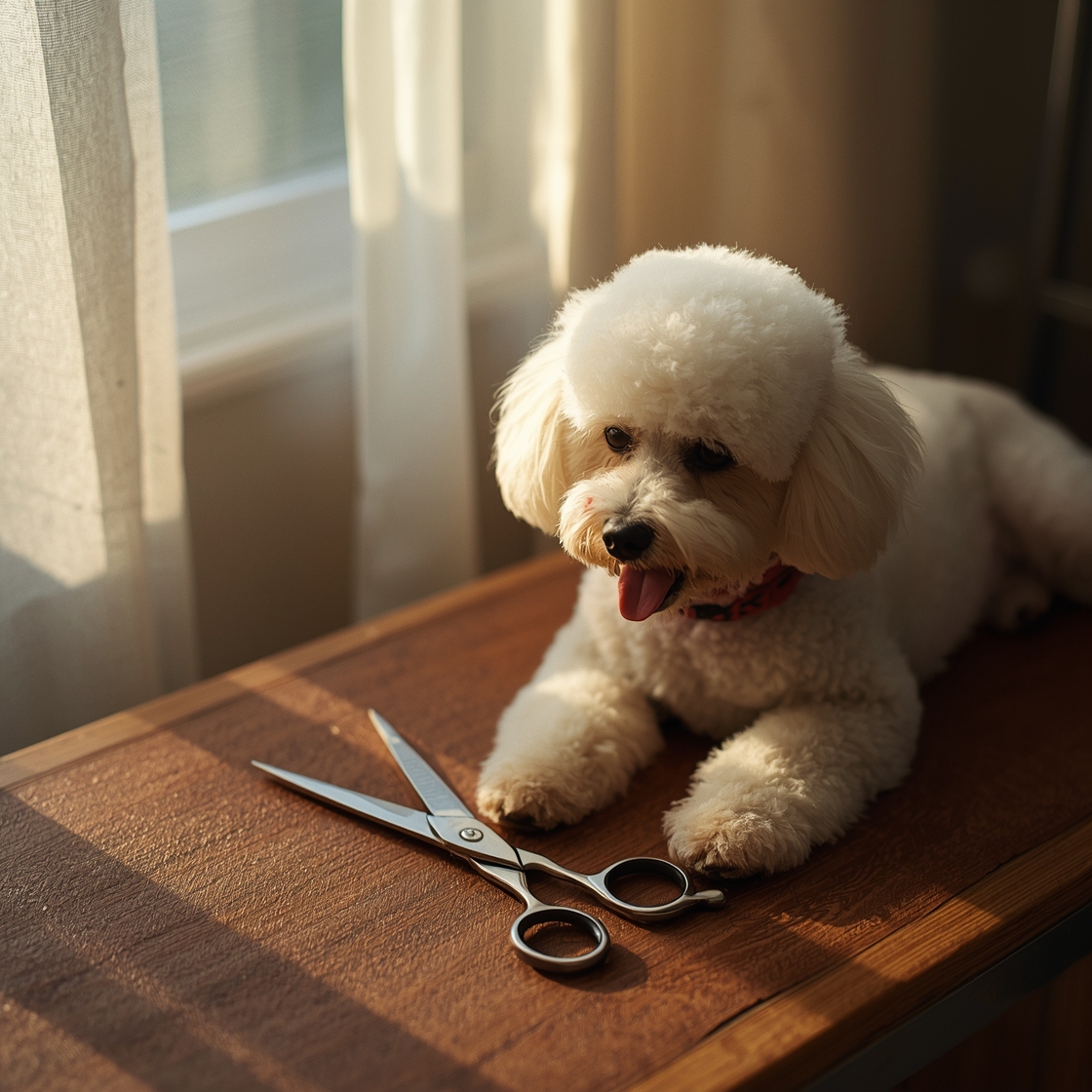
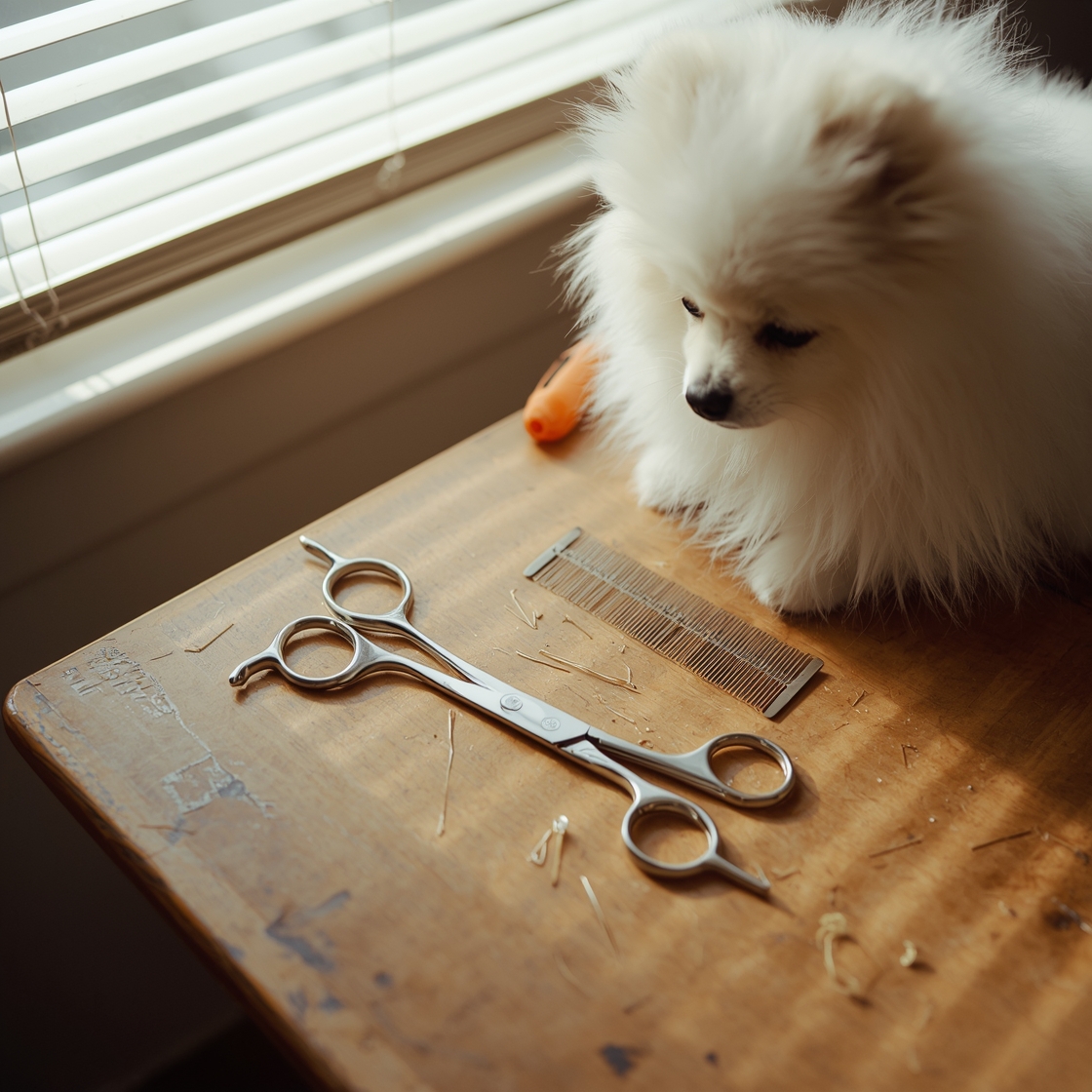
The best pet grooming scissors for small dogs are a rounded-tip trimmer you can see past, plus a kit only if you will use the extra shears — not kitchen scissors, not a mat saw, and not a 7-inch straight blade on a 6 lb face. The We read the titles and descriptions of 7 SKUs. Listed snapshots ran $7.73–$23.59 (median $9.99, a 3.1× spread). 2 of 7 sit under $8 (Chibuy $7.73; 5-in-1 Premium $7.98). 2 of 7 sit at the $10 band (4-in-1 kit $9.97; Doscpe curved $9.99). 3 of 7 sit $15.99–$23.59 (GLADOG $15.99; Tweezerman $18.99; Gimars $23.59). 0 of 7 replace a groomer on a felted coat. 0 of 7 replace a veterinarian for a nick that will not stop. A $8 pair you keep sharp beats a $24 kit that stays in shrinkwrap.
Small dogs have small faces, thin ear edges, and owners who “just tidy the eyes.” That sentence is how people cut skin. Round tips are this comparison's first filter. Length is the second. A hold plan is the third.
Our guides are reader-supported. This article may contain affiliate links. As an Amazon Associate we may earn a commission if you buy through links, at no extra cost to you.
Related: thick-coat shears, general shears, kits, home-groom safety, clippers.
Quick picks at a glance
- Best listed cheapest round-tip single: Chibuy — $7.73. Entry stainless. Expect to replace, not to heirloom.
- Best listed cheap kit: 5 in 1 Premium Dog Grooming Scissors — $7.98. Five pieces. Quality varies; count what you will actually use.
- Best listed 4-in-1 safety kit: Professional 4 in 1 with Safety Round — $9.97. Kit class. Confirm tips are actually round on this lot.
- Best listed named 5-in-1: GLADOG — $15.99. Mid kit. Safety language on the title.
- Best listed named single (round tip): Tweezerman — $18.99. Brand you can find again. Face-tidy class.
- Best listed curve: Doscpe 6.69 inches Round Tips — $9.99. Contour tool. Still a blade.
- Best listed highest kit: Gimars Titanium 6 in 1 4CR — $23.59. Coating and piece count are listing stories.
How small shear listings compare on labels
Four jobs. A $24 six-piece on a dog who will not hold still is a drawer of nicks waiting. A $8 round-tip you use on dry, combed bangs is the product.
| Job | What actually works | Category | Fail if you skip it |
|---|---|---|---|
| Eye bangs / muzzle tidy | Short, rounded tip, two-person if needed | Tweezerman $18.99; Chibuy $7.73 | Kitchen scissors; pointed craft shears |
| Feet / sanitary on a 10 lb dog | Small straight or kit straight | 4-in-1 $9.97; GLADOG $15.99 | Cutting a mat |
| Cheek / cap contour | Curved, round tip | Doscpe $9.99 | A 7-inch straight on a 3-inch face |
| One-box home kit | 5-in-1 / 6-in-1 | 5-in-1 $7.98; Gimars $23.59 | Treating every piece as “pro” |
Before you shop: (1) the hair is combed out and you can see skin or the eye, (2) the pet is held — crate, helper, or you stop, (3) tips are round near eyes and ears, (4) blood, a scream, or a coat you cannot comb is a clinic or a groomer, not a sharper $24 kit. Fail gate 2 and this checklist is how you shop past an emergency.
Why the best pet grooming scissors for small dogs are three objects
- Single round-tip trimmer — Chibuy $7.73; Tweezerman $18.99.
- Curved round-tip — Doscpe $9.99.
- Multi-piece kits — 5-in-1 Premium $7.98; 4-in-1 $9.97; GLADOG $15.99; Gimars $23.59.
Kitchen shears are not on these seven cards. Do not use them. Pointed fabric shears are how ear edges bleed.
Want current listings? See small-dog grooming scissors on Amazon →
How this desk scored the best pet grooming scissors for small dogs
this comparison uses four visible signals plus the listed sticker:
- Tip class. Round vs (undeclared) point. Face work wants round. If the photo is pointy, skip that piece for eyes.
- Single vs kit. Kits dilute spend across thinning, comb, and a case. Singles concentrate the blade you will use.
- Sticker vs implied job. $7.73 habit vs $23.59 piece count.
- Length language. Doscpe prints 6.69 inches. That is long for a Yorkie face — use it on the body cap, not as an eyeliner tool.
Price is not a sharpness grade. A $7.73 Chibuy kept clean beats a $23.59 Gimars left sticky with treat grease.
The 7 cards on this URL
1. Tweezerman Pet Grooming Scissors-Rounded Tip Trimming Scissor for
Best for: a named $18.99 round-tip when face tidy is the job and you want a brand you can reorder.
Listed $18.99. Card title is truncated at “for” — that is the live listing title. Rounded-tip class.
Honest drawback: 2.5× Chibuy. You are paying for a name and a single good pair, not for a kit of extras. Still a blade near an eye.
2. Professional 4 in 1 Dog & Cat Grooming Scissors Kit with Safety Round
Best for: a $9.97 starter kit when you do not already own a straight, a thin, or a comb.
Listed $9.97. Safety-round language. Piece quality varies by seller photo. Confirm tips on this carton.
Honest drawback: four pieces at $10 is $2.50 a tool if you pretend they are equal. They are not. One decent straight and a comb would be a win. The rest may be drawer weight.
3. GLADOG Professional 5 in 1 Dog Grooming Scissors Set with Safety
Best for: a $15.99 named five-piece when $10 kits feel too thin and $24 feels like a leap.
Listed $15.99. Safety language. Mid kit.
Honest drawback: five pieces still include tools you may never learn. Thinning shears on a 6 lb face without a lesson is how you leave tracks. Use the straight/round pair first.
4. Chibuy Professional Pet Grooming Scissors with Round Tip Stainless
Best for: the $7.73 first pair when the job is “will I even cut bangs without a panic.”
Listed $7.73. Cheapest card. Round-tip stainless. Correct first spend.
Honest drawback: budget steel. Nicks if you force a mat. Replace when they chew instead of cut. “Professional” in the title is aisle language.
5. Gimars Titanium Coated Professional 6 in 1 4CR Stainless Steel Dog
Best for: the highest sticker kit when you want piece count and a coating claim, not a single heirloom blade.
Listed $23.59. 4CR + titanium coating are steel-aisle words. Six pieces.
Honest drawback: 3.1× Chibuy. Pay it for the kit geometry (straight + curve + thin + comb), not for a medal. A coating does not make a wriggling Pomeranian safer.
6. Doscpe Curved Dog Grooming Scissors 6.69 inches Round Tips Pet
Best for: contour on a small cap or feet when you already own a short straight for the eyes.
Listed $9.99. Prints 6.69 inches. That is a long curve for a chihuahua muzzle — use it on the body silhouette, not as an eyeliner.
Honest drawback: curve + length = more blade in the air. Round tips help. They do not make a 6.69-inch tool a face micro-shear.
7. 5 in 1 Premium Dog Grooming Scissors
Best for: a $7.98 carton when you want extras and will inspect each piece before it goes near an eye.
Listed $7.98. Almost Chibuy money for five pieces. That math is the watch-out: cheap kits hide one usable straight and four regrets.
Honest drawback: “Premium” is a word. Confirm round tips. If the photo is mixed pointed/round, assign pointed pieces to nothing near the face.
Check 5-in-1 Premium listings →
Comparison of the seven cards
| Card | Listed | Class | Honest job | Watch-out |
|---|---|---|---|---|
| Chibuy | $7.73 | Round-tip single | First face tidy | Budget steel |
| 5-in-1 Premium | $7.98 | Cheap kit | Extras if inspected | Mixed tip risk |
| 4-in-1 Safety Round | $9.97 | Mid-cheap kit | First carton | $2.50/tool fantasy |
| Doscpe curved | $9.99 | 6.69-in curve | Cap / feet | Long for a muzzle |
| GLADOG 5-in-1 | $15.99 | Named kit | Straight + extras | Thinning without a lesson |
| Tweezerman | $18.99 | Named round single | Face tidy | 2.5× Chibuy |
| Gimars 6-in-1 | $23.59 | Highest kit | Piece count | Coating ≠ safer |
Zone desk: best pet grooming scissors for small dogs
| Zone | Tool | Length story | Fail |
|---|---|---|---|
| Eyes / bangs | Tweezerman $18.99 or Chibuy $7.73 | Short strokes, comb first | Pointed tips; one-hand wriggle |
| Muzzle corners | Same round-tip | Tiny bites of hair | Scooping toward the eye |
| Ears (edges) | Round-tip only | Skin in the edge | Close clipper thinking |
| Feet / pads | Kit straight or Doscpe curve | Dog standing or on a towel | Cutting between pads blind |
| Sanitary | Kit straight | Clean first | Dirty coat packs the blade |
| Cap / skirt | Doscpe $9.99 or kit curve | Comb, then curve | Mats |
Grip and hand size (desk, not a lab)
Small-dog work is precision. Large handles on Gimars-class kits can be fine. Tiny craft scissors from a junk drawer are not on this URL and are often pointed — skip them.
If your hand shakes, sit, brace your wrists, and take less hair. $23.59 does not steady a wrist. A helper holding the dog does.
Left-handed: most cheap kits are right-biased. We will not invent an ambidextrous chart. If the thumb hole fights you, stop.
Types on these seven cards (and what they are for)
Straight, round tip. Face and tidy. Tweezerman, Chibuy, and the straight in most kits.
Curved, round tip. Silhouette. Doscpe $9.99. Also a kit curve if the carton includes one.
Thinning / blending. Chunks of hair, not length. On a small face, easy to overdo. Use after you can already see the shape with a straight.
Comb. The real safety tool. If the comb hangs, you do not cut.
Case. Keeps blades from the junk drawer. Not a skill.
Breed and body notes (geometry, not a salon card)
Yorkshire terrier / silky. Eye hair is the complaint. Comb. Round-tip. Two people if the dog air-snaps. Do not “just a little more.”
Pomeranian. Face + ruff. The ruff is not a 6.69-inch curve job on day one. Bangs: short straight. Ruff: groomer or a lesson.
Maltese / Havanese / Coton. White hair hides nicks until you see pink. Light. Comb. Stop.
Shih tzu / Lhasa. Topknot and eyes. If you cannot see the eye, you do not cut. Book a groomer for the first shape, then maintain.
Chihuahua / min-pin / Russian toy. Tiny. Chibuy $7.73 or Tweezerman $18.99. Doscpe 6.69 inches is a body tool.
Frenchie / pug / Boston. Wrinkles are not a scissor job. Face folds are a wipe/clinic routine. Scissors are the stray chin hair, if any.
Dachshund / corgi (small). Feet and sanitary more than a cap. Kit straight. Pants may tangle — comb, do not saw.
Puppy. Soft tools, shorter sessions, more food. Do not “train” with thinning shears on a 12-week muzzle.
Senior / thin skin. Round tip. Tiny bites. Blood is a stop and a clinic conversation.
Skin, nicks, and when this URL ends
A nick that keeps bleeding, a puncture near an eye, or a dog that will not let you near the face is a veterinarian or a groomer, not a sharper Gimars. We will not write a wound protocol.
If the dog screams, you hit skin or a mat. Both are a reason to put the shears down.
Price bands on this URL
$8. Chibuy $7.73, 5-in-1 Premium $7.98. Correct first spend.
$10. 4-in-1 $9.97, Doscpe $9.99. Kit vs curve. Pick the job.
$16–$24. GLADOG $15.99, Tweezerman $18.99, Gimars $23.59. Pay for a name or piece count.
A $80 Japanese shear from a sister salon aisle is not on these seven cards. Do not invent one.
Care of the shears
Wipe. Dry. A drop of shear oil on the pivot if they squeak. Hair and treat grease eat edges.
Do not use them on paper, tape, or human bangs “just once.” That is how $7.73 dies.
Store closed, in a case if you have one. Kids + shears: no.
We will not invent a nick rate. We will not invent a 30-day Pomeranian rotation. We will not put a fake CMG on the byline. Comb, round tip, hold plan, clinic for blood.
If a listing says “surgical steel,” screenshot it. It is their sentence.
Worked households
Dog A — 7 lb Yorkie, eye bangs, apartment. Chibuy $7.73. Helper holds. Comb. Three cuts. Stop. Tweezerman later if the cheap pair proved you will do this weekly.
Dog B — two Maltese, one person. Book a groomer for the first pass. Maintain with Tweezerman $18.99. Do not buy Gimars and a 5-in-1 “to compare.”
Dog C — Pom, first home tidy. Doscpe $9.99 is not the eye tool. Round-tip short. Ruff is a groomer conversation.
Dog D — senior shih tzu, cloudy eyes. You need to see. If you cannot, you do not cut. Clinic for the eyes; groomer for the hair.
Dog E — chihuahua who hates hands. Three-minute Chibuy, food, stop. A 20-minute Gimars session is how you lose the dog.
FAQ
Rounded or straight best pet grooming scissors for small dogs for face work?
Rounded tip. Straight vs curved is the second question. Face work wants a tip that is not a needle. Tweezerman $18.99 and Chibuy $7.73 are this comparison's face class.
How often should I groom my small dog with scissors?
Eyes: when hair crosses the cornea line you can see, not on a blog’s daily rule. Feet: when they click or collect debris. A full shape is a groomer calendar for most households.
What are the best pet grooming scissors for small dogs with sensitive skin?
The pair you use lightly on a combed coat. Steel brand is secondary. Pink is a stop. A $24 coating does not make pressure safe.
How do I clean and maintain my pet grooming scissors?
Wipe after every session. Dry. Oil the pivot. Do not wash them like a fork and leave them wet.
Do I need Gimars at $23.59 if Chibuy is $7.73?
Only if you will use a curve and a thinner and the cheap pair proved the dog will hold. Otherwise Chibuy plus a comb is the kit.
Can I cut mats with these scissors?
No. Lift a mat you can see through with fingers or book a groomer. Cutting toward skin is how people open a cheek.
Are kitchen scissors OK for a “quick trim”?
No. Pointed, wrong geometry, often dirty. These seven cards exist so you do not do that.
Session recipes (desk, not a lesson)
Three-minute bangs. Comb. Hold the hair, not the skin. Round-tip. One or two cuts. Treats. Stop.
Ten-minute feet. Dog on a towel. Kit straight. Pad by pad. Do not dive the webbing blind.
First-ever home tidy. Pay a groomer once. Watch. Then buy Chibuy $7.73 to maintain that shape, not to invent a new one.
If the dog leaves, you lost. Shorter next time.
Lighting, tables, and a second human
You cannot cut what you cannot see. A headlamp is cheaper than a nick. A table is optional for a 6 lb dog on a towel; it is useful if your back is the limit.
Second human: anyone who air-snaps, including “sweet” Poms.
Thinning shears on a small face
Thinning removes bulk. On a 6 lb muzzle it also removes the look you wanted. Use after the straight has set a line. If the kit thinner is junk (cheap 5-in-1 $7.98), leave it in the case.
Cats on a “dog & cat” kit
The 4-in-1 title says dogs and cats. A cat face is a specialist job. Two-person hold. Or a cat groomer. Do not treat the title as a protocol.
Label math examples (desk arithmetic)
Chibuy $7.73 + Doscpe $9.99 = $17.72 — still under Tweezerman $18.99, and you have face + curve. That is a real two-tool kit if you will use both.
5-in-1 $7.98 vs Chibuy $7.73. Twenty-five cents. Buy the single if you only need bangs. Buy the kit if you will inspect pieces.
GLADOG $15.99 vs Gimars $23.59. $7.60 for more pieces and a coating claim. Pay it for the extra curve/thin, not for the word titanium.
Tweezerman $18.99 vs Gimars $23.59. $4.60. Named single vs six pieces. Face-only households should take Tweezerman.
Groomer at $55 vs seven years of Chibuy. If you will not hold a 7 lb dog still, pay the human.
Aftercare
Hair in a bin. Check the skin in good light. Pink: stop. Blood: clinic thinking, not a YouTube styptic tutorial from us.
Sources this desk actually used
- Live Amazon card snapshots (titles, prices, class language, Doscpe 6.69-inch print).
- Public home-grooming safety themes: comb first, round tips near eyes, no scissors into mats (VCA-style pages).
- Object split: single vs curve vs kit.
If a maker updates piece count, believe the box.
More worked households
Household F — you already own Tweezerman. Do not buy Chibuy “to compare.” This desk did not run a side-by-side.
Household G — kids want to help. They hold the treat pouch. They do not hold Gimars.
Household H — two small dogs, different coats. One round-tip. Do not sanitize by sharing a bloody blade — we are not writing an infection protocol; use common sense and a clinic.
Household I — “my vet said keep hair out of the eyes.” That is a length goal, not a license to cut toward a cornea. Comb. Round tip. Or a groomer.
Household J — travel. Chibuy $7.73 in a hard case. You will not reshape a shih tzu in a hotel bathroom with Doscpe 6.69 inches.
Apartments, noise, and neighbors
Scissors are quiet. The dog is not. A scream at 10 p.m. is a hold-plan failure, not a steel failure.
What the best pet grooming scissors for small dogs are not
They are not a clipper. They are not a rake. They are not kitchen shears. They are not a 5-in-1 license to invent a show trim. They are not a reason to skip the vet when an eye is red.
The seven cards are the same.
Sister geometry: thick-coat shears if the problem is bulk on a dense coat — still not mats. Kits if the problem is a motor.
Length by zone (planning bands, not a lab)
| Dog | Face tool | Body / cap | Pair spend on this URL |
|---|---|---|---|
| Toy (2–6 lb) | Chibuy $7.73 or Tweezerman $18.99 | Skip Doscpe or use very little | $8–$19 |
| Small (7–15 lb) | Same | Doscpe $9.99 or kit curve | $18 (Chibuy+Doscpe) |
| Compact brachy | Round-tip only, folds off-limits | Feet / sanitary kit straight | $8–$16 |
These bands are desk planning. If the listing does not print length, look at the photo against a coin or skip.
More breed and mix notes
Papillon / phalène. Ear fringe is not a Doscpe playground. Comb. Tiny cuts or a groomer.
Cavalier. Ears and eyes. Soft. Round tip. Do not thin the ear leather.
Bichon. The “round head” is a groomer skill. Maintain, do not invent.
Mixed toy. Treat as the smallest face in the mix. Shorter blade, fewer ambitions.
Hairless / very sparse. This URL is usually the wrong aisle.
When hair is a medical sentence
Hair glued with discharge at the eye, a swelling, or a sudden inability to see is a clinic. We will not list diagnoses. Stop shopping shears.
Static, dry houses, and white toy coats
Winter static makes fine hair fly into eyes and owners reach for shears too often. A barely damp (not wet) comb or a pet-safe mist is a household choice. Soaking a Maltese “to beat static” and then cutting wet hair is how you get a line you did not intend — wet hair looks longer. Dry. Comb. Then Chibuy $7.73 or Tweezerman $18.99.
We do not sell a house-brand spray. If the skin is pink, stop experimenting.
Human hair shears, craft shears, and aisle lies
Human bangs shears are often pointed. Craft shears are worse. These seven cards exist so you stay in the pet aisle. Do not “just use the kitchen pair” and then blame Gimars $23.59 when you return to Amazon.
Nail scissors from a human kit are not face shears. Different curve, different tip, different disaster.
Between the pads, dewclaws, and “while I have the shears”
Do not invent a pad-surgery. Hair between pads on a small dog can be a tidy if you can see. Dewclaws and webbing are nick factories. If you cannot see, a groomer. Doscpe 6.69 inches is the wrong length for a 4 lb pad.
Show trim, puppy cut, and Instagram
A “teddy” or “puppy cut” is a groomer’s length map. None of these seven cards include a lesson. Maintain a shape someone already set. Do not invent a new head on a 7 lb Yorkie with the 5-in-1 Premium $7.98 thinner.
More session failures (desk, not a scold)
You cut toward the eye. Stop forever that motion. Comb hair away, cut the hair you hold.
You cut a mat “to get it over with.” That is how cheeks open. Book a groomer.
You used the kit thinner on bangs. Tracks. Leave the thinner in the Gimars case until a human shows you.
You worked 25 minutes because you paid $23.59. The dog left ten minutes ago. You lost.
Storage, rust, and treat grease
Rinse salt if you beach-groom. Dry metal. A coffee mug of packed shears is a rust farm. Treat grease on Tweezerman $18.99 is how a named pair starts chewing.
Travel: Chibuy $7.73 in a hard glasses case. Tips through a tote is how you find a hole and a nick later.
Right-handed kits and tired thumbs
Cheap kit handles are stamped for a right thumb. If you are left-handed and the 4-in-1 $9.97 fights you, stop. A fight with the handle is a fight with the dog. Tweezerman $18.99 may fit better — If nothing fits, pay a groomer.
Arthritis: sit, brace, fewer cuts. $23.59 does not replace a rest.
Internal links and what this URL is not
This page is small-dog shear class and the seven cards. Thick-coat bulk, motors, and gloves live on the sister links above. It is not a breed-standard trim guide. It is not veterinary ophthalmology.
If a roommate still finds hair in the dog’s eyes after an honest week of three-minute bangs, the leftover is usually a dog who only lets you do one side — not a missing eighth SKU.
Coat oil, tear stains, and why shears are not a washcloth
Toy faces collect tear path hair. That hair is often glued with discharge. Cutting glued hair without seeing the skin is how you open a lid. Wipe per your vet’s routine first. Then comb. Then Chibuy $7.73. Tweezerman $18.99 does not dissolve stain.
We will not recommend a tear-stain formula. If the eye is red or the dog squints, this URL ends.
Furniture, lint, and the honest second product
The shears are for the dog. The sofa is a roller. Buying Gimars $23.59 will not clean the couch. Households angry about white hair usually need a bin and a shorter bangs calendar.
Car seats: a $7.73 Chibuy in a case is not a detailing kit. Do not trim a wriggling Yorkie in a moving car.
One-hand households and helper math
If you live alone, a 7 lb snapper is a groomer problem until you have a hold that works. A $9.97 kit is not a second human. Towel wrap is a technique some owners use; if you have never been shown, do not invent a burrito on a brachy with folds.
A helper is worth more than Doscpe $9.99. Two hands on a Pom bangs beat a 6.69-inch curve in the air.
More FAQ additions
Can I use the best pet grooming scissors for small dogs on a cat’s face?
The 4-in-1 title says cats. A cat face is still a specialist job. Two-person hold or a cat groomer. Do not treat the keyword as a protocol.
Is Tweezerman $18.99 “safer” than Chibuy $7.73?
It is a named pair. Safety is tip shape, comb, and hold — not the sticker. A pointed $19 pair would be worse than a round $8 pair. These two cards both claim round tips. Confirm the photo.
Do thinning shears in Gimars $23.59 make a thick small-dog skirt?
Some toys have a skirt. Thin after the comb travels. A 6 lb “thick” mix may still be cotton. If the comb hangs, you have a mat, not a thinner job.
How do I know the 5-in-1 Premium $7.98 tips are actually round?
Look at the photo and the pieces in your carton. If one pair is pointed, that pair does not go near eyes. We cannot see your box from here.
Should I cut wet or dry?
Dry. Wet hair looks longer and clumps. Dry, comb, then cut. A damp Maltese bangs line is how you discover a too-short forehead at 8 a.m.
Force dryer, bath, and the shear calendar
Water plus face hair without a plan is how you get a wet mat at the eye. If you bathe a toy, dry the face first, then decide if bangs still need Chibuy $7.73. Do not cut dripping hair.
A force dryer is loud. Many small dogs hate it. Desensitize with food or skip it. Ear-safe distance is a groomer habit.
Professional groomer and this URL
A good groomer on a toy face will set a line you can maintain. Ask them to show the comb angle before you leave. “Just take a lot off the eyes” is how you get a surprised Yorkie.
Price of a tidy vs seven years of Chibuy: if you cannot hold the dog, the van is the product.
Mobile grooms still need your dog to tolerate tools. A panic in a van is not a steel problem.
The best pet grooming scissors for small dogs on this URL are a $7.73–$18.99 round-tip band, a $9.99 curve, and $8–$24 kits. Chibuy and Tweezerman are the face class. Doscpe is the contour. The four kits are piece-count buys. Do not make them pretend to be mat saws or kitchen shears.
Last reviewed: August 2026. If something is stale, contact us.