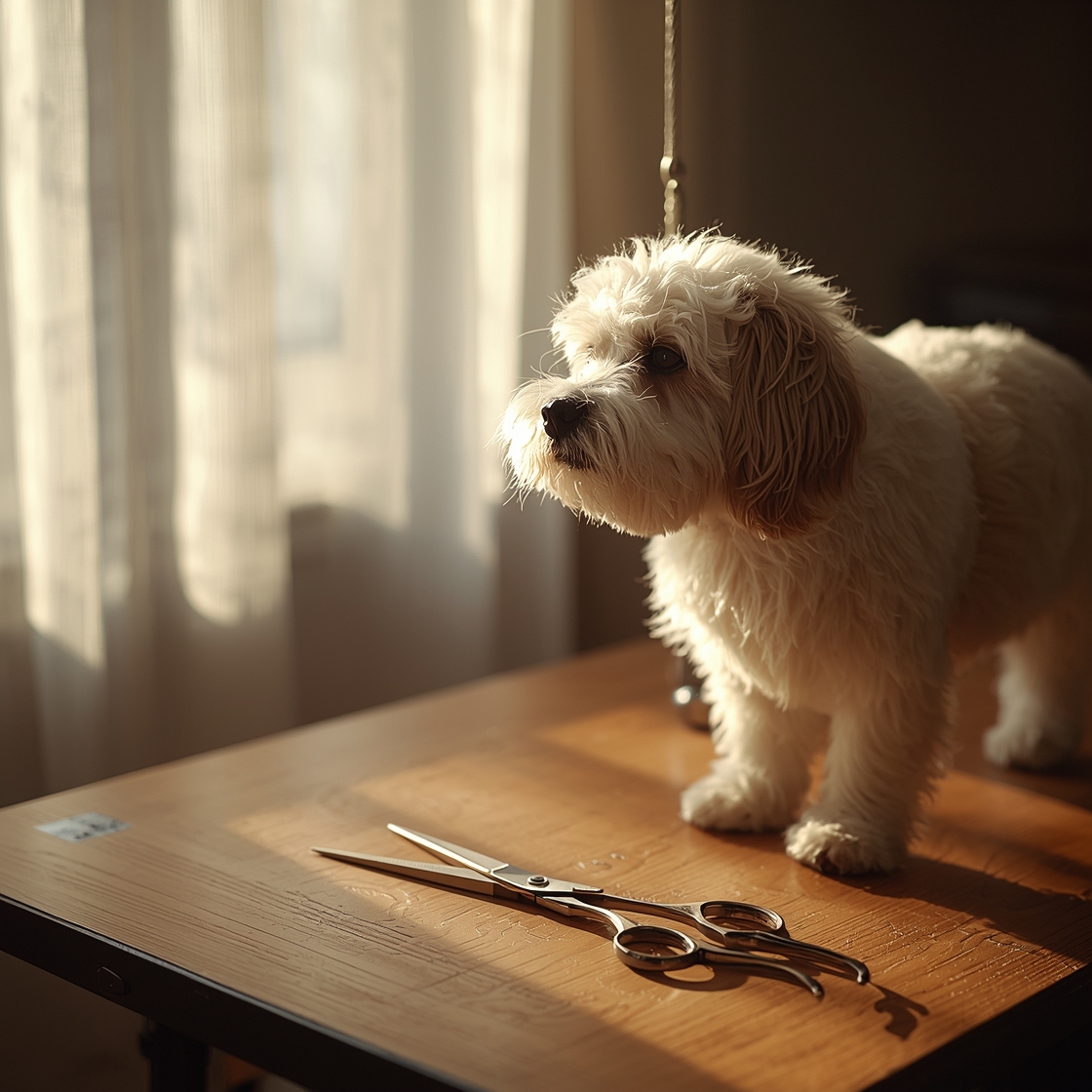
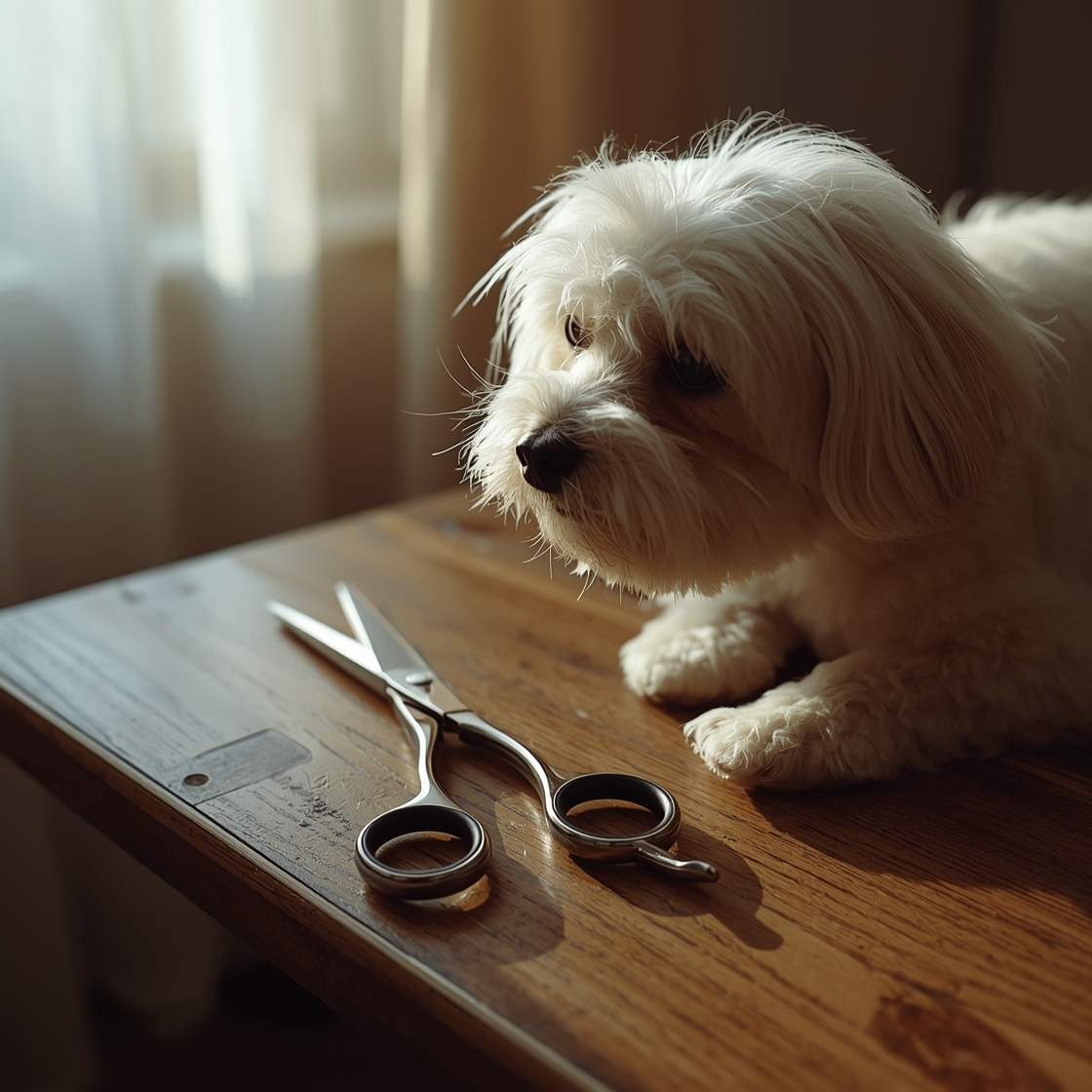
The best pet grooming scissors for thick coats are a straight plus a thinner you use after the coat is combed, not a saw for mats and not a substitute for a rake or a clipper. The We read the titles and descriptions of 7 SKUs. Listed snapshots ran $9.97–$38.99 (median $18.99, a 3.9× spread). 3 of 7 sit $9.97–$15.99 (4-in-1 kit $9.97; LovinPet $12.99; GLADOG $15.99). 3 of 7 sit $18.99–$23.59 (Tweezerman $18.99; ULG curved $19.98; Gimars $23.59). 1 of 7 is the highest kit (Professional Dog Grooming Scissors Set $38.99). 0 of 7 replace an undercoat rake on a felted double coat. 0 of 7 replace a veterinarian for a nick that will not stop. A $10 kit you use on dry, detangled hair beats a $39 set you drive into a mat.
Thick coats have depth. Scissors finish a shape. They do not empty wool. If a comb cannot travel, you are on the rake page or at a groomer — not in a shear aisle.
Our guides are reader-supported. This article may contain affiliate links. As an Amazon Associate we may earn a commission if you buy through links, at no extra cost to you.
Related: small-dog shears, general shears, clippers, kits, home-groom safety.
Quick picks at a glance
- Best listed cheapest kit: Professional 4 in 1 Safety Round — $9.97. Entry carton. Inspect tips.
- Best listed named single (mid): LovinPet — $12.99. One pair. Confirm tip shape in the photo.
- Best listed named 5-in-1: GLADOG — $15.99. Mid kit. Safety language.
- Best listed named round-tip: Tweezerman — $18.99. Face tidy class — still useful on a thick-coat face.
- Best listed curve: ULG Curved Dog Grooming Shears — $19.98. Contour. Not a mat saw.
- Best listed mid-high kit: Gimars Titanium 6 in 1 4CR — $23.59. Piece count + coating claim.
- Best listed highest kit: Professional Dog Grooming Scissors Set — $38.99. 3.9× the cheap kit. Pay for steel/piece story, not a medal.
How thick shear listings compare on labels
Four jobs. A $39 set on an unraked malamute is how blades chew and skin pays. A $10 kit after a rake is a finish.
| Job | What actually works | Category | Fail if you skip it |
|---|---|---|---|
| Bulk on a combed drop coat | Thinning shears, slow | GLADOG / Gimars / $38.99 set (if a thinner is in the box) | Thinning a mat |
| Line / sanitary / feet | Straight | 4-in-1 $9.97; LovinPet $12.99 | Kitchen scissors |
| Cap / skirt silhouette | Curved | ULG $19.98 | A 7-inch curve into wool you cannot see |
| Face tidy on a thick-coat breed | Round-tip | Tweezerman $18.99 | Pointed craft shears |
Before you shop: (1) a comb travels to the skin in the zone you will cut, (2) the pet is held, (3) you are finishing shape, not emptying April wool, (4) blood, heat from fighting, or a felt pad is a clinic or a groomer, not a $39 upgrade. Fail gate 1 and this checklist is how you shop past a fantasy.
Why the best pet grooming scissors for thick coats are three objects
- Straight / named single — LovinPet $12.99; Tweezerman $18.99 (round-tip face).
- Curved — ULG $19.98.
- Kits — 4-in-1 $9.97; GLADOG $15.99; Gimars $23.59; Pro Set $38.99.
A clipper is a different object. A rake is a different object. Scissors do not replace them on a double coat you have not detangled.
Want current listings? See thick-coat grooming scissors on Amazon →
How this desk scored the best pet grooming scissors for thick coats
this comparison uses four visible signals plus the listed sticker:
- Class. Single vs curve vs kit. Kits should include a thinner if bulk is why you clicked — confirm the photo.
- Sticker vs implied job. $9.97 habit vs $38.99 piece/steel story.
- Tip language. Round near faces. ULG is curved; check tips on this lot.
- Reach vs wool. Long blades on an uncombed ruff are how you cut what you cannot see.
Price is not a sharpness grade. A $12.99 LovinPet kept clean beats a $38.99 set left packed with hair.
The 7 cards on this URL
1. GLADOG Professional 5 in 1 Dog Grooming Scissors Set with Safety
Best for: a $15.99 named kit when you want a straight plus extras on a coat you already combed.
Listed $15.99. Safety language. Mid kit.
Honest drawback: five pieces still include a thinner you can overuse. Thick coat ≠ “thin until it looks like a summer clip.” Leave guard hair if the dog is a double coat.
2. Professional 4 in 1 Dog & Cat Grooming Scissors Kit with Safety Round
Best for: the $9.97 first carton when the habit is unproven.
Listed $9.97. Safety-round language. Piece quality varies.
Honest drawback: four cheap pieces. One usable straight is a win. Do not assign a junk thinner to a Newf ruff.
3. Gimars Titanium Coated Professional 6 in 1 4CR Stainless Steel Dog
Best for: a $23.59 piece-count kit when you want a curve and a thinner in one box.
Listed $23.59. 4CR + titanium are steel-aisle words.
Honest drawback: coating does not add tooth length. A 6-in-1 on an uncombed thick coat is six ways to nick. Comb first.
4. LovinPet Pet Grooming Scissors Professional Dog Cat Grooming Shears
Best for: a $12.99 named single when you only need a straight tidy on feet or sanitary.
Listed $12.99. Confirm tip shape. “Professional” is aisle language.
Honest drawback: one pair. Bulk work wants a thinner from a kit. Do not saw a ruff with a single straight.
5. ULG Curved Dog Grooming Shears
Best for: contour on a combed skirt or cap.
Listed $19.98. Curve class. Check tip photos.
Honest drawback: a curve in thick wool you cannot see is a longer blade in the dark. Comb. Lift. Cut what you lifted.
6. Tweezerman Pet Grooming Scissors-Rounded Tip Trimming Scissor for
Best for: face and ear-edge tidy on a thick-coat dog whose body is a rake/clipper job.
Listed $18.99. Round-tip class.
Honest drawback: this is not a bulk tool. Using Tweezerman on a malamute saddle is comedy. Use it where tips matter.
7. Professional Dog Grooming Scissors Set
Best for: the highest sticker kit when you want a fuller steel/piece story and you already comb.
Listed $38.99. 3.9× the $9.97 kit. Generic title — open the photos. Count shears vs comb vs case.
Honest drawback: $39 is still consumer kit money, not a Japanese salon set. It does not authorize a lion cut on a husky. If the carton is light on thinning geometry, you paid for a case.
Comparison of the seven cards
| Card | Listed | Class | Honest job | Watch-out |
|---|---|---|---|---|
| 4-in-1 Safety Round | $9.97 | Cheap kit | First carton | Junk thinner risk |
| LovinPet | $12.99 | Named single | Feet / sanitary | Not bulk |
| GLADOG 5-in-1 | $15.99 | Named kit | Straight + extras | Over-thinning |
| Tweezerman | $18.99 | Round-tip single | Face | Wrong for saddle bulk |
| ULG curved | $19.98 | Curve | Cap / skirt | Blind cuts in wool |
| Gimars 6-in-1 | $23.59 | Mid-high kit | Piece count | Coating ≠ reach |
| Pro Set | $38.99 | Highest kit | Steel/piece story | Generic title |
Pairing desk: best pet grooming scissors for thick coats
| Coat phase | Primary | Secondary | Fail |
|---|---|---|---|
| Blow / wool dump | Rake (sister URL) | None of these seven | Shears as a plow |
| Combed drop coat, shape | Kit thinner + ULG $19.98 | Straight for line | Mats |
| Feet / sanitary | LovinPet $12.99 or 4-in-1 | Comb | Dirty packed blades |
| Face on a husky / golden | Tweezerman $18.99 | Helper | Pointed tips |
Do the best pet grooming scissors for thick coats need thinning shears?
Often yes for bulk on a combed single or drop coat. No as the first tool on a double coat in April. Thinning a wool layer you have not raked hides mats and irritates skin. Confirm a thinner is actually in the Gimars / GLADOG / Pro Set carton before you pay for “bulk.”
Blade length for dense coat (planning, not a lab)
Longer blades cover more hair per bite. They also hide more skin per bite. On thick coats, lift a section, comb it, cut what you lifted. A 7-inch vanity blade is how people nick a flank they never saw.
We will not invent inch recommendations per SKU. Doscpe’s 6.69 print lives on the small-dog sibling, not on these seven cards. ULG is “curved” without a printed length on the card — believe the photo.
Steel desk (labels, not a Rockwell)
| Card | Steel story on the listing | What we will say |
|---|---|---|
| Gimars | 4CR + titanium coat | Aisle words. Wipe and dry. |
| Others | Stainless / unnamed | Keep them dry. Replace when they chew. |
| Pro Set $38.99 | “Professional” set | Sticker, not a certificate |
Rusted cheap steel scratches. Packed hair is a lapping compound.
Breed and body notes (geometry, not a salon card)
Husky / Malamute / Samoyed. Double coat. Rake. Do not scissor a “summer cut.” Tweezerman for face wisps only. ULG on a combed skirt if a groomer showed you the line.
Golden / other retrievers. Feathering. Comb. Straight or curve on combed pants. Mats behind ears: groomer, not LovinPet as a saw.
German shepherd. Pants and saddle wool. Rake first. Shears are tidy, not the blow.
Chow / Akita. Dense ruff. Easy to cut skin you cannot see. Groomer unless you can lift and see.
Doodle / drop coat. Cotton mats. Shears finish a groomed dog. Felt is a groomer or a careful clipper, not a $9.97 kit.
Newf / Saint / Bernese. Heavy. Split sessions. $38.99 does not make this a Tuesday evening.
Collie / sheltie. Feathering + undercoat. Comb. Thin sparingly. Do not “thin the weather coat” for Instagram.
Puppy. Soft. Short. No thinning marathon.
Senior / thin skin. Round tip on the face. Tiny bites. Blood is a stop.
Skin, nicks, and when this URL ends
A nick that keeps bleeding or a coat that smells like infection is a veterinarian. We will not write a wound protocol. We will not diagnose hot spots.
If the dog screams, you hit skin or a mat. Put the shears down.
Price bands on this URL
$10–$16. 4-in-1 $9.97, LovinPet $12.99, GLADOG $15.99. Correct first spend.
$19–$24. Tweezerman $18.99, ULG $19.98, Gimars $23.59. Face, curve, or piece count.
$39. Pro Set. Pay for the carton you photographed, not the adjective.
A $120 salon shear is not on these seven cards.
Care of the shears
Wipe. Dry. Oil the pivot. Do not use them on mats, rope toys, or packing tape.
Store closed. Kids + $38.99: no.
We will not invent a bulk-gram score. We will not invent a 30-day golden rotation. We will not put a fake CMG on the byline. Comb, lift, cut, clinic for blood.
If a listing says “cuts thick coats like butter,” screenshot it. It is their sentence.
Worked households
Dog A — golden, combed pants, first home tidy. GLADOG $15.99 straight on the line. Thin sparingly. Mats: stop.
Dog B — husky, April. Rake (sister URL). Tweezerman $18.99 for face only. Do not buy the $38.99 set as a plow.
Dog C — doodle, felted. Book a groomer. ULG $19.98 will polish the top of a mat and lie to you.
Dog D — Newf, already owns a rake. Pro Set $38.99 only if you will finish a combed skirt. Otherwise LovinPet $12.99 for feet.
Dog E — senior chow, thin skin. Tweezerman, three minutes, food. A 40-minute Gimars session is how you lose the dog.
FAQ
Do the best pet grooming scissors for thick coats need thinning shears?
For bulk on a combed drop coat, a thinner helps. For a double coat in a blow, a rake helps. Thinning a mat is how you hide a problem.
How often should I groom a pet with a thick coat using scissors?
Shape: when the last line has grown and the coat is combed. Wool: on the rake calendar, not the shear calendar. Daily scissoring is how you get nicks.
What makes a pair of grooming scissors suitable for thick fur?
A comb that already traveled, a blade that cuts instead of chews, and a hold plan. Steel adjectives are secondary.
Should I use thinning shears in addition to straight scissors?
Yes for blending a combed shape. No as a substitute for detangling. Confirm the kit actually includes a thinner.
How do I keep my grooming scissors in top condition?
Wipe, dry, oil the pivot, do not cut mats. Replace when they fold hair.
Are there safety tips for using scissors on nervous pets?
Helper. Sit. Less hair. Round tips on the face. Stop if they cannot stand. A $39 kit is not sedation.
Can scissors replace a clipper on a thick coat?
Sometimes for a tidy. Not for a full body on a felted dog. See clippers.
Session recipes (desk, not a lesson)
Ten-minute feet. Comb. LovinPet $12.99. Pad by pad. Stop.
Twenty-minute skirt. Rake or comb until the comb travels. ULG $19.98 on lifted sections. Thin only what you can see.
Face only on a thick-coat breed. Tweezerman $18.99. Helper. Three cuts. Stop.
If the dog leaves, you lost. Shorter next time.
Lighting, tables, and a second human
You cannot cut thick hair you cannot see. A headlamp is cheaper than a nick. A table helps a Newf more than a $39 upgrade.
Second human: doodles, chows, and anyone who air-snaps.
Double coats vs drop coats (the whole page)
Double: wool + guard. Shears finish guards after wool is raked. Shaving or scissoring “to cool them off” is the persistent myth — veterinary-derm summaries have warned about sunburn and coat-regrowth mess for years. We reprint that warning.
Drop / cotton: mats. Shears after a groomer or a careful detangle. Not as the detangle.
Label math examples (desk arithmetic)
4-in-1 $9.97 + Tweezerman $18.99 = $28.96 — still under Pro Set $38.99, and you have a kit plus a face pair.
ULG $19.98 vs Gimars $23.59. $3.61. Dedicated curve vs six pieces. Contour-only households can take ULG.
LovinPet $12.99 vs GLADOG $15.99. $3. Buy the single if you only tidy feet. Buy the kit if you want a thinner in the box.
Two Pro Sets = $77.98. That money is a rake plus a cheap kit plus a groomer lesson.
Groomer at $85 vs $9.97 kit. If you cannot comb the coat, pay the human.
Aftercare
Hair in a bin. Check skin in good light. Pink: stop. Damp wool against skin: dry it. Blood: clinic thinking.
Sources this desk actually used
- Live Amazon card snapshots (titles, prices, class).
- Public home-grooming safety: comb first, no scissors into mats (VCA-style pages).
- Double-coat caution reprinted from public veterinary-derm themes (not our trial).
- Object split: straight vs curve vs kit vs rake vs clipper.
If a maker updates piece count, believe the box.
More worked households
Household F — you already own GLADOG. Do not buy Gimars “to compare.” This desk did not run a side-by-side.
Household G — wipe-and-scissors believer. Wipes are not detangle. Add a rake or book a van.
Household H — $38.99 as the whole thick-coat plan. Count the pieces. If there is no rake, you still need the sister page.
Household I — two goldens, one person. Split days. One zone per night. ULG does not create a second pair of hands.
Household J — travel. Tweezerman $18.99 in a hard case for face. You will not reshape a Newf in a hotel tub with the Pro Set.
Apartments and hair
Scissors are quiet. The pile of thick-coat hair is not. Bag it. A vacuum is a different object.
Kids, other pets, and “helping”
A child holds the treat pouch. They do not hold ULG. Cats on a “dog & cat” kit: specialist job or skip.
When shedding is a medical sentence
Hair with skin, greasy odor, moth-eaten patches: clinic. Stop shopping shears.
What the best pet grooming scissors for thick coats are not
They are not a rake. They are not a clipper. They are not kitchen shears. They are not a summer-cut license on a husky. They are not a reason to skip the vet when the coat smells like infection.
The seven cards are the same.
More breed and mix notes
Anatolian / livestock guardians. Dirt + coat. Clean, comb, then tidy. Do not scissor farm felt.
Australian shepherd. Variable. Comb. Thin the pants if they are cotton-y, not if they are wool-felted.
Akita. Dense. Short strokes on the ruff. See skin.
Newfie. Dry after a swim before you cut. A wet shear is a skin scrape.
Wolfish mixes. Treat as husky-class. Rake. Face only with Tweezerman.
If you do not know coat type, lift the loin guards. Wool underneath = rake first. Cotton from skin to tip = sister doodle/clipper pages.
Static, wet wool, and why $38.99 still chews
Winter static makes thick hair fly and owners grab shears too soon. A barely damp (not wet) surface or a pet-safe mist is a household choice. Soaking a double coat to “beat static” and then cutting is how you set a felt layer. Dry. Comb. Then ULG $19.98 or a kit straight.
Wet wool packs a blade. Dirty grit is a whetstone you did not want. Farm mud: rinse, dry, rake, then decide if LovinPet $12.99 is even the right aisle.
Human shears, craft shears, and aisle lies
Human bangs shears are often pointed. These seven cards are pet-aisle. Do not “just use the kitchen pair” on a golden skirt and then blame the Pro Set $38.99 when you return to Amazon.
Nail scissors from a human kit are not ruff shears. Different curve, different disaster.
Between the pads, sanitary, and “while I have the shears”
Hair between pads on a thick-coat dog can be a tidy if you can see. Webbing is a nick factory. Sanitary: wash dirt off first. A dirty sanitary packs GLADOG $15.99 like a mop. Tweezerman $18.99 is the wrong length for a Newf sanitary — use a kit straight.
Show trim, summer cut, and Instagram
A “teddy” on a doodle or a “lion” on a husky is a groomer religion. None of these seven cards include a lesson. Maintain a shape someone already set. Do not invent a new silhouette with the 4-in-1 $9.97 thinner.
Shaving or scissoring a double coat “to cool them off” is the myth this desk will not repeat as advice. Guard hair is weather. Wool is insulation both ways.
More session failures (desk, not a scold)
You cut a mat “to get it over with.” That is how flanks open. Book a groomer.
You used the kit thinner as a rake. Tracks and hidden felt. Leave the thinner in the Gimars $23.59 case until the comb travels.
You worked 40 minutes because you paid $38.99. The dog left twenty minutes ago. You lost.
You curved into wool you could not lift. ULG $19.98 is a longer blade in the dark. Lift first.
Storage, rust, and treat grease
Rinse salt if you beach-groom. Dry metal. A coffee can of packed shears is a rust farm. Treat grease on a $38.99 set is how a high carton starts chewing.
Travel: Tweezerman $18.99 in a hard case for face. The Pro Set is a suitcase tax you will not use in a hotel tub.
Right-handed kits and tired thumbs
Cheap kit handles are stamped for a right thumb. If the 4-in-1 $9.97 fights a left hand, stop. A fight with the handle is a fight with the dog. If nothing fits, pay a groomer.
Arthritis: sit, brace, fewer cuts. $38.99 does not replace a rest. A Newf is a project, not a product review.
Force dryer, bath, and the shear calendar
Water plus wool without a dryer is a damp felt layer. If you cannot dry to the skin, skip the “deshed bath then scissor” reel.
If you do bathe: detangle dry first; rinse clear; towel; dry; rake; then shears. A force dryer is loud. Desensitize with food or skip it. Ear-safe distance is a groomer habit; we are not teaching a salon certification.
Professional groomer, mobile van, and this URL
A good groomer on a thick coat will rake and blow out, then scissor a line. Ask what they will do before you drop off. “Summer cut” on a malamute is the sentence you veto.
Price of a blow-out vs $39 of Pro Set: if you will not comb at home, the van is the product. The Amazon cards are for people who will sit on the floor after the comb travels.
Mobile grooms still need your dog to tolerate tools. A panic in a van is not a steel problem.
Hands, kids, and apartments
Kids + ULG: no. The $19.98 curve is not a toy.
Apartments: bag the hair. Thick-coat piles clog a shared laundry sink. A $10 kit plus ten minutes of vacuum is still cheaper than a felted coat at the groomer.
More length and zone planning (desk, not a lab)
| Dog | Face | Body bulk | Pair spend on this URL |
|---|---|---|---|
| Medium golden | Tweezerman $18.99 | GLADOG $15.99 thinner after comb | ~$35 |
| Large husky | Tweezerman only | Rake (sister); skip saddle shears | $19 |
| Giant Newf | Skip or tiny tidy | Pro Set $38.99 after comb, split nights | $39 + rake |
| Doodle, combed | Round-tip | ULG $19.98 + kit thinner | $20–$24 |
These bands are desk planning. If the listing does not print length, look at the photo against a coin or skip.
Coat oil, “shiny thick hair,” and why shears are not shampoo
Thick coats often look greasy before they look fluffy. That is sebum plus dirt, not a failure of LovinPet $12.99. Shears finish length. They do not degrease a coat. If the dog smells like a damp towel, you want a bath plan or a clinic, not a firmer bite.
“Shine” on a listing is lighting.
Furniture, lint, and the honest second product
The shears are for the dog. The sofa is a roller or a pet-hair vacuum. Buying the Pro Set $38.99 will not clean the couch. Households angry about hair usually need a rake and a bin.
Left-handed, one-hand, and helper math
If one wrist is the limiting reagent, Tweezerman $18.99 for face only is more honest than a $38.99 set you cannot finish. Sit. Rest. The dog can wait a day.
A helper is worth more than Gimars $23.59. Two hands on a chow ruff beat six pieces in a case.
Internal links and what this URL is not
This page is thick-coat shear class and the seven cards. Small-dog face geometry, motors, gloves, and rakes live on the sister links. It is not a breed-standard trim guide. It is not veterinary dermatology.
If a roommate still finds a felt pad after an honest week of “just scissors,” the leftover is a rake you did not buy — not a missing eighth SKU.
The best pet grooming scissors for thick coats on this URL are a $9.97–$15.99 kit/single band, a $19–$24 curve-and-kit band, and a $38.99 set. LovinPet and the 4-in-1 are tidies. GLADOG and Gimars are piece-count kits. ULG is the curve. Tweezerman is the face. The Pro Set is the high carton. Do not make them pretend to be rakes.
Last reviewed: August 2026. If something is stale, contact us.