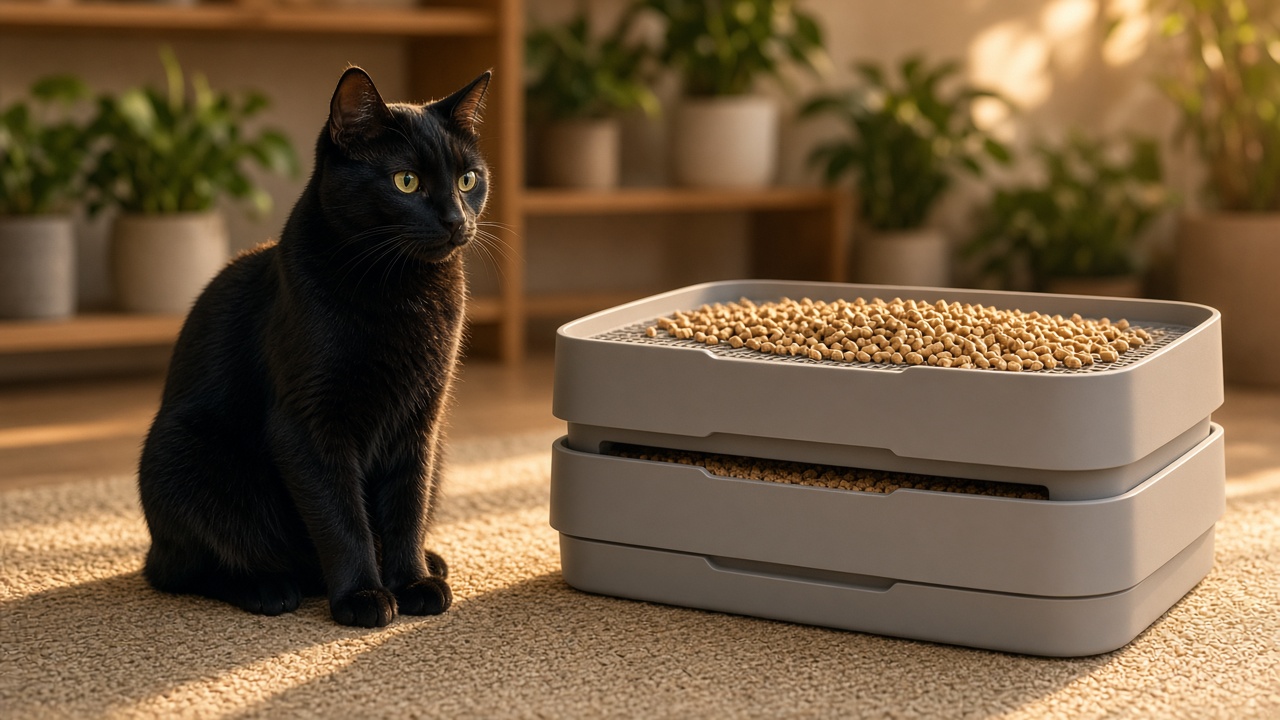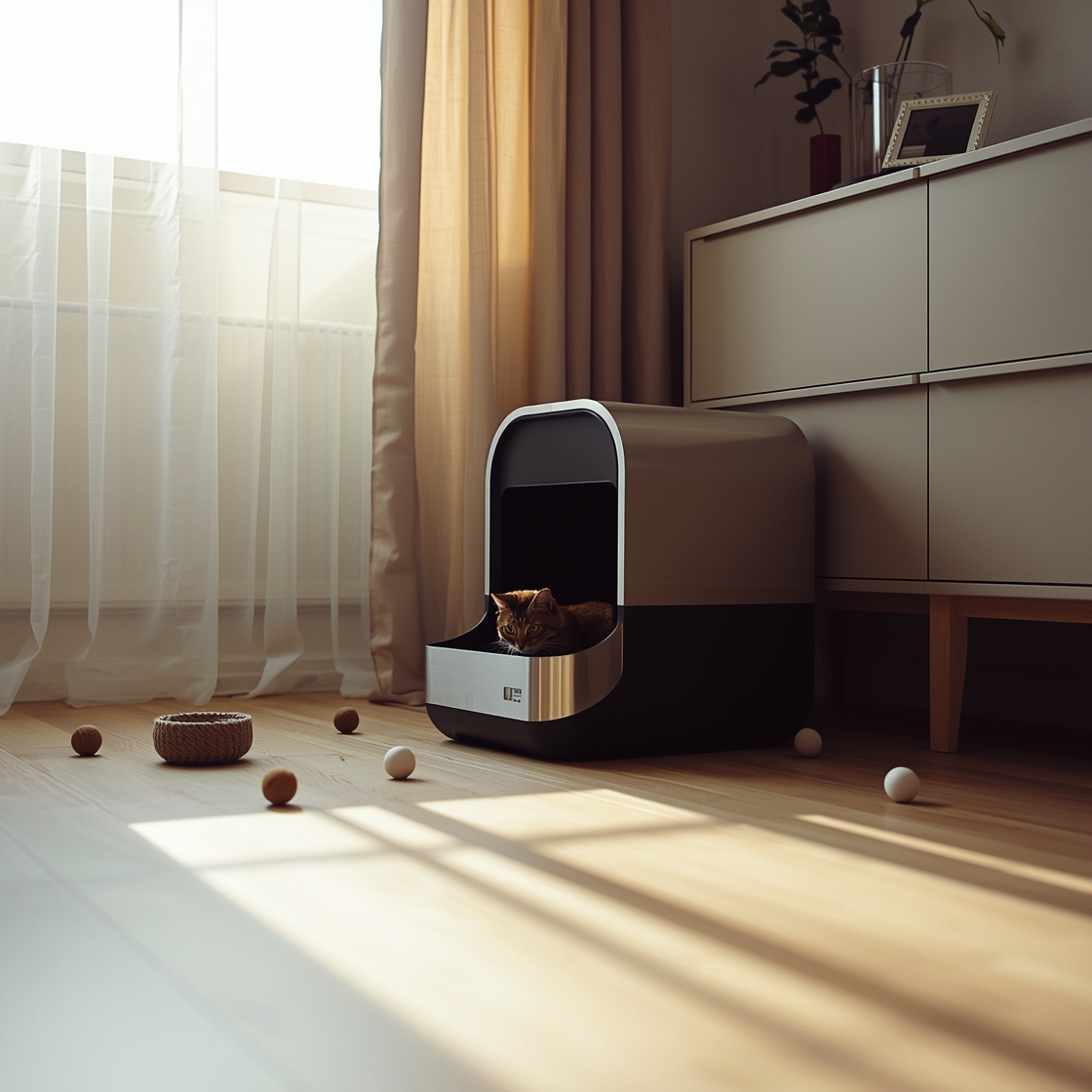
The best automatic cat litter box is a rake or drum that accepts clumping clay at 2–4 mm, a waste drawer you will empty on a calendar (about 7–10 days for one cat; 3–5 for two), and a 10–30 minute exit delay so the mechanism never starts with the cat inside. Quiet motors and carbon pads help. They do not replace box count.
Buy a mid rake in the $180–$210 band (Cumrige / Fumoi class) if you want a quieter cycle and a drawer you can live with. Buy Paruuntys or UPFAS if the job is “stop scooping every morning” for one cat on a tight budget. Buy an open-top unit if the cat already boycotted a hood. Do not pour crystal or pine pellets into a sifter the manual never named.
We did not house-trial seven motors, meter decibels, culture waste drawers, or claim veterinary review. Nothing here has been reviewed by a veterinarian on our behalf. Cornell Feline Health Center’s litter-box pages still treat location, cleanliness, and enough boxes as the floor — a motor is labor reduction, not a diagnosis. AAFP/ISFM-style environmental-needs writing still treats one box per cat, plus one as a welfare floor. Automation does not erase that count.
Affiliate disclosure: we may earn a commission from Amazon links.
Multi-cat hardware that is actually sized for two or three cats lives on automatic litter boxes for multiple cats. If you are also automating meals, keep food away from litter — start meals on automatic feeders for multiple cats only after the box location is stable.
What the best automatic cat litter box actually has to do
A self-cleaning box is not a washing machine. It waits for two signals — weight or motion on entry, then a clear exit — and only then does a rake or drum move. That delay is a safety feature. Shortening it to “instant” is how owners get a cat standing on a moving bar.
Three jobs get mashed into one shopping query:
- Cut daily scooping for one cat — mid rake, clumping clay, drawer emptied on a calendar.
- Open entry — cats that refuse a tunnel or globe still need the sealed drawer.
- Two cats, one machine — larger drawer plus a second box anyway. Overflow stops the cycle.
If you will not empty a drawer on a calendar, a $15 high-sided tray plus a daily scoop is still a legitimate “best.” This page exists for the houses that want the motor and will maintain it.
How this desk compared automatic boxes
PetBench Litter Desk (August 2026) mapped seven currently attached Amazon cards to buying jobs. We scored listings on five published facts only:
- Litter the manual names — clumping clay vs “any litter” marketing.
- Drawer language — size and liner type vs household size.
- Entry geometry — open vs enclosed vs slim under-furniture.
- Reset honesty — owner-theme sensor resets vs “smart health” claims we will not endorse.
- Price band you can replace in 24 months — these motors wear.
We did not invent a ranked medal table, reprint unsourced “90% odor reduction” tiles as fact, or treat an app as a urinalysis. Snapshot prices on the cards move.
Named examples — not a medal table
These seven cards are currently sold examples.
1. Cumrige Automatic Litter Box
Best for: mid-range budget that still wants a quieter cycle than the cheapest rake.
Listing copy and owner themes put Cumrige in the compact apartment band: a self-cleaning cycle described as quieter than bargain motors, with a footprint that fits a laundry nook. The honest drawback is the same class problem as most mid rakes — occasional sensor hiccups that owners clear with a power reset, not a service call.
Pros: Mid price for a sealed-cycle unit; compact footprint. Cons: Sensor resets show up in owner notes.
2. Paruuntys Automatic Litter Box
Best for: a first automatic on a tight budget.
This is the entry rake in the set. The job it can do is “stop scooping every morning” for a single cat that already uses clumping clay. The job it cannot do is hold a multi-cat weekend. Owner notes flag a small waste drawer and a simple one-button reset — treat that as the product, not a defect to review-bomb.
Pros: Low entry price; simple reset. Cons: Limited waste-drawer capacity.
3. Open-Top Automatic Litter Box
Best for: cats that refuse a covered tunnel or globe.
Covered boxes are a human odor preference, not a feline requirement. An open-top automatic keeps the rake and the sealed drawer while leaving the entry visible — useful for large cats, elderly cats, and any cat that already boycotted a hood. The trade-off is footprint and splash: you still need a litter mat and a room that can tolerate an open tray.
Pros: Open entry; carbon-filter odor help on many listings. Cons: Larger footprint than slim enclosed units.
4. UPFAS Automatic Cat Litter Box Self Cleaning
Best for: first-time owners who want plug-and-play assembly.
UPFAS sits in the $100 band with a night-quiet motor claim in owner notes. Plastic housing is the honest con: it is a consumable appliance, not furniture. If you need a unit you can move between rooms during a transition week, lighter plastic is a feature.
Pros: Simple setup; quiet motor theme in owner notes. Cons: Housing feels less stout than metal-frame listings.
5. Fumoi Automatic Litter Box
Best for: multi-cat households that still insist on one machine (add a second box anyway).
Fumoi listings emphasize a larger waste bin and app empty-alerts. That is a capacity play, not a substitute for box count. Owner notes also flag a louder cycle — if the box lives next to a bedroom wall, read Table 1 before you click.
Pros: Larger bin; app emptying reminders. Cons: Higher cycle noise in owner reports.
6. Automatic Litter Box
Best for: owners who want Wi-Fi alerts and a sturdier frame in the $240 band.
The generic-titled card in this set is the premium-of-this-shelf option: metal-frame language and mobile alerts. An app that says “drawer full” is useful. An app that claims to diagnose urinary disease is not a product this desk will endorse — we do not sell that claim.
Pros: Wi-Fi alerts; sturdier frame language. Cons: Price is hard to justify for a single cat that already likes a $110 rake.
7. Mintakawa Automatic Cat Litter Box Self Cleaning
Best for: small floor plates and under-furniture installs.
Mintakawa’s slim profile is the reason it is on this page. The odor filter is a plus; the smaller drawer is the tax. If you travel, pair it with a neighbor who will empty on day four, not day twelve.
Pros: Slim silhouette; affordable filter claim. Cons: Frequent emptying.
Comparison: automatic cat litter box cards at a glance (table 1)
| Product | Best for | Snapshot price | Check |
|---|---|---|---|
| Cumrige | Mid quiet apartment | $199.94 | Price |
| Paruuntys | Tight budget | $99.98 | Price |
| Open-Top | Hood-averse cats | $197.99 | Price |
| UPFAS | Easy first setup | $108.99 | Price |
| Fumoi | Larger drawer / app | $199.98 | Price |
| Automatic Litter Box | Wi-Fi + frame | $239.98 | Price |
| Mintakawa | Slim footprint | $109.99 | Price |
Want a wider shelf? Browse automatic cat litter boxes on Amazon →
Before you shop:Rule — job to machine (table 2)
Before you shop:Rule (desk, August 2026): (1) litter the manual names, (2) drawer interval that matches the household, (3) entry the cat will use. Fail any gate and skip the brand tile.
| Primary job | Prefer | Skip first | Why |
|---|---|---|---|
| Cut daily scooping for one cat | Mid rake unit + clumping clay 2–4 mm | Crystal-only tray unless the manual names it | Most rakes need a clump |
| Open-entry cats that refuse hoods | Open-top automatic | Fully enclosed globe on day one | Entry geometry beats brand |
| Two or more cats, same litter | Larger waste drawer + extra box | One undersized drawer for the house | Overflow stops the cycle |
| Tight laundry-room footprint | Slim / under-furniture profile | Wide open-top frames | Measure the alcove first |
| Night-quiet apartments | Listings that print a dB or “night quiet” claim | Max-speed marketing only | Startle ends use |
Price bands logged on Amazon search cards (table 3)
| Band | Typical street price | What you usually get | Desk watch-out |
|---|---|---|---|
| Entry rake | $90–$120 | Basic motor, small drawer | Empty often; plastic flex |
| Mid automatic | $180–$210 | Quieter cycle, carbon filter | Confirm litter compatibility |
| Premium / app | $230–$250+ | Wi-Fi alerts, metal frame claims | App is a log, not a nurse |
| Globe / flagship class (named elsewhere) | $450–$650 | Large sealed drum, app | Out of this card set’s price band |
Price bands are retail snapshots. They are not hygiene grades.
Litter honesty matrix for the best automatic cat litter box (table 4)
| Litter type | Typical rake / sifter fit | Odor help | Desk note |
|---|---|---|---|
| Clumping clay, 2–4 mm granules | High on most rake manuals | Needs sealed drawer + carbon | Default pairing |
| Lightweight clay | Medium | Similar to standard clay | Tracks more; may miss rake |
| Silica crystals | Low–medium unless named | Crystal tray designs | Jams sifters in owner reports |
| Tofu / plant clump | Variable | “Natural” marketing | Clump speed must match cycle delay |
| Pine pellets | Low on rake units | Wood scent ≠ ammonia control | Check the manual before you pour |
Drawer cadence (table 5)
| Household | Typical empty interval owners report | Failure if you stretch it |
|---|---|---|
| One adult cat | 7–10 days on a mid drawer | Ammonia bloom, sensor film |
| Two cats, one box | 3–5 days | Overflow halt, box boycott |
| Three-plus | Do not rely on one drawer | Add a second box first |
This is a planning card, not a lab. Undersized drawers overflow and the firmware often halts — that is how a “self-cleaning” box becomes a dirty box with a dead motor.
How an automatic cat litter box actually cycles
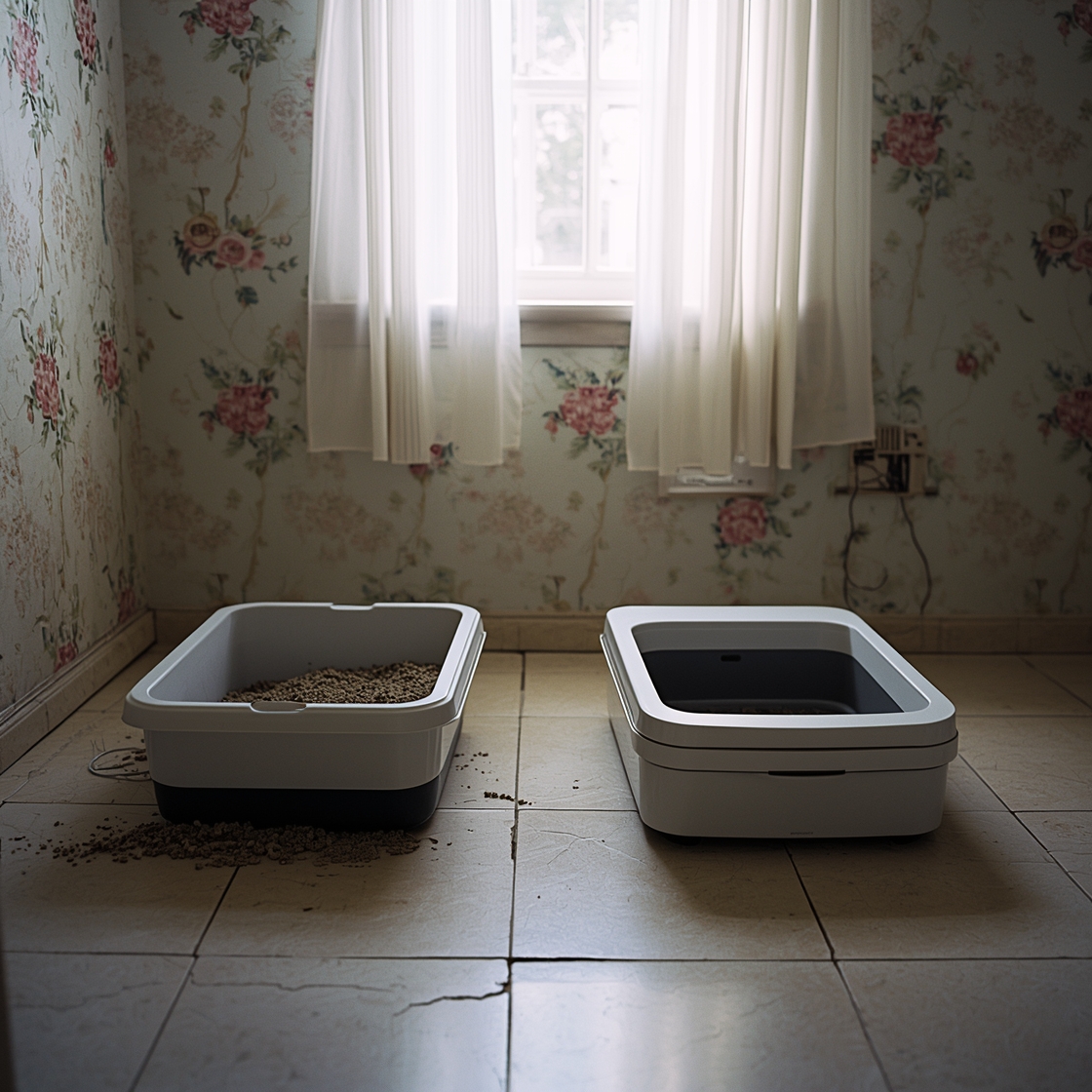
Most consumer units wait, then rake or rotate. Two mechanical families dominate this shelf:
- Rake / sifter — a bar or comb pulls clumps into a chute. It needs a clump that holds shape. Soft tofu or wet crystal beds fail this family first.
- Globe / drum — the chamber rotates and dumps solids into a sealed tray. It still needs the maker’s approved litter; it is not a washing machine.
A sealed waste drawer plus a carbon or charcoal pad is the odor stack this desk will defend. Marketplace “90% odor reduction” tiles are marketing unless a method is printed. We do not reprint unsourced percentages as fact.
Safety language that is worth reading on the manual: pinch-sensor pause, weight threshold so the rake does not start with a kitten inside, and a liner or bag that does not block the chute. Wipe the sensor bar weekly. Dust on the bar is the most boring, most common “it stopped cleaning” ticket in owner forums.
What automation buys — and what it does not
Time: emptying a drawer every several days instead of scooping twice a day is the real product. Hygiene: drier remaining litter is less of a bacterial buffet than a weekend-ignored open box. Tracking: a high rim and a mat still matter; automation does not vacuum paws.
What it does not buy: a diagnosis. Blood in urine, straining, or a sudden box boycott is a clinic appointment, not a firmware update. We are a research desk. We will not dress a rake as a urinalysis.
Multi-cat homes should still keep a second (even manual) box during the first 7–10 days. Parallel boxes prevent the “new machine is a monster” strike. Use the same litter brand and scent the cat already accepted.
Cornell’s litter-box care writing still puts cleanliness and location ahead of gadget class. A motor in a closet the cat already refused will stay refused.
Setup SOP — first two weeks
- Measure the alcove: width, depth, and the door swing if any.
- Confirm power: most units are mains-only; a GFCI laundry outlet is a feature, not a footnote.
- Fill with the same clumping clay the cat already uses, unless the manual forbids it.
- Place the new unit beside the old box for 3–5 days. Do not retire the old box on night one.
- Set cycle delay to the longest setting for week one.
- Empty the drawer on a calendar, not when you smell it. Smell means you are late.
- If the cat refuses, stop moving the box and stop changing litter. Change one variable.
Cycle timing and the best automatic cat litter box litter match
Self-cleaning boxes typically rake 10–30 minutes after exit. Clumping clay with a 2–4 mm granule is the pairing most rake manuals assume. Crystal and pine pellets show up in owner-reported jams when the sifter was never designed for them.
Waste-drawer math from Table 5 is a planning tool. If you travel, the slim Mintakawa-class drawer needs a human on day four. A larger Fumoi-class bin still needs a calendar.
Multi-cat rules for an automatic litter box
One automatic unit is still one resource. Dominant cats can guard a popular machine the same way they guard a popular tray. Visual separation and a second location beat a louder app notification. Introduce over 7–10 days with the old box parallel.
If you are also automating meals, keep food away from litter. Feeding-station guidance and litter-station guidance are different jobs.
Listing literacy — how to read a litter-box card
When comparing Amazon cards for the best automatic cat litter box, read the bullet list for units (liters of litter, drawer bags, dB if printed, cycle delay minutes) before star averages. PetBench discards “#1 bestseller” badges as ranking signals. Prefer a return window that lets you check noise and entry in week one.
Ask the listing:
- Does it name clumping clay, or only “litter”?
- Is the waste liner a standard bag or a proprietary cartridge?
- Is the “app” required for basic cleaning, or optional?
- Is there a printed max cat weight? Globe and rake sensors fail differently on very small and very large cats.
Decision checklist
- Write the job in one sentence (“quiet night cycle for one 12 lb cat in a 24-inch alcove”).
- Match that job to a class in Table 2.
- Confirm one printed measurement on the live listing (width or litter type).
- Confirm one maintenance cost (liners, filters, bags).
- Only then compare the $99 vs $240 band.
If step 3 fails because the maker printed nothing, treat the SKU as incomplete for desk purposes and pick another card in the same class.
Frequently Asked Questions
What should I prioritize when shopping for the best automatic cat litter box?
Apply the Before you shop:Rule: litter the manual names, drawer interval, entry the cat will use. The best automatic cat litter box survives those gates — not a generic top-seven list. Feline-behavior literature still treats “one box per cat, plus one” as a welfare floor; a motor does not erase that count.
Which litter works with a self-cleaning box?
Standard clumping clay with roughly 2–4 mm granules is the default. Avoid crystals and pellets unless that exact model’s manual names them.
How often should I empty the drawer?
Plan 7–10 days for one cat on a mid drawer, 3–5 days for two cats sharing one unit. Wipe the sensor bar weekly. Replace carbon pads on the maker’s printed interval.
How do I transition a cat to an automatic box?
Keep the old box beside the new one, use the same litter, delay the cycle, and move the old box away only after the cat has used the new one on its own. Treats after a successful visit are fine; forcing a cat into a globe is not.
Will an automatic box eliminate odor?
No sealed drawer eliminates ammonia if you skip empties. Carbon pads and a dry clump help. Ventilation in the room still matters. Perfume sprays on a dirty drawer are not a strategy.
Do I still need two boxes for two cats?
Yes, as a welfare floor. Automation is labor reduction. It is not a license to run one resource for two territorial animals.
Room placement and the rest of the house
Put the box where the cat already toilets if you can, then improve the machine — not the reverse. A laundry-room GFCI outlet is convenient for humans and often terrible for a cat that already toileted in a quiet hallway. If you must move the station, slide it a few feet per day after the cat is using the automatic unit, and keep a backup tray at the old coordinates until accidents stop.
Do not park food bowls on the litter mat. AAFP-style feeding guidance and litter guidance both treat those as separate resources. Water fountains belong in a third zone when you have the square footage.
Liners and bags: proprietary cartridges raise the true monthly cost above the sticker on the motor. Generic bags that collapse in the chute create false “sensor errors.” If the listing does not name a bag size, photograph the drawer on arrival and write the inch dimensions on a tape label before the first Amazon return window closes.
Failure modes this desk logs from owner themes
| Symptom | First check | Usually not |
|---|---|---|
| Cycle never starts | Sensor film, cat still sitting, delay set to max | “Dead unit” on day two |
| Cycle starts with cat inside | Delay too short; weight threshold too low | Need a louder motor |
| Clumps left in the bed | Wrong granule; wet tofu; overfill | Buy a $650 globe immediately |
| Overflow halt | Drawer full; bag collapsed | More fragrance spray |
| Cat boycotts | Parallel old box removed too soon | The cat is “being dramatic” as a diagnosis |
A boycott after a litter and box change on the same weekend is a human scheduling error. Change one variable.
Consumables and two-year cost (desk arithmetic, not a quote)
Assume one cat, clumping clay you already buy, and a mid rake:
- Motor street price: $100–$210 in this card set.
- Drawer bags: $8–$15 / month if proprietary; less if any tall kitchen bag actually fits.
- Carbon pads: $6–$12 / quarter on listings that sell them separately.
- Extra litter volume: globes and deep rakes often hold more than a $15 open tray — budget a first fill of 8–15 lb, then top-ups after each dump.
A $99 rake that eats $18/month in unique bags can cost more than a $200 unit that takes a standard liner by month 14. Print that math before you optimize for the lowest motor sticker.
When to skip automation
Skip it for a cat in a medical workup for straining or blood in urine until the clinic says the box type is not the variable they need to watch. Skip it if you will not empty a drawer on a calendar. Skip a globe if the cat has already failed every covered box.
A $15 high-sided tray plus a daily scoop is still a legitimate answer for some houses. The best automatic cat litter box is the one whose litter, drawer, and entry survive the three gates — and whose owner will empty it before the room smells.
What to do tomorrow
- Write the job in one sentence (alcove width, cat count, hood yes/no).
- Confirm the litter you already use is clumping clay 2–4 mm, or read the manual before you switch.
- Pick a class from Table 2, then a card from Table 1.
- Place the new unit beside the old box. Longest cycle delay. Same litter.
- Put drawer-empty day on a calendar.
Sources
- Cornell Feline Health Center, Litter box care: https://www.vet.cornell.edu/departments-centers-and-institutes/cornell-feline-health-center/health-information/feline-health-topics/litter-box-care
- AAFP/ISFM Feline Environmental Needs Guidelines (one box per cat, plus one — welfare floor this desk reprints, not a trial we ran)
- Maker listing language on the seven Amazon cards above (prices as August 2026 snapshots)