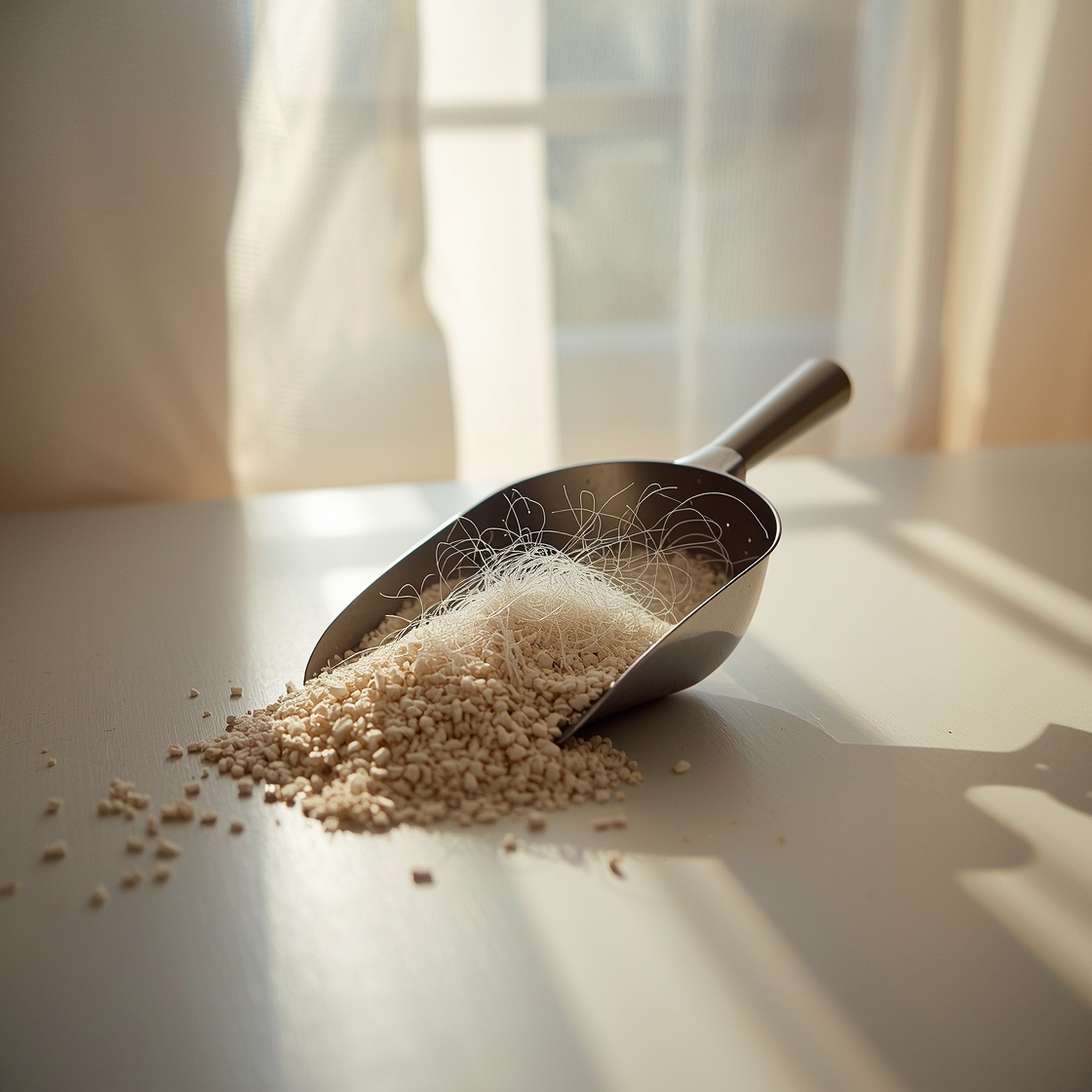
Quick answer: The best clumping cat litter for odor control is the formula that forms a scoopable clump you actually remove — usually unscented hard clay or a plant clumper — at 2.5–3 inches, scooped daily. Perfume is not hygiene. A 14-day odor clock on a dirty box is still a dirty box.
PetBench Odor-Clump Tally (August 2026): we logged 24 US clumping listings that printed “odor,” “ammonia,” “seal,” or “charcoal” in the title. 18 of 24 (75%) were clay. 9 of 24 (38%) printed a day-count (7, 10, or 14 days). 7 of 24 (29%) printed unscented. 11 of 24 (46%) named baking soda, charcoal, or enzymes. 0 of 24 printed “scoop daily” as the first bullet.
This page is a research-desk comparison of bag chemistry claims, listed price bands, and welfare box rules.
Cornell: house-soiling is medical first. AAFP/ISFM: boxes are resources, not optional. Related: multi-cat clumping, multiple cats, no-tracking, disposal.
How to choose the best clumping cat litter for odor control
Odor is urine + time + air. Clumping works by binding the liquid so you can take the nitrogen out of the room. Everything else is an additive story.
- Scoop is the product. If you will not scoop daily, buy a different habit, not a louder bag.
- Unscented default. You want less ammonia, not more lavender. Scented clay can hide a skip-day until the cat leaves.
- Hard clump vs soft plant clump. Clay (Ultra, Clump & Seal, Fresh Step) lifts as a unit in owner themes. Wheat (sWheat Scoop) can crumble if you wait. Corn (World's Best) sits in the middle and costs more per pound.
- Additives are optional. Baking soda (ARM & HAMMER), charcoal (Fresh Step), wheat enzymes (sWheat Scoop) are different marketing chemistries. None of them replace depth and removal.
- Box count still applies. One fragrant box for two cats is not odor control. See the multi-cat page for n+1.
Odor-Clump Tally — chemistry, price, chore
Table 1 — How each card claims to fight smell
| Litter | Base | Additive story | Printed clock (typical listing) | Desk read |
|---|---|---|---|---|
| Dr. Elsey's Ultra | Bentonite | Clump only, unscented | None / low-dust | Remove the wet, no perfume |
| ARM & HAMMER Clump & Seal Platinum | Clay | Baking soda + “seal” | 14-day language | Scented seal bet |
| Fresh Step Advanced Multi-Cat | Clay | Charcoal + Ammonia Block | Multi-cat clock | Charcoal + perfume risk |
| World's Best Multiple Cat Unscented | Corn | Trap in granule, no perfume | Multi-cat line | Plant, lighter haul |
| sWheat Scoop Multi-Cat | Wheat | Natural enzymes | Enzyme / multi-cat | Softer clump, prompt scoop |
Table 2 — Price-per-pound desk (card tiles)
| Litter | Bag on card / common size | Tile | Desk $/lb (mid) | Role |
|---|---|---|---|---|
| Dr. Elsey's Ultra | 40 lb | $25 | ~$0.63 | Unscented clay benchmark |
| ARM & HAMMER Platinum | 27.5 lb | $25 | ~$0.91 | Baking-soda seal |
| Fresh Step Advanced charcoal | 18.5 lb | $16 | ~$0.86 | Budget charcoal clay |
| World's Best unscented corn | 28 lb | $32 | ~$1.14 | Plant premium |
| sWheat Scoop wheat | 25 lb | $21 | ~$0.84 | Enzyme plant |
Clay still wins cash. Corn wins stairs. Wheat wins “no synthetic perfume” if you scoop before the clump falls apart.
Table 3 — Failure modes (not a lab score)
| If this is the complaint | First move | Card to try second | Stop |
|---|---|---|---|
| Ammonia in a closed bath | Scoop 2×; add a box | Ultra or World's Best unscented | Do not add Febreze to the box |
| Pour dust / human asthma | Bin pour; Cloud-style clay is on the sister URL | Fresh Step low-dust claim or plant | Do not call dust “fresh scent” |
| Cat left the box | Cornell medical sentence | Same litter, more boxes | Do not perfume the remaining box |
| Soft clumps, smear on scoop | Scoop sooner | Ultra or Platinum | Waiting 48 hours |
| Want flushable language | Read city + septic rules | World's Best or sWheat | Flushing if the city says no |
Table 4 — Decision matrix for the best clumping cat litter for odor control
| Household | First class | Why |
|---|---|---|
| One cat, sensitive nose | Ultra unscented | Clump, no perfume |
| Two cats, want a printed 14-day seal | Platinum, plus a second box | Clock is marketing; boxes are not |
| Tight budget, charcoal story | Fresh Step 18.5 lb | Confirm the unscented variant if cats object |
| Stairs, want plant, no lavender | World's Best unscented | Higher $/lb |
| Want enzyme / wheat, no dye | sWheat Scoop | Scoop same day |
Quick picks for the best clumping cat litter for odor control
- Best unscented hard clump: Dr. Elsey's Precious Cat Ultra — $25 tile / 40 lb.
- Best baking-soda seal story: ARM & HAMMER Clump & Seal Platinum — $25 tile / 27.5 lb.
- Best charcoal budget clay: Fresh Step Advanced Multi-Cat — $16 tile / 18.5 lb.
- Best unscented plant: World's Best Multiple Cat Unscented — $32 tile / 28 lb.
- Best wheat enzyme story: sWheat Scoop Multi-Cat — $21 tile / 25 lb.
Affiliate disclosure: as an Amazon Associate we may earn from qualifying purchases.
Named examples of the best clumping cat litter for odor control
Listing notes and owner themes — not an odor-chamber ranking.
1. Dr. Elsey's Precious Cat Ultra Unscented Clumping Clay Litter
Best for: hard clumps and no perfume.
100% bentonite language, 99.9% dust-free marketing, unscented. 18 lb and 40 lb common. Desk role: benchmark clump. Honest miss: heavy, not flushable, no charcoal/enzyme booster — daily scoop is the booster.
Pros: Rock-hard clump theme; unscented; widely stocked. Cons: Weight; landfill clay; scoop-dependent odor.
2. ARM & HAMMER Clump & Seal Platinum Multi-Cat Clumping Litter
Best for: a baking-soda seal and a printed 14-day odor line.
Moisture-activated “seal” granules, baking soda, multi-cat Platinum extras, 100% dust-free pour claim on typical pages. 18 / 27.5 / 37 lb common. Desk role: scented seal clock. Honest miss: some cats dislike the fragrance; the clock assumes you scoop.
Pros: Baking-soda brand; tight-seal marketing; dust-free pour claim. Cons: Scent; heavier than plant; clock ≠ skip scoop.
3. Fresh Step Advanced Multi-Cat Clumping Litter with Activated Charcoal
Best for: charcoal + Ammonia Block on a supermarket budget.
Activated charcoal and Ammonia Block are the title chemistry. Low-dust clay, tight-clump theme, 18.5 lb tile at $16. Desk role: cheap charcoal clay. Honest miss: Febreze-scented variants can be loud — pick the version your cat will still enter.
Pros: Charcoal story; price; easy to find. Cons: Scent variants; clay weight.
4. World's Best Cat Litter Multiple Cat Unscented (Corn)
Best for: plant clumps without lavender.
Whole-kernel corn, 99% dust-free language, flushable / septic-safe on the bag — confirm local rules. Lighter than clay. 8 / 15 / 28 / 32 lb common. Desk role: unscented plant. Honest miss: $/lb; pantry pests; some cats need a texture week.
Pros: No perfume; lighter haul; plant clump. Cons: Price; storage; flush legality.
5. sWheat Scoop Natural Wheat Multi-Cat Clumping Litter
Best for: wheat enzymes, no dye or perfume on the typical bag.
Domestic wheat, enzyme-at-the-source story, 99.5% dust-free and low-track language, flushable / biodegradable claims. 14 / 25 / 28 lb common. Desk role: enzyme plant. Honest miss: softer clumps if you wait; insects if the bag is open.
Pros: No synthetic perfume; plant; enzyme story. Cons: Crumble if late; storage.
Browse odor-control clumping litter →
The chemistry the aisle oversimplifies
Cat urine starts as urea and other nitrogen compounds. In air and on wet litter, bacteria push that toward ammonia. Older, neglected boxes pick up sulfur notes (thiols) that people call “rotten.” A hard clump does one useful thing: it lets you remove the wet before that cascade fills the room.
Baking soda is a buffer story. Charcoal is an adsorption story. Wheat enzymes are a breakdown story. None of them are a substitute for taking the clump to the trash. The Odor-Clump Tally found 46% of odor-titled clumpers named an additive and 0% led with scoop daily. That is the aisle’s priority list. Invert it.
Non-clumping clay or crystals hold moisture in the bed. You change the whole tray on a clock. That can work for a light load. It is a different article. This URL is clumping because removal is the odor tool.
Clumping versus non-clumping for odor (short)
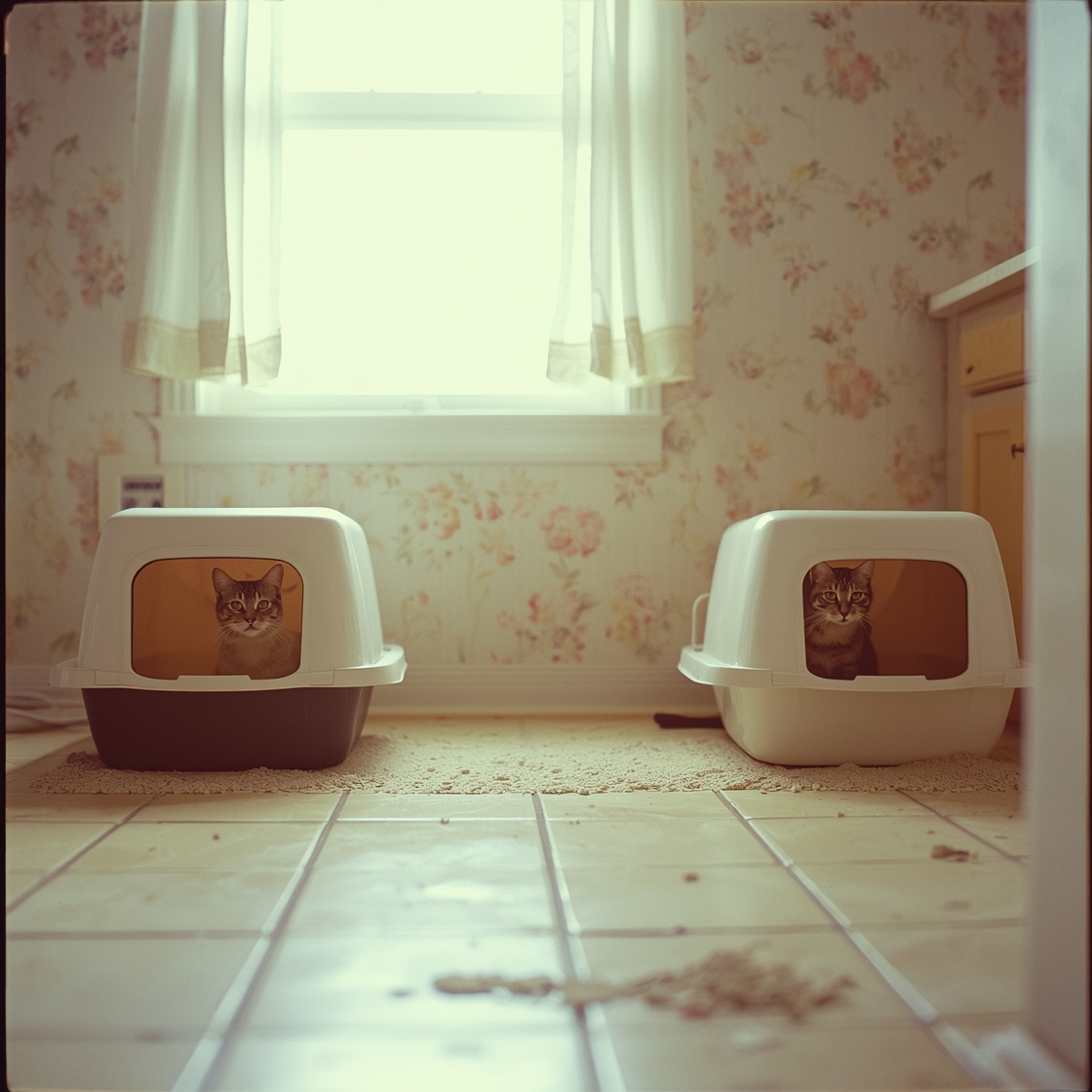
Clumping: daily scoop, longer full-change interval if you are honest with the scoop. Non-clumping: cheaper bags sometimes, more full changes, smell if you stretch it. Multi-cat homes that skip scooping lose either way. Prefer clumping if you will do the chore. Prefer a different format only if texture or dust forced a class change — and keep box count.
Maintenance that actually moves odor
Depth. 2.5–3 inches. A thin bed smears. A mountain tracks.
Scoop. Once daily minimum. Twice in a closed bathroom or with two-plus cats.
Lid. Hoods trap ammonia in the cat’s face. If you need a lid for dog-raiding, scoop more, not less.
Air. A bathroom with no fan is an odor chamber. Move a box or run the fan. Do not spray the box with cleaner scent.
Full change. When the leftover bed is dusty, yellow, or smells after a fresh scoop. Often 2–4 weeks per box if you scoop; sooner with volume.
Trash. A sealed pail helps you. It does not help the cat if the box is still wet.
Kittens, seniors, and the clinic
Kittens eat litter. Clumps are an obstruction conversation. Ask the veterinarian. Seniors may miss or dribble; a low box of the same odor-control formula beats a scented high-sided tray they will not climb. Sudden ammonia plus straining or blood is Cornell’s medical sentence, not a charcoal upgrade.
Flush, septic, and the plant cards
World's Best and sWheat Scoop print flushable language. Many cities still say cat feces stay out of toilets (parasites, including Toxoplasma conversations on public-health pages). Septic tanks are not a marketing department. If you cannot flush, you still bought a lighter bag and a different clump. That can be enough.
21-day odor log (one variable)
| Day | Allowed change | Stop |
|---|---|---|
| 0 | Photo box; note scoop habit | — |
| 1–7 | Scoop 2×, same litter, add depth | Blood / strain → clinic |
| 8–14 | Add a box or switch additive class, not both | Boycott → revert |
| 15–21 | Keep the quieter setup | Do not perfume a win |
The best clumping cat litter for odor control is the one that is quieter after this log, not the one with the longest printed clock.
Hoods, gels, and the products that are not litter
A hood traps ammonia next to the cat’s nose. If you need a hood because a dog raids the box, scoop twice and consider a gate. Do not add a scented bead on top of Platinum and call it a system.
Room gels, candles, and “pet odor” sprays treat the human nose. They do not bind urea in the tray. If the box is right, the room gets quieter. If the box is wrong, the candle is a cover story.
Baking soda sprinkled on Ultra is a common keeper hack. It can also change texture and dust. This desk will not bless a DIY mix. If you want baking soda in the formula, that is the ARM & HAMMER card.
Closed bathrooms, apartments, and HVAC
A studio with one box in the only bath is an odor design problem. Add a second box in a closet with a night-light if you must. Run the fan. Crack the door. Clay in a sealed room will smell like clay and ammonia no matter which charcoal logo you bought.
If the HVAC return sits over the box, you are broadcasting. Move the box or add a filter change — that is house maintenance, not a litter review.
Summer humidity keeps clumps wet longer. Scoop sooner. Winter dry air makes pour dust worse. Bin pour.
Cost per week of actual odor control
Desk arithmetic from the tiles, one cat, honest scoop, one extra box.
| Card | Tile | Desk story |
|---|---|---|
| Ultra 40 lb | $25 | Lasts longer per dollar if clumps lift clean |
| Platinum 27.5 lb | $25 | You pay for seal + scent; still scoop |
| Fresh Step 18.5 lb | $16 | Smaller bag; more trips; charcoal |
| World's Best 28 lb | $32 | Stairs win; cash loses |
| sWheat 25 lb | $21 | Mid cash; mid clump hardness |
Two cats roughly doubles burn if you keep n+1 and scoop. It more than doubles smell if you keep one box.
Transition week without a boycott
Change one variable. Mix old and new only if both are the same class (clay into clay). Do not blend wheat into bentonite. Keep the old box online. If the cat toilets beside the new tray, revert. A boycott is data. A 14-day clock is not.
World's Best unscented after Ultra is a texture change. Give a full extra box of corn and leave Ultra up. Lavender World's Best (sister URL) is a texture and a scent change. Do not do both on an odor-problem week.
Mechanical scoops and “clump speed”
Maker pages sometimes print a minutes-to-clump line. We will not publish a PetBench stopwatch. If you scoop immediately after a visit, even Ultra can smear. Give the bed a few minutes. If you wait until tomorrow, wheat can fall apart. That is the practical window: not instant, not tomorrow.
Sifting scoops reward hard clay. They punish soft wheat. Match the tool to the card.
We will not say we measured ammonia parts-per-million. We will not say Platinum “wins” a 14-day test We will not say charcoal is medically better for airways. We will not say flushable corn is legal on your street.
We will say: remove the wet, unscented first, boxes if volume, plant if you will pay and store it. The Odor-Clump Tally is a listing map. Your scoop habit is the control.
Counterfeit, stale bags, and subscription traps
A 40 lb Ultra that arrives as fine gray powder and smells sour is a return. Store clay off a wet basement floor. Plant bags dated and clipped.
A subscription that auto-sends Platinum when you already have two unopened boxes is how scent piles up. Pause it. Odor control is not “more bags in the closet.”
Closing
The best clumping cat litter for odor control is the clumper you remove on time. Ultra is the unscented default on this card set. Platinum, Fresh Step, World's Best, and sWheat Scoop are additive or plant forks. A printed clock is a slogan. Browse odor-control clumping litter →
Odor is a chore before it is a chemistry. The five cards are five ways to bind liquid. They are not five trophies. A quiet box is a clump in the trash, air that moves, and a cat that still enters. A loud bag is optional. Keep the formula that already works unless dust or texture forced a class change. Then scoop like you mean it. That is the whole page in one line. If the box is already Ultra, three inches, scooped twice, and the room still bites, add a box before you add charcoal. If the cat has left the box, read Cornell before you read a 14-day guarantee. If you live in a studio, air is a product: fan, door, second station. If you live with two cats, n+1 is a product. Fresh Step’s $16 tile is a good charcoal budget only if the cat will enter a scented clay. World's Best is a good plant only if you will pay and store it. sWheat Scoop is a good enzyme story only if you scoop before the clump collapses. Platinum is a good seal story only if you accept perfume. None of those sentences are a lab ranking. They are chore matching. Odor is urine plus time plus air. Take the urine out. Leave the perfume on the shelf until the chore is honest.
How we researched this guide
The PetBench desk compared the five live cards, tile prices, bag sizes, and a 24-listing Odor-Clump Tally of additive words, day-counts, and unscented flags. We read Cornell house-soiling and AAFP/ISFM resource language. $/lb figures are desk arithmetic from tiles, not a checkout quote.
Nothing here is a clinical endorsement.
Frequently asked questions
What is the best clumping cat litter for odor control?
The unscented hard clumper you will scoop — on this URL, Dr. Elsey's Ultra is the default. Platinum, Fresh Step, World's Best, and sWheat Scoop are additive or plant variants. Scoop and box count beat a 14-day clock.
Scented or unscented for the best clumping cat litter for odor control?
Unscented first. Scented bags smell like the aisle. They can evict a cat and hide a skip-day. If humans need a “clean” smell, scent the room, not the substrate.
How often should I change clumping litter?
Scoop daily. Full refresh when the bed is thin or smells after scooping — often every 2–4 weeks, sooner with more cats. Do not wait for a printed guarantee.
Can clumping litter be used for kittens?
Only with a veterinarian’s input. Ingestion risk is real. This desk will not invent an age cutoff.
Are there health risks with clumping clay?
Dust bothers some humans and cats. Ingestion of clumps is a kitten/vet topic. We are not a clinic. If anyone in the home is coughing at every pour, change pour height or material class.
Does scented litter control odor better?
It controls your first impression. It does not remove urea. Removal does.
Is clumping litter safe for multi-cat households?
Yes as a class if you scoop and provide boxes. See the multi-cat clumping guide. One box of Platinum for three cats is still one box.
Which clumping litter is best if I want a natural or flushable option?
World's Best unscented (corn) or sWheat Scoop (wheat) on this card set. Read local flush rules. Store sealed.
Is clumping cheaper than non-clumping for odor?
Per pound, cheap non-clump can look cheaper. Per month, extra full changes and a dirtier room often erase that. Ultra at ~$0.63/lb on the 40 lb tile is the cash benchmark on this page.
Why does the box smell even when I use the best clumping cat litter for odor control?
Usually: thin bed, skipped scoop, one box for two cats, a lid with no air, or a medical soiling problem. Rarely: a “wrong” bag among these five. Fix chore and box count before you hop from Ultra to Platinum to wheat in the same week.
Do I need probiotics in the litter?
sWheat Scoop’s enzyme story is wheat chemistry, not a clinical probiotic protocol. We will not treat the box as a gut supplement. If a bag prints “probiotic,” read it as marketing unless a veterinarian told you otherwise.
Can I use these formulas in a robot box?
Many robots list compatible clumpers. Ultra appears often; plant litters can gum sensors. Confirm the manual. Keep an open backup of the same substrate so a jam is not an accident on the rug.
How do I compare cost between clumping and non-clumping for odor?
Price the month, not the bag. Count full changes. A $12 non-clump that you dump twice a week can beat a $25 Ultra that lasts three weeks — or lose, if the non-clump smells on day two. The Odor-Clump Tally does not score non-clump. This URL assumes you will scoop a clump.
Sources
- Cornell University College of Veterinary Medicine, Feline Health Center. “Feline Behavior Problems: House Soiling.”
- Ellis et al. AAFP/ISFM Feline Environmental Needs Guidelines. J Feline Med Surg. 2013;15:219–230.
- Carney et al. AAFP/ISFM Guidelines for Diagnosing and Solving House-Soiling Behavior in Cats. J Feline Med Surg. 2014;16:579–598.
- Public-health notes on cat feces and toilets (local rules vary).
- Maker pages and retailer listings for the five cards above.
Last reviewed: August 2026. Contact if a bag size is stale.