Our guides are reader-supported. This article may contain affiliate links. As an Amazon Associate we may earn a commission if you buy through links, at no extra cost to you.
Quick answer: The best cat carrier for travel is the bag that matches the trip, then the cat, then the space. Cabin: a compressible soft bag whose packed exterior fits that aircraft’s under-seat well and still lets the cat sit, stand, turn, and lie. Car: a closed carrier that cannot slide — a seat-belt loop is a slide-stop, not a crash rating, unless the maker publishes a crash standard. Cargo: a rigid, labeled kennel. Airlines approve a booking, not a hangtag.
across 8 major US airline public pet pages we opened, 8 of 8 required the pet to stay inside the carrier for taxi, takeoff, and landing; 0 of 8 treated an Amazon “airline approved” badge as binding; 5 of 8 published an under-seat size that still said “confirm aircraft.” IATA’s passenger PDF states it does not certify, approve, or endorse any commercial cat container.
This is a research-desk explainer. Read the current airline page, measure the cat, measure the space, then pick a bag.
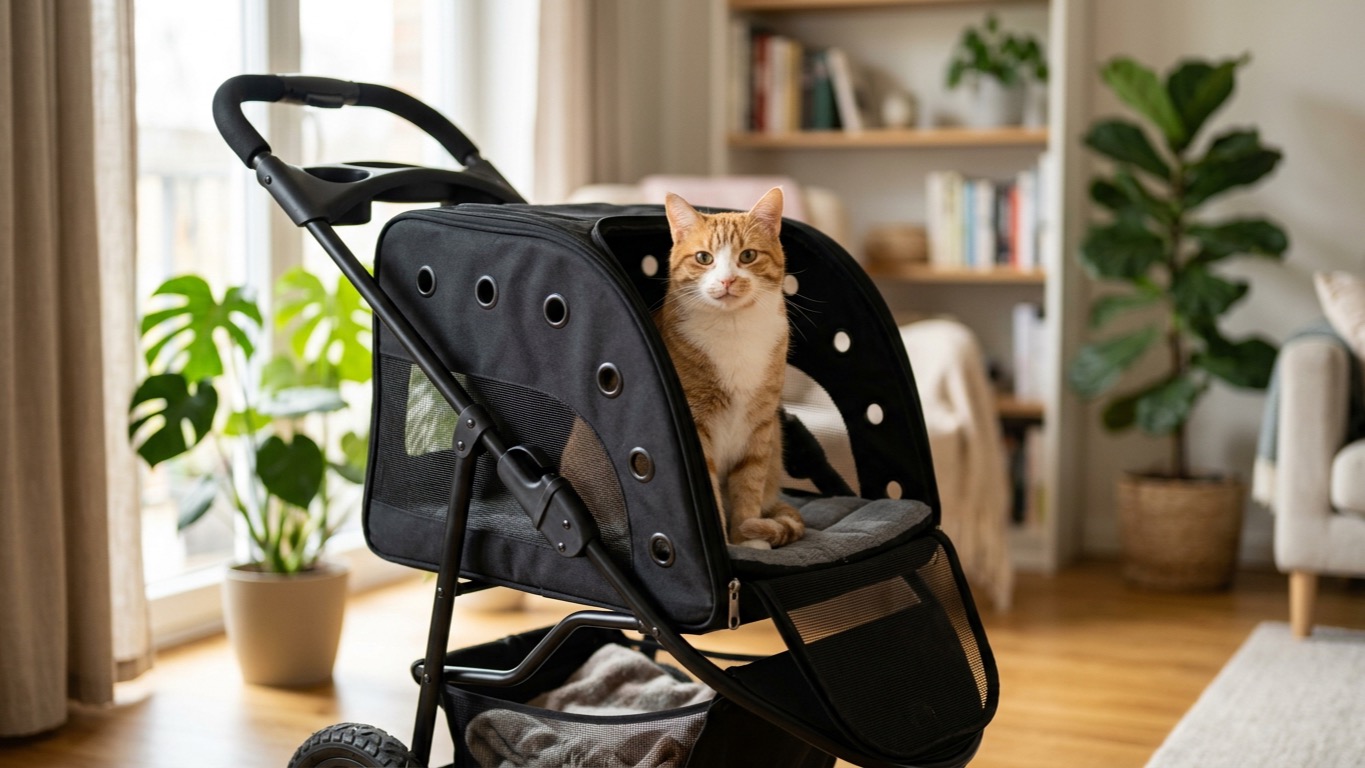
If you need wheels through a terminal, see the wheeled-carrier guide. For a city walk, a cat stroller is a different product. Backpacks live on the ventilated cat-backpack page.
How to choose the best cat carrier for travel (four steps)
Do this in order. Buying a “best” bag first is how people end up at a gate with a backpack that will not go under the seat, or in a car with a tote that slides off the back seat.
- Name the trip. Vet and errands, a car ride, an in-cabin flight, cargo or checked-pet travel, and a hands-free backpack walk are different jobs. One bag rarely does all of them well.
- Measure the cat. Standing naturally: nose to base of tail, floor to ear tip (or head, whichever is higher), shoulder width, weight. Sherpa’s FAQ measures height to the top of the back for its soft bags and says those bags are meant for a pet to lie down, with enough room to stand and turn. IATA’s cabin guidance is stricter: can the cat sit erect, stand erect, turn around, and lie down in a natural position? A bag that fits under a seat but pins the cat in a crouch is the wrong bag.
- Measure the space. For a cabin flight, that is the under-seat well on the aircraft you booked — not a blog’s composite inch chart. For a car, that is the seat or floor plus how you will keep the bag from sliding. For cargo, that is a rigid kennel sized so the cat can stand, sit, turn, and lie.
- Then pick a bag. Secure closures, ventilation that still works when the bag is pushed back or belted in, a leak-proof base, and a size the cat can actually use.
If the cat is sick, injured, short-nosed (Persian, Himalayan, exotic), or a poor traveler, ask whether the trip should happen at all. The American Veterinary Medical Association (AVMA) says brachycephalic pets are more at risk of overheating and breathing problems during travel — especially air travel — and that boarding or a sitter can be safer when the trip is optional.
What the FAA and IATA actually say
The FAA does not publish a universal cabin-pet inch chart and does not bless brands. Its “Flying with Pets” page (last updated 4 December 2025; fetched 20 August 2026) is explicit: each airline decides whether cabin pets are allowed. If the airline allows them, the container is carry-on baggage and must follow 14 CFR 121.589. It must fit under the seat without blocking anyone’s path to the aisle; it must be stowed before the last passenger door closes, or the airplane cannot leave the gate; and it must stay stowed while the airplane is moving on the airport surface and for takeoff and landing. Follow the flight attendant. Airlines commonly add species lists, cabin-pet caps, a closed-container rule, and a health certificate. Service animals are not pets and, under DOT rules (14 CFR part 382), are not required to ride in a container.
IATA writes standards. It does not run a product-approval shop. Its passenger PDF, “Guidance for Passengers Traveling with their Dog or Cat in the Cabin,” states this in plain language: IATA does not certify, approve, sell, or otherwise endorse any commercial dog or cat travel container. It publishes Container Requirement 1 (CR1). Airlines may reject a container that fails those standards or their own, stricter, policy. Soft cabin bags and rigid cargo kennels are different rules. A hangtag that says “IATA approved” is marketing.
That cabin guidance is still a useful welfare checklist. A cat in the cabin must be in a container that fits under the seat, or another place the airline specifies. Soft-sided bags may compress — and IATA warns that compressing vents can trap heat. IATA asks whether the animal can sit erect, stand erect, turn around, and lie down naturally; whether at least 16 percent of the area on the four vertical sides is ventilation; and whether the container is escape-proof and leak-proof, with absorbent bedding. Cats must not be taken out during the flight. IATA advises against sedation; if a veterinarian directs otherwise, tell the airline. Unweaned animals and animals under 8 weeks must not travel under this guidance. A health certificate is required for international travel.
IATA’s CR1 sizing formula is for shipping kennels, not cabin under-seat space. Do not buy a hold kennel and expect it to slide under seat 14C. Do not treat a composite “18-inch IATA limit” as a real number.
For booking the pet slot and measuring the well, use our airline pet-carrier explainer.
Car: a loop is a slide-stop, not a crash rating
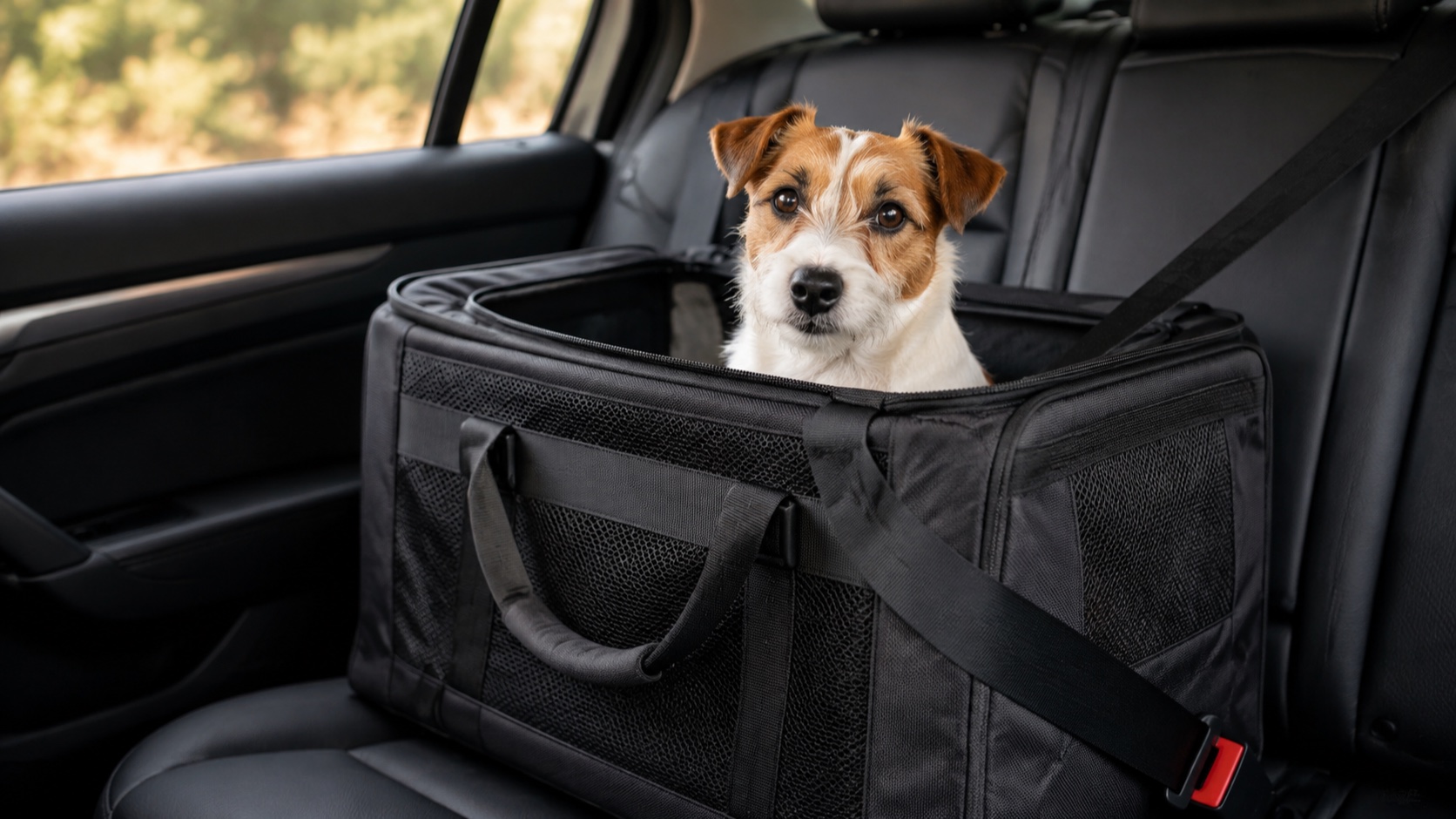
A carrier on a car seat is not a crash-tested car seat unless the manufacturer publishes a crash standard and you install the product the way that test used it. Most soft bags include a luggage strap or seat-belt pass-through so the bag does not slide off the seat on a gentle stop. That is not a child-seat equivalent.
Sherpa’s FAQ is unusually plain. After telling you how to route a lap or shoulder belt through the luggage strap, it warns that the product is not crash tested and is not intended to secure your pet in a collision or a sudden stop. Treat every unnamed “seat-belt compatible” tote the same way unless you can fetch a real crash-test claim for that model.
We did fetch one. Sleepypod sells the Sleepypod Air and the Sleepypod Atom as crash-tested travel carriers and says they are independently verified by the Center for Pet Safety. On the pages we fetched on 20 August 2026, Sleepypod publishes a 30 mph crash-test claim for both, a 4-star CPS mark for the Air, and a 5-star CPS mark for the Atom. Those are car-safety claims, not an airline certificate. There is no U.S. legal crash standard for pet restraints the way FMVSS 213 exists for child seats. Install the carrier the way Sleepypod specifies.
Never let a cat ride loose on a lap or on the parcel shelf. A closed carrier that cannot slide is the baseline. A published crash-tested carrier is a step above that.
Cabin versus cargo — do not mix the boxes
If the cat is small enough, and the airline accepts cabin cats on that flight, the usual tool is a soft-sided bag that still has an air path when it is pushed under the seat. Soft fabric can give a little. That same give can collapse vents. Look for a frame that stays off the cat, mesh that is not sealed shut when the rear is compressed, and locking zipper sliders. Sherpa defines “airline approved,” on its FAQ, as ventilation, a leak-proof base, and a bag that safely encloses the pet — with sizing as the exception, because sizing is airline-specific.
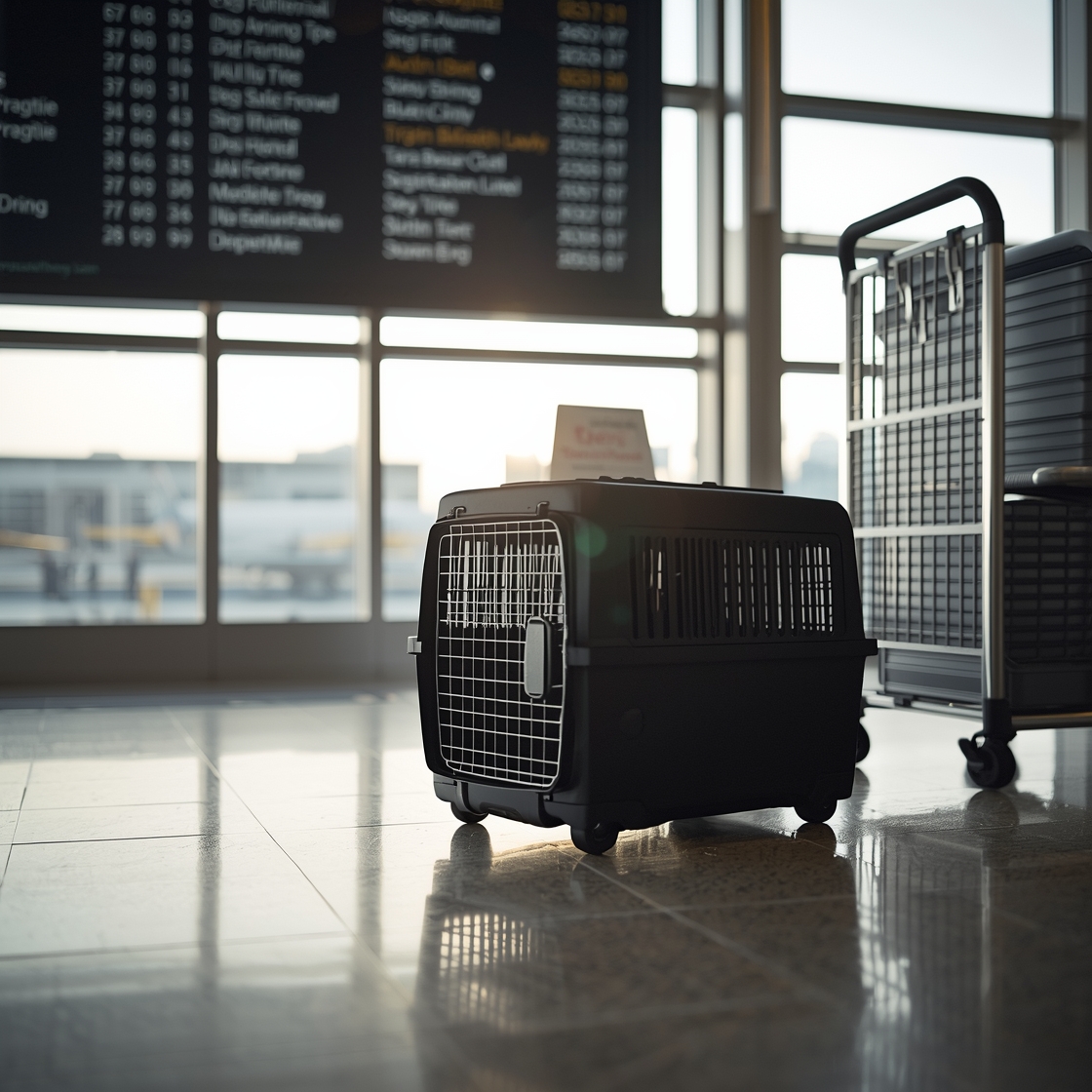
If the cat cannot sit, stand, turn, and lie in a bag that still fits under the seat, this is not a cabin trip. Cargo or a checked-pet program — where the airline still offers one — is a rigid kennel job. IATA CR1-style hold kennels are hard-sided, leak-proof, ventilated on four sides, and labeled. Soft mesh totes are the wrong object for the hold. Wheels on a cargo kennel must be removed or rendered inoperable under IATA’s published CR1 language. Many U.S. passenger airlines have narrowed or closed civilian checked-pet programs. Confirm the current path before you buy a giant crate “for the plane.”
AVMA’s travel page: a Certificate of Veterinary Inspection for air travel is typically issued within 10 days before the flight, signed by a federally accredited veterinarian. That is AVMA’s published timing, not a universal 48-hour rule. If the cat is going in the hold, ask whether the airline also wants a health-and-acclimation statement. Destination countries set their own import rules; start months ahead for international moves.
Currently sold bags — manufacturer claims, not a ranking
The names below are products we opened on a manufacturer site on 20 August 2026. Figures are what those makers published that day, not a finding that a bag “meets United / Delta / American.” Measure the unit you receive and compare it to the trip you booked.
Sherpa Original Deluxe Pet Carrier
The primary cabin-and-vet example on this page: a quilted soft bag with a patented spring-wire frame that lets the rear be pushed down several inches, mesh panels, locking zippers, a waterproof interior base, top and side entry, a washable faux-lambskin liner, and a luggage strap that doubles as a seat-belt pass-through. Size from the pet’s measurements first, then weight. Small and medium sizes are in Sherpa’s Guaranteed On Board program — a manufacturer refund scheme for listed domestic U.S. and Canada flights if boarding is denied because of carrier size, with a long list of voids. Not every GOB size is guaranteed on every airline. The Large is often too tall for cabin use; check the airline, not the hangtag.
SturdiBag Pro 3.0
Sturdi, a Gig Harbor maker that has sold flex-height bags since 1993, publishes a rod design that compresses to fit under most airline seats. Manufacturer figures as of 20 August 2026: Small 18 in deep × 10 in wide × 9.25 in high (25 lb chart limit); Medium 15 × 12 × 11.75 in (25 lb); Large 18 × 11.5 × 11.5 in (30 lb). Sturdi’s own copy says the bag is intended for in-cabin travel on most major airlines excluding XL and XXL. Those inches are manufacturer numbers, not a gate measurement.
Sleepypod Air
Use this when the car ride is the hard part and you want a published crash-test claim. The Air is the expandable cabin-and-car bag: Sleepypod says it compresses under a seat, then springs back. Ask the airline how it treats expandable bags. CPS rating, as Sleepypod publishes it, is a car claim. It does not replace the FAA stowage rule.
Sleepypod Atom
The smaller crash-tested shell. Sleepypod’s FAQ says most airlines accept it for in-cabin travel and that you should still contact the airline first. Sleepypod publishes a 5-star CPS mark for the Atom on the page we fetched. Car claim. Not an IATA certificate.
Petmate Vari Kennel
The hard-sided example for cargo, housebreaking, or a car floor — not a cabin under-seat bag. Petmate sells 19, 24, 28, 32, 36, and 40 inch shells, made in the U.S. from EcoTEC plastic with a stated minimum of 90 percent pre-consumer recycled content. Interior dimensions we fetched: the 19-inch shell is 16.2 × 12 × 9 in inside (up to 10 lb); the 24-inch is 21.5 × 15 × 13.5 in (10–20 lb). Petmate lists a squeeze-latch wire door, side and back vents, an interior moat, zip-tie holes, and wing nuts that it says are required for airline travel. “Meets most air travel requirements” is Petmate’s language. Contact the airline. Size so the cat can stand, turn, and lie.
Want to browse current listings? See cat carriers for travel on Amazon →
Backpacks: hands-free on the ground, rarely a cabin bag
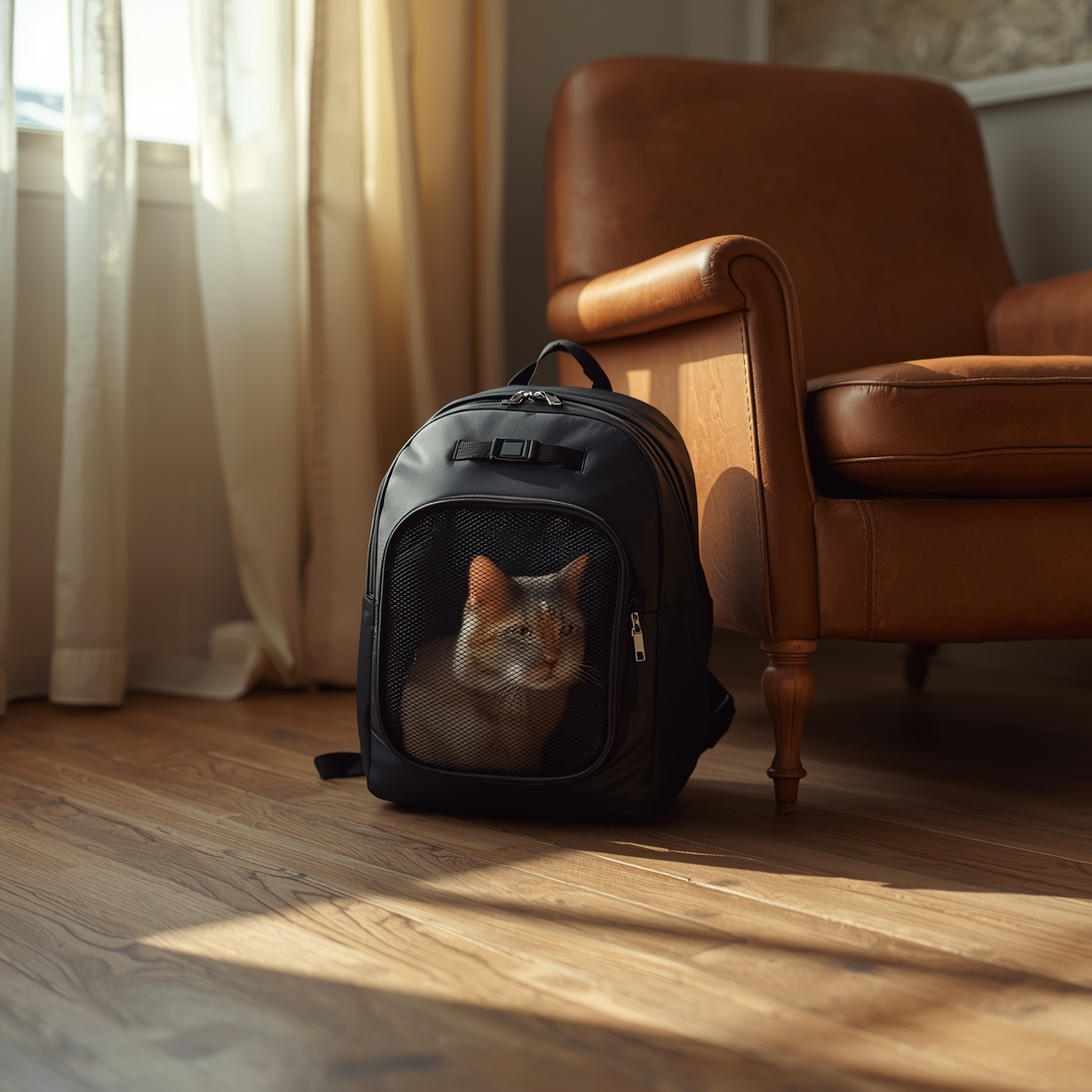
A backpack is a walking tool. Most are taller than they are long. A 17-inch-high pack will not go under a typical U.S. mainline seat even if a listing says “airline approved.” Treat backpacks as errands, trails, and terminal walks — then transfer the cat into a cabin bag if you are actually flying.
PetSafe’s Happy Ride Backpack Pet Carrier is a currently sold example on petsafe.com: polyester and nylon, fiberglass rods, mesh windows, an interior harness tether, a seat-belt loop, and a maker limit of 20 lb. PetSafe publishes about 12 × 13 × 17 inches. That geometry is a backpack, not an under-seat tote. The seat-belt loop is a slide-stop unless PetSafe publishes a crash standard for this model —
If the cat hates being worn, use a stroller.
Papers, sedation, and a calm cat
There is no universal “vet visit 48 hours before the flight” rule we can source as a single requirement.
AVMA’s travel page: confirm the cat is healthy enough to travel; keep rabies vaccination current; and get a Certificate of Veterinary Inspection from a federally accredited veterinarian when you cross state or national lines (typically within 10 days before air travel). Identification tags and a current microchip registry are worth doing before any trip. For international export from the United States, USDA APHIS is the federal path.
Sedation is not a travel hack. AVMA: consult your veterinarian before giving tranquilizers or sedatives; they can increase the risk of heart or respiratory problems and generally are not allowed by airlines. IATA says the same. If a veterinarian directs medication for a medical reason, get it in writing. We are not that veterinarian.
IATA suggests introducing the cat to the container well before the journey, a light meal at least two hours before the flight, a short drink and exercise immediately before crating, and absorbent bedding in a clean, leak-proof bag. Pack proof of vaccination, records, a recent photograph, a leash, food, water, and a small first-aid kit you already know how to use. TSA’s public checkpoint rule is process, not a brand list: take the cat out, send the empty carrier through the X-ray, keep control of the cat on a leash, and never put the cat through the tunnel. If the cat cannot do the flight without being taken out, this is not a cabin-pet itinerary.
Best cat carrier for travel tables
Airline public pages and maker specs — not a gate test.
Table 1 — Trip type × bag class
| Trip | Prefer | Avoid | Why |
|---|---|---|---|
| Cabin flight | Soft bag with documented exterior inches + a frame that stays off the cat | Fashion backpacks; expandable bags stuffed to the listing photo | Under-seat envelope is the constraint |
| Car miles | Closed carrier + belt path; CPS-published crash claim if you want that step | Loose lap cat; “seat-belt compatible” with no crash page | Loop ≠ FMVSS 213 |
| Cargo / checked pet | Rigid CR1-style kennel, wheels off, labeled | Soft mesh tote | Hold rules are not cabin rules |
| Vet / errands | Soft bag the cat already treats as furniture | Brand-new bag on appointment morning | Novelty stacks on fear |
| Trail / transit walk | Backpack with chest strap + interior tether | Using that pack as the cabin bag | Height kills under-seat odds |
Table 2 — Cabin footprint bands (desk checklist)
| Exterior L×W×H (in), packed | Typical story | Desk action |
|---|---|---|
| ≤17×10×9 | Conservative under-seat | Strong default for many US mains |
| 17–18×11×10 | Borderline | Confirm airline + seat type + aircraft |
| >18×12×11 | Often gate-check risk | Soft cabin bag was the wrong class |
| Soft pack “expands” | Listing lies when stuffed | Measure with pad + cat mass |
| Backpack 12×13×17 | Walking geometry | Transfer before boarding |
Table 3 — Maker claims we actually opened (20 Aug 2026)
| Product | Maker claim we fetched | What it is not |
|---|---|---|
| Sherpa Original Deluxe | Spring-wire compress; GOB refund on listed flights; strap not crash-tested | A boarding right |
| SturdiBag Pro 3.0 | Published Small/Med/Large inches; in-cabin intent excluding XL/XXL | A gate measurement |
| Sleepypod Air | Compresses then springs; 30 mph / 4-star CPS as Sleepypod prints it | An airline certificate |
| Sleepypod Atom | Smaller shell; 30 mph / 5-star CPS as Sleepypod prints it | IATA approval |
| Petmate Vari Kennel | EcoTEC shells; wing nuts “required for airline travel” on their page | A cabin under-seat bag |
Table 4 — Paperwork clock (AVMA / USDA / IATA language)
| Document | Who prints the timing | Desk note |
|---|---|---|
| Certificate of Veterinary Inspection | AVMA: typically within 10 days before air travel | Not a universal 48-hour myth |
| Rabies + ID / microchip | AVMA travel page | Do it before any trip |
| International export | USDA APHIS | Start months ahead |
| Sedation letter | Only if a veterinarian directs it | Airlines generally disallow OTC tranquilizers |
| Airline pet slot | The airline, not IATA | Booking ≠ hangtag |
Table 5 — 7-day acclimation ladder
| Day | Goal | Duration |
|---|---|---|
| 1 | Open bag as furniture | Free access |
| 2 | Treats inside, door open | 5 min |
| 3 | Brief zipper close | 1–2 min |
| 4 | Short indoor carry | 5 min |
| 5 | Hallway walk | 5–8 min |
| 6 | Car practice, bag belted | 10 min |
| 7 | Full dry-run with harness clip if the bag has one | 15 min |
Skipping acclimation is the most common reason owners call a best cat carrier for travel a failure — the product may be fine while the cat was never trained to it.
Frequently asked questions about the best cat carrier for travel
What is the best cat carrier for travel?
There is not one. A vet-and-car bag, a cabin bag, a cargo kennel, and a backpack are different products. For most small cats on a booked cabin flight, a compressible soft bag such as the Sherpa Original Deluxe or a SturdiBag Pro 3.0 in a size that still lets the cat sit, stand, turn, and lie is the usual starting point. For a lot of car miles, look for a published crash-test claim (Sleepypod Air or Atom, as those makers and CPS describe them). For cargo, use a rigid kennel such as a correctly sized Petmate Vari Kennel. Measure first.
Is there one best cat carrier for travel that works on every airline?
No. Measure the under-seat space on your aircraft and the cat’s sitting height. A soft carrier that fits a 12 lb cat may fail a 16 lb cat in the same bag.
Do I need an “airline-approved” or “IATA-approved” brand?
No. IATA says it does not certify or endorse commercial containers. The FAA regulates how a cabin pet container is stowed and leaves cabin-pet acceptance to the airline. “Airline approved” on a hangtag means the brand hopes its published size is close to a policy it read once.
Is a seat-belt loop enough in the car?
It is enough to reduce sliding. It is not a crash rating unless the manufacturer publishes a crash standard for that model and you install it that way. Sherpa states its strap is not crash-tested. Sleepypod publishes CPS-verified crash tests for the Air and Atom.
Can I use one bag for cabin and cargo?
Not as a default. Cabin bags compress into a footwell. Hold kennels follow IATA CR1-style rigid, labeled, leak-proof shipping rules.
How do I keep a cat calm in a carrier?
Acclimate for weeks, not the night before. Leave the bag out, feed in it, and practice the security lift. Do not add an over-the-counter sedative because a blog said so.
Can a brachycephalic cat fly in the cabin?
AVMA flags extra heat and breathing risk, especially in air travel. Some airlines restrict short-nosed breeds. Optional trips may be safer as a sitter week. Ask the veterinarian who knows that cat.
Sources
- FAA, Flying with Pets — https://www.faa.gov/travelers/fly_pets
- IATA, Guidance for Passengers Traveling with their Dog or Cat in the Cabin
- IATA, Live Animals programme — https://www.iata.org/en/programs/cargo/live-animals/
- AVMA, Traveling with your dog or cat — https://www.avma.org/resources-tools/pet-owners/petcare/animal-travel-certificates-regulations-requirements/traveling-your-dog-cat
- USDA APHIS, Pet Travel — https://www.aphis.usda.gov/pet-travel
- Sherpa Original Deluxe + FAQ — https://sherpapet.com/
- SturdiBag Pro 3.0 — https://sturdiproducts.com/
- Sleepypod Air / Atom — https://sleepypod.com/
- Center for Pet Safety, Sleepypod Air and Atom pages
- Petmate Vari Kennel — https://www.petmate.com/products/petmate-vari-kennel
- PetSafe Happy Ride Backpack — https://www.petsafe.com/