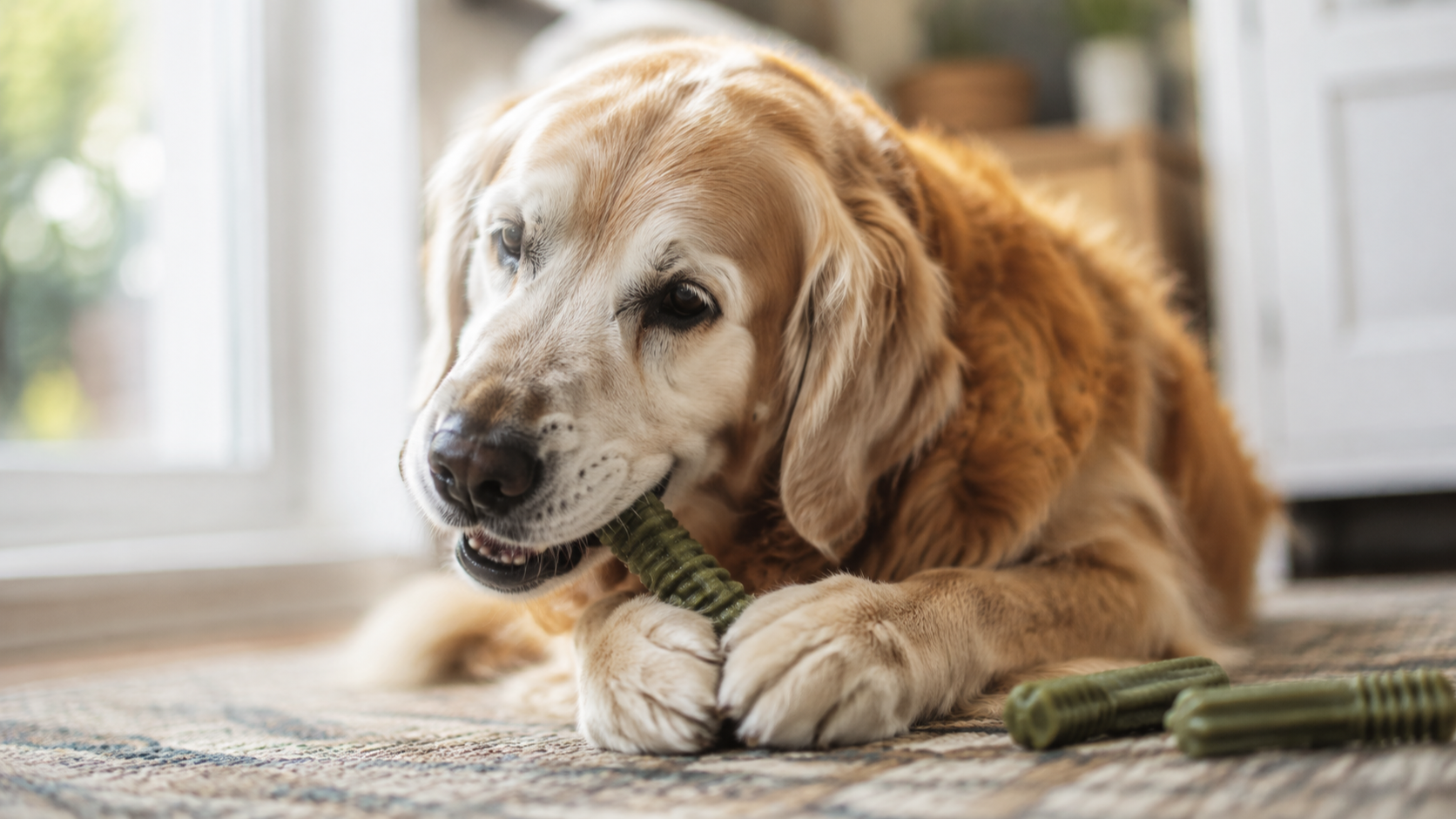
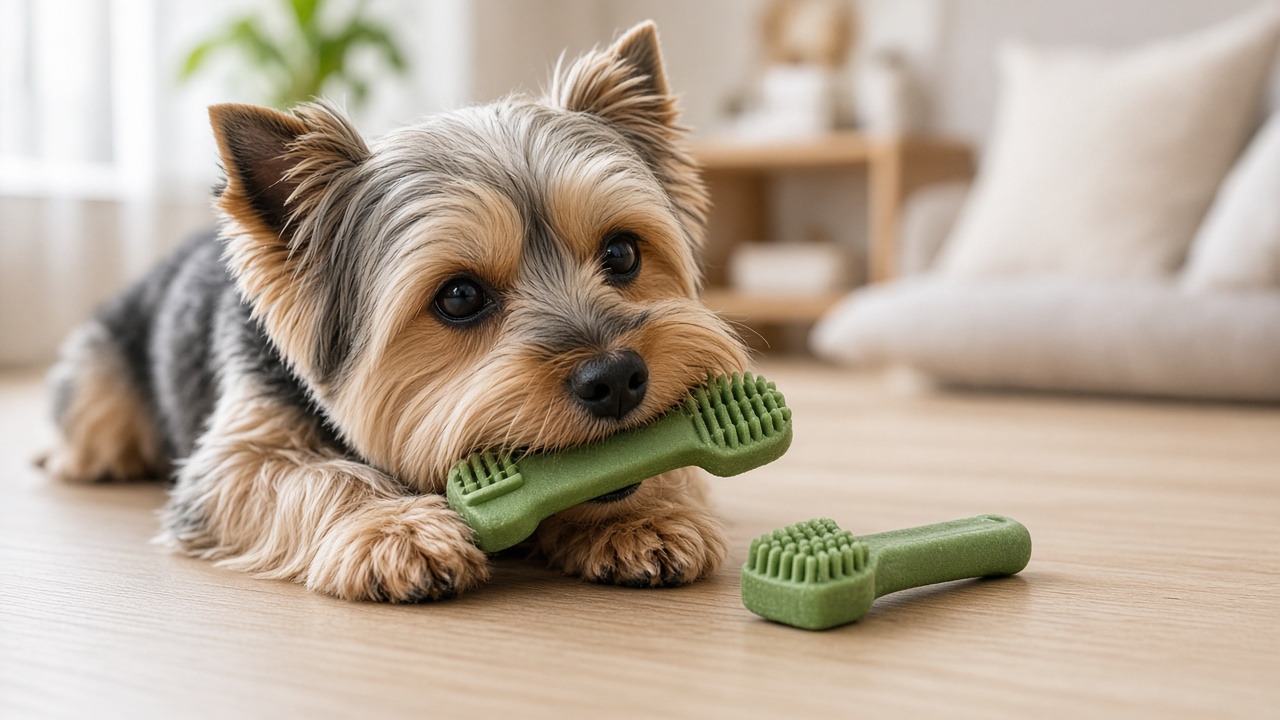
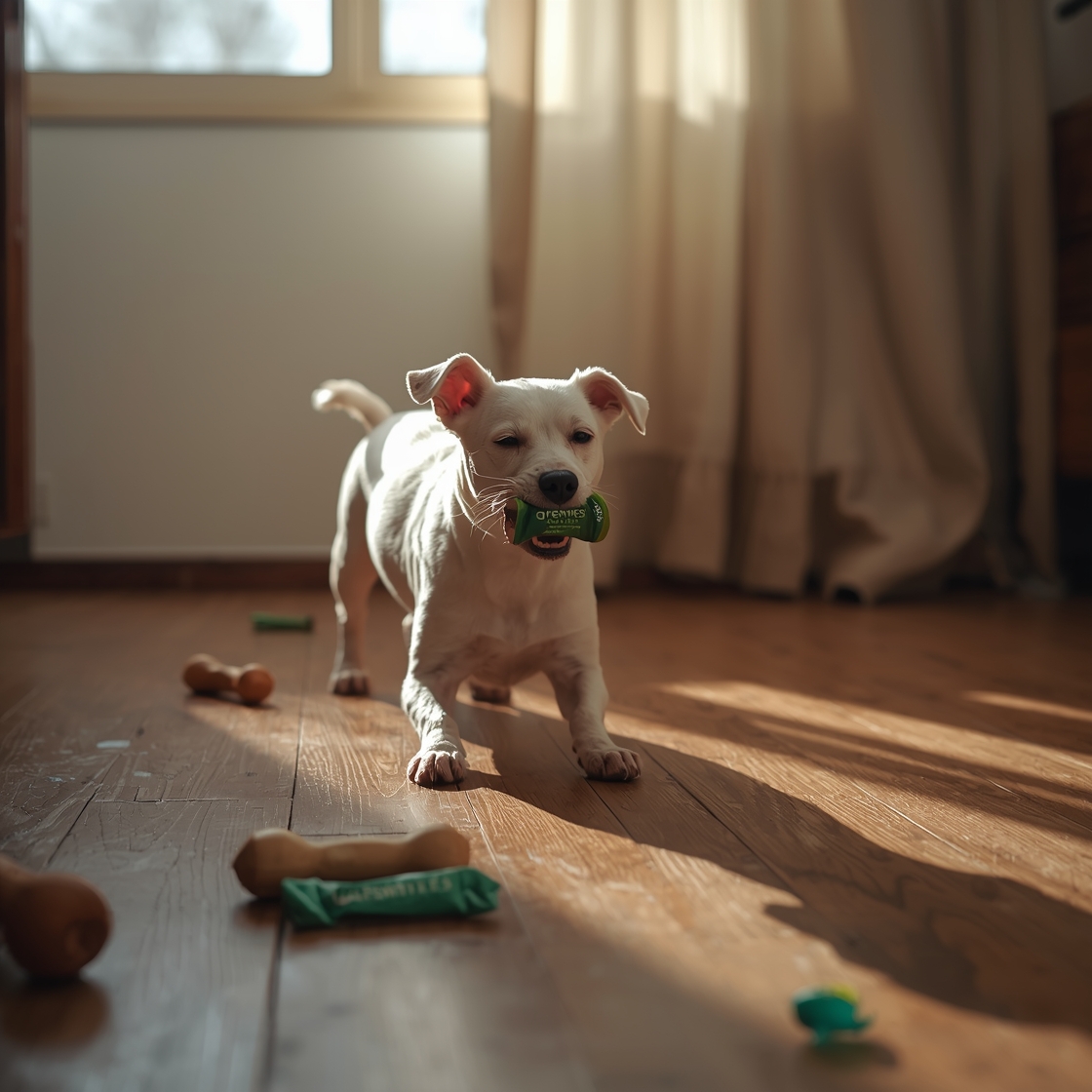
The best dog dental chew for small breeds is a weight-banded, preferably VOHC-accepted chew that flexes instead of snapping, sized so a Yorkie or Chihuahua is not asked to open a Labrador stick. The We read the titles and descriptions of 7 SKUs. 6 of 7 carry a VOHC seal on the public list or maker claim we checked; Pedigree Dentastix Small/Toy does not. Listed bag snapshots ran $7–$30. Maker weight floors: Greenies Teenie 5–15 lb, Milk-Bone Mini 5–24 lb (not under 5 lb), Dentastix Small/Toy 7–22 lb (not under 7 lb). Oversized chews are a fracture risk on toy jaws — that is veterinary dental literature, not a desk trial.
Match the bag’s weight line. Then count the calories against the 10% treat budget. Then brush anyway.
Our guides are reader-supported. This article may contain affiliate links. As an Amazon Associate we may earn a commission if you buy through links, at no extra cost to you.
Senior mouths are a different texture job: dental chews for senior dogs. All-size dental aisle: best dog dental chews. Tiny-breed walking hardware lives on the small-breed harness guide.
Quick picks at a glance
- Best tiny / teacup band (5–15 lb): Greenies Teenie Original — VOHC-accepted, bendable, about 26 kcal, listed $16–$30.
- Best published plaque/tartar figures: Virbac C.E.T. VeggieDent Fr3sh XS/S — Z-shape, plant-based; Virbac publishes about 37% plaque / 70% tartar reduction with daily use (manufacturer study, not ours). Listed $15–$25.
- Best value VOHC daily: DentaLife Small Dog — porous ridges, about 5–20 lb, listed $12–$20.
- Best grain-free longer chew: WHIMZEES Brushzees Extra-Small — toothbrush shape, VOHC, listed $14–$28.
- Best grocery VOHC: Milk-Bone Brushing Chews Mini — 5–24 lb, about 31 kcal, listed $8–$18.
- Lowest cost per chew: Pedigree Dentastix Small/Toy — 7–22 lb, not VOHC-accepted, listed $7–$16.
- Upper small-breed band (15–25 lb): Greenies Petite Original — same formula family as Teenie, listed $16–$30.
This checklist is a completeness score, not a taste test.
| Chew | Maker weight band | VOHC (desk check) | Listed bag | Calories (maker, where printed) | Fit score if wrong size |
|---|---|---|---|---|---|
| Greenies Teenie | 5–15 lb | Yes | $16–$30 | ~26 | Fail if you skip Teenie for Petite on a 6 lb dog |
| Virbac VeggieDent Fr3sh XS/S | XS; Small ~11–22 lb | Yes | $15–$25 | Check bag | Fail if you buy Large for an 8 lb dog |
| WHIMZEES Brushzees XS | Extra-small dogs | Yes | $14–$28 | Higher than soft sticks | Partial on seniors with broken teeth |
| DentaLife Small | ~5–20 lb | Yes | $12–$20 | Check bag | Fail if you break a large stick in half |
| Milk-Bone Brushing Mini | 5–24 lb | Yes | $8–$18 | ~31 | Fail under 5 lb |
| Pedigree Dentastix S/Toy | 7–22 lb | No | $7–$16 | Check bag | Fail under 7 lb |
| Greenies Petite | 15–25 lb | Yes | $16–$30 | Check bag | Fail under 15 lb |
Before you shop: (1) weight band on the bag matches this dog, (2) chew flexes under a thumbnail — rigid bone-like objects are out, (3) calories fit the treat budget. Fail gate 1 and VOHC does not save you.
Why small mouths need a different chew than the dental aisle photo
Dental disease is common. Small-breed dogs are especially exposed because the jaw is compact: less room per tooth, tighter contact points, food packed against back molars. AVMA and typical veterinary-dental client pages treat brushing as the mechanical gold standard. A chew is a supplement that some dogs will actually finish.
The best dog dental chew for small breeds is therefore a size first. A Greenies Petite in a 6 lb Chihuahua is the wrong object even if the formula is the same family as Teenie. Breaking a large stick in half is not a size tier. It is a sharp fragment.
VOHC’s accepted-products list is the independent signal that a plaque or tartar claim met a defined standard. It is not a safety rating for worn teeth. It is not a calorie rating. It is not a “this dog liked it” rating. Six of the seven cards on this page sit in the VOHC-accepted class on the checks we ran; Dentastix Small/Toy does not. Re-open vohc.org before you treat a 2026 listing as frozen.
What
How we compared the best dog dental chew for small breeds
Four desks. No durometer. No replica teeth.
| Desk | What we opened | What We do not reprint it as a PetBench measurement.
Size and calorie desk for the best dog dental chew for small breeds
| Dog size | Chew width heuristic | VOHC | Calories / chew (desk band) |
|---|---|---|---|
| Under 10 lb | About 0.75–1 in; Teenie / XS only | Look for the seal | 15–30 |
| 10–20 lb | About 1–1.5 in | Preferred | 30–50 |
| 20–25 lb | About 1.5 in; Petite band | Preferred | 50–70 |
| Chew type | Sessions / week (maker typical) | Supervision | Stool watch |
|---|---|---|---|
| Daily VOHC stick (Greenies, DentaLife, Milk-Bone) | Daily if the bag says daily | Until the piece is gone | Greasy stool = cut back |
| Longer plant chew (WHIMZEES) | Daily or as labeled | Always — firmer | Add to calorie budget |
| Grocery non-VOHC (Dentastix) | Daily if you accept no seal | Until softened | Fast disappearance is not “more cleaning” |
Treats should stay near 10% of daily calories. A 26 kcal Teenie on a 7 lb dog is a real slice of the day. Subtract it from dinner.
The 7 cards on this URL
1. Greenies Teenie Original Dental Dog Treats
Best for: the all-around tiny-band pick for dogs about 5–15 lb.
Greenies is the dental-treat name most listings lean on. Teenie is the size that actually matches teacup and toy mouths. Maker notes: rawhide-free, bendable texture, designed for once-daily use, VOHC-accepted for plaque and tartar control, about 26 calories. That calorie number matters on a 7 lb dog.
The honest drawback: an enthusiastic chewer finishes Teenie in seconds. It is a daily dental treat, not a 20-minute occupation. Grain/wheat base — skip if that is your dog’s problem. Grain-free job on this page is WHIMZEES or VeggieDent.
Check Greenies Teenie listings →
2. Virbac C.E.T. VeggieDent Fr3sh Tartar Control Chews (Extra Small / Small)
Best for: owners who want a vet-channel chew with published figures.
VeggieDent uses a Z-shape meant to increase grip and scraping on back teeth. Plant-based, no animal proteins, added prebiotic on typical panels. VOHC-accepted. Virbac publishes clinical reduction figures of roughly 37% plaque and 70% tartar with daily use — those are manufacturer numbers. Extra Small for the smallest dogs; Small for about 11–22 lb.
The honest drawback: higher cost per chew than grocery bags, and some dogs ignore veggie flavor. That is a palatability problem, not a desk score.
Check VeggieDent XS listings →
3. WHIMZEES by Wellness Brushzees Dental Dog Treats (Extra-Small)
Best for: small dogs on grain-free or vegetarian diets that need a longer chew.
Brushzees Extra-Small is sized for the tiniest dogs and shaped like a toothbrush, with nubs and ridges. VOHC-accepted. Short ingredient list on typical bags. Grain-free and vegetarian, no artificial colors, flavors, or preservatives on the maker copy we read. It tends to turn gummy rather than snap, so it lasts longer than a soft stick.
The honest drawback: denser and higher in calories than a soft chew. Firmer texture may be too hard for very old or dental-compromised dogs. Those mouths belong on the senior chew page.
Check WHIMZEES Brushzees XS listings →
4. DentaLife Daily Oral Care Dental Treats for Small Dogs
Best for: budget-minded owners who want a porous, ridged chew for daily use.
DentaLife for small dogs is sized for about 5–20 lb (there is also a toy-breed Mini version on some shelves). Calling card: porous texture with multiple ridges and air pockets. VOHC-accepted. Chicken-flavored on typical bags. Designed to clean toward the gumline when fed once a day.
The honest drawback: soft enough that eager chewers finish it quickly. Glycerin and grain on typical panels — not ideal for every sensitive dog.
Check DentaLife small-dog listings →
5. Milk-Bone Brushing Chews Mini Daily Dental Dog Treats
Best for: everyday grocery VOHC maintenance for dogs 5–24 lb.
Mini is made for 5–24 lb — not for dogs under 5 lb. VOHC-accepted. Nubs and ridges. About 31 calories. Fortified with vitamins and minerals including calcium on typical bags. No artificial flavors on the copy we read. Once per day.
The honest drawback: wheat/grain with added glycerin. Mini is still too large for a true teacup under 5 lb. Those dogs stay on Greenies Teenie or VeggieDent Extra Small.
Check Milk-Bone Brushing Mini listings →
6. Pedigree Dentastix Small/Toy Breed Dental Chews
Best for: the lowest cost-per-chew when you accept no VOHC seal.
Small/Toy is labeled for 7–22 lb — not under 7 lb. X-shape with a scraping texture. Pedigree describes a triple action: clean, freshen, reduce tartar. That is brand copy. Original with chicken plus a Fresh option. Big bags (100+ treats) keep per-day cost low.
The honest drawback: not VOHC-accepted, unlike the other six cards. Wheat/grain and glycerin base. Soft chew disappears fast. Cheap is a feature. A seal is not.
Check Dentastix Small/Toy listings →
7. Greenies Petite Original Dental Dog Treats
Best for: slightly larger small breeds (15–25 lb) too big for Teenie.
Same VOHC-accepted Greenies formula family as Teenie, sized for about 15–25 lb. Rawhide-free, bendable, toothbrush-shaped on typical bags. Too large for teacup dogs under 15 lb. Premium price, grain-based.
If your dog sits on the 14–16 lb line, read Greenies’ own tie-break. We are not inventing a third size.
Check Greenies Petite listings →
Price tiers (bag, not fantasy per-day)
Budget bags — about $7–$18. Dentastix Small/Toy and Milk-Bone Brushing Mini. Counts of 50–100+ drop the cost per chew to pennies. Trade-off: softer grain-based chew that vanishes. Dentastix also skips VOHC.
Mid-range — about $12–$25. DentaLife, WHIMZEES, Virbac VeggieDent. You are paying for VOHC, a cleaner list, or published figures.
Premium — about $16–$30. Greenies Teenie and Petite. You are paying for the most listed dental-treat brand, a bendable small-mouth design, and precise size tiers.
A professional cleaning still costs more than a year of any bag on this page. That is not a reason to skip the clinic when tartar is already a ridge.
What to skip on a small jaw
Antlers, nylon bones, hooves, and “indestructible” sticks. Veterinary dental pages treat rock-hard objects as a slab-fracture risk, especially on tiny teeth. If it would threaten a human tooth, it is not a small-breed dental chew.
Xylitol is toxic. Skip any human dental product. Rawhide is a choke and GI-obstruction story, not a VOHC story.
If the dog drools from one side, drops kibble, paw-at-mouth, or has breath that suddenly turned septic, stop shopping. That is a veterinarian.
Soft vs long-lasting is a real trade-off
Soft, bendable chews (Greenies Teenie, DentaLife) are gentler and gumline-friendly. They vanish. Firmer plant chews (WHIMZEES) last longer and can be too hard for a senior toy dog. Virbac sits in the “shaped for scrape, priced like a clinic shelf” slot. Dentastix is the “I will actually buy this every month” slot without a seal.
Match the job. Do not buy all seven.
Breed notes: Yorkie, Chihuahua, Pomeranian, Maltese, Shih Tzu
A Yorkie and a 24 lb Boston are both “small” in casual speech. They are not the same chew. The these small-jaw chew fit listings treats pounds on the bag as the gate, then breed anatomy as a warning label.
Yorkshire Terrier / Chihuahua / toy Pomeranian. Crowded incisors, thin mandibles, enthusiastic owners who buy “the cute big dental bone.” Teenie or VeggieDent Extra Small is the honest band. Milk-Bone Mini and Dentastix Small/Toy print floors at 5 lb and 7 lb. A 4 lb teacup is not a rounding error. If the dog is under the printed floor, do not “just break it.” Breaking creates shards.
Maltese / Havanese. Hair in the mouth is a second hygiene job. A chew does not replace wiping the beard. Soft sticks that smear into facial hair need a towel, not a second stick.
Shih Tzu / brachycephalic toys. Short muzzles change how a Z-shape or toothbrush chew sits. If the dog cannot get molars on the ridges, the VOHC study geometry is not happening in your living room. A shorter Teenie-style treat may contact more tooth than a long stick the dog holds like a cigar.
Senior toys. Leave this URL for the senior chew page when teeth are already missing. WHIMZEES Extra-Small is the firmest card on this page. Firm is a feature for a 4-year-old and a risk for a 14-year-old.
How to introduce a chew without creating a resource fight
Put the dog on a mat. Hand the chew. Stay. The first three sessions are supervision, not “enrichment in another room.” Small-breed trachea and small-breed ambition are a bad mix if a chunk breaks off.
If you have two dogs, separate rooms. A 8 lb dog that steals a 25 lb dog’s Petite Greenies is how this comparison's size gate fails in real houses.
If the dog swallows half the stick in one gulp, that SKU is too small or too soft for that eater, even if the weight band matches. Step to a slightly larger band only if the maker still allows that weight — or switch shapes (Z vs toothbrush) rather than jumping to a large-breed bag.
Puppies with baby teeth are not automatically “small breed dental chew” customers. Many bags say adult. Deciduous teeth fracture too. Ask the puppy’s veterinarian before you invent a teething protocol from this URL.
Supervision, choking, and what “until it’s gone” means
“Supervised” means you can reach the mouth in one step. It does not mean you are in the house somewhere. Soft sticks go from “chew” to “swallowable plug” quickly. WHIMZEES lasts longer and then becomes a gummy plug — still a swallow risk.
Water after. Some glycerin-heavy treats increase thirst. That is not a side-effect study. It is a bowl.
Discard pieces smaller than the last molar’s width. The last piece is the choke piece. Proud owners who let the dog “finish every crumb” are finishing the risk.
Storage, staleness, and the bag that smells like a closet
Oil rancidity and a stale stick are why a dog suddenly refuses a brand they liked. Clip the bag. Skip the humid bathroom. Do not pour a month of Teenie into an open jar on a sunny counter.
If the chew snaps like a cracker when the bag said bendable, it has dried out. Dry is harder. Harder is the fracture story again.
Cost per year, worked on listed bands
Assume one chew per day, 365 days, mid-bag prices from these listing snapshots. These are desk models, not invoices.
| Card | Mid listed bag | Typical count cue | Model year (desk) | What you are paying for |
|---|---|---|---|---|
| Dentastix S/Toy | ~$12 | 80+ | Lowest | Habit, no VOHC |
| Milk-Bone Mini | ~$13 | 40–60 | Low | VOHC grocery |
| DentaLife Small | ~$16 | 40–58 | Low-mid | VOHC porous |
| WHIMZEES XS | ~$21 | 28–48 | Mid | Time + plant list |
| VeggieDent XS/S | ~$20 | 15–30 | Mid-high | Published % + Z |
| Greenies Teenie | ~$23 | 43–96 (bag varies) | Mid-high | Tiny-band design |
| Greenies Petite | ~$23 | 30–60 | Mid-high | 15–25 lb band |
Buying the $7 Dentastix bag and the $30 Greenies bag in the same month is how people double calories and still skip the brush. Pick one daily SKU. Keep a second shape only if the first is refused.
A professional cleaning still dwarfs any row. That is not a slogan against cleanings. It is why the chew is a between tool.
Brushing is still the job this aisle is avoiding
AVMA-style home-care pages put a dog toothbrush and veterinary toothpaste on the calendar several days a week. The best dog dental chew for small breeds does not retire that brush. If the dog will not take a brush, a wipe is the fallback — still not a chew.
Finger brushes exist because toy mouths are small. Do not use human toothpaste. Xylitol and fluoride are the usual reasons.
If brushing causes screaming that is new, assume pain until a clinic says otherwise. Shopping a firmer chew to “get in there” is how owners make week-three worse.
When the VOHC list and the Amazon title disagree
Listings lag. Formulas change. A bag can keep a seal photo after a recipe swap. The only verification that counts is the current VOHC accepted-products list plus the exact product name on your carton.
If the listing says “#1 vet recommended” and the VOHC page does not list that SKU, believe the council page. Marketing adjectives are not a seal.
Multi-person households and the unassigned chew
The stack fails when three people each gave a dental stick today. Write the calorie on the tin. One daily chew. this comparison's 10% treat budget dies in a house with generous grandparents.
Children can hand a chew on the mat. They should not be the only supervisor.
Photos versus jaws — how 2026 listings hide the job
A listing photo on a fluffy white terrier does not mean the stick fits a 4 lb Chihuahua. A “small/medium” badge does not mean Teenie. A “professional” badge does not mean VOHC. Read the weight line, the calorie line, and the seal. If those three are missing, the best dog dental chew for small breeds decision is “not this SKU.”
Travel, boarding, and the chew that does not survive a car
A Teenie in a hot glove box becomes a grease spot. A WHIMZEES in a purse becomes a lint magnet. For boarding, send the same SKU and size the dog already knows, counted for the stay, plus a note that this is a once-daily dental treat — not an all-day buffet. Boarding staff who “give extra enrichment” will blow the calorie budget and the choking plan.
If the dog is flying, a dental chew is not an IATA crate requirement. Do not invent a cabin protocol from this page. Soft cabin bags live on the carrier guide.
Weekend guests who love your dog will offer “just one more.” Put the bag away. this comparison's 10% rule dies at dinner parties.
A stale travel bag is harder than the bag at home. Harder is the fracture story. Refresh the travel tin every trip.
Frequently Asked Questions
How do I pick the best dog dental chew for small breeds without cracking a tooth?
Knuckle test: the chew should flex slightly under thumbnail pressure. Rigid bone-like chews crack small teeth. Then match the maker weight band. Teenie or VeggieDent XS for the smallest dogs. Petite only at 15–25 lb.
What is the best dog dental chew for small breeds under 5 lb?
Greenies Teenie is the standout band (labeled 5–15 lb, soft, bendable). Virbac VeggieDent Extra Small is the other gentle option. Milk-Bone Mini (5+ lb) and Dentastix Small/Toy (7+ lb) are labeled for slightly bigger dogs.
How often should I give my small dog dental chews?
Most bags here say once daily. Keep treats near 10% of daily calories. Daily use is where VOHC studies are usually built. A chew three times a week is still a chew, not a cleaning.
Can dental chews replace brushing?
No. Chews do not reach every surface the way a brush does. Brushing several times a week remains the gold standard on AVMA-style home-care pages. A daily chew is a bonus some dogs will accept.
What does VOHC-accepted mean?
The Veterinary Oral Health Council reviews submitted studies and grants a Seal of Acceptance to products that meet a defined standard for reducing plaque or tartar. Six of our seven cards carry it; Dentastix Small/Toy does not. Verify on vohc.org.
Are there ingredients I should avoid?
Xylitol. Excessive added sugar. Grain and glycerin are fine for many dogs and a problem for some — WHIMZEES and VeggieDent are the grain-free / plant jobs on this page.
How do I know if a dental chew is working?
Less visible plaque along the gumline and fresher breath after a couple of weeks is an owner-side hint. The reliable check is a veterinary dental exam. If you see no change, ask whether a professional cleaning is due. Do not escalate to a harder chew as a DIY scaler.
Is a grocery Dentastix bag a waste?
It is a cheap daily habit with no VOHC seal. If that is the bag you will actually buy, it is better than a premium bag that stays in the pantry. It is not this comparison's effectiveness winner.
Related pages
A last desk check before you click: the weight line, the flex, the calorie, the VOHC name. If those four are clean, you have a chew. If any one is missing, keep walking. That is the whole checklist.
If you already bought the wrong size, do not finish the bag “so it isn’t waste.” Waste is a molar. Donate unopened bags or stop. Opened wrong-size sticks go in the trash, not in a 6 lb mouth. The best dog dental chew for small breeds is the next correct bag, not loyalty to the last receipt. A receipt cannot grow a new cusp. If a friend swears by a large-breed stick “snapped in half for the Yorkie,” that friend is describing a shard protocol. Snap in half is not a size tier. Buy Teenie. Thank them for the thought. Keep the molar intact.
How we researched this guide
Desk research. The We read the titles and descriptions of seven current Amazon-search listings against weight band, VOHC status, listed bag price, and printed calories. Virbac’s plaque/tartar percentages are manufacturer figures.
Limitations: listed prices move; VOHC lists update; “2026” is a date stamp. Any dog in oral pain needs a clinic, and those instructions supersede this URL.