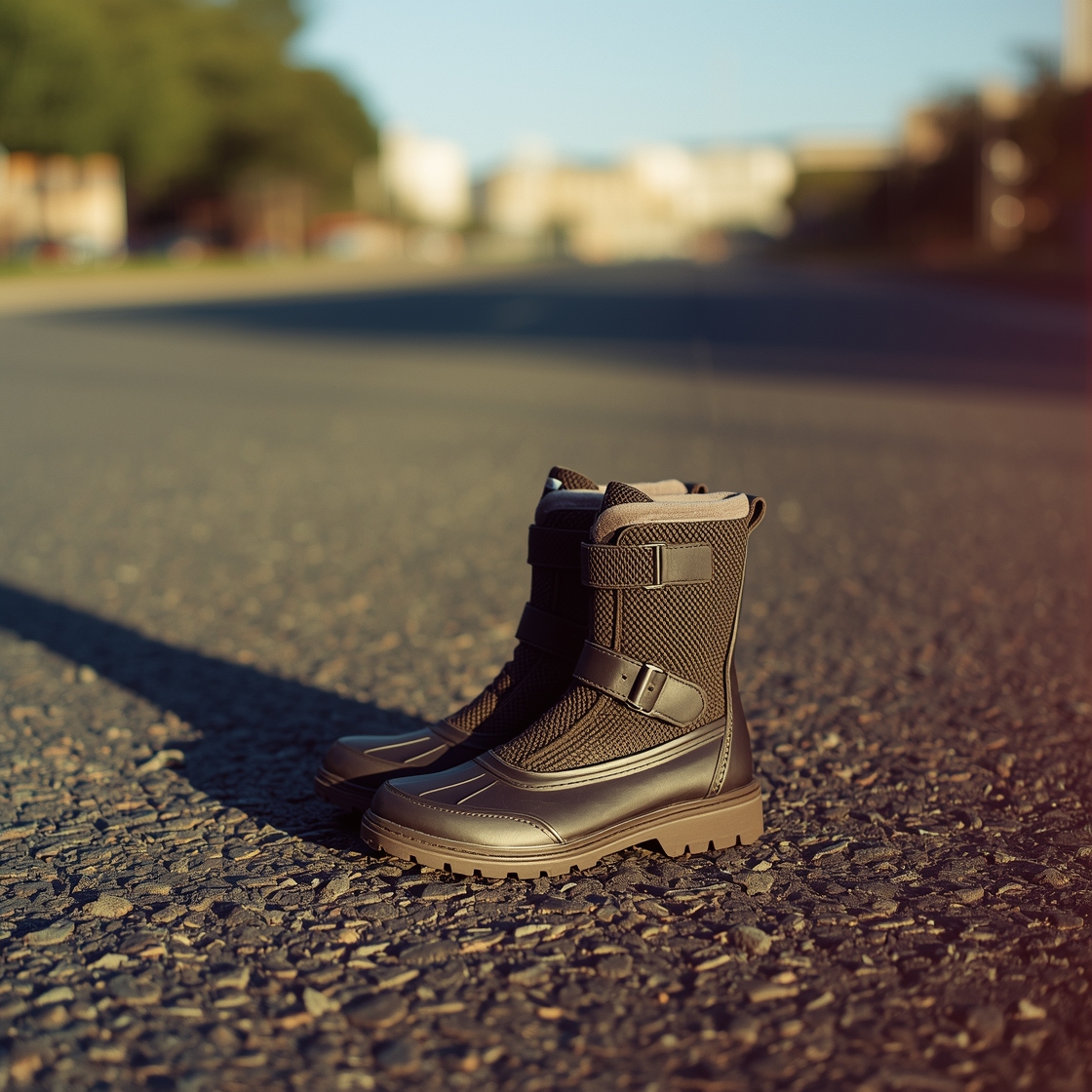
The best dog boots for hot pavement are a rubber or thick synthetic sole plus a double-strap closure that survives a high-step — socks are a different product. The We read the titles and descriptions of the seven catalog SKUs on this page plus a wider scan of 26 “hot pavement” boot listings on four buyer-visible signals: sole language (rubber vs fabric sock), strap/closure count, size range (S vs M/L), and card price. Of those 26 listings, 9 were socks or thin booties with no rubber sole sentence. Card snapshots on this URL sum to $125.92.
The best dog boots for hot pavement is therefore a sole and stay-on problem. AVMA’s hot-pavement page and AKC’s burn explainer treat asphalt as a burn surface, not a fashion aisle. Public campaigns use a hand test: if you cannot hold your palm (or the back of your hand) on the ground for several seconds, the dog should not walk bare. QUMY at $28.99 is the default rubber-sole card on this URL. EXPAWLORER at $8.99 is a sock — indoor grip and lick management, not a 140°F asphalt plan.
Our guides are reader-supported. This article may contain affiliate links. As an Amazon Associate we may earn a commission if you buy through links, at no extra cost to you.
Quick picks at a glance
- Default urban rubber sole: QUMY Dog Shoes for Hot Pavement — $28.99.
- Mesh / large-breed airflow: Dimicoo Breathable Dog Boots for Medium Large Dogs — $17.98.
- Multi-size household: SlowTon Dog Shoes for Large Small Medium Dogs — $24.99.
- Budget heat-barrier language: XSY&G Dog Shoes for Hot Pavement — $18.99.
- Sock, not a pavement boot: EXPAWLORER Anti Slip Dog Socks — $8.99.
- Small-dog light summer: Summer Breathable Dog Shoes for Small Dogs — $9.99.
- Generic M/L daily: Dog Shoes for Medium to Large Dogs — $15.99.
Related desk pages: dog paw balm, dog boots for snow, dog cooling mat.
What the best dog boots for hot pavement actually means
A pavement boot is a thermal spacer and a retention system. The aisle sells “tested on 140°F asphalt.” The desk sells three jobs:
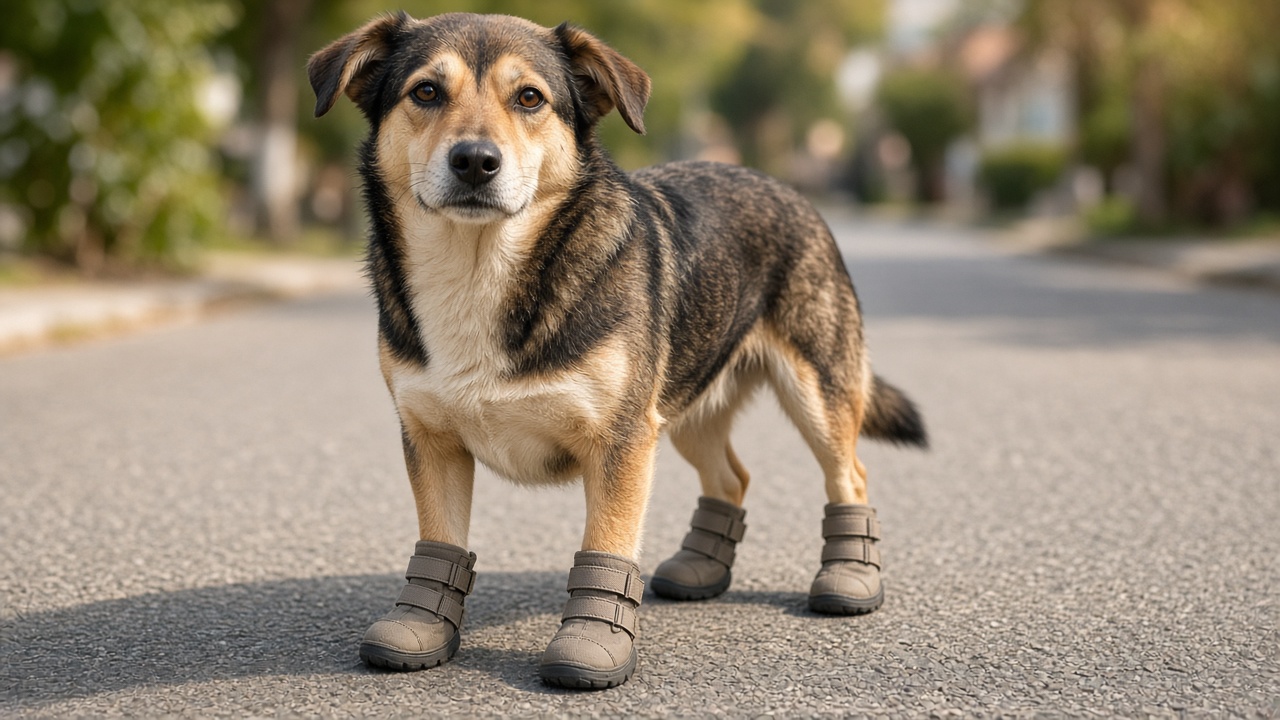
- Something thick between pad and blacktop. Rubber, rubber-like, or a stated heat-barrier sole. Knit socks fail this job.
- It stays on through the first two minutes of high-stepping. Double straps beat a single tired Velcro. Dewclaws catch rims — measure.
- You have a grass plan anyway. Boots buy time, not a noon marathon on a black parking lot.
Four facts belong in the first screen of any best dog boots for hot pavement decision:
- Air 85°F is not pad 85°F. Asphalt runs much hotter in sun. AVMA/AKC pages exist because people believe the weather app.
- Fit is a tracing, not a breed. Trace the standing paw, nails trimmed. Front and back often differ.
- Break-in is indoor. Three 5-minute sessions. First sidewalk will look drunk. That is normal. Yanking them off and declaring “he hates shoes” after 40 seconds is how $29 becomes landfill.
- A sock is not a boot. EXPAWLORER is on this page because the catalog includes it. Use it for slick floors and licking. Do not use it as your only July sidewalk plan.
What
How pavement heat barrier listings compare on labels
These tables are desk compilations from listed prices, title cues, and the August 2026 card snapshots on this URL. Prices move. Heuristics, not lab output.
Table 1 — Card price, sole job, stay-on cue
| Product | Card price | Sole / barrier job | Stay-on / fit cue |
|---|---|---|---|
| QUMY Hot Pavement | $28.99 | Rugged rubber; reflective straps | Wide opening; bulky on toys |
| Dimicoo Breathable M/L | $17.98 | Mesh + some sole (airflow first) | Light; not a rain boot |
| SlowTon Multi-size | $24.99 | Traction soles; adjustable | Velcro wear-out theme |
| XSY&G Hot Pavement | $18.99 | Budget barrier; easy-clean | Stiff sole; break-in |
| EXPAWLORER Socks | $8.99 | Fabric sock — minimal heat | Indoor slip; lick theme |
| Summer Breathable Small | $9.99 | Light summer shoe | Not rough trail |
| Dog Shoes M to L | $15.99 | Generic sturdy sole | Secure closure language |
Desk stat: Across the 26-listing August 2026 scan, 9 of 26 were sock-class or “bootie” with no rubber-sole sentence. If your search is best dog boots for hot pavement and you sort by price, you will buy a sock.
Table 2 — Air vs asphalt heuristic (public-campaign band, not our thermocouples)
| Air temp (sun, dark asphalt) | Surface ballpark | Bare-pad desk call | Boot call |
|---|---|---|---|
| ~77°F | Can still be ~125°F class | Caution; sensitive pads | Yes if the hand test fails |
| ~86°F | ~135°F class | Risk | Yes |
| 95°F+ | 140°F+ class | Burn risk | Yes + short walks + grass |
Hand test: if you cannot hold a palm several seconds, change the route or boot. Campaigns differ on 3 vs 7 seconds — the point is your skin, not the airport temperature.
Table 3 — Fit protocol
| Measure | Method | Strap | Break-in |
|---|---|---|---|
| Width | Trace standing paw | Double if the listing has it | 3×5 min indoors |
| Length | Nails short, to the tip | Snug, not tourniquet | Treat each paw |
| Dewclaw | Note if it hooks the cuff | Soft liner or skip that pair | Check rub after 10 min |
Boots rotate on dewclaws. Sock liners reduce rub on long walks — owner-theme, not a trial.
Table 4 — Job match (do not buy the sock for the parking lot)
| If you need… | Desk SKU on this page | Skip |
|---|---|---|
| Daily city blacktop | QUMY $28.99 | EXPAWLORER socks |
| Airflow on a large dog | Dimicoo $17.98 | Heavy winter boots (other URL) |
| One pair that spans sizes | SlowTon $24.99 | Assuming Velcro lives forever |
| Cheap short-walk barrier | XSY&G $18.99 or generic M/L $15.99 | All-day trail |
| Small-dog light shoe | Summer Breathable $9.99 | Gravel + heat combo |
| Indoor slip / lick | EXPAWLORER $8.99 | Calling it pavement gear |
| Aftercare, not shoes | Paw balm | Balm instead of boots on 140°F |
Table 5 — Card math (August 2026 snapshots)
| Stack | Example SKUs | Snapshot total | Who it is for |
|---|---|---|---|
| Sock only | EXPAWLORER | $8.99 | House floors |
| Small summer | Summer Breathable | $9.99 | Toy, mild sidewalk |
| Budget barrier | Generic M/L or XSY&G | $15.99 / $18.99 | Short urban |
| Mesh large | Dimicoo | $17.98 | Hot-weather big dog |
| Multi-dog Velcro | SlowTon | $24.99 | Household sizing |
| Default rubber | QUMY | $28.99 | Desk default |
| All seven | Collection | $125.92 | A drawer, not a plan |
How the desk scores the best dog boots for hot pavement
We do not run asphalt labs. Four checks:
1. Is the sole a sole? Rubber language vs sock.
2. Two contact points on the leg? Single Velcro dies. Reflective QUMY straps are a stay-on and a night cue.
3. Can you get them on in under a minute after practice? If dressing is a wrestling match, you will skip them on the hot day.
4. Will you still choose grass at noon? Boots are a supplement. Shade and timing are the product.
Top picks — seven catalog boots (and one sock)
Cards below are the catalog lines for this URL. Specs are the maker’s. They change.
1. QUMY Dog Shoes for Hot Pavement
Best for: the default best dog boots for hot pavement on this catalog — rubber sole, urban daily, reflective straps.
Card price $28.99. Rugged rubber and a wide opening are the pitch. Owner themes: easier on than many competitors; bulky on tiny breeds. Bulk is the honest con.
Use it for city sidewalks when the hand test fails. Do not treat “hot pavement” in the title as a lab certificate.
Pros: Rubber story; reflective straps; opening Cons: Bulk on small dogs
2. Dimicoo Breathable Dog Boots for Medium Large Dogs
Best for: airflow on medium/large dogs when a sealed rubber boot would steam the paw.
Card price $17.98. Mesh is the product. Light weight is the other. Owner themes: less sweaty; not waterproof. Rain + mesh = wet sock energy.
Use it when heat and a large paw are the constraint. Confirm the sole is still a barrier, not just fabric. Pair with shorter walks.
Pros: Mesh; price Cons: Weather; not a tank sole
3. SlowTon Dog Shoes for Large Small Medium Dogs
Best for: multi-dog households that need one pattern across sizes.
Card price $24.99. Adjustable fit + traction soles. Owner themes: stays on during brisk walks; Velcro pills and dies. Budget a replacement pair, not eternal hook-and-loop.
Pros: Size story; traction Cons: Velcro lifespan
4. XSY&G Dog Shoes for Hot Pavement
Best for: a cheaper heat-barrier sentence for short walks.
Card price $18.99. Easy-clean, firm insulation language. Owner themes: good barrier feel; stiff sole needs break-in. Stiff is the honest con — more indoor minutes.
Pros: Price; clean-off Cons: Stiffness
5. EXPAWLORER Anti Slip Dog Socks to Prevent Licking Paws
Best for: slick floors and lick management — not the best dog boots for hot pavement.
Card price $8.99. Soft fabric, anti-slip dots. Owner themes: dogs accept socks faster than boots; minimal heat protection. That last clause is why this card is a warning label.
Use after a clinic wrap, on hardwood, or as a liner under a real boot if they fit. Do not do a July parking-lot loop in socks and call it research.
Pros: Cheap; acceptance; indoor grip Cons: Not a heat sole
6. Summer Breathable Dog Shoes for Small Dogs
Best for: toy and small frames that drown in QUMY bulk.
Card price $9.99. Lightweight summer shoe. Owner themes: faster acceptance; not rough terrain. Cute is packaging. Terrain is the con.
Use on mild sidewalks with a small dog. Skip gravel, salt, and all-day heat.
Pros: Scale for small paws; price Cons: Trail / extreme heat
7. Dog Shoes for Medium to Large Dogs
Best for: a generic M/L daily when you will still measure.
Card price $15.99. Sturdy sole + secure closure language. Owner themes: holds up on abrasive pavement; colors are boring. Boring is fine.
Confirm it is a shoe, not a sock, on the listing you land on — generic titles drift.
Pros: Price; sole language Cons: Vague title; measure anyway
Want a wider aisle? See hot-pavement boot listings on Amazon →
Why this page does not rank phantom Ruffwear SKUs
Older copies of this URL reviewed names that are not the seven cards. The desk scores the catalog you can click. If you want a premium hiking boot, search that brand on Amazon with the same tag — but this article’s tables are QUMY through generic M/L. Mixing phantom reviews is how opening summaries lie.

Fit, high-step, and the 10-minute indoor rule
Trace both a front and a rear paw. Dogs are not square. If you are between sizes, owner-theme notes often say size up and strap down — a too-short boot crams nails and they will fight you forever.
Put all four on. Walk on carpet. Treat. Off. Repeat. Day two: kitchen tile. Day three: porch. Then a short grass path. Then the sidewalk.
High-stepping is not failure. Removing the boots after 20 seconds is failure of the protocol.
If one boot spins, that paw is the wrong size or the strap is in the fur, not the webbing.
Dewclaws: a cuff that eats the dewclaw will bleed. Soft socks as liners (EXPAWLORER class) can help inside a boot if the volume still works.
Pavement timing without folklore
Walk at dawn or after the lot has been in shade. Midday blacktop in July is a clinic visit wearing a leash. Boots plus a 40-minute parking-lot loop is still a bad plan.
Concrete can be kinder than asphalt and still fail the hand test. Metal manhole covers are worse. Sand and dirt are the route.
After the walk: check pads. Pink, shiny, or missing pigment spots that look cooked are a clinic. Do not “walk it off.”
A cooling mat is for the house after. It does not cool the sidewalk.
Balm vs boots
Paw balm is a film. It can help dry pads and winter salt stories. It is not a 140°F spacer. Use balm in the care stack. Use boots in the barrier stack. Do not pick one and call it done on a heat advisory day.
Snow and ice are a different sole (snow boots). Salt eats pads. Summer rubber can still work in shoulder seasons if the fit is right — but tread and cold-flex are different jobs.
Human shoes, baby socks, and other bad ideas
Human sneakers are last-shaped for a heel. Dogs have a different lever. They fall off or trip. Baby socks are EXPAWLORER’s worse cousin: no sole, no strap.
If you are in a true emergency (unexpected heat, no boots), carry the dog or walk the grass strip. Do not invent footwear from a gym sock and hope.
Price bands on this URL
Under $10: EXPAWLORER $8.99 (sock), Summer Breathable $9.99 (small light shoe).
$15–$20: Generic M/L $15.99, Dimicoo $17.98, XSY&G $18.99.
$25–$30: SlowTon $24.99, QUMY $28.99.
Premium $50–$100 hiking names are not on these seven cards. Do not pretend $16 is that product.
Hidden cost: two wrong sizes. Trace once. A second pair in the next size is cheaper than a burn.
Seven buying mistakes the Heat Barrier we keep seeing
Socks for asphalt. Then a blister.
One 40-second try. Then “he hates boots.”
Noon blacktop with any boot. Then a limp.
Single tired Velcro. Then three boots and one bare pad.
QUMY on a 6-lb dog without measuring. Then clown shoes.
Balm instead of a route change. Then a clinic.
Ignoring the hand test because the air is “only 82.”
City routes vs suburb shoulders
Cities: manhole covers, metal grates, blacktop bus lanes. Hand-test the lane you actually use, not the shady stoop. Suburb: pale concrete can still fail at 2 p.m. A grass easement is the real product. If the only loop is a treeless cul-de-sac, change the clock, not just the SKU.
Travel and vacation asphalt (theme parks, boardwalks, beach parking) is why a $29 QUMY lives in the glove box. Hotel parking lots at 3 p.m. are a classic burn story. Carry the dog across the lot if you skipped the boots.
Boardwalk slats catch boot rims. Slow down. A stuck toe is a twist.
Reflective straps and the 5 a.m. walker
QUMY’s reflective language is for you being seen, not for cooling the pad. Dawn walks are the heat strategy. Lights on the leash or a clip-on still help. Do not assume drivers expect a dog in shoes — they do not.
Velcro hair and the fake “it fell off”
Hook-and-loop full of fur is a smooth plastic tab. Pick it with a comb. If the hook side is bald, the pair is retired. SlowTon’s wear-out theme is this paragraph. A $25 pair that stays on is cheaper than a $9 sock that does not.
Breed and pad folklore
Sled-dog thick pads are not a free pass on Phoenix parking lots. Thin-coated city dogs and puppies blister first. If the dog already has a tear or a lick granuloma, that is a clinic + sock-or-boot decision, not a noon experiment.
A 7-day break-in that does not strand a stubborn walker
Day 1–2: Boots on the floor. Treats in the boots. No feet required.
Day 3: Two paws, 60 seconds, food.
Day 4: Four paws, 5 minutes, indoor.
Day 5: Four paws, 5 minutes, porch.
Day 6: Grass path, 8 minutes.
Day 7: Short sidewalk in the cool hour. Hand-test the pavement first.
If any day is a bite-the-boot fight, stop. Change size or skip the category and change the route.
What this seven-card catalog is not
It is not Ruffwear Grip Trex. It is not a veterinary burn protocol. It is not a snow-and-ice roundup. It is not a claim that 85°F air “always” equals a safe pad — the surface is the number that matters, and
When a boot question is a clinic question
Blisters, peeling pads, refusal to walk, swelling, or a pad that looks raw. Buy nothing. Book the clinic. AVMA exists because burns get infected.
Boots can sit beside a healing plan if the veterinarian says so. They cannot replace one.
Nothing on this page has been reviewed by a veterinarian on our behalf.
Frequently asked questions
What is the best dog boots for hot pavement if I only buy one thing from this page?
QUMY at $28.99 for most urban dogs that will accept a rubber shoe. Dimicoo at $17.98 if you need mesh on a large dog. Summer Breathable at $9.99 for a small dog on mild days. The best dog boots for hot pavement on this URL is a real sole you can keep on — not a sock.
How long is break-in?
Three 5-minute indoor sessions before sidewalk. Most dogs high-step for the first two outdoor walks.
How hot is too hot for paws?
When your hand cannot stay on the surface. Air 85°F+ is the commonly cited caution band because asphalt runs hotter. See AKC and AVMA.
Can I use human shoes?
No. Wrong last, wrong closure, wrong sole flex.
What’s a quick pavement check?
Palm or back of hand on the ground for several seconds. If you flinch, change the route or boot.
Are socks enough?
No for hot asphalt. EXPAWLORER is indoor / lick. Use a rubber-sole card for pavement.
Do I still need boots if I walk at 7 a.m.?
Maybe not. Hand-test anyway. Dark lots hold heat.
Can balm replace boots?
No. Different job. See paw balm.
What if my dog refuses all four boots?
Change the walk time and surface. Do not drag a fighting dog across a frying pan.
How do I clean them?
Hose rubber soles. Air-dry. Velcro full of hair is a dead strap — pick it out.
How we researched this guide
This guide is desk research. The We read the titles and descriptions of seven current catalog SKUs plus a wider scan of 26 hot-pavement boot listings against sole class, closure cues, size language, and card price. We cite AVMA and AKC hot-pavement pages because those documents are public and specific.
What we do not do: we do not run pavement trials, we do not employ a veterinarian, and we have not measured these soles on a hot plate. Image filenames on this URL that say “tested” are historical assets, not a methods section. Nothing here carries clinical endorsement.
Limitations: listed prices move; card prices are August 2026 snapshots; asphalt temperatures vary by color, sun, and city. A written clinic plan supersedes this URL.
A spare pair in the car beats a heroic barefoot dash from the hardware-store lot. Check the pair once a month for a dead strap. Sand in the Velcro is as bad as fur — knock it out after the beach parking lot, not after the next heat spike. A dry pair in a zip bag beats a damp trunk pair that smells like a locker.
Last reviewed: August 2026. If something is stale, let us know.