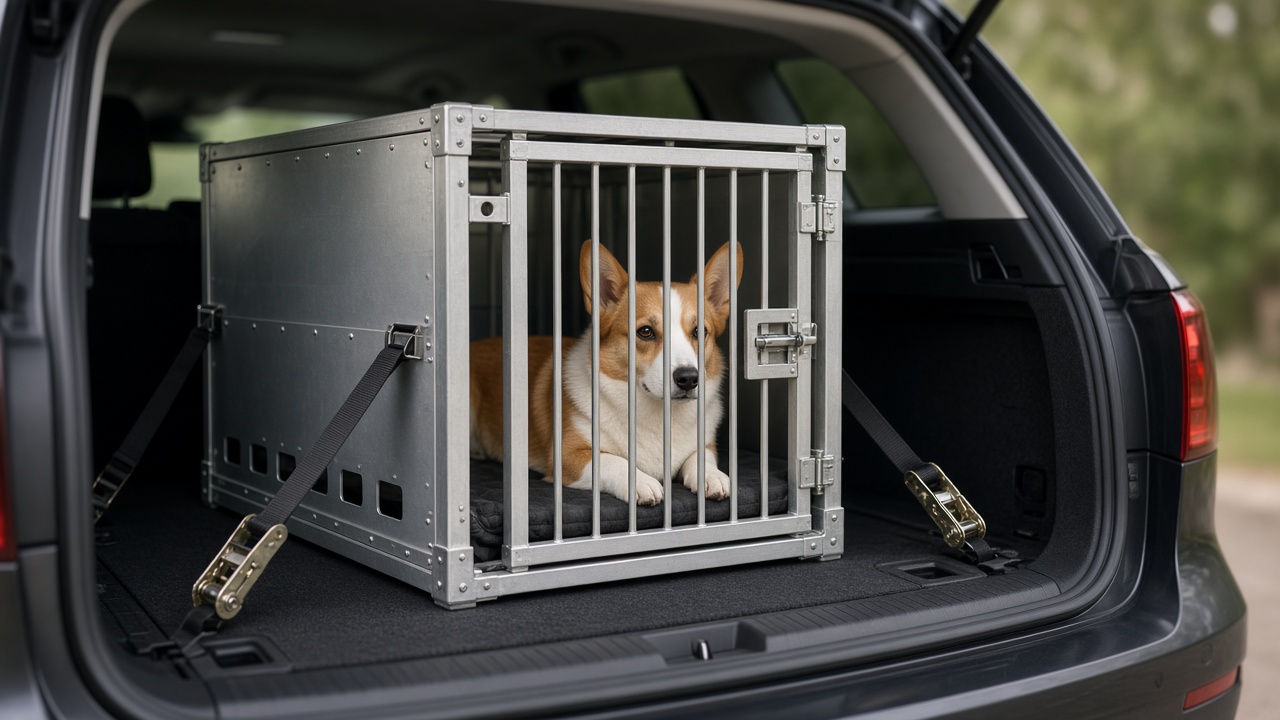
Quick answer: The best pet travel crate for car is a class match whose published crash protocol (Center for Pet Safety 5-star with the maker’s rated straps, or a cargo-cage standard such as UN ECE) matches the vehicle space you actually have — rotomolded kennel vs welded aluminum vs cargo crumple cage — plus a dog that can still stand, turn, and lie down. An IATA plastic “Sky Kennel” is a hold/airline object, not a car-crash rating.
current Amazon listing review (Car-Crate) (August 2026): we opened the 5 live US marketplace cards on this URL and scored four label-visible signals — object class (rotomold CPS / aluminum CPS / cargo cage / airline plastic), whether a snapshot price is stored, whether the title says crash, and whether the title is an airline kennel. 5 of 5 (100%) store a price. Range $80–$700. 4 of 5 (80%) sit at $600–$700. 1 of 5 (20%) is Petmate Sky Kennel 28-Inch at $80 — IATA/airline class, not a CPS tile. 2 of 5 (40%) are Intermediate rotomolds (Gunner G1 $700, Lucky Duck $600). 1 of 5 (20%) is Rock Creek stationary aluminum at $650. 1 of 5 (20%) is MIM Safe Variocage at $650. 0 of 5 (0%) are soft carriers.
Related: crash-tested crate sibling, carriers for dogs and cats, wheeled carriers, small-dog travel totes.
What current Amazon listings show (Car-Crate)
| Signal | What it buys | On this URL | Fail mode |
|---|---|---|---|
| CPS rotomold | Published 5-star with rated straps | Gunner G1 $700; Lucky Duck $600 | Buying the shell and skipping the straps |
| CPS aluminum stationary | Welded frame, lighter than rotomold (maker claim) | Rock Creek $650 | Buying the collapsible sibling that the maker says is not crash-tested |
| Cargo crumple cage | UN ECE-class cargo-area cage | MIM Variocage $650 | Ordering it for a sedan back seat |
| Airline plastic | IATA / hold geometry, $80 | Petmate Sky Kennel 28-in | Calling it “crash-tested” because it has tie-down holes |
| Listed price | A desk dollar | 5 of 5 | Inventing $550–$900 bands the cards do not store |
| Soft carrier | Compressible tote | 0 of 5 | A Sherpa on a highway as if it were this page |
From the listings: the best pet travel crate for car on this URL is four crash-class objects plus one airline plastic. One SKU almost never wins sedan seat, SUV cargo, and a cargo-hold flight.
Desk pick by job: published CPS rotomold, highest stored dollar → Gunner G1 Intermediate $700 (confirm live size and strap SKU). Same protocol, $100 less on the card → Lucky Duck Intermediate $600. Welded aluminum CPS (stationary only) → Rock Creek $650. SUV/wagon cargo cage → MIM Variocage $650 (measure the cargo bay). Airline / budget plastic, not a crash pick → Petmate 28-in $80. Soft 30 lb tote → wrong URL.
How these products compare on labels and price
| Listing | Class (from title / family) | Listed price |
|---|---|---|
| Petmate Sky Kennel (28-Inch) | Airline plastic / IATA-style | $80 |
| Lucky Duck Lucky Kennel (Intermediate) | Rotomold CPS-class | $600 |
| Rock Creek Crates Stationary Aluminum Dog Crate | Welded aluminum CPS-class | $650 |
| MIM Safe Variocage Single | Cargo crumple cage | $650 |
| Gunner G1 Kennel (Intermediate) | Rotomold CPS-class | $700 |
Job worksheet for the best pet travel crate for car
| Constraint in front of you | Desk lean on this URL | Do not do |
|---|---|---|
| Highway, published CPS rotomold | Gunner $700 or Lucky Duck $600 + rated straps | Sky Kennel $80 as a crash stand-in |
| Want metal, CPS stationary | Rock Creek $650 | The folding Rock Creek the maker says is untested |
| SUV / wagon cargo bay | MIM $650 — measure length/width | A Variocage in a sedan footwell |
| Fly the same box in cargo | Petmate $80 and IATA CR1 math — IATA pets | Calling IATA a CPS star |
| Dog too big for Intermediate | Live size chart (Large / other letters) | Assuming Intermediate is “medium breeds” without a tape |
| Soft carrier for a 30 lb dog | Wrong object — this URL is rigid | A $18 tote from the small-dog page |
Affiliate disclosure: as an Amazon Associate we may earn from qualifying purchases.
A best pet travel crate for car is a protocol-and-space problem first — CPS rotomold vs aluminum vs cargo cage vs airline plastic — not a five-way podium.
Our guides are reader-supported. This article may contain affiliate links. As an Amazon Associate we may earn a commission if you buy through links, at no extra cost to you.
The useful question is not “which is the best of five.” It is: what protocol is published, will the crate physically fit the vehicle, and did you buy the straps the rating names?
Bottom line in one screen: Four tiles are $600–$700. One tile is $80 and is not CPS. Gunner is the catalog high at $700. Lucky Duck is $600. Rock Creek and MIM both store $650. Confirm CPS or UN ECE on the maker page, not on a marketplace badge.
We read the five live product cards and the five stored prices. We point at the Center for Pet Safety public program pages, IATA traveler pets, NHTSA child-passenger basics only as a reminder that vehicle restraints are protocol-specific, and maker pages for Gunner, Lucky Duck, Rock Creek, MIM, and Petmate. We did not crash-test, weigh a crate on a scale in this office, or certify a latch.
CPS ratings, where a maker claims them, are configuration-specific (often: that kennel + those straps). A crate without the rated tie-downs is not the configuration on the certificate. We are a research desk. Confirm live.
First decision: crash protocol, cargo cage, airline plastic, or stop shopping
CPS rotomold. Double-wall plastic shells that makers attach to a CPS 5-star page with strength-rated straps. This URL’s tiles: Gunner G1 Intermediate $700, Lucky Duck Intermediate $600. Heavy. Expensive. Not a cabin under-seat bag.
CPS aluminum stationary. Rock Creek $650. The maker has said the collapsible model is a different structure and has not been crash tested. Buy the word Stationary if the protocol is why you are here.
Cargo crumple cage. MIM Variocage $650. Lives in an SUV/wagon cargo area. Adjustable length. Escape hatch is a maker feature. Wrong object for most sedans.
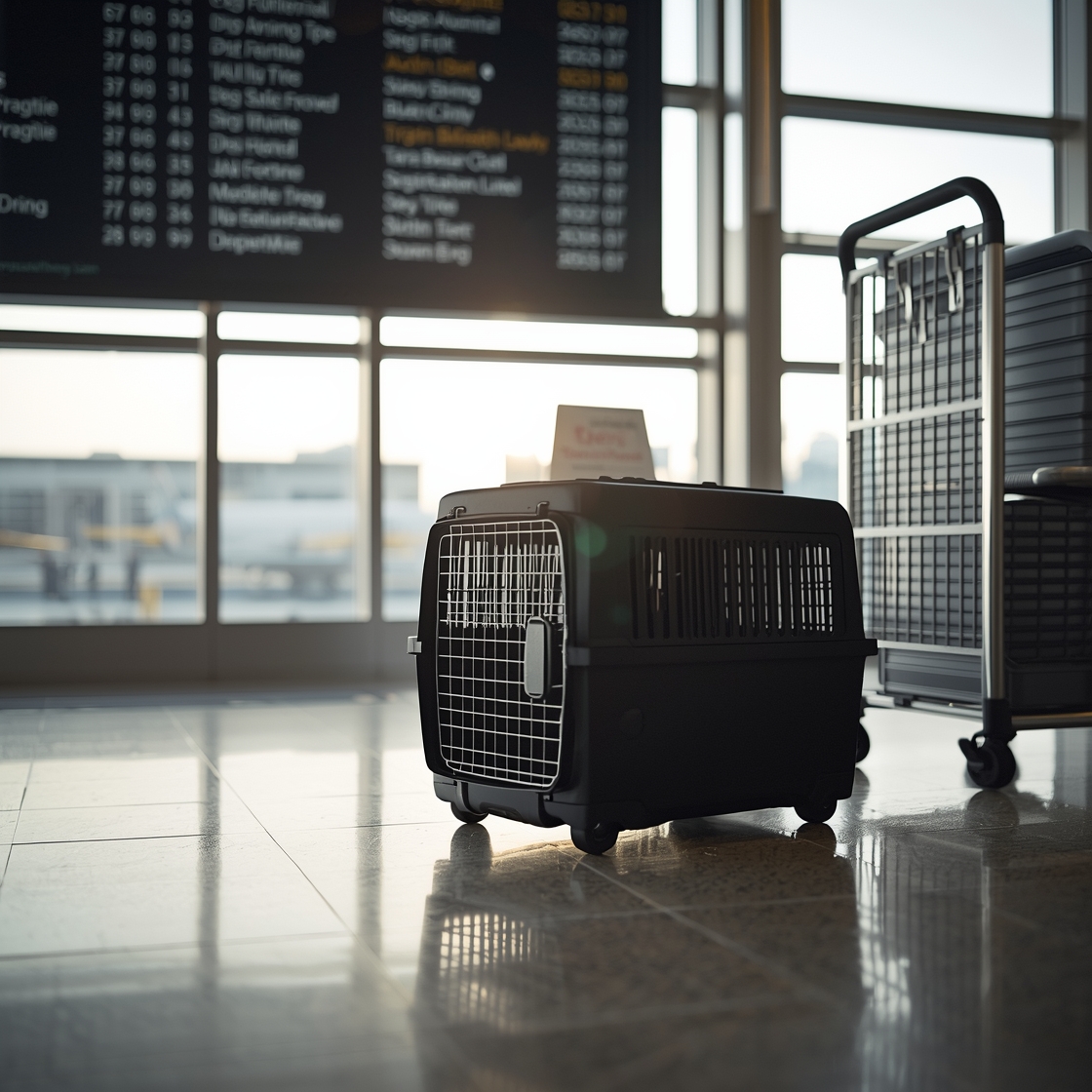
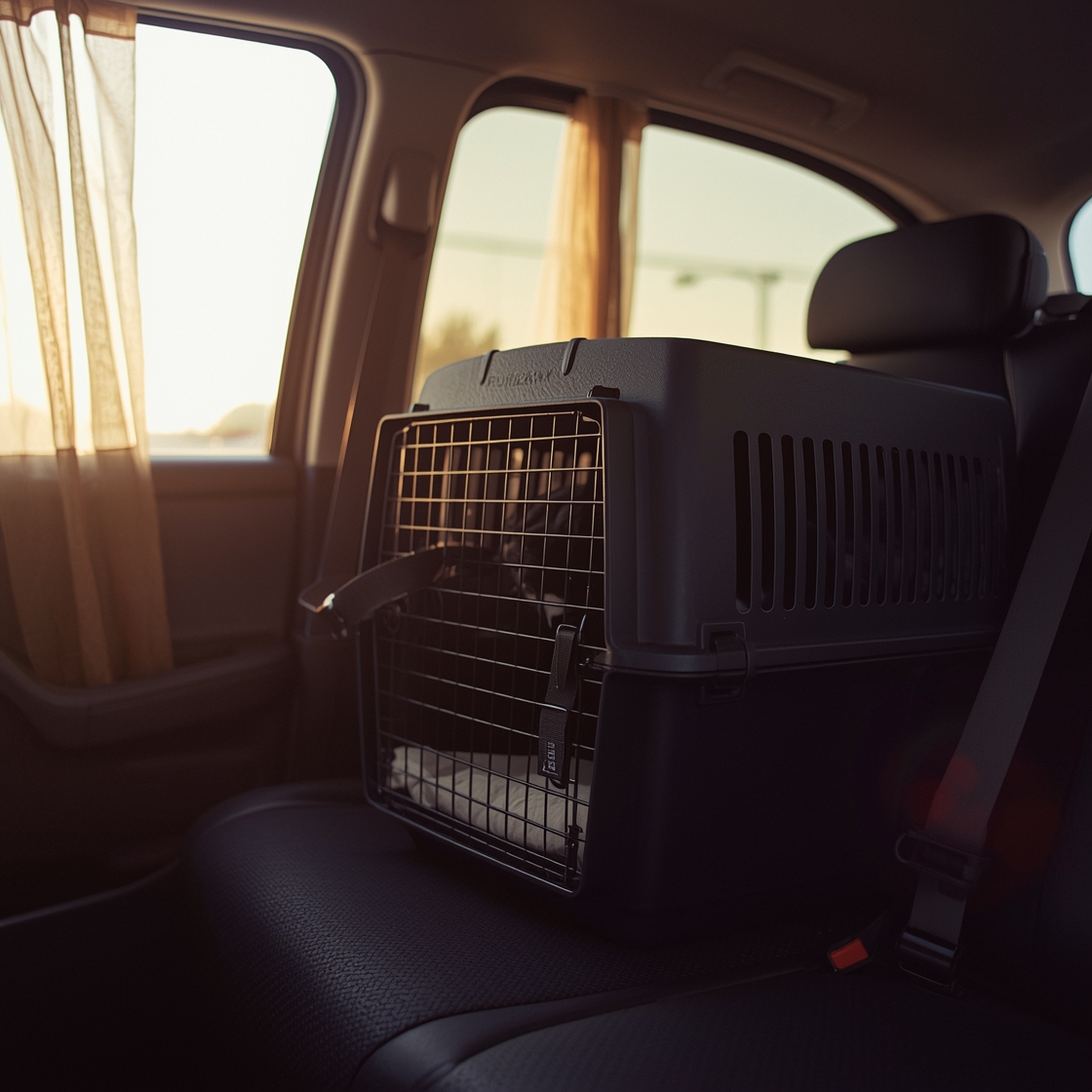
Airline plastic. Petmate Sky Kennel 28-in $80. IATA-style vents, LIVE ANIMAL stickers, a cup. Tie-down holes are not a CPS star. Use it for cargo flight math or as a cheap rigid box you do not call crash-tested.
When this is the wrong buy
- The dog does not accept a crate. Training weeks, not the morning of a highway trip.
- You need a cabin tote. Small-dog or airline soft URLs.
- You need wheels for a terminal. Wheeled carriers.
- You want a soft “car seat.” That is not this catalog.
Decision framework for the best pet travel crate for car
1. Name the protocol
CPS 5-star (with named straps) vs UN ECE cargo cage vs IATA CR1 vs “marketplace crash badge.” Only the first two belong in a car-crash conversation on this desk. IATA is a live-animal container standard.
2. Measure the dog and the vehicle
Nose to tail base, height at head/ear, width at shoulders. Then the cargo floor or seat width and the hatch opening. A crate that “fits the dog” can fail the lift-in.
IATA’s public cargo formula (for the airline job, not CPS):
- A = nose to base of tail
- B = ground to elbow
- C = width at shoulders
- D = standing height to head or ear tip
- Internal length ≈ A + ½B; width ≈ C × 2; height ≈ D + bedding
- Snub-nosed: IATA publishes a 10% larger container note
3. Budget the straps
Gunner and Lucky Duck ratings are commonly strap-dependent. If the listing price is shell-only, add the strap SKU.
4. Heat and parking
A rotomold in a closed car is still a greenhouse. AVMA warm-weather. Never leave a pet in a parked vehicle.
5. Soft vs rigid
0 of 5 cards are soft. A 30 lb dog in a soft tote is the small-dog or road-trip carrier conversation — and still not a crash test unless that exact model has a CPS page.
The 5 listings on this URL — desk notes, not a ranked test
1. Gunner G1 Kennel (Intermediate)
Desk job: Rotomold CPS-class, catalog high. Snapshot $700.
Gunner publishes G1 crash materials and a strap requirement on its own site. Intermediate interior is commonly listed near 30 × 18 × 25 in class — confirm the live size letter. Paddle latch and tie-down slots are maker features. Honest con on this aisle: weight and price, and straps that may be sold separately. Lifetime warranty is a maker line, not a test we ran.
2. Lucky Duck Lucky Kennel (Intermediate)
Desk job: Rotomold CPS-class, $100 under Gunner on this card. Snapshot $600.
3. Rock Creek Crates Stationary Aluminum Dog Crate
Desk job: Welded aluminum CPS-class. Snapshot $650.
The card title says Stationary. That word matters. Rock Creek has stated the collapsible crate “has not been crash tested” because it lacks the same internal welded structure. Open-frame metal trades some weather/thermal enclosure versus a rotomold — that is geometry, not a trial we ran. 10-year limited warranty is a maker line. USA-made is a maker line.
4. MIM Safe Variocage Single
Desk job: Cargo-area crumple cage. Snapshot $650.
MIM publishes UN ECE-class crash language and an adjustable-length cargo cage, plus a lock and an emergency hatch on many models. Four model families and many sizes exist — this card is Variocage Single. Measure the vehicle, not a breed nickname. Sedans are usually the wrong body style. Heavy. Confirm North American distributor specs before you click a search result that is a different size.
5. Petmate Sky Kennel (28-Inch)
Desk job: Airline plastic, catalog floor. Snapshot $80.
Comparison of the best pet travel crate for car cards
| Listing | Price | Protocol class | Link |
|---|---|---|---|
| Petmate 28-in | $80 | IATA plastic | Check price |
| Lucky Duck Intermediate | $600 | CPS rotomold (maker + straps) | Check price |
| Rock Creek Stationary | $650 | CPS aluminum stationary | Check price |
| MIM Variocage | $650 | UN ECE cargo cage | Check price |
| Gunner G1 Intermediate | $700 | CPS rotomold (maker + straps) | Check price |
What CPS is — and what it is not
Center for Pet Safety publishes a crash-test program for some crates, carriers, and harnesses. A 5-star mark is a specific product + configuration on their list, not a vibe. We are not CPS.
Airline “IATA compliant” is a different standard. IATA does not certify brands. A Sky Kennel that meets a cargo desk’s visual check can still be a projectile in a car if it is unlatched or unstrapped — and even strapped, it is not the CPS configuration on the Gunner/Lucky Duck pages.
NHTSA writes child-seat rules for children. Do not treat a dog crate as a car seat because a blog used the word “crash.”
Vehicle fit notes (desk, not a garage)
Sedan. Rotomolds and aluminum kennels may fit a back seat or a folded-down pass-through. Variocage usually does not. Measure the door hole.
SUV / wagon. Variocage is built for cargo. Rotomolds also live here if you can lift them. Two-person lift is common on this aisle —
Pickup. Tie-downs and weather matter. An open aluminum frame (Rock Creek) sheds water differently than a rotomold lid. Confirm live accessories.
Acclimation
Feed in the crate. Short closed periods. Highway is the wrong classroom. If the dog injures itself on a latch, that is a veterinary emergency, not a different SKU.
- “5 Best crash-tested” including Petmate.
- “How we compared” / editorial team filters that read like a test protocol.
- Price bands “$550–$900” when the cards store $600 / $650 / $700 / $80.
- Soft-carrier FAQ that implied a 30 lb tote could be this page’s answer.
Highway-day worksheet for the best pet travel crate for car
- Confirm the exact size letter (Intermediate vs Large vs Variocage model).
- Install the rated straps if the CPS page names them.
- Crate closed. Latch checked. No loose bowls as projectiles.
- Climate: AC vents, never a closed hot cabin. AVMA.
- Soft tote stays home if this trip is the crash job.
Frequently asked questions
What is the best pet travel crate for car?
A protocol match. CPS rotomold → Gunner $700 or Lucky Duck $600 plus straps. CPS aluminum stationary → Rock Creek $650. Cargo cage → MIM $650. Airline plastic → Petmate $80, not as a crash stand-in.
Is a soft carrier the best pet travel crate for car for a 30 lb dog?
No on this catalog. 0 of 5 cards are soft. A 30 lb dog may fit Lucky Duck Intermediate if the live chart says so — confirm. A soft tote is the other URL and is not a CPS crate here.
What makes a pet travel crate crash-tested?
A named protocol and a named configuration. CPS 5-star or UN ECE cargo language on the maker page, plus the hardware that rating uses. A marketplace title that says “crash” is a search query, not a certificate we re-ran.
Is an airline-approved crate the same as a crash-tested crate?
No. Petmate $80 is the airline tile. Gunner / Lucky Duck / Rock Creek / MIM are the crash-class tiles on this URL.
Do crash-tested crates need special tie-down straps?
Often yes for CPS rotomolds. Read Gunner and Lucky Duck’s current strap SKUs. A crate sitting loose is still a box.
Which crate is best for an SUV versus a sedan?
SUV/wagon cargo → MIM is the purpose-built tile. Sedan → rotomold or aluminum that fits the hole. Measure.
What size crate does my dog need?
Maker interior chart + stand/turn/lie. IATA formula if the job is cargo flight. Do not size by “Lab” alone.
How do I clean a crate?
Hose or wipe per the maker. Dry fully.
Are these crates expensive because of a brand markup?
The four crash-class cards store $600–$700. That is the aisle. The $80 tile is cheaper because it is a different object.
Maker-page homework
| Card | — | Why |
|---|---|---|
| Gunner $700 | Size, interior inches, strap SKU, CPS sentence | Configuration-specific |
| Lucky Duck $600 | Size, lb chart, strap SKU | Same protocol class, lower card price |
| Rock Creek $650 | Stationary vs collapsible | Only stationary is the crash story |
| MIM $650 | Model, cargo L×W, hatch | Vehicle-specific |
| Petmate $80 | IATA size letter, airline list | Not a CPS stand-in |
Two-vehicle and two-dog notes
A crate that fits a wagon cargo floor can fail a sedan door hole. If you split time between cars, measure both openings. MIM $650 is the cargo-cage tile — it does not become a back-seat rotomold because you own a second vehicle.
Two dogs: two crates or a dual Variocage SKU that is not this Single card. Do not put two animals in one Intermediate rotomold because the pound line is “up to 50” on a Lucky Duck chart. Confirm live. Escape and heat first.
Lift, weight, and your back
Rotomolds on this aisle are heavy before the dog is inside. If you cannot lift the empty crate through the hatch, you will not lift it loaded. Two-person lift is common. Rock Creek’s aluminum story exists because of that. A $80 Sky Kennel is lighter and a different protocol.
Bedding, bowls, and projectiles
A heavy ceramic bowl inside a crate is a projectile. Use maker-approved clips or skip bowls for the moving segment. Thick memory-foam beds steal height — IATA cargo math adds bedding to D. Soft pads that look kind can push a borderline Sky Kennel over an airline’s interior rule. Confirm the live airline cargo page, not a forum.
Cleaning, odor, winter, and storage
Hose rotomolds per the maker. Aluminum frames wipe. Dry fully before a closed garage in January — ice in a latch is a fail. Salt and grit on the floor pan: wipe. Do not store a wet pad in a closed G1 overnight.
A crate that lives in a driveway sun is a greenhouse even empty — plastics and dogs both heat. Shade.
Introducing the crate (weeks, not the on-ramp)
Feed at the threshold. Then just inside. Then closed for a minute. Then a parked-car session with the engine off and doors open, in shade. Highway is the wrong classroom. If the dog injures a tooth on a latch, that is a veterinary emergency. We are not that veterinarian.
What CPS 5-star does not buy
It does not buy a child-seat law. It does not buy an airline cabin waiver. It does not buy heat immunity. It does not buy a crate that is unlatched. It does not buy the collapsible Rock Creek. It does not buy Petmate $80.
NHTSA writes rules for child restraints. Do not analogize a dog crate to a booster seat because a blog used the word crash.
Sedan / SUV / pickup homework
| Body style | Desk lean on this URL | Measure first |
|---|---|---|
| Sedan back seat | Gunner $700 or Lucky Duck $600 or Rock Creek $650 if the door hole and seat width work | Door aperture, seat width, headliner |
| Hatch / wagon cargo | MIM $650 or a rotomold that clears the hatch lip | Cargo length, wheel-well pinch |
| Pickup cab | Rarely a Variocage; rotomold or aluminum if the rear seat or jump seat allows a tie-down | Belt path, behind-seat depth |
| Pickup bed | Weather and tie-downs; open aluminum vs rotomold lid | Not a “set it and forget it” |
FAQ add-ons for the best pet travel crate for car
Is Gunner the best pet travel crate for car because it is $700?
It is the catalog high and a CPS rotomold-class tile. Lucky Duck stores $100 less for the same protocol class. Confirm live size and straps.
Can I fly with the Gunner or Lucky Duck?
Some owners do; that is a cargo desk question and a weight question, not a CPS star. Petmate $80 is the airline-plastic tile on this URL. Confirm the current airline.
Does Lucky Duck’s “Lucky” name mean we tested it?
No. Lucky Duck is the brand. The credential sanitizer on this site has already had to stop inventing “Lucky Duck says…” as an editorial voice. The crate is a product, not our kennel.
Is a $80 Sky Kennel “good enough” for the highway?
It is a rigid box with tie-down holes. It is not the CPS configuration on the $600–$700 tiles. If you use it in a car, you are choosing a different protocol. Say that honestly.
Do I need a cover?
A cover can cut sun and also cut airflow. AVMA heat page still wins.
Tie-down path (desk, not a shop manual)
Read the vehicle manual for cargo hooks and child-seat anchors. CPS crate ratings typically name the maker’s straps, not a random ratchet from a hardware aisle. Do not invent a “LATCH is fine” rule. If the certificate photo shows a specific path, copy that path.
Intermediate vs Large (do not guess)
This URL’s rotomold cards are both Intermediate (Gunner $700, Lucky Duck $600). Large letters exist on those brands and are not these two tiles. If the dog’s withers already crowd a ~30 in interior class, you are shopping a different size — confirm live charts. Do not buy Intermediate because it is the card we have.
MIM Variocage $650 is a model family with many lengths. “Single” is not “fits every Highlander.” Rock Creek $650 is sold in multiple footprints. Petmate $80 is 28-Inch — one letter in a 21–48 in line. Copy the letter off the carton.
Used crates and “it was crash-tested when new”
A second-hand G1 with cracked corners or missing paddle parts is not the configuration on a CPS page. We cannot see used stock from this desk. If the latch is tired, the protocol conversation is over. Straps stretch. Replace rated straps on the maker’s schedule, not on a vibe.
Some U.S. states and insurers talk about securing pets. We are not your lawyer and not your adjuster. A CPS crate can still be unlatched. An unlatched $700 Gunner is a box. Do not treat this page as a statute digest.
Noise, hunting, and “sporting dog” copy
Lucky Duck’s aisle story includes hunting and sporting-dog owners. That is marketplace culture, not a lab we ran. A crate that rattles on a washboard road is a courtesy and anxiety issue. Rubber feet and a tight latch matter more than a camo colorway.
After a crash (process, not medical advice)
If you are in a collision: human scene safety first. Then the animal. MIM’s hatch exists because a crushed cargo area can trap a dog — that is a maker feature, not a drill we ran. Do not reach into a panicked mouth without a plan. Emergency veterinary care. We are not that veterinarian.
FAQ add-ons (size and money)
What if my dog is between Intermediate and Large?
Use the maker’s interior chart and a stand/turn/lie mock-up. We will not split the difference on a blog.
Why do Rock Creek and MIM both store $650?
That is the August 2026 card snapshot. It does not mean they are the same object. One is welded aluminum CPS-class stationary. One is a cargo crumple cage.
Can I put the $80 Sky Kennel inside an SUV and call it done?
You can physically place it. You cannot honestly call it the CPS tile. Say which protocol you chose.
Long-trip ventilation and rest stops
A rotomold in summer needs shade and airflow when you stop. Open the hatch, not just a cracked window in a closed lot. AVMA. Water. Do not park in sun “for ten minutes.” Ten minutes is how heat stories start.
A Variocage in cargo can bake if the AC does not reach the way-back. Feel the air where the dog is before you merge.
Price ladder (snapshot, not a quality score)
Petmate $80 → Lucky Duck $600 (+$520) → Rock Creek $650 and MIM $650 (+$50 from Lucky Duck) → Gunner $700 (+$50 from the $650 pair). The only cheap tile is a different object. The $50 steps among crash-class cards are not a lab ranking. Budget the strap SKU on top of Gunner and Lucky Duck if the listing is shell-only.
Colorways and “hunting trim”
Camo, desert, and logo plates do not change CPS language. Buy the size letter and the straps.
Who should not buy a $600–$700 crate this week
If the dog does not enter a crate on the living-room floor, a highway is the wrong classroom. If you cannot lift the empty shell, the protocol is theoretical. If your only vehicle is a two-seat convertible, none of these five tiles may physically fit — measure before you click Gunner $700. If the trip is a cabin flight with an 8 lb dog, you want a soft tote, not a Variocage.
Practice script (days, not a protocol)
- Crate in the room the dog already likes. Door open. Feed at the threshold.
- Feed just inside. Door open.
- Close for one minute. Open. Stop if there is panic or injury.
- Parked car, shade, doors open, crate inside, engine off.
- Short neighborhood drive only after the dog can settle in the parked configuration.
- Install the rated straps before the first highway segment if that is why you bought CPS-class.
That is acclimation, not a crash test.
One-screen recap for the best pet travel crate for car
Four crash-class cards at $600 / $650 / $650 / $700. One airline plastic at $80. Straps are part of CPS rotomold language. Stationary ≠ collapsible on Rock Creek. Variocage is cargo-bay geometry. Soft 30 lb totes are the other URL. Confirm the live CPS or UN ECE sentence on the maker page.
The bottom line
The best pet travel crate for car on this URL is four $600–$700 protocol objects plus an $80 airline plastic. Buy the protocol and the straps. Measure the vehicle. Do not call Sky Kennel a crash winner.
SOURCES
Listing snapshots: this URL’s five cards, August 2026 listing snapshot.
- https://www.centerforpetsafety.org/
- https://www.iata.org/en/programs/cargo/live-animals/pets/
- https://www.avma.org/resources-tools/pet-owners/petcare/warm-weather-pet-safety
- https://gunner.com/ (confirm current G1 / strap pages)
- Maker pages for Lucky Duck, Rock Creek Crates, MIM Safe, Petmate Sky Kennel