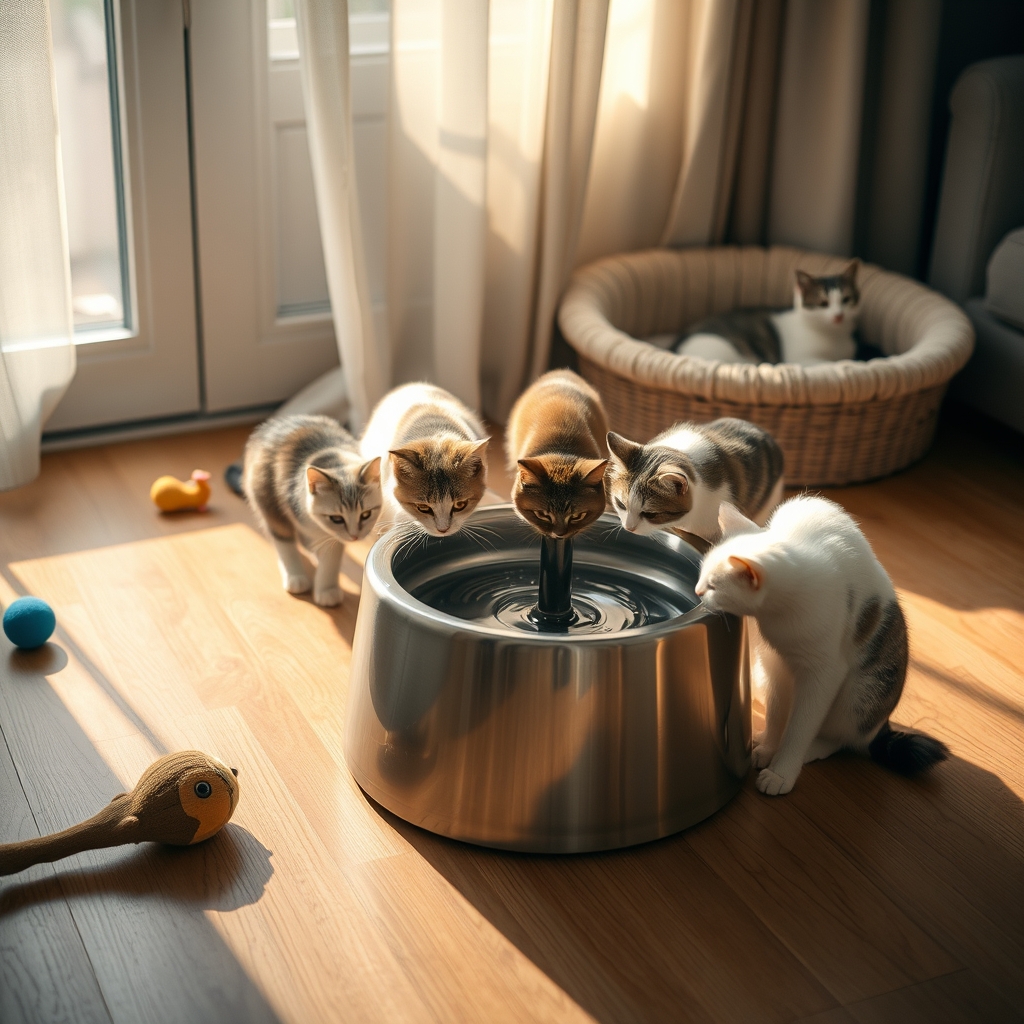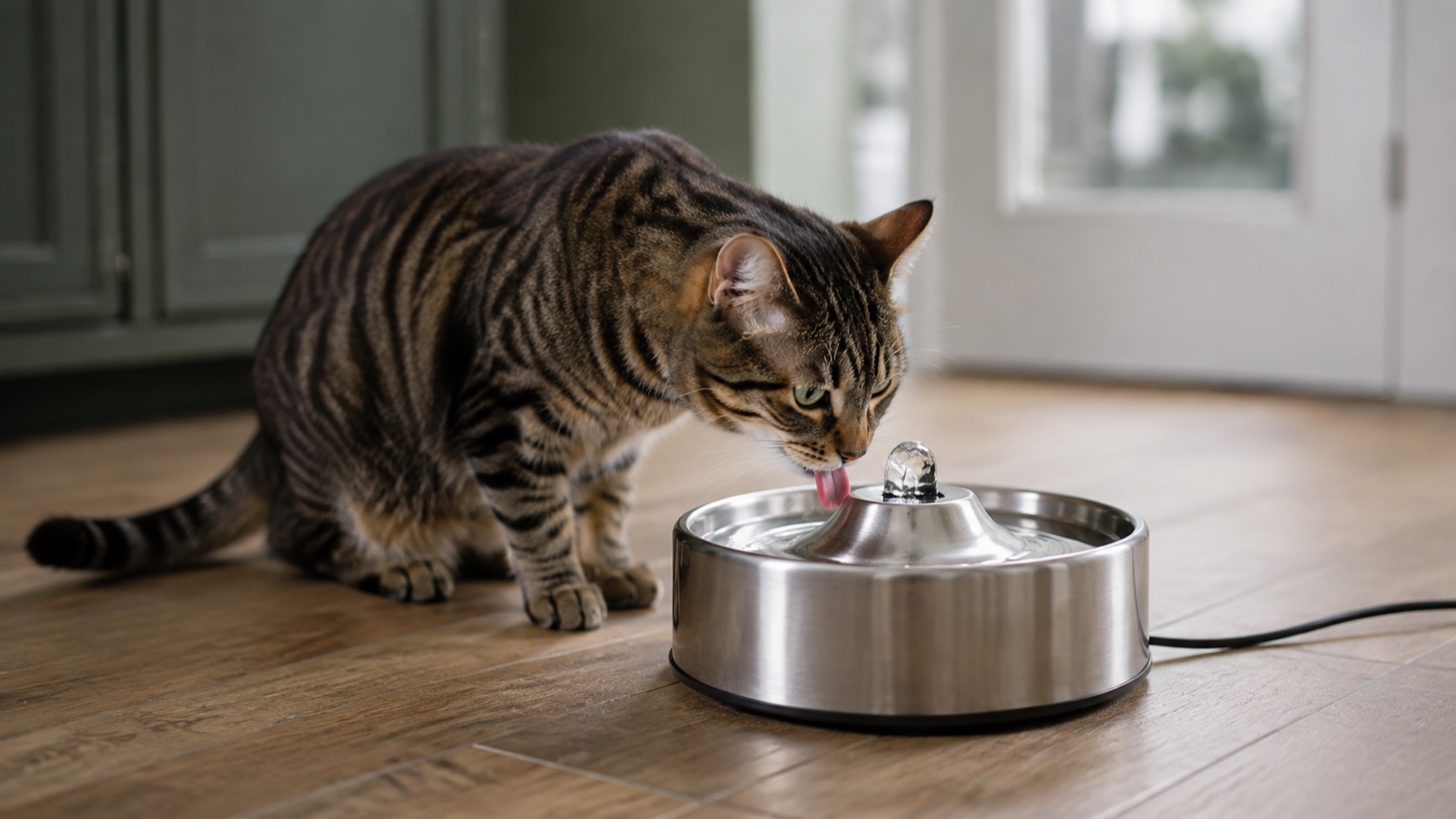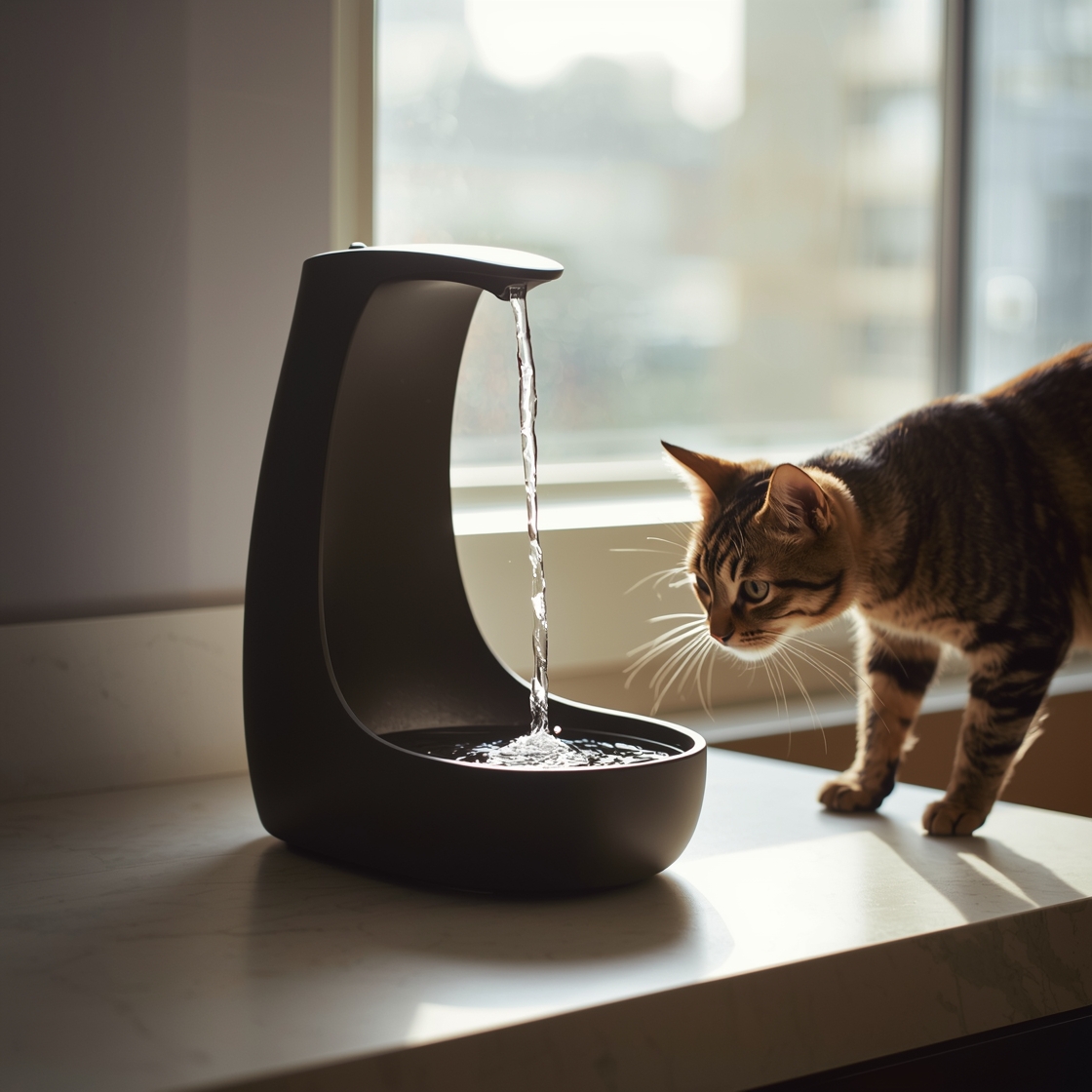
The best cat water fountain with filter for multiple cats is a 2.8–3.8 L non-porous tank with a filter you will replace on a busy-house calendar — not a 2 L single-cat bowl three adults empty by dinner. The We read the titles and descriptions of the seven catalog SKUs on this page plus a wider scan of 26 multi-pet fountain listings on four buyer-visible signals: listed liters, drink-face access (360° vs one spout), filter stages named, and cordless vs plug-in. Of those 26 listings, only 8 printed ≥2.8 L. Card snapshots on this URL sum to $426.
The best cat water fountain with filter for multiple cats is therefore a volume + hygiene problem. Cornell’s Feline Health Center treats water intake as part of the FLUTD conversation. The 2013 AAFP/ISFM Environmental Needs Guidelines treat multiple water sites as a multi-cat need. Neither document ranked these seven SKUs. One 2 L fountain in the kitchen is still one resource.
Our guides are reader-supported. This article may contain affiliate links. As an Amazon Associate we may earn a commission if you buy through links, at no extra cost to you.
Quick picks at a glance
- Biggest tank / 360°: PetSafe Drinkwell Stainless Steel 360 Multi-Pet Fountain — 3.8 L — $80.
- Per-cat RFID log: PETLIBRO Dockstream RFID Cat Water Fountain for Multi-Cat (3L) — $90.
- Value 2.8 L stainless: Veken 95oz/2.8L Stainless Steel Cat Water Fountain — $40.
- Cordless 3 L quiet claim: PETKIT EVERSWEET MAX Cordless Cat Water Fountain (3L) — $90 — maker says under 26 dB.
- Cordless 2.5 L mid: PETLIBRO Dockstream Cordless Cat Water Fountain (2.5L) — $50.
- Compact triple filter: Catit PIXI Stainless Steel Drinking Fountain (Triple Filter) — 2 L class — $38.
- Budget 2 L stainless: PETLIBRO Stainless Steel Automatic Cat Water Fountain (2L / 67oz) — $38.
Related desk pages: best cat water fountain, best stainless steel cat water fountains, best cat feeder for two cats.
What the best cat water fountain with filter for multiple cats actually means
Three cats are not “one cat times three” on a 67 oz tank. Combined daily intake plus splash plus “the dog also drinks” empties a 2 L bowl before the filter has a career. this comparison's capacity line is simple:
- 2.0–2.5 L: two cats if you top off; three cats if you like doing dishes.
- 2.8–3.0 L: three cats through a day in most owner-theme households.
- 3.8 L: the PetSafe 360 job — several pets, fewer panic refills.
International Cat Care treats multi-cat homes as a resource-distribution problem. Water is a resource. One fountain plus one still bowl in another room is the N+1. One fountain next to the only feeder is a blockade.
Four facts belong in the first screen of any best cat water fountain with filter for multiple cats decision:
- Liters first. If the listing will not print a volume, keep shopping.
- Access geometry. A 360° tower lets two cats drink without a queue. A single spout is a timeshare.
- Filter calendar scales with heads. Maker “every 4 weeks” becomes every 2 weeks with three longhairs and a pump full of fur.
- A second still bowl. Pumps die at 2 a.m. Multi-cat homes need a backup dish.
What
How multi cat fountain listings compare on labels
These tables are desk compilations from listed liters, materials, and the August 2026 card prices on this URL. Prices move. Heuristics, not lab output.
Table 1 — Capacity, access, and card price
| Product | Listed capacity | Access / power cue | Card price | Multi-cat job |
|---|---|---|---|---|
| PetSafe Drinkwell 360 SS | 3.8 L / 128 oz | 360° tower, plug-in | $80 | Biggest shared tank |
| PETLIBRO Dockstream RFID 3L | 3 L / 101 oz | RFID + app, pump-free pitch | $90 | Who is drinking |
| Veken 95oz / 2.8L SS | 2.8 L / 95 oz | Two flow modes | $40 | Value sweet spot |
| PETKIT EVERSWEET MAX 3L | 3 L / 105 oz | Cordless, <26 dB claim | $90 | Place-anywhere 3 L |
| PETLIBRO Dockstream cordless 2.5L | 2.5 L / 84 oz | Cordless, SS tray | $50 | Mid cordless |
| Catit PIXI triple filter | ~2 L | Multi-position SS top | $38 | Compact / picky drinkers |
| PETLIBRO SS auto 2L / 67oz | 2 L / 67 oz | Adjustable flow | $38 | Budget metal, small multi |
Desk stat: In the wider August 2026 scan of 26 multi-pet listings, 18 of 26 used “multiple cats” while printing ≤2.2 L. Marketing is not liters.
Table 2 — Seven SKUs against the multi-cat fit test
| Product | 3-cat day fit | Filter theme | Noise / pump theme | Watch-out |
|---|---|---|---|---|
| PetSafe 360 | Best volume here | Carbon + foam | Plug-in tower | Footprint |
| RFID Dockstream 3L | Good volume | Multi-layer | Pump-free pitch | $90 + tags + Wi-Fi |
| Veken 2.8L | Sweet spot | 5-stage language | Two modes | 2–3 week clean in busy homes |
| PETKIT MAX 3L | Good volume | Recirc filter | Maker <26 dB | Battery + $90 |
| Cordless Dockstream 2.5L | Tight for 4+ | Bottom-draw | Quiet cordless | Filter ~2 weeks multi |
| Catit PIXI | Tight for 3+ | Triple (cotton/carbon/resin) | Compact | Refill cadence |
| PETLIBRO 2L | Tight for 3+ | 3-layer | Quiet-pump theme | Smallest tank |
Table 3 — Household vs fountain choice
| Household | Desk liters | Index pick on this page | Also do this |
|---|---|---|---|
| 2 adults | 2.5–3.0 L | Veken 2.8L or cordless 2.5L | One still bowl upstairs |
| 3 adults | 2.8–3.8 L | Veken or PetSafe 360 | Second water room |
| 4+ or cats + dog | 3.8 L | PetSafe 360 | Dog-sized backup bucket |
| Need per-cat data | 3 L | RFID Dockstream | Clinic if one cat drops |
| No outlet where they drink | 2.5–3.0 L | PETKIT MAX or cordless Dockstream | Charge calendar |
| Budget, 2 cats | 2.0–2.8 L | PIXI or PETLIBRO 2L or Veken | Top off daily if 2 L |
Table 4 — Running-cost levers (not a lab bill)
| Lever | Why it matters in a multi-cat house | Failure mode | Desk rule |
|---|---|---|---|
| Filter interval | More hair, more chlorine taste complaints | “Monthly” on a 4-cat pump | Buy a 6-pack on day one |
| Pump brush | Hair is the clog | New fountain every six months | Weekly impeller |
| Reservoir size | Fewer dry-tank mornings | 2 L + 3 cats | ≥2.8 L or two fountains |
| Second still bowl | Pump outages | All water in one device | N+1 water |
| Stainless / SS tray | Less odor in shared use | Plastic slime | Metal on the tongue |
| Placement vs litter | Cats avoid toilet-adjacent water | One fountain by the box | Separate rooms |
Table 5 — Card math (August 2026 snapshots)
| Stack | Example SKUs | Snapshot total | Who it is for |
|---|---|---|---|
| Value 3-cat | Veken 2.8L | $40 | default listing review buy |
| Big shared | PetSafe 360 | $80 | Cats + small dog |
| Cordless 3 L | PETKIT MAX | $90 | No outlet |
| Track drinkers | RFID 3L | $90 | Medical-watch household |
| Budget 2-cat | PIXI or PETLIBRO 2L | $38 | Accept more refills |
| Cordless mid | Dockstream 2.5L | $50 | 2–3 cats, moveable |
| All seven | Collection | $426 | A closet, not a plan |
How the desk scores the best cat water fountain with filter for multiple cats
We do not run hydration labs and we do not score “tested for 2026.” Four checks:
1. Liters you can read. 3.8, 3.0, 2.8, 2.5, 2.0. Those are the ranks that matter.
2. Can two cats drink at once? 360° or a wide tray beats a single flower spout.
3. Will you open the pump? Multi-cat hair wins every time.
4. Is there a second water site? This checklist fails a one-fountain-only home for three cats even if the tank is 3.8 L.
If you only have one cat, the shorter best cat water fountain page is the better URL. Do not buy RFID for a solo cat unless you like apps.
Top picks — seven catalog fountains for shared homes
Cards below are the catalog lines for this URL. Specs are the maker’s. They change.
1. PetSafe Drinkwell Stainless Steel 360 Multi-Pet Fountain
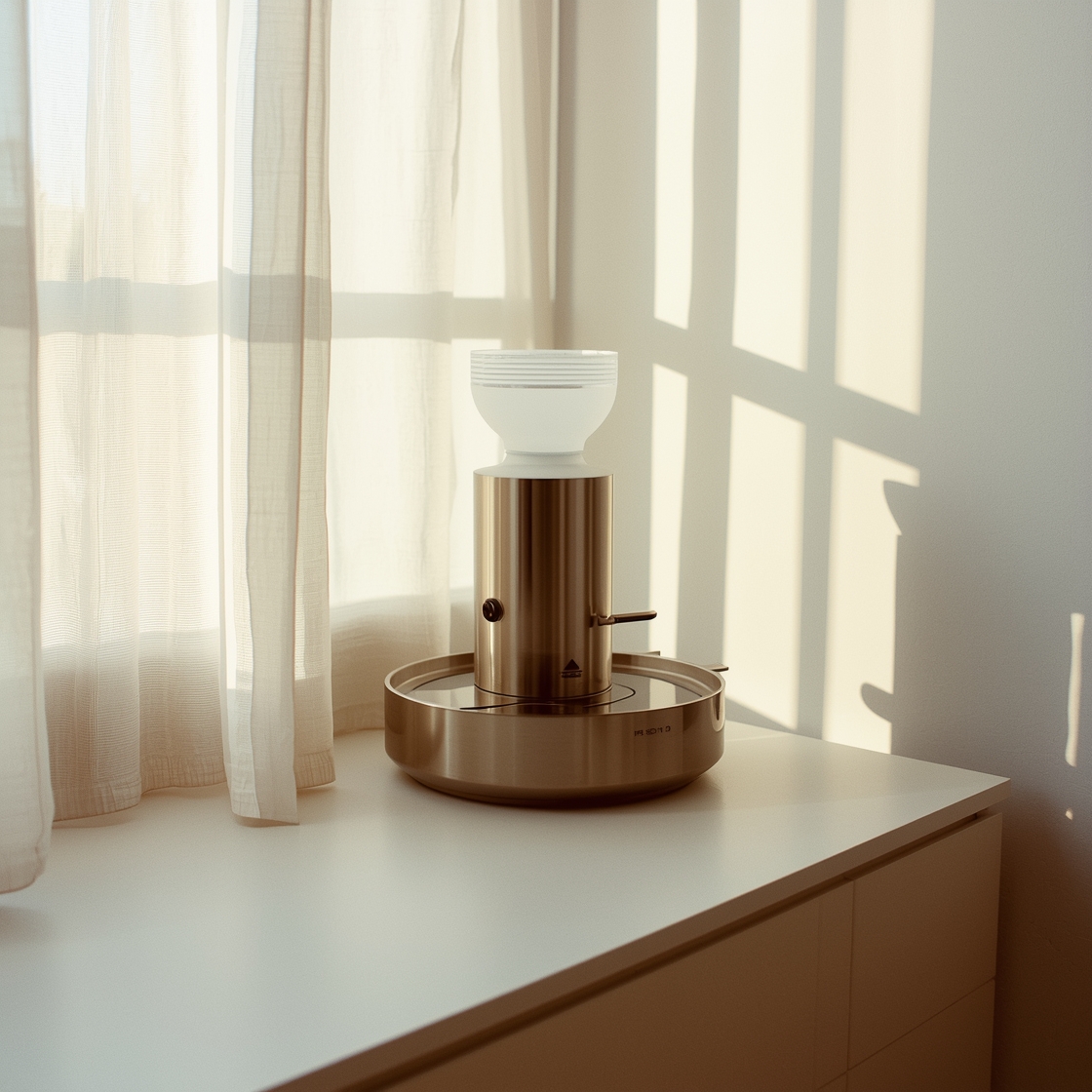
Best for: three or more pets that need the largest listed tank and 360-degree access.
Card price $80. 3.8 L / 128 oz is this comparison's volume winner. The tower design is the access winner — several streams, several angles, less queueing. Dual filtration language: carbon plus foam. Stainless body, top-rack dishwasher pitch on the maker’s page.
The honest con is footprint. This is furniture, not a mug. Filters are a running cost. If you have two cats and a huge kitchen, you may still want this so you stop topping off. If you have two cats and a tiny studio, measure the floor.
Pros: Largest tank here; 360° access; stainless Cons: Bulk; filter spend
2. PETLIBRO Dockstream RFID Cat Water Fountain for Multi-Cat (3L)
Best for: a household that needs a per-cat drink log because one cat is the medical question.
Card price $90. 3 L. RFID collar tags for up to five pets and a 2.4 GHz app are the product. Pump-free draw is the quiet/clean pitch. Stainless tray. Multi-layer filter (carbon, resin, non-woven).
The honest con is complexity. Tags, Wi-Fi, and $90 are a lot if you only wanted more water. RFID is a signal, not a diagnosis. If one cat’s visits drop, that is a clinic conversation, not a firmware update.
Pros: Per-cat log; 3 L; pump-free pitch Cons: Price; app/tag overhead
3. Veken 95oz/2.8L Stainless Steel Cat Water Fountain
Best for: the default best cat water fountain with filter for multiple cats value — 2.8 L metal without a $90 app.
Card price $40. 95 oz / 2.8 L sits in the three-cat day band. Stainless, dishwasher-safe language, 5-stage filter copy, two flow modes. Mixed-pet marketing (cats plus small-to-medium dogs).
The honest con is maintenance cadence. Busy homes chew filters and pumps on a 2–3 week clock. 2.8 L is smaller than 3.8 L. If you also have a thirsty dog, look at PetSafe.
Pros: Sweet-spot liters; metal; $40 Cons: Not the biggest; filter cadence
4. PETKIT EVERSWEET MAX Cordless Cat Water Fountain (3L)
Best for: a 3 L tank where there is no outlet — bedrooms, sunrooms, rental islands.
Card price $90. 3 L / 105 oz. Maker battery language: about 5000 mAh and long charge intervals (listings have used figures on the order of tens of days — treat those as manufacturer claims, not desk measurements). Maker noise language: under 26 dB. App and motion-sensor flow are extras.
The honest cons: you will charge it; filters about monthly on the maker’s page; $90. Cordless is a placement feature. It is not quieter than a clean plug-in just because it is cordless — the 26 dB figure is the maker’s.
Pros: 3 L without a cord; placement freedom Cons: Charge calendar; premium price
5. PETLIBRO Dockstream Cordless Cat Water Fountain (2.5L)
Best for: cordless placement at $50 when 3 L and RFID are more than you need.
Card price $50. 2.5 L / 84 oz. Rechargeable pack (listings often cite ~5000 mAh). Stainless tray. Bottom-draw / vertical filter language. Easy teardown in owner themes.
The honest con: 2.5 L is tight for four cats. Maker multi-pet filter language is often about every two weeks. This is a two-to-three-cat cordless, not a kennel tank.
Pros: Cordless mid price; SS tray; simple clean theme Cons: 2.5 L; faster filters in multi use
6. Catit PIXI Stainless Steel Drinking Fountain (Triple Filter)
Best for: two cats or picky drinkers who want several drink postures in a compact stainless top.
Card price $38. Triple-action filter: cotton, carbon, ion-exchange resin — Catit’s usual stack. Multiple drink zones on the steel top. About 2 L class.
The honest con is the whole multi-cat thesis: 2 L is a refill hobby with three adults. Monthly filter on the maker’s page still adds up. Buy PIXI as a second fountain in a bedroom, or as the only fountain for two small cats.
Pros: Trusted filter stack; multi-position top; $38 Cons: Small for 3+; monthly cartridges
7. PETLIBRO Stainless Steel Automatic Cat Water Fountain (2L / 67oz)
Best for: the cheapest stainless door into this brand when you accept more top-offs.
Card price $38. 67 oz / 2 L. Quiet-pump theme. Three-layer filter (cotton, carbon, resin). Adjustable flow.
The honest con is identical to PIXI: 2 L is not a four-cat plan. Use it as fountain #2 or as a two-cat starter. Filters every 2–4 weeks, sooner with a crowd.
Pros: Affordable stainless; adjustable flow Cons: Smallest tank; filter cadence
Want the wider aisle? See multi-cat filtered fountains on Amazon →
How to choose the best cat water fountain with filter for multiple cats (five checks)
- Count heads, then add a dog if you have one. Buy liters for the high-use day, not the quiet Tuesday.
- Print the volume. 2.8 L or above for three cats is The usual pick.
- Plan two water sites. Fountain + still bowl, or two fountains on two floors.
- Budget filters in the same checkout. A $40 fountain with no spare cartridges becomes a $40 bowl.
- Separate from litter and from the only feeder. AAFP resource maps are about distance, not brand.
Cornell FHC owns the medical frame. Wet food and a workup own crystals. A 360° tower does not.
Two fountains vs one huge tower
One 3.8 L PetSafe in the kitchen plus a 2 L PIXI upstairs is often calmer than one trophy tank every cat must visit. Shy cats drink where the bully is not. That is the same logic as two-cat feeders.
If they already queue and stare, a second water site is cheaper than an RFID app.
Filters in a hair house
Longhairs plus a fountain is a pre-filter problem. Skim the surface. Brush the pump. Replace foam. Carbon/resin cartridges do not eat entire coats. If you skip the brush, you will believe “multi-cat fountains don’t work.”
Hard water scales the impeller. Vinegar soaks on non-electrical parts if the maker allows it. Descale more often than the box says if your kettle already crusts.
Cordless vs plug-in in a shared home
Cordless wins rooms without outlets and rooms where a cord is a chew toy. Plug-in wins “I never remember to charge.” A dead cordless fountain at 6 a.m. with three cats is a still, warm bowl. Set a charge reminder or keep the still dish.
PETKIT’s 26 dB claim and long battery figures are manufacturer numbers. Owner themes still cluster on cordless units as quieter in bedrooms when the pump is clean — treat that as a theme, not a certificate.
RFID: useful signal, not a diagnosis
Dockstream RFID can show that one tag stopped visiting. That is useful. Tags fall off. Cats drink from the bathtub. The app is not a urinalysis. If the log drops and the cat is hiding, skip the settings menu. Book the clinic.
Introduction: three cats and a new pump
Run the new fountain beside the old bowls for several days. Do not remove the still water on night one. Some cats need a week. Place a second still bowl in the quiet room so the shy cat is not required to walk through the other two.
If one cat guards the fountain, you do not have a SKU problem. You have a resource problem. Add a second tank.
Seven buying mistakes the Multi-Cat we keep seeing
“Multiple cats” on a 2 L photo. Read the ounces.
One fountain by the litter. Then the tub.
RFID for a household that will not charge tags. Then a $90 bowl.
No spare filters. Then odor in week three.
Cordless with no charge habit. Then a dry morning.
Skipping the pump brush. Then “it got loud.”
Treating liters as medicine. Then a delayed FLUTD visit.
A 14-day multi-cat fountain introduction that does not start a blockade
Day 1: place the new tank beside the existing bowls. Do not pull the still water. Three cats do not vote as a committee. The bold one will try first. The shy one will wait.
Days 2–4: add a still bowl in the quiet room if you do not already have N+1. If the bold cat sits on the 360° tower, that is a resource, not a success metric.
Days 5–7: first skim of hair. First pump glance. If flow dropped already, you have a longhair house. Buy the extra foam now.
Days 8–14: first cartridge check. If the water smells, you are on a two-week calendar whether the box said four. The best cat water fountain with filter for multiple cats in week two is the one that is still full at 10 p.m. and still used by the shy cat.
Never introduce a fountain on the same weekend you change food, litter, and a feeder. One variable.
Two floors, one bully, and why liters are not enough
A 3.8 L PetSafe in a kitchen the bully owns is a 0 L fountain for the cat on the landing. Carry a 2 L PIXI or a still bowl upstairs. AAFP’s multiple-resource rule is locations, not gallons in one room.
Night feeders who also drink at 3 a.m. need water where they already walk. Do not make them cross the dog.
Hair, pumps, and a Saturday maintenance block
Set a recurring 15-minute block: empty, wash, brush impeller, rinse pre-filter, refill. Three cats make this non-optional. If Saturday is impossible, pick Wednesday. Unassigned cleaning is how shared fountains die.
Assign a person. The unassigned belly in grooming is the unassigned pump here. Write the name on the tank.
Keep a spare pump if the ecosystem sells one. Keep a spare cartridge six-pack. A dry multi-cat house on a Sunday when Amazon is a day away is how you get three cats on one mug.
Hard water and three-cat scale
Scale is faster when the pump never stops and three tongues never pause. If your kettle crusts in a week, your impeller will too. Descale on the maker’s method. A white crusty Drinkwell is not “premium stainless aging.” It is a neglected impeller.
Well water with iron stains ceramic and glass. Stainless hides it until the pump wheezes. None of that is a brand defect.
What this seven-card catalog is not
It is not the seven single-cat glass and ceramic cards on the best cat water fountain page (Brook, MISFANS, Tomxcute, 74 oz starter). Those are material stories. This URL is a liters-and-access story. Do not mix the catalogs in your head and wonder why a 90 oz glass piece is missing.
Cost per year in a three-cat house
Veken at $40 plus $10 filters × 18 (two-week cadence) is about $220. PetSafe at $80 plus foam and carbon on a similar clock can land in the same band or higher. RFID at $90 plus tags plus filters is the data tax. Cordless at $90 plus a forgotten charge is a still bowl with a battery.
The cheap mistake is a $38 2 L tank plus daily top-offs plus a second emergency fountain you buy at 9 p.m. Buy the 2.8 L once.
When a multi-cat fountain question is a clinic question
Any one cat straining, blood in urine, crying, vomiting, or a sudden stop in drinking — even if the other two look fine. Buy nothing. Book the clinic. Shared water does not mean shared health.
Wet food, dry food, and why three dry-food cats empty a tank
Clinic educational pages treat canned food as a major water source. Three dry-food adults will drink more from the fountain than three wet-food adults. If you just switched the house to kibble, expect the 2.8 L Veken to need a top-off that it did not need last month. That is diet, not a defective pump.
Conversely, a house that already feeds wet food still benefits from a second water site. Cats like options. The fountain is not redundant. It is the moving-water option.
Vacations, boarding, and the three-cat sitter note
Write: “Fountain: empty, wash bowl, brush the black impeller, refill. Spare filter in the left drawer. Still bowl on the landing stays full.” If the sitter only “adds water,” you will come home to a loud, low tank and three cats on the tub.
For trips longer than a week, a 3.8 L PetSafe plus a still bowl is kinder than a 2 L PIXI you hoped would last. Cordless units need a charge on day 1 of the sit. Do not discover that on day 8.
Mixed-species honesty
A small dog on the PetSafe 360 is the design intent. A large dog is a drain. Cats may stop using a fountain a dog slobbers in. If the dog is the problem, the dog gets a bucket and the cats keep the steel tray. Shared water is a hygiene multiplier.
Frequently asked questions
What is the best cat water fountain with filter for multiple cats if I only buy one thing from this page?
Veken 2.8 L at $40 for most three-cat homes; PetSafe 360 at $80 if you also have a dog or hate refilling. The best cat water fountain with filter for multiple cats on this URL is the liters-and-access match, not the app.
How big should a fountain be for three cats?
Desk default: 2.8 L or larger, plus a still bowl. 2 L is a two-cat tank.
Do I need RFID?
Only if you will use the log. It does not replace a clinic.
How often do I change filters with multiple cats?
Often every 2–3 weeks in owner-theme busy homes, even if the box says 4. Follow the dirt, not the optimistic interval.
Is stainless required?
A stainless tray or body is the hygiene theme on this page. Plastic bowls still dominate the wider aisle. Shared use makes slime worse.
Can two cats share a 2 L PIXI?
Yes if you top off and clean. Three cats will empty it. Use it as fountain #2.
Are cordless fountains safe overnight?
If charged, yes as a device. Keep a still bowl anyway. Pumps and batteries fail.
Should water sit in more than one room?
Yes. AAFP-style N+1. Especially in a three-story or bully-and-shy pair.
Will a fountain stop urinary crystals?
No. It may help a cat drink. The veterinarian owns the plan.
What if one cat never uses the fountain?
Keep their still bowl. Do not force the shared tank. Some cats never switch.
Heat, AC, and summer refill math
Hot apartments raise drinking. A 2.8 L tank that lasted a weekday in March can go dry on an August afternoon with three adults and a panting dog. Check the tank at dinner in summer even if you never did in winter. That is weather, not a new SKU.
AC rooms are dry. Fountain water still evaporates. Top off. Do not wait for the pump to suck air — dry-run is how impellers die.
Winter heat does the same evaporation trick next to a vent. Keep particle-board trees and fountain splash apart; this page is water, but a soaked engineered-wood base on a nearby tower is a slow lean. Place the tank on a tray. Place the tree on dry floor. Two jobs, two footprints.
If you foster or rotate a fourth cat for a month, treat the house as a 4-cat liter problem immediately. Do not wait for the 2.8 L tank to teach you. A spare still bowl on day one is cheaper than a dehydrated newcomer.
How we researched this guide
This guide is desk research. We cite Cornell FHC’s FLUTD overview, the 2013 AAFP/ISFM Environmental Needs Guidelines, and International Cat Care’s multi-cat advice because those documents are public and specific.
What we do not do: we do not run “tested for 2026” household trials, we do not employ a veterinarian, and we have not verified RFID logs or decibel stickers. Nothing here carries clinical endorsement.
Limitations: listed prices move; card prices are August 2026 snapshots; battery-day and dB figures are manufacturer claims. A written clinic plan supersedes this URL.