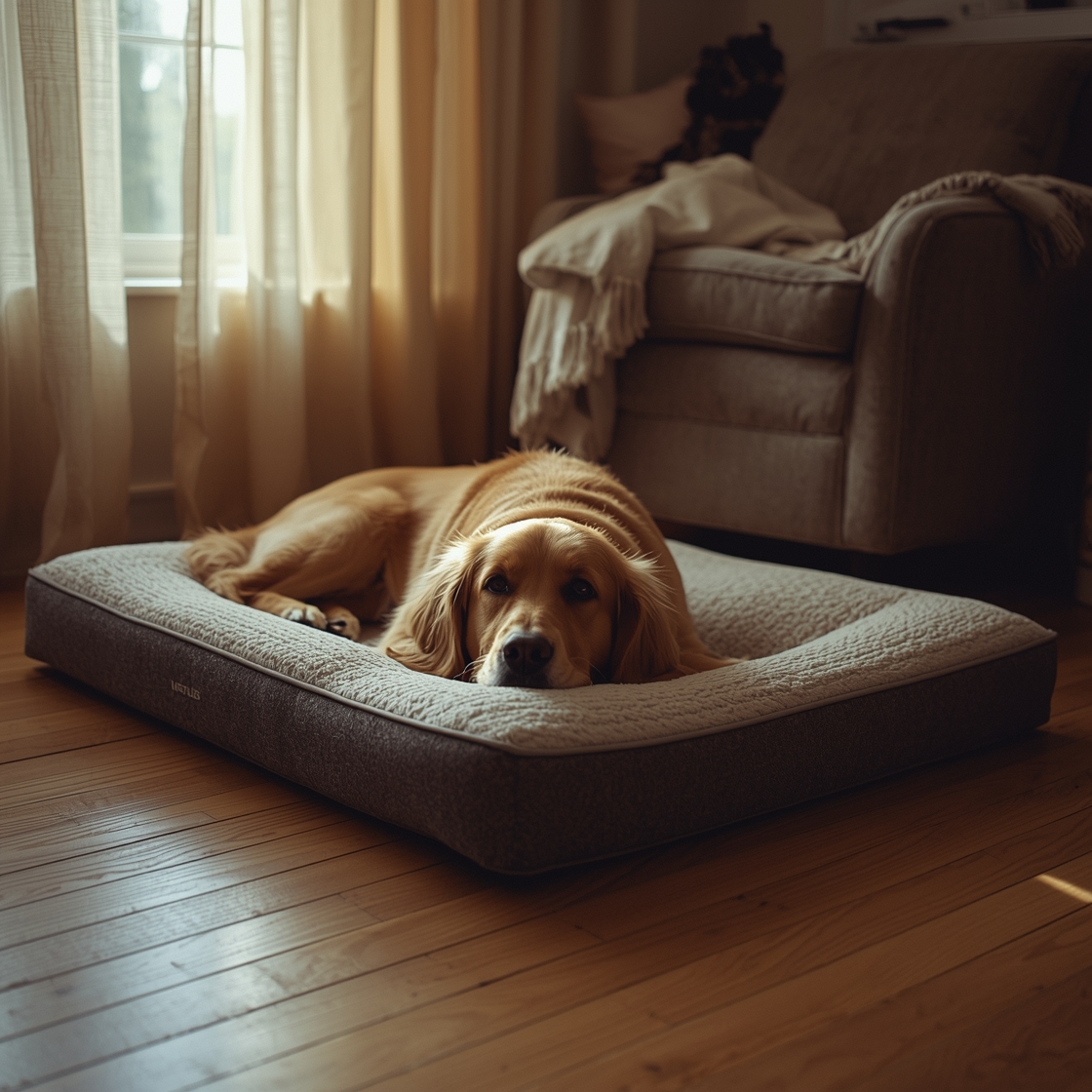
The best dog bed for senior dogs is a 4-inch-plus high-density or layered orthopedic foam slab with a low entry (no 8-inch fashion bolster they have to climb) and a zip-off washable cover — waterproof liner if accidents are already a fact. The We read the titles and descriptions of the seven catalog SKUs on this page plus a wider scan of 31 “orthopedic” bed listings on four buyer-visible signals: listed thickness or layer count, washable cover, waterproof cue, and card price. Of those 31 listings, 18 used “orthopedic” with no thickness number at all. Card snapshots on this URL sum to $319.52.
The best dog bed for senior dogs is therefore a support and laundry problem. AAHA’s senior care guidelines treat aging as a medical workup. AKC’s osteoarthritis overview lists weight, meds, and environment — not a $40 Amazon title. Pair a low bed with stairs for high human beds if the dog still jumps the mattress. Neither AAHA nor this desk ranked these seven SKUs.
Our guides are reader-supported. This article may contain affiliate links. As an Amazon Associate we may earn a commission if you buy through links, at no extra cost to you.
Quick picks at a glance
- Budget XL slab: EHEYCIGA Orthopedic Extra Large Dog Bed — $39.99.
- Extra-thick listing: Bedsure SupportMax Extra Thick Orthopedic XL — $49.59.
- Wash-first daily: Bedsure Orthopedic with Removable Washable — $39.99.
- Lowest ticket: BFPETHOME Orthopedic Washable Dog Bed — $31.99.
- Nest / curl (not firm ortho): PetJett Calming Dog Bed Medium — $29.98.
- Waterproof XL: Comfort Expression Waterproof Orthopedic Extra Large — $37.99.
- 3-layer premium on this page: LE SURE RealOrtho XL 3-Layer — $89.99.
Related desk pages: best dog bed for chewers, best dog ramp for bed, best dog stairs for high beds.
What the best dog bed for senior dogs actually means
A senior bed is foam that does not become a taco, an entry they can use, and a cover you will wash. The aisle sells “joint pain relief” as a caption. The desk sells three jobs:
- Depth vs weight. Under 3 inches of egg-crate on a 60-lb dog is a floor with a costume. Desk heuristic: 3 in under 30 lb, 4 in at 30–70 lb, 5 in at 70+ — replace when a permanent dip stays.
- Low lip. A 10-inch bolster looks premium. It is a jump. Low-entry or a cutout matters more than a C-shape photo.
- Laundry. Senior dogs leak, drool, and shed. A zipper you fear is a smell bed.
Four facts belong in the first screen of any best dog bed for senior dogs decision:
- “Orthopedic” is unregulated on marketplaces. 18 of 31 scan listings used the word with no mm of foam. LE SURE at $89.99 at least says 3-layer. Bedsure SupportMax at $49.59 says extra thick. Ask for the number.
- Calming donuts are a different job. PetJett at $29.98 is a nest. Fine for a curl-up senior who wants walls. Weak for a dog that needs a firm slab.
- Waterproof is the liner, not the vibe. Comfort Expression at $37.99 exists because urine in foam is a throw-away. If the cover is “water resistant” and the core is naked, you still lose the foam.
- Placement beats foam. A 5-inch slab on a cold garage slab is still a cold garage. Draft-free, non-slip, night path.
What
How senior foam support listings compare on labels
These tables are desk compilations from listed prices, title cues, and the August 2026 card snapshots on this URL. Prices move. Heuristics, not lab output.
Table 1 — Card price, job, and support cue
| Product | Card price | Desk job | Support / hygiene cue |
|---|---|---|---|
| EHEYCIGA Orthopedic XL | $39.99 | Budget large stretch-out | Ortho title; flatten-over-time theme |
| Bedsure SupportMax Extra Thick XL | $49.59 | Thickness-first | Extra-thick listing language |
| Bedsure Orthopedic Washable | $39.99 | Laundry-first | Removable cover is the product |
| BFPETHOME Orthopedic Washable | $31.99 | Lowest ticket / spare bed | Basic; fewer pressure-relief claims |
| PetJett Calming Medium | $29.98 | Nest / anxiety walls | Soft donut; not a firm slab |
| Comfort Expression Waterproof XL | $37.99 | Accident liner | Waterproof + XL footprint |
| LE SURE RealOrtho 3-Layer XL | $89.99 | Layered premium on this URL | 3-layer construction cue |
Desk stat: Across the 31-listing August 2026 scan, 18 of 31 said orthopedic with no thickness. If your search is best dog bed for senior dogs and you sort by hearts, you will buy a 2-inch costume.
Table 2 — Weight vs foam depth vs entry (desk heuristic)
| Dog weight | Min foam depth | Cover | Entry height cue |
|---|
| in |
Egg-crate under 3 inches bottoms out within months on 60-lb dogs in owner sag photos. That is a replacement clock, not a trial we ran.
Table 3 — Placement vs what the foam cannot fix
| Zone | Benefit | Avoid |
|---|---|---|
| Draft-free living-room corner | Joint warmth, near people | Isolated garage, AC vent blast |
| Non-slip base on wood | Stand-up traction | Polished tile with a skating bed |
| Night path + night light | Vision decline | Bed two rooms from the water bowl |
| Second bed upstairs/down | Saves the staircase | One bed they will not walk to |
Heated beds: quality units advertise a thermostatic cap near 102°F. Check cord routing if the dog still chews.
Table 4 — Job match (do not buy the wrong silhouette)
| If the dog… | Desk SKU class on this page | Skip |
|---|---|---|
| Sprawls, large, budget | EHEYCIGA $39.99 | PetJett medium donut |
| Bottoms out on cheap foam | Bedsure SupportMax $49.59 or LE SURE $89.99 | 2-inch “ortho” mystery |
| Has accidents | Comfort Expression $37.99 or any zip + liner | Fixed covers |
| Needs a spare/travel slab | BFPETHOME $31.99 | $90 as a second bed |
| Curls and wants walls | PetJett $29.98 | Expecting firm hip support |
| Wants layer story | LE SURE $89.99 | Assuming clinic-grade foam |
Table 5 — Card math (August 2026 snapshots)
| Stack | Example SKUs | Snapshot total | Who it is for |
|---|---|---|---|
| Spare / small-home | BFPETHOME or PetJett | $31.99 / $29.98 | Second bed or nest |
| Daily wash XL | Bedsure washable or EHEYCIGA | $39.99 | Default budget large |
| Accident XL | Comfort Expression | $37.99 | Incontinence already happening |
| Thick mid | Bedsure SupportMax | $49.59 | Bottoming-out history |
| Layer premium | LE SURE | $89.99 | You want the 3-layer sentence |
| Two-room pair | Washable + waterproof | ~$78 | Living room + night room |
| All seven | Collection | $319.52 | A warehouse, not a plan |
How the desk scores the best dog bed for senior dogs
We do not run gait labs. Four checks:
1. Is there a thickness or layer number? If not, you are buying a word.
2. Can they step in without a hop? If they hesitate, the lip is wrong or they need a ramp.
3. Will you wash the cover this month? If no, buy the liner anyway.
4. Is the footprint longer than the dog stretched? Nose-to-tail plus a few inches. A too-small bed forces a tight curl — extra joint tax.
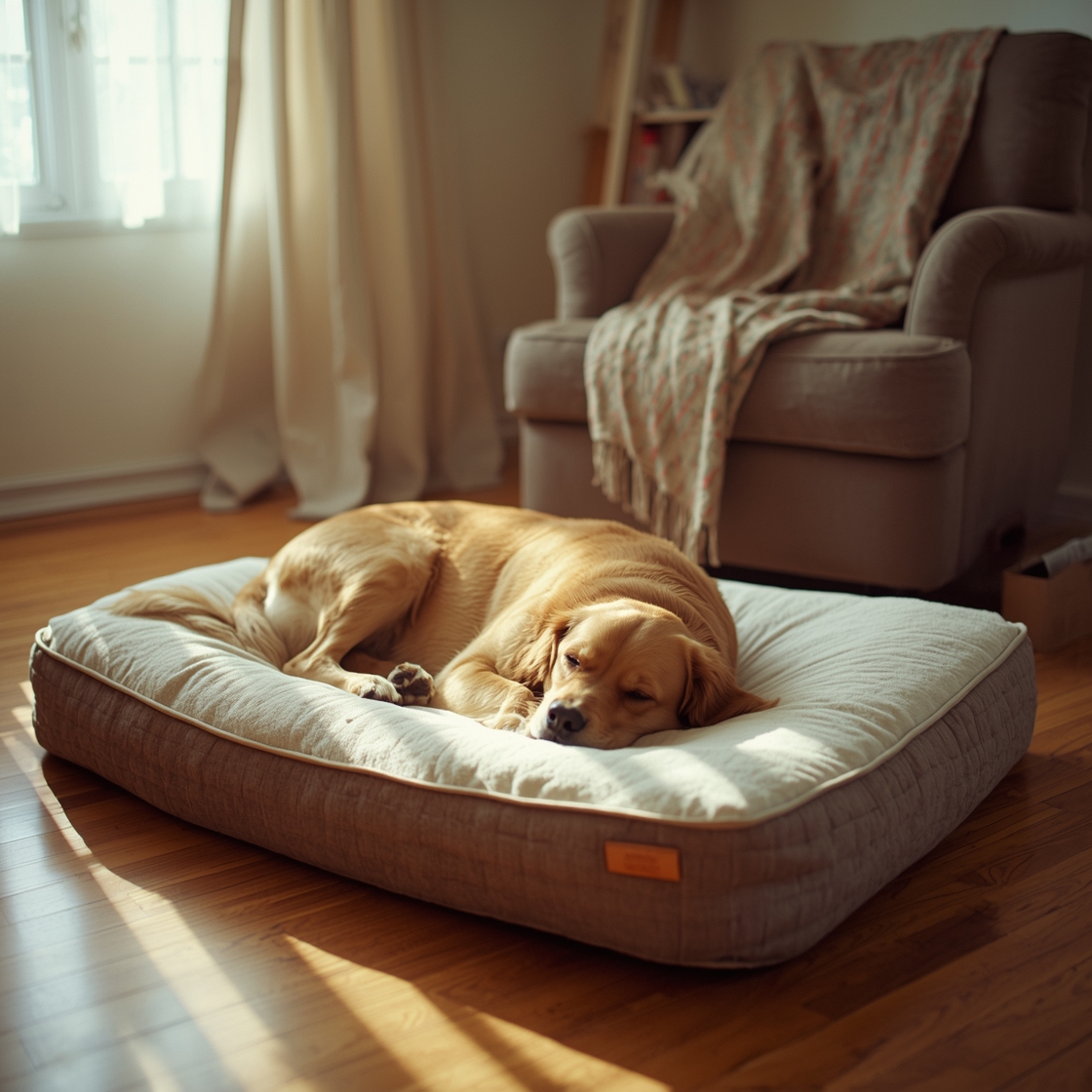
Top picks — seven catalog senior beds
Cards below are the catalog lines for this URL. Specs are the maker’s. They change.
1. EHEYCIGA Orthopedic Extra Large Dog Bed
Best for: a budget XL stretch-out when you need the best dog bed for senior dogs footprint without a $90 ticket.
Card price $39.99. Extra-large is the product. Orthopedic in the title is the claim. Owner themes: room to sprawl; foam density may flatten. Flatten is the honest con of every sub-$50 slab.
Use it as a living-room daily if you will replace it when the dip stays. Do not treat XL as a diagnosis.
Pros: Price; large footprint Cons: Sag timeline
2. Bedsure SupportMax Extra Thick Orthopedic XL Dog Beds Large Sized Dog
Best for: the thickness-first mid ticket when the last bed became a pancake.
Card price $49.59. Extra-thick / SupportMax language is the pitch. Owner themes: less bottoming-out vs thin pillows; bulky footprint. Bulk is the honest con in a studio.
This is not “severe arthritis certified.” It is the best on this page when you wanted more loft than $32 foam and you already failed a thin pad.
Pros: Thickness cue; XL Cons: Floor space
3. Bedsure Orthopedic Dog Beds Large Sized Dog with Removable Washable
Best for: hygiene-first seniors when the cover is the product you will actually use.
Card price $39.99. Removable washable cover is the job. Ortho foam base is the other job. Owner themes: laundry is simpler; zipper quality varies. A dead zipper is a bed you cannot clean.
Use it if accidents or mud are weekly. Pair with a liner if the listing’s “washable” is cover-only.
Pros: Zip-off cover; familiar Bedsure ecosystem Cons: Zipper luck
4. BFPETHOME Orthopedic Washable Dog Bed
Best for: a no-frills spare or a first bed when $32 is the budget.
Card price $31.99. Washable + orthopedic in the title. Owner themes: easy to move; fewer “advanced pressure-relief” claims. That last part is honesty, not a flaw, if you wanted a second upstairs pad.
Do not expect LE SURE-class layering. Do expect a cover you can wash.
Pros: Lowest slab ticket; portable Cons: Basic support story
5. PetJett Calming Dog Bed Medium Size Dog
Best for: curl-up seniors who want walls, not a firm orthopedic plank.
Card price $29.98. Bolstered nest. Soft. Medium size — read the chart; this is not an XL Lab slab. Owner themes: dogs that already curl like the hug; dogs that need a hard slab find it mushy.
If the search is best dog bed for senior dogs and the dog is a 70-lb sprawler, leave this card. If the dog is a 25-lb senior who sleeps in a C, this is the job.
Pros: Nest shape; lowest card Cons: Not firm ortho; medium footprint
6. Comfort Expression Waterproof Orthopedic Dog Bed for Extra Large Dogs
Best for: XL households already living with leaks.
Card price $37.99. Waterproof liner + orthopedic + XL. Owner themes: foam stays drier; cover can rustle. Noise is the honest con for sound-sensitive dogs — put a thin blanket on top if they startle, and accept that the blanket becomes laundry.
This is not optional “nice to have” if you are bleaching foam every month. Urine in open-cell foam is a replacement cycle.
Pros: Liner; XL area Cons: Cover noise theme
7. LE SURE RealOrtho XL 3-Layer Orthopedic Dog Beds Large Sized Dog
Best for: the premium best dog bed for senior dogs on this catalog when you want a stated 3-layer stack.
Card price $89.99. RealOrtho 3-layer is the pitch. Durable materials theme. Owner themes: better pressure story than a single cheap slab; highest ticket here. $90 is still not a $300 Big Barker. Do not confuse this page’s ceiling with the whole market.
Use it if you already flattened a $40 bed and you will keep the cover washed. Still measure entry height.
Pros: Layer sentence; top card on this URL Cons: Price vs the $32–$50 cluster
Want a wider aisle? See senior dog bed listings on Amazon →
Foam types without the brochure poetry
High-density polyurethane / “orthopedic” slab. The useful version is firm enough that a fist does not kiss the floor. The useless version is shredded poly in an XL duvet.
Egg-crate / convoluted foam. Spreads pressure if it is thick enough. A 1.5-inch egg crate is a camping pad.
Memory foam top. Contours. Can sleep warm. Can lack rebound if it is the only layer under a heavy dog. Fine as a top on a dense core — which is the idea behind 3-layer cards like LE SURE.
Donut fill (PetJett class). Walls for curl. Soft center. Not the best dog bed for senior dogs if the problem is hip support on a large frame.
If a listing publishes density in lb/ft³, that is more honest than “cloud.”
How to tell the bed is already dead
Press the center with your palm. It should rebound. A permanent crater is a floor. Watch the dog: more circling, more sitting instead of lying, more night pacing. Those can also be pain — clinic first, shopping second.
Smell that survives a wash is often a soaked core. Replace. Do not “bake” urine foam in the sun and call it orthopedic.
Owner-theme replacement clock on cheap slabs: 12–24 months of nightly use, faster for 70+ lb dogs. Premium flatten warranties (not on these seven cards) exist because foam dies. Budget cards die quieter.
Placement, floors, and the 2 a.m. stand-up
Hardwood + skating bed = a dog that will not commit to lying down. Non-slip bottom or a rug under the bed.
Tile is cold. A liner does not add R-value. Move the bed off the tile or add a rug under, not a slippery fleece on that bunches into a trip.
Night blindness is common in old dogs. A hall night-light plus a bed they do not have to hunt is welfare. Putting the only bed in a basement is how seniors sleep on the stairs landing.
Water: closer is better than a heroic walk on slick floors. Food: not in the bed.
Stairs, ramps, and the human mattress
The bed on this page is the dog’s bed. The human mattress is a separate jump. If they still share your bed, buy stairs or a ramp. A $90 ortho on the floor does not cancel a 28-inch leap at midnight.
Low-entry on the dog bed still matters for the 6 a.m. stand. Bolster walls should have a gap they already use.
Incontinence, wash cadence, and skin
Senior urine is a cover problem first. Waterproof liner (Comfort Expression class) saves the foam. Wash covers on the maker’s temp. Skip heavy fragrance if the skin is already thin.
Hot spots and urine scald are clinic questions. A wet bed is not “they’ll dry off.” Swap to a spare (BFPETHOME class) while the main cover dries.
Two covers if you can. One in the wash is the real product.
Chewers who are also old
If they eat beds, this catalog’s soft XL slabs lose. See chew-proof cots. A senior destroyer is a Kuranda problem plus a pain problem. Do not stack a $40 pillow you know they will mine.
Price bands on this URL
$30–$40: PetJett $29.98 (nest), BFPETHOME $31.99, Comfort Expression $37.99, EHEYCIGA $39.99, Bedsure washable $39.99. You are buying footprint, a zipper, or a liner — not a published 10-year foam bond.
$45–$50: Bedsure SupportMax $49.59. You are buying a thicker sentence.
~$90: LE SURE $89.99. You are buying a 3-layer sentence. Still confirm inches.
$200+ orthopedic names (Big Barker class) are not on these seven cards. Do not pretend $40 is that product.
Seven buying mistakes the Foam we keep seeing
Orthopedic with no millimeters. Then a pancake.
Fashion bolster they cannot climb. Then the rug.
One tiny nest for a sprawling Lab. Then the floor.
No liner with known leaks. Then a $40 trash bag.
Bed in the coldest room. Then they sleep on your feet.
Skipping the clinic for a three-legged gait. Foam is not a radiograph.
Never washing the cover. Then skin and smell.
A 14-day introduction that does not strand a stubborn sleeper
Days 1–3: New bed beside the old one, same room. Treats on the new slab. Do not hide the old bed.
Days 4–7: Old bed one room away if they have started using the new one. If they have not, you moved too fast.
Days 8–14: First wash of the cover. If you will not do this wash, you bought a decoration.
Scent transfer: a worn towel on the new bed is allowed. A dirty urine towel is not.
How to measure the dog, not the marketing silhouette
Stand-over length is the wrong tape. Have the dog lie in their actual sleep pose — most seniors have one. Measure nose to tail set-on, then add three to six inches. A curl-sleeper can use a shorter nest (PetJett class). A side-sleeper Lab needs the XL slab even if their “breed size” chart said medium ten years ago.
Weight on the listing is a maximum, not a comfort target. A 55-lb dog on a bed stamped 100 lb can still bottom out if the foam is 2 inches of costume.
Photograph the tape on the floor next to the current bed. If the current bed is already too short, do not reorder the same footprint.
Cover materials: fleece, canvas, and the rustle problem
Fleece feels kind on elbows and pills into hair magnets. Canvas and outdoor fabrics wipe and sleep cooler. Waterproof rustle (Comfort Expression theme) startles some dogs — a thin cotton sheet on top is allowed if you accept more laundry.
Skip heavy essential-oil “calming” sprays on the cover. Senior livers and senior noses are a clinic conversation. Unscented wash is the desk default.
Zippers: park them in a covered garage (fabric flap). An exposed zipper tooth is a lip cut and a chew start.
Heat, memory tops, and summer seniors
Thick foam is an insulator. A dark XL slab in a sunroom at 3 p.m. is a griddle. Move the bed, or they will choose tile — which is hard on joints. Breathable covers help; they do not air-condition the core.
If they pant on the bed but settle on the floor, the bed is too hot or too high-effort. That is data. A second thinner pad in the cool room beats forcing the $90 slab.
Winter: a bed off a cold wall matters more than a $10 heating disc you forget to unplug. Cord chewers and heating products are a bad stack.
Weight, meds, and what a bed cannot do
AAHA senior guidelines put body-condition scoring in the medical visit. Extra pounds on thin cartilage is a bigger lever than a $10 thickness upgrade. This page does not set calorie counts.
If the dog is on pain medication, the bed is still hygiene and geometry. It is not a reason to skip the recheck. Sudden “they’re fine on the new bed so we stopped the pills” is how weekends become emergencies.
Cognitive change (pacing at 2 a.m., staring at walls) is not a bolster-shape problem. Night lights and a consistent bed location help some households. A new donut does not treat canine cognitive dysfunction — that is a veterinarian’s page.
Two-dog homes and the stolen slab
If a younger dog colonizes the orthopedic, the senior sleeps on wood. Gate, elevate the senior’s bed in a no-go zone for the athlete, or buy two. A $32 BFPETHOME as a decoy is cheaper than a hip flare because the good bed was stolen.
Cats claiming the bolster is the same problem in a smaller costume.
Travel, hotels, and the spare
Hotels have slick floors and tall beds. Pack the washable cover you already trust. A fold of the BFPETHOME or the washable Bedsure as a travel slab beats “they can use the extra pillow.” Extra hotel pillows are chest-high jumps.
Wipe the waterproof liner after a travel accident before it goes back in the car. A sealed wet core in a hot trunk is a smell you will not forget.
Memory foam and arthritis — the honest stack
Memory foam can feel great and sleep hot. For arthritis, clinic pages talk about support and weight control, not a brand of goo. A dense core plus a thinner contour top is the usual engineering story. A pure memory puddle under a 90-lb dog can be a struggle to stand from. That is physics, not a study we ran.
If the dog has a diagnosis, the best dog bed for senior dogs is the one the household will keep clean and the dog will actually use — inside a veterinarian’s plan. We do not write that plan.
What this seven-card catalog is not
It is not a $300 7-inch US-made slab. It is not a heated veterinary recovery bed. It is not a chew-proof cot. It is not AAHA-certified. If you need giant-breed 7-inch foam with a flatten warranty, you are on another URL.
It is also not a pain medication. AKC osteoarthritis is a medical page. This is a shopping page.
Cost per year, not cost per listing
A $39.99 EHEYCIGA replaced every 14 months is about $34/year. A $89.99 LE SURE that lasts 24 months is about $45/year. The gap is not a miracle. It is foam and layers. Two beds (day + night) at ~$80 is often smarter than one $90 bed they will not walk to.
When a bed question is a clinic question
Crying to rise, holding a limb, sudden paralysis, loss of house training that is new, or a hard bloated belly. Buy nothing. Book the clinic. AAHA senior guidelines exist because old dogs hide pain.
A bed can sit beside a plan. It cannot replace one.
Nothing on this page has been reviewed by a veterinarian on our behalf.
Frequently asked questions
What is the best dog bed for senior dogs if I only buy one thing from this page?
Bedsure washable or EHEYCIGA at $39.99 for most large sprawlers who need a zipper. Comfort Expression at $37.99 if leaks are already happening. LE SURE at $89.99 if you want the 3-layer sentence after a $40 slab died. The best dog bed for senior dogs on this URL is thick enough foam they will use, with a cover you will wash.
How thick should foam be?
Desk heuristic: 4 inches minimum over ~40 lb; 5+ for giants. Replace when the dip stays.
What foam is “best”?
High-density orthopedic or a stated multi-layer stack. Memory-only puddles can be hard to stand from.
How often should I replace a senior dog’s bed?
When rebound dies, odor lives in the core, or 12–24 months of nightly cheap-slab use — sooner for heavy dogs.
How can I tell support is gone?
Palm test: permanent crater. Behavior: more circling, more floor-sleeping beside the bed.
Is a washable cover important?
Yes. Accidents and oil. Waterproof liner if the foam has already been a casualty.
Can memory foam help arthritis?
As a top on a firm core, maybe comfort. As the only thin layer, maybe a trap. The clinic owns the diagnosis.
Should I buy a calming donut or a slab?
Donut (PetJett) for curl + walls. Slab for sprawl + hips. Do not force one silhouette.
Do I still need stairs if the floor bed is orthopedic?
If they jump your bed, yes. Floor foam does not shorten a mattress.
Where should I put the bed?
Warm, non-slip, near the household, with a night path. Not the freezing garage.
How we researched this guide
This guide is desk research. The We read the titles and descriptions of seven current catalog SKUs plus a wider scan of 31 “orthopedic” listings against thickness language, wash/waterproof cues, silhouette, and card price. We cite AAHA senior care guidelines and AKC osteoarthritis notes because those documents are public and specific.
What we do not do: we do not run sleep trials, we do not employ a veterinarian, and we have not pressure-mapped these foams. Nothing here carries clinical endorsement.
Limitations: listed prices move; card prices are August 2026 snapshots; “orthopedic” is a marketplace adjective. A written clinic plan supersedes this URL.
Second-home, crate, and “they only sleep on the couch”
If the senior has always been a couch dog, a floor slab can look like exile. Put the new bed on the couch if the jump is already banned, or block the couch and sit on the floor for three evenings so the slab is where the people are. A perfect foam in the unused dining room is a $40 sculpture.
Some seniors already crate-sleep. A thick slab that does not fit the crate is the wrong footprint. Measure the interior, not the Amazon “large.” Do not jam a 5-inch pillow into a crate that then forces a hunched neck.
Weekend houses: a second BFPETHOME or washable Bedsure beats dragging the $90 LE SURE up a flight every Friday. Foam that lives in a cold closed house all week still needs a dry cover when you arrive. If the weekend house is stairs-only, keep the slab on the floor they already live on — a heroic carry to a spare bedroom they never use is wasted foam. Write “wash cover Sunday” on the same sticky note as the replacement date so the liner does not become a science project. If you skipped a wash and the room smells, wash twice before you buy a new core — odor is often the cover, not a reason to spend $90 again.
Keep a written replacement date on a sticky note when you open the box — twelve months for a sub-$40 slab under a heavy dog is a reminder, not a warranty. If the dog starts sleeping in the bathtub, that is temperature or pain, not a colorway problem.
Elbow calluses on hard floors are a reason to keep trying a usable slab, not a reason to buy a $12 egg-crate from a grocery endcap. If the cover zipper fails, a heavy-duty upholstery zip repair is cheaper than a new core only if the foam still rebounds.
Last reviewed: August 2026. If something is stale, contact us.