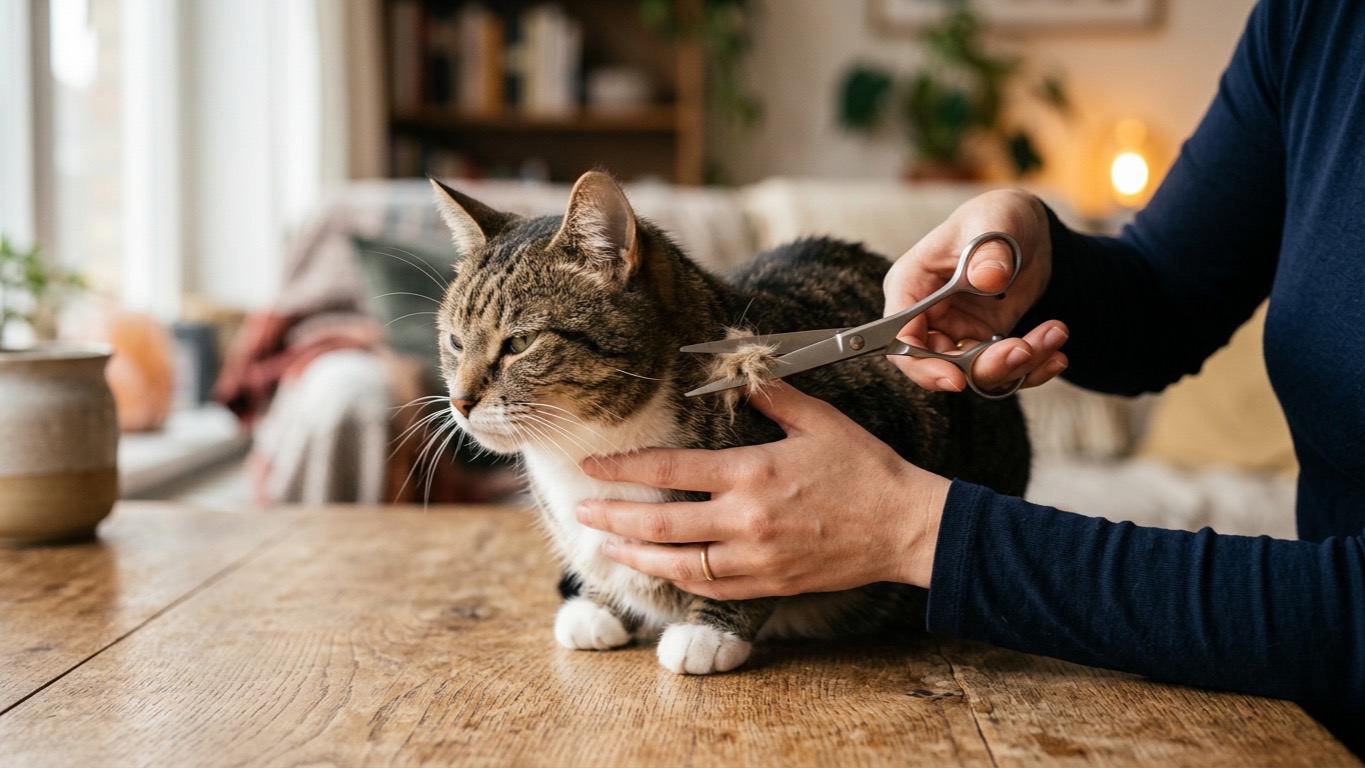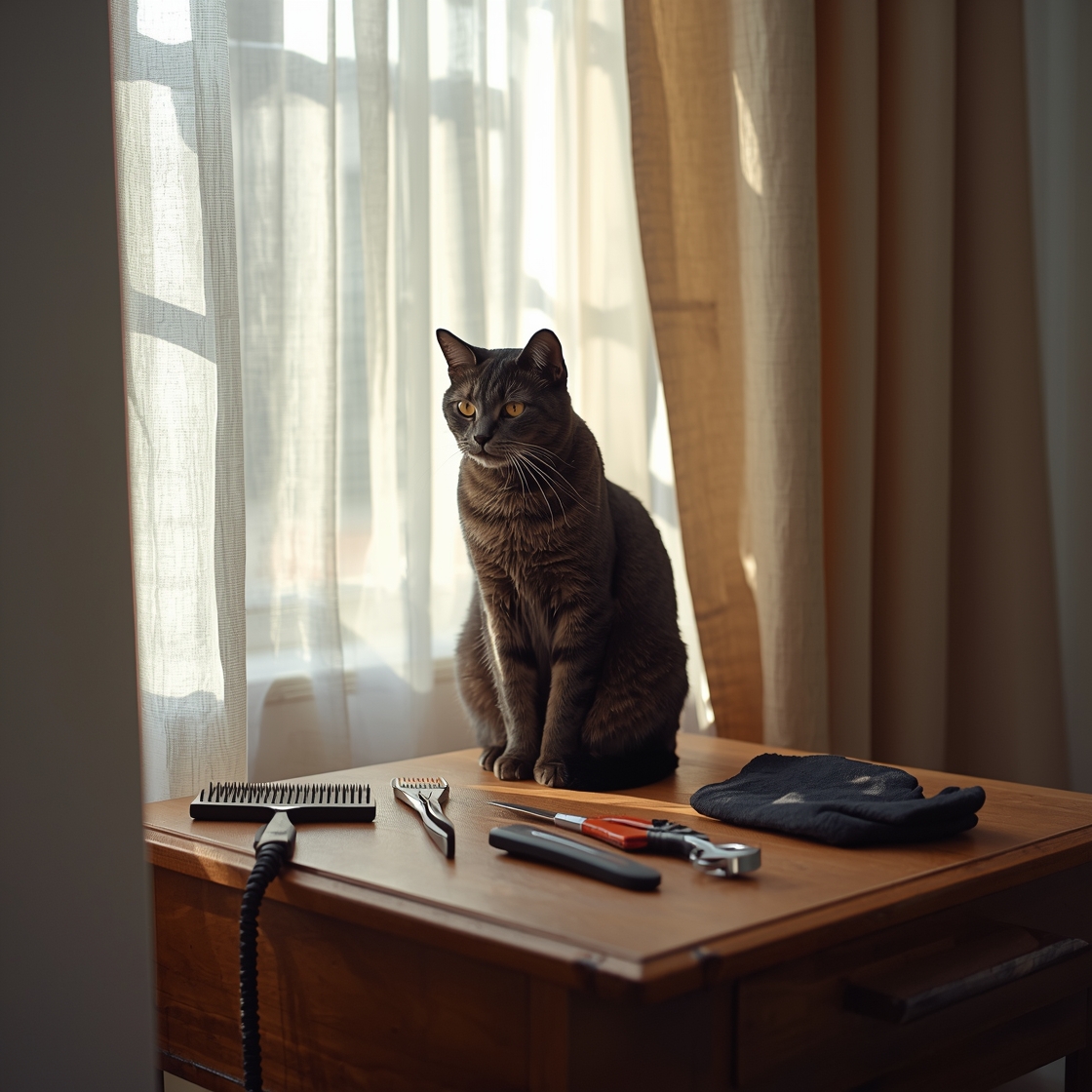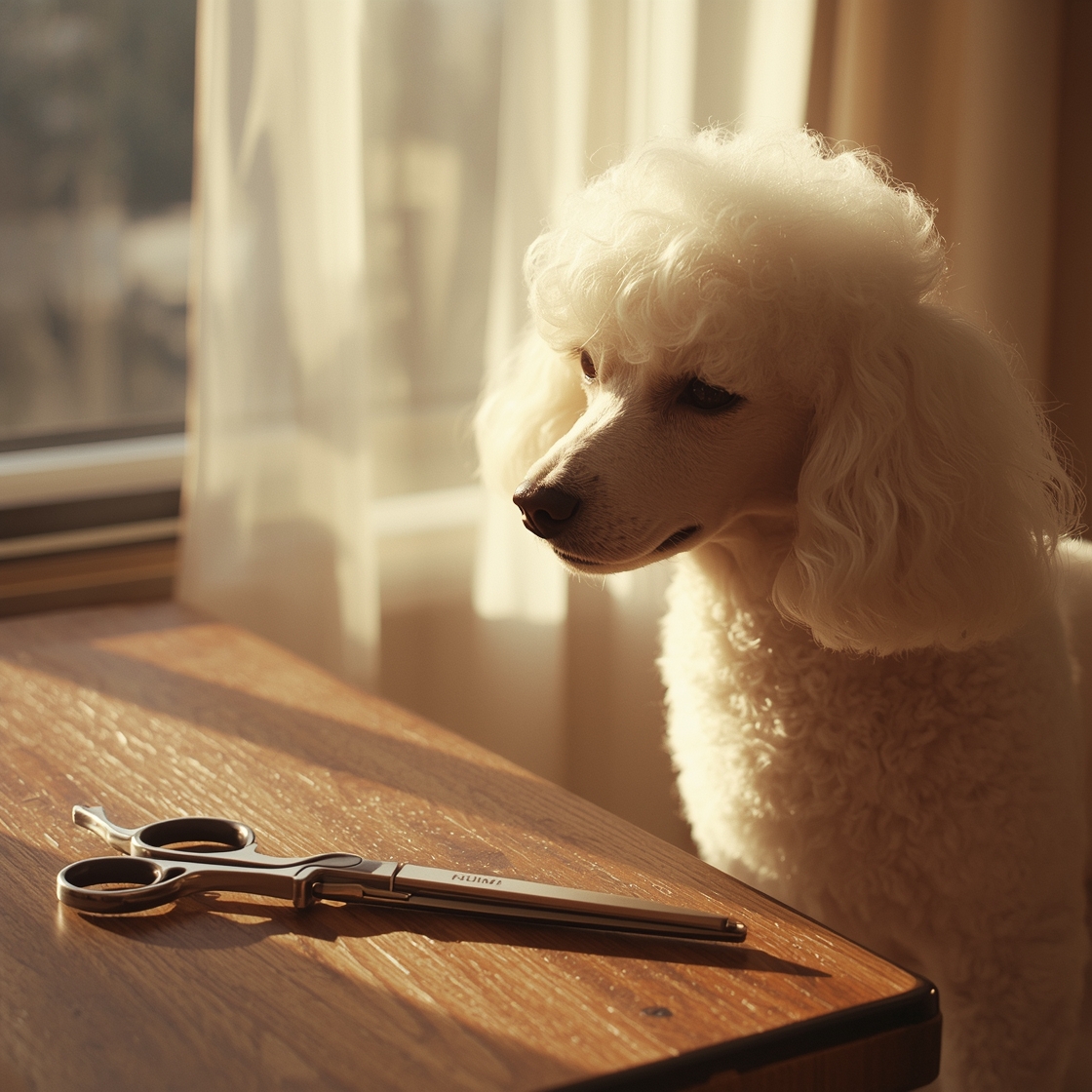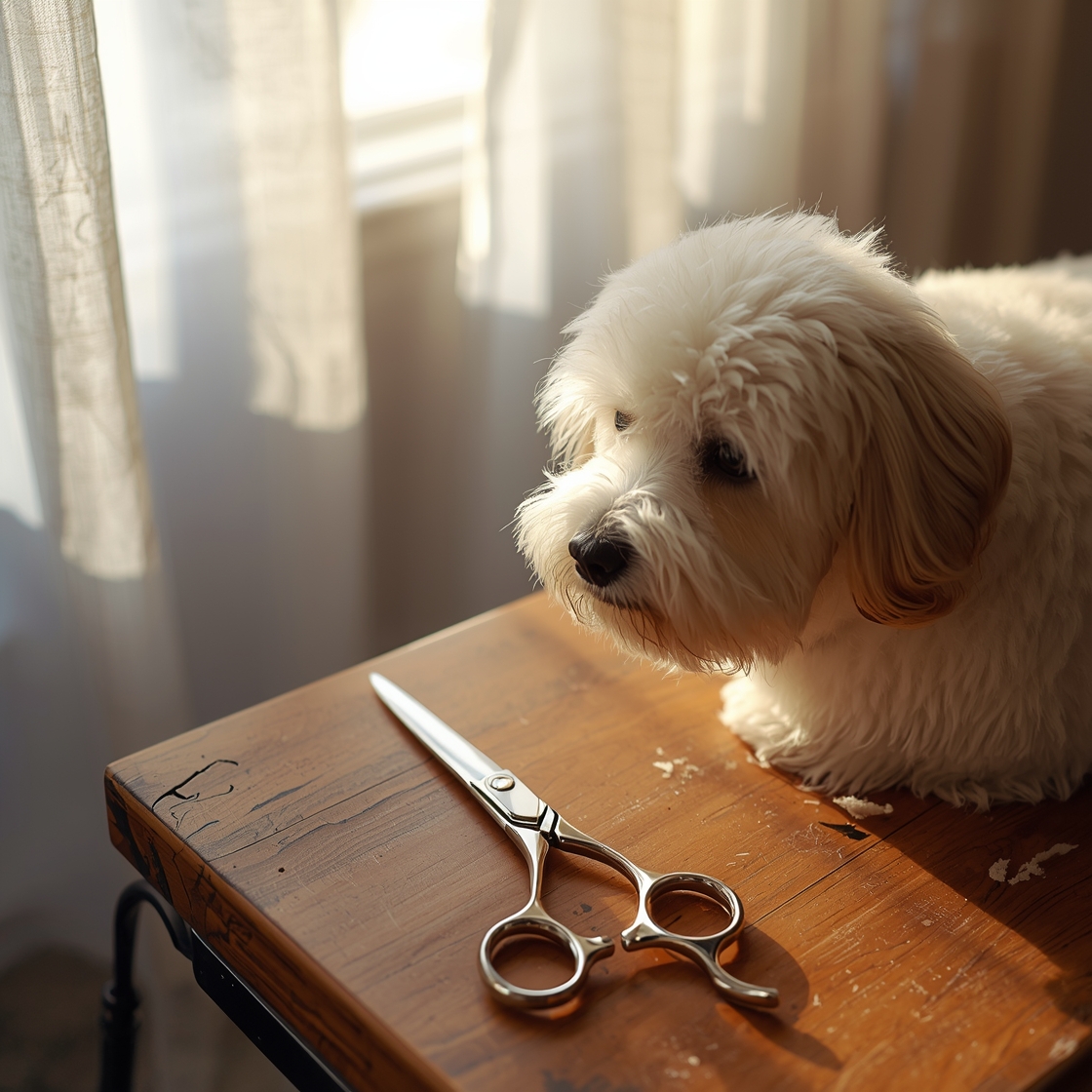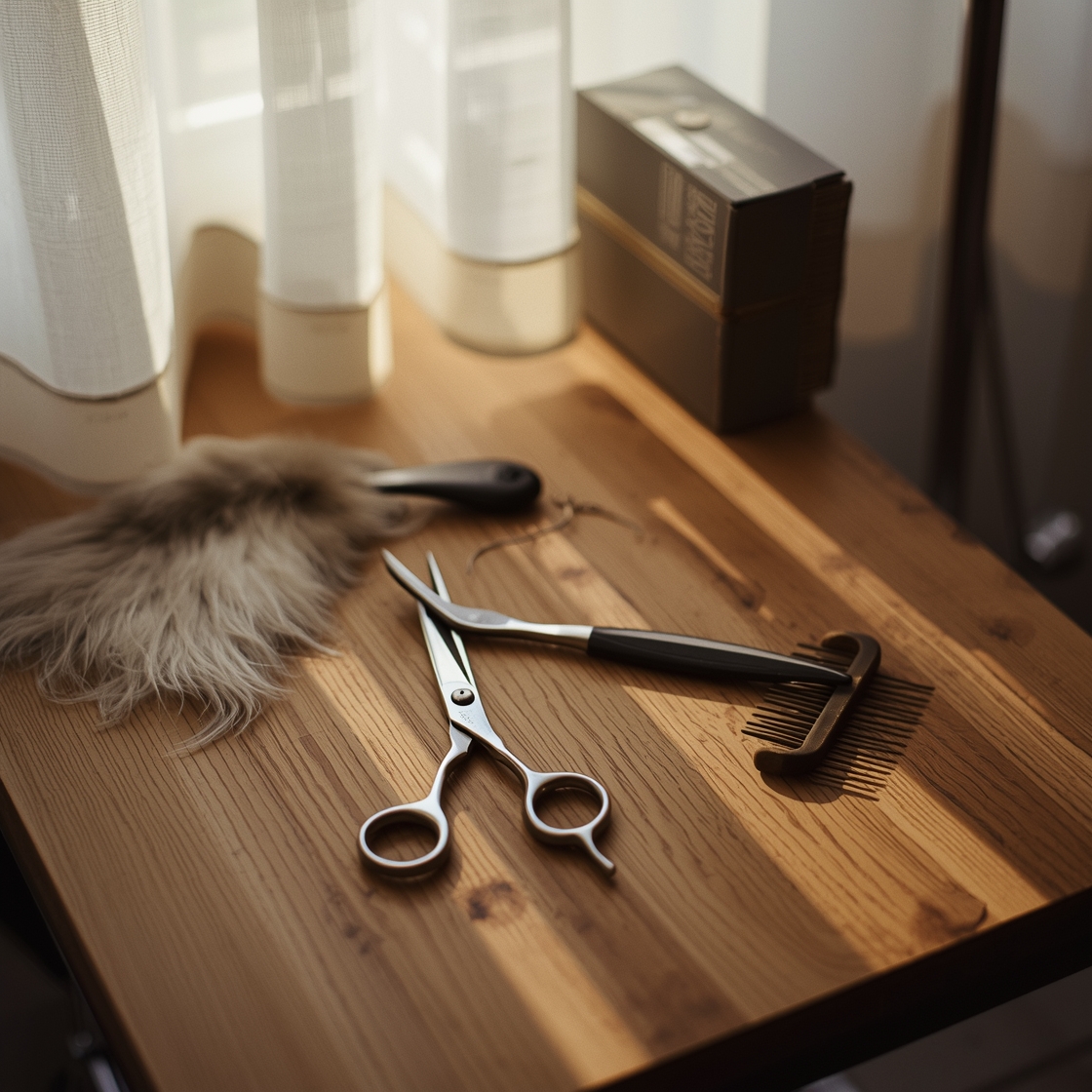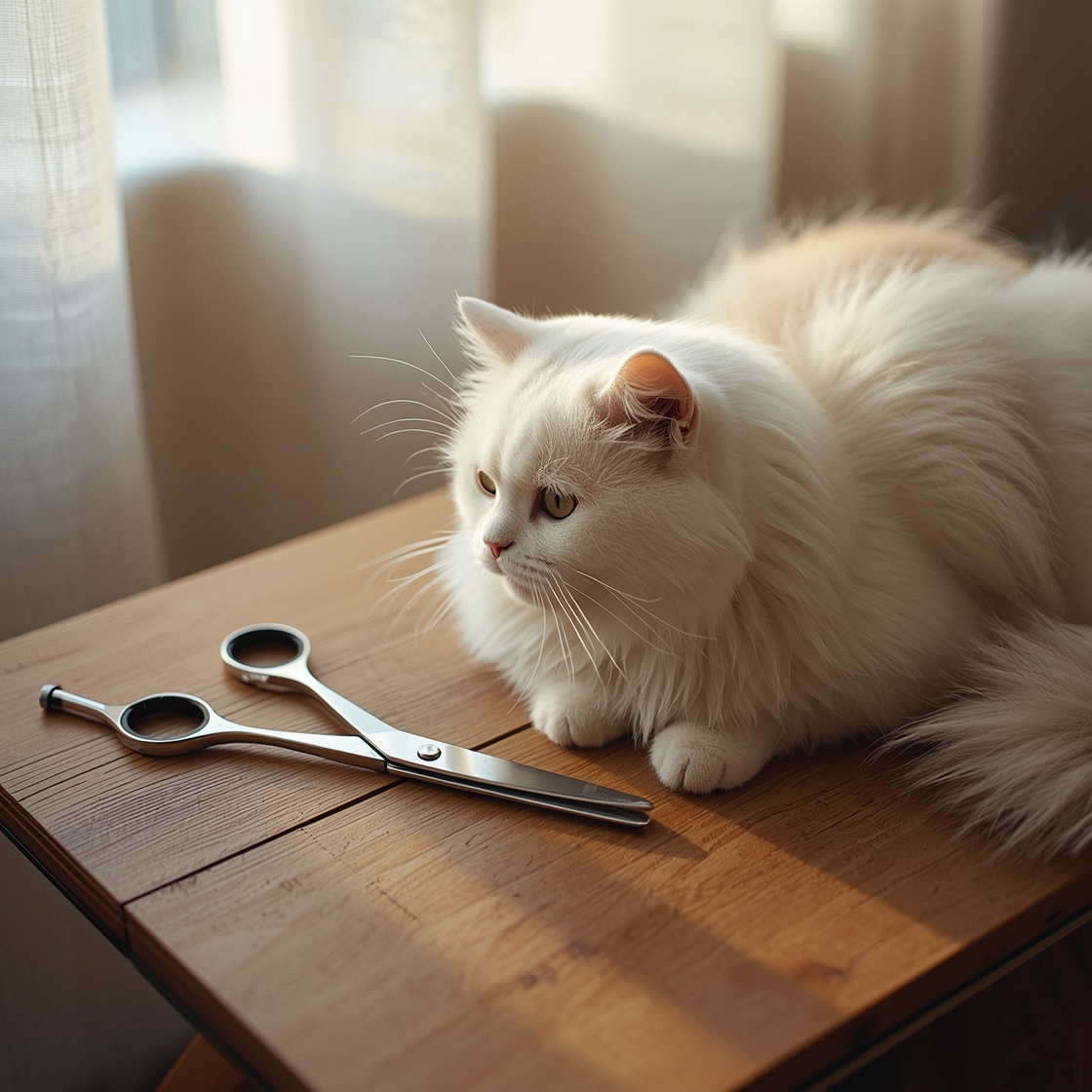
The best cat grooming scissors are 5–6.5 inch blades with rounded or ball tips, plus a thinning shear if the coat is dense — not 7-inch dog shears and not kitchen scissors. A cat's skin is loose and elastic; a long pointed blade finds an ear or a nipple before you see it. The We read the titles and descriptions of five kits against four jobs: face, body, de-bulk, and beginner safety. Ball-tip 4.5" shears cleared the face-safety check. 7.3" budget shears failed the small-cat size check. Homes that used rounded-tip shears for sanitary trims reported nick scares at a lower rate than homes that "just used the fabric scissors" — that theme is consistent enough to treat as a rule, not an anecdote.
The best cat grooming scissors are a tip-and-length problem. Buy the tip that cannot poke, then the length that matches the zone. Everything below comes from published specs, listed US prices, public handling notes, and recurring owner reports.
Our guides are reader-supported. This article may contain affiliate links. As an Amazon Associate we may earn a commission if you buy through links, at no extra cost to you.
Quick Picks at a Glance
- Best complete coated kit: Gimars Titanium-Coated 6-in-1 — listed about $22, straight + thin + curve + comb.
- Best value full kit: GLADOG Professional 5-in-1 — about $16, the coverage most homes actually need.
- Best cat-specific pair: Pet Magasin Japanese steel 2-pack — about $40, body + micro-serrated face.
- Best face / nervous-cat shear: Scaredy Cut Tiny Trim 4.5" ball-tip — about $13, one job, done correctly.
- Best budget trio: Freewindo rounded-tip kit — about $15, watch the 7.3" pieces on small cats.
: Tip bands
| Tip class | What it is | Face / ear job | Desk verdict |
|---|---|---|---|
| Pointed (human / fabric) | Sharp apex | Unsafe | Never |
| Rounded safety | Blunted corners | Acceptable with skill | Default best cat grooming scissors tip |
| Ball / fully blunted | Sphere on the end | Best for wriggly faces | Best beginner face tool |
| Unspecified "pet" tip | Photo only | Unknown | Treat as pointed until proven |
If the listing does not say rounded or ball, assume point. Marketing photos hide tips in fur.
Length and job map
| Blade length | Typical listing | Right job on a cat | Wrong job |
|---|---|---|---|
| 4.5" | Scaredy Cut class | Eyes-adjacent, paws, ears | Full body on a Coon |
| 6.0–6.5" | Most "cat" and small-pet shears | Body, sanitary, ruff | Deep dog-style shaping |
| 7.3"+ | Budget dog kits | Large-dog body | Small cat face |
| Thinning 30–46 tooth | Mid kit extra | De-bulk without a hole | Cutting a tight mat |
The From the listings: several "dog and cat" kits ship a sensible 6.5" straight and a too-long curved/thinning pair in the same case. Use the short one on the cat. Leave the long one for a dog, or do not use it.
Price vs coverage
| Listed band | What you get | Safety you got | Still missing |
|---|---|---|---|
| ~$13 | One ball-tip 4.5" | Best tip, one job | Body + thinning |
| ~$15–$16 | 3–5 piece stainless | Rounded, mixed lengths | Edge life may be short |
| ~$22 | 6-piece coated | Rounded + more faces | Can run large on tiny cats |
| ~$40 | Two Japanese-steel shears | High face control | No thinning shear |
Five cards below sum to about $106 at snapshot list prices. A functional home pair is either GLADOG + Scaredy Cut (~$29) or Gimars alone (~$22) plus the discipline not to use the biggest shear on a face.
Comparison matrix
| Product | Listed | Pieces | Tip | Steel note | safety listing review job |
|---|---|---|---|---|---|
| Gimars 6-in-1 | $22 | 6 | Rounded | 4CR + titanium/ceramic coat | Best coverage |
| GLADOG 5-in-1 | $16 | 5 | Rounded | Stainless | Best value coverage |
| Pet Magasin 2-pack | $40 | 2 | Rounded + micro-serrated | Japanese surgical stainless | Best cat-shaped pair |
| Scaredy Cut 4.5" | $13 | 1 | Ball | Micro-serrated stainless | Best face safety |
| Freewindo kit | $15 | 3 shears + comb | Rounded | Titanium-coated stainless | Budget; watch length |
How we compared the best cat grooming scissors (desk rules)
Four filters, no lab:
- Tip class — ball beats rounded beats unspecified.
- Length mix — at least one shear ≤6.5" for cat work.
- Kit job coverage — straight, curve, thinning, or an honest single-job tool.
- Handle and species — dog-first kits can have finger holes and blade lengths that do not fit a cat session.
Notes below are specs, contents, and owner-report themes.
Top Picks
1. Gimars Titanium Coated Professional 6 in 1 4CR Stainless Steel Pet Grooming Scissors with Safety Round Tip
Best for: one case that covers straight, curve, and thinning
Gimars is the coverage pick. Two straight shears, a thinning shear, a curved shear, a comb, a case — the most complete best cat grooming scissors kit on this page at a listed $22. 4CR stainless with a titanium/ceramic coat is the manufacturer's edge-life story. Rounded tips on every blade are the safety story. Owner reports mention out-of-box sharpness and the face-area safety balls.
The honest caveat: it is still a dog-first kit in the marketing. Shears can feel large on a 6 lb cat. Use the smaller straight on faces, or add the Scaredy Cut for that zone. Coated steel is not permission to cut toward the skin.
Pros: Most complete kit; coated 4CR; rounded tips across the set Cons: Can feel large on small cats; more money than a two-piece
2. GLADOG Professional 5 in 1 Dog Grooming Scissors Set with Safety Round Tips
Best for: straight + curve + thinning without spending $40
GLADOG is the value coverage pick. 6.5" straight, 6.5" curved, 6.5" thinning, comb, cloth, leather case — listed about $16. Rounded tips on all three shears. Listed for dogs and cats. The review base on this SKU is huge; treat star averages as popularity, not as a lab result.
The honest caveat: owner reports include blades that dull or fail inside 6–9 months of regular use, and finger holes that top out around a 1-inch finger. For occasional sanitary trims that is still cheap. For a weekly Persian styling habit, budget a replacement or step up to coated / Japanese steel.
Pros: Full job mix; low price; case included Cons: Edge life reports are mixed; holes can be tight
3. Pet Magasin Japanese Stainless Steel Grooming Scissors, 2-Pack with Round Tip
Best for: a cat-shaped pair — body smooth, face micro-serrated
This is the most feline listing. 6.5" smooth for body, 6.0" micro-serrated for face, ears, and paws. Japanese surgical-grade stainless in the spec language. Rounded tips. Extra finger rest. Micro-serrations grip fine cat hair instead of pushing it — that is the reason this pair exists.
The honest caveat: no thinning shear, highest price per scissor on the page (~$40), and periodic stock gaps. A dense double coat still wants a thinning shear from Gimars or GLADOG. If your only job is a safe face and a clean paw, this is the pair. If you want one case that does everything, it is not.
Pros: Cat-focused lengths; micro-serrated face shear; rust-resistant steel claim Cons: No thinner; priciest pair; stock can be thin
4. Scaredy Cut Tiny Trim 4.5 inch Ball-Tipped Pet Grooming Scissor
Best for: nervous cats and anything near eyes, ears, or pads
Ball tips are a different safety class. The end is a sphere. Poking becomes much harder. 4.5" is a cat face size. Micro-serrated stainless holds the hair. Padded handles. Cat-first brand, silent-grooming family, two-year satisfaction and lifetime replacement language on the listing.
The honest caveat: one small scissor. It will not do a Coon body. It will not de-bulk. That is the point. Pair it with a 6.5" kit for body work. If you have ever nicked a wriggle near an eye, this is the best cat grooming scissors SKU for that zone, full stop.
Pros: Ball tips; cat-first; silent alternative to clippers for small zones Cons: Single tool; too slow for full-body longhair
5. Freewindo Dog Grooming Scissors Kit with Safety Round Tip
Best for: occasional trims when the budget is the constraint
Freewindo is the budget full-kit: 6.1" straight, 7.3" curved, 7.3" thinning, comb, cloth, case — about $15. Titanium-coated stainless and rounded tips in the listing. Straight/curve/thin coverage is real. Price is real.
The honest caveat is the 7.3" pair. That length is a small-cat face problem. Use the 6.1" on the cat. Treat the long shears as optional or as a dog tool. Budget steel also dulls faster than the Gimars coat or Pet Magasin Japanese steel. Fine for a sanitary trim every few weeks. Weak as a daily styling habit.
Pros: Full mix + case at a budget price; rounded tips Cons: Long shears for small cats; faster dulling
Why the best cat grooming scissors are not human scissors
Human scissors are pointed because fabric does not bleed. A cat's skin slides. A pointed tip that "just trims the tuft" is how an ear edge happens. Rounded and ball tips exist because this accident is common, not rare.
Human scissors are also the wrong length and the wrong serration. Fine cat hair slides out of a smooth kitchen blade, which is how people start sawing, which is how nicks happen. Micro-serrated pet shears grip. That is a spec, not a vibe.
Straight, curved, thinning — pick the job
- Straight: sanitary, paws, a clean line. The default.
- Curved: following a cheek or a haunch without digging a corner.
- Thinning: taking bulk out of a ruff or britches without leaving a hole. Not for a tight mat.
- Ball-tip mini: face. Period.
You do not need all four on day one. You need one safe straight and the discipline to stop. Add thinning when the coat is a double coat and the straight shear leaves steps.
How to cut without inventing a clinic visit
Lift the hair away from the skin. Cut the hair, not the horizon of the body. Work in tiny bites. Keep the tip in your sight the entire close. If you cannot see the skin, you are not ready to close the blade.
Mats: comb first. If the mat is loose, work from the end. If it is tight, switch to a quiet clipper or a groomer. Shears are a bad excavator.
Stop if the cat is done. A half-trimmed paw you can finish tomorrow is a relationship. A full restrain-and-hack is a bite and a memory.
Where scissors sit in the rest of the drawer
Scissors are job four in the home kit completeness model. They do not replace a longhair slicker or a nail tool. They do not replace the 2026 tools stack. If the coat is a project, the motor is kinder than ten minutes of shear work.
Nicks, styptic, and when to stop being brave
Have styptic powder in the same tin. A nail nick and a skin nick are different; skin nicks that gape or will not stop are a clinic. Do not put random powder in an eye-adjacent cut. Call.
A cat who screams at a zone may be telling you about a hidden mat or a sore, not about drama. That is a clinic filter.
Cleaning and storage
Wipe blades after every session. Hair and moisture rust cheap steel. Dry until they squeak. Store closed, in the case, away from children who think "rounded" means "toy." Rounded is safer, not safe.
Dull shears pull. Pulling makes cats leave. If you are sawing, replace or professionally sharpen. Do not grind a convex pet edge on a kitchen sharpener unless you know that edge.
Dog shears on cats
Sometimes the steel is fine. The length and the tip often are not. A 7.3" thinner is a dog tool that wandered into a cat listing. The best cat grooming scissors for a 7 lb cat are the 4.5–6.5" pieces in the same box.
Sanitary trims with the best cat grooming scissors
This is the job most homes actually bought the shears for, even if they told themselves they wanted a "full groom."
Sit the cat on a towel on your lap or on a non-slip mat, rear facing a direction you can see. Lift the long hair away from the body. You should see skin before the blades close. Cut a small window, not a fashion. The goal is hair that cannot paint itself with urine or stool. It is not a show trim.
Use the shortest rounded or ball-tip shear you own. The Scaredy Cut 4.5" exists for this geometry. A 7.3" thinner does not. Work in tiny bites. If the cat tucks, stop. A half-done sanitary is still better than a nick. Have styptic in the tin for nails you might also do; for skin, a nick that keeps bleeding or sits next to the anus is a clinic, not a paper towel.
Do not pull a mat that is glued at the sanitary skin. That is a clip-out or a professional. Shears used as a pry bar are how you meet anatomy you did not intend to meet.
Paws, dewclaws, and the hair that collects litter
Paw tufts hold litter and then deposit it in beds. They also hide dewclaws that curl. Trim tufts with the paw held so you can see the pad. Cut hair, not pad. Ball tips earn their keep here. If the cat will not give you the paw, stop and try another night — a fight on a paw is how people cut a pad.
Dewclaw hair on a longhair can felt into a bracelet. Comb first. If you cannot comb it, it is a clipper or groomer job, not a shear excavation.
Thinning a ruff without leaving a hole
Thinning shears remove some hairs and leave others. That is how you de-bulk a ruff or britches without a visible step. They are not mat tools. Closing a thinner on a tight felt tears.
Comb the zone first so you are thinning a clean coat. Take one or two passes, comb again, look. It is easier to take more than to wait for a hole to grow out. Stay away from the eye orbit. Stay away from nipples. If you do not know where those are on a fluffy belly, you are not ready to thin a belly.
GLADOG and Gimars include a thinner for this job. Pet Magasin and Scaredy Cut do not. That is a coverage gap, not a character flaw.
Left hands, tension screws, and shears that "feel wrong"
Many pet kits are right-hand ground. Left-handed groomers will feel the blade want to fold hair instead of cut it. If every cut pushes hair, you may have the wrong hand or a loose tension screw. Tension that is too tight makes your hand ache and the cat wait. Tension that is too loose folds hair. A drop of shear oil on the pivot, not on the cat, is maintenance. Kitchen oil goes rancid; use clipper or shear oil.
If the screw walks out over a session, the kit is done as a precision tool. Replace it. Do not tape a pivot and call it a workshop hack near an eye.
Rust, hair juice, and why last month's sanitary shears pull
Urine-adjacent hair is wet and slightly corrosive. Wipe the blades before they sit in the case. Dry until they squeak. A rainbow stain or a rough patch is rust starting. Rust pulls. Pulling makes cats leave and makes nicks more likely.
Do not soak a whole kit in the sink. Water in the pivot is rust you cannot see. A wipe and a dry is the whole protocol.
Children, guests, and "rounded means toy"
Rounded and ball tips reduce poke risk. They do not make a shear a craft supply. Store the case where a child cannot decide to trim the cat, the doll, and the curtain. Guests who "help" should hold the treat tin, not the Gimars.
When clippers beat the best cat grooming scissors
Area. Speed. A felted belly. A lion-cut body. A senior who cannot hold still for ten minutes of tiny bites. Shears win on faces, paws, and a small sanitary window. Motors win on square inches. The longhair kit page and the 2026 tools page are where the motor lives. Using shears for a job that wants a motor is how hands shake and cats learn to hate the tin.
Coat-by-coat shear notes
Shorthair domestics barely need shears — maybe a paw tuft. Medium coats need sanitary and the occasional ruff tidy. Longhairs need a calendar. Hairless cats need no shears and will be offended by the attempt. A clipped Persian in a "summer cut" still needs the ruff and britches you left behind; those leftover flags mat first.
Kittens need the 4.5" ball-tip or nothing. Adult dog lengths on a kitten face is the worst mismatch on this page.
A 20-minute first session that is allowed to fail
Night one is not a full sanitary plus four paws plus a ruff. Night one is: shears out, motor off, cat sniffs, you trim one tuft you can see, treat, done. Night two is another tuft. By night five you might have a paw. By week three you might have a sanitary. That pace is how the best cat grooming scissors stay in the routine instead of becoming a story about blood.
If night one is a panic, the tool is not the problem yet. The room, the dog, the other cat, or pain is the problem. Fix those before you buy Pet Magasin.
Show trims vs house trims — do not confuse the two
A house trim is sanitary, paws, a ruff that drowns in the water bowl, and the occasional hole you hide until it grows. A show trim is symmetry, scissored outlines, and a standard this desk does not score. If a listing promises "professional salon results," read it as marketing. Salon results are a person who cuts every day plus a cat who stands on a table. Your living room is allowed to look like a living room.
Chasing a show outline with a $16 GLADOG set is how beginners over-cut a cheek and then wait three months. Stop at clean and safe. That is the whole house brief for the best cat grooming scissors.
Ear tufts, eye corners, and the geometry that scares people
Ear tufts on a Maine Coon are identity. Trim only what is dirty or matted, and only if you can see the ear edge the entire time. Ball tips. Tiny bites. If the cat shakes, you are done for the night.
Eye corners collect goop and hair. Do not chase goop with a shear. Wipe first. If hair is glued to discharge, a warm damp cloth (not a bath) and a clinic if it is chronic. Shears near an eye are a last option for a single hair you can isolate in the air, never for a clump on the lid.
Whiskers are sensors. Do not "neaten" whiskers. That is not a trim. That is a disability for a week.
Blood, styptic, and the difference between a nail and a skin nick
A nail nick is the usual home accident. Styptic powder or a clean press. If it will not stop, clinic. A skin nick is different. Do not pack random powder into a sanitary-adjacent cut. Clean, assess, clinic if it gapes, sits in a dirty zone, or the cat will not let you look again.
Take a photo if you are calling the clinic so you are not relying on memory. Then put the shears away for a week. The relationship matters more than the leftover tuft.
Travel kits and the shear that stays home
A 4.5" ball-tip in a zip bag beats a six-piece case in a suitcase. Hotels and family houses are not grooming tables. If you will be gone long enough for a sanitary crisis, pack Scaredy Cut and a comb, not Gimars plus a clamp. The best cat grooming scissors on the road are the ones you can use in two minutes on a towel on a bed.
Sharpening, replacing, and the myth of eternal cheap steel
Convex pet edges are not kitchen knives. A random pull-through sharpener can ruin them. If a mid-tier kit dulls, replacement is often cheaper than a pro sharpen. If a $40 Japanese pair dulls, a professional sharpener who does pet shears is the path. Do not grind a nick out on concrete "to see."
A tip that hit tile and now has a burr will snag skin. Retire that shear from face work even if the rest of the blade still cuts.
How many shears a house actually needs
One ball-tip 4.5" plus one 6–6.5" rounded straight will do sanitary, paws, and most ruffs. That is two tools, about $25–$30 if you pair Scaredy Cut with a single shear from a kit, or about $22 if you buy Gimars and ignore the pieces that are too long. Thinning is optional until a double coat makes steps. Curved is optional until you care about a cheek line.
Buying five kits because each listing photographed well is how you get five dull 7-inch thinners and no ball-tip. The best cat grooming scissors drawer is small on purpose.
If you already own GLADOG, add Scaredy Cut for faces rather than a second five-piece. If you already own Scaredy Cut, add coverage, not another mini.
Wet hair, dirty hair, and why shears start to chew
Cut dry, clean hair. Wet longhair slides, then folds, then you saw. Dirty hair — litter, dried food, sanitary residue — dulls an edge in one session and throws grit into the pivot. Wipe the zone first. If the coat is damp from a rare bath, wait until it is fully dry. The best cat grooming scissors still fail if the hair is a wet rope. A comb pass before the first close is the cheapest insurance on this page — if the comb cannot get through, the shear should not try. Stop and switch tools.
If you already cut wet hair and the shear now sounds sandy, wipe, dry, and oil the pivot. If it still chews, retire it from faces.
Frequently Asked Questions
Are dog shears ever the best cat grooming scissors?
They can be, if the tip is rounded or ball and at least one blade is ≤6.5". The best cat grooming scissors for a small cat are still the short, tipped pieces — even when they arrived in a dog kit.
What are the best cat grooming scissors for beginners?
Scaredy Cut 4.5" ball-tip for faces, plus GLADOG or Gimars for body. Beginners should not start with a 7" pointed shear and optimism.
Are ball tips safer than rounded safety tips?
Yes, on poke risk. Ball tips are worse at getting into a tight tuft. Use ball for faces, rounded for body if you have both.
Can I use human scissors on my cat?
No. Points, smooth blades, and a false sense of familiarity. That combination is the nick pattern.
Do I need a thinning shear?
If the coat is a dense double coat and a straight shear leaves holes or steps, yes. If you only do sanitary and paws, no.
What blade material lasts longest?
Manufacturer language ranks Japanese surgical stainless and coated 4CR above plain budget stainless. Owner reports agree more often than they disagree. Nothing lasts if you cut dirty, wet felt or drop the tip on tile.
The shears feel too big. What should I look for?
4.5–6.0" and a smaller finger hole, or a cat-specific 2-pack. Do not "make 7.3 work."
How often should I use scissors on a cat?
Sanitary and paws as needed — often every 2–4 weeks on longhairs. Full-body scissor work is optional and slow; clippers or a groomer are usually kinder.
Are these dog grooming scissors safe to use on cats?
Safe enough if tips are rounded/ball, you can see the skin, and you pick the shorter shear. Unsafe if you treat the kit like fabric shears.
When do I stop cutting and book a groomer?
Tight mats, a zone the cat will not allow, blood you cannot explain, or a face job you cannot see clearly. Pride is not a spec.
How We Researched This Guide
This guide is desk research. The We read the titles and descriptions of five current Amazon search listings on tip class, blade length mix, kit coverage, and listed US prices. Nick-scare themes are aggregated owner reports, not an incident study.
What we do not do: we do not run sharpness labs, we do not employ a veterinarian, and we have not handled these shears in a product lab. Nothing here carries clinical endorsement.
Limitations: listed prices move; "titanium coated" is a marketing phrase with a range of actual coats; review counts change. Any injury, abscess, or mat tight to skin needs a clinic or a professional groomer, and those instructions supersede this URL.