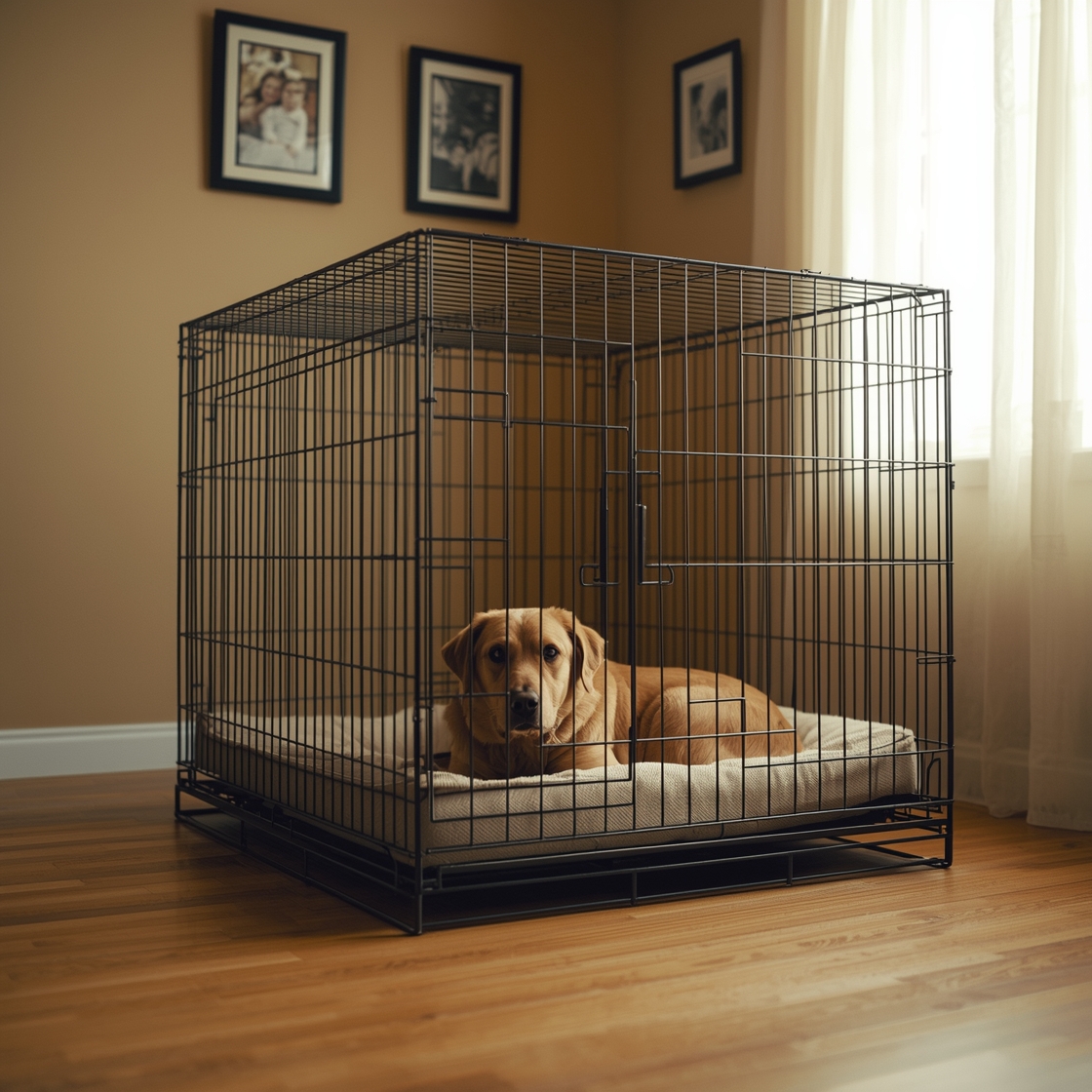
The best dog crate for large dogs is a 42- or 48-inch interior (length + ~4 in; ears clear) in the construction class that matches this dog — folding wire for polite house use, welded steel for chewers and lock-pickers, airline plastic for a flight. The We read the titles and descriptions of 6 SKUs. Listed snapshots run $100.64–$224.25. 2 of 6 are folding wire (MidWest iCrate $104.99; Amazon Basics $100.64). 2 of 6 are welded-steel / heavy-duty cages (Hiwokk 48" $129.99; LUCKUP $189.99). 1 of 6 is premium collapsible mesh (Diggs Evolv $224.25). 1 of 6 is an airline plastic shell (Petmate Sky Kennel $125.99). 0 of 6 replace crate training. Measure nose-to-tail, not “Lab weight.”
Buy the size. Then buy the class. Then introduce the crate as a den, not a jail.
Our guides are reader-supported. This article may contain affiliate links. As an Amazon Associate we may earn a commission if you buy through links, at no extra cost to you.
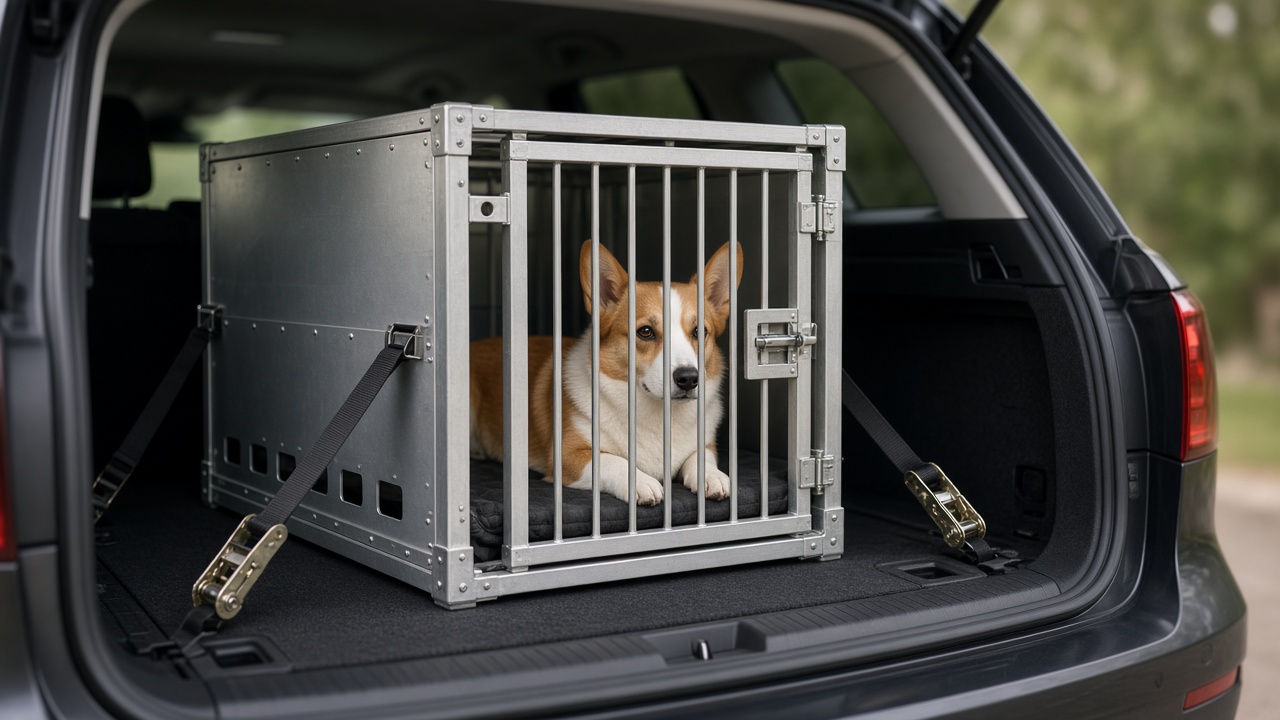
Size math: crate size by breed and the crate size calculator. Puppies: best dog crate for puppies. Car crash kennels are a different scoreboard: crash-tested travel crates.
Quick picks for the best dog crate for large dogs
- Best default house wire: MidWest iCrate Double Door — $104.99. Divider, two doors, parts everywhere.
- Best budget wire twin: Amazon Basics Metal Wire — $100.64. Same job, lighter gauge, simpler latch.
- Best welded value at 48": Hiwokk 48 Inch Heavy Duty — $129.99. Furniture, not luggage. Dual locks, wheels that lock.
- Best escape-class cage: LUCKUP Heavy Duty — $189.99. Measure the interior; titles run smaller than wire equivalents.
- Best design-first everyday: Diggs Evolv Collapsible — $224.25. Looks, mesh pattern, not a lock-picker crate.
- Best flight shell: Petmate Sky Kennel — $125.99. Airline hardware language. Confirm this carrier’s current rules.
How to choose the best dog crate for large dogs
- Measure standing. Nose to base of tail. Height to ears when sitting if they sit tall. Add about 4 inches to length so they can turn and lie. Height: stand without the head jammed. Weight is a check on the crate’s load rating, not the primary number.
- Class the problem. Polite adult who already crates: folding wire. Chewer / escaper: welded tube, dual latches, bar spacing that does not give a muzzle purchase. Flight: IATA-style plastic with the hardware the airline names. Anxiety that is panic: a stronger box is not a treatment plan — trainer and clinician, then hardware.
- Doors and rooms. Double doors save a crate that only fits one way in a nook. A single door is fine if the room is honest.
- Tray and wash. A slide-out pan you will actually empty beats a “leak-proof” claim you never test. Pad thickness: for airline shells, thick orthopedic mats steal interior height. Many carrier pages imply ≤3 in of pad.
- Fold vs furniture. Wire folds for the car and the closet. Welded steel does not. If you move apartments twice a year, price the fold.
How large crate frame listings compare on labels
Table 1 — Job → construction class
| Primary job | Prefer | Skip first | Why |
|---|---|---|---|
| House training, polite large dog | Folding double-door wire | $200 design crate | Parts, divider, price |
| Occasional / guest / travel wire | Amazon Basics class | Welded furniture | Folds; lighter latch |
| Chewer, paw on the latch | Welded steel, dual locks | Standard-gauge wire | Gauge and latch are the product |
| Known escape artist | LUCKUP class + training | “Indestructible” marketing | No crate is a personality |
| Room-center looks | Diggs Evolv | Hiding a rusty wire | You will use what you will look at |
| Cargo hold / airline | Petmate Sky Kennel | Wire in the hold | Airline rules, not Amazon titles |
| Car crash restraint | CPS travel kennel | This card set | Different URL, different list |
Table 2 — The six cards: tile, class, desk role
| Card | Class | Tile | Typical large size language | Desk role | Honest miss |
|---|---|---|---|---|---|
| MidWest iCrate Double Door | Folding wire | $104.99 | 42 / 48 in | Default house crate | Not escape-class |
| Amazon Basics Metal Wire | Folding wire | $100.64 | Large / XL wire | Budget twin | Lighter gauge, simpler latch |
| Hiwokk 48 Inch Heavy Duty | Welded steel | $129.99 | 48 in named | Heavy-duty value | Heavy; bar spacing for large dogs |
| LUCKUP Heavy Duty Cage | Welded steel | $189.99 | Measure interior | Escape-class | Often shorter than wire twins |
| Diggs Evolv Collapsible | Mesh collapsible | $224.25 | Size the SKU | Premium everyday | Not a lock-picker crate |
| Petmate Sky Kennel | Airline plastic | $125.99 | IATA size chart | Flight + den | Bulk; less airflow than wire |
Price math: six prices sum to $875.85. Median tile $127.99. Wire class is 23% of spend (two cards) and the default answer for most homes. Design-first Diggs is 26% of spend on 17% of cards.
Table 3 — Breed-length desk (averages, not your dog)
Size matters more than the bathroom scale. A long 65 lb hound needs more interior length than a compact 80 lb bully.
| Breed planning band (avg adult) | Interior length desk | Interior height desk | First card class |
|---|---|---|---|
| Labrador (55–80 lb) | 42–48 in | 30–34 in | iCrate / Basics 42–48 |
| German Shepherd (65–90 lb) | 48 in | ~34 in | iCrate 48 or Hiwokk 48 |
| Long-bodied 70 lb mix | 48 in first | Ears clear | Measure; do not buy 36 |
| Great Dane (110–175 lb) | ~60 in | ~38 in | This card set is short — shop giant |
| Mastiff (160–230 lb) | ~66 in | ~40 in | Giant SKU, not a 48" wire |
Use the calculator from this dog’s tape, not the row above.
Table 4 — Decision matrix for the best dog crate for large dogs
| Household | First card | Pair with |
|---|---|---|
| First crate, Lab / Shepherd mix | MidWest iCrate 42 or 48 | Divider if still growing |
| Cash-tight, same job | Amazon Basics | Accept lighter latch |
| Strong chewer, indoor daily | Hiwokk 48 | Lock the wheels; pad the tray |
| Defeated two wire crates | LUCKUP | Trainer if it is panic, not hobby |
| Crate stays in the living room | Diggs Evolv | Not for a Houdini |
| Flight this year | Sky Kennel | Airline PDF, not a forum screenshot |
| SUV crash job | Not these six | CPS travel crates |
The 6 cards on this URL
1. MidWest iCrate Double Door Folding Dog Crate — Best overall house wire
Best for: the default best dog crate for large dogs in a normal home — two doors, divider, parts you can actually buy.
The iCrate is everywhere because replacement pans and clips exist. 42 and 48 inch sizes are the large-breed language. Rubber feet protect floors. Owner themes: pan rattles until you pad it; standard-gauge wire loses to a determined lock-picker.
Pros: Double doors; divider; folds; parts. Cons: Not escape-class; tray noise.
Check MidWest iCrate listings →
2. Amazon Basics Metal Wire Dog Crate for Large Dogs — Best budget wire
Best for: the same folding-wire job at the friendliest tile on this URL.
Functionally a twin of the classic layout: double door, tray, flat fold. Owner themes: lighter wire, simpler latch, fine for polite dogs and guest use.
Pros: Lowest tile; same convenience class. Cons: Gauge and latch are the miss.
Check Amazon Basics large wire crate listings →
3. Hiwokk 48 Inch Heavy Duty Dog Crate — Best welded value
Best for: a 48-inch welded tube when wire has already been a puzzle.
Dual locks, slide-out tray, lockable wheels. Owner themes: heavy, daily indoor furniture, bar spacing is for large breeds — not a toy dog who can slip a muzzle through.
Pros: Welded class; 48" named; wheels lock. Cons: Weight; not luggage.
Check Hiwokk 48-inch listings →
4. LUCKUP Heavy Duty Dog Cage and Crate — Best escape-class card
Best for: the graduate crate after a dog has defeated folding wire.
Corrosion-resistant steel story, double latch, top hatch so you can drop a treat without opening the main door. Owner themes: 38-inch-class interiors show up in the line — measure. A “large dog” title that is 36 inches inside is a crouch.
Pros: Dual latch; top hatch; escape-class intent. Cons: Interior can be shorter than wire twins; price.
Check LUCKUP heavy-duty listings →
5. Diggs Evolv Collapsible Dog Crate — Premium everyday
Best for: a crate you will leave in the room because it does not look like a kennel-club leftover.
Diamond-mesh pattern is marketed as kinder to paws and jaws than wide wire. Collapses clean. Owner themes: costs two to three budget crates; not aimed at determined escapers.
Pros: Looks; mesh; collapse. Cons: Price; not escape-class.
6. Petmate Sky Kennel Airline Dog Kennel — Best flight shell
Best for: a plastic airline-style kennel when a carrier PDF is in your future — and for dogs that settle better in a den than in a wire fishbowl.
Steel-wire vents, hardware and labeling most cargo programs expect. Owner themes: bulky to store, hotter than wire in August, wipe-clean.
Pros: Airline-shaped job; enclosed den. Cons: Storage; airflow in heat.
Check Petmate Sky Kennel listings →
Measuring the dog, not the breed name
Stand the dog. Tape nose to tail base (not the plume). Sit them: ear tip to floor if they have satellite dishes. Add ~4 in to length. If they are between 42 and 48, long-bodied dogs take 48. Undersize is how you buy twice.
A growing puppy: size to adult length and use a divider (iCrate includes one). Three crates in 18 months is a tax. See puppy crates.
Giant breeds: a 48-inch Hiwokk is not a Dane crate. Shop the 54–60+ class. This URL’s cards stop being honest there.
Escape resistance that is real
No crate is indestructible. Marketing that promises otherwise is selling a word.
What actually slows a hobbyist Houdini: welded joints (bolts loosen under leaning), dual or lockable latches away from paw reach, heavier tube or thick-gauge wire at the corners dogs test first, bar spacing too tight for a muzzle to get purchase.
What does not: a $12 padlock on a folding iCrate the dog already folds. What does not: a stronger box for a panic attack. That dog needs a behavior plan. A steel cube raises the stakes of the next attempt.
Introducing the best dog crate for large dogs
Make it a room, not a sentence.
- Mat and a chew that is legal in there.
- Treats in, door open.
- Short closed-door minutes while you are visible.
- Quiet corner that is still in the household, not a basement exile.
- Never as punishment.
If chewing the crate is the hobby, move up a construction class and add exercise. If anxiety is the hobby, a blanket with your scent is a comfort trick, not a diagnosis. Persistent panic: trainer, and a veterinarian if medical differentials are on the table. We are not that veterinarian.
Price bands
Under $110: MidWest and Amazon Basics. Most well-adjusted large dogs live here for years.
$120–$200: Hiwokk, Sky Kennel, LUCKUP. Welded security or a flight shell.
$200+: Diggs. You are buying looks and mesh details, not a prison.
Spend on the problem you have. Most owners over-buy security and under-buy length.
Heat, cars, and airline height
Wire breathes. Plastic holds heat. A Sky Kennel in a parked car is still a parked car. AVMA warm-weather guidance treats a closed cabin as a medical risk.
Airline: the carrier’s current crate page wins. IATA-style formulas are for air crates. A thick bed that steals height can fail the “stand comfortably” sentence. Confirm this flight, this airline, this date.
Car crash: a house wire crate sliding in a hatch is a loose object. CPS-listed travel kennels live on another page.
Two dogs, apartments, and the crate you can lift
Two large dogs need two crates or a carefully introduced shared den — shared is a behavior plan, not a SKU. A 48-inch welded unit is furniture. If you are a fourth-floor walk-up, price the fold (iCrate / Basics / Diggs) or you will hate the Hiwokk on moving day.
Wheels on Hiwokk help. Lock them so the crate is not a wagon the dog drives.
We will not say we bent six frames. We will not say MidWest “wins 2026.” We will not say LUCKUP is escape-proof. We will not say a crate treats separation anxiety. We will not invent a veterinarian quote.
We will say: measure, class the job, wash the tray, and treat panic as a training-and-clinic problem.
How we researched this guide
The PetBench desk compared the six live cards, listed tiles ($100.64–$224.25), and construction class (wire / welded / mesh / airline plastic). Breed length bands are published-typical averages, not a tape from this desk. We read common crate-training sequences and airline-kennel client pages.
Nothing here is a clinical endorsement.
Frequently asked questions
How do I pick the best dog crate for large dogs?
Measure nose-to-tail, add about 4 inches, confirm standing height, then pick a class: folding wire (iCrate / Basics), welded (Hiwokk / LUCKUP), mesh design (Diggs), or airline plastic (Sky Kennel).
How do I pick the best dog crate for large dogs if the puppy is still growing?
Size to projected adult length. Use a divider. Do not buy a 36-inch “for now” unless you like shopping twice.
Which materials last for strong dogs?
Welded steel-tube is the escape-resistant class most owners actually need. Thick-gauge wire handles typical large dogs. Plastic shells suit dens and flights. No material is chew-proof.
How do I stop escapes?
Inspect latches and gaps. Move up a class if the dog is a hobbyist lock-picker. Pair hardware with training. Panic is not a latch problem.
My dog chews the crate or seems anxious — now what?
Class up for chew. Add exercise. For anxiety, short positive sessions, not a bigger bolt. If it persists, a professional trainer — and a veterinarian if pain or medical anxiety is possible.
Is a 42-inch crate enough for a Labrador?
Often, if they are not a long-bodied outlier and they can stand and turn. Many Labs and Shepherds are happier in 48. Measure.
Sources
- Manufacturer size charts and listings for the six cards above.
- IATA / airline pet-travel crate pages (confirm the carrier you will fly).
- Common veterinary and trainer crate-introduction sequences (positive association, no punishment).
- these large crate frame listings, August 2026.
Last reviewed: August 2026. Contact if a size chart is stale.
- July 2026: Six verified crates with live pricing replaced an unbranded ten-item list.