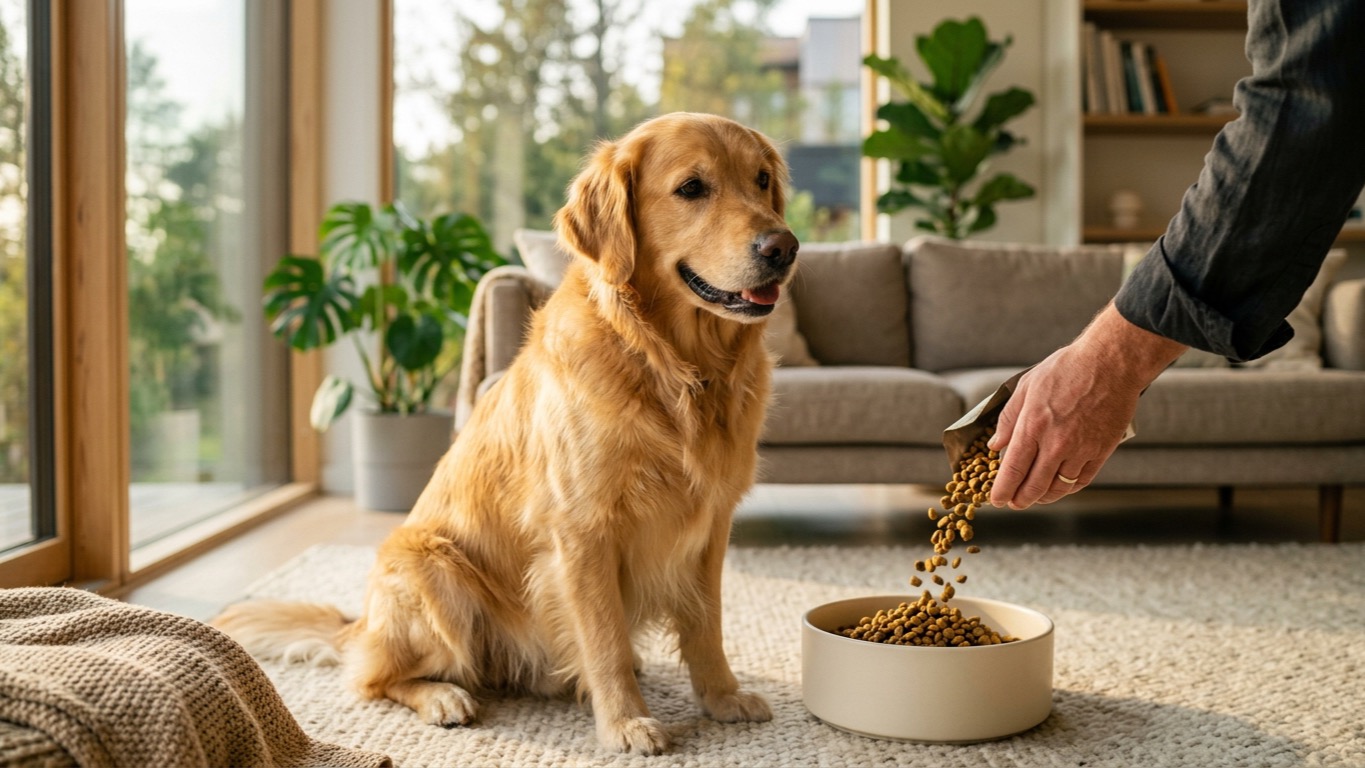
Quick answer: Merrick Premium Grain Free Dry Adult is the best-fit grain free dog food for most adult dogs on this list. Skip grain-free if your dog has a heart murmur or a DCM workup. Confirm the bag lists no wheat, corn, rice, barley, or oats.
Grain-free dog food is a carb swap; the FDA logged 1,382 DCM reports and did not name a cause.
This page is a 2026 label briefing from comparing published specs. Our research team analyzed FDA updates and maker ingredient pages.
The seven adult listings we compared in August 2026 ran from $9.78 to $72.98.
What grain free dog food is
Grain-free dog food swaps cereal carbs for peas, lentils, chickpeas, or potatoes.
It is not a separate nutrient class.
AAFCO publishes adult and growth profiles. It does not publish a grain-free profile. The legal line on a bag is “complete and balanced,” not a grain claim.
A grain-free title only means the recipe omits wheat, corn, rice, barley, oats, and other grains. The calories still have to come from somewhere. On the maker pages we compared, that somewhere was often a pulse.
Grain-free is not a proven heart-safer diet. It is not an allergy diet by default. A small kibble is not a giant-breed plan.
Loose stool is a different job. Start with dog food for a sensitive stomach. Do not treat grain-free as the default fix.
What the FDA reported about grain-free dog food and DCM
The FDA opened a dilated cardiomyopathy inquiry in July 2018 and still has not named grain-free food as the cause.
Dilated cardiomyopathy, or DCM, is a stretched, weak heart. The FDA’s July 2018 notice flagged reports in dogs eating certain grain-free diets. Many of those diets listed peas, lentils, other pulses, or potatoes in the first ten ingredients.
Key counts from the FDA:
- 524 DCM reports from January 1, 2014 through April 30, 2019, including 515 canine reports
- 608 canine DCM reports from May 1, 2019 through July 31, 2020
- 255 canine DCM reports from August 1, 2020 through November 1, 2022
- 1,382 canine DCM reports from January 1, 2014 through November 1, 2022
- More than 90 percent of products in the early case review were grain-free
- 93 percent of those reported products contained peas, lentils, or both
On December 23, 2022, the FDA said report counts alone do not prove a causal link. The agency said it does not plan more public updates until it has meaningful new science.
The FDA also noted most U.S. dogs eat pet food without developing DCM. The American Veterinary Medical Association figure on that same FDA page is 77 million pet dogs.
That 2022 note is not a recall. A cough, faint, or food strike still belongs at a clinic.
Who needs grain free dog food
Most adult dogs do not need grain-free food.
A diagnosed grain allergy is uncommon in the published allergy set.
BMC Veterinary Research reviewed 297 dogs with cutaneous adverse food reactions. The top named sources were animal proteins, not a grain class:
- Beef in 102 dogs, or 34 percent
- Dairy in 51 dogs, or 17 percent
- Chicken in 45 dogs, or 15 percent
- Wheat in 38 dogs, or 13 percent
- Corn in 13 dogs, or 4 percent
- Rice in 5 dogs, or 2 percent
Wheat shows up. A blanket “grain allergy” does not. If a clinic is running a food trial, the job is usually one protein. That is a hypoallergenic dog food problem, not an automatic grain-free aisle run.
Grain-free can fit an adult dog with a confirmed grain trigger. It can also fit an owner who wants the title and will still read pulses. Use a small-breed recipe only for a small dog.
Do not start grain-free as a wellness upgrade. Skip it for a murmur or a DCM workup.
Skip it for a healthy adult with no diet diagnosis. Do not put a large dog on a small-breed calorie plan.
How to read a grain free dog food bag
Trust the ingredient list and the AAFCO statement, not the front-of-bag lifestyle art.
The FDA’s inquiry treated pulses in the first ten ingredients as a diet pattern of interest. Our research team used a tighter check on maker lists: the first six slots.
Use this open-bag checklist:
- Find the words Grain Free on the actual bag, not only in an ad.
- Scan for wheat, corn, rice, barley, oats, and other grains.
- Mark every pea, lentil, chickpea, bean, pea flour, or pea protein in the first six names.
- Read the AAFCO line. Adult maintenance and all life stages are different jobs.
- Match kibble class to the dog. Small-breed bags are not a cheap plan for a 70-pound dog.
- Skip the swap if the dog has a cough, faint, murmur, or food strike. That is a clinic visit.
The FDA cited AAFCO’s adult methionine-cystine minimum of 0.65 percent. It said nearly all grain-free products it checked were above that line. Taurine talk still belongs at a clinic.
Best grain free dog food for adult dogs
Merrick Premium Grain Free Dry Adult is the on-label adult pick; the rest fill small-breed, fish, or look-alike jobs.
The Open-Bag Rule we used: the food had to be adult dry kibble. It had to sit on a U.S. listing we compared in August 2026.
The live title had to print Grain Free, or shoppers had to treat it as grain-free anyway. Puppy food, wet food, raw, and treats did not get in. Recipes with no maker ingredient list did not get in.
How the seven listings split:
- Merrick Premium Grain Free Dry Adult Dog Food — Grain Free and Adult both sit on the name. Merrick lists deboned chicken first, 32 percent minimum protein, 16 percent minimum fat, and 381 kcal per cup. Peas sit in the sixth slot. Listed at $25.98. This is the best-fit adult bag on the set.
- Jinx Grain Free Dry Dog Food — Grain Free is in the name. Jinx lists cage-free chicken first, then chickpeas and lentils in slots 3 and 4, and 27 percent minimum protein. Listed at $10.88. Often a small bag, so check ounces.
- Nature’s Recipe Grain Free Small Breed Dry Dog Food — Grain Free and Small Breed are both on the name. Nature’s Recipe lists 24 percent minimum protein, plus garbanzo beans and peas after tapioca and canola meal. Listed at $9.78. Use it only for a small dog.
- Taste of the Wild High Prairie Adult Dry Dog Food — The listing title says Adult, not Grain Free. Taste of the Wild lists High Prairie as grain-free. The maker page shows 32 percent minimum protein and 18 percent minimum fat. Taurine is listed at 0.12 percent minimum. Peas and pea flour sit in slots 5 and 6. Listed at $58.99. Open the bag you buy.
- Blue Buffalo Wilderness Salmon Adult — The listing title highlights Wilderness salmon, not the words Grain Free. Blue Buffalo’s maker page calls this Adult Grain-Free Salmon. Listed at $68.98. Confirm the bag you open is the grain-free recipe, not the grain-inclusive Wilderness salmon.
- Natural Balance Limited Ingredient — The listing title is LID, not Grain Free. Listed at $72.98, the high sticker on this set. LID is a protein-trial tool. It is not automatically grain-free. Open the bag.
- Diamond Naturals Adult Dry Dog Food — The listing title says Adult, not Grain Free. Listed at $43.99. Do not treat an Adult title as a grain-free bag. If rice or barley is on the label, this listing failed the keyword.
Grain free dog food compared by label attributes
These seven listings differ by title words, protein mins, and pulse placement.
They are not a ranked score.
| Food | Listed price (Aug 2026) | Grain Free on listing title | Maker protein min | Pulses in first six ingredients | What the bag is for |
|---|---|---|---|---|---|
| Merrick Premium Grain Free Dry Adult | $25.98 | Yes | 32% (Merrick) | Peas in slot 6 | Adult grain-free title |
| Jinx Grain Free | $10.88 | Yes | 27% (Jinx) | Chickpeas and lentils in slots 3–4 | Low-sticker grain-free title |
| Nature’s Recipe Grain Free Small Breed | $9.78 | Yes | 24% (Nature’s Recipe) | Garbanzo beans in slot 6 | Small-breed grain-free title |
| Taste of the Wild High Prairie Adult | $58.99 | No | 32% (Taste of the Wild) | Peas and pea flour in slots 5–6 | Named prairie adult; verify grains |
| Blue Buffalo Wilderness Salmon Adult | $68.98 | No | Not printed on the maker page we used | Confirm on the bag you open | Salmon Wilderness; verify grains |
| Natural Balance Limited Ingredient | $72.98 | No | Not used here | LID is a protein job | Clinic food trial, not a default GF pick |
| Diamond Naturals Adult | $43.99 | No | Not used here | Title is Adult, not Grain Free | Adult leftover; fail if rice is on the bag |
Listing notes from the August 2026 set:
- Nature’s Recipe at $9.78 is the floor. Merrick at $25.98 is 2.66 times that floor.
- Jinx at $10.88 is 1.11 times the floor. Unit price can rise if the bag is small.
- Taste of the Wild at $58.99 is 6.03 times the floor. Blue Buffalo at $68.98 is 7.05 times the floor.
- Natural Balance at $72.98 is 7.46 times the floor. Diamond at $43.99 sits near the $41.65 mean.
Is grain free dog food bad
Grain-free dog food is not automatically bad.
The open question is pulse-heavy formulas in a dog with heart risk.
The FDA has not concluded that grain-free food causes DCM. It also has not closed the file with a clean cause.
Reports rose after public alerts. They fell in the 2020–2022 window (255 reports) after the 2019–2020 peak (608 reports).
A yes-or-no shopping rule:
- No, it is not “bad” as a class. The bag must be complete and balanced. The dog must have no heart red flags. You must accept the pulse swap.
- Yes, skip it if the dog has a murmur or a DCM workup. Skip it if a clinic already asked you to leave pulse-heavy diets.
Grain-free is a carb swap. High protein is a different checkbox.
Taste of the Wild High Prairie can be both. That still does not make bison an allergy diagnosis.
FAQ
Short answers on grain free dog food, DCM reports, and who should skip it.
Is grain free dog food bad for adult dogs?
No as a class. The FDA counted 1,382 canine DCM reports through November 1, 2022 and did not name a cause. Skip it when a heart murmur or DCM workup is on the record.
What is the best grain free dog food for adult dogs?
Merrick Premium Grain Free Dry Adult is the best-fit pick on this set. The name prints Grain Free and Adult. Merrick lists 32 percent minimum protein.
Does a dog need grain-free food for an allergy?
Usually no. BMC Veterinary Research found beef, dairy, and chicken ahead of wheat in 297 dogs. Wheat was 13 percent. Rice was 2 percent.
How do I know a bag is truly grain-free?
The live list must omit wheat, corn, rice, barley, oats, and other grains. A Wilderness or High Prairie title is not enough. Open the bag.
Why do peas and lentils matter on a grain-free bag?
The FDA flagged diets with pulses high on the list. In the early case review, 93 percent of reported products had peas, lentils, or both.
Is limited-ingredient food the same as grain-free?
No. Limited ingredient is a protein-count job. Natural Balance Limited Ingredient is listed at $72.98 for that job. Read the bag.
What should I do if my dog coughs or collapses on any food?
Stop shopping and go to a clinic. The FDA lists cough, hard breathing, low energy, and collapse as urgent signs.