
The best dog bed for chewers is a metal-framed elevated cot with taut ballistic or PVC-coated fabric and covered corners — or, if you still want a pillow, a ripstop shell with a written chew-through guarantee. We read the titles and descriptions of the five catalog SKUs on this page plus a wider scan of 22 “chew-proof” bed listings on four buyer-visible signals: frame type (metal vs foam pillow), listed denier or fabric class, written chew warranty, and card price. Of those 22 listings, 14 were plush pillows with no chew clause — marketing, not a survival plan. Card snapshots on this URL sum to $834.
The best dog bed for chewers is therefore a geometry problem. Teeth need an edge. Kuranda at $130 hides the edge in aluminum knuckles. Frisco at $35 is the budget steel version with an ~85 lb cap. Orvis at $189 is the honest soft bed: chew-resistant, money-back if they get through. Big Barker at $300 is a joint bed that happens to wear better than fleece — not a destroyer cot. The AKC’s destructive-chewing overview treats chewing as a behavior job. Neither the AKC nor this desk ranked these five SKUs as medicine.
Our guides are reader-supported. This article may contain affiliate links. As an Amazon Associate we may earn a commission if you buy through links, at no extra cost to you.
Quick picks at a glance
- Most chew-proof geometry: Kuranda All-Aluminum Chewproof Elevated Dog Bed — $130.
- Specialist ballistic cot: K9 Ballistics Chew Proof Armored Ripstop Elevated Dog Bed — $180.
- Budget steel cot: Frisco Steel-Framed Elevated Dog Bed — $35.
- Soft bed with a chew clause: Orvis ToughChew ComfortFill-Eco Bolster Dog Bed — $189.
- Joint foam, moderate chewer only: Big Barker 7" Pillow Top Orthopedic Dog Bed (Headrest Edition) — $300.
Related desk pages: best dog bed for senior dogs, best dog crate for puppies.
What the best dog bed for chewers actually means
A chew bed is a frame, a surface, and a warranty sentence. The aisle sells “indestructible.” The desk sells three jobs:
- Remove the grip. Taut fabric on metal. No floppy lip. No dangling zipper pull.
- Stop a nick from becoming a mouthful. Ripstop and ballistic weaves exist for that. 200-denier fleece does not.
- Write down what happens when it fails. A 1-year chew-proof clause (Kuranda) or a money-back chew-through (Orvis) is a signal. It is not a promise your particular dog cannot win.
Four facts belong in the first screen of any best dog bed for chewers decision:
- Destroyer vs nibbler. If every pillow is confetti, you want Kuranda or K9 Ballistics. If the dog mouths seams when bored, Orvis can be the sleep surface.
- Weight caps are real. Frisco Large ~85 lb. Kuranda listings go toward giant-breed weights (~250 lb class). Buy the stamp, not the photo.
- Cots are firm. Airflow and wipe-clean are the comfort. Add a chew-safe pad only if you accept another chew target.
- The bed does not stop chewing. The AKC is about exercise, confinement, and what you allow. Fabric delays the mess.
What
How chew survival listings compare on labels
These tables are desk compilations from listed warranties, fabric cues, and the August 2026 card prices on this URL. Prices move. Heuristics, not lab output.
Table 1 — Type, warranty cue, card price
| Product | Type | Written chew / durability cue | Card price | Job |
|---|---|---|---|---|
| Kuranda All-Aluminum | Aluminum cot, ballistic nylon | 1-year chew-proof (maker terms) | $130 | Default destroyer cot |
| K9 Ballistics Armored | Aluminum cot, 1200D ripstop | Chew-proof warranty (120-day class on many listings) | $180 | Specialist ballistic |
| Frisco Steel-Framed | Steel cot, PVC-coated | Durability theme; no famous chew clause | $35 | Budget cot ≤~85 lb |
| Orvis ToughChew Bolster | Ripstop padded bolster | ToughChew money-back if chewed through | $189 | Soft + clause |
| Big Barker 7" Headrest | 7" orthopedic foam | 10-year no-flatten (foam, not chew-proof) | $300 | Joints; moderate chew only |
Desk stat: Across the 22-listing August 2026 scan, 14 of 22 used “chew-proof” or “indestructible” in the title with a plush pillow photo and no warranty sentence. If your search is best dog bed for chewers and you sort by stars, you will buy stuffing.
Table 2 — Fabric class vs owner-theme survival (desk heuristic)
| Shell / surface | Denier / class cue | Heavy-chewer theme | Clean | On this page |
|---|---|---|---|---|
| Standard polyester plush | 200–400 | Weeks | Machine | Not a card here |
| PVC-coated cot fabric | Coated weave | Months if corners covered | Hose / wipe | Frisco |
| Ripstop nylon padded | 600–1200 | Months; seams still lose | Cover wash | Orvis |
| Ballistic / 40 oz nylon cot | 1000+ / 40 oz | Longest cot theme | Wipe | Kuranda |
| 1200D armored ripstop | 1200D | Nick-stop weave theme | Wipe | K9 Ballistics |
| Tough microfiber pillow | Not denier-led | Better than fleece; still fabric | Cover wash | Big Barker |
Chewers target seams and zipper pulls. Recessed or covered zippers outlast exposed coils in owner damage photos. That is geometry, not a trial we ran.
Table 3 — Dog weight vs bed choice
| Dog weight | Desk footprint cue | Cot vs pillow | Watch-out |
|---|---|---|---|
| <25 lb | 24×18 in class | Small cot or ToughChew if they only mouth | Tiny dogs still shred bolsters |
| 25–50 lb | 30×20 in class | Frisco or Kuranda small/med | Anxiety chewing ≠ size |
| 50–85 lb | 36×28 in class | Frisco Large or step up to Kuranda/K9 | Frisco cap ~85 lb |
| 85–250 lb class | Maker giant chart | Kuranda / K9 only among these cots | Do not “make do” with Frisco |
| Senior + moderate chew | Large/XL pillow | Big Barker; not a destroyer | Foam warranty ≠ chew warranty |
Rotate two covers on padded beds. Wet, soiled fabric invites more shredding than a dry, fitted shell — owner-theme, not a lab.
Table 4 — Cost per year heuristic (replacement math)
| Path | Year-1 cash | Failure mode | Desk note |
|---|---|---|---|
| Three $40 plush beds | $120 | Stuffing, repeat | Hidden default |
| Frisco once | $35 | Size cap; taut surface | Best $ per chew-resistance if they fit |
| Kuranda once | $130 | Firm cot; assembly | Warranty is the hedge |
| K9 Ballistics once | $180 | Premium taut | Specialist brand |
| Orvis once | $189 | Extreme shredder still wins | Clause is the hedge |
| Big Barker once | $300 | Chew breach possible | You paid for foam years |
Table 5 — Card math (August 2026 snapshots)
| Stack | Example SKUs | Snapshot total | Who it is for |
|---|---|---|---|
| Budget cot | Frisco | $35 | ≤~85 lb, taut OK |
| Default destroyer | Kuranda | $130 | Escape-artist chewer |
| Specialist cot | K9 Ballistics | $180 | Power chewer, 1200D |
| Soft + clause | Orvis | $189 | Wants a pillow |
| Joints first | Big Barker | $300 | Large/senior, mild chew |
| All five | Collection | $834 | A showroom, not a plan |
How the desk scores the best dog bed for chewers
We do not run chew labs and we do not score “vet-recommended energy.” Four checks:
1. Can teeth find an edge? If yes, it is a pillow. If the corner is metal, it is a cot.
2. Is there a written chew sentence? Kuranda 1-year chew-proof. K9 chew-proof (confirm current term). Orvis ToughChew money-back. Big Barker’s 10-year is flatten, not chew. Read the PDF.
3. Will you clean it? Cots wipe. Pillows need a zipper you will actually use.
4. Does the weight stamp match the dog? A 90-lb dog on an 85-lb Frisco is a bent-frame story.
Top picks — five catalog beds
Cards below are the catalog lines for this URL. Specs are the maker’s. They change.
1. Kuranda All-Aluminum Chewproof Elevated Dog Bed
Best for: the default best dog bed for chewers when the dog has already killed every fabric pillow.
Card price $130. Aircraft-grade aluminum and knuckle-joint corners are the geometry. 40 oz ballistic (Cordura-class) nylon is the surface. Airflow under the cot is the comfort. Kuranda’s 1-year chew-proof warranty is the hedge — confirm current terms on the maker page. Sizes on typical listings run toward large/giant weight classes.
The honest con is the sleep feel: firm, suspended, no plush unless you add a pad (which becomes another chew toy). Assembly is required. It costs more than a big-box pillow. That is the job.
Pros: Covered corners; taut ballistic; written chew-proof term Cons: Firm; assemble; not a cushion
2. K9 Ballistics Chew Proof Armored Ripstop Elevated Dog Bed
Best for: power chewers when you want a specialist brand and a 1200-denier ripstop story.
Card price $180. All-metal frame that covers edges. 1200D ripstop ballistic that is supposed to stop a nick from running. Elevated, wipe-clean, cool. Manufacturer chew-proof language (often 120-day class on Amazon-sold units — verify the listing you are in).
The honest con is the ticket versus Frisco, and the same firm cot feel. For a dog that already defeated a cheap cot, this is the step up, not a personality transplant.
Pros: Armored frame; 1200D ripstop; specialist category Cons: Premium vs generic cots; firm surface
3. Frisco Steel-Framed Elevated Dog Bed
Best for: the budget best dog bed for chewers when the dog is under the Large weight cap and will accept a taut cot.
Card price $35. Powder-coated steel. PVC-coated breathable surface. Skid feet. Hose-off. Owner themes: survives weather and claws for the price; assembles without drama.
The honest cons: Large ~85 lb. No cushion. No famous chew-proof PDF. A giant breed does not “grow into” this frame.
Pros: Lowest card price; wipe-clean; steel Cons: Weight cap; taut only; warranty is ordinary retail
4. Orvis ToughChew ComfortFill-Eco Bolster Dog Bed
Best for: chewers whose owners still want a bed, not a trampoline.
Card price $189. Double-layer ripstop nylon. Bonded microvelvet over ComfortFill-Eco recycled fill. Bolsters for a head rest. Removable cover. Orvis ToughChew money-back if the dog chews through — confirm current terms.
Be honest: this is chew-resistant. An extreme shredder can still win. That is why Kuranda exists. Medium and large are the usual size story — check the listing.
Pros: Real pillow + written chew-through hedge; washable cover Cons: Not 100% chew-proof; premium padded price
5. Big Barker 7" Pillow Top Orthopedic Dog Bed (Headrest Edition)
Best for: large and senior dogs that are moderate chewers and need foam more than a cot.
Card price $300. Seven-inch three-layer therapeutic foam (2-in base, 3-in support, 2-in comfort on typical maker copy). 10-year no-flatten warranty is a foam sentence, not a chew sentence. Tough microfiber, headrest bolster, machine-wash cover, water-resistant liner, made-in-USA listing theme. Sizes typically 48×30 in up to 52×36 in — large/XL, not a terrier pillow.
The important caveat for this list: a dedicated destroyer can still breach fabric. Heavy chewers belong on metal. This URL is not the senior bed catalog either — Big Barker is here as the “joints first, chew second” card.
We do not call this bed “vet-recommended.” Clinic educational pages discuss support surfaces. That is not an endorsement of this SKU by this desk.
Pros: Thick foam; long flatten warranty; durable cover vs cheap plush Cons: Not chew-proof; expensive; large/XL only
Cot vs pillow — the only comparison that matters
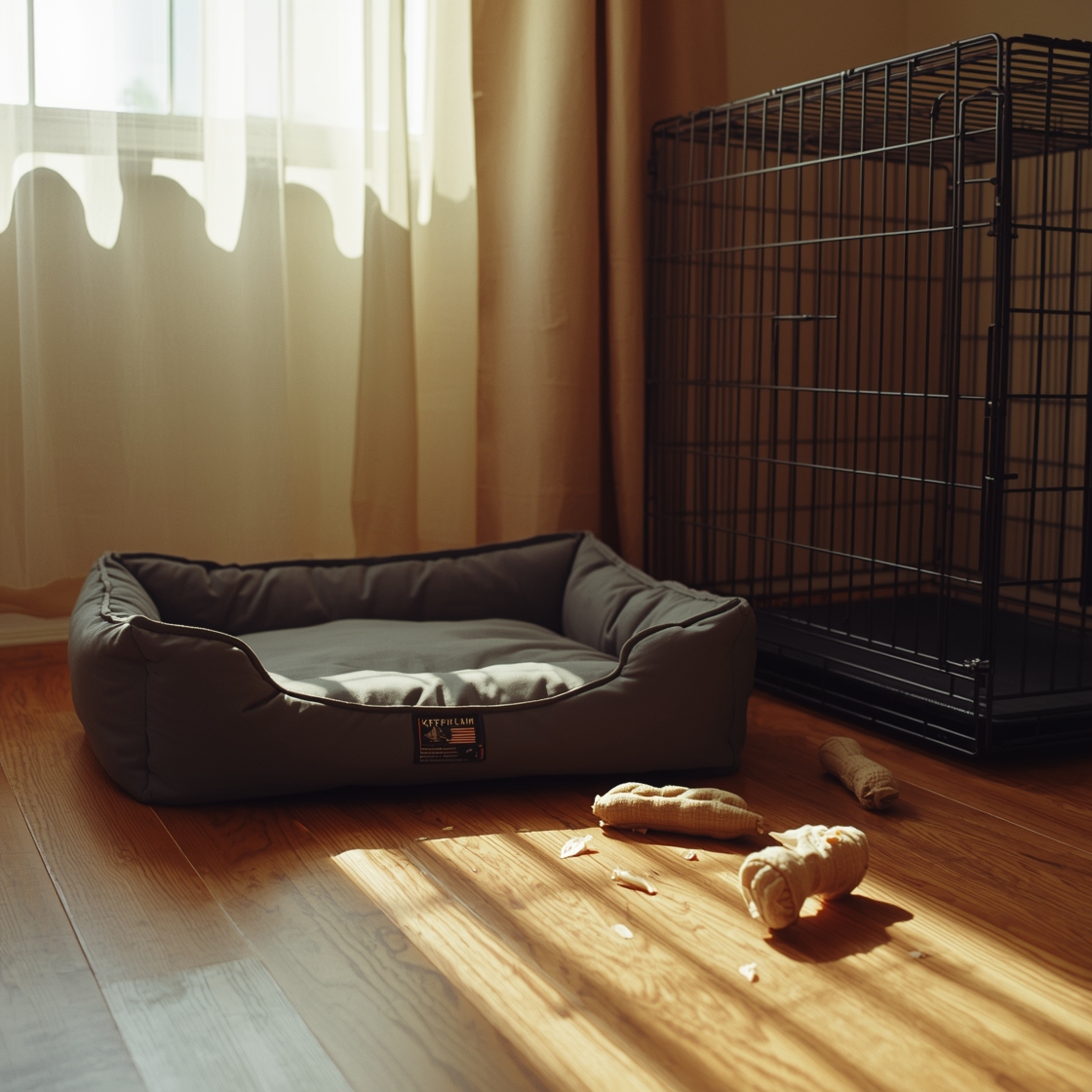
Elevated metal cots (Kuranda, K9 Ballistics, Frisco) win on chew geometry. Nothing floppy to grip. Airflow. Wipe-clean. The trade-off is a firm sleep. Thin seniors may want a second surface they cannot destroy, or a clinic conversation about joints — not a $40 fleece.
Reinforced padded beds (Orvis, Big Barker) win on curl-up comfort and washable covers. The trade-off is fabric. Extreme shredders still win. Orvis at least writes a chew-through check. Big Barker writes a flatten check.
Practical rule: the more stuffing you have vacuumed this year, the more you lean metal.
Price ranges and what $35 vs $300 actually buys
Budget cot — $35. Frisco. Steel + coated fabric. You are buying geometry at the lowest card on this URL. You are not buying a giant-breed stamp.
Mid chew-proof cots — $130–$180. Kuranda $130. K9 Ballistics $180. Aluminum, covered edges, ballistic/ripstop, written chew language. This is the destroyer tier.
Premium padded — $189–$300. Orvis $189 (ripstop + clause). Big Barker $300 (foam years). You are paying for sleep quality. Chew is a maybe.
Hidden cost: three dead plush beds at $40 is $120 and a GI risk if they swallow foam. A $130 Kuranda is often the cheaper year.
How to pick the best dog bed for chewers without lying to yourself
Count the corpses. Zero dead beds? You might be on this page early. Three dead beds? Stop buying pillows.
Watch the target. Seam chewers lose to covered zippers. Edge chewers lose to metal knuckles. Stuffing miners lose to cots with no stuffing.
Match the weight stamp. Then size up if the dog sprawls. A too-small cot invites chewing the rail because the body hangs off.
Crate pairing. A cot that fits the crate is a chew plan. A pillow that fills the crate is a stuffed toy. See puppy crate sizing if the real problem is confinement.
Enrichment first. The AKC on destructive chewing is about what the mouth is for. A bed is a sleep surface. A frozen Kong is a job. Do not expect nylon to replace a walk.
Fit, assembly, and the first-week failure modes
Kuranda and K9 need tools and patience. If you leave a loose rail, you built a chew toy. Follow the maker diagram. Recheck bolts after the first week of bouncing — owner-theme, not a trial.
Frisco is the “apartment Saturday” cot. Still check the feet so it does not skate into a wall.
Orvis: zip the cover fully. An open zipper is an invitation. Wash the cover before first use if the dog is smell-sensitive; skip fabric softener that can irritate skin (clinic if a rash appears).
Big Barker: heavy. Measure the door. A 7-inch slab does not float up a walk-up.
Cleaning the best dog bed for chewers
Cots: shake, wipe, hose. Dry in sun if the maker allows. Do not soak aluminum joints in standing water if the hardware is mixed metal.
Orvis / Big Barker: cover off, gentle cycle, cold or warm per label, low dry or air. Foam cores stay out of the washer unless the maker says otherwise. A wet core is a smell factory.
Hair mats on bolsters are a brush job. Mats become chew handles.
Seven buying mistakes the Chew Survival we keep seeing
“Indestructible” plush. Title lie.
Frisco for a 110-lb dog. Cap math.
Kuranda plus a fleece pad the dog can peel. You reintroduced the target.
Orvis for a known stuffing-eater. Money-back is not an ER visit.
Big Barker because a blog said orthopedic = tough. Different job.
No crate, no walk, new bed. Then the sofa is next.
Leaving a zipper pull dangling. Lunch.
Indoor vs outdoor, puppies vs adults
Kuranda and Frisco listings often sell indoor/outdoor use. Sun kills cheap PVC faster than aluminum stories admit. Bring the cot in for storms if the hardware is mixed. A wet cot is fine; a cot sitting in a puddle for a week is rust theater.
Puppies chew because mouths itch and the world is edible. A $300 Big Barker is a terrible puppy product. A $35 Frisco or a well-sized Kuranda plus a rotation of legal chews is the desk stack. Adult “I destroy beds when you leave” is closer to separation distress — a trainer and possibly a clinic, not a third pillow.
Outdoor-only dogs still need a dry, shaded platform. A cot off the dirt is hygiene. It is not a kennel license to skip water and shade.
Two-bed homes and the “sofa is softer” problem
If the human sofa is allowed, the cot loses. That is not a product failure. Gate the sofa or accept that you bought a $130 daybed the dog uses at 2 a.m. only.
A second sleep site in the room you actually sit in beats a perfect cot in the unused guest room. Dogs sleep near people. Place the metal where the household lives.
If joints and chew both matter, the honest stack is Kuranda or K9 in the chew zone and a senior orthopedic in the supervised evening room — not one SKU that claims both miracles.
Outdoor hardware and mixed-metal rust
If the cot lives on a porch, rinse road salt and fertilizer. Mixed screws in aluminum frames are the quiet failure: the rail looks fine, the fastener weeps rust, and a wobble becomes a chew handle. Owner-theme notes say a quarterly wrench check is cheaper than a replacement rail kit.
A cot that sits under a leaky gutter is a puddle with legs. Move it. Mold on ballistic nylon is a scrub, not a “patina.”
Warranty claims without the folklore
Photograph the damage. Keep the order number. Read the exclusions (chew-proof often excludes “left unsupervised with a known shredder” or requires registration). A warranty is a process, not a personality.
Amazon returns are a separate clock from Kuranda’s year. Do not assume they stack.
When a bed question is a clinic question
Vomiting fabric, bloody stool, sudden frantic chewing, or a dog that cannot settle at all. Buy nothing. Book the clinic. Pica and GI obstruction are medical. A cot is not a treatment.
Nothing on this page has been reviewed by a veterinarian on our behalf.
Frequently asked questions
Will the best dog bed for chewers stop destructive chewing?
No. Tougher geometry delays damage. The AKC still owns the behavior stack: exercise, management, what you hand the mouth.
What is the best dog bed for chewers if I only buy one thing from this page?
Kuranda at $130 for a proven destroyer. Frisco at $35 if they are under ~85 lb and you will accept taut. Orvis at $189 if you need a pillow and a written chew-through hedge.
What makes a dog bed chew-proof?
Remove the grip: metal corners, taut ballistic or coated fabric, no loose flaps. Ripstop stops a nick from running. Warranties are confidence, not physics.
Are elevated cots or padded beds better for chewers?
Cots for destroyers. Padded (Orvis) for occasional mouthers who still want a nest. Big Barker only if joints outrank chew.
Is any dog bed truly 100% chew-proof?
No. Kuranda and K9 are the closest geometry on this URL. A warranty is the maker’s bet, not a promise about your dog.
How do I clean a chew-proof dog bed?
Cots wipe or hose. Orvis and Big Barker: wash the cover, protect the core.
What size chew-proof bed should I buy?
Weight stamp first, sprawl second. Frisco Large ~85 lb. Kuranda listings toward ~250 lb class. Big Barker large/XL only.
Do chew-proof beds come with a warranty?
Kuranda: 1-year chew-proof (confirm). K9: chew-proof term (often 120-day class — confirm). Orvis: ToughChew money-back. Big Barker: 10-year flatten, not chew. Read the current PDF.
Are chew-proof beds comfortable enough?
Cots are firm and cool. Many dogs sleep on them. If you need curl-up foam, you are in Orvis/Big Barker territory and you accepted fabric risk.
Can I put a blanket on a cot?
Yes, and it may become the new chew toy. Use a cheap, replaceable layer or skip it.
How we researched this guide
This guide is desk research. We read the titles and descriptions of five current catalog SKUs plus a wider scan of 22 “chew-proof” bed listings against frame type, fabric class, written chew language, and card price. We cite the AKC’s destructive-chewing page because it is public and specific.
What we do not do: we do not run bite-force trials, we do not employ a veterinarian, and we have not timed how long a particular dog takes to defeat a zipper. Nothing here carries clinical endorsement.
Limitations: listed prices move; card prices are August 2026 snapshots; denier and warranty days change by seller. A written clinic plan supersedes this URL.
A chewed zipper pull in the yard is a swallow risk even after you “won” the bed war. Walk the perimeter after the first week. If you find foam crumbs, the dog won a round — switch to a cot the same day, do not “see if the hole grows.”
Last reviewed: August 2026. If something is stale, contact us.