
Quick answer: The best dog grooming scissors are a job stack — a straight shear for flat body lines, a thinning or chunker pair to blend, and a curved or rounded-tip pair for face and feet. One cheap 4-inch straight shear is how you get steps, nicks, and a dog that will not sit still next time.
We read the titles and descriptions of the 7 live US marketplace cards already on this URL and scored four label-visible signals — kit vs single shear, a printed blade length, a steel or coating word (4CR / titanium / stainless), and a safety-tip or “round” sentence. 6 of 7 (86%) were multi-piece kits. Only 1 of 7 (14%) printed a blade length in the title (7.0 in). 2 of 7 (29%) named titanium. 3 of 7 (43%) used safety / round-tip language. Listing snapshot prices ran $9.97–$49.99 (median $26.99, a 5.0× spread). Zero tiles published a tooth count, a convex-vs-bevel sentence, or a sharpening interval.
This page is a research-desk map of coat job → shear class, using listing-stated prices and VCA’s public coat-care text. Thepetbench is not a groomer and not a veterinary practice. Nothing here has been reviewed by a veterinarian on our behalf.
Related: small-breed shears, curly-coat shears, home kit under $100, clippers, 2026 tool stack, home-clip safety.
Straight vs thinning vs curved vs wrong job
| Job | What it does on a coat | Listing example on this page | Fail mode |
|---|---|---|---|
| Straight shear | Flat lines: back, sides, leg columns | Most kits include one | Steps if used as the only pair |
| Thinning / blending | Softens a clipper line; removes bulk without a hole | Gimars / 7.0 in / TINMARDA kits | Fine teeth fight a wet mat |
| Curved shear | Rounds a rump, a topknot, a leg cylinder | HASHIMOTO Curved | Used on a flat back, it scallops |
| Rounded-tip / safety | Face, ears, paws when you cannot see skin | GLADOG, 4-in-1 kit | Still a blade; not a mat cutter |
| Chunker | Faster bulk on a thick coat | Not titled on these 7 cards | Wrong on a silky toy face |
| Human hair shear | Thin, convex, no finger rest for coat | Dropped | Snags, slips, nicks |
| Clipper | Length, sanitary, emergency mat | Other URL | Not a pair of scissors |
From the listings: “best dog grooming scissors” search tiles still sell kits. A kit is a starter tray. It is not a proof that every pair inside is the right geometry for the coat in front of you.
Price — listing snapshot prices we fetched
Street prices from the seven cards on this URL as of August 2026. Marketplace tiles move. These are not maker list prices; none of the seven cards published a factory MSRP we could cite.
| Listing (card title) | Snapshot price | Pieces (title) | Desk job |
|---|---|---|---|
| Professional 4 in 1 … Safety Round | $9.97 | 4-in-1 kit | Face/paw touch-up, small dog |
| GLADOG Professional 5 in 1 … Safety | $15.99 | 5-in-1 kit | First home tray |
| Gimars Titanium … 6 in 1 4CR | $23.59 | 6-in-1, 4CR + titanium word | Mid kit with a steel claim |
| HASHIMOTO Curved | $26.99 | Single curved | Contour only |
| Professional Dog Grooming Scissors Set | $38.99 | Unspecified set | Daily mid tray |
| 7.0in Titanium Professional … set | $39.99 | Set, 7.0 in named | Longer blade, larger body |
| TINMARDA Dog Grooming Kit | $49.99 | Full kit | Clipper-adjacent tray |
A $10 kit is a safety-tip starter, not a salon convex shear. Budget on a thick coat is not “buy the cheapest straight pair twice.”
Kit-composition worksheet for the best dog grooming scissors
| What the carton says | What the desk still needs | Skip if… |
|---|---|---|
| “5-in-1” / “6-in-1” | Straight + thinning + comb at minimum | The only pair is a 4-inch straight |
| “Safety” / “round tip” | Keep those for face and feet | You planned to cut a mat with them |
| “Titanium” / “4CR” | A steel word, not a Rockwell number | You treat the word as a lifetime edge |
| “7.0 in” | Longer reach on a large body | You have a Yorkie face in front of you |
| “Curved” | One dedicated contour pair | You expected it to replace the straight |
| No length, no tooth count | Assume entry steel | You need a named convex Japanese shear |
Affiliate disclosure: as an Amazon Associate we may earn from qualifying purchases.
The best dog grooming scissors depend on the job — straight for lines, thinning for blend, curved for contours — not a single durability contest across seven marketplace kits.
Our guides are reader-supported. This article may contain affiliate links. As an Amazon Associate we may earn a commission if you buy through links, at no extra cost to you.
The useful question is not “which is the best of seven.” It is: what job is this blade doing — and is the job a straight cut, a blend, a curve, or a clipper?
We read the seven live product cards, the listing-stated prices and titles, VCA’s grooming-and-coat-care page and its hot-spot page, and public maker language where a brand page existed. Dimensions, steel words, and kit counts below are listing-stated unless we say otherwise.
We did not run a cut trial, a “minutes per dog” clock, or a nick score. “Professional” on a $10 carton is marketing. If a claim needs a groomer, a dermatologist, or a sedated clip-off, it is not in this article.
A small-breed shear page already maps short-finger geometry. Curly-coat finish lives on the curly shear page. Clippers live on the clipper page. Home-clip safety lives on the safety page. Pair a first tray with the kit-under-$100 page if you still need a clipper and a brush.
First decision: the coat, the job, or a shopping problem you should stop
VCA’s coat-care page (Barnes, Llera, Hunter, Yuill) is the line we will keep: dogs with long, silky, or curly coats require daily brushing, especially around the ears, armpits, and the back of the legs. Scissors are not that daily tool. Scissors are a length and shape tool after the coat is open. If a comb cannot travel from the skin out, you are not ready to cut.
When the groomer or the veterinarian is the answer, not the cart
- A mat you cannot lift with fingers, or a mat you cannot see skin through — VCA: if the tangle is extensive, seek a groomer or the veterinarian. Only use clippers to remove mats — never scissors.
- Skin under the coat that is red, wet, cracked, or smelly. VCA’s hot-spot page (pyotraumatic / acute moist dermatitis): mats can hide a sore. That is a vet visit, not a sharper pair.
- The dog screams, snaps, or freezes when you touch a panel. Pain is information. We are a research desk. We are not that veterinarian.
- You were about to “just snip it.” Scissors on skin you cannot see are how you get a cut that needs sutures.
- You were about to use kitchen shears or last year’s human haircut pair. Those blades are the wrong thickness and the wrong tip.
If the coat is already a job for clippers and sedation, stop shopping scissors. Book the table.
Decision framework for the best dog grooming scissors (do this before you shop)
Buying has six hard edges. Match the tool to the job and the coat in front of you, not to a “best of” list.
1. Job — straight, thinning, curved, or clipper
Pick the job first. One object rarely does two jobs well.
Straight is the daily length tool on a flat panel. Back, sides, the outside of a leg. A 6.5–7.5 inch blade is the usual home length on a medium or large body. A 4–5.5 inch blade is a face and foot tool. The 7.0 in set on this page is the only card that prints a length. The rest leave you guessing.
Thinning / blending is how you hide a clipper step. Teeth remove some hairs and leave others. A chunker is a coarser cousin for bulk. Neither is a mat cutter. Neither is a face tool on a toy.
Curved follows a cylinder — a rump, a topknot, a leg. HASHIMOTO is the only single-purpose curved card on this URL. Kits that “include a curved pair” still need you to use that pair on a curve, not on a flat back.
Clipper is length at scale, a sanitary, or a mat you should not cut. That is the clipper page.
2. Coat — thick double, fine single, or curly lock
Fine or silky coats (Maltese, Yorkie furnishings) need a lighter, shorter pair and a thinning pair so you do not leave a hole. Curly coats (Poodle, Bichon, many doodles) are a finish problem after a slicker and a comb — that is the curly-coat page.
3. Hand and finger rest
A dog shear usually has a finger rest and a larger ring. A human pair often does not. If the listing photo shows two identical small rings and no rest, treat it as a face tool at best. If your thumb joint already hurts, a longer session on a cheap pair is a wrist problem, not a “bond.”
4. Steel word vs steel number
4CR and “titanium coated” are listing words. They are not a Rockwell C number, not a convex-edge proof, and not a sharpening interval. Gimars is the only card that prints both 4CR and titanium. Two cards print titanium. The $7–$16 kits print neither. Pay for a named steel if you cut every week. Do not pay for the word “Professional” alone.
5. Safety tip is a zone, not a personality
Rounded tips reduce the chance of a poke on a face or a paw. They do not make a dull blade safe. They do not let you cut a mat. GLADOG and the 4-in-1 kit advertise this class. Keep them for the zones where the dog moves.
6. Price band is a kit class, not a quality score
PetBench bands from this URL’s seven snapshots:
| Band | Snapshot range on this page | What you usually get |
|---|---|---|
| Starter | $9.97–$15.99 | Safety-tip kits, short blades, unnamed steel |
| Mid kit | $23.59–$39.99 | A steel or length word; still a kit |
| Full tray | $49.99 | TINMARDA-class “kit,” not a single Japanese convex |
There is no $70–$150 convex pair on these seven cards. If you need that class, you are shopping a different aisle. We will not invent Andis / Wahl / Oster podium names that are not on this URL’s cards.
The 7 listings on this URL — desk notes, not a ranked test
Below are the seven cards already live. Each note is listing language plus a job.
1. GLADOG Professional 5 in 1 Dog Grooming Scissors Set with Safety
Desk job: First home tray with a safety-tip sentence.
Listing snapshot $15.99. Title says 5-in-1 and safety. That is a starter class: face, paws, a light body pass on a small or already-open coat. It is not a thick-coat chunker. Lower-grade steel is the honest listing risk — we have no Rockwell number.
2. Professional 4 in 1 Dog & Cat Grooming Scissors Kit with Safety Round
Desk job: Cheapest safety-round kit on this URL.
Listing snapshot $9.97. Compact. Fine for a nervous small dog’s face if the coat is already combed. Not a mat tool. Not a Newfoundland tool.
3. Gimars Titanium Coated Professional 6 in 1 4CR Stainless Steel Dog
Desk job: Mid kit that actually prints a steel word.
Listing snapshot $23.59. Title: 6-in-1, titanium coated, 4CR stainless. That is the most specific steel sentence on this page. Still a kit. Still needs oil and a dry tray. “Requires careful maintenance to prevent rust” is the usual 4CR caveat —
4. 7.0in Titanium Professional dog Grooming Scissors set
Desk job: The only card that prints a blade length.
Listing snapshot $39.99. 7.0 in is a body length on a medium or large dog. It is a clumsy face tool. Titanium is a coating word, not a convex-edge proof. Higher kit price than the 4CR six-pack; still not a named Japanese shear.
5. HASHIMOTO Curved Dog Grooming Scissors
Desk job: Single curved shear — the only non-kit title.
Listing snapshot $26.99. Buy this after you have a straight pair, or you will scallop a flat back. Legs, rump, topknot. Not a full-body only tool.
6. TINMARDA Dog Grooming Kit
Desk job: Highest snapshot price; “kit” not “shear.”
Listing snapshot $49.99. Treat it as a tray that may include clipper-adjacent pieces. Confirm the carton: if the scissors inside are still unnamed 5-inch straights, you paid for the case.
7. Professional Dog Grooming Scissors Set
Desk job: Mid-price set with no steel word and no length.
Listing snapshot $38.99. Comfortable-ring language is common on this class. Tension screws need a check before every session. Without a printed length, assume a mixed tray and measure the blades when they arrive.
Comparison: dog grooming scissors at a glance
| Product | Desk job | Snapshot price | Buy link |
|---|---|---|---|
| GLADOG 5 in 1 Safety | Starter tray, safety tips | $15.99 | Check price |
| 4 in 1 Safety Round | Small-dog touch-up | $9.97 | Check price |
| Gimars 6 in 1 4CR | Mid kit, steel word | $23.59 | Check price |
| 7.0in Titanium set | Longer body blade | $39.99 | Check price |
| HASHIMOTO Curved | Contour only | $26.99 | Check price |
| TINMARDA Kit | Full tray | $49.99 | Check price |
| Professional Set | Mid set, no length printed | $38.99 | Check price |
Want the category without a ranked list? Browse dog grooming scissors on Amazon →
Thick coats vs fine coats — geometry, not a second podium
| Coat | First shear job | Second shear job | Do not |
|---|---|---|---|
| Thick double (open coat) | Long straight (7 in class) | Thinning or chunker | $10 4-inch kit as the only pair |
| Fine / silky | Short straight + thinning | Rounded tip on face | Heavy chunker on a toy muzzle |
| Curly / lock | Finish after slicker + comb | Curved on the silhouette | Cut a mat; use the curly page |
| Wire / terrier jacket | Hand-strip or groomer first | Light tidy only | “Fluff” a wire with thinning teeth |
VCA: brush before you cut. Water and a mat make a tighter knot. Conditioner does not dissolve a mat.
Home kit tiers: best dog grooming scissors as a tray, not a trophy
| Tier | What to put in the tray | Snapshot analog on this page | Still buy separately |
|---|---|---|---|
| Face-only | Rounded-tip short pair | 4-in-1 / GLADOG | Comb, good light |
| Weekly body | Straight 6.5–7.5 in + thinning | 7.0 in set or Gimars kit | Slicker, brushes |
| Contour | Add one curved | HASHIMOTO | Table or non-slip mat |
| Full home station | Kit + clipper | TINMARDA + clippers | Table with storage |
Best dog grooming scissors — maintenance desk

Maker and groomer-education consensus is boring and correct:
| Signal | What to do | Skip if… |
|---|---|---|
| Hair in the pivot | Brush out; drop of shear oil | You used clipper oil as a soak |
| Blade slides instead of cuts | Tension check, then a sharpener | You keep cutting and “push harder” |
| Nicks in the edge | Stop; a nick grows | You cut a mat or a staple |
| Wet tray | Dry, oil, close in a sleeve | Bathroom cup |
| Human sharpener who has never seen a convex edge | Ask first | You own a $200 convex pair (not on this page) |
Replace a $10 pair when the edge is gone. Sharpen a named steel pair when a sharpener who does pet shears will take them. We cannot time “every 3 months” — that depends on how often you cut and what you cut.
Blade geometry the best dog grooming scissors listings rarely print
A marketplace title will say “professional” before it says bevel, convex, or tooth count. The desk still needs those words because they change the job.
| Geometry | What the edge is | Home use | Risk if you buy it for the wrong job |
|---|---|---|---|
| Bevel / semi-bevel | Flatter grind, more forgiving | Most $10–$40 kits on this URL | Feels “grabby” on a silky coat if the edge is gone |
| Convex | Hollow, slides, expensive to sharpen | Not on these 7 cards | A kitchen sharpener ruins it |
| Micro-serrated | Tiny teeth on one blade | Wet or silky hair that wants to slip | Can leave a chewed look on a show finish |
| Thinning 30–46 tooth | Fine blend | Hide a clipper step | Fights a mat; pulls if you close on a knot |
| Chunker 14–26 tooth | Faster bulk | Thick open coat | Holes on a toy face |
| Curved 6.5–8 in | Arc follows a cylinder | Rump, topknot, leg | Scallops a flat back |
None of the seven cards print a tooth count. If a kit photo shows one pair with slots, that is the thinning pair — use it as a blender, not as a mat saw.
Offset handles (the thumb ring sits ahead of the finger ring) reduce wrist bend on a long body pass. The listings do not print “offset” either. When the pair arrives, look at the rings from the side. If they stack in a straight line, you have a classic handle. Neither is “better.” Offset is a wrist preference.
Coat-by-coat buying map for the best dog grooming scissors
This is a job map, not a breed ranking. Coat in front of you beats registration papers.
| Coat in front of you | First buy | Second buy | Leave to a groomer |
|---|---|---|---|
| Lab / short double, already clipped | Thinning to hide a step | Short safety pair for feet | Full “puppy cut” the first time |
| Golden / long furnished | 7 in straight + thinning | Curved for the feather | Undercoat mats behind the ears |
| Husky / Malamute blow | Scissors are finish after a rake | Thinning only on the skirt | Shaved “lion” — wrong coat science |
| Poodle / doodle curl | Curly shear page | Rounded tip for face | Any mat you cannot see through |
| Yorkie / Maltese furnishings | 4.5–5.5 in straight + thinning | Safety tip | Eyes if the dog will not hold |
| Wire terrier jacket | Tidy only | — | Hand-strip / breed clip |
| Senior thin skin | Shorter sessions, safety tips | Soft slicker first | Any nick history — veterinarian |
VCA’s daily-brush rule for long, silky, or curly coats is still the first line. Scissors do not replace that brush. A slicker-and-comb page is the class split. The breed-tool chooser is the wider map.
Safety protocol the best dog grooming scissors cannot skip
We are a research desk. This is not a training class. It is the stop list.
- Comb first. If the comb stops, you are not cutting. You are looking at a mat or a sore.
- See the skin. Lift the coat. Point the tips away from the body. Rounded tips help on a face; they do not see for you.
- Hold the panel. A second person or a grooming table with an arm is safer than a sliding sofa.
- Quiet the room. A startle plus an open blade is how ears get nicked.
- Stop on blood or a scream. Pressure, a clean cloth, a veterinarian if it does not stop. Do not “finish the haircut.”
- No kitchen shears. No human pair. No sewing scissors.
The home-clip safety page is the longer version.
Additional guidance on best dog grooming scissors
Human hair scissors. Ultra-thin, often convex, no finger rest, sharp points. They snag a coat and they poke. Dedicated pet shears are thicker and usually have a rest. The desk does not need a trial to say: do not use the bathroom pair.
Storage. Sleeve or case, dry, tips protected, out of a child’s reach and out of a dog’s mouth. Do not toss them in the same tub as a wet slicker.
How often to replace. When the cut pushes instead of shears, or when a nick is visible. A kit pair at $10 is a consumable. A $40 set with a steel word is worth one professional sharpen if the pivot is still tight.
Small breeds. Short blades, rounded tips, less leverage on a tiny face. Use the small-breed page.
Left-handed buyers. Most kits are right-hand ground. A “lefty” pair is a different grind, not a flipped handle. None of the seven cards print left-hand. If that is your hand, read the carton before you open the clamshell.
Wet coat. Do not scissor a soaking dog. Hair stretches wet and snaps back short. Dry, comb, then cut. A coat-shine spray is a slip aid on a dry, open coat — not a license to cut a mat.
Puppies. Short sessions. Safety tips. The first “haircut” is often a groomer’s job so the dog learns the table.
Frequently asked questions
What defines the best dog grooming scissors for a first-time home groomer?
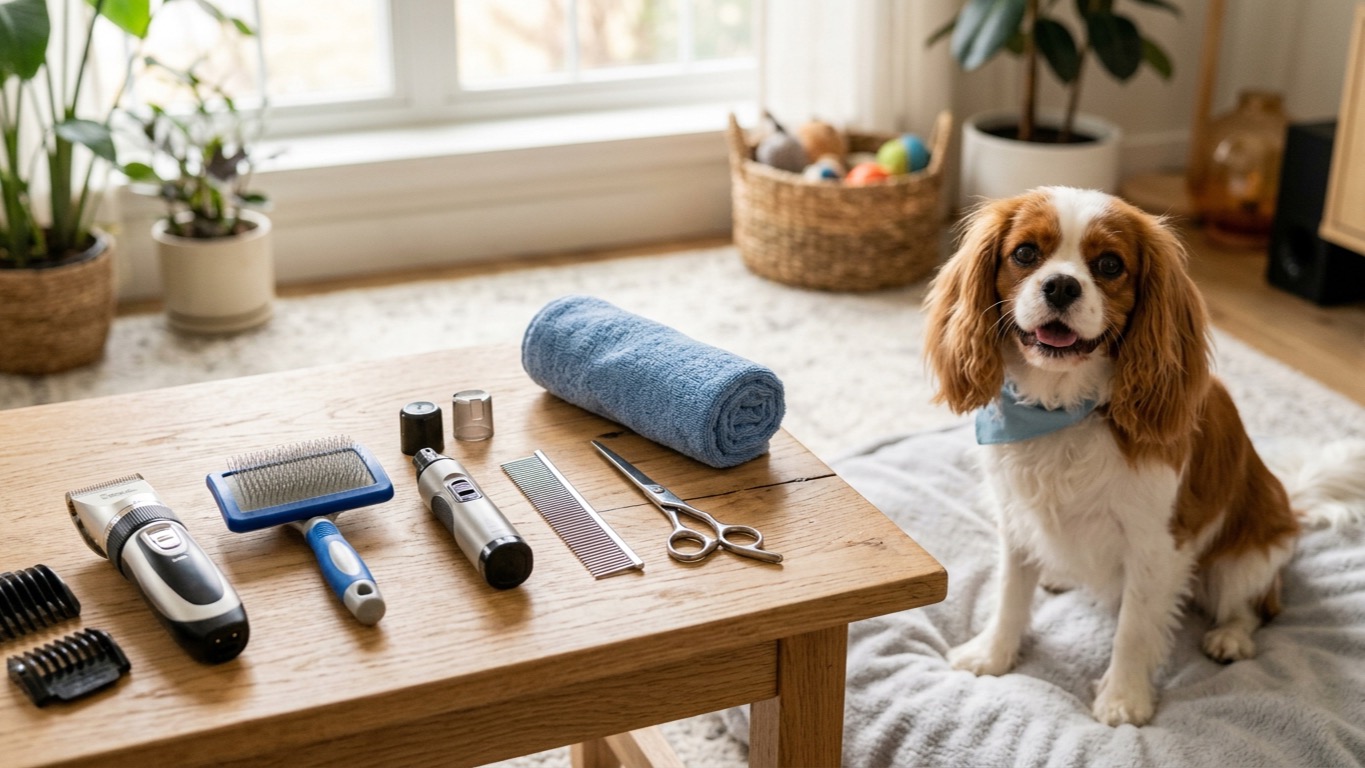
A matched tray: one straight pair long enough for the body you have, one thinning pair, and a rounded-tip pair for face and feet. The these shear-job listings on this URL is 86% kits — that is the market, not a proof of quality. Read the carton for a length and a steel word. If neither is printed, you bought a starter.
How often should I replace my dog grooming scissors?
When they push, fold hair, or show a nick. There is no universal month count. A $10 safety kit is cheaper to replace than to mail out. A named-steel pair is cheaper to sharpen once than to replace twice — if you can find a pet-shear sharpener.
How can I tell if my scissors are dull?
Hair bends in the blade. You hear a crunch. You start taking three passes where one used to do. Check tension first (a loose pivot feels dull). Then stop cutting.
Is it better to sharpen or buy new?
Under ~$20 snapshot: replace. Mid kit with a steel word: one sharpen if the edge is even. Convex Japanese shears (not on these cards): only a convex specialist.
Can I use ordinary human hair-cutting scissors?
No. Wrong tip, wrong thickness, wrong rings. They snag a coat. They nick skin. Buy a pet pair with a finger rest.
What’s the best way to store grooming scissors between sessions?
Dry, oiled at the pivot, in a sleeve, tips covered. Not in a wet bathroom cup. Not loose in a drawer with clipper blades.
Are the best dog grooming scissors enough to skip a groomer?
For a tidy face and a light body pass on an already-open coat, sometimes. For a breed clip, a mat, or a dog in pain — no. VCA’s mat rule still stands: clippers, not scissors, when you cannot see skin.
SOURCES
Institutions and clinical education:
- https://vcahospitals.com/know-your-pet/grooming-and-coat-care-for-your-dog
- https://vcahospitals.com/know-your-pet/hot-spots-in-dogs
Listing snapshots (this URL’s seven cards, August 2026 listing snapshot): prices and titles as stored on the live product cards.
Related desk pages:
- https://www.thepetbench.com/articles/best-dog-grooming-scissors-for-small-breeds/
- https://www.thepetbench.com/articles/best-dog-grooming-scissors-for-curly-hair/
- https://www.thepetbench.com/articles/best-pet-grooming-clippers/
- https://www.thepetbench.com/articles/dog-grooming-safety-tips-for-home/
Session-planning bands
VCA wants the coat open before you cut. Minutes below are planning bands from coat length —
| Coat state | Comb-to-skin first | Typical tidy desk | Stop and book |
|---|---|---|---|
| Short pet body | Ears, paws, sanitary | 10–20 min face + feet | Any hidden mat |
| Medium open jacket | Full panel | 20–40 min body + blend | Comb stops |
| Thick double in shed | Slicker / rake first | Scissors are finish only | Undercoat sheet |
| Curly / lock | Daily brush (VCA) | Finish shears only | See curly page |
If the comb stops, the session is not “almost a haircut.” The session is not a haircut.
When the best dog grooming scissors stop being the answer
Extensive mats, hidden hot spots, or pain when touching a panel require a groomer or a veterinarian — clippers for mat removal per hospital education, never scissors on skin you cannot see. Listing-stated kit counts and prices — not cut trials by our desk — inform the notes above.
Last reviewed: August 2026. opening summary, these shear-job listings, listing price desk, kit-composition worksheet. Research desk; VCA cited. Contact if a listing snapshot price changed.