The best automatic pet feeder for multiple cats is not a dual-bowl timer. It is a lock that matches the thief plus a bowl that matches the food, placed on a visually separated station. A splitter hopper is a schedule. Only a registered microchip or RFID lid — or a room that actually stays shut — stops a thief.
Buy a SureFeed Microchip Pet Feeder if the meal is wet or a diet the other cat must not touch, and the cat already has an implant. Buy a PETLIBRO One RFID if the food is dry and the cat will keep a 4.2 g collar tag on. Buy a PETLIBRO Granary Dual 5 L only if every cat at that station may eat the same kibble. Two trays are not two diets.
Nothing here has been reviewed by a veterinarian on our behalf. A cat that stops eating, loses weight, or needs a therapeutic diet needs that cat’s veterinarian. A feeder is a lock and a schedule. It is not a diagnosis.
Affiliate disclosure: we may earn a commission from Amazon links.
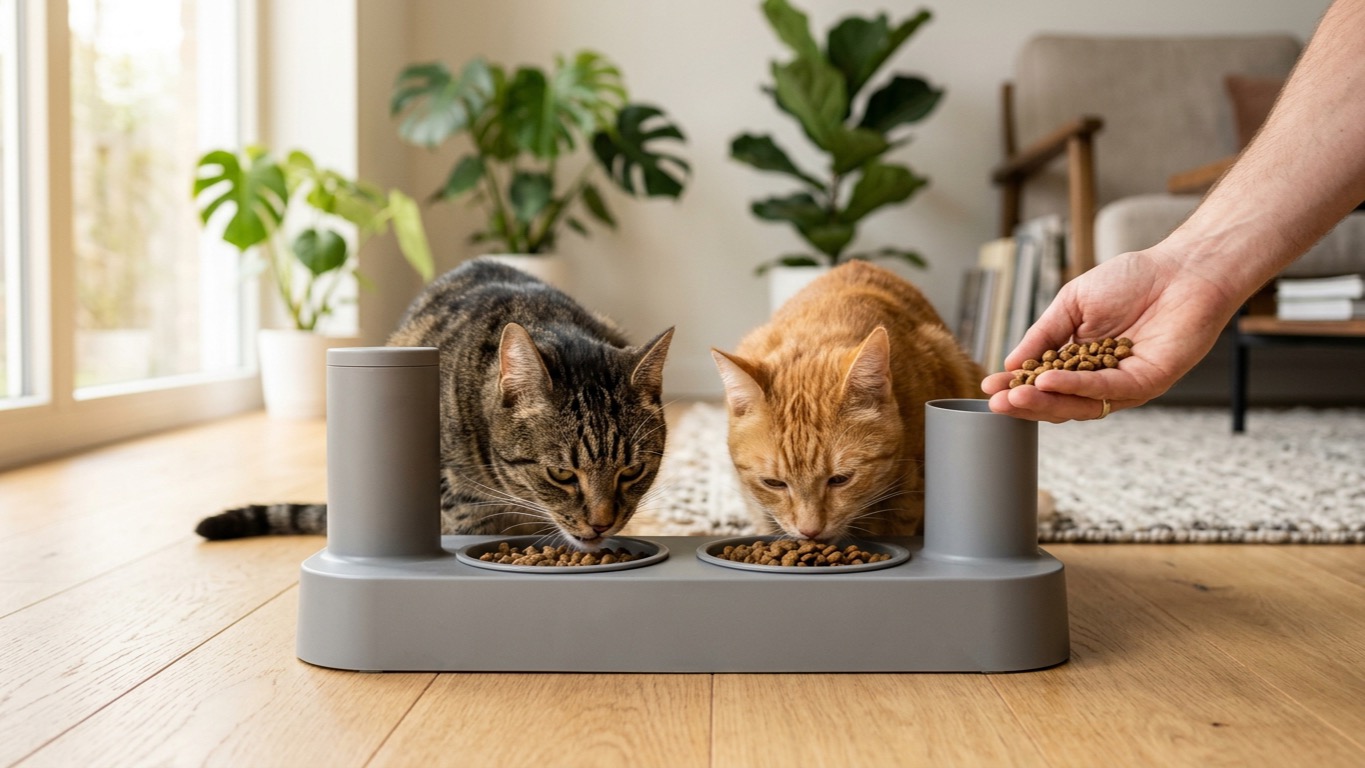
AAFP’s 2018 feeding-program consensus (Sadek and colleagues, Journal of Feline Medicine and Surgery) is the frame: cats prefer to eat often and alone; multi-cat homes need multiple feeding stations that are visually separated; meals can be offered through programmable feeders, “some of which utilize individual microchips.” Cornell Feline Health Center : some cats miss dinner unless food is left out, others eat too much when it is always there. “Feeding cats separately or in different parts of the house may be helpful.”
A camera answers “did anyone eat.” That job lives on cat feeders with a camera. Cooling a wet tray is a different job: automatic wet-food feeders. What goes in the bowl — including a weight-management bag — is not this page: cat food for weight loss. AAFP also says feeding stations should not sit next to litter boxes.
What the best automatic pet feeder for multiple cats actually has to do
The useful question is not “which feeder won.” It is: what is the lock, what food will it hold, and what still gets past the lock?
Four access methods showed up on maker pages we opened in August 2026:
- Microchip lid — implant (or maker RFID tag) opens a sealed bowl. One meal.
- RFID collar lid — brand tag only, dry hopper.
- Scheduled open bowl — a clock drops kibble or pops a lid. No ID.
- Physical diet separation — a room, a baby gate, a size-limiting hole. AAFP names these on the same page as microchip feeders.
A ranked “best automatic feeder” cannot substitute for that list.
The four access methods (August 2026) — table 1
| Access method | What the opened maker pages actually lock | Wet food? | How many cats per unit | What it cannot do |
|---|---|---|---|---|
| Microchip lid (implant, optional maker RFID tag) | Lid opens for a registered implant or Sure Petcare RFID collar tag. SureFeed US page, opened August 2026: “all common identification microchips worldwide”; stores 32 pet identities; bowl 400 ml or two wet pouches; 4 × C alkaline cells, maker-stated ~6 months; memories survive a battery pull. | Yes — sealed single-meal bowl. | Typically one unit per diet you must protect. Memory of 32 IDs is not “one hopper feeds 32 cats their own food.” | Multi-day dry hopper. It is one meal behind a lid. |
| RFID collar lid (brand tag only) | Lid unlocks for that brand’s collar tag. PETLIBRO One (PLAF301) product page: reader “verifies the pet’s collar tag (not microchip)”; one tag per feeder; 3 L dry tank; up to 10 meals/day; 2.4 / 5 GHz Wi-Fi; kibble 2–15 mm. | No. Maker FAQ: dry only. | One feeder per cat you need to lock out. | An implant. A lost collar is a lost key. Wet or therapeutic pouches. |
| Scheduled open bowl (timer / splitter hopper) | A clock drops kibble, or a lid pops on a delay. PETLIBRO Granary Dual (opened August 2026): 5 L, splitter into two stainless trays, dry only, 2–15 mm kibble, USB 5 V plus 3 × D backup. Cat Mate C200 (Closer Pets): two 400 g bowls, ice pack, 1 × AA ~12 months, lids open on a 48-hour quartz timer. | Hopper: no. C200-style trays: wet or dry, until the ice pack is spent. | Two bowls ≠ two locks. The splitter serves two cats the same food. | Stop a fast eater. Protect a prescription bag. |
| Physical diet separation | A room, a baby gate, a size-limiting hole, a high shelf the other cat cannot use. AAFP names these on the same page as microchip feeders. | Whatever the bowl holds. | One station per social group you actually have. | Work while you sleep unless a person or a lock is still there. |
That table is the selection rule.
Microchip lid: the implant is the key, not the diet
Sure Petcare’s US Microchip Pet Feeder page (MPF001 family) prints the mechanism in one sentence: programme the pet’s microchip; the lid opens when a registered pet approaches; it stays closed for everyone else. The same page lists a training mode that introduces lid movement gradually. The FCC user manual for MPF001 adds the failure case the marketing tile skips: if an unauthorised pet tries the bowl while it is already open, the lid closes.
What the same pages do not print is a clinic success percentage for this SKU. We are not inventing one. Sure Petcare’s January 2020 “pet pilferers” note is a maker-commissioned survey of 500 UK dog and cat owners, not a feeding trial: 44% said they had caught one pet taking food from another’s bowl; 31% then refilled the bowl “in case”; 72% said they had overfed; 64% had never used scales. Those are owner answers on a Sure Petcare page. They are not a lab result, and they are not “SureFeed reduced stealing by X%.”
The Connect variant is a separate SKU: a Hub (up to ten devices) plus the Sure Petcare app. Sure Petcare’s bowl list says the original split bowl is not compatible with Connect. Mix bowls only after that line, not after a blog table.
A microchip lid is the right axis when:
- the cat already has an implant you can enrol (Sure Petcare publishes a chip-number checker);
- collars come off, or a dog in the house will eat the bag;
- the meal is wet or a veterinary diet that a dry hopper cannot hold.
It is the wrong axis when you need a week of kibble in a sealed tank. Capacity is one meal. Plan a refill, or a person.
RFID collar lid: a tag is a key you can lose
PETLIBRO’s One RFID page is plain: the reader “verifies the pet’s collar tag (not microchip).” FAQ: not microchips, not other brands’ tags, and one tag per feeder. Tag 4.2 g, snap-release. Hopper 3 L (~13 cups). Mains first; 3 × alkaline D emergency only — on battery the maker disables Wi-Fi so the schedule can still run.
No implant to read if the collar is under the sofa, and no wet-food seal. Honest use: dry portions for a cat that will wear the tag, plus an app log of that unit. Two diets is two feeders. A pair of Ones is not “one smart feeder for the house.”
Scheduled open bowl: two trays, one food, no ID
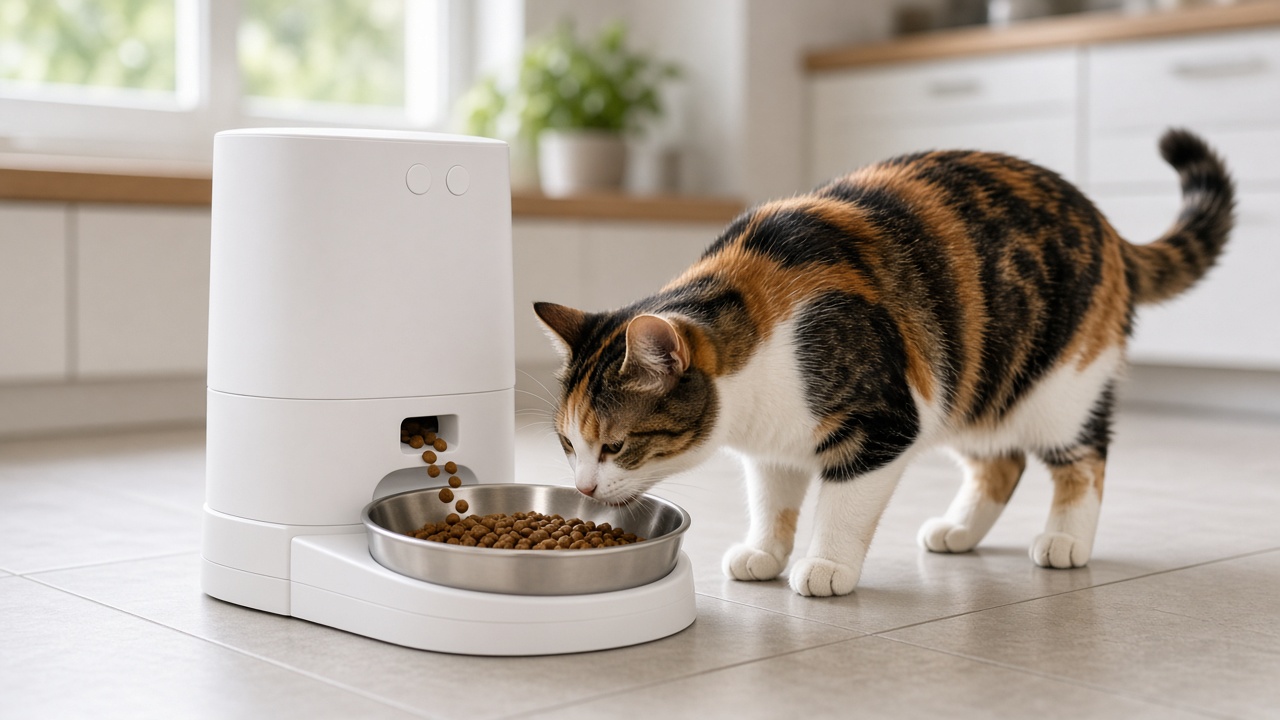
A splitter hopper is a clock with two mouths. PETLIBRO’s Granary Dual pages print the same limits: dry food only, kibble 2–15 mm, lift-out stainless trays, 3 × D as backup not everyday power. Wi-Fi dual-tray page: 1–10 meals, 1–50 portions, about 20 ml each. The non-Wi-Fi 5 L listing we loaded: up to 6 meals, same dry-only rule.
Cat Mate C200 (Closer Pets) is the wet-capable timer: two 400 g dishwasher-safe bowls, ice pack, fly-proof lids, 1 × AA ~12 months, 48-hour quartz timers, and a lid-link clip that opens both lids at once. That clip is a sharing tool, not a lock. It will not protect a renal pouch. FDA leftover guidance still treats opened perishable food as a 2-hour problem once it sits at room temperature — an ice pack buys hours, not a weekend fridge.
Use this axis when every cat at the station may eat the same food and guarding is mild. If one cat finishes both trays, change axis.
Diet separation: the gate AAFP names next to the microchip
AAFP does not say “buy a branded lid.” It says determine which cats spend time together and which avoid each other, then put food where each cat already feels safe. Tools on that page, in the same paragraph as microchip feeders: baby gates, size-limiting entrances, elevated shelves or tables the other cat cannot use, and enough distance that stations are visually separated. Cornell: separate rooms can be enough.
That is still the first move for a veterinary diet. The feeder does not prescribe the bag. Sure Petcare’s own US-page disclaimer: products “are not intended to diagnose, cure, treat or prevent diseases or conditions and do not replace veterinary care.” A lock only keeps the other cat out of a bag a veterinarian already named. If no bag has been named, start with weight-loss food and the clinic.
One peer-reviewed household study, cited without turning it into a SureFeed advert: Witzel-Rollins et al. (University of Tennessee, JFMS 2022; 23 cats, BCS ≥7/9) compared a bowl with an automatic feeder at two or six meals. The hardware was PortionPro Rx (Vet Innovations) — an RFID collar-tag shield, not a SureFeed implant reader. Cats on the automatic feeders were more likely to reach BCS ≤6/9 (P = 0.006): 83.2% of the six-meal auto group, 40% of the two-meal auto group, none of the bowl group. Owners also rated the plan easier (P = 0.01). Two vs six meals did not change weekly percent weight lost. Small n. Different machine. Those figures stay on that paper.
Theft modes the lock does not automatically beat — table 2
Sure Petcare’s own help article, “My Cats Are Stealing Food from Each Other’s Microchip Pet Feeder,” is the honest theft list. A lid can still lose.
| Theft / escape mode (August 2026 desk list) | What the sourced page says to do | What still fails |
|---|---|---|
| Feeders too close | Sure Petcare help: keep Microchip Pet Feeders at least 30 cm apart so one cat cannot dive the open bowl. | Two lids on one mat is one station. AAFP wants visual separation, not 30 cm of plastic. |
| Rear raid | Same help page: a cat reaches from behind while the lid is open for the registered pet. Maker accessory: Rear Cover. | No rear cover = the hoop is a front door only. |
| Side-by-side squeeze | Help page: another cat eats from the side while the authorised cat is in the hoop. Maker asks for the serial number and a video; no printed DIY fix. | A determined pair can share a 400 ml bowl in the seconds the lid is up. |
| Lid already open | MPF001 manual: unauthorised approach should close the lid. Sensors in the hoop must be clean. | Dirty sensors, dying C cells, or a cat that loiters in the hoop keep the bowl public. |
| Lost or swapped collar tag | PETLIBRO One: one dedicated tag. Snap-release is a safety feature and a lost key. | The implant path (SureFeed) survives a missing collar. The One does not. |
| Splitter dash | Granary Dual / any open dual tray: both bowls get the same kibble at the same second. | A fast eater owns both portions. Move stations or change axis. |
| Linked wet lids | C200 lid-link clip opens both compartments together. | Designed for sharing. Do not use it to “protect” two diets. |
| Room separation that leaks | AAFP / Cornell: separate rooms, gates, size holes. Witzel-Rollins bowl group: one household left the study because cats could not be kept apart. | A closed door only works if it stays closed for the whole meal. |
The August 2026 working rule: place first, then lock. A locked lid on a shared placemat is still one resource.
Hygiene: the bowl is a food-contact surface
Cornell: food left out for grazing should be replaced with fresh food every day. Wet food is a same-day surface. AAFP still wants someone to confirm the cat ate, and to watch for bowl guarding.
Maker pages we opened: SureFeed bowls seal at the lip when the lid closes — a warped or third-party dish can break that; stainless bowls are sold separately. PETLIBRO hoppers are dry-only; Granary Dual trays lift out. C200 bowls and lids are dishwasher-safe; the instruction PDF says use the ice pack with wet food unless the room is below 5 °C / 40 °F, and freeze the pack at least 6 hours. Wash hoop sensors (SureFeed manual) and trays on the interval the food demands. A locked bowl of spoiled food is still spoiled food.
FDA kitchen leftover guidance is written for human food. We use it as the only public perishable-food clock that exists, not as a pet-food certification. Once a wet lid opens, the 2-hour leftover analog applies to what sits in the bowl.
Power: print the cell count, not a vibe — table 3
| Unit (pages opened August 2026) | Everyday power | Backup / notes the maker printed |
|---|---|---|
| SureFeed Microchip Pet Feeder | 4 × 1.5 V alkaline C. Not designed for rechargeables (manual / help). | Maker: about 6 months normal use; rear light flashes red when low; IDs stay in memory with batteries out. |
| SureFeed Connect | Same 4 × C alkaline. Hub is mains + Ethernet to the router. | Help article: ~6 months; Hub is a separate brick. No Hub = no app, lid still works as a feeder. |
| PETLIBRO One (PLAF301) | Mains (AC 100–240 V). | 3 × alkaline D, emergency only. Battery-only: Wi-Fi off; schedule still runs. |
| PETLIBRO Granary Dual 5 L | USB / 5 V adapter. | 3 × alkaline D, emergency only. Maker: do not run D-cells as the sole everyday supply. |
| Cat Mate C200 | 1 × AA alkaline. | Maker: about 12 months; remove the cell after a trip. No mains cable to fail. |
Weekend-away drill:
- Read the low-battery tell-tale today, not at the airport.
- Alkaline only where the maker banned rechargeables (SureFeed C cells; PETLIBRO D-cell notes).
- A hopper on D-cell backup is a schedule, not a camera. The One and the Granary Wi-Fi models drop the radio on battery.
- Keep one ordinary bowl and a measured scoop as the outage plan. AAFP still wants you to know the cat ate.
Named examples (not a ranking)
These are currently sold examples of the four axes.
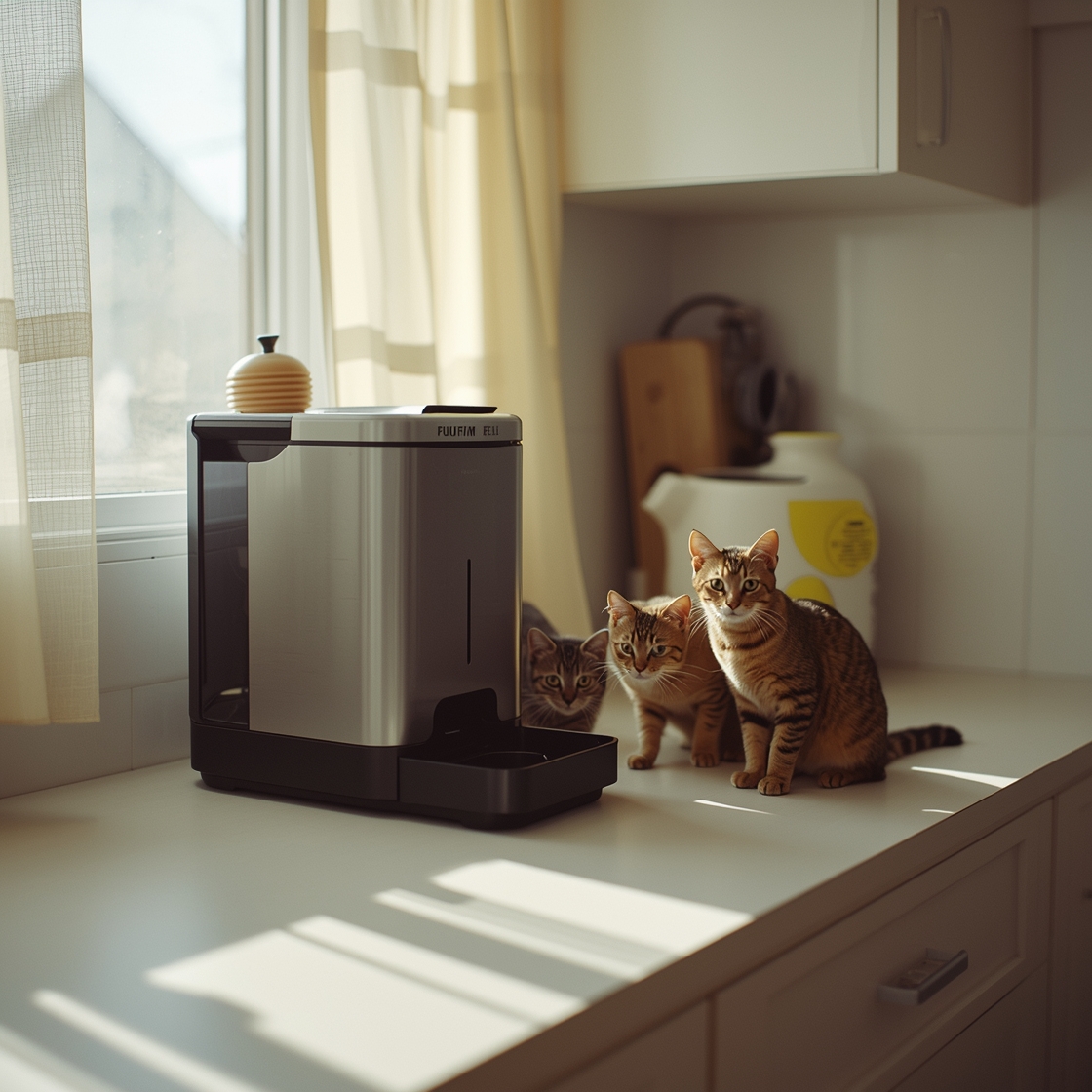
SureFeed Microchip Pet Feeder — implant or Sure Petcare tag, wet or dry, one meal
Maker job: stop the other pet reaching the bowl. 400 ml sealed bowl; 32 IDs; 4 C cells; optional rear cover. One meal. One unit per diet you must isolate.
Check SureFeed Microchip Pet Feeder on Amazon
PETLIBRO One RFID Automatic Cat Feeder — brand tag only, 3 L dry hopper
Maker job: unlock a 3 L dry hopper for one collar tag and log that unit in the app. Not a microchip reader. Not wet food.
Check PETLIBRO One RFID feeder on Amazon
PETLIBRO Granary Dual 5 L — scheduled splitter, no ID
Maker job: drop the same dry food into two stainless trays on a timer. No recognition. If a cat can reach both trays, both trays are that cat’s.
Check PETLIBRO Granary Dual 5L on Amazon
Cat Mate C200 — timed wet trays, deliberately unlockable
Maker job: open one or two 400 g bowls on a 48-hour clock with an ice pack. The lid-link clip is a sharing tool, not a microchip substitute.
Want the wider dry-hopper shelf? Browse automatic cat feeders on Amazon
Feeder count desk — best automatic pet feeder for multiple cats (table 4)
| Cats / job | Units this desk would plan | Why |
|---|---|---|
| Two cats, same dry food, mild guarding | One Granary Dual or two timed hoppers 3+ ft / visually separated | Watch one meal. If both trays empty into one stomach, add a lock. |
| Two cats, one prescription bag | One SureFeed (or a room that stays shut) + one ordinary station | The lock protects the named bag. The other cat still needs a station. |
| Two cats, dry only, collar-tolerant | Two PETLIBRO Ones | One tag per feeder. A pair is two locks, not one “house feeder.” |
| Three-plus, mixed diets | n locks or n rooms — do not stretch one splitter | AAFP: stations that are visually separated. |
| Wet meals on a workday | SureFeed per protected diet, or C200-class iced trays if sharing is allowed | Dry hoppers print “dry only.” |
Owner-theme notes (not a PetBench measurement): a shared open timer is how a dominant cat finishes both portions.
Hopper math — desk planner, not a prescription (table 5)
| Cat body weight (typical adult) | Dry g/meal starting band (label math) | Meals / day | Days a 3 L / ~13-cup hopper can cover at that rate |
|---|---|---|---|
| 9 lb | Follow the bag’s kcal, not this row | 2–3 | Roughly a week-plus if portions are small |
| 12 lb | Follow the bag | 2–3 | Mid week if portions grow |
| 15 lb | Follow the bag | 2–3 | Plan a mid-week refill |
Gram-per-kcal on the bag is the real number. This table is a hopper-refill planner. A cat on a renal or weight plan needs the clinician’s gram target, not a carousel default. Clean the bowl weekly — biofilm causes refusal before visible slime on white plastic.
A 5 L Granary Dual holds more calendar days than a SureFeed’s 400 ml bowl. That is capacity, not a lock.
August 2026 choose-the-axis checklist
Work top to bottom. Stop at the first “yes” that matches the house you have, not the house in the listing photo.
- Has a veterinarian named a diet this cat must eat and the others must not? If yes, lock that bowl (microchip lid or a room that actually stays shut). The bag is a clinic sentence. The lid is only the lock.
- Is the meal wet, raw, or a pouch that spoils? If yes, a dry hopper is the wrong machine. SureFeed’s sealed 400 ml bowl or a C200-style iced tray. Wash daily. Cornell: replace grazing leftovers every day.
- Does one cat already steal, or does a dog share the kitchen? If yes, you need a lid that reads an ID — implant (SureFeed) if collars fail; PETLIBRO One if you will keep a 4.2 g tag on.
- Do all cats at this station eat the same dry food without guarding? If yes, a Granary-style splitter or any timed hopper is enough as a clock. Watch one meal. If both trays empty into one stomach, go back to step 3.
- Where will the station sit? AAFP: visually separated; not by the litter box; use height the other cat cannot climb if agility allows. Sure Petcare: ≥30 cm between microchip lids, plus a rear cover if someone raids from behind.
- What happens when the mains die? Print the cell count from Table 3. Leave a measured scoop.
- How will you know the shy cat ate? A camera is a witness, not a lock — that is the camera-feeder page. A body-condition check is a clinic skill. This desk did not score BCS.
How we selected examples of the best automatic pet feeder for multiple cats
We opened maker pages and manuals in August 2026 and mapped each SKU to an access method: implant lid, brand-tag lid, clocked open bowl, or physical separation. A product is on this URL only as an example of an axis. Specs change; a number we could not load is not on this page.
Primary-source names we used: AAFP 2018 feeding-program consensus (Sadek and colleagues), Cornell Feline Health Center feeding pages, Sure Petcare US pages and help articles, PETLIBRO One and Granary Dual pages, Closer Pets C200 leaflet, FDA leftover guidance as a perishable-food clock, and the 2022 JFMS Witzel-Rollins paper (PortionPro Rx hardware — not SureFeed).
Listing literacy for the best automatic pet feeder for multiple cats
When comparing Amazon cards, read lock type, wet vs dry, hopper liters, and cell count before star averages. PetBench discards “#1 for multi-cat” badges. Two bowls are not two diets. An app log is a witness, not a lock. Snapshot prices move — use the Check price links.
Ask the listing:
- Does it read an implant, a brand tag, or a clock?
- Does the maker print dry-only?
- Is backup power everyday power, or emergency-only with Wi-Fi off?
- Is there a rear cover if the hoop is open at the back?
Decision checklist — lock, bowl, map
- Has a clinic named a bag one cat must eat and others must not? Lock that bowl or that room.
- Is the meal wet or a pouch? Dry hoppers are the wrong machine.
- Does a thief or a dog already steal? You need an ID lid, not a splitter.
- Do all cats at this station eat the same dry food without guarding? A timer can be enough as a clock. Watch one meal.
- Where will it sit? Visually separated; not beside the litter box; 30 cm is not a social map.
- What happens when mains die? Print the cell count. Leave a measured scoop.
- How will you know the shy cat ate? Camera page or a person.
Frequently Asked Questions
Do I need a microchip feeder, or is an RFID collar enough?
Enough for what. PETLIBRO One is enough if the cat keeps the 4.2 g tag on and the food is dry. SureFeed is the axis that still works when the collar is off, and it is the one in this set whose maker page states wet food in a sealed 400 ml bowl. Neither one writes a diet.
Can one automatic feeder serve two cats without mixing meals?
Only if “meals” means the same food in two trays (Granary Dual) or two timed wet bowls (C200). Different bags need different locks or different rooms. AAFP: cats that eat together are not proof they should.
Will a microchip feeder stop all stealing?
No. Sure Petcare’s own help page lists close placement, rear reach, and side-by-side eating as live failure modes. The MPF001 manual says a dirty hoop or tired batteries will misbehave. Place, cover the rear, clean the sensors, then blame the cat.
What did SureFeed clinically prove?
This desk did not find a SureFeed-branded clinical success percentage we are willing to reprint as fact. The 2020 Sure Petcare note is a 500-owner UK survey (44% had seen bowl theft). The 2022 JFMS weight-loss paper used PortionPro Rx, not SureFeed. We are not sliding those 83.2% / 40% / 0% figures onto a different machine.
Do automatic feeders work with wet food?
Most hoppers in this file say no — PETLIBRO One and Granary Dual print “dry food only.” SureFeed prints wet and dry in a 400 ml sealed bowl. C200 prints wet or dry in 400 g trays with an ice pack. Rotary coolers are a different URL: wet-food feeders. A 5 L dry hopper can cover days if kibble flows; a SureFeed is one meal; a C200 is two trays and an ice pack, not a week.
One hopper or two for the best automatic pet feeder for multiple cats?
Two separate stations is the AAFP-shaped default. One splitter is a clock for the same food. Microchip or RFID lids if one cat is on a prescription diet or a weight plan the others must not share.
Weekend-away power drill
Read the low-battery tell-tale today. Alkaline only where the maker banned rechargeables. A hopper on D-cell backup often drops Wi-Fi. Keep one ordinary bowl as the outage plan.
A camera answers “did anyone eat” and belongs on the camera-feeder page. Wet cooling is a different machine: wet-food feeders. The bag itself is not this URL: cat food for weight loss.
Transition week: one variable at a time
Cats refuse texture and location changes faster than they refuse a new clock.
- Keep the same bag for seven days.
- Change only the lock or the timer — same grams.
- Place the new unit where that cat already eats, then add distance if a thief appears.
- Do not add a new flavor, a new feeder, and a new room on the same Monday.
Hairball, urinary, or appetite changes belong with a veterinarian. This desk will not diagnose a skipped meal from a product card.
Some roundups mixed a tight access-method framework with a later “feeder count” table that printed ±5 g accuracy and a 60–70% dominant-cat share as if those were desk measurements. They were not. The useful sentence is still the first one: lock, bowl, map — in that order — before you compare hopper liters or Wi-Fi badge color.
What to do tomorrow
- Write whether a clinic has named a bag one cat must eat alone.
- Write wet vs dry.
- Write whether a thief or a dog already steals.
- Match that sentence to Table 1, then a named card.
- Place stations so they are visually separated. Confirm the shy cat ate.
The feeder that belongs in a multi-cat home is the one whose lock matches the thief, whose bowl matches the food, and whose placement matches the social map AAFP asked you to draw. A timer without a lock is a schedule. A lock on a shared mat is still one bowl. That is the best automatic pet feeder for multiple cats rule this URL will keep.
Sources
- AAFP, Feline feeding programs / consensus (Sadek et al., JFMS 2018): https://catvets.com/guidelines/practice-guidelines/feeding-guidelines
- Cornell Feline Health Center, Feeding your cat: https://www.vet.cornell.edu/departments-centers-and-institutes/cornell-feline-health-center/health-information/feline-health-topics/feeding-your-cat
- FDA, Food safety in your kitchen (2-hour perishable leftover clock): https://www.fda.gov/food/buy-store-serve-safe-food/food-safety-your-kitchen
- Witzel-Rollins et al., JFMS 2022 (PortionPro Rx hardware — not SureFeed)
- Sure Petcare US Microchip Pet Feeder pages, MPF001 manual, and “cats stealing food” help article (August 2026)
- PETLIBRO One (PLAF301) and Granary Dual 5 L product pages (August 2026)
- Closer Pets / Cat Mate C200 leaflet (bowl weight, ice pack, AA cell)