Best Bearded Dragon Terrariums (2026 Size & Safety Picks)
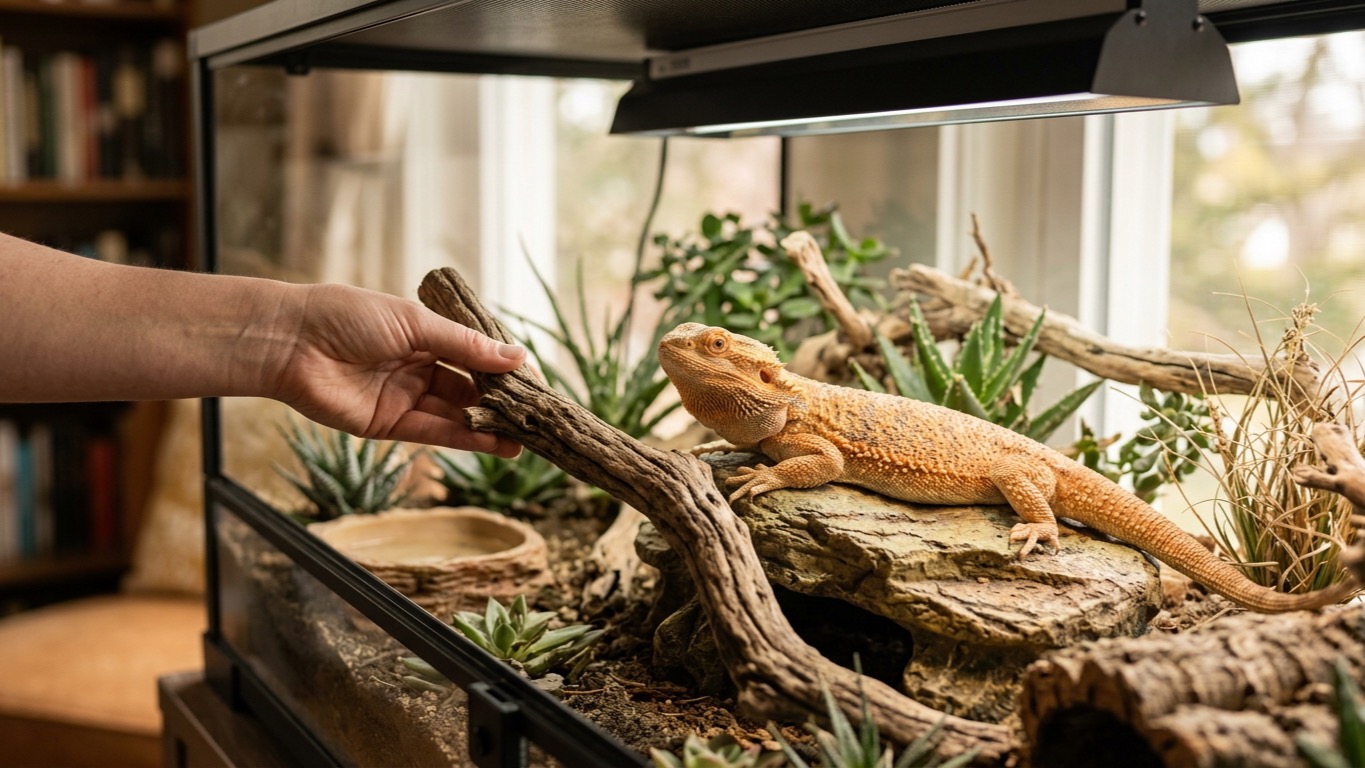
The best reptile terrarium for bearded dragons is a 4×2×2 ft / ~120-gallon adult floor plan (48×24×24 in) with a 95–105°F basking surface, a 75–85°F cool side, and UVB rated for that length. A 24-gallon glass box is juvenile or quarantine space. Accessories do not replace cubic feet.
Buy the 4-foot PVC or 120-gal glass first. Use the ALOTIKI 24 Gallon only as a temporary hatchling, quarantine, or hospital box. Pair any adult enclosure with dual thermometers, a thermostat-controlled basking lamp, and UVB sized for 48 inches. Do not treat tongs, sand, or a décor kit as housing.
Nothing here has been reviewed by a veterinarian on our behalf. Specs are maker pages or published husbandry ranges as of August 2026. RSPCA reptile-care language and keeper-education consensus both treat space, heat gradient, and UVB as the floor — not a plastic-plant count. We reprint those ranges.
Affiliate disclosure: we may earn a commission from Amazon links.
What this URL’s cards actually are
These seven cards are the live affiliate attachments. ” Most are kit pieces. Read Table 4 before you treat any of them as a 120-gallon home. The best reptile terrarium for bearded dragons is still the 4-foot class after every accessory click.
1. Reptile Thermometer and Humidity Gauge
Best for: a cheap second (or third) readout so you are not flying on one sticker gauge.
Owner notes treat this class as a daily check, not a lab instrument. Place one probe or gauge at the basking surface and one at the cool end. A single $6 unit in the geometric center of the tank is how keepers invent a “perfect average” that exists nowhere the dragon actually sits.
Pros: Low cost; no wiring. Cons: Not a calibration standard.
2. RUNANIA Bearded Dragon Tank Accessories
Best for: a starter décor bundle for a small grow-out tank you already sized honestly.
Kits that “fit 20–40 gal” are labeled that way for a reason. Plastic hides and bowls are fine as consumables. They do not add missing floor. If the listing photo shows a crowded 24-gal, believe the photo.
Pros: Covers basic décor cheaply. Cons: Plastic wear; sized for small tanks.
3. OLIISS Iridescent Reptile Feeding Tongs with Rubber Tips
Best for: offering insects without teaching the dragon that fingers are food.
Rubber tips reduce cricket-squish. Coat wear is cosmetic. Tongs are a handling tool, not housing.
Pros: Distance from bites; soft tips. Cons: Finish wears.
4. ALOTIKI 24 Gallon Reptile Tank
Best for: a temporary hatchling, quarantine, or shed box — not the adult best reptile terrarium for bearded dragons.
A 24-gallon footprint cannot hold a 16–24 inch adult with a real gradient. Listing language that implies “adult home” on this volume is the mismatch this desk exists to flag. Keep it if you already bought it; plan the 4×2×2 as the real spend.
Pros: Affordable glass; sliding lid on many listings. Cons: Far below adult floor area; heavy for the volume you get.
5. REPTI HOME Reptile Heat Lamp Bulbs
Best for: a replaceable basking bulb in a ceramic fixture you already own, on a thermostat.
Bulbs are consumables. Shorter life than premium brands is a common owner note in this price band. Heat lamps start fires when they contact décor or a screen. A dimming thermostat is the safety product; the bulb is the element.
Pros: Standard fixture fit; low sticker. Cons: Replace often; not UVB.
6. Exo Terra Desert Sand
Best for: keepers who already chose a loose desert look and accept the ingestion debate.
Sand looks like a postcard. Loose particulate substrates are the class herp communities argue about because dragons eat on the floor. This desk will not call sand “safe” as a slogan. Tile, slate, paper, or a sealed bioactive mix are the alternatives keepers use when they want zero loose grit. If you use sand, feed on a plate and watch stools. Impaction signs are a clinic appointment.
Pros: Desert look; easy to spot-clean if dry. Cons: Compacts; ingestion risk class.
7. Janinka 10-12" Large Reptile Driftwood Branch for Bearded Dragon Gecko
Best for: a climb/bask perch inside a box that already has floor area.
A 10–12 inch branch in a 24-gal tank is a crowded stick. In a 4×2×2 it is a legitimate furniture piece. Clean tannin leach if you wet-wash it. Do not wedge it under a heat lamp as a fire path.
Pros: Climbing / basking furniture. Cons: Needs cleaning; does not add gallons.
Comparison: cards on this page at a glance
| Product | Honest job | Snapshot price | Check |
|---|---|---|---|
| Gauge | Dual-zone numbers | $5.99 | Price |
| RUNANIA kit | Small-tank décor | $19.99 | Price |
| Tongs | Insect offering | $6.99 | Price |
| ALOTIKI 24 gal | Temporary only | $89.99 | Price |
| Heat bulbs | Basking element | $11.99 | Price |
| Desert sand | Optional loose look | $17.99 | Price |
| Driftwood | Perch | $17.49 | Price |
Want the actual adult box class? Browse 4x2x2 reptile enclosures on Amazon → or 120 gallon reptile terrarium.
Herp — stage to footprint
| Stage | Typical length class | Desk minimum floor plan | Upgrade trigger |
|---|---|---|---|
| Hatchling | Under ~10 in | Temporary 20–40 gal only if you already own the adult box on order | Rapid growth; do not “finish” here |
| Juvenile | ~10–16 in | 40–75 gal short-term | Body fills the hot-side tile |
| Adult | 16–24 in, to ~600 g in published ranges | 120 gal / 4×2×2 | Sexual maturity / full length |
| Large morph / pair (rare, advanced) | Upper 24 in class | Larger than 4×2×2 | Do not stack two adults in 75 gal |
Tall, narrow aquaria fail this table. Beardies are horizontal animals. Height beyond 24 inches is enrichment only after floor area is honest. 75 gallons appears in older minimums. This desk treats 120 gallons / 4-foot length as the long-term target because horizontal gradient needs distance, not just gallons printed on an end-cap.
Material class (table 2)
| Material | Heat hold | Weight | Typical adult-box street band | Desk watch-out |
|---|---|---|---|---|
| Glass aquarium | Loses heat faster | High | $200–$450 for 75–120 class | Needs stronger lamps; two-person lift |
| PVC / expanded PVC panel | Holds heat | Medium | $400–$900 for 4×2×2 | Less “show tank”; seams and cleaning |
| Hybrid glass-front + PVC | Mixed | Medium-high | Mid–premium | Seal the mixed joints |
| Screen-top desert cage | Vents hard | Medium | Variable | Heat and humidity escape; lamp distance critical |
| Melamine / wood | Medium | Medium | DIY + $300–$600 kits | Seal against moisture; not a damp rainforest box |
Climate honesty matrix (table 3)
| Parameter | Published keeper-range this desk reprints | How we know on a Tuesday | Not evidence |
|---|---|---|---|
| Basking surface | About 95–105°F | Probe or IR gun on the surface, not the air | “The bulb is 100W so it must be fine” |
| Cool side | About 75–85°F | Second thermometer at the far end | One analog gauge in the middle |
| Night drop | Many keepers allow a drop if the room is stable | Night reading | Guessing from the hallway |
| UVB | Maker distance + 10–12 hour photoperiod language | Replace on the printed month interval | A “full spectrum” plant LED |
| Humidity | Often low–moderate desert; watch sheds | Hygrometer off the wet hide | Misting like a chameleon |
What this URL’s product cards actually are (table 4)
| Card | Job it can do | Job it cannot do |
|---|---|---|
| Thermometer / humidity gauge | Daily numbers | Calibrate a hospital |
| RUNANIA accessory kit | Décor for a small tank | Replace a 4×2×2 |
| Feeding tongs | Keep fingers off feeder insects | Fix a too-small box |
| ALOTIKI 24-gal tank | Hatchling / hospital / grow-out temporary | Adult lifetime housing |
| Heat lamp bulbs | One heat source in a fixture you already own | UVB; thermostat; fire safety by themselves |
| Exo Terra desert sand | A look some keepers want | Impaction-proof substrate |
| Driftwood branch | Climb / bask perch in a large enough box | Add missing floor area |
Decision matrix for the best reptile terrarium for bearded dragons (table 5)
| Household | First buy | Pair with | Skip |
|---|---|---|---|
| Planning an adult now | 4×2×2 PVC or 120-gal class glass | Dual thermometers + UVB rated for 48 in | 24-gal “complete kit” as the forever home |
| Already own 24-gal | Keep as hospital / shed box | Order the adult footprint | Adding only sand and tongs |
| Apartment, two-person lift OK | Glass 4-ft if you can site it | Stronger basking watt + thermostat | Screen-top in a cold room without extra heat |
| Heat-bill / drafty room | PVC 4×2×2 | Lower watt to hit the same surface temp | Bare glass in a garage |
How we selected — research desk, not a grow-out barn
We mapped attached cards to jobs, then mapped adult housing to published floor-plan language that keepers and herp-education orgs repeat: roughly 4×2×2 for a typical Pogona vitticeps adult, a surface basking range near 95–105°F, a cool side near 75–85°F, and UVB chosen for the length of the lamp-to-animal path, not the watt number on a blister pack.
Ferguson-zone UVB language (zone 3 for many diurnal desert lizards in published herp-lighting guides) is a distance and lamp-type problem. A compact coil that lights one corner of a 20-gal lid is not a 48-inch T5 HO path. This desk did not meter your living room.
Building the actual best reptile terrarium for bearded dragons
Buy in this order unless a clinic already prescribed otherwise:
- The box — 4×2×2 PVC or a true 4-foot glass. Measure the room, the door, and the stand. PVC is lighter and holds heat. Glass shows the animal and dumps heat into the room.
- Thermostats — dimming for basking bulbs; on/off for ceramic heat emitters. Uncontrolled lamps cook.
- Heat source — halogen or basking flood over a stone/tile that can take the IR. Measure the surface.
- UVB — a tube or panel the manufacturer rates for the mount distance across a 48-inch length. Replace on the month interval. Compact coils that only light one corner are a common miss.
- Two thermometers + one hygrometer — hot surface, cool end, humidity. The $6 card on this page is an example of the class, not a medal.
- Hides — one on the warm side, one on the cool side. A single center cave is not a gradient.
- Floor — tile/slate/paper if you want zero loose grit; loose sand only with eyes open.
- Water dish and greens plate — shallow, tip-resistant, cleaned daily. Tongs are for insects, not a substitute for a salad plate.
Front-opening doors beat top-only grab for routine work. Top-only 40-gal aquaria train keepers to dive-bomb the animal. Sliding front glass on a 4-foot tank is the access pattern owner notes describe as calmer.
Lighting and heat — units, not vibes
Photoperiod: many published care sheets use about 10–12 hours of day lighting. Night should be dark unless a ceramic emitter is holding a safe minimum in a cold house — and that emitter still sits on a thermostat.
Watt is not temperature. A 100 W flood over a 24-gal can overshoot 110°F on the tile; the same bulb over a 4×2×2 may never reach 95°F on the far stone. Move the fixture, change watt, or change the basking rock mass. Record three numbers for two weeks: hot surface, cool air or surface, and room ambient.
UVB decay is a calendar problem. A tube that looked purple last spring is not a measurement. If you cannot meter UVB, you still replace on the maker’s printed life.
Substrate honesty for the best reptile terrarium for bearded dragons
| Floor | Upside | Downside |
|---|---|---|
| Slate / tile | Clean, heat mass, no grit | Needs hides for traction and dig enrichment elsewhere |
| Paper / shelf liner | Cheap quarantine | Ugly; replace often |
| Excavator / clay mixes | Digs | Humidity and mold if kept wet |
| Loose sand | Aesthetic | Ingestion class; compaction |
| Bioactive soil | Advanced keepers | Wrong moisture = scale rot risk; not “set and forget” |
Juveniles that still gulp crickets on the floor are the high-risk cohort for loose grit in owner reports. Adults on a salad plate are a different risk. Neither is a lab result from this desk.
Ventilation, humidity, and sheds
Beardies are not chameleon-mist projects. Stale wet corners grow fungus; arctic blasts from a window AC freeze the cool side. Adjustable vents on PVC help. Screen tops on glass dump heat — plan lamp watt accordingly. A humid hide (damp moss in a closed box) is a local tool for a bad shed, not a whole-tank rainforest.
Stuck shed on toes and tail tips is a husbandry plus clinic question. Do not rip scale. Do not “just add more sand.”
Price bands for a real adult enclosure (table 6)
These are street-price snapshots for the box, not lab grades.
| Spend band | What you are usually buying | Honest leftover invoice |
|---|---|---|
| Under $150 | Accessories, a 24-gal, or a used stand | You are not done |
| $150–$350 | 75-gal glass or a used 4-foot | Possible if length is honest; budget lamps separately |
| $350–$700 | New 4×2×2 PVC or large glass + stand | Where adult housing usually lands in 2026 search cards |
| $700+ | Premium PVC, bulkheads, furniture stands | Finish and convenience, not a different species |
Lighting and thermostats are a second invoice. A $90 tank with a $12 bulb and no thermostat is the expensive path after the first thermal burn or the first vet visit this desk will not pretend to price.
Placement, stands, and fire
A 4-foot glass filled with décor is a two-person lift. Measure stairs. Use a stand rated for the water-equivalent weight even if you run dry (glass + slate + animal + you leaning on it). Keep lamps off curtains. Use ceramic sockets rated for the watt. A smoke detector in the room is not dramatic; it is furniture.
Do not site the cool side against a south window that cooks at 2 p.m. and the hot side against an AC vent. The room is part of the gradient.
Husbandry log — what to write down
For two weeks after any box change: hot surface AM/PM, cool end, UVB hours, appetite (salad vs insects), stool quality, and activity. Change one variable at a time. Glass-surfing on a 24-gal after a growth spurt is a size signal, not a décor signal.
Weighing on a kitchen scale is a keeper habit many herp vets ask for. Sudden drop or a closed mouth for days is a clinic, not a new branch.
Listing literacy
Read external inches and internal if printed. “24 gallon” is volume, not a 4-foot length. “Bearded dragon kit” often means a 20-gal and a coil UVB. Demand a printed UVB model and a thermostat mention.
PetBench discards “complete kit” badges. Complete for a weekend is not complete for a decade.
Decision checklist
- Write the job (“adult 20-inch male, 4-foot wall, I can lift PVC”).
- Match Table 1 and Table 5.
- Confirm one printed dimension on the live listing.
- Confirm UVB + thermostat as separate line items.
- Only then add sand, tongs, and décor cards.
If step 3 is a 24-gal marketed as adult housing, treat the listing as incomplete for desk purposes.
Frequently Asked Questions
What size is the best reptile terrarium for bearded dragons?
For a typical adult, this desk uses 4×2×2 ft / ~120 gallons as the long-term floor plan. 75 gallons is an older minimum some keepers still cite; 40 gallons and 24 gallons are not adult answers. The best reptile terrarium for bearded dragons is the box that holds a real hot-to-cool distance, not the kit with the most plastic plants.
Is a 24-gallon tank enough for an adult?
No. Keep 24-gal cards as temporary or hospital space. Plan the 4-foot enclosure as the real purchase.
Is 75 gallons enough?
Sometimes as a floor, if the length is close to 4 feet and the animal is not a large morph. A short 75-gal cube is still a poor gradient. Prefer 120-gal / 4×2×2 when you can.
Why front-opening over top-opening?
You work the animal on its horizon. Lifting a screen on a 40-gal is how keepers get tail-whips and escaped juveniles. Latched fronts also stay shut.
How do I keep the temperature gradient?
Two measurement points, a thermostat, and enough horizontal distance. Add watt or move the lamp; do not “hope” a 24-gal has a cool side.
Do I need UVB if I have a hot lamp?
Yes. Heat is not UVB. Plant LEDs are not a substitute. Follow the UVB maker’s distance chart for a 48-inch mount.
Is desert sand required?
No. Tile and paper are legitimate. Sand is an aesthetic choice with a known ingestion argument. Feed off a plate if you use it.
Can two adults share one 4×2×2?
This desk will not recommend pairing as a default. Aggression and food competition are common owner themes. Housing two adults is an advanced, often separate-enclosure problem.
Quarantine, veterinary travel, and why the 24-gal still earns a shelf
A lifetime 4×2×2 does not retire a small tank. Keepers who do this well use the small glass as: (1) a 30–90 day quarantine for a new animal, (2) a hospital box that is easy to wipe and heat, (3) a shed box with a humid hide you do not want rotting the big enclosure’s corners, and (4) a travel-to-clinic carrier only if the clinic accepts that footprint and you can hold heat for the drive. None of those jobs is “adult housing.” If you skip quarantine because the big display tank looks empty, you are optimizing Instagram, not biosecurity.
Wipe protocol for a hospital box: remove loose sand, use a reptile-safe disinfectant the label allows on hard surfaces, rinse, dry, replace paper. Do not bleach-and-hope on porous wood. This is husbandry hygiene, not a diagnosis.
UVB mount geometry on a 48-inch box
A T5 HO tube that is 22 inches long in the center of a 48-inch tank leaves two dead corners. Many published UVB guides want the lamp to cover most of the basking half, not a spotlight the size of a teacup. If the listing for a “bearded dragon kit” shows a compact coil on a 20-gal lid, assume the UVB field is a disk, not a lane. On PVC, use the manufacturer’s recommended fixture bridges; drilling a lid without a plan is how people crack panels and void the only thing they spent $600 on.
Shade cloth or a half-log under the UVB path gives the animal a choice. Forced 12-hour full blast with no shade is not “more vitamins.” Photoperiod still ends at night.
Diet is not this page — but the box changes how you feed
Adults shift toward more plant matter in published care sheets; juveniles eat more insects. A too-small tank makes salad plates and insect chaos occupy the same six inches, which is how sand and cricket guts mix. In a 4×2×2 you can keep a greens plate on the cool half and tong-feed insects on the warm half. That is a layout choice, not a nutrition prescription.
Calcium and UVB interact in real physiology. This desk will not dose your dragon. If you are guessing UVB and guessing powder, stop guessing one of them — usually the lamp calendar is the cheaper fix to try first, then call the clinic if stools, appetite, or limb use change.
Escape, mesh, and the “screen top is safer” myth
Screen tops prevent some jumps and dump heat. Dragons that glass-surf will still find a warped clip. Hardware-cloth lids on DIY wood boxes need edges that do not cut toes. PVC with sliding fronts needs a latch a curious snout cannot walk open. A 24-gal sliding lid that sits on a dresser at cat-height is a predation problem, not a terrarium problem.
Cats and dogs in the same room: the enclosure is a barrier, not a friendship experiment. Place the stand so a dog cannot body-check the glass.
Cleaning cadence that matches the floor you chose
| Floor | Daily | Weekly | Monthly |
|---|---|---|---|
| Tile / slate | Spot feces, rinse dish | Wipe tile, check lamp dust | Full take-out, inspect silicone / PVC seams |
| Paper | Replace wet sheets | Full paper swap | Same as tile on the empty box |
| Loose sand | Scoop feces (like a cat box) | Stir / sift compacted zones | Deep replace if sour or wet |
| Bioactive | Spot, watch isopods | Leaf / moisture check | Only if the culture crashes |
Ammonia you can smell at standing height is late, same as in mammal cages. A desert species does not excuse a feces field.
Buying used — what to inspect
Used 4×2×2 PVC is common and often the value buy. Inspect: warped doors, missing thumb-screws, cloudy inner film, rodent-chewed corners if it lived in a garage, and whether the seller included the fixture bridges. Used glass: chips at the rim, failed silicone, and a stand that matches the footprint. Never buy a used enclosure that housed an ill animal unless you can fully disinfect hard surfaces and you accept residual risk. We are not a biosecurity lab; we are telling you the residual risk exists.
Weekend checklist before you leave town
- Confirm thermostat setpoints with a surface reading, not memory.
- Water dish full and stable; some keepers add a second dish on the cool side in heat waves.
- Timers for day/night actually programmed (a lamp left on 48 hours is a fire and a stressor).
- No décor touching the basking beam.
- Someone who can come by if a bulb dies — a ceramic emitter on a thermostat is the usual backup for heat, not for UVB.
A neighbor who “likes animals” is not a plan unless they have the key and the thermostat picture you texted them.
Common listing traps
- “40-gallon breeder is fine forever” — fine for a juvenile chapter, not the adult chapter.
- “Includes UVB” — often a compact coil. Read the model.
- “Self-heating rock” — hot-spot burn class in older products; this desk prefers overhead heat you can measure and thermostat.
- “Complete kit $129” — complete for a weekend, not a decade.
- Colored sand and calcium sand — marketing. Calcium sand is still a loose particulate with a swallowing story.
Brumation-season box notes (not a protocol)
Some temperate-season Pogona keepers see winter rest: less appetite, more hiding, more time on the cool side. That is a clinic-plus-husbandry conversation, not a reason to downsize the enclosure so the animal “feels cozy.” A 4×2×2 with a working gradient still lets the dragon choose. Shrinking to a 24-gal because the animal is sitting still is how people lose the cool-side option and the UVB path at the same time.
If you change photoperiod in winter, change it on a timer and write it down. Random on/off from a busy hallway switch is not a season.
Stand load and room geometry (desk arithmetic)
A 4-foot glass box is not a bookshelf ornament. Dry glass plus slate plus a water dish plus a person leaning on the rim is a furniture problem. Use a stand rated for the water-equivalent footprint even if you run the enclosure dry. PVC 4×2×2 is the apartment move when stairs and one-person lifts are the constraint; glass is the show tank when two people can carry it and the room can eat the extra heat dump.
Measure three things before you click a 120-gal listing: door swing, stair turn, and the wall length with the stand’s overhang. A 48-inch tank on a 46-inch stand is how rims chip. Leave lamp clearance above the lid — a fixture that kisses a curtain is a fire path, not a husbandry upgrade.
If the only 4-foot wall in the house is against a south window, you do not have a cool side. Move the box or add shade. The best reptile terrarium for bearded dragons still fails if the room cooks the gradient you just paid for.
What to do tomorrow
- Measure the wall and the stand for a 48-inch box.
- If you only own a 24-gal, keep it as hospital space and price the 4-foot class.
- Buy a thermostat before you buy a second décor kit.
- Place two thermometers — surface and cool end — before you add sand.
- Write UVB model and replace-by month on a tape label.
- Confirm the stand rating and the stair turn before the box ships.
Measure the wall before you add sand, tongs, or a $6 gauge. Those SKUs do not create missing length on a 24-gallon box sold as an adult home.
Sources
- RSPCA, Bearded dragons: https://www.rspca.org.uk/adviceandwelfare/pets/other/beardeddragons
- ARAV / herp-vet husbandry ranges reprinted by keeper-education sites (gradient and UVB as units, not vibes)
- Published UVB distance charts (T5 HO vs compact coil) — follow the lamp maker, not a kit photo
- Maker listing language on the seven Amazon cards above (August 2026 snapshots)