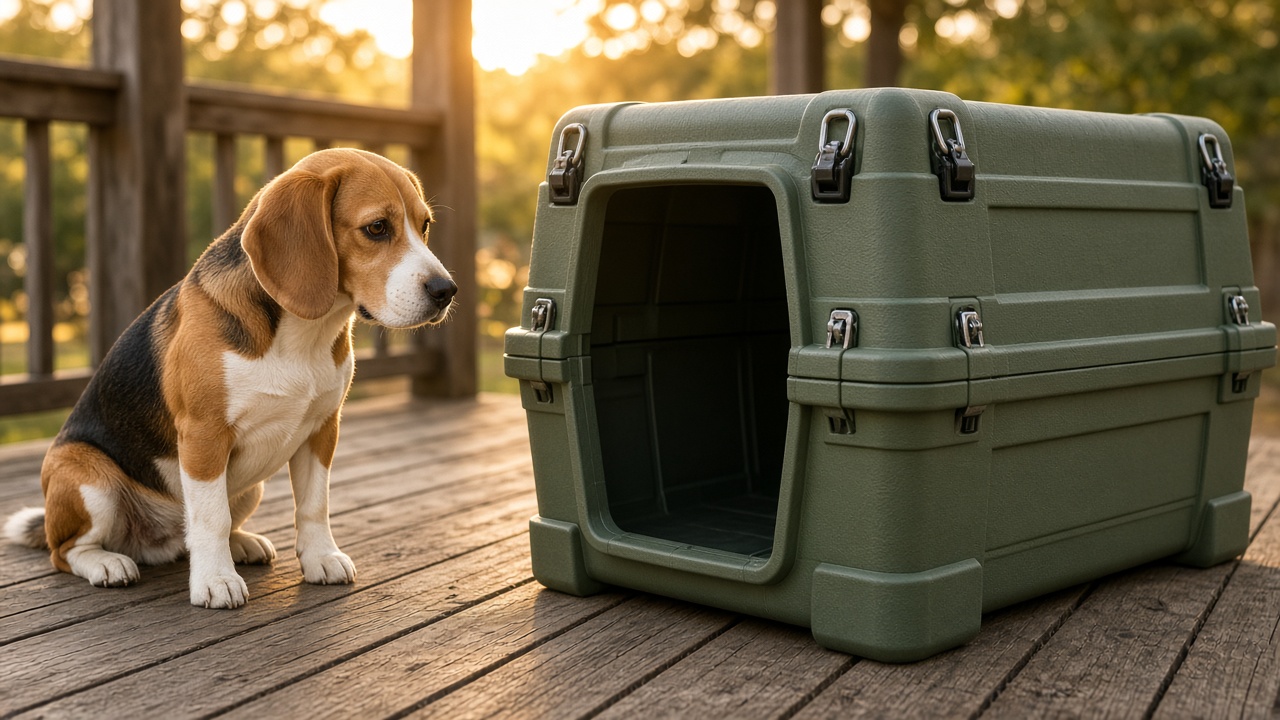
A dog crate size by breed chart is a starting point—always confirm your individual dog can stand, turn, and lie flat without hitting the ceiling or door lip.
This is not veterinary advice, and it is not a crash-test report. The Pet Bench is a research desk. Breed charts are a starting point. The number that matters is the dog in front of you — measured — not the name on the papers.
Most “crate size by breed” pages sell one interior as if a Labrador is a single size. Adult Labs run a wide band. A car crate wants a snug fit. An airline crate is sized from IATA’s formula. A house crate is usually one size larger than the travel crate. Those are three different jobs. This page is a printable way to pick the interior, then check whether a certified car size actually exists for that interior.
If you already know you need a crash-tested travel crate, the buying page is our crash-tested dog crate guide. This chart does not replace it and does not rank products.
Three jobs, three size rules
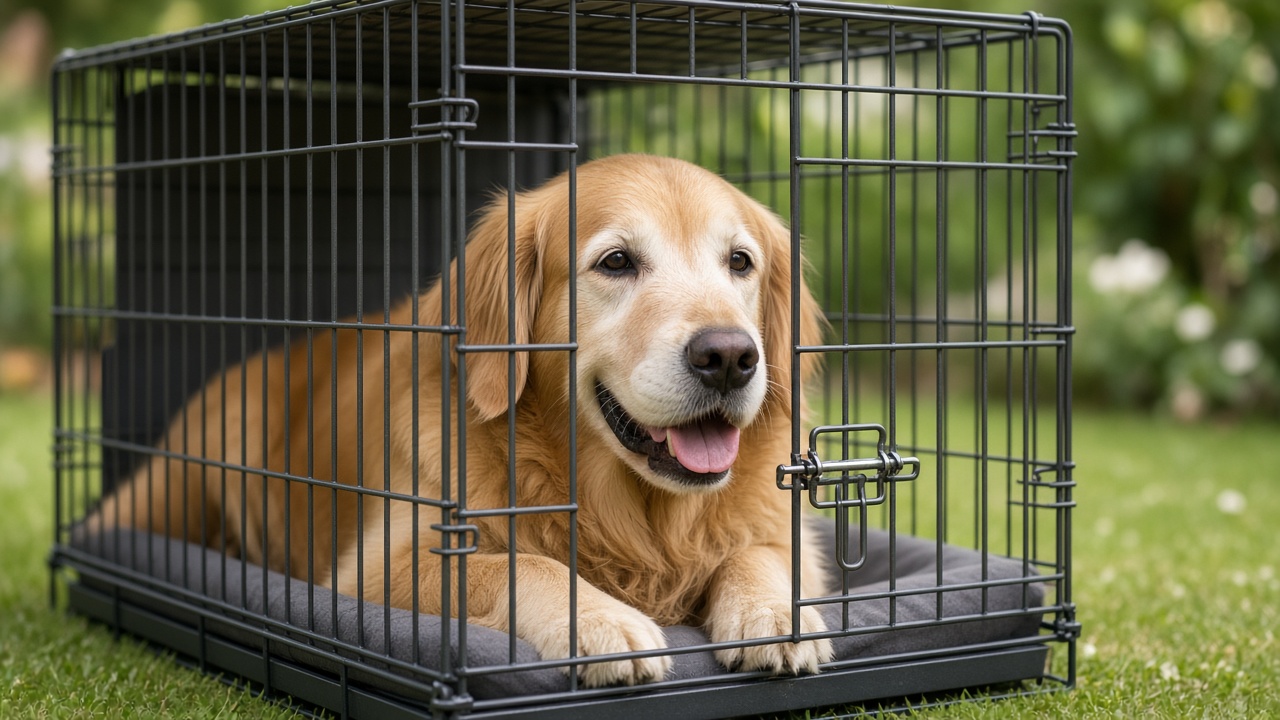
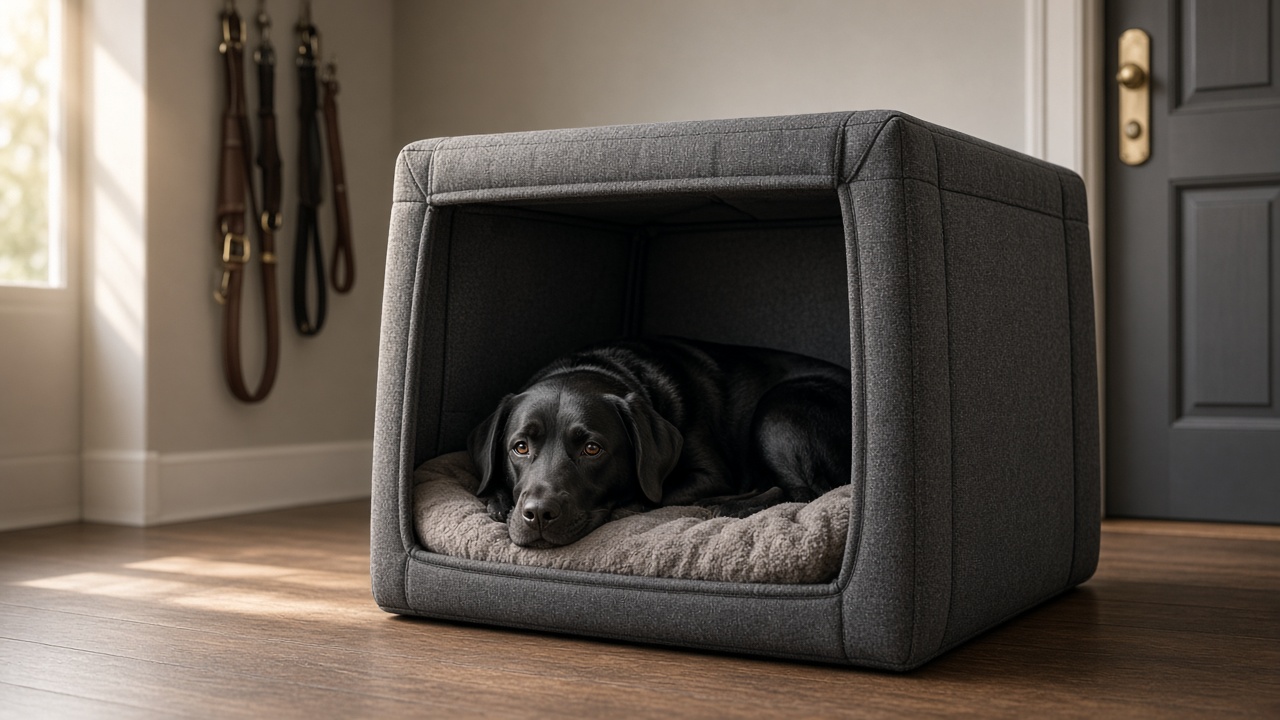
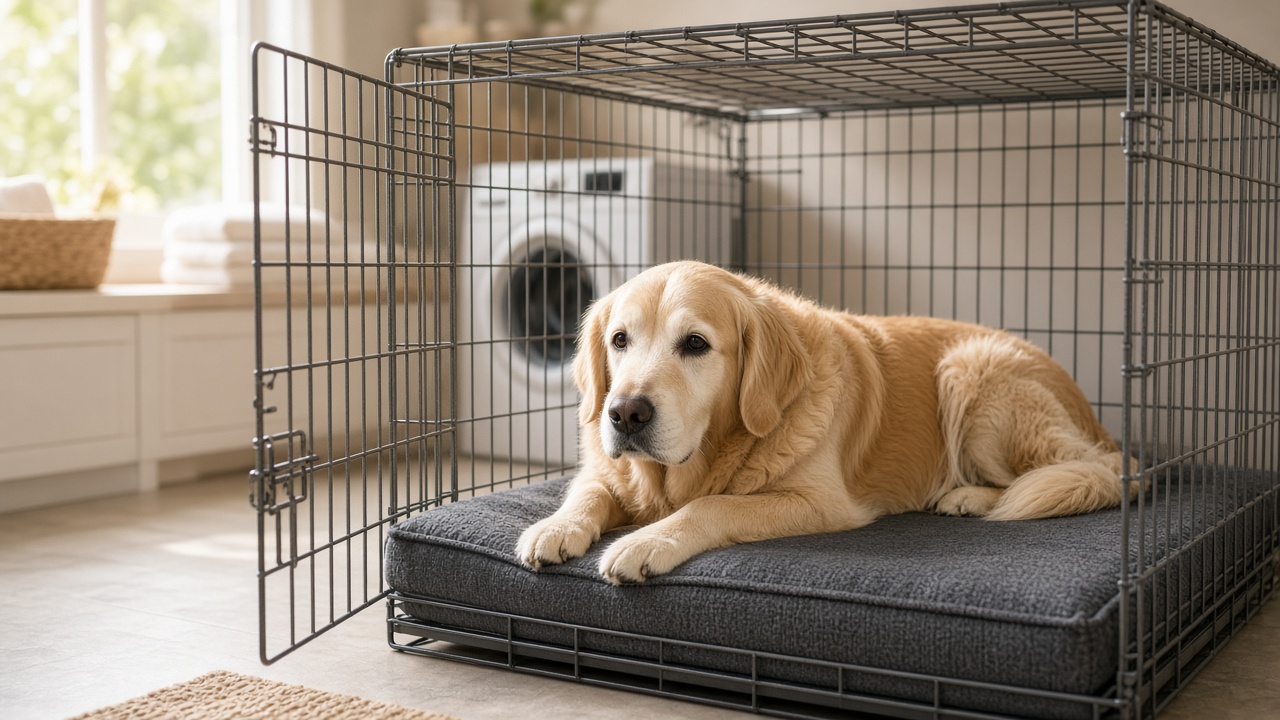
House crate. The dog should stand, turn, and lie on its side. Manufacturers who publish a travel size (Lucky Duck is explicit) tell you to go up one size for home use. Extra floor space at home is comfort. Extra floor space in a crash is momentum.
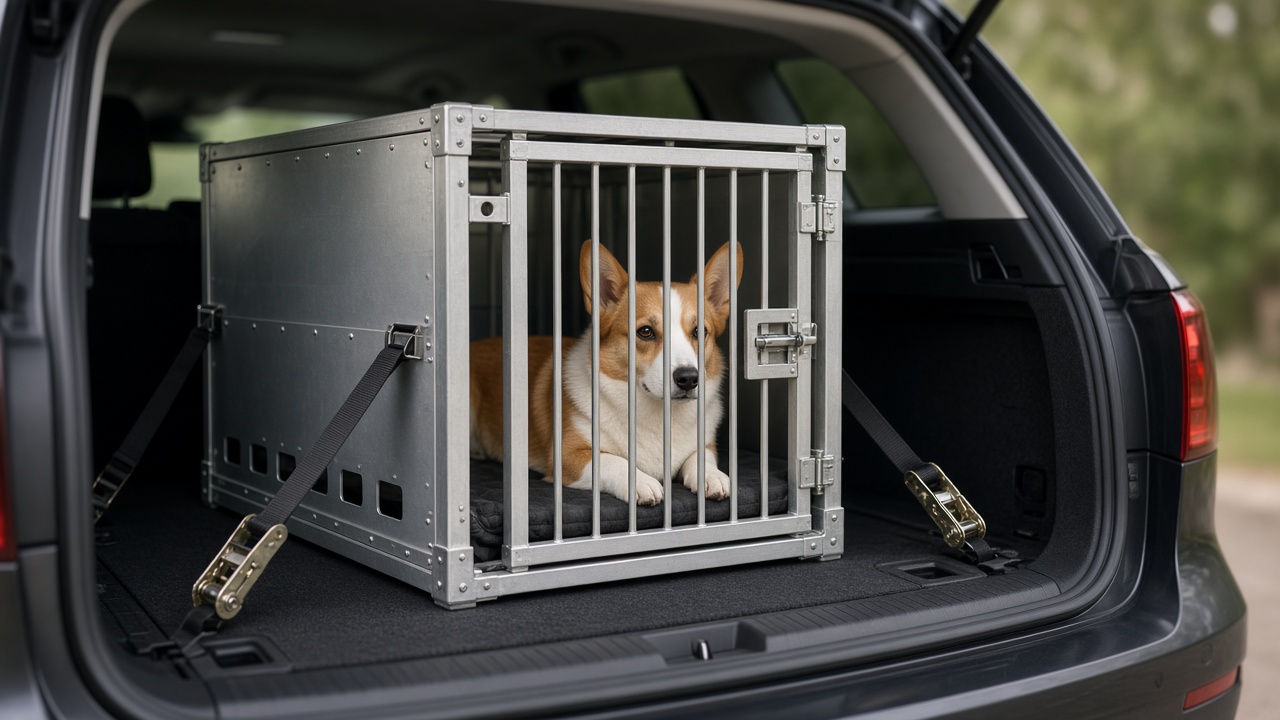
Car crate. Center for Pet Safety (CPS) crash-tests a specific model and size, usually at about 30 mph with a weighted dummy. A 5-star badge on an Intermediate does not make that brand’s Large certified. Gunner’s own fit guide for travel is a snug fit — “paws tucked,” not stretched out. The crate still has to let the dog stand and lie down. Then it has to be strapped the way that size was tested. Details and the current certified list live on the crash-tested crate page and at centerforpetsafety.org/cps-certified.
Air crate (cargo / checked). IATA Live Animals Regulations, Container Requirement 1 (LAR 2026) is the written rule airlines point to. IATA does not certify brands. The dog must be able to stand, sit erect, lie in a natural position, and turn about normally while standing. Size is calculated from your dog, not from a breed nickname.
IATA’s public formula (internal dimensions):
- A = nose to base of tail
- B = ground to elbow
- C = width at shoulders or widest point (use the larger)
- D = standing height to the top of the head or ear tips (use the higher)
- Length = A + ½ B
- Width = C × 2
- Height = D + bedding
- Snub-nosed (brachycephalic) breeds: 10% larger container
- Two animals: width = C × 3; three: C × 4. Animals over 14 kg (about 31 lb) travel one per crate.
Manufacturer labels are usually exterior. Airlines and honest size charts use interior. Expect about 1–2 inches of wall on each side.
Top 7 Dog crate size by breed
The picks below are the 7 dog crate sizes by breed on sale right now, listed with what each suits best and an honest drawback. Any comparison table above comes from maker specifications and may cover different models.
1. Midwest 42-Inch Single Door iCrate
Best for: Medium-sized breeds like Border Collies or Spaniels
We compared this model to other mid-range wire crates and found it remains the standard for durability and ease of use. Owners report that the divider panel is essential for house-training puppies as they grow into their adult size.
Pros: Industry-standard wire construction; Includes divider panel for growth Cons: Single door limits placement options
2. Midwest 48-Inch Single Door iCrate
Best for: Large breeds requiring extra room for comfort
For owners of large breeds, this 48-inch option provides the necessary footprint for comfort without overcomplicating the design. We compared its structural integrity to similar models and noted that owners consistently prefer the Midwest brand for long-term reliability.
Pros: Spacious interior for larger dogs; Reliable latching mechanism Cons: Heavy and bulky to move
3. FDW | 48" Foldable Metal Dog Crate | Dark Black | Cage for XL Dogs
Best for: Budget-conscious owners of extra-large breeds
We compared this crate to higher-priced competitors and found it offers a practical solution for those needing a large enclosure on a budget. Owners report that while the wire is thinner, it holds up well for calm dogs that are already crate-trained.
Pros: Highly affordable price point; Folds flat for storage Cons: Thinner wire gauge than premium brands
4. Amazon Basics Portable Metal Wire Dog Crate with Removable Tray
Best for: First-time dog owners needing a basic starter
We compared this entry-level crate to more expensive alternatives and found it provides all the essential features for a new pet owner. Owners report that the removable tray is a standout feature, making routine maintenance much simpler.
Pros: Simple, no-frills assembly; Removable tray for easy cleaning Cons: Basic finish can scratch easily
5. Aidoly Extra Large Dog Crate 48 Inch Double Door Pet Cage Kennel
Best for: Owners needing flexible access points
We compared the accessibility of this crate to single-door models and found the dual-entry design significantly improves placement options in tight spaces. Owners report that the double doors make it much easier to position the crate in a corner or alongside a wall.
Pros: Double-door design for versatility; Secure locking system Cons: Assembly instructions can be vague
6. BestPet | Dog Crate | 48" | Black | Foldable Metal Kennel with Double
Best for: Multi-purpose use in varied home layouts
We compared this foldable kennel to other 48-inch options and found it balances portability with a generous interior space. Owners report that the ability to access the dog from either the front or the side is a major convenience for daily routines.
Pros: Easy to fold and transport; Dual doors for convenient access Cons: Latch handles can be stiff
7. Sweetcrispy 36 Inch Dog Crate
Best for: Compact spaces and smaller dog breeds
We compared this 36-inch crate to larger alternatives and found it is the ideal size for smaller living quarters or apartment dwellers. Owners report that it is perfect for smaller breeds but caution that it should not be used for dogs prone to escaping or destructive behavior.
Pros: Very compact footprint; Excellent price-to-value ratio Cons: Not suitable for heavy chewers
Comparison: Dog crate size by breed at a Glance
| Product | Best for | Approx. price | Where to buy |
|---|---|---|---|
| Midwest 42-Inch Single Door iCrate | Medium-sized breeds like Border Collies or Spaniels | $67.12 | Check price |
| Midwest 48-Inch Single Door iCrate | Large breeds requiring extra room for comfort | $89.99 | Check price |
| FDW / 48" Foldable Metal Dog Crate / Dark Black / Cage for XL Dogs | Budget-conscious owners of extra-large breeds | $64.89 | Check price |
| Amazon Basics Portable Metal Wire Dog Crate with Removable Tray | First-time dog owners needing a basic starter | $46.99 | Check price |
| Aidoly Extra Large Dog Crate 48 Inch Double Door Pet Cage Kennel | Owners needing flexible access points | $62.99 | Check price |
| BestPet / Dog Crate / 48" / Black / Foldable Metal Kennel with Double | Multi-purpose use in varied home layouts | $66.88 | Check price |
| Sweetcrispy 36 Inch Dog Crate | Compact spaces and smaller dog breeds | $34.92 | Check price |
Want to browse every option? See the full range of dog crate size by breed on Amazon →
Measure first (print this block)
Do this standing, on a hard floor, no “they’ll grow into it” guess.
- A — tip of nose to base/root of tail: ______ in
- B — ground to elbow: ______ in
- C — shoulders or widest point: ______ in
- D — ground to head or ear tip, whichever is higher: ______ in
- Adult weight today: ______ lb. Still growing? Write the expected adult band, not a wish.
Air minimum (IATA)
- Length = A + (B ÷ 2) = ______ in
- Width = C × 2 = ______ in
- Height = D + bedding (write the pad thickness: ______ in) = ______ in
- Snub-nosed? Add 10% to each number.
Car (travel) — smallest interior that still clears those standing/lying needs, and a CPS-certified size if you want a crash credential. Check the live CPS list for that exact size. Tie-downs are part of the certification (Gunner strength-rated straps; Lucky Duck ratchet kit).
House — usually the next size up from the travel interior.
Weight-band chart (starting point only)
These bands use published interiors and the maker’s own travel-weight notes, plus the CPS list as of this writing. They are not a ranking and not a promise your dog fits. A tall, lean 55 lb hound and a compact 55 lb bully are different interiors.
| Weight band (typical adult) | Example breeds (typical adults — measure yours) | Travel interior to look for (L × W × H, inches) | Certified car size that exists today |
|---|---|---|---|
| Under ~18 lb | Chihuahua, Yorkshire Terrier, Maltese, Pomeranian | Soft carrier ~20 × 11 × 12 | Diggs Passenger — CPS 5-star; tested with an 18 lb dummy (Oct 2021) |
| ~18–50 lb | Beagle, Cocker Spaniel, French Bulldog*, Corgi, smaller Aussie | ~24–25 × 18 × 17–20 | Gunner G1 Medium (interior 25 × 18 × 19.75; CPS 5-star, 45 lb dummy, Mar 2017). Lucky Kennel Medium (24 × 18 × 17; CPS 5-star, 50 lb dummy, Jan 2024; maker says under 50 lb) |
| ~50–70 lb | Labrador, Golden, German Shorthaired Pointer, Border Collie, many Malinois | ~30 × 18–20.5 × 22–25 | Gunner G1 Intermediate (30 × 18 × 25; CPS 5-star, 75 lb dummy, Jun 2015). Lucky Kennel Intermediate (30.25 × 20.5 × 22; CPS 5-star; maker: average Labs/retrievers under 70 lb, ~24 in at the shoulder) |
| ~70–110 lb | German Shepherd, Rottweiler, larger retrievers | ~34–36 × 21–22 × 26–29 | Lucky Kennel Large (35.75 × 22 × 26.5; CPS 5-star; maker: 70–110 lb). Gunner G1 Large interior is 33.25 × 21 × 29 — not on the current CPS certified list. Cabela’s GunDog Large is listed by CPS; confirm that exact listing before you treat it as certified. |
| Over ~110 lb or extra-tall | Great Dane, Mastiff, oversized mixes | Measure; many hard kennels run out of certified sizes | No CPS-certified crate on the current list is published for this band. Air still uses the IATA formula. For the car, be honest: you may be in uncertified territory or a custom cage. |
\*French Bulldog, Pug, Boxer, English Bulldog, Pekingese and other snub-nosed dogs: IATA wants 10% more container. IATA also advises against hold travel for snub-nosed dogs in hot weather. Many airlines add their own seasonal bans — check the carrier, not a blog.
Puppies: size the house crate for the adult you expect, with a divider. Size the travel crate for the body that is getting in the car or on the plane this week.
Worked example (so the formula is not abstract)
Say A = 28 in, B = 10 in, C = 8 in, D = 22 in, bedding = 1 in, not snub-nosed.
- Air length = 28 + 5 = 33 in
- Air width = 16 in
- Air height = 23 in
That dog’s air crate must be at least 33 × 16 × 23 inside. A Gunner Intermediate (30 in interior length) is short for that air formula even if the dog is a “50–70 lb Lab” on a breed chart. A Lucky Large (35.75 in interior length) clears the length. That is why breed tables lose to a tape measure.
For the same dog in a car, you still want them able to lie down and stand, but you do not add “room to trot.” Then you check whether that interior is a CPS-certified size and whether you have the straps that were in the test.
What this chart will not do
- It will not pick a brand for you. The Travel & Car Safety hub and the crash-tested crate guide are the product pages.
- It will not treat “crash-tested” marketing as a credential. CPS publishes which sizes passed. MIM Safe Variocage is tested to European automotive protocols (ECE / ISO / Swedish SPCT) — a real, different system, not a CPS badge.
- It will not tell you to sedate for travel. IATA and the AVMA discourage tranquilizers for transport except under a veterinarian’s direction, with the dose on the health certificate.
Print the measure block and the table. Write the four numbers in ink. If the breed row and the tape disagree, keep the tape.
Frequently Asked Questions
Can I trust dog crate size by breed charts for mixed breeds?
Use them as a starting point, then measure your dog standing, turning, and lying flat inside the crate.
Can I use one crate for home, car, and the plane?
Sometimes, if the interior clears the IATA formula and that exact size is CPS-certified and it still fits the cargo area. Usually you size home larger and travel smaller. Lucky Duck says its published interiors are for travel and to go up one size at home.
My breed is not in the table.
Measure A, B, C, D. Use the weight band only as a first filter. Mixed breeds are why the formula exists.
Is a bigger car crate safer?
Not for a crash. Extra interior lets the dog build speed inside the box. Snug is the travel rule; certified-for-that-size is the credential.
Where do I put the crate in the car?
Cargo area of an SUV or wagon, tied to the vehicle anchors the way that model was tested. Not the front passenger seat (airbags). Small certified carriers belong on the back seat, belted. This is setup, not a substitute for reading the maker’s tested configuration.
Using a Dog Crate Size by Breed Chart Without Oversimplifying
Breed charts are starting points, not prescriptions. Mixed breeds, deep-chested individuals, and seniors who curl tighter than puppies may need the next size up or down. Measure your dog standing, sitting, and turning around inside the crate with the door closed—manufacturer length ratings sometimes exclude the plastic lip at the front.
Travel crates and home crates serve different jobs. A snug airline-compliant size is not automatically the right long-term rest space at home if your dog cannot stretch fully.
Additional Guidance on Dog Crate Size By Breed
Our research desk compiled this section from manufacturer specifications, published welfare guidance, and recurring owner themes or veterinary endorsement. Adjust any routine to your individual pet's health history with professional guidance when symptoms appear.
Practical monitoring beats guesswork: note appetite, stool quality, energy level, and behavior changes whenever you adjust food, housing, or care tools. Reversible trials with one variable at a time make cause and effect clearer than changing multiple products simultaneously.
Practical monitoring beats guesswork: note appetite, stool quality, energy level, and behavior changes whenever you adjust food, housing, or care tools. Reversible trials with one variable at a time make cause and effect clearer than changing multiple products simultaneously.
Practical monitoring beats guesswork: note appetite, stool quality, energy level, and behavior changes whenever you adjust food, housing, or care tools. Reversible trials with one variable at a time make cause and effect clearer than changing multiple products simultaneously.
Practical monitoring beats guesswork: note appetite, stool quality, energy level, and behavior changes whenever you adjust food, housing, or care tools. Reversible trials with one variable at a time make cause and effect clearer than changing multiple products simultaneously.
Practical monitoring beats guesswork: note appetite, stool quality, energy level, and behavior changes whenever you adjust food, housing, or care tools. Reversible trials with one variable at a time make cause and effect clearer than changing multiple products simultaneously.
Practical monitoring beats guesswork: note appetite, stool quality, energy level, and behavior changes whenever you adjust food, housing, or care tools. Reversible trials with one variable at a time make cause and effect clearer than changing multiple products simultaneously.
Sources
- IATA, Traveler’s Pet Corner / CR1 container formula (LAR 2026): https://www.iata.org/en/programs/cargo/live-animals/pets/
- IATA, Container Requirements 1 (PDF): https://www.iata.org/contentassets/b0016da92c86449f850fe9560827bbea/pet-container-requirements.pdf
- Center for Pet Safety, certified products list: https://centerforpetsafety.org/cps-certified/
- Center for Pet Safety, Gunner G1 Medium / Intermediate / Small listing pages (test weights 45 / 75 lb; Small on the same list)
- Center for Pet Safety, Lucky Kennel Medium listing (50 lb dummy, Jan 2024) and Intermediate / Large listings
- Center for Pet Safety, Diggs Passenger (18 lb dummy, Oct 2021)
- Gunner, G1 sizing guide (published interiors): https://gunner.com/pages/sizing-guide
- Lucky Duck, Lucky Kennel Medium / Intermediate / Large product pages (published interiors and travel weight notes)
Last reviewed: August 2026. We will revise if IATA updates CR1 or if CPS adds or drops a certified size.