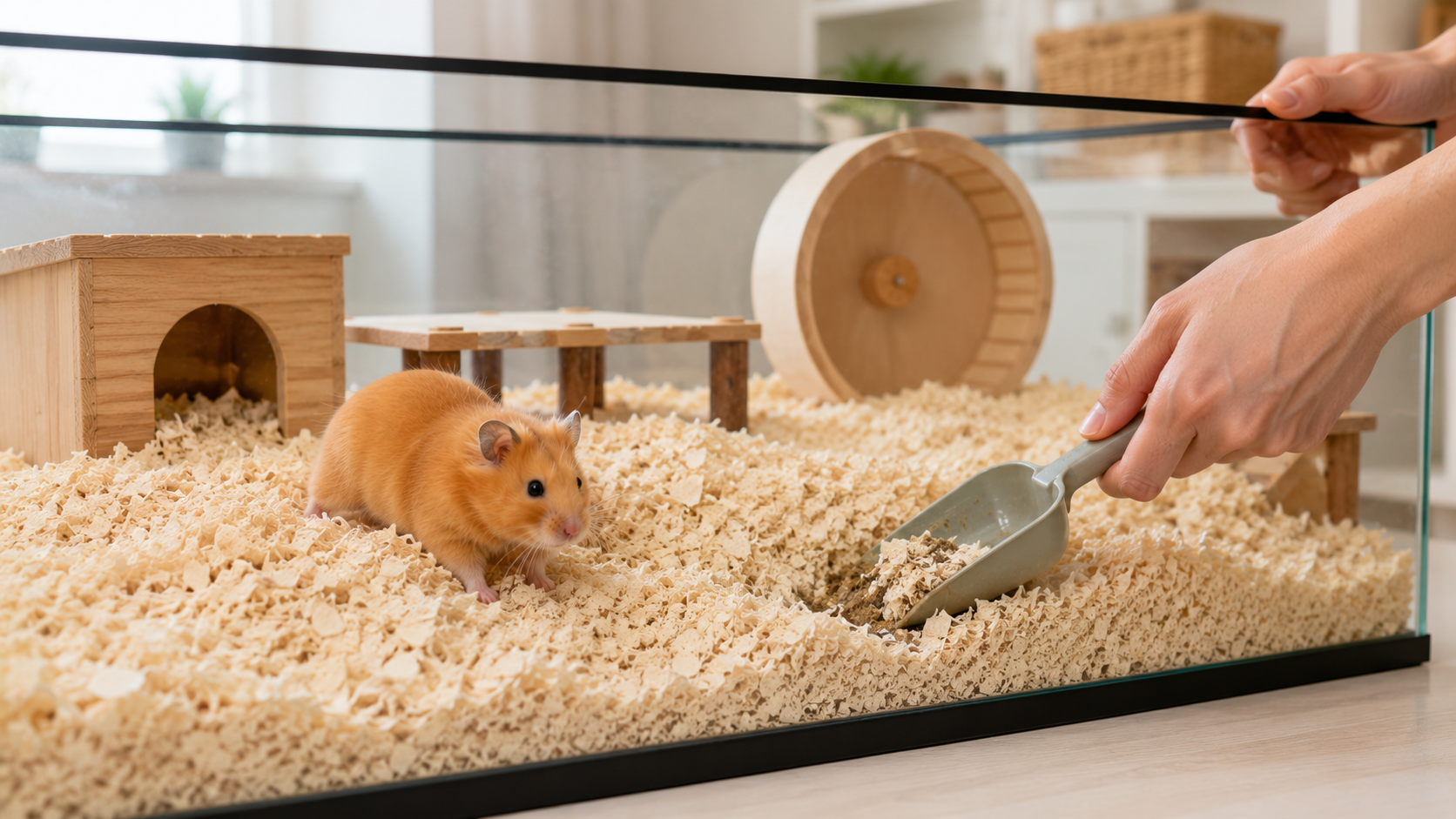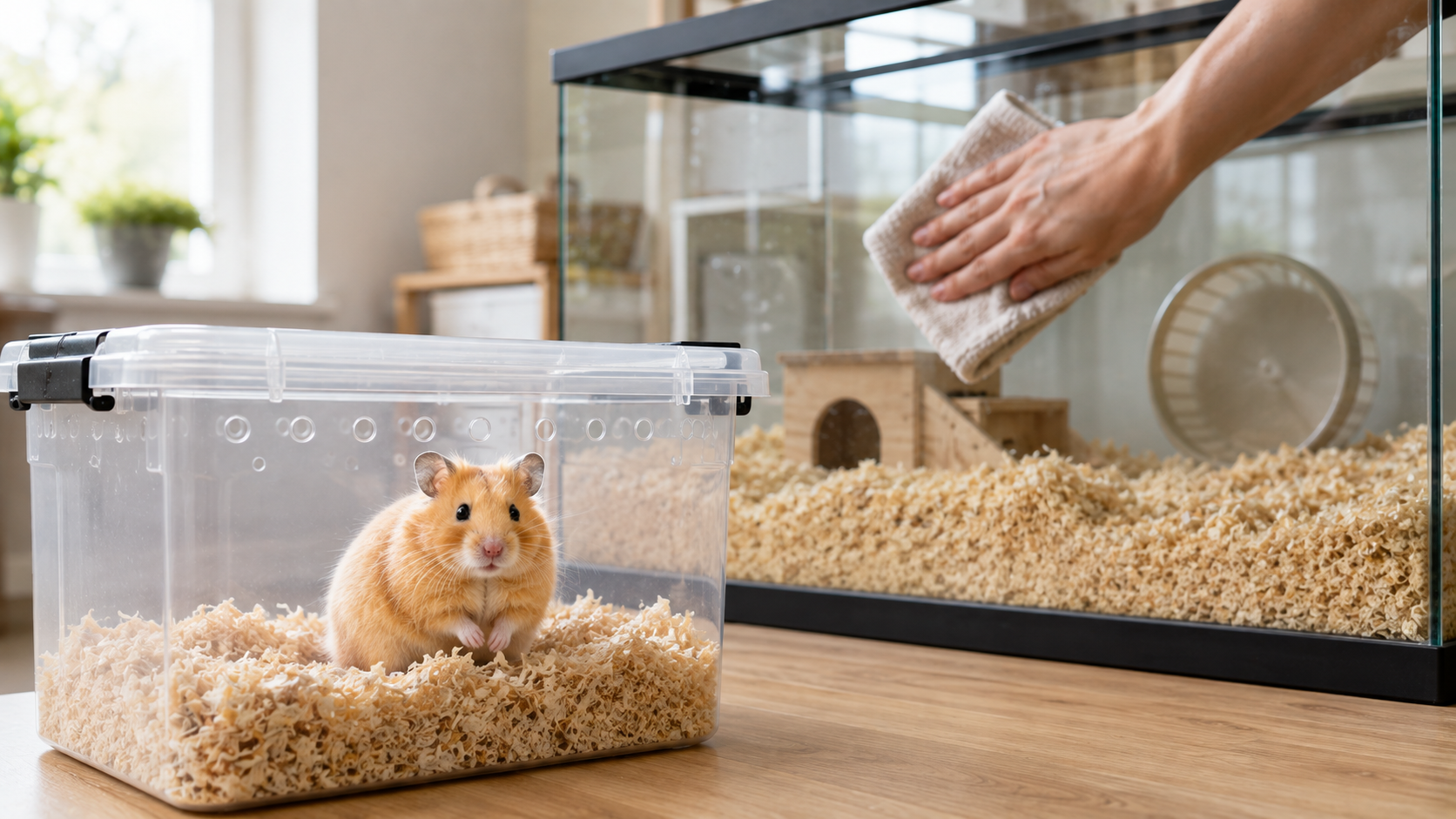
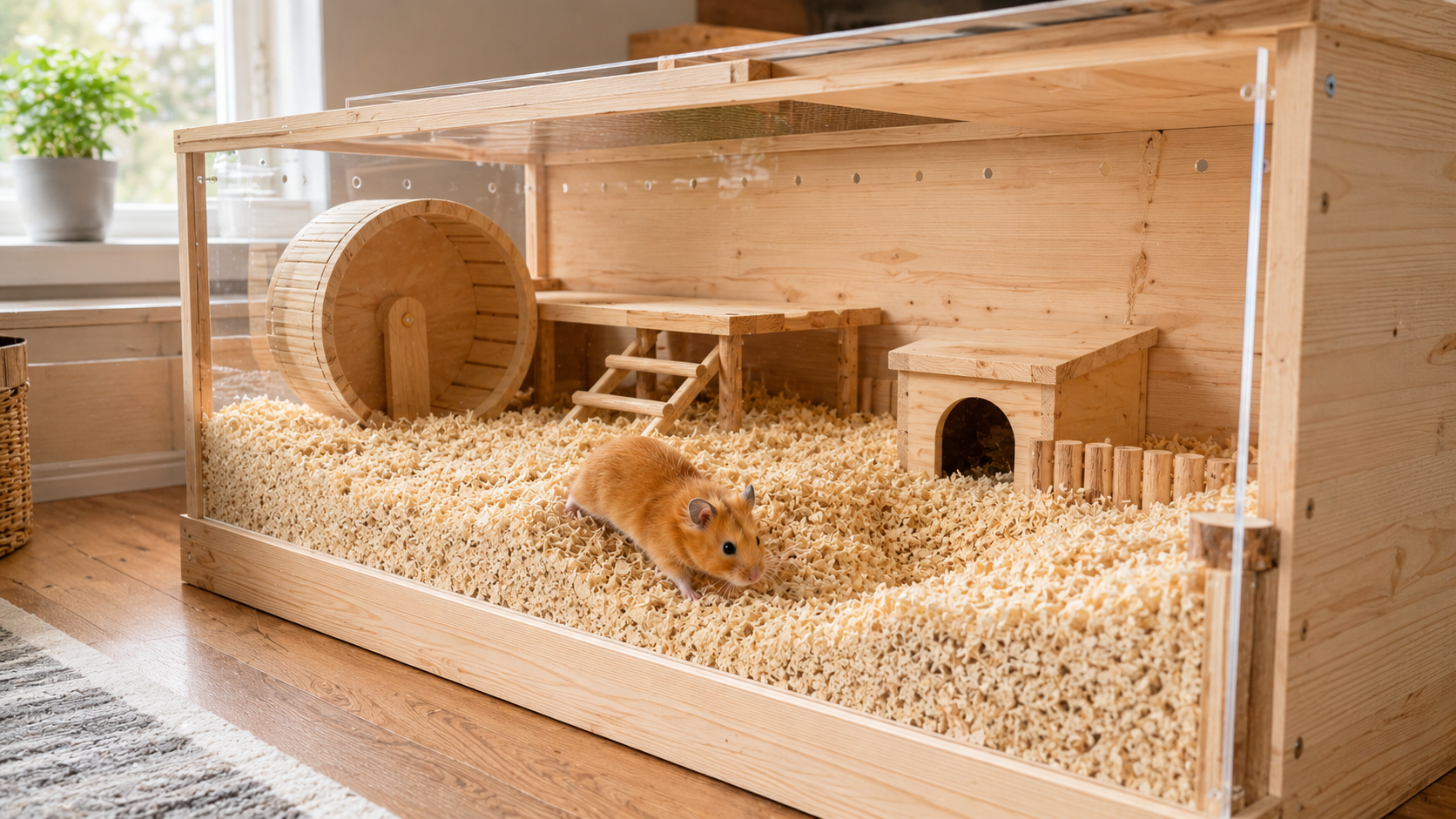
A DIY hamster cage is a measured unbroken floor that clears the welfare rectangles — HamsterWelfare / PDSA / Blue Cross at 100 × 50 cm, HamsterWelfare’s 775 in² conversion, PETA’s 800 in² or a 75-gallon aquarium with a fitted mesh lid — plus a lid that breathes and stays shut, not a shop arcade or a $34.99 acrylic cube with a 9-in-1 label. We read current Amazon listing titles and descriptions and scored 7 SKUs. Sticker sum is $491.84. 3 of 7 titles say Acrylic (9 in 1 $47.99; 8 in 1 $59.99; generic Acrylic $34.99). 1 of 7 titles say Wooden (HOTAMO $99.99) — and RSPCA’s environment page says wooden cages shouldn’t be used. 1 of 7 is MidWest Awesome Arcade ($55.99) — a vertical shop class. 1 of 7 is VEVOR ($126.90) — highest sticker, still a listing, not a taped floor. 1 of 7 is Chewproof ($65.99) — a marketing adjective, not a welfare rectangle. 0 of 7 print interior L × W. 0 of 7 replace a tape measure. 0 of 7 are a CritterTrail-sized target.
This URL’s job is build-or-buy class. The shopping sibling is best cages for a Syrian hamster. Pair any box with burrowing bedding and a large silent wheel. A pretty acrylic kit that loses on unbroken floor is still a shop tray.
We grouped listings by class versus tape, not a weekend craft trophy. If the hamster is already out, wet, or not eating, that is an exotic-vet problem.
Our guides are reader-supported. This article may contain affiliate links. As an Amazon Associate we may earn a commission if you buy through links, at no extra cost to you.
Related: Syrian cages, burrowing bedding, silent large wheel. Heatstroke, a fall from a tall stack, or a chewed-out escape is a clinic / emergency. We are not that clinic.
What is a DIY hamster cage?
A homemade or converted enclosure — modified storage bin, aquarium with a mesh lid, Detolf-style cabinet, wooden box, or cubes-and-coroplast (C&C) — that has to survive continuously growing incisors, a burrow, and a talent for the one gap you did not measure. PDSA names an extra-large cage, a glass tank, or a homemade enclosure. Blue Cross calls tanks or aquariums ideal with a mesh lid and wants bar or mesh gaps less than 1 cm. PETA prints at least 800 square inches or a 75-gallon aquarium with a fitted mesh lid for one Syrian or one or two dwarfs. HamsterWelfare prints 100 × 50 × 50 cm (L × W × H), converts the floor as 5,000 cm² (775 in²) of unbroken floor, attributes that to Germany’s Veterinary Association for Animal Welfare (TVT), and says levels do not count. The RSPCA environment page does not print a square-inch minimum. It wants a suitable home-cage, thick bedding, a solid floor, and enough depth to dig. We will not write “600 square inches” into their mouth.
On this URL the seven tiles are shop cages, not bin-cut lists. That mismatch is the original fact this page can own: a DIY keyword with seven retail cards. We score the cards as what Amazon attached, then score the five DIY classes as what the charities actually printed.
Browse DIY hamster cage on Amazon →
What current Amazon listings show (Cage-Floor, August 2026)
| Job | What actually works | Category | Fail if you skip it |
|---|---|---|---|
| Unbroken floor | Tape L × W vs 100 × 50 cm / 775 in² / 800 in² | Off every shop tile until the tape wins | Counting a tube as floor |
| Lid that breathes and latches | Fitted mesh, gaps under 1 cm (Blue Cross) | Not a solid bin lid with two holes | Cat-as-lid, or no lid “because no cat” |
| Burrow depth | PDSA 25 cm / 10 in; PETA 8 in+; HamsterWelfare ~10 in as the better section | Bedding | A shallow acrylic tray |
| Syrian wheel | PDSA 30 cm / 12 in solid; PETA 11 in min; HamsterWelfare ≥28 cm | Wheel | A 9.5-inch “large” in a short box |
| Wood as the box | RSPCA says no | HOTAMO $99.99 as the caution tile | A sealed-plywood fantasy |
| Shop kit as DIY | Only if the floor still tapes | Acrylic / Arcade / VEVOR / Chewproof as listings | “9 in 1” as a welfare number |
| Two Syrians in a big DIY | No — PDSA, PETA, RSPCA treat Syrians as solitary | None | A 75-gallon as a social licence |
Before you shop: (1) you wrote L × W from the inside floor, (2) you compared both sides, not only area, (3) the lid can do air and predators, (4) wet, not eating, or a limb in a grid is stop. Fail gate 4 and this checklist is how you walk past an emergency.
Kaytee’s Crittertrail 2-Level is listed by the maker at 11.5 × 20 × 16 in with 0.29 in bar spacing. Treating 11.5 × 20 as footprint is 230 in² — far under 775 / 800. PDSA’s opening line on cages is that most shop cages are not big enough. A DIY that copies that footprint has already failed the only measurement this page asks you to take.
Why DIY hamster cage is a tape worksheet
- Area can hide a squeeze. HamsterWelfare’s listed Detolf is 163 × 42 cm (6,845 cm²) — above 5,000 cm², narrower than 50 cm. Measure both sides.
- Quarts are not square inches. We will not print “a 110-quart bin is 775 in².” Measure the tote you have.
- Gallons are volume. A short, tall 75-gallon can lose on running rectangle. PETA named 75-gallon or 800 in², not a licence to skip L × W.
- The seven cards are shop objects. This keyword is DIY. The tiles are retail. Score them as listings. Do not call them “7 DIY hamster cage that stood out in our evaluation.”
- Wood is the class RSPCA rejects. HOTAMO is on the page anyway. That tension is the honest sentence.
The seven Amazon cards sit in a sixth bin: named shop classes attached to a DIY URL. Useful as a contrast. $0 of taped interiors.
How this desk scored the seven cards (and refused to score “hold up”)
”
We grouped listings by the seven attached cards on class honesty:
- Acrylic-word titles: 3 of 7. Wooden-word titles: 1 of 7. Arcade / MidWest: 1 of 7. Chewproof adjective: 1 of 7. VEVOR brand word: 1 of 7.
- Prices on cards: 7 of 7. Sum $491.84. Median among the seven is $59.99 (8 in 1). Mean is $70.26.
- Printed interior floor on cards: 0 of 7.
- Yes.
Want current SKU shopping? Tape the floor you already have. Then: browse DIY hamster cage on Amazon →
How these products compare on labels and price
| Tool (this URL) | Card price | Honest job | |
|---|---|---|---|
| Hamster Cage Chewproof | $65.99 | Chew-adjective shop class — still tape the floor | |
| HOTAMO Wooden Hamster Cage with Acrylic Board Base | $99.99 | Wooden-cage caution class (RSPCA) | |
| 9 in 1 Acrylic Hamster Cage | $47.99 | Modular acrylic-kit class | |
| VEVOR Hamster Cage | $126.90 | Highest-sticker shop class | |
| 8 in 1 Acrylic Hamster Cage with All Accessories | $59.99 | Bundle-kit class (accessories ≠ floor) | |
| Acrylic Hamster Cage | $34.99 | Lowest-sticker / tabletop caution | |
| MidWest Homes for Pets Hamster Cage \ | Awesome Arcade Hamster Home | $55.99 | Vertical arcade / tube-class shop cage |
No rank column. “Best for persistent chewers” was a podium line. Chewproof is a word.
The 7 cards on this URL
Hamster Cage Chewproof — $65.99
A search title, not a species standard. Reinforced edges are a listing theme Ventilation versus solid walls is still the RSPCA-versus-tank argument: mesh sides preferred on the UK environment page; tanks still want a mesh lid on PDSA / Blue Cross / PETA. $65.99 is 13.4 percent of the sum.
HOTAMO Wooden Hamster Cage with Acrylic Board Base — $99.99
Wooden is in the title. Acrylic base is in the title. $99.99 is 20.3 percent of the sum. RSPCA’s environment page: plastic is better than metal, wooden cages shouldn’t be used. PDSA allows wooden hides inside a washable box. A wooden box that is the cage has to take urine, teeth, and a rinse. Those are the jobs wood loses. If you want a furniture look, that is a Syrian cage shopping problem, not a reason to ignore RSPCA. We will not publish a pet-safe sealer spec
9 in 1 Acrylic Hamster Cage — $47.99
Nine is a kit count, not a floor. $47.99 is 9.8 percent of the sum. Acrylic shows the burrow and holds a wipe-down; it does not add inches you did not buy. Assembly is a listing theme. ” Confirm L × W on the listing and on the plastic in your room. Kits shrink in photos.
VEVOR Hamster Cage — $126.90
Highest sticker. 25.8 percent of $491.84. Brand-word search, not a named interior. “Expansive footprint” was old-body praise. We will say: this is the tile you open for dimensions, then you tape. Price is not floor. If the listing still loses 100 × 50 cm, you bought a heavy shop cage.
8 in 1 Acrylic Hamster Cage with All Accessories — $59.99
Median sticker. Accessories are wheels, bottles, and hides of unknown diameter. PDSA’s Syrian wheel is 30 cm / 12 in solid; a kit wheel is often the fail. $59.99 is 12.2 percent of the sum. Bundle is convenience. Bundle is not 775 in².
Acrylic Hamster Cage — $34.99
MidWest Homes for Pets Hamster Cage | Awesome Arcade Hamster Home — $55.99
Arcade and tubes are the title job. $55.99 is 11.4 percent of the sum. Vertical engagement is a photo. PDSA: single-level, larger cages tend to beat multi-level tall cages because hamsters have poor eyesight and fall. HamsterWelfare: unbroken floor, not stacked platforms. Easy-to-connect tubes are extra area you do not count as floor. Harder-to-clean is an owner theme, not a trial we ran. If this is the only box, tape the base rectangle, not the marketing silhouette.
The five DIY classes (rebuild, not a shop podium)
Use this as a first filter. None of these rows is a cut-list this desk built.
| DIY class | What people like | Failure that usually lands first | Floor / depth check | When to buy ready instead |
|---|---|---|---|---|
| Modified storage bin | Cheap, can be deep | Chewed rim / stale solid lid | Inside L × W; do not convert quarts | Tape loses 100 × 50 cm; cannot fit 20–25 cm bedding plus a Syrian wheel; other pets can open it |
| Aquarium / tank | Glass does not chew; charities name tanks | Heat + stale air; lid not mesh | Measure glass floor; gallon ≠ rectangle | Floor misses; no fitted mesh; sits in sun |
| Detolf-style cabinet | Long glass run | The short side (42 cm vs 50 cm on the listed Detolf) | Measure this cabinet | Cannot verify both sides; will not latch; wood edges in reach |
| Homemade wooden | Looks like furniture | Chew-through, urine soak, cannot rinse | Same unbroken floor — then stop and read RSPCA | You are trying to follow the environment page |
| C&C | Modular, looks large | Grid gap; mesh floor; open top | Unbroken coroplast, not cube count | Cannot swear gap < hamster; no lid; shallow tray |
Buy-ready in that last column means a finished enclosure that already clears floor and bedding — the Syrian cage guide — not a CritterTrail-class cube with more levels.
Modified storage bin
A tote with a ventilated lid and enough unbroken floor to stop being a tote. HamsterWelfare lists converting a large plastic box as a budget class. PDSA lists a homemade enclosure. Neither page prints a bin SKU. Measure the inside floor — flat rectangle, not the rim, not the quart label.
What has to hold up:
A bin that clears the printed floor, holds PDSA’s 25 cm / 10 in of bedding (Blue Cross prints 20 cm; PETA prefers 8 in or more), and still has room for a solid Syrian wheel is a serious enclosure.
Aquarium or tank conversion
PDSA lists a glass tank next to extra-large cages and homemade boxes. Blue Cross calls tanks or aquariums ideal for deep bedding and fewer bar-escapes, still wants mesh lid. PETA: 75-gallon with fitted mesh, or 800 in², for one Syrian or one or two dwarfs.
Measure the glass. A gallon rating is volume. This desk will not invent the L × W of a 75-gallon tank. Different footprints exist. A short, tall tank can hold water and lose the run. A long, low tank can clear floor and still lose bedding-plus-wheel if the glass is eight inches high and you need ten inches of substrate plus a wheel.
Honest glass failures:
- Solid sides versus air. RSPCA prefers mesh sides. PDSA, Blue Cross, and PETA will house in glass. We will not pick a winner. If you use a tank, the lid is the lung. PETA: fitted mesh, not a glass canopy. Blue Cross: mesh, gaps under 1 cm.
- Falls. PDSA: single-level larger beats multi-level tall. Deep bedding is a burrow. Stacked platforms over a long drop to glass is the warning.
- Escape at the rim. Silicone gaps, a sliding top that does not latch, mesh that only rests — poorly constructed in RSPCA’s language.
Glass does not chew. That is the real advantage. Costs: weight, heat, the temptation to treat a starter tank as if PETA endorsed it. They endorsed 75-gallon or 800 in² — and the mesh lid.
IKEA Detolf-style
A long, low glass display cabinet or similar shell. HamsterWelfare lists a DIY Detolf at 163 × 42 cm (6,845 cm²), discontinued, second-hand only, plus other cabinet/desk conversions (Platsa, Komplement, Pax, Linnmon) with their own printed rectangles. Those figures are HamsterWelfare’s listings, not tape we ran.
The honest failure is the short side. 163 × 42 wins on area versus 5,000 cm² and loses on width versus 50 cm. A skinny runway is not the same welfare object as a 100 × 50 cm rectangle.
Other fails: cracked second-hand glass; sliding doors a hamster can rattle; a top never meant for mesh; chew points that move to silicone and particle-board edges; a glass box in a sunny bay still hitting PDSA’s “away from direct sunlight.”
If the cabinet you can actually buy does not measure generously on both sides, this class is a style.
Homemade wooden
The least romantic class. RSPCA environment page: wooden cages shouldn’t be used. We will not publish a cut-list that pretends
PDSA names homemade enclosures as a type and names multi-chambered hamster-safe wooden hides as nest boxes. A hide is not a cage.
Failure modes if someone is still looking: chew-through (teeth never stop — RSPCA fact file); a slat or mesh floor (not a loophole); urine damp you cannot scoop (PDSA wants you to rinse and dry); a sealed cube with a heavy lid and 10 in of bedding as a humidity box next to the heatstroke line.
Research-desk position: people build it; the UK environment page tells you not to use wooden cages; HOTAMO $99.99 is the card that makes that sentence concrete on this URL.
C&C — cubes and coroplast
Storage-cube grids plus a corrugated-plastic base. Guinea-pig keepers scale it. Hamster keepers copy it because it looks large. We will not mint one.
What the pages support:
- Measure unbroken plastic floor. Cube count is not floor. Levels do not count.
- PDSA: fantastic escape artists. If a snout or leg can pass, the grid is wrong.
- RSPCA / HamsterWelfare: solid floor; barred flooring as a bumblefoot route. Fleece over wire is still wire.
- Chew-through at cuts, tape, zip-ties.
- Open-top C&C is normal in guinea-pig rooms. It is not normal with a cat. PDSA wants a secure lid. Hamsters climb grids.
- Bedding walls must be tall enough for a real burrow and still leave a lid.
C&C holds up when the floor is a measured rectangle, walls beat a burrow, the grid cannot pass a hamster, the walk is solid, and the top closes. It fails as a guinea-pig pen with a hamster in it.
Failure modes that apply to every class
Ventilation. RSPCA wants mesh sides, a raised lid, away from ultrasound (TVs, screens, vacuums, running water) and draughts. PDSA wants 18–21°C and no draughts. Those jobs fight in a DIY box. Solid-wall classes make the lid do all the breathing. No fetched charity page prints a hole-count recipe.
Chew-through. Incisors do not stop. RSPCA names gnawing as wear. PDSA wants things to chew: untreated softwood (washed and baked), cardboard, safe woods. That is enrichment and a warning: they will chew the enclosure if it is the same stuff. Inspect rim, clip, silicone, grid tie, trim.
Bar spacing. We will not mint a universal DIY millimetre. Kaytee’s 0.29 in on a Crittertrail is a maker spec on a small shop cage, not a DIY standard. The welfare test is behavioural: squeeze, stuck limb, mesh foot. HamsterWelfare treats easily escapable and barred flooring as unsuitable.
Escape, lids, cats, dogs. PDSA’s list starts with a large floor and then a secure lid. PETA’s aquarium is useless without fitted mesh. A lid keeps the hamster in, the cat and toddler out, and air moving. A baking sheet fails air. An open C&C fails containment. A decorative roof with no latch fails the first time a dog leans.
Mesh versus solid floor. Not taste. Solid so bedding can work; avoid wire floors. If DIY uses a grid as the floor, put a solid base in.
Heat, cold, placement. PDSA 18–21°C; PETA 65–75°F; RSPCA indoors, no damp, predictable light, not bright sun, away from ultrasound, quiet enough to rest. A garage overnight can hit the cold end (torpor). A TV-room cabinet fails ultrasound and quiet at once.
The box still has to hold a burrow and a wheel
A class that clears floor and then cannot hold bedding or the wheel is still a failed box.
PDSA: at least 25 cm / 10 in of bedding that holds a burrow, sleep, and a pantry. PETA: 8 in or more, and notes wild tunnels can run more than 2 feet. HamsterWelfare: a hamster could start in about 6 in, and a 10 in (25 cm) section is more suitable. Those are not the same number. The shared rule is deep and structured, not a dusting. Use the burrowing bedding guide — then put that depth in a box tall enough to take it.
The wheel is why the box cannot be a low tray. PDSA: ≥30 cm / 12 in Syrian, 20 cm / 8 in dwarf, solid, no slats. PETA: 11 in min Syrian, 9 in dwarf, solid. HamsterWelfare: at least 28 cm Syrian, 20 cm dwarf; a cage that cannot fit an adequate wheel is unsuitable. The silent large wheel page is the sibling. This draft will not duplicate it.
PDSA wants nest boxes; hamsters sleep most of the day. RSPCA wants a nest box large enough to sleep, store food, and move, preferably without a floor so you can lift it. A DIY that is all wheel and no hide is not finished.
Syrians live alone. That is PDSA, PETA, and RSPCA in different words. A large DIY is not a reason to house two Syrians. PETA’s 75-gallon line is one Syrian or one or two dwarfs; PDSA still does not want domesticated Russian dwarfs housed together.
Water: PDSA wants a bottle with a metal spout. The bottle is not the only thing holding the lid down.
Deleted:
- Top 7 / Best-for / Pros / Cons as an evaluation of DIY builds.
- “We compared various DIY… owners report.”
- Comparison table that treated shop tiles as DIY winners.
- Practical-monitoring loops and a second thin FAQ.
- “No product cards, no Amazon” in a cut-list while seven cards sat above it — that contradiction is gone. The cards stay. The lie that they were not here does not.
Kept: TVT / HamsterWelfare 100 × 50 × 50 and 775 in²; PDSA and Blue Cross same floor; PETA 800 in² and 75-gallon; RSPCA’s refusal to print in² and refusal of wooden cages; Detolf 163 × 42; Crittertrail 11.5 × 20 × 16 as a contrast; heat bands printed separately; wheel and bedding figures as published, not averaged.
Worked rooms (desk, not a workshop)
Room A — first Syrian, you have a tape and a tote. Kit: measure inside L × W. If you lose 100 × 50 cm / 800 in², stop cutting holes. Shop the Syrian cage page or find a longer tote. Do not “start in” the $34.99 acrylic tile.
Room B — you already own MidWest Arcade $55.99. Kit: tape the base. If the base loses, this is a play object, not a home. Do not add tubes to “make up” floor.
Room C — you like HOTAMO $99.99 because it matches the dresser. Kit: read RSPCA again. Use wood as a hide inside a washable box, or pick a different card.
Room D — 75-gallon in a south window. Kit: mesh lid, move the tank, PDSA 18–21°C. Glass in sun is a kiln.
Room E — C&C leftover from a guinea pig. Kit: solid coroplast, measure gaps, add a lid, raise walls for 10 in of bedding. If you cannot swear the hamster cannot pass the grid, this class has failed.
Room F — you wanted VEVOR because it is $126.90. Kit: open the listing for L × W. Price is 25.8% of our sticker sum. Floor is still a tape.
Room G — two Syrians “because the DIY is huge.” Kit: no. Separate boxes. A bigger rectangle is not a social licence.
Printable decision checklist
Print this. Tape it to the bin, the tank, or the cabinet before you cut anything.
Floor (do this first)
- [ ] I measured unbroken inside floor, L × W. My numbers: ______ × ______
- [ ] I compared that rectangle to HamsterWelfare’s 100 × 50 cm (775 in²) and to PETA’s 800 in².
- [ ] I did not count shelves, tubes, or a second level as floor.
- [ ] I did not convert quarts to in² without a primary interior measurement.
- [ ] I did not treat Kaytee Crittertrail 11.5 × 20 × 16 in as the target.
Which class, and why it might fail
- [ ] Bin: I can name chew points on rim and lid. Lid is mesh enough to breathe and secure enough for a cat or dog.
- [ ] Tank: Lid is fitted mesh (PETA), not a solid canopy. Out of direct sun (PDSA). I know RSPCA prefers mesh sides.
- [ ] Detolf-style: I measured this cabinet. I did not hide a short side. Listed Detolf is 163 × 42 cm, discontinued, second-hand.
- [ ] Wooden: I have read RSPCA’s line. I am not using a slatted or mesh floor. I am not treating HOTAMO $99.99 as a loophole.
- [ ] C&C: Walk is solid plastic. A hamster cannot pass or lodge. Top can close. Base is tall enough for a burrow.
What has to fit inside
- [ ] Bedding depth: PDSA 25 cm / 10 in; PETA 8 in+; HamsterWelfare ~10 in as the more suitable section. My usable depth: ______
- [ ] Bedding type — burrowing guide.
- [ ] Syrian wheel: PDSA 30 cm / 12 in solid; PETA 11 in min; HamsterWelfare ≥28 cm. Dwarf: PDSA 20 cm / 8 in; PETA 9 in. My diameter: ______
- [ ] At least one hide / nest box (RSPCA, PDSA).
- [ ] Water bottle, metal spout (PDSA), not the only lid weight.
Room, predators, heat
- [ ] Indoors, quiet, not on a sill, not next to a TV or running water (RSPCA).
- [ ] Room in PDSA’s 18–21°C, or a plan that is not a greenhouse or a garage. PETA 65–75°F.
- [ ] Lid stays on if a cat jumps or a dog leans.
- [ ] I can inspect every chewable edge without dismantling the house.
After it is built
- [ ] I can spot-clean wet bedding without emptying the burrow (PDSA daily list; RSPCA every few days).
- [ ] A fuller clean can wait until the hamster is awake (RSPCA, PDSA).
- [ ] If this box failed the floor tape, I am shopping the Syrian cage guide.
Desk arithmetic on the $491.84 sticker sum
$34.99 + $47.99 + $59.99 = $142.97 of acrylic-kit class (29.1% of the sum, 42.9% of the tile set). Three tiles, not three floors.
$99.99 wooden + $55.99 arcade = $155.98 (31.7%) sitting in the two classes this checklist is least romantic about (wood; vertical shop).
$65.99 chewproof + $126.90 VEVOR = $192.89 (39.2%) of adjective + brand-word shop.
If you split $491.84 across a bin, a mesh lid, and a 12-inch solid wheel you still have to buy, you may have spent the sum on listings and still owe the tape. If a local tote that actually measures 100 × 50 cm is $30, $491.84 is about 16 of those totes. That comparison is desk money math, not a slight against VEVOR. It is a slight against a Top 7.
Cleaning, ultrasound, and the quiet room
RSPCA wants a quiet place and names ultrasound sources. A cabinet under a TV is a welfare miss even if the floor tapes. PDSA’s fuller clean includes rinse and dry; spot-clean wet without flattening the whole burrow. Wake the hamster for the big clean when you can — both charities talk about not wrecking the nest on the hamster’s schedule.
Damp + sealed + deep bedding is the humidity box. Air still has to move.
FAQ
Is a DIY hamster cage kinder than a shop cage?
It can be. PDSA says most shop cages are not big enough and names a glass tank or a homemade enclosure. A DIY that loses on unbroken floor is not kinder. Measure L × W before you congratulate the build. MidWest Arcade $55.99 and Acrylic $34.99 are shop tiles on this URL — they do not automatically win because the keyword says DIY.
Can I start a DIY hamster cage in a small bin and upgrade later?
The hamster lives in whatever you put them in tonight. None of the fetched pages describe a starter cage as a welfare step. HamsterWelfare treats a floor under 100 × 50 cm as a main reason a cage is unsuitable.
Do I need a lid on a DIY hamster cage if I do not have a cat?
PDSA still wants a secure lid because hamsters escape. A lid also stops a jump from a tall C&C wall and a visiting dog. PETA’s aquarium wording is a fitted mesh lid, not “a lid if you have predators.”
Are wooden DIY hamster cage builds ever all right?
RSPCA’s environment page says wooden cages shouldn’t be used. PDSA allows wooden hides inside a cage. HOTAMO $99.99 is the wooden card, not a loophole. We will not write a workaround the environment page does not print.
Can two hamsters share a large DIY hamster cage?
Syrians, no. PDSA, PETA, and RSPCA treat Syrians as solitary. PDSA also tells you not to house domesticated Russian dwarfs together. A bigger box is not a social licence.
Does the VEVOR $126.90 tile settle DIY hamster cage size?
No. It is 25.8% of the sticker sum and 0% of a taped interior until you measure.
What floor depth supports a durable DIY hamster cage?
PDSA 25 cm / 10 in; PETA 8 in or more; HamsterWelfare about 10 in as the more suitable section. Six inches is a start-to-burrow figure on HamsterWelfare, not the target this Index will treat as done.
- ”
Using DIY hamster cage as a Saturday that might be a no-cut
Saturday morning: tape the tote or the tank. If the tape loses, do not cut the plastic. Saturday afternoon: shop the Syrian cage sibling or find a longer box. Saturday evening: a wheel diameter and a bedding depth, not a 9-in-1 unboxing.
Children: the hamster is not a toy in an arcade. MidWest’s title is a marketing silhouette. Hands-off during the day sleep.
Other pets: the lid is part of the cage. An open C&C in a dog house is a prey scene.
Sources this desk actually used
- Live Amazon card snapshots (titles, stickers, class).
- RSPCA — Creating the right home for your hamster (environment)
- RSPCA — hamsters
- PDSA — Hamsters as pets
- PETA — Caring for Gerbils and Hamsters
- HamsterWelfare — Cages Advice and Evidence
- Blue Cross — Hamster care
- Kaytee CritterTrail 2-Level Habitat, published dimensions 11.5 × 20 × 16 in, bar spacing 0.29 in (maker page)
If a listing updates inches, believe the listing. If a charity page updates a floor, believe the charity.
A closing kit: a tape, a notebook with L × W, a mesh-lid plan, a bedding-depth number, a wheel-diameter number, and the Syrian cage URL if the tape loses. If that kit is empty, a $126.90 VEVOR tile is not the missing piece. If that kit is full and the tote is 100 × 50 cm with a latching mesh lid, you have already done DIY hamster cage. The next dollar is substrate and a 12-inch solid wheel, not a ninth acrylic panel.
If you only open one related guide after this URL, open the Syrian cage page when the job is a finished enclosure, or the wheel page when the box already tapes and the spine does not. Do not open both and buy both the same hour unless the tape already won.
If the tape loses, do not cut the plastic. If the lid cannot do air and predators at the same time, the class is wrong. If the only way the box holds up is on a social-media thumbnail, it does not hold up.
If you only remember one sentence: a DIY hamster cage is a taped unbroken floor plus a lid; seven shop cards sum to $491.84 and print zero interiors; 100 × 50 cm / 775 in² / 800 in² are the printed rectangles; RSPCA will not give you an in² figure and will not bless a wooden cage; HOTAMO is the wooden caution tile; Arcade is not floor; VEVOR is a sticker; the Top 7 was a shop podium on a DIY URL.
Syrian versus dwarf on the same DIY hamster cage tape
The floor rectangles on HamsterWelfare, PDSA, and Blue Cross are printed for hamsters as a group, including dwarfs on the HamsterWelfare page. PETA’s 800 in² / 75-gallon line is one Syrian or one or two dwarfs. Do not give a dwarf a CritterTrail-class cube because the animal is small. The tape does not shrink with the species. What does change is the wheel: PDSA 20 cm / 8 in dwarf versus 30 cm / 12 in Syrian; PETA 9 in versus 11 in; HamsterWelfare 20 cm versus ≥28 cm. A Syrian wheel in a dwarf box can still be legal if the box is tall enough and the dwarf can mount it; a dwarf wheel in a Syrian box is the bent-back object the wheel page already refuses.
Roborovski dwarfs are fast and small. Grid gaps that a Syrian only tests with a paw can pass a Robo. Blue Cross’s less-than-1 cm line is the number we will repeat. If you cannot measure the gap, the C&C class has already failed.
Syrians live alone. Repeat it for the person who bought VEVOR $126.90 “so they can have a friend.” A friend is a second box. Dwarf pairing is a species-and-source conversation PDSA is already cautious about for domesticated Russian dwarfs. This desk will not write a pairing protocol.
Sexing errors at the pet store are how “two girls” become a litter. A large DIY is a nursery you did not plan. Exotic-vet, not a ninth acrylic panel.
Bedding, paper, and the dust that is not a floor
The burrowing URL is the material sister. This page only needs the depth and the structure. Scented shavings and dusty woods are a lung conversation on charity pages; unscented, burrow-stable substrate is the job. A shallow dusting on an Arcade base is not a burrow. A 10-inch layer that the hamster cannot climb out of because you skipped hides and a wheel stand is a different fail — height still has to leave a running surface and a nest.
Sand baths, where used, are a dish, not the floor. A sand floor is not RSPCA’s solid-floor-plus-bedding object.
Paper bedding that collapses every night is why HamsterWelfare talks about structure, not only inches. If the tunnel falls, change the type or the mix — then keep the depth.
Night noise, wheels, and the apartment DIY hamster cage
A hamster is nocturnal. A wheel in a thin acrylic kit on a dresser next to a bed is a 2 a.m. object. The silent large wheel page is the dB-adjacent sister. This page’s job is: the box must fit that wheel. A $34.99 acrylic title that cannot take a 12-inch solid wheel has failed the Syrian job even if someone calls it a DIY starter.
Ultrasound: RSPCA names TVs, screens, vacuums, running water. A Detolf under a television can tape a beautiful rectangle and still fail the quiet line. Move the box.
Bar-gap behavioral test (no invented millimetres)
We will not mint a DIY number beyond Blue Cross’s less than 1 cm. The test you can run without a lab: if a snout fits, a body may follow or a body may stick. If a limb fits and a shoulder does not, that is a trap. If the walking surface is the grid, that is the bumblefoot sentence. Fleece does not cancel the wire.
Kaytee’s 0.29 in on a Crittertrail is a maker spec on a 230 in²-class footprint. Copying that gap on a huge C&C is not automatically safe, and copying that footprint on a DIY is automatically a floor fail.
More FAQ
Can I use an IKEA Pax or a desk as a DIY hamster cage?
HamsterWelfare lists several cabinet and desk conversions with their printed rectangles. Those listings are not a licence to assume your Pax is the same L × W. Measure the cabinet you actually have. Climbable shelves stay out. Wood edges in reach of teeth are HOTAMO-class problems wearing furniture names.
Is a 9 in 1 or 8 in 1 kit a DIY hamster cage?
It is a shop kit with a DIY keyword on this URL. Count accessories after you tape the floor. A kit wheel is often the fail. $47.99 and $59.99 are 9.8% and 12.2% of the sticker sum. They are not 775 in².
What if my DIY hamster cage already exists and loses the tape?
Do not add a second level and call it done. Shop the Syrian cage sibling or find a longer box. The hamster is in the too-small box tonight. Speed matters more than a pretty lid upgrade.
Can I connect two acrylic kits to win DIY hamster cage floor?
Only the unbroken walking rectangle counts. A tube between two cubes is not floor on HamsterWelfare’s rule. If you create one long unbroken base that actually tapes 100 × 50 cm, you have a different object than two $34.99 titles with a pipe.
A Saturday script that includes a no-buy
09:00 tape the tote. Write L × W. 09:20 compare to 100 × 50 cm and 800 in². 09:25 if you lose, close the utility knife. 10:00 open the Syrian cage page or measure a different tote. 14:00 if you won, plan mesh lid + 10 in bedding + wheel diameter. 16:00 inspect every raw edge. 18:00 do not add a second hamster.
If you already clicked VEVOR, HOTAMO, or Arcade before the tape, the Index still wants the tape. A return window is a better welfare tool than a second level.
A last pass on seven cards: this page cannot tell you VEVOR’s interior because the card does not print it. It can tell you $126.90 is 25.8% of $491.84 and 0% of a taped floor. If you only remember two sentences, remember those two.