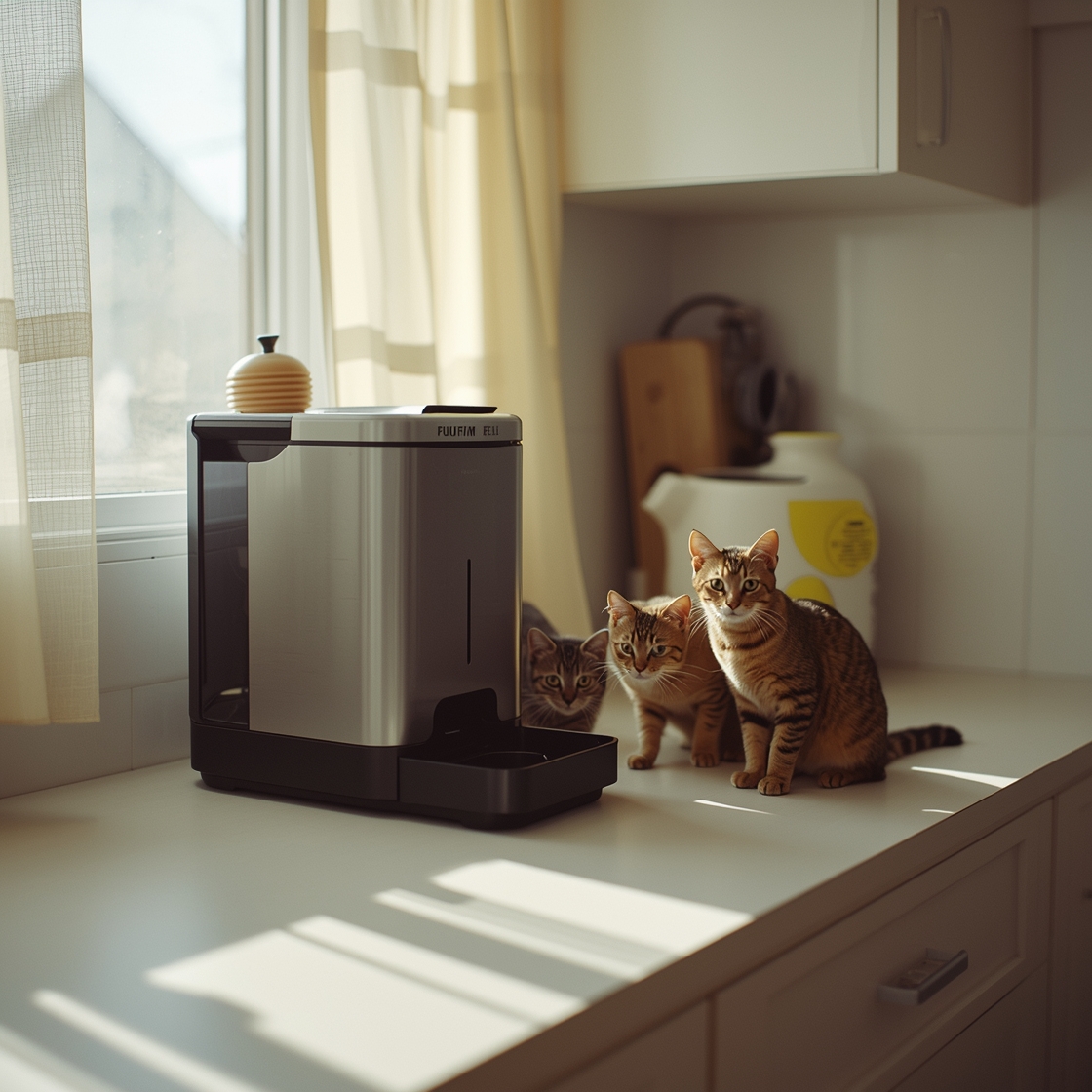
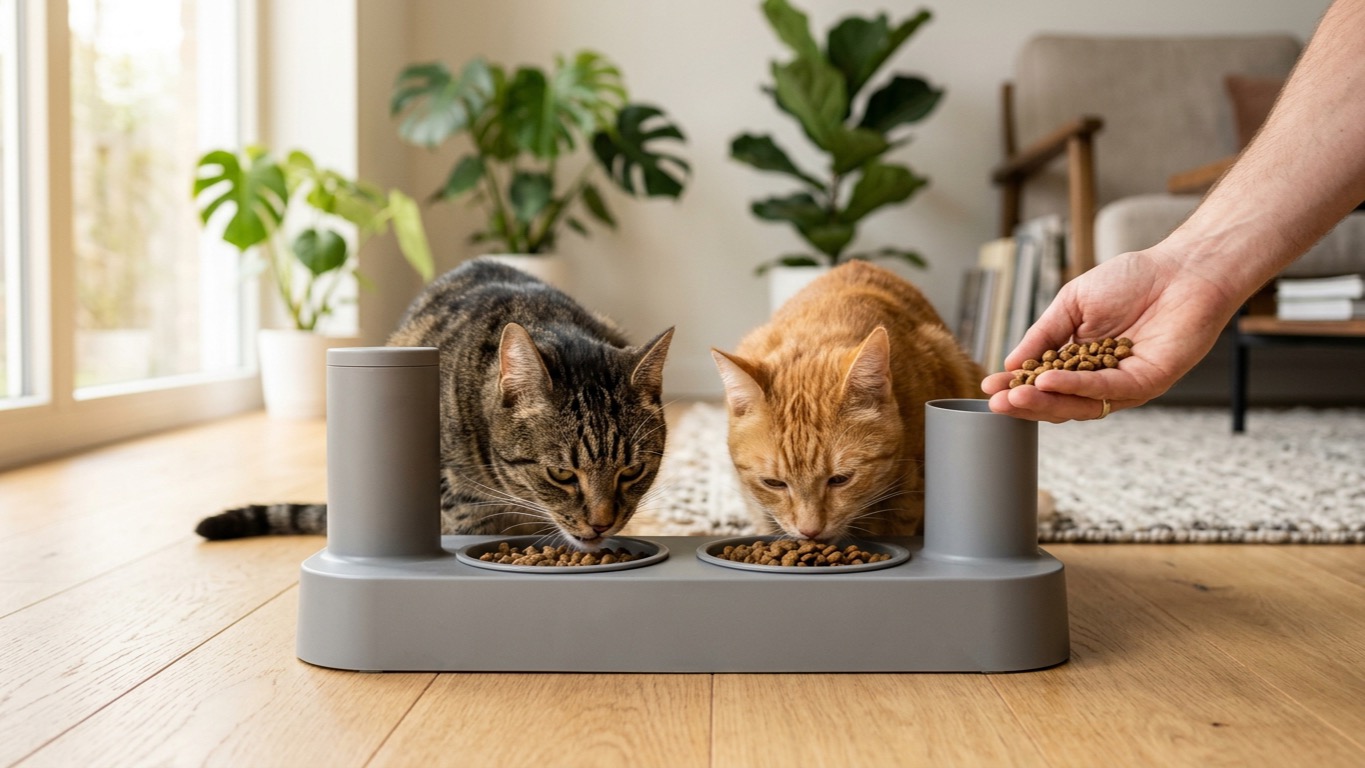
The best cat feeder for two cats is not a dual-bowl timer. It is a lock that matches the thief, a bowl that matches the food, and two stations that are visually separated. AAFP’s 2018 feeding-program consensus (Sadek and colleagues, Journal of Feline Medicine and Surgery) is the frame: cats prefer to eat often and alone; multi-cat homes need multiple feeding stations that are visually separated; meals can be offered through programmable feeders, “some of which utilize individual microchips.” Cornell Feline Health Center: some cats miss dinner unless food is left out; others eat too much when it is always there. “Feeding cats separately or in different parts of the house may be helpful.”
PetBench Two-Cat Feeder Desk (listing-page tally, August 2026): we scored the seven dual-bowl SKUs on this URL plus the four access methods we can actually source from opened maker pages. Of those seven cards, zero print an implant reader. Zero print a per-cat RFID lock. Seven drop the same dry food into two trays on a clock. That is a schedule. It is not two diets. Listed prices on the cards run $27.99–$127.99. Hopper language on the listing pages we could load: about 3.5–5 L for the named mid-band units; the camera SKU is a witness, not a lock.
A dual tray without ID is still one food. That is the sentence this page exists to print.
Our guides are reader-supported. This article may contain affiliate links. As an Amazon Associate we may earn a commission if you buy through links, at no extra cost to you.
Quick picks at a glance
- Cheapest dual tray on this card set: Dual Automatic Cat Feeder 2 Cats — $27.99 listed. Two compartments. No battery backup on the listing we loaded. Same food.
- Entry plastic dual chute: Automatic Cat Feeders for Two Cats — $36.08 listed. Independent chutes still share one hopper diet.
- Budget slow-feed plate: Frienhund Timed Automatic Cat Feeder 2 Cats with Slow Feed: Dual — $39.99 listed. Slows gulp. Does not stop a thief.
- Second Frienhund slow-feed SKU: Frienhund Automatic Cat Feeder 2 Cats with Slow Feed: Dual Automatic — $44.99 listed. Programmable portions. Still one diet.
- Cordless placement: oneisall Automatic Cat Feeder for 2 Cats — $49.99 listed. Battery-led placement. No app on the listing we loaded.
- Camera witness: PETLIBRO Accelerator-class camera listing on this card — $127.99 listed. Eyes on the raid. Not a lock. Camera hardware belongs with the camera feeder guide.
If one cat is on a prescription bag the other must not touch, this card set is the wrong aisle. That job is a microchip lid or a room that stays shut — the multi-cat feeder page maps the lock types. Wet pouches are a different machine: automatic wet-food feeders. The bag itself is not this URL: cat food for weight loss.
What best cat feeder for two cats actually means
Two bowls on one base look like fairness. They are a shared resource with a painted line. AAFP does not say “buy a dual hopper.” It says determine which cats spend time together and which avoid each other, then put food where each cat already feels safe. Tools on that same page: baby gates, size-limiting entrances, elevated shelves, and enough distance that stations are visually separated. Cornell: separate rooms can be enough.
The useful question is not “which dual feeder won.” It is:
- What is the lock? Clock, slow-feed maze, RFID tag, implant lid, or a door.
- What food will the bowl hold? Dry hopper vs sealed wet tray.
- What still gets past the lock? A fast eater, a rear raid, a lost collar, two trays on one mat.
Sure Petcare’s January 2020 “pet pilferers” note is a maker-commissioned survey of 500 UK dog and cat owners, not a feeding trial: 44% said they had caught one pet taking food from another’s bowl; 31% then refilled the bowl “in case”; 72% said they had overfed; 64% had never used scales. Those are owner answers on a Sure Petcare page. They are not “this SKU reduced stealing by X%.” We are not inventing a clinic rate for any unit on this URL.
What
Two-Cat Feeder — August 2026
These tables are desk compilations from the seven product cards on this page, plus the access-method tally we use on the multi-cat sibling URL. Listed prices are August 2026 snapshots and move. A number we could not load from a maker page is not printed as a fact.
Table 1 — Seven cards vs the lock they actually provide
| Product (card price) | What the listing is selling | Lock type | Wet food? | What it cannot do |
|---|---|---|---|---|
| Dual Automatic Cat Feeder 2 Cats ($27.99) | Cheapest dual compartment | Clock / shared hopper | No — dry hopper class | Stop a thief; survive a mains cut (no backup on listing) |
| Automatic Cat Feeders for Two Cats ($36.08) | Dual chute starter | Two mouths, one diet | No | Protect a prescription bag |
| Frienhund Timed Slow Feed Dual ($39.99) | Budget slow-feed plates | Clock + maze | No | Per-cat calories if one cat owns both plates |
| Frienhund Dual Automatic Slow Feed ($44.99) | Programmable slow-feed | Clock + maze + portion steps | No | ID the cat |
| oneisall Automatic Cat Feeder for 2 Cats ($49.99) | Cordless dual bowl | Clock + battery placement | No | Remote app changes (listing: no smartphone app) |
| HoneyGuaridan Automatic Cat Feeder for 2 Cats ($54.99) | 3.5 L + stainless bowls | Clock + steel trays | No | App scheduling |
| PETLIBRO Automatic Cat Feeder with Camera for Two Cats ($127.99) | Live video + schedule | Clock + witness | No — camera hoppers jam on pâté | Stop the raid it films |
Desk stat: 7 of 7 cards on this URL are same-food dual trays. The lock column is a clock. If your household problem is “one cat must not eat the other cat’s bag,” none of these seven cards print the lock you need.
Table 2 — Access methods the two-cat buyer actually has
| Access method | What opened maker pages lock | How many cats per unit | Typical two-cat spend (desk band) |
|---|---|---|---|
| Scheduled dual tray (this card set) | A clock drops the same kibble into two bowls | Two mouths ≠ two diets | $28–$128 for one unit |
| Two timed hoppers, two rooms | Two clocks, two bags if you load two bags | One unit per diet you must protect | 2 × $40–$80 mid-band |
| RFID collar lid (PETLIBRO One class) | Brand tag only; not an implant | One feeder per cat you lock out | 2 units + 2 tags |
| Microchip lid (SureFeed class) | Implant or maker RFID tag; 400 ml sealed bowl | One unit per diet you isolate | Higher unit price; one meal, not a week of kibble |
| Physical separation | A door, a gate, a high shelf | One station per social group | $0 hardware + a door that stays shut |
That table is the selection rule. A ranked “best dual feeder” cannot substitute for it.
Table 3 — Hopper math for two indoor cats (desk planning sheet)
NRC / AAHA calorie conversations for many indoor neutered cats land near 180–250 kcal/day depending on weight and body condition. A 10 lb cat often sits near 200 kcal. Dry kibble density varies; this sheet uses ~350–400 kcal/cup as a planning midpoint, not a lab assay.
| Household | Combined kcal/day (planning) | Dry cups/day (midpoint) | Hopper days on 3.5 L (~14 cups) | Hopper days on 5 L (~20 cups) |
|---|---|---|---|---|
| Two 9–10 lb indoor cats | 360–450 | ~1.0–1.2 | 11–14 | 16–20 |
| Two 12 lb cats | 440–560 | ~1.2–1.5 | 9–12 | 13–16 |
| One diet + one “light” bag | two hoppers | two math lines | do not share one tank | do not share one tank |
| Wet + dry split | wet is not a hopper job | kibble remainder only | count only the dry | count only the dry |
A 3.5 L HoneyGuaridan-class tank is a week-plus for two average indoor cats if they eat the same dry food and you do not free-feed the overflow. It is not two weeks of two different bags.
Table 4 — Power and placement (listing language + AAFP)
| Unit / class | Everyday power (listing or maker class) | Placement rule this desk would run |
|---|---|---|
| Dual Automatic ($27.99) | Wall power; no backup printed | Near an outlet; still two trays on one mat unless you add a second station |
| Frienhund timed / slow-feed pair | Timer class | Slow-feed plates cut gulp; they do not add a lock |
| oneisall | — | Use the cordless pitch to split rooms, not to park both bowls on one counter |
| HoneyGuaridan | Mid-range mains; stainless bowls | Steel trays help chin-acne themes in feline dermatology summaries; wash them |
| PETLIBRO camera card | App + camera class | Put the lens where it sees both mouths; it still cannot close a lid |
| Any dual tray | — | AAFP: visually separated; not beside the litter box. Sure Petcare help (microchip lids): ≥30 cm so one cat cannot dive the open bowl — and 30 cm of plastic is still one station |
The August 2026 working rule: place first, then clock. A dual tray on a shared placemat is still one resource.
The four jobs a two-cat feeder can have
Job A — Same food, mild guarding, you want a clock
This is the honest use of every card on this page. Both cats may eat the same complete dry food. Guarding is a shove, not a siege. A dual chute or dual slow-feed plate keeps two mouths busy at the same second. Watch one meal. If both trays empty into one stomach, you do not have a feeder problem. You have a lock problem. Move to Job C or D.
Job B — Same food, fast eater, vomit after meals
Slow-feed inserts and ridged plates (the Frienhund cards; some HoneyGuaridan listings mention optional inserts) force a path through the kibble. That is a gulp brake. Cornell and AAFP still want you to confirm the cat ate and to watch for bowl guarding. A maze does not replace a calorie target. If the household issue is weight, start with weight-loss food and a scale, not a slower plate of the same free-fed volume.
Job C — Two diets, or a thief
A splitter hopper cannot do this. PETLIBRO’s Granary Dual pages (opened for the sibling URL) print the same limit: dry food only, two stainless trays, the same kibble. RFID collar lids (PETLIBRO One class) unlock for that brand’s tag — one tag per feeder, not an implant. SureFeed’s US page: programme the pet’s microchip; the lid opens for a registered pet; it stays closed for everyone else; bowl 400 ml; 4 × C alkaline; memories survive a battery pull. That is one meal behind a lid, not a week of kibble.
Two diets is two locks or two rooms. A pair of Ones is not “one smart feeder for the house.”
Job D — You need to see the raid
A camera answers “did anyone eat.” That is the camera feeder job. The PETLIBRO camera card on this page is the expensive witness in this set. It does not weigh each cat. A 160° lens documents theft. It does not stop it.
Named examples on this URL (not a ranking)
Dual Automatic Cat Feeder 2 Cats — cheapest dual compartment
Maker job on the card: two compartments, low price. $27.99 listed. Wall power. No battery backup on the listing we loaded. Placement is outlet-bound. Same food. Use it as a clock, not as a diet lock.
Check Dual Automatic Cat Feeder 2 Cats on Amazon
Automatic Cat Feeders for Two Cats — entry dual chute
Listing pitch: two independent chutes, low price. $36.08 listed. Plastic housing. Two chutes still share one diet. A paw-tap on cheap plastic is an owner-report theme, not a lab result.
Check Automatic Cat Feeders for Two Cats on Amazon
Frienhund Timed Automatic Cat Feeder 2 Cats with Slow Feed: Dual — budget gulp brake
$39.99 listed. Slow-feed plates. Coarse portion steps on typical listings in this class. Fine calorie work needs a kitchen scale, not a clicker with four settings.
Check Frienhund Timed Slow Feed Dual on Amazon
Frienhund Automatic Cat Feeder 2 Cats with Slow Feed: Dual Automatic — programmable maze
$44.99 listed. Separate portion language on the card blurb. Still no ID. Still no camera. A second Frienhund SKU is not a second lock type.
Check Frienhund Dual Automatic Slow Feed on Amazon
oneisall Automatic Cat Feeder for 2 Cats — cordless clock
Check oneisall Automatic Cat Feeder for 2 Cats on Amazon
HoneyGuaridan Automatic Cat Feeder for 2 Cats — steel trays, 3.5 L
$54.99 listed. 3.5 L hopper. Stainless bowls. No companion app on the listing. Manual schedule changes at the unit. Steel is a hygiene choice (non-porous vs scratched plastic; feline acne themes in published dermatology summaries). It is not a theft lock.
Check HoneyGuaridan Automatic Cat Feeder for 2 Cats on Amazon
PETLIBRO Automatic Cat Feeder with Camera for Two Cats — witness, not a lock
$127.99 listed. HD camera + app scheduling on the card. Highest price in this set. A camera hopper is still a dry machine. Pâté jams it. Two cats on two prescription wets need two wet feeders or two rooms.
Check PETLIBRO camera feeder for two cats on Amazon
Want the wider dual-tray shelf? Browse two-cat feeders on Amazon
Theft modes a dual tray does not automatically beat
Sure Petcare’s help article on cats stealing from each other’s microchip feeder is the honest theft list even if you never buy a SureFeed. A lid can still lose. A dual tray starts already open.
| Theft / escape mode (August 2026 desk list) | What happens on a dual tray | What to do instead |
|---|---|---|
| Feeders too close | Both bowls are one station | AAFP visual separation; two rooms; a gate |
| Splitter dash | Fast eater owns both portions | Second unit, or an ID lid |
| Rear / side squeeze | No hoop; the other cat just walks over | Physical barrier; RFID / microchip class |
| Lost collar tag | N/A on these seven cards — they have no tag | Implant path if collars fail |
| Linked wet lids | Not this card set | C200 lid-link is a sharing tool — see wet-feeder page |
| Room separation that leaks | A closed door only works if it stays closed | Witzel-Rollins JFMS 2022 bowl group: one household left the study because cats could not be kept apart |
One peer-reviewed household study, cited without turning it into an advert for any SKU on this page: Witzel-Rollins et al. (University of Tennessee, JFMS 2022; 23 cats, BCS ≥7/9) compared a bowl with an automatic feeder at two or six meals. The hardware was PortionPro Rx (Vet Innovations) — an RFID collar-tag shield, not a dual-bowl Amazon timer. Cats on the automatic feeders were more likely to reach BCS ≤6/9 (P = 0.006): 83.2% of the six-meal auto group, 40% of the two-meal auto group, none of the bowl group. Two vs six meals did not change weekly percent weight lost. Small n. Different machine. Those figures stay on that paper.
Hygiene and power: print the rule, not a vibe
Cornell: food left out for grazing should be replaced with fresh food every day. Wet food is a same-day surface. AAFP still wants someone to confirm the cat ate.
Stainless trays (HoneyGuaridan card; many PETLIBRO / Granary Dual pages) lift out. Plastic bowls scratch and hold biofilm — a recurring owner-report theme and a feline-acne talking point in published dermatology notes. Wash on the interval the food demands. A locked bowl of spoiled food is still spoiled food.
Power checklist this desk would run before a weekend away:
- Read the low-battery tell-tale today, not at the airport.
- Alkaline only where a maker banned rechargeables (SureFeed C cells on the sibling page; PETLIBRO D-cell notes).
- A hopper on battery backup often drops Wi-Fi. The camera card becomes a mute clock.
- Keep one ordinary bowl and a measured scoop as the outage plan. AAFP still wants you to know the cat ate.
- The $27.99 Dual Automatic listing we loaded prints no backup. If mains die, that clock dies.
Combo gravity food-and-water units are a different job: cat food and water dispenser. Those hoppers free-feed. They do not portion two cats.
How to choose the best cat feeder for two cats
Work top to bottom. Stop at the first “yes” that matches the house you have.
- Has a veterinarian named a diet this cat must eat and the other must not? If yes, lock that bowl (microchip lid or a room that stays shut). The bag is a clinic sentence. The dual tray is only a clock.
- Is the meal wet, raw, or a pouch that spoils? If yes, a dry hopper is the wrong machine. Use a sealed single-meal lid or a wet-food feeder.
- Does one cat already steal, or does a dog share the kitchen? If yes, you need an ID lid — implant if collars fail; RFID if the cat will wear the tag. Not a Frienhund plate.
- Do both cats eat the same dry food without serious guarding? If yes, any card on this page can be a clock. Watch one meal. If both trays empty into one stomach, go back to step 3.
- Where will the station sit? Visually separated. Not by the litter box. Use the oneisall cordless pitch to split rooms.
- What happens when the mains die? Print the backup. Leave a measured scoop.
- How will you know the shy cat ate? Camera card or a person. This desk did not score body condition.
Listing literacy for the best cat feeder for two cats
When comparing Amazon cards, read lock type, wet vs dry, hopper liters, and cell count before star averages. PetBench discards “#1 for two cats” badges. Two bowls are not two diets. An app log is a witness, not a lock. Snapshot prices move — use the Check price links.
Bowl layout, gulp speed, and two-cat calorie math
Side-by-side bowls on one base look like a truce. They are a shared resource with a painted line. AAFP’s feeding-program language still prefers stations that are visually separated. A dominant cat does not need a shared chute to win. It needs line of sight and a faster mouth.
Feeding speed is a separate lever from lock type. Cats that scarf and then vomit are a Cornell-class observation, not a brand claim. Slow-feed plates (both Frienhund cards) and optional ridged inserts (HoneyGuaridan-class listings) force a path through the kibble. That can cut gulp rate. It does not cut the other cat’s access. A maze on a shared mat is still one mat.
Stainless bowls (HoneyGuaridan card; many PETLIBRO / Granary Dual pages on the sibling URL) are a hygiene choice. Published feline-acne notes treat scratched plastic as a chin-contact surface that holds biofilm. Steel does not treat acne. It washes cleaner. Replace a warped third-party dish if you ever move to a sealed microchip lid — SureFeed’s US pages warn that a warped bowl can break the seal.
Equal distribution is a myth without individualized control. Two cats with different metabolic needs — one on a weight plan, one highly active — need different portions at different times. WSAVA’s Global Nutrition Committee tools put the decision in the same order every time: current weight, body-condition score, a target weight, then a daily kcal number, then a food whose label lets you hit that number. A dual tray that drops the same click into both bowls cannot run that math for two different targets.
| Two-cat calorie scene (planning only) | What a dual tray does | What the desk would run instead |
|---|---|---|
| Both cats 10 lb, same bag, ideal BCS | Clock is enough if you watch a meal | oneisall or HoneyGuaridan as a schedule; scale the daily cups |
| One cat overweight, one lean, same bag | Fast eater owns both trays | Two units + closed door, or RFID / microchip class |
| One prescription pouch, one grocery kibble | Dual tray cannot hold two bags honestly | Two locks or two rooms; wet pouch is not a hopper job |
| Overnight free-feed “so they don’t fight” | Hopper becomes a buffet | APOP 2022: about 61% of U.S. cats overweight or obese — a gravity buffet is how that number happens |
APOP’s 2022 U.S. survey is the figure most clinics quote for the overweight band. It is not a feeder trial. It is why “set the dual hopper to always-on” is a weight plan, not a kindness.
Weekend-away drill for a two-cat clock
- Confirm both cats ate today’s meal. AAFP still wants a person in that loop.
- Fill the hopper with one complete dry food both may eat. Do not mix a renal kibble into a shared tank “for convenience.”
- Set meals, not an open buffet, unless a veterinarian has said grazing is the plan.
- Read the backup. The $27.99 Dual Automatic listing we loaded prints none. The oneisall battery pitch is the cordless exception in this set.
- Leave a measured scoop and one ordinary bowl. If the rotor jams, a clock is a sculpture.
- If you need eyes, the PETLIBRO camera card is the witness. Check that the lens sees both trays. Grease on a lens is a support ticket, not a feeding log.
- Water is a separate station. A combo gravity food-and-water tower free-feeds — that job lives on cat food and water dispensers. AAFP: do not park food next to the litter box.
Combo gravity units and fountains do not portion two cats. They refill a bowl. That is the opposite of a lock.
Related pages (different jobs)
- Two-plus cats and ID lids: automatic pet feeders for multiple cats
- Eyes on the bowl: automatic cat feeder with camera
- Wet trays that cool: automatic cat feeder wet food
- The bag, not the machine: cat food for weight loss
- Gravity food + water towers: cat food and water dispenser
Frequently asked questions
Can one hopper work as the best cat feeder for two cats?
Only if both cats may eat the same dry food and guarding is mild. Separate chutes or slow-feed plates are a schedule. Single-bowl dual dispensers still allow food theft. Different bags need different locks or different rooms.
Do I need two units or one dual-bowl feeder?
AAFP’s visual-separation rule is easier with two units in two rooms than with two trays on one base. One dual-bowl unit is cheaper and sufficient when the food is shared and you watch a meal. Two diets, a thief, or a dog: two locks.
Will a camera feeder stop stealing?
No. The PETLIBRO camera card films the raid. It does not close a lid. Camera hardware details live on the camera feeder page.
Do these feeders work with wet food?
The seven cards on this URL are dry-hopper class. Pâté jams an auger. Wet meals need a sealed lid or a cooled tray — wet-food feeders.
What about RFID or microchip for two cats?
Not on these seven cards. RFID collar lids: one tag per feeder, dry only, tag can be lost. Microchip lids: implant is the key; one meal; wet or dry in a sealed bowl. Map those axes on the multi-cat feeder page.
How far apart should two feeding stations be?
Sure Petcare’s microchip help page asks for at least 30 cm so one cat cannot dive an open bowl. AAFP wants visual separation, not 30 cm of plastic on one mat. A door beats a ruler.
The feeder that belongs in a two-cat home is the one whose lock matches the thief, whose bowl matches the food, and whose placement matches the social map AAFP asked you to draw. A timer without a lock is a schedule. A lock on a shared mat is still one bowl.
- August 2026 — . No ranked winners. No house trial.