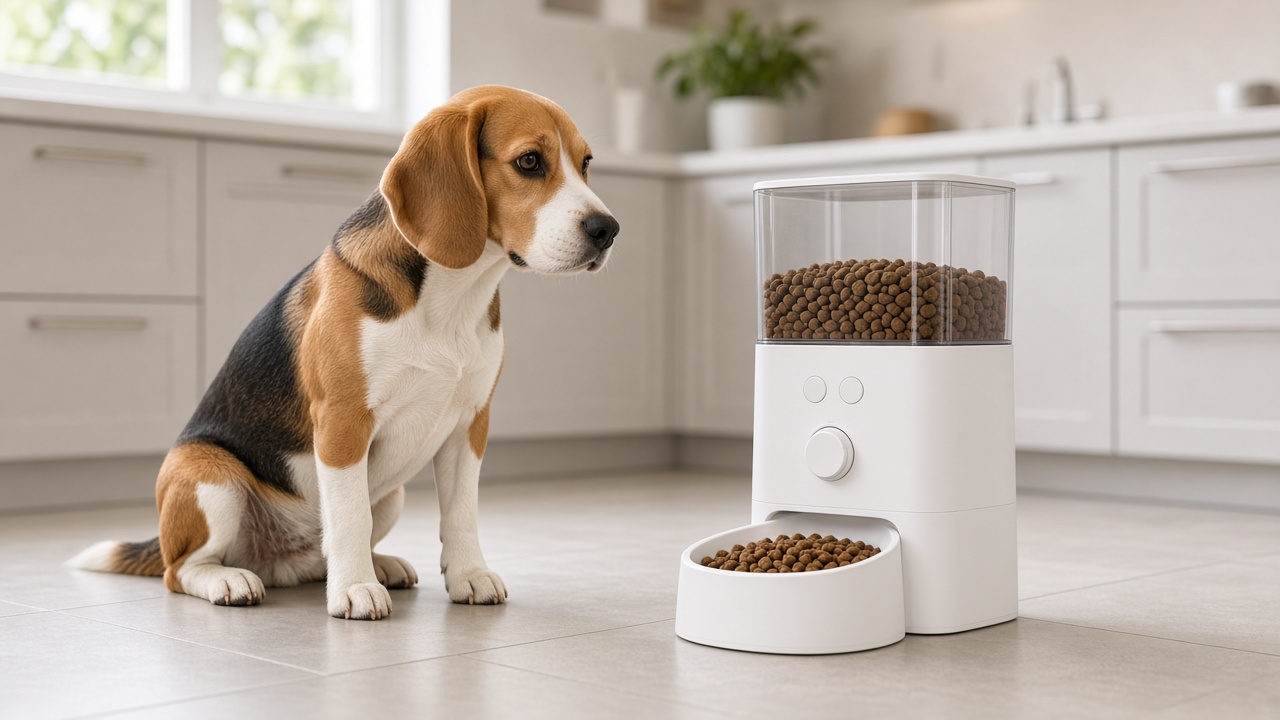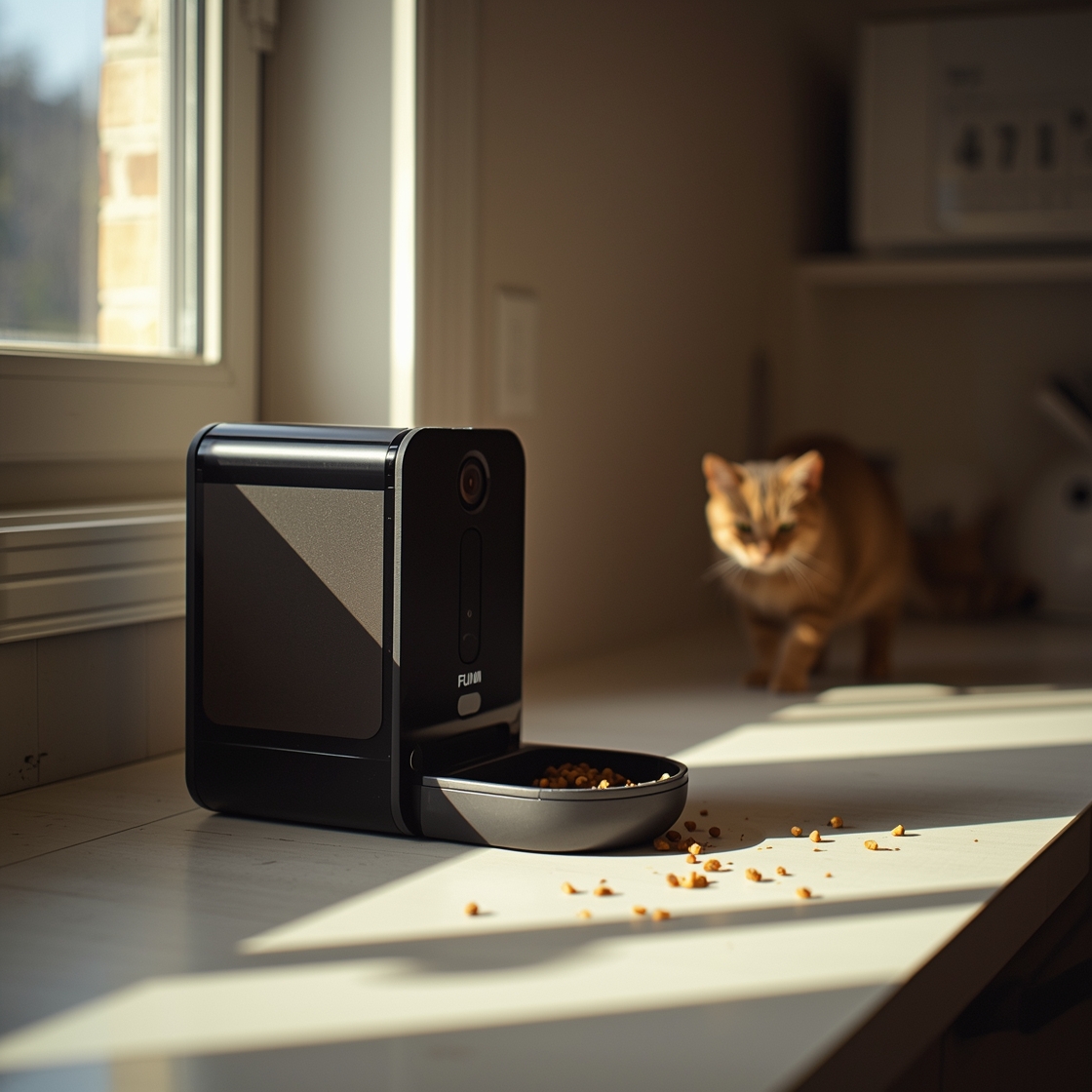
The best automatic cat feeder with camera is a dry-kibble hopper with a 1080p-or-better lens, local video you can keep without a subscription, and a portion schedule that still runs when Wi-Fi dies. PetBench Camera-Feeder Desk (August 2026) coded seven live listings against maker hoppers (2.5–6 L), Wi-Fi bands, and storage: 4 of 7 can record to microSD without a paid cloud plan; the other three sell history as Care+ or a camera-tier subscription after a short trial.
For most single-cat homes, buy the PETLIBRO Granary Automatic Cat Feeder with Camera — dual-band Wi-Fi, 5 L hopper, 1080p / 145° night vision, microSD up to 256 GB. For two cats who share one food, the WOpet Heritage View 6L is the wider lens and bigger hopper. None of these machines portion wet food.
Specs are manufacturer and retailer pages. A camera shows whether the bowl emptied. It does not diagnose illness.
India routing is serve-time only.
What a camera feeder is — and is not
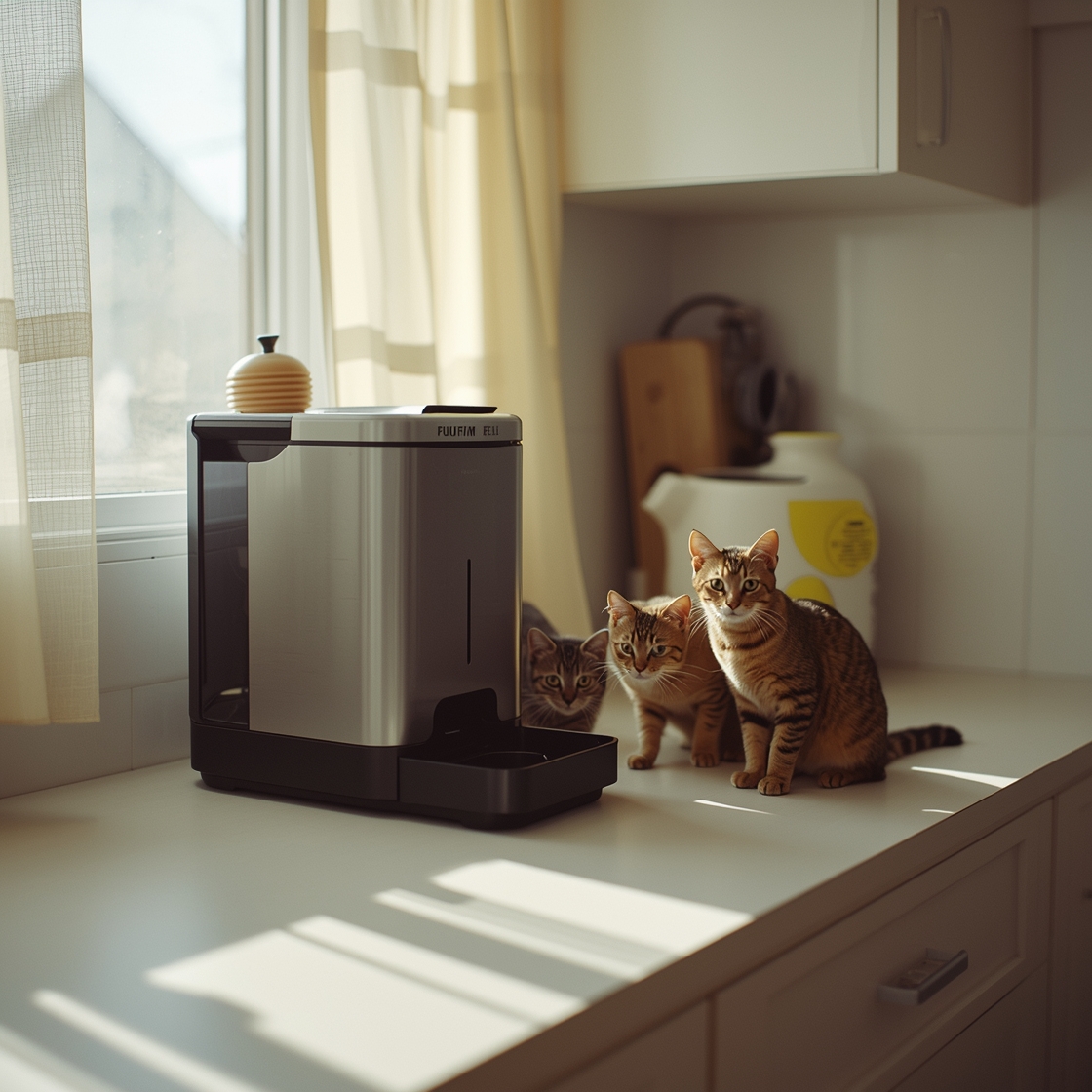
A camera feeder is three products bolted together: a timed kibble auger, a cheap security camera, and a phone app. The auger is the feeding tool. The camera is a check. The app is how you change the clock from work.
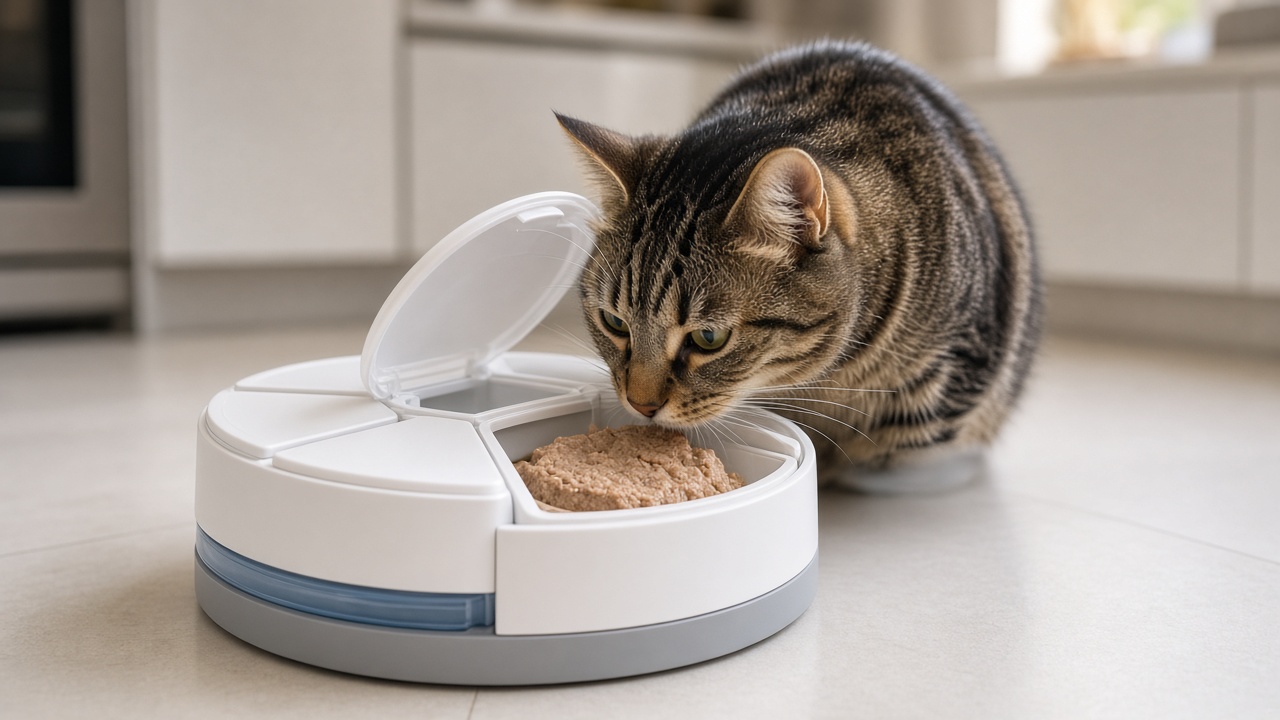
It is not a wet-food machine. Hoppers and impellers jam on pâté. For chilled cans, use the wet-food feeder page.
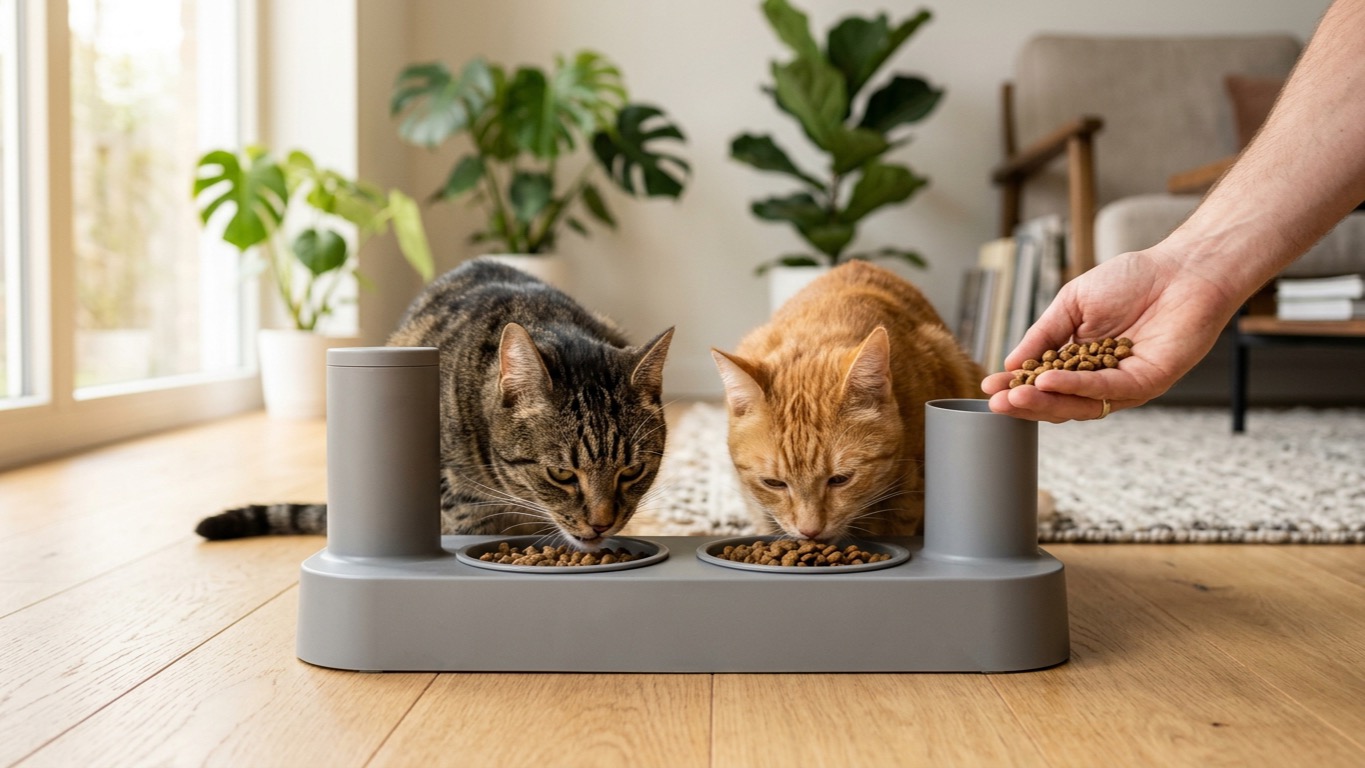
It is not a multi-cat justice system. Dual bowls split one hopper. A bully still eats both. Separate rooms beat a 160° lens.
It is not a medical device. Skipped meals belong with a veterinarian, not a highlight reel.
How this desk compared the best automatic cat feeder with camera

Every SKU below is a currently sold model we could match to an Amazon search URL and a maker spec page. Cut list: no 1080p, no Wi-Fi app, no night vision, no multi-day hopper.
We weighted four published facts:
- Video you keep — microSD vs cloud lock-in after a trial.
- Radio — 2.4 GHz only vs 2.4 + 5 GHz. Mesh homes drop 2.4-only units near refrigerators and microwaves; that is a recurring owner-forum theme, not a desk measurement.
- Hopper liters and kibble diameter — 2.5 L vs 6 L, 12 mm vs 15 mm max.
- Outage path — D-cell / AAA backup so the schedule survives a blackout. Camera usually dies on battery. Meals should not.
”
Hopper-duration
| Cats | Hopper (L) | Meals / day (typical) | Desk refill band | SKU that matches |
|---|---|---|---|---|
| 1 | 3 | 2 | 7–10 days | PETKIT YumShare Solo |
| 1 | 4 | 2 | ~10–15 days | Faroro 4 L |
| 1 | 5 | 2 | 12–18 days | PETLIBRO Granary single |
| 2 same food | 5–6 | 4 | 5–7 days | WOpet 6 L or Granary dual tray |
| 2 different foods | 2+3 split | 2+2 | Hopper-limited | PETKIT Dual-Hopper only |
Kibble denser than the maker’s max diameter jams the auger. PETLIBRO publishes 2–15 mm; PETKIT Solo wants under 12 mm. Measure a piece before you buy a 15-day fantasy.
Named units (not a ranking)

1. PETLIBRO Granary Automatic Cat Feeder with Camera (Single Tray)
Best for: one cat, dual-band Wi-Fi, video that does not require a monthly plan.
1080p, 145° lens, infrared night vision. 5 L hopper, 2–15 mm kibble, up to 10 meals/day at 1–50 portions, stainless tray. Two-way audio, motion/sound alerts. Local microSD to 256 GB. D-cell backup. Stocked at Amazon, Best Buy, PetSmart, Costco. About $139.99 on the card. Cloud replay beyond the card is a paid add-on — live view and local clips are the free path.
2. PETKIT YumShare Solo Automatic Cat Feeder with Camera
Best for: a lower street price and AI-sorted clips (Feeding / Eating / Visiting) if you accept 2.4 GHz only.
About $90 on the card. 1080p night vision. 3 L hopper (~2.9 lb), up to 10 meals at 1–5 portions. Bowl-full pause, 20-second meal call, two-way audio, five AAA backup. Kibble under 12 mm. Hopper is small for two cats.
3. PETKIT YumShare Dual-Hopper Automatic Cat Feeder with Camera
Best for: two dry foods on two schedules — kibble plus topper, or regular plus a prescription dry.
Split 5 L (2 L + 3 L). 1080p, 940 nm IR. 1–10 meals, 1–10 portions per hopper. Remaining-food monitor, two-way audio, 20-second call, four D-cells (maker: up to 60 days standby). Video history needs PETKIT Care+ after a 7-day trial. 2.4 GHz only. Card price $119.99.
4. WOpet Heritage View Automatic Cat Feeder with Camera for Two Cats (6L, Dual Bowls)
Best for: two cats, one food, widest published view on this list.
6 L hopper, splitter, two stainless bowls. 1080p, 160° horizontal, 70° tilt, night vision advertised to ~33 ft. 4 GB microSD in the box — local video without a subscription. Dual-band Wi-Fi, 10 meals, 1–20 portions, two-way audio, 10-second call, 3× D-cell backup (cells often not included). Both bowls get the same food. A guarder can still stand over both. Card $119.99.
5. HHOLOVE O Sitter Automatic Cat Feeder with 2K AI Camera
Best for: camera-first homes — pan/tilt and a laser, smallest hopper.
2K lens, 360° horizontal, 110° tilt, AI tracking, highlight clips, remote laser. 2.5 L (10-cup) hopper, low-food alerts, leftover-bowl skip, blockage sensor, dual-band Wi-Fi, two-way audio, battery backup. Cloud storage and AI highlights sit behind a subscription on the camera-only tier. Card $129.99. This is a pet cam that also feeds, not a 6 L bunker.
6. PETLIBRO Granary Automatic Cat Feeder with Camera for 2 Cats (Dual Tray)
Best for: two cats, identical food and portions, same app as the single-tray Granary.
5 L, 1080p / 145°, dual-band, 10 meals, 1–50 portions, two-way audio, local microSD, D-cell backup. Trays sit close. A food bully can guard both. Card $149.99 — highest on this page. If the cats need different foods, this SKU is the wrong object; use Dual-Hopper or two rooms.
7. Faroro Automatic Cat Feeder with Camera, 1080P, 4L
Best for: the densest schedule on the list — up to 15 meals/day, 1–30 portions — if you will live in Smart Life.
4 L transparent hopper, 1080p / 120°, adjustable angle, night vision, dual-band via Smart Life (not a pet-brand app), blockage sensor, low-food alerts, two-way audio, 3× D-cell backup. Street price moves; the card has no locked dollar. A 3 MP sibling exists — confirm the SKU at checkout.
Comparison: best automatic cat feeder with camera (table 2)
| Product | Hopper | Camera / storage | Radio | Card price |
|---|---|---|---|---|
| PETLIBRO Granary single | 5 L | 1080p 145°, microSD | Dual-band | $139.99 |
| PETKIT Solo | 3 L | 1080p, AI clips | 2.4 only | $90 |
| PETKIT Dual-Hopper | 2+3 L | 1080p, Care+ history | 2.4 only | $119.99 |
| WOpet Heritage View | 6 L dual bowl | 1080p 160°, 4 GB SD in box | Dual-band | $119.99 |
| HHOLOVE O Sitter | 2.5 L | 2K pan/tilt, cloud AI | Dual-band | $129.99 |
| PETLIBRO Granary dual | 5 L two trays | Same as single + split | Dual-band | $149.99 |
| Faroro 4 L | 4 L | 1080p 120°, Smart Life | Dual-band | Listing |
See camera feeders on Amazon →
Camera-spec
| Feature | Desk minimum | Recurring fee? | Who clears it here |
|---|---|---|---|
| Resolution | 1080p | No | All seven |
| Night vision | IR on the bowl | No | All seven |
| Two-way audio | Yes | App free tier | All seven |
| Local SD history | Preferred | No | PETLIBRO both, WOpet (card included) |
| Cloud / AI history | Optional | Yes after trial | PETKIT Dual-Hopper Care+; HHOLOVE camera tier |
| Dual-band Wi-Fi | Prefer on mesh | No | PETLIBRO, WOpet, HHOLOVE, Faroro |
| Pan/tilt | Only if you want room view | Often cloud | HHOLOVE only |
FCC equipment authorization applies to the radio, not to “pet-safe video.” Treat this like any indoor IP camera: unique app password, lens aimed at the bowl, not the hallway. For a standalone cam with no feeder, see pet camera, no subscription.
Storage math: SD vs a year of Care+
A 128 GB microSD at 1080p event clips is weeks of bowl traffic for most single-cat homes, not a year of 24/7 cinema. Overwrite is the point. You are buying “did she eat Tuesday.” You are not buying a nanny archive.
Cloud plans win if you want off-site clips after a theft or a smashed feeder. They lose if the reason you bought the Granary was “no monthly.” Add 12 months of Care+ (check current PETKIT pricing — it moves) to the Dual-Hopper’s $120 and the Granary’s $140 local path is often cheaper in year one. We are not locking a 2026 subscription dollar here because those pages change.
Power outages and what the camera does
Every unit on this page publishes a battery backup for meals. On battery, makers typically cut the radio and the lens to save cells. Your cat gets kibble. You do not get a livestream. Put fresh D-cells or AAAs in the bay before a storm week. WOpet’s card often ships without the D-cells — budget three.
A schedule saved on-device keeps firing if the router dies. You lose remote edits, alerts, and talk. That is why you set the weekday clock before you leave, not from the airport.
Two-cat reality
WOpet and Granary dual tray split one food. PETKIT Dual-Hopper splits two foods. None of them weigh each cat. For serious guarding, two feeders in two rooms is the desk answer, same as on the two-cat feeder page. A 160° lens documents the theft. It does not stop it.
Portion grams and obesity
Maker “portions” are auger clicks, not grams. Calibrate: put a bowl on a kitchen scale, run one portion, write the grams, multiply by meals. Compare to the kcal/cup on the bag. Indoor cats gain on “default 4 portions” faster than owners notice on a camera. The lens is useful after you have a gram target.
AAFCO feeding directions on the bag are starting points for an average cat, not a weight-loss plan. A clinic sets those grams. We do not.
Placement, glare, and why night vision still fails
The lens sits near the floor. A window behind the feeder blows out the bowl at noon. A black fridge beside it eats IR at midnight. Put the unit on an interior wall, bowl facing the room, not facing glass. WOpet’s 70° tilt exists because cats are different heights; a fixed 120° Faroro needs the stand height right on day one. Owner returns for “can’t see at night” often mean the IR is reflecting off a stainless bowl into the lens — tilt the tray or use a matte bowl if the maker allows a swap.
Do not aim the camera at a litter box, a bedroom, or a street window. These are always-on IP cameras. Unique password, 2FA if the app offers it, guest network if you have one. FCC authorization means the radio was certified, not that the cloud vendor is private.
Kibble shape, freeze-dried toppers, and jams
Auger feeders publish a max diameter, not a “works with all gourmet shapes.” Star-shaped or disc kibble bridges in a 3 L Solo even when the caliper says 11 mm. Freeze-dried nuggets belong in the Dual-Hopper’s second chamber only if they stay under that SKU’s limit and do not crumble into dust that packs the impeller. Dust is how “smart bowl empty” sensors lie: the tray looks full of powder and the cat ate nothing.
If you feed a prescription dry that comes in large kibbles, PETLIBRO’s 15 mm window is the reason that SKU stays on the shortlist. If you feed a tiny kitten kibble, most of these hoppers still work — the jam risk is oversized adult pieces, not small ones.
Calibration week (desk method, not a lab)
Day 1: weigh the empty steel or plastic bowl. Run one portion. Write grams. Repeat three times. Average.
Day 2: set meals so daily grams match the bag’s cup converted to grams, or the clinic’s target.
Day 3: watch the first clip. If kibble piles and the cat walks away, you have a texture or staleness problem, not a camera problem. Hopper food older than the bag’s “use within X days of opening” is stale even if the lens is sharp.
Day 7: weigh the cat if you have a home scale. A feeder that “worked” while adding 200 g/week is a calorie error.
This is a kitchen scale and a calendar. It is not veterinary nutrition.
Mesh Wi-Fi and the 2.4 GHz ghetto
Pet gadgets still ship 2.4-only because the radio is cheap and the range through cabinets is better on paper. Combined-SSID mesh (one name for 2.4 and 5) often steers phones to 5 GHz and leaves the feeder on a congested 2.4 channel next to the microwave. Dual-band Granary / WOpet / Faroro / HHOLOVE can use 5 GHz when the AP allows it. Solo and Dual-Hopper cannot. If pairing fails, split the SSID for ten minutes, join 2.4, then recombine. That is a setup note, not a throughput test we ran.
Smart Life (Faroro) means you already live in Tuya’s account model. PETLIBRO and PETKIT want their own apps. Two apps is normal in a two-brand house. Three apps is how people stop checking the camera.
When a camera feeder is the wrong tool
Skip this category if you only need a 7 a.m. click and you are home — a $40 timer is enough. Skip it if the diet is wet-only. Skip it if you will not wash the tray; grease on a lens is a support ticket. Skip it if two cats need two prescription wets at two times — that is two wet feeders, not one 2K turret.
A camera feeder is a hopper plus a check. The best automatic cat feeder with camera for a studio apartment with one cat and a mesh router is still the Granary single. The best for a two-cat, one-bag house is WOpet. The best for two bags is Dual-Hopper. Those sentences are job matches, not scores.
Frequently asked questions
Does the best automatic cat feeder with camera stop food guarding?
No. It records it. Separate feeders 3+ feet apart, or separate rooms.
How do automatic cat feeders with cameras work?
The app writes a meal table to the device. At the time, the auger drops kibble. The camera streams or writes a clip. Two-way audio is a speaker and mic. Night vision is IR LEDs, not a second “health sensor.”
Are they worth it vs a $40 timer?
Yes if you need eyes on the bowl or remote schedule changes. No if you only need a click at 7 a.m. and you are home. The camera is the price jump.
Can I use one for multiple cats?
Same food: WOpet or Granary dual. Different dry foods: Dual-Hopper. Different wet foods: not this page.
Do they work with wet food?
No. Use a wet-food feeder.
Do they require a subscription?
Feeding: no. History: PETLIBRO and WOpet can stay on SD. PETKIT Dual-Hopper and HHOLOVE’s camera tier sell history.
Do they work without Wi-Fi?
Meals yes, if the schedule is already on the unit. Live view no.
What happens in a power outage?
Backup cells keep the clock. Camera usually off. Replace cells on a calendar, not after the outage.
What to do tomorrow
- Measure kibble diameter and count cats / diets.
- Decide if you will pay monthly for clips. If no, Granary or WOpet.
- If two foods, Dual-Hopper. If two cats and one food, WOpet or Granary dual.
- Weigh one portion on a scale before you leave town.
- Set the schedule on-device, then pull the router for ten minutes and confirm a meal still drops.
That is the whole method. The best automatic cat feeder with camera is the hopper and storage plan that matches the house — not the 2K marketing still.
Travel checklist (desk, not a boarding pass)
The night before you leave: hopper above the low-food line, backup cells seated, schedule confirmed with a test drop, SD card seated (or Care+ logged in if that is your plan), bowl clean, water filled. Pull Wi-Fi for five minutes and confirm the next meal still fires. If it does not, the schedule never landed on the device — fix that at home, not from a gate.
A sitter who only “checks the app” is not a sitter if the radio is down. Leave a mechanical backup: a measured dry portion in a closed container and a written time. That is unfashionable and it works.
International travel does not change the feeder. It changes whether someone can reach the apartment. The Polar wet feeder and this dry hopper are different clocks; do not load pâté in the Granary because you packed both pages in one tab.
App ecosystems and what “AI clips” actually store
PETLIBRO, PETKIT, WOpet, and HHOLOVE each want an account. Faroro uses Smart Life. That is five password surfaces for a bowl camera. Use a unique password. If the app offers 2FA, turn it on. Do not reuse the email password you used for the Amazon checkout.
“AI clips” on the Solo classify motion into Feeding / Eating / Visiting. That is on-device or cloud labeling of a motion event. It is not a veterinary appetite score. A false “Eating” clip can be a paw on the tray. A missed meal can look like a Visiting clip if the cat walked by. Watch the video when the grams on the scale and the clip disagree.
Care+ after seven days on the Dual-Hopper is a history product. Live view may still work on the free tier — read the current PETKIT page the week you buy. This desk will not freeze a 2026 monthly dollar.
Firmware updates can change hopper timing. After an app update, re-weigh one portion. Auger clicks drift. That is a calibration note, not a defect claim we measured.
Stainless vs plastic trays and why smell shows up on camera
Grease on a lens looks like “bad night vision.” Wash the tray when you refill. Stainless (Granary, WOpet bowls) holds less odor than the Solo’s plastic path. Cats refuse stale fat before owners see it on 1080p. If the cat sniffs and leaves, clean first, then change food, then blame the feeder.
Place a silicone mat under the unit. Auger bounce walks cheap plastic across tile. A walking feeder aims the lens at a kickplate.
Guest networks and apartment Wi-Fi
A feeder on a landlord router you cannot split will fail pairing more often than a mesh you own. If you cannot create a 2.4 GHz SSID, you may be stuck with Smart Life / Tuya devices that tolerate the combined SSID, or you skip the camera and buy a timer. That is a building constraint, not a brand review.
Do not put the feeder on a public guest network that expires every 24 hours. The schedule should live on the device; the network should be boring and permanent.
Internal links if the job is not this page
- Wet meals: best automatic cat feeder wet food
- Two-cat hardware: best cat feeder for two cats
- Camera only: pet camera, no subscription
Sources
- PETLIBRO Granary camera feeder specifications (hopper, dual-band, microSD, kibble 2–15 mm)
- PETKIT YumShare Solo and Dual-Hopper specifications (hopper split, Care+, 2.4 GHz, kibble limits)
- WOpet Heritage View specifications (6 L, 160°, included SD)
- HHOLOVE O Sitter specifications (2K pan/tilt, 2.5 L, subscription tier)
- Faroro 1080p 4 L listing / Smart Life control
- FCC equipment authorization (radio devices): https://www.fcc.gov/oet/ea
- AAFCO feeding directions are on the bag, not a camera spec
Two schedules, one hopper — why it fails
A single 5 L Granary can run ten meals a day. That does not give two cats two calorie targets. The bully eats meal 3 and meal 4. The shy cat eats crumbs. A camera documents the crime. Dual trays split volume, not personalities. If you need two gram targets, you need two hoppers in two rooms or a microchip feeder (different category, not on these cards).
Night snacks: cats graze. Fifteen Faroro meals can look like a clinic weight-loss plan and still fail if each “portion” is an unknown gram. Calibrate first.
Subscriptions in year two
Year-one math (Granary local SD vs Care+) breaks in year two if you keep paying for cloud you do not open. If you have not watched a clip in 30 days, cancel the plan and keep the SD. The feeder still feeds.
The best automatic cat feeder with camera is a storage-and-hopper match
Granary single if you want dual-band and no monthly. WOpet if two cats, one food. Dual-Hopper if two foods. O Sitter if you want a pan/tilt cam and accept a small hopper. Faroro if you already live in Smart Life and want 15 meal slots. Solo if $90 and 2.4 GHz is acceptable. That list is a job map. It is not a ranked 7.
Cleaning interval that matches wet vs dry
Dry hoppers still get fat dust. Wipe the tray every refill; wash weekly. If you ever try “just a little wet” in a camera hopper, you have left this category and entered spoilage. Don’t.
SD cards wear. A cheap no-name 256 GB that dies takes your only local history. Buy a known card; replace yearly if the feeder writes constantly.
The best automatic cat feeder with camera remains the hopper, radio, and storage match — Granary or WOpet if you refuse a monthly fee.
Night IR and the stainless bowl
If night clips are white-out, tilt the camera or swap to a matte bowl if the maker allows it. IR bounce is the usual cause, not a “broken 1080p.” This is the first fix owners skip.
Firmware: after an update, re-run the one-portion weigh. Augers drift. The best automatic cat feeder with camera is still the one whose storage plan you will actually pay for — or not pay for.
Blockage sensors vs a real jam
Faroro, HHOLOVE, and others list blockage sensors. They pause an auger. They do not pulverize a 16 mm disc kibble. Measure first. If the cat is hungry and the app says jammed, empty the throat by hand with the unit unplugged. Do not reach in while powered.
That is the last hardware note. Buy the storage plan you will live with.
Time zones and travel
If you fly west and change the app clock from the airport, you can double-feed. Set the feeder’s timezone at home and leave it. Remote extra meals are for true misses, not jet lag. The schedule on the device is the source of truth.
Multiple feeders, one app account
Two Granarys can live in one PETLIBRO account. Name them by room. Do not clone the same gram schedule onto a kitten and an adult. The camera tells you who showed up. The schedule still has to be the right grams.
Name devices by room so alerts mean something. A generic “feeder 1” alert at 3 a.m. is how people mute the app and miss a real jam.