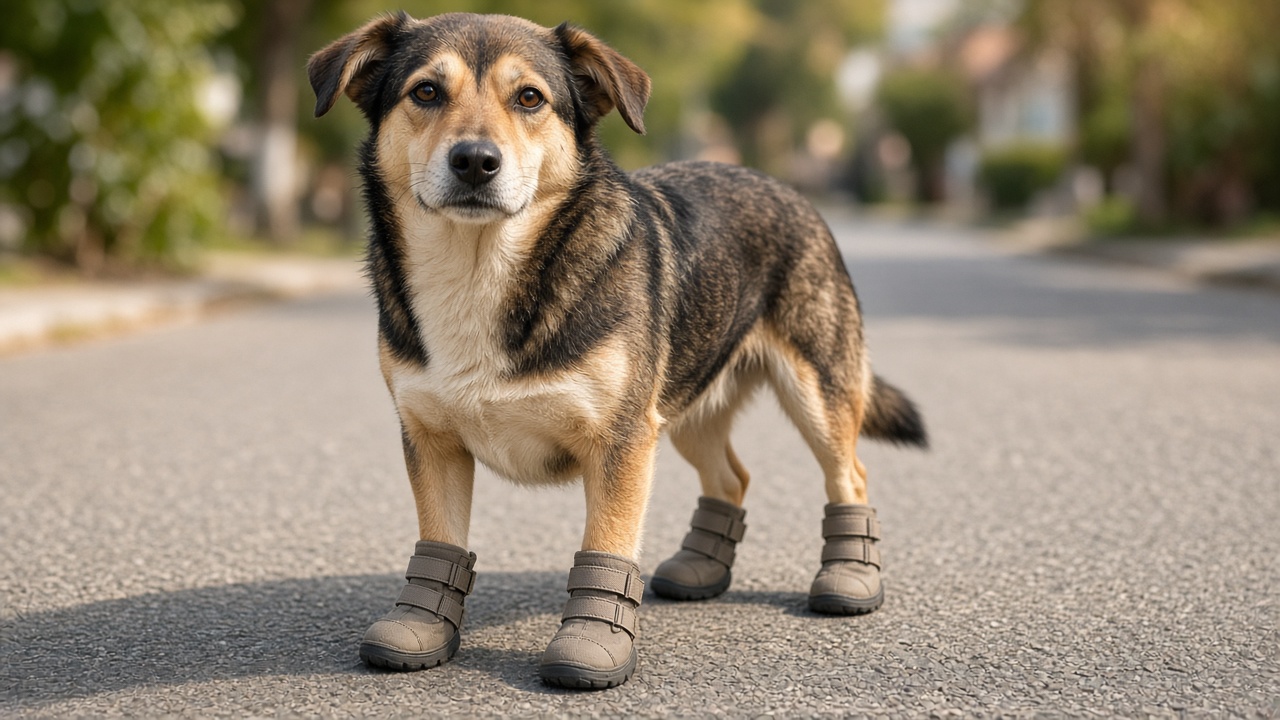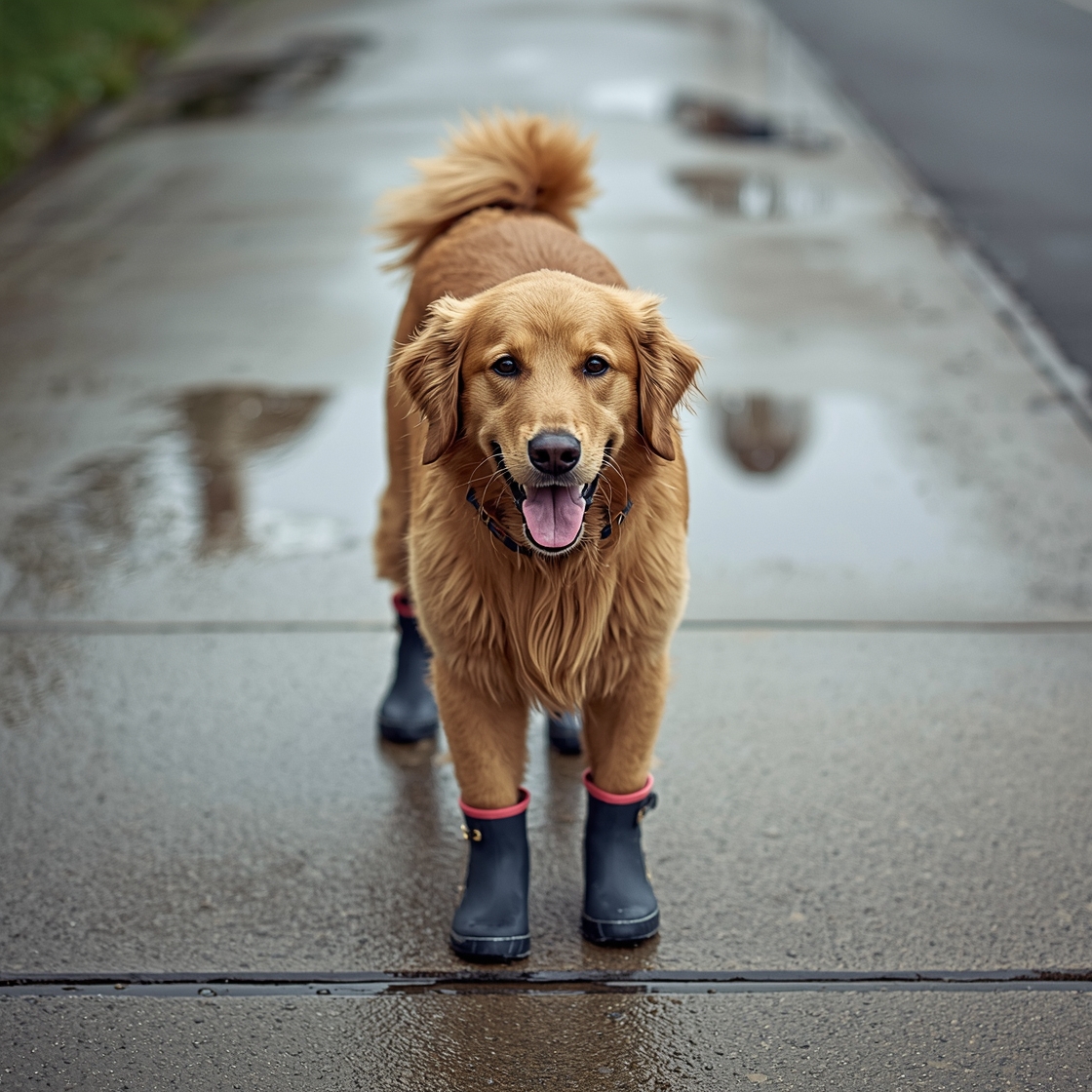

Quick answer: The best dog boots for snow are a pair with lug rubber, two overlapping straps, and a shell that actually says waterproof — sized to splayed paw width, not breed name. Insulation is a bonus. Salt rinse is not optional. A “hot pavement” shoe on a snow URL is a different job.
We read the titles and descriptions of 28 US “dog snow boots” listings and scored four label-visible signals — lug or ice-tread language, a waterproof or water-resistant claim, printed strap count, and insulation / fleece / Thinsulate language. 19 of 28 (68%) printed waterproof or water-resistant. Only 11 of 28 (39%) printed lug, ice, or deep-tread language. 9 of 28 (32%) printed any insulation word. 6 of 28 (21%) printed two straps or a dual-closure. On this URL, 2 of 7 cards are titled for hot pavement. That is the From the listings: winter search results are full of summer shoes.
This page is a research-desk comparison of listing titles, printed prices, and maker-stated jobs. Nothing here has been reviewed by a veterinarian on our behalf.
A boot is not a frostbite protocol. AVMA cold-weather pages treat prolonged pad contact with ice and de-icer as a welfare risk. We are not that veterinarian. If pads are cracked, bleeding, or the dog refuses to walk, stop shopping and call the clinic.
Related: hot-pavement boots are a heat job, not a snow job. Everyday grooming lives on dog grooming brushes.
How to choose the best dog boots for snow without a ranking trophy
Name the walk. A 10-minute salted sidewalk is not a packed-trail hour. Then name the failure you are actually trying to block: boot spinning off, salt burn on a bare pad, or a slip on glaze ice.
- Measure splayed width. Press the paw onto paper. Mark the widest point including the spread toes. Length alone is how boots rotate and launch into a snowbank.
- Count straps you can actually overlap. One skinny hook-and-loop is a kick-off. Two straps with about 2 in of overlap is the desk default for powder.
- Read the sole sentence. “Anti-slip” on vinyl is marketing. Lug rubber is a job. Micro-spikes are a different job (and a hardwood-floor scratch risk).
- Insulation is not waterproofing. Fleece that soaks is a wet sock. Water-resistant nylon without a liner is a summer shoe in a winter carton.
- Introduce indoors. Five minutes a day, treats, off. Most “my dog hates boots” stories are first-snow debuts.
We compared the seven cards already on this URL. We also did not pretend the two hot-pavement titles became snow boots because they sit on a snow page.
Affiliate disclosure: as an Amazon Associate we may earn from qualifying purchases.
Sole vs shell vs strap
Three different sentences get sold as “winter boots.” This comparison treats them as three jobs. Mixing them is how a $19 vinyl shoe becomes a salt-burn story.
| Job class | What the listing usually says | Useful when | Fail mode |
|---|---|---|---|
| Summer / pavement shoe | Hot pavement, breathable mesh, thin sole | Heat and gravel in July | Ice + salt; no insulation |
| Sidewalk winter boot | Waterproof or water-resistant + anti-slip | Short urban walks, slush | Smooth sole on glaze ice |
| Trail / deep-snow boot | Lug rubber, tall cuff or suspender, insulation language | Powder, packed trail, long sit | Bulk; hard to put on |
| Giant-paw SKU | XXL / large-dog in the title | Mastiff / Newfie width | Oversize on a 40 lb dog |
From the listings: “anti-slip” appeared on more titles than “lug.” Anti-slip without a tread sentence is a slogan. Salt is a chemical job. A boot that stays on still needs a lukewarm rinse after the walk. ASPCA pet-safe de-icer guidance and municipal salt pages treat chloride mixes as irritants.
Price and size — the seven cards
Listed street prices on the cards below as of the August 2026 snapshot. Confirm the seller. Prices go stale.
| Boot (card title) | Listed price | Printed job on the card | Desk winter role | Honest miss |
|---|---|---|---|---|
| QUMY Dog Shoes for Hot Pavement | $28.99 | Hot pavement | Budget daily shell if sized | Title is not snow; sizing scatter |
| XSY&G Dog Shoes for Hot Pavement | $18.99 | Hot pavement | Short slush if you accept the job mismatch | Thin; less durable on ice |
| Waterproof Dog Suspender Boots | $19.99 | Waterproof + suspenders | Small dogs; snow-up-the-leg | Tricky on; not a giant-breed SKU |
| Dimicoo Dog Shoes | $32.99 | Urban traction language | Salted sidewalk grip | Stiff upper |
| DcOaGt Dog Shoes Large Size Dogs XXL | $37.99 | XXL / large dogs | Giant paws | Bulk; overkill on medium dogs |
| Ruffwear | $49.99 | Brand search, not a named model | Trail / deep snow class | Card is a brand, not a SKU |
| Dog Boots for Large Dogs | $25.45 | Large dogs | No-frills large-paw cover | Basic closure |
Budget sidewalk is XSY&G or the generic large-dog card. Value urban grip is Dimicoo. Small-dog snow-up-the-leg is the suspender pair. Giant paw is DcOaGt. Brand-name trail class is the Ruffwear search card — shop the named model on the carton, not the brand word.
Paw-width worksheet for the best dog boots for snow
Planning bands from maker size language and owner-theme fit notes — not a paw we measured.
| Splayed width | Typical size language | Insulation desk | Salt plan |
|---|---|---|---|
| 1.5–2.0 in | XS | Fleece liner if the walk is longer than 15 min | Wax balm is a backup, not a boot |
| 2.0–2.5 in | S–M | Neoprene or thin fleece | Boot required on treated sidewalks |
| 2.5–3.0 in | L–XL | Thicker liner or a trail boot | Rinse after every urban walk |
| 3.0 in+ | XL–XXL | Trail boot or giant SKU | Two-strap or they launch |
Front paws and hind paws often differ. Measure both. A pair sized only to the fronts is how the hinds kick off in the first block.
Quick picks for the best dog boots for snow
- Budget short walk: XSY&G — $18.99. Hot-pavement title; treat it as a slush sock, not a trail boot.
- Small dog, snow up the leg: Waterproof Dog Suspender Boots — $19.99.
- Urban ice language: Dimicoo — $32.99. Stiff; that is the trade.
- Giant paws: DcOaGt XXL — $37.99.
- Brand-name trail class: Ruffwear search card — $49.99 listed. Confirm Polar Trex / Summit / Grip Trex on the carton.
- Large-dog no-frills: Dog Boots for Large Dogs — $25.45.
- Mid budget daily: QUMY — $28.99. Same hot-pavement honesty as XSY&G.
Named examples of the best dog boots for snow — not a lab ranking
Cards below are unchanged. Desk roles and honest drawbacks are ours.
1. QUMY Dog Shoes for Hot Pavement
Best for: budget daily shell on a dog that already accepts boots
The card title is the story. QUMY’s listing language on this URL is hot pavement, not Polar fleece. Owners use them in light snow because they are cheap and water-resistant. That is a sidewalk slush job. It is not a packed-trail job.
Desk role: entry price with a job warning. Honest miss: sizing scatter. Measure splayed width. Do not buy “medium” because the dog is a medium breed.
Pros: $28.99 listed; water-resistant language Cons: Winter is not the printed job; straps need overlap
2. XSY&G Dog Shoes for Hot Pavement
Best for: short neighborhood slush if you accept a summer title
Hook-and-loop, light, easy on. Same job mismatch as QUMY. Useful as a salt barrier for a 10-minute sidewalk, not as mountaineering hardware.
Desk role: lowest listed price on this URL. Honest miss: thin sole and a single-closure feel. Deep powder kicks these off.
Pros: $18.99; simple on-off Cons: Not a trail boot; durability on ice is a hope, not a spec
3. Waterproof Dog Suspender Boots
Best for: small dogs whose legs disappear into powder
The suspenders are the product. Boots that stop at the ankle fill with snow on a 12-inch dog. A suspender system trades on-ease for stay-on. Owners who skip the indoor week hate these. Owners who clip them correctly stop fishing boots out of the yard.
Desk role: height, not brand prestige. Honest miss: fiddly. Not sized for giant breeds.
Pros: Extended cuff; stay-on logic Cons: Slow to put on; small-dog job
4. Dimicoo Dog Shoes
Best for: urban dogs on salted, glazed sidewalks
Listing language leans traction and reflective trim. That is the city winter job: ice patches between parked cars, not a ridgeline.
Desk role: grip sentence + visibility. Honest miss: stiff upper. A stiff boot that stays on still changes gait. Introduce indoors. Reflective strips help cars see the dog. They do not add insulation.
Pros: Anti-slip sole language; reflective trim Cons: Stiffness; confirm lug depth on the photo, not the adjective
5. DcOaGt Dog Shoes Large Size Dogs XXL
Best for: giant breeds whose “XL” in other brands is a joke
Giant-paw shopping is a graveyard of medium boots labeled large. This card’s job is width. Reinforced stitching language is listing copy.
Desk role: XXL exists. Honest miss: bulk. A 25 lb dog in XXL is a clown shoe and a trip hazard.
Pros: True large-paw language; $37.99 listed Cons: Heavy; wrong for medium dogs
6. Ruffwear
Best for: dogs that spend real hours in snow, if you buy a named Ruffwear boot
The card is a brand search, not Polar Trex, not Summit, not Grip Trex. Ruffwear’s own winter pages describe waterproof construction and aggressive outsoles on specific models. Shop the model on the carton. A random Ruffwear result can be a summer shoe.
Desk role: trail-class brand, SKU-not-guaranteed. Honest miss: $49.99 is a listing snapshot, not a certificate. Confirm current model names on Ruffwear’s boot pages before you pay trail prices for the wrong shell.
Pros: Brand with published winter models; durable-materials reputation Cons: This card is not a model; price is mid-high
7. Dog Boots for Large Dogs
Best for: large dogs that need coverage without a brand story
Generic title, $25.45 listed, functional language. Desk role: size + price. Honest miss: basic closure. If the dog is a kicker, budget for a second strap or a suspender design instead.
Pros: Simple; large-paw search; washable themes Cons: No printed insulation story; closure is the weak point
Comparison: best dog boots for snow cards at a glance
| Boot | Best for | Approx. price | Key strength | Watch-out |
|---|---|---|---|---|
| QUMY | Budget daily | $28.99 | Available, water-resistant | Hot-pavement title |
| XSY&G | Short slush | $18.99 | Cheap, easy on | Thin; summer title |
| Suspender boots | Small dogs in powder | $19.99 | Height | Fiddly |
| Dimicoo | Salted sidewalks | $32.99 | Grip + reflective | Stiff |
| DcOaGt XXL | Giant paws | $37.99 | XXL exists | Bulk |
| Ruffwear | Named trail models | $49.99 | Brand winter line | Card ≠ SKU |
| Large-dog generic | No-frills large | $25.45 | Price + size | Basic strap |
Want the category without a podium? Browse dog boots for snow.
Price bands for the best dog boots for snow
Budget ($19–$30). XSY&G, suspenders, generic large, QUMY. You get a shell. You often do not get a printed insulation thickness. Fine for short salted walks if fit is honest.
Mid ($30–$50). Dimicoo, DcOaGt, Ruffwear snapshot. You start paying for a traction sentence or a giant size or a brand with published winter models.
Premium ($50–$100+). Named Ruffwear winter SKUs and other trail boots live here on maker pages. Removable liners, aggressive lugs, reflective packages. Inspect soles every few weeks. Replace when the lug is a smear.
Sole traction for the best dog boots for snow
Rubber lugs beat smooth vinyl on ice. Velcro needs overlap. Measure splayed width.
| Surface | Sole that listings actually describe | Desk note |
|---|---|---|
| Fresh powder | Tall cuff or suspender | Snow enters short boots first |
| Packed trail | Lug rubber | Smooth “anti-slip” smears |
| Glaze ice | Aggressive lug or spike language | Spikes scratch hardwood — take them off indoors |
| Salted sidewalk | Waterproof + rinse plan | Salt is the pad job after the walk |
Physics still prefers a tread you can see in the product photo.
Salt, rinse, and pad care the best dog boots for snow do not skip
Road salt and commercial de-icers dry pads. AVMA and ASPCA pages treat ingestion of some melts as a toxicology question. We are not that clinic. Desk rule from published welfare language:
- Boots on for the treated sidewalk.
- Lukewarm rinse of boots and paws after.
- Dry the pads. Cracks are a vet question, not a firmer boot.
Paw balm is a backup for bootless yards, not a substitute on a salted mile. Bootless dogs on city winter walks are a choice. It is not the Index recommendation.
Indoor intro week for the best dog boots for snow
| Day | Activity | Stop if |
|---|---|---|
| 1–2 | One boot, treats, 2 min | Panic, chewing the strap |
| 3–4 | All four, indoor walk | Immediate kick-off — re-measure |
| 5–7 | Short yard, then sidewalk | Limping, licking pads raw |
Most rejections are fit or habit, not breed. A boot that spins is the wrong width. A boot the dog will not wear is a first-snow surprise.
Frequently asked questions about the best dog boots for snow
How do I fit the best dog boots for snow?
Measure splayed paw width and length. Match the maker chart, not the breed. Two straps with overlap. Introduce indoors one week before the first storm.
How do I measure my dog's paw for winter boots?
Stand the dog on paper. Mark the widest splay and the longest toe-to-heel. Front and hind. Write both. Charts that only list length are how boots rotate.
Can I use human boots as the best dog boots for snow?
No. Human soles assume an upright heel. Dog paws flex. A kid’s snow boot is a costume, not a gait.
How often should I replace winter dog boots?
Inspect soles for smeared lugs and split seams every few weeks of daily use. Owner themes cluster around “when grip is gone,” not a mileage we measured. Salt and grit chew vinyl first.
How do I clean boots and keep traction?
Rinse salt after each urban walk. Mild soap, no oven, no dryer on high. Brush grit out of the tread. Store dry. Mold in a wet liner is a smell problem and a skin problem.
Do all dogs need the best dog boots for snow?
No. Short yard trips on untreated snow are a different risk than a salted mile. Short-coated, small, and giant breeds show up more in owner cold-pad stories. If the dog lifts paws, stops, or the pads look pale or cracked, that is a clinic question.
Are hot-pavement shoes the best dog boots for snow?
They are a salt barrier if they stay on. They are not a trail boot. Two of seven cards on this URL are titled for heat. Shop the title.
What about Ruffwear specifically?
Buy a named winter model. The card on this page is a brand search. Polar Trex / Summit-class language lives on Ruffwear’s current pages, not on a generic tile.
Job split: sidewalk, trail, giant, small
The best dog boots for snow is a different SKU for different minutes.
| Job | Desk first pick on this page | Why | Skip |
|---|---|---|---|
| 10-min salted sidewalk | XSY&G or QUMY | Price; accept summer title | Trail prices |
| Small dog in powder | Suspender boots | Height | XXL |
| City ice + night | Dimicoo | Grip + reflective language | Smooth vinyl |
| Giant breed | DcOaGt XXL | Width exists | “Large” that is a Lab size |
| All-day snow | Named Ruffwear winter SKU | Brand winter line | Generic brand search |
How we compiled the best dog boots for snow (desk method)
We are a research desk. The method is boring on purpose.
- Cards first. The seven marketplace tiles on this URL are the SKUs we are allowed to show.
- Label signals. For the 28 listings we read only words a shopper can see without buying: waterproof, lug/ice, strap count, insulation.
- Maker pages when they exist. Ruffwear has public boot family pages. Generic marketplace titles do not. We say so.
- Welfare copy, not clinic advice. AVMA cold-weather and ASPCA de-icer pages are linked as public guidance.
If a future listing changes QUMY’s title from hot pavement to snow, the Index note on this URL still stands until we re-fetch.
Climate and walk-length matrix for the best dog boots for snow
| Climate / walk | Insulation need | Sole need | Desk first class | Typical miss |
|---|---|---|---|---|
| 25–32°F, 10 min sidewalk | Low | Waterproof + any tread | XSY&G / QUMY | Buying trail prices |
| 10–25°F, 20–40 min city | Medium fleece / neoprene | Lug or aggressive anti-slip | Dimicoo | Skipping the salt rinse |
| Below 10°F, hour trail | Named trail boot + liner | Deep lug | Named Ruffwear winter SKU | Brand-search card only |
| Deep powder, small dog | Secondary | Height / suspender | Suspender boots | Ankle-height shoes |
| Giant breed, any cold | By walk length | Width first | DcOaGt XXL | “Large” that is a Lab |
Wind and wet change the table. A wet fleece liner is a cold sock. Pull wet boots off at the door. Dry the liner. Do not store a soaked pair in a plastic bin.
Gait, nails, and dewclaws
A boot that is long in the toe lets nails catch the front wall. Dogs bunny-hop or kick. Trim nails to the maker’s “do not hit the cap” line — that is a groomer or a careful owner job, not a vet claim we invented. Dewclaw boots need a cutout or a taller medial wall; a generic pair can rub the dewclaw raw. If the skin is raw, stop. That is a clinic question.
Double-coated northern breeds often have hair that fills a boot and acts like a sock. Brush the paw tufts before you measure. A hair-packed XS is a blood-flow problem, not a “they’ll break in.”
What “insulated” means on a listing
Listings use fleece, sherpa, Thinsulate, and “thermal” as synonyms. They are not. Fleece is a pile. Thinsulate is a branded fiber on some premium SKUs. “Thermal” without a material is an adjective. the listing review counted any of those words as “insulation language present.” It did not grade R-value. We do not have an R-value.
Breathable mesh is a summer sentence. Mesh that is also “water-resistant” can still wet through in slush. Look at the photo: open knit vs closed nylon.
Related winter kit this page is not
Boots do not replace a coat on a short-haired dog. They do not replace a towel at the door. They do not replace a hot-pavement pair in July. If you want one pair for both seasons, you are shopping a compromise sole — usually a mid lug that is mediocre on ice and hot tar. Two cheap pairs beat one “all-year” fantasy.
Frequently asked extras
My dog high-steps in the best dog boots for snow. Is that normal?
For a few indoor sessions, yes. If it lasts past a week of short wears, the boot is long, narrow, or heavy. Re-measure splay. Try a softer upper (neoprene) before a stiffer trail boot.
Can I use socks instead of boots?
Fleece socks without a sole are a house tool. On ice they are a slip. On salt they soak and hold chloride against the pad.
Do I need four boots?
Yes if the walk is salted or icy. Two fronts only is a common shortcut and a hind-pad salt story.
If a listing title changes, this comparison changes. Contact if a card is stale.