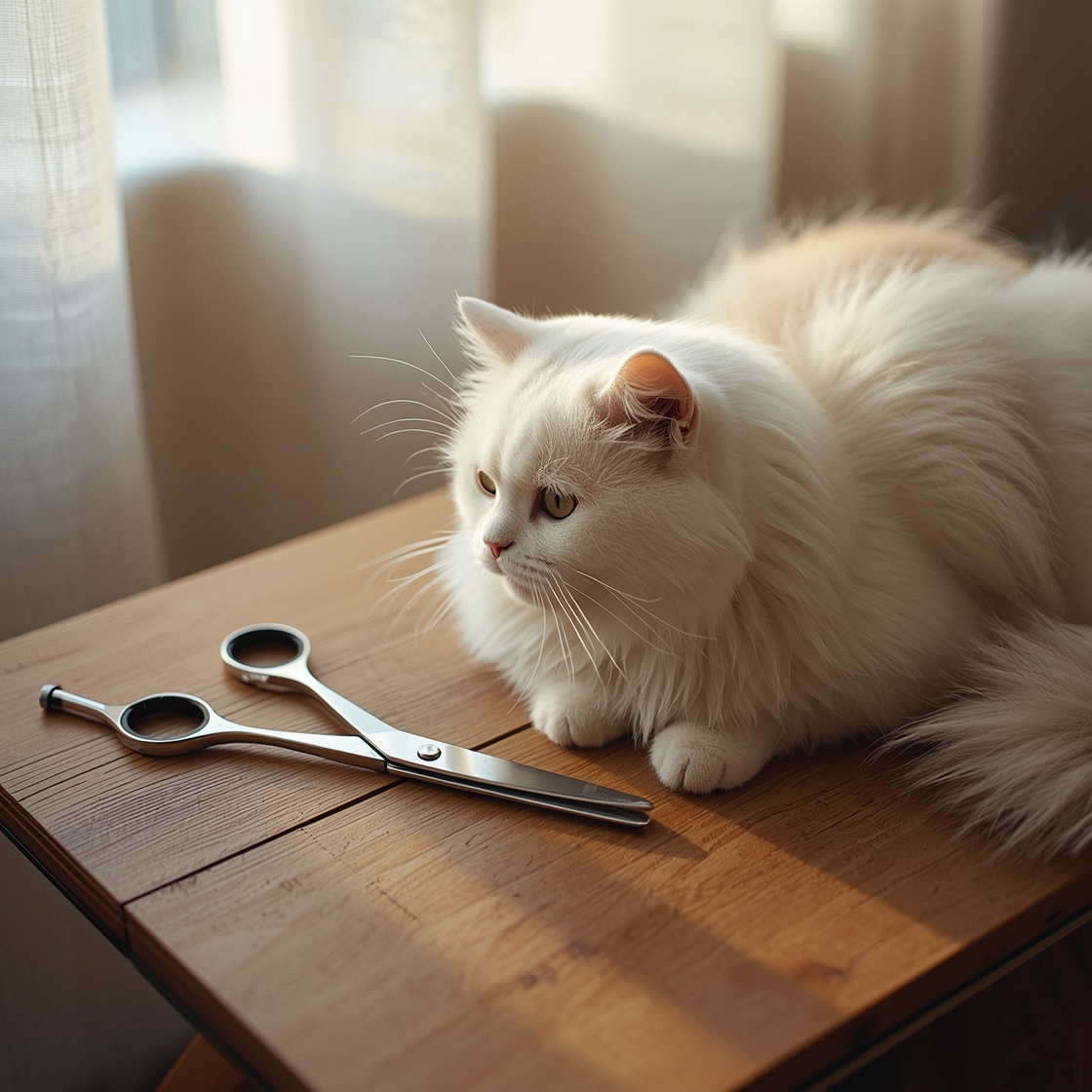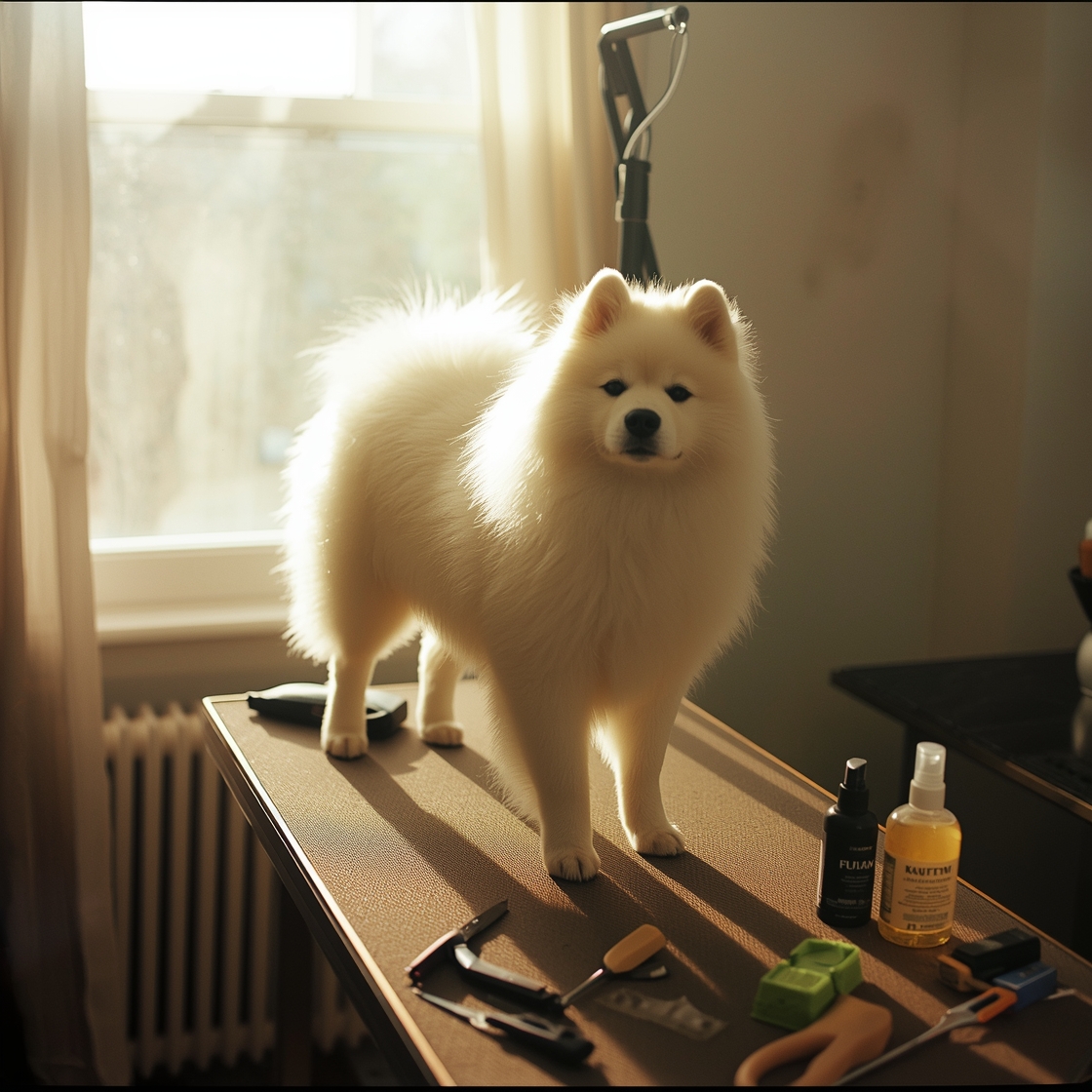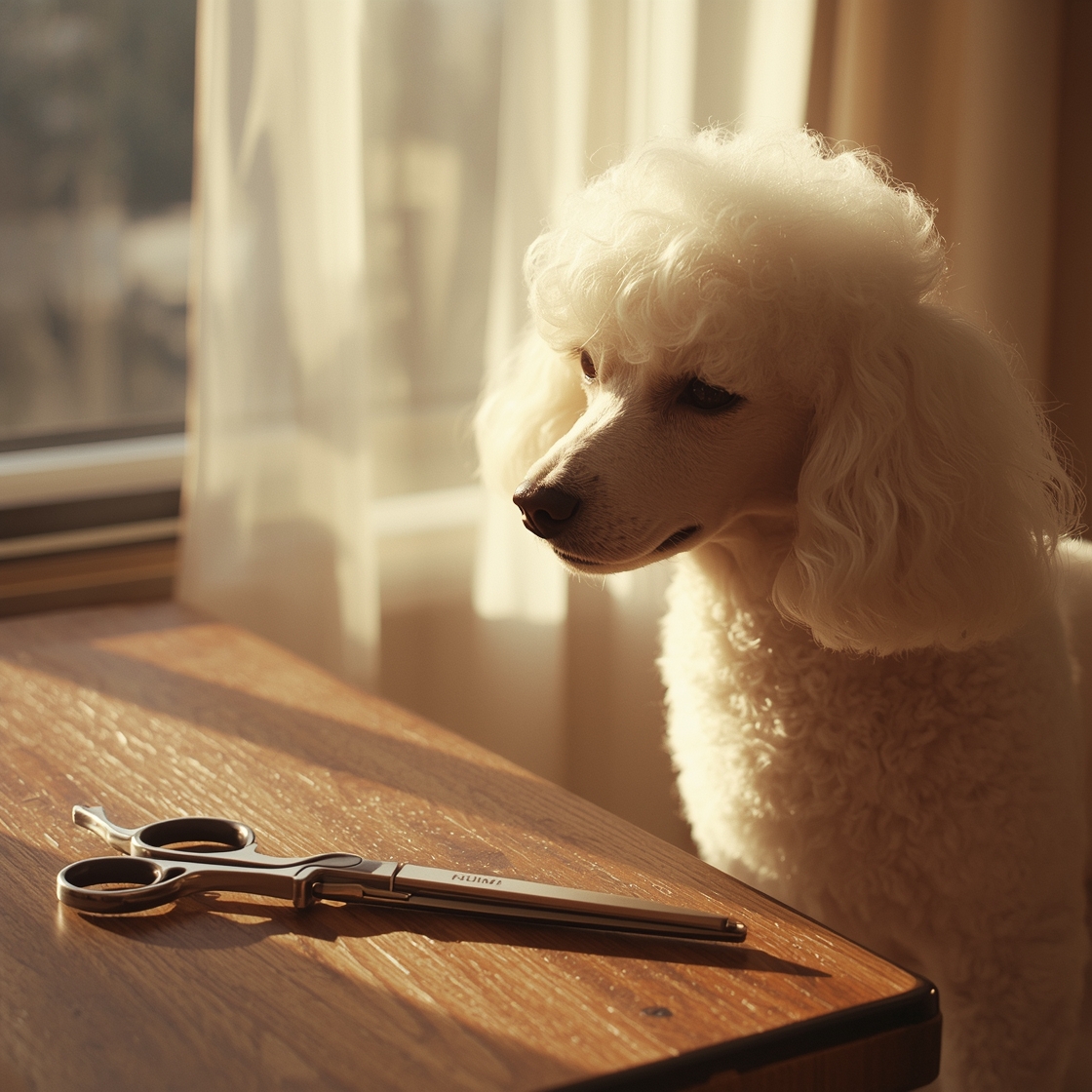
Quick answer: The best dog grooming scissors for curly hair are a finish stack after a slicker and a comb — a curved body shear for the silhouette, a thinning pair to blend a clipper step, and a rounded 4.5–6 inch tip for face work. They are not a $8 five-pack used as a mat cutter, and they are not a human hair pair.
We read the titles and descriptions of the 7 live US marketplace cards on this URL and scored four label-visible signals — kit vs single shear, a “curved” or “chunker” word, a steel or coating word, and a safety/round-tip sentence. 6 of 7 (86%) were multi-piece kits. 0 of 7 (0%) printed “curved,” “chunker,” or “curly” in the title. 1 of 7 (14%) named 4CR / titanium (Gimars). 2 of 7 (29%) used safety language (4-in-1, GLADOG). Listing snapshot prices ran $7.98–$29.97 (median $15.99, a 3.8× spread). Zero tiles published a tooth count, a pin-length slicker spec, or a line-brush protocol.
This page is a research-desk map of curl job → shear class, using listing-stated prices and VCA / Poodle Club of America public text. Thepetbench is not a groomer and not a veterinary practice. Nothing here has been reviewed by a veterinarian on our behalf.
Related: general shears, Poodle brushes, brush vs comb, clippers, home-clip safety.
Slicker first, then shear
| Job | What it does on a curly coat | Listing example on this page | Fail mode |
|---|---|---|---|
| Slicker + comb | Opens the lock to the skin | Other URLs | Skipping this is how you cut a mat |
| Straight finish | Evens a panel after the coat is open | Most kits include one | Steps if used on a still-matted lock |
| Thinning / blend | Softens a clipper hat | Gimars / Fiurfiy kits | Fine teeth fight a wet knot |
| Curved body | Rounds a rump, a topknot, a leg cylinder | Not titled on these 7 cards | Buying a kit and never using the curve |
| Rounded-tip face | Eyes, muzzle, sanitary | 4-in-1, GLADOG, Pets First | Still a blade; not a tear-stain cure |
| Clipper | Length, sanitary, emergency mat | Other URL | VCA: clippers for mats, never scissors |
| Deshed blade | Seasonal undercoat | Dropped | Wrong geometry for curl-lock |
From the listings: “best dog grooming scissors for curly hair” search tiles still sell generic kits. A kit is a starter tray. It is not proof the blades inside are curved, convex, or long enough for a Standard jacket.
Price — listing snapshot prices we fetched
Street prices from the seven cards on this URL as of August 2026. Marketplace tiles move.
| Listing (card title) | Snapshot price | Title signal | Desk job |
|---|---|---|---|
| 5 in 1 Premium Dog Grooming Scissors | $7.98 | Kit, no steel word | Occasional face tidy |
| Professional 4 in 1 … Safety Round | $9.97 | Safety round | Small-dog face / paw |
| Pets First #1 … Body & Facial | $12.99 | Facial trimmer | Detail only |
| GLADOG Professional 5 in 1 … Safety | $15.99 | Safety kit | First home tray |
| Fiurfiy 6-in-1 | $19.98 | 6-in-1 | Mid kit, unnamed steel |
| Gimars Titanium … 6 in 1 4CR | $23.59 | 4CR + titanium | Only steel sentence |
| Dog Grooming Scissors Kit | $29.97 | Generic kit name | Highest snapshot, least specific title |
A $8 kit is a safety-tip starter, not a salon curved pair. Budget on a Poodle jacket is not “buy the cheapest five-pack twice.”
Curl × clip worksheet for the best dog grooming scissors for curly hair
PCA’s Poodle standard (height at the withers) is a conformation sentence, not a carton word “large.”
| Coat / clip | Shear desk | Still required first | Stop and book |
|---|---|---|---|
| Sporting / 1 in pet body | Short straight + rounded tip | Comb-to-skin | Any panel the comb cannot pass |
| Medium pet jacket | 6.5–7 in finish + thinning | Daily slicker (VCA) | Wet mat |
| Growing / show-length curl | Curved + thinning (not on these titles) | Line-brush | You cannot see skin |
| Corded | Not a slicker-and-shear page | Corder’s tools | Do not cut a finished cord “to tidy” |
| Doodle in the house | Same stack if the coat is curl | Comb-to-skin | Sheds like a retriever — different coat |
Affiliate disclosure: as an Amazon Associate we may earn from qualifying purchases.
The best dog grooming scissors for curly hair depend on clip length and whether the coat is already open — not a durability contest across seven generic kits.
Our guides are reader-supported. This article may contain affiliate links. As an Amazon Associate we may earn a commission if you buy through links, at no extra cost to you.
The useful question is not “which is the best of seven.” It is: is this coat open to the skin, and is the remaining job a silhouette, a blend, or a clipper?
We read the seven live product cards, the listing-stated prices and titles, VCA’s grooming-and-coat-care page and its hot-spot page, and the Poodle Club of America’s reprint of the Poodle standard. Dimensions and kit counts below are listing-stated unless we say otherwise.
We did not run a curl trial, a “minutes per dog” clock, or a nick score. “Professional” on a $10 carton is marketing. If a claim needs a groomer, a dermatologist, or a sedated clip-off, it is not in this article.
The general shear page maps straight vs thinning vs curved for all coats. The Poodle brush page is the daily tool. Clippers live on the clipper page. Home-clip safety lives on the safety page.
First decision: the lock, the clip, or a shopping problem you should stop
The Poodle standard — the same text the Poodle Club of America reprints — does not describe “fluffy dog hair.” It describes two coat qualities:
- Curly: “of naturally harsh texture, dense throughout.”
- Corded: “hanging in tight even cords of varying length.”
An open curly coat is a slicker-and-comb problem first. A corded coat is a different object. Do not take a cheap kit through a finished cord and call that a trim.
VCA’s coat-care page: dogs with long, silky, or curly coats require daily brushing, especially around the ears, armpits, and the back of the legs. VCA also names the tool class: slicker brushes work well for dogs with curly, non-shedding coats, like poodles. That sentence is about a brush. It is not a shear ranking.
When the groomer or the veterinarian is the answer, not the cart
- A mat you cannot lift with fingers, or a mat you cannot see skin through — VCA: if the tangle is extensive, seek a groomer or the veterinarian. Only use clippers to remove mats — never scissors.
- Skin under the coat that is red, wet, cracked, or smelly. VCA’s hot-spot page: mats can hide a sore. That is a vet visit, not a sharper pair.
- The dog screams, snaps, or freezes when you touch a panel. Pain is information.
- You were about to bathe a matted dog. VCA: brush burrs and tangles before the bath; tangles can become impossible after water.
- You were about to “just snip it.” Scissors on skin you cannot see are how you get a cut that needs sutures.
If the coat is already a job for clippers and sedation, stop shopping scissors. Book the table.
Decision framework for the best dog grooming scissors for curly hair
1. Job — finish, blend, face, or clipper
Pick the job first.
Finish straight evens a panel that already combs from the skin out. If it does not comb, you are not finishing. You are cutting a knot.
Thinning hides a clipper hat or a step. It is not a dematting tool.
Curved is the silhouette tool on a Poodle-type body. Zero of seven cards on this URL print “curved.” If you need that job, you are shopping a named curved pair (the general shear page cards HASHIMOTO) or reading the carton photo, not trusting the title “Dog Grooming Scissors Kit.”
Rounded-tip face is eyes, muzzle, sanitary. Pets First is the only card that says facial. GLADOG and the 4-in-1 say safety.
Clipper is length at scale or a mat. Other URL.
2. Length — Toy face vs Standard jacket
PCA height rules: Toy 10 in or under; Miniature over 10 and at or under 15 in; Standard over 15 in. A Toy face wants 4.5–6 in. A Standard body wants 6.5–8 in. None of the seven cards print a blade length. Measure when they arrive.
3. Steel word vs steel silence
Gimars is the only card that prints 4CR and titanium. The $7.98–$15.99 kits print neither. Pay for a named steel if you finish every week. Do not pay for the word “Premium” on an $8 five-pack.
The 7 listings on this URL — desk notes, not a ranked test
1. Professional 4 in 1 Dog & Cat Grooming Scissors Kit with Safety Round
Desk job: Cheapest safety-round kit.
Listing snapshot $9.97. Face and paws on a small, already-open coat. Not a Standard jacket tool. Not a mat tool.
2. GLADOG Professional 5 in 1 Dog Grooming Scissors Set with Safety
Desk job: First home tray with a safety sentence.
Listing snapshot $15.99. Same class as the 4-in-1, one more piece. Still a starter. Still not a curved-body proof.
3. Dog Grooming Scissors Kit
Desk job: Highest snapshot, least specific title.
Listing snapshot $29.97. The title does not name a brand, a length, a steel, or a curve. Confirm the carton. A $30 generic kit can still be a short straight plus a comb.
4. Gimars Titanium Coated Professional 6 in 1 4CR Stainless Steel Dog
Desk job: Only card that prints a steel word.
Listing snapshot $23.59. 6-in-1, 4CR, titanium coated. Still a kit. Still needs a comb-to-skin test before you finish a curl.
5. Fiurfiy 6-in-1 Dog Grooming Scissors
Desk job: Mid kit, unnamed steel.
Listing snapshot $19.98. Six pieces is a tray count, not a curl proof. Use whatever thinning pair is in the carton as a blender after the coat is open.
6. 5 in 1 Premium Dog Grooming Scissors
Desk job: Lowest snapshot on this URL.
Listing snapshot $7.98. “Premium” on an $8 five-pack is a carton word. Occasional face tidy on a small, already-open coat. Not a weekly Standard jacket tool.
7. Pets First #1 Pet Grooming Scissors Body & Facial Trimmer Durable
Desk job: The only card that says facial.
Listing snapshot $12.99. Detail around muzzle and eyes after the coat is combed. Not a full-body finish pair. Compact is the point.
Comparison: dog grooming scissors for curly hair at a glance
| Product | Desk job | Snapshot price | Buy link |
|---|---|---|---|
| 4 in 1 Safety Round | Small-dog face / paw | $9.97 | Check price |
| GLADOG 5 in 1 Safety | First home tray | $15.99 | Check price |
| Dog Grooming Scissors Kit | Generic highest snapshot | $29.97 | Check price |
| Gimars 6 in 1 4CR | Only steel word | $23.59 | Check price |
| Fiurfiy 6-in-1 | Mid kit | $19.98 | Check price |
| 5 in 1 Premium | Occasional tidy | $7.98 | Check price |
| Pets First Facial | Face detail | $12.99 | Check price |
Want the category without a ranked list? Browse curly-coat shears on Amazon →
Blade geometry for best dog grooming scissors for curly hair
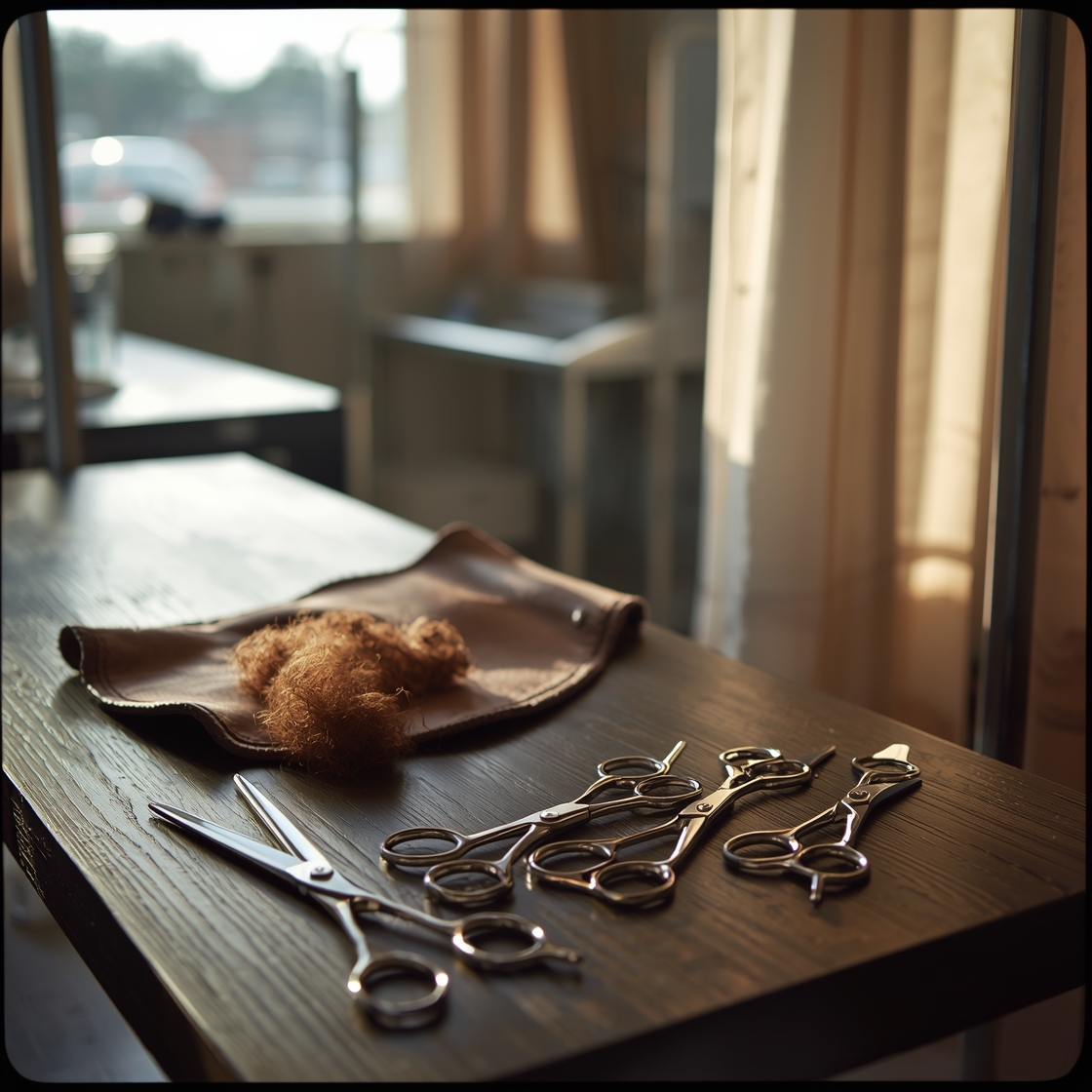
A lock is not a straight fiber. The cut has to travel around a curl, not through a felted sheet.
| Geometry | Curl job | On these 7 titles? |
|---|---|---|
| Curved 6.5–8 in | Silhouette: rump, topknot, leg cylinder | No |
| Straight 6.5–7.5 in | Even a combed panel | Implied in kits; length unpublished |
| Thinning 30–46 tooth | Hide a clipper hat | Implied if the photo shows slots |
| Chunker 14–26 tooth | Faster bulk on an open jacket | No |
| Rounded 4.5–6 in | Face, ears, sanitary | 4-in-1, GLADOG, Pets First |
| Human convex | Wrong fiber, sharp points | Dropped |
Safety the best dog grooming scissors for curly hair cannot skip
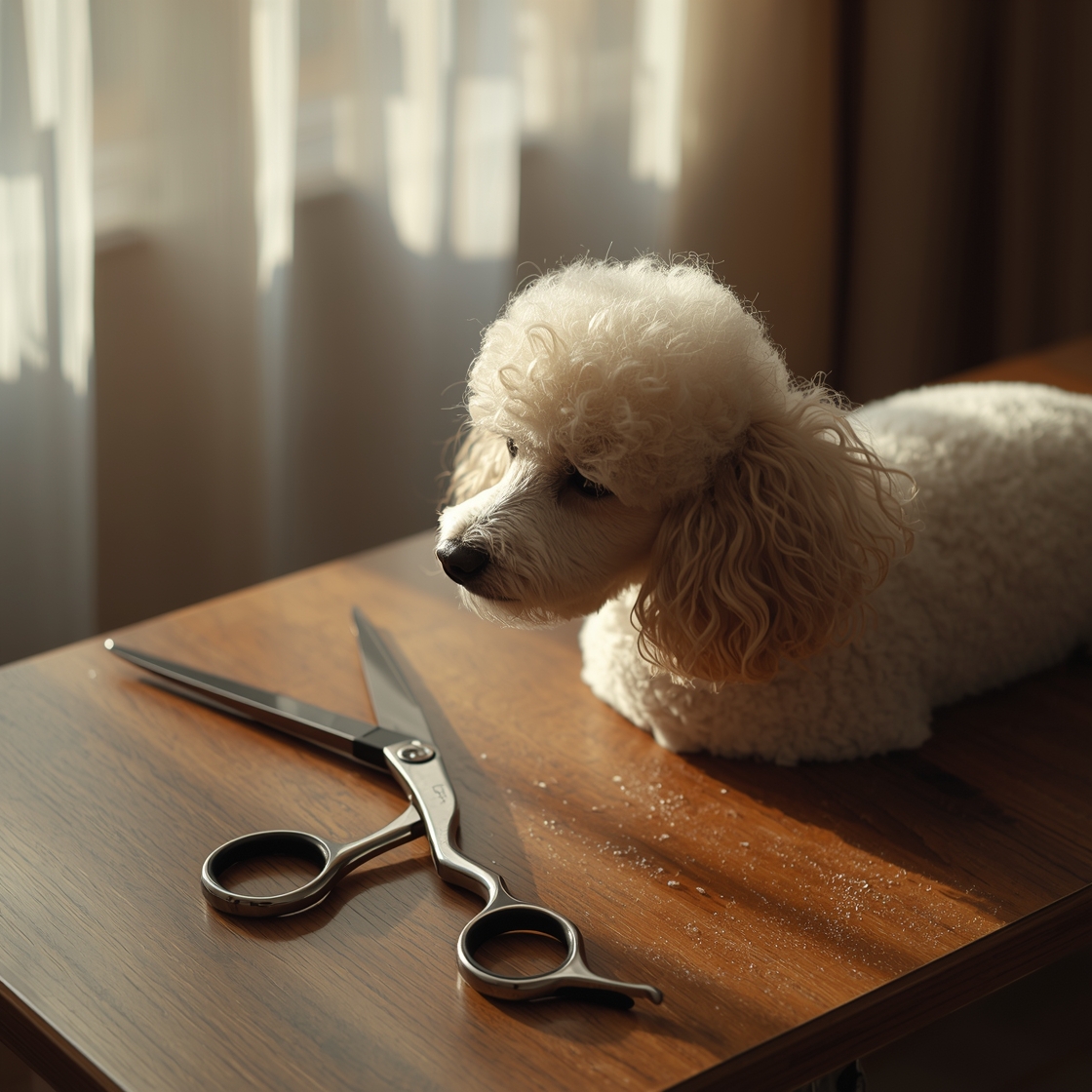
VCA’s mat rule is the whole page in one line: clippers for mats, never scissors, when you cannot see skin.
| Zone | Tool class | Stop if |
|---|---|---|
| Face / eyes | Rounded tip only | The dog jerks; you cannot see the lid |
| Ears | Short pair, lift the leather | Heat, smell, or a mat in the canal — veterinarian |
| Armpits / groin | Comb first | Any wet, red, or hidden knot |
| Topknot | Curved or short straight | The band is hiding a mat |
| Sanitary | Clipper is often safer | You cannot see skin |
A grooming table with an arm is safer than a sliding sofa. The home-clip safety page is the longer stop list.
Line-brushing a curly coat before the best dog grooming scissors for curly hair come out
Work in sections from skin outward with a slicker sized to the panel — ears and hocks need a smaller head than a Standard’s flank. Follow with a comb that travels from root to tip. If the comb stops, the slicker pass is not finished. Stop before bathing matted areas; water tightens tangles.
VCA wants daily inspection on curly coats. Minutes below are planning bands from coat length —
| Coat state | Daily inspect | Typical slicker+comb desk | Shear job after |
|---|---|---|---|
| Sporting / 1 in pet body | Ears, pits, legs | 5–15 min | Face + feet tidy |
| Medium pet jacket | Same + furnishings | 15–30 min | Finish + thinning |
| Growing / show-length jacket | Full panel | 30–60+ min or a table | Curved silhouette |
| Corded | Cord protocol | Not this page | Not a kit from this URL |
If the comb stops, the session is not “almost a haircut.”
Home kit tiers: best dog grooming scissors for curly hair as a tray
| Tier | What to put in the tray | Snapshot analog | Still buy separately |
|---|---|---|---|
| Face-only | Rounded-tip short pair | Pets First / 4-in-1 | Comb, good light |
| Weekly pet clip | Straight + thinning + safety | Gimars or Fiurfiy kit | Long-pin slicker (Poodle brush page) |
| Silhouette | Add a named curved pair | Not on these 7 titles; see general shears | Table or non-slip mat |
| Length change | Clipper | Clipper page | Groomer for the first full clip |
Maintenance desk
| Signal | What to do | Skip if… |
|---|---|---|
| Hair in the pivot | Brush out; drop of shear oil | You soaked them in clipper oil |
| Blade slides instead of cuts | Tension, then a sharpener | You keep pushing through a lock |
| Nicks in the edge | Stop; a nick grows | You cut a mat or a rubber band |
| Wet tray | Dry, oil, sleeve | Bathroom cup |
| Human sharpener, never seen a convex edge | Ask first | You own a $200 convex pair (not on this page) |
Replace a $8 pair when the edge is gone. Sharpen a named-steel pair once if the pivot is still tight.
Coat-by-coat map for the best dog grooming scissors for curly hair
This is a job map, not a breed ranking. Coat in front of you beats registration papers.
| Coat in front of you | First tool | Shear job | Leave to a groomer |
|---|---|---|---|
| Poodle, open pet clip | Long-pin slicker + comb | Face + feet + a light body even | First Sporting clip; any hidden mat |
| Bichon / similar lock | Same stack | Rounded tip; thinning on a hat | Tight show scissor |
| Portuguese Water Dog | Slicker + comb | Finish after a working clip | Corded or neglected jacket |
| Doodle, curl-dominant | Same as Poodle | Same finish stack | Leaky coat that still sheds like a retriever |
| Doodle, wave / leaky | Slicker + undercoat check | Do not “deshed” a curl with a blade | Mixed coat that felts at the pants |
| Senior thin skin | Short sessions, safety tips | Face only if the dog will hold | Any nick history — veterinarian |
A breed-tool chooser is the wider map. A shedding-brush page is the wrong aisle for a typical Poodle lock.
Price bands on this URL (not a quality score)
PetBench bands from the seven snapshots:
| Band | Snapshot range | What you usually get |
|---|---|---|
| Starter | $7.98–$12.99 | Safety-tip or facial pair, unnamed steel |
| Mid kit | $15.99–$23.59 | A steel word (Gimars) or a 6-in-1 count |
| Generic high | $29.97 | Least specific title on the page |
There is no $70–$150 convex Japanese pair on these cards. If you need that class, you are shopping a different aisle. We will not invent a salon podium to decorate a $8 five-pack.
Brand names stay verbatim inside the product cards.
Additional guidance
Doodles. A Poodle crossed with a shedding breed is not a Poodle standard. Coat can be curl, wave, or a leaky coat that mats and sheds. The comb-to-skin test still decides whether scissors are a finish tool or a bad idea.
Corded coats. Do not take a marketplace kit through a finished cord. That is a different craft.
Shaving for summer. VCA: some long-haired dogs are more comfortable shorter; leave at least 1 inch (2.5 cm) to avoid sunburn; ask the groomer or veterinarian. A shaved curly coat still has ears, furnishings, and a growth cycle.
Wet coat. Do not scissor a soaking curl. Hair stretches wet and snaps back short. Dry, comb, then cut. A coat-shine spray is a slip aid on a dry, open coat — not a license to cut a mat.
Left-handed buyers. Most kits are right-hand ground. None of the seven cards print left-hand.
Frequently asked questions
What length for the best dog grooming scissors for curly hair?
Face and feet: 4.5–6 in, rounded tip. Body finish on a Mini or Standard: 6.5–8 in. None of the seven cards on this URL print a length. Measure the blades when they arrive. A Toy is not a Mini with a shorter slogan.
What are the best dog grooming scissors for curly hair?
A finish stack after a slicker and a comb: straight for an open panel, thinning to blend, curved for the silhouette, rounded tip for the face. The these curl-finish listings found 0 of 7 live titles printed “curved.” Shop the job, not the word “premium.”
How do I choose the right size for my pet?
Match the blade to the panel, not the breed name. PCA height: Toy ≤10 in, Mini 10–15 in, Standard >15 in. A Standard flank wants a longer finish pair. A Toy muzzle wants a short safety pair.
Can I use human hair scissors on my dog?
No. Wrong tip, wrong thickness, wrong rings. They snag a lock. Buy a pet pair with a finger rest.
How do I care for dog grooming scissors?
Dry, oil the pivot, sleeve, tips covered. Not in a wet cup with a slicker. Replace a $8 kit pair when it pushes. Sharpen a named-steel pair once if a pet-shear sharpener will take them.
Do I need a groomer if I buy these kits?
If you want a clip that looks like a clip, yes, at some interval. Kits keep a pet length tidy between appointments. They do not replace a blade on a mat. They do not replace a veterinarian when the skin is the problem.
Can the best dog grooming scissors for curly hair replace a slicker?
No. VCA names the slicker for curly, non-shedding coats. Scissors are the finish. The Poodle brush page is the daily tool.
How often should I scissor a curly coat at home?
VCA wants daily brushing, not daily scissors. A pet-length body might need a tidy every 4–8 weeks if the comb still travels. A growing jacket needs a groomer on a clock you did not invent here. If you skip brush days, check friction zones first — ears, armpits, the back of the legs — not the pretty topknot.
What if my curly dog hates the scissors?
Short sessions. Find the sore panel before you insist. A dog that hated a dull kit pair may accept a sharper, shorter face pair — or may be telling you there is already a mat or a hot spot. VCA’s hot-spot list includes poor grooming and the itch-lick cycle. If the skin is a lesion, that is the veterinarian, not a softer slogan.
SOURCES
Institutions and breed text:
- https://vcahospitals.com/know-your-pet/grooming-and-coat-care-for-your-dog
- https://vcahospitals.com/know-your-pet/hot-spots-in-dogs
- https://poodleclubofamerica.org/-breed-standard/
Listing snapshots: this URL’s seven cards, August 2026 listing snapshot.
Related desk pages:
- https://www.thepetbench.com/articles/best-dog-grooming-scissors/
- https://www.thepetbench.com/articles/best-dog-brush-for-poodles-2026-top-9-picks/
- https://www.thepetbench.com/articles/best-pet-grooming-clippers/
Session order for the best dog grooming scissors for curly hair
Do not start with the blade. The order is the whole page.
- Look at the skin at ears, armpits, groin, and the back of the legs. Red or wet → veterinarian, not a kit.
- Slicker in sections from the skin out. A surface pass is how a lock felts underneath.
- Comb-to-skin. If it stops, you are not scissoring that panel.
- Dry. Wet curl stretches and snaps back short.
- Face and feet with a rounded tip. Then body finish. Then thinning on a hat. Curved last if you have a named curved pair.
- Stop when the dog is done, not when the Instagram outline is done.
A coat-shine spray is optional slip on a dry, open coat. It is not step zero.
A table with an arm is safer than a sliding sofa for a Standard who has never stood still. The general shear page is where a named curved pair (HASHIMOTO) actually lives — not on these seven generic kit titles. If you only buy one upgrade after a $16 kit, buy a named curve or a longer finish straight — not a second unnamed five-pack. A third identical $8 kit does not add a tooth count the carton still refuses to print. Measure the blades on arrival; none of these seven titles printed a length. Write the number on the sleeve so you do not guess next month.
When the best dog grooming scissors for curly hair stop being the answer
Extensive mats, hidden hot spots, or pain when touching a panel require a groomer or a veterinarian — clippers for mat removal per hospital education, never scissors on skin you cannot see. Listing-stated kit counts and prices — not curl trials by our desk — inform the notes above.
Last reviewed: August 2026. opening summary, these curl-finish listings, listing price desk, curl × clip worksheet. Research desk; VCA and PCA cited. Contact if a listing snapshot price changed.