The best dog house for large dogs is the shell whose published interior lets this dog sit, stand, lie, and turn — then holds a climate package (elevation, insulation or venting, rain break). On this URL that usually means a printed-floor foam-core only when the withers math fits (ASL Dog Palace, 24 × 35.5 in = 852 sq in), a height-gated igloo when sitting height plus 1–2 in still clears the dome (Petmate Indigo Large, exterior 25.750 in), a hose-clean resin when the door — not the 32 in roof — clears the shoulders (Suncast DH350), a barn plastic for mild/wet shade (Petmate Barnhome III Large) — not a carton that says Large and not an IATA flight crate. We read current Amazon listing titles and descriptions and scored 4 named SKUs. 1 of 4 (25%) prints a usable interior floor. 0 of 4 (0%) print a card price on this listing snapshot. 2 of 4 (50%) print the word “Large” in the card title. 1 of 4 (25%) prints “insulated.” Saskatchewan SPCA’s public rule is 36 sq in of floor per inch of withers. 852 ÷ 36 = 23.7 in of withers — not ASL’s “26.5 in or less” shoulder line. 0 of 4 replace the indoor house on a below-freezing night.
Desk pick: Measured near 24 in withers and you want a printed floor + foam → ASL if 852 sq in still clears sit / stand / lie / turn. Rain/wind break, dog already sleeps inside → Indigo Large only if sitting height + 1–2 in fits under 25.75 in. Mild/wet hose-out → Suncast DH350 if the printed door clears this chest; else Barnhome III Large as a shade barn. Freeze nights → indoor crate or the house you already live in. A 26 in shepherd is 84 sq in short of Saskatchewan’s 936 sq in target on ASL’s floor.
Buy inches you can quote, then a climate package. AVMA cold-weather animal safety still prefers the dog inside on freeze nights. Named houses below are currently sold examples. They are not a medal table.
Our guides are reader-supported. This article may contain affiliate links. As an Amazon Associate we may earn a commission if you buy through links, at no extra cost to you.
If the honest object is an indoor crate, that lives on crates for large dogs. A car crate is a third object: crash-tested crates. Bedding that goes inside a house or a crate lives on orthopedic beds for large breeds. Summer pads are cooling dog beds. .
Quick picks at a glance
- Best listed printed interior + foam: ASL Solutions Dog Palace — interior 30.5 H × 24 W × 35.5 L in; up to 4 in EPS per panel. Floor math matches ~24 in withers, not 26.5.
- Best listed wind/rain igloo: Petmate Indigo Large — exterior 43.750 × 34.000 × 25.750 in; 50–90 lb band; offset door; rooftop vent. Height is the gate.
- Best listed hose-clean resin: Suncast DH350 Deluxe — resin, removable roof, up-to-100 lb band. Door opening is the large-dog test, not the 32 in roof.
- Best listed barn plastic (no foam number): Petmate Barnhome III Large / Petbarn 3 class — 38 × 29 × 30 in, 50–90 lb, rear vent, raised floor. Mild-climate shell.
What current Amazon listings show (Large-House, August 2026)
| Job | What actually works | Category | Fail if you skip it |
|---|---|---|---|
| Winter sleeping den | Small insulated box + vestibule + straw | ASL-class foam-core if inches fit | Buying a giant porch so the air volume stays cold |
| Wind / rain break while you are outside with the dog | Offset door + raised, drainable floor | Indigo-class igloo | Parking an open wire crate in the yard |
| Mild / wet hose-out | Resin or barn plastic, vented, staked | Suncast / Barnhome | Calling a single-wall barn “insulated” |
| Indoor night / freeze / puppy / senior / sick | The house you already live in | Crate or bed URLs | Leaving a large breed on a chain “because the SKU is weatherproof” |
Before you shop: (1) you measured withers, sitting height, nose-to-tail, and shoulder width on this dog, (2) published interior (or an honest “interior not printed”) still clears sit / stand / lie / turn, (3) the door clears the shoulders, (4) you have a climate package, (5) AVMA’s indoor sentence still wins on freeze nights. Fail gate 5 and this checklist is how you buy a wet plastic box.
How we scored the best dog house for large dogs
this comparison uses four visible signals plus listed inches:
- Printed interior vs weight band. Interior floor beats “up to 90 lb.”
- Door vs shoulders. Suncast-class doors fail deep-chested dogs that still match a 100 lb sticker.
- Climate package. Foam thickness printed (ASL) vs structural-foam marketing (Indigo) vs no foam number (barn).
- Object honesty. Den ≠ IATA crate ≠ indoor orthopedic bed.
Price is not a quality grade. A $180 foam-core box that is 3 inches too short at the withers is the wrong object.
The selection rule for the best dog house for large dogs
If the published interior does not clear the dog you measured, the SKU is wrong, no matter what the carton says.
Two printed size languages sit on this page. They are not the same job.
Outdoor sleeping den (this URL). Saskatchewan SPCA’s Ideal Doghouse factsheet (May 2017; this desk opened it 21 August 2026) sizes a small insulated sleeping box so the dog’s own heat can warm it. Too small: the dog cannot stand, turn, and lie. Too big: the air volume wins and the den stays cold. USDA 9 CFR 3.4 uses performance language — sit, stand, lie, turn about freely — and does not publish a square-inch formula. It is the federal outdoor-housing rule for licensed facilities, not a backyard shopping law, and it is the clearest public checklist this desk could fetch: roof, four sides, a floor; a wind break and rain break at the entrance; clean dry bedding below 50 °F (10 °C); additional bedding at 35 °F (1.7 °C) or lower; a separate shade area; no metal barrels, cars, or refrigerators as houses.
Travel crate (a different URL). IATA’s Traveler’s Pet Corner and Container Requirement 1 (LAR 2026, Edition 52) size a shipping box so the animal can stand, sit erect, lie naturally, and turn about while standing. Public formula: A = nose to base of tail; B = ground to elbow; C = shoulder or widest point; D = standing height to head or ear tip, whichever is higher. Internal length = A + ½B; width = C × 2; height = D + bedding. Snub-nosed breeds need 10% more. That is cargo. It is usually larger than a heat-holding den. Do not buy an IATA crate and call it a winter dog house, and do not buy a snug den and call it a flight crate.
If a maker prints only exterior inches, those inches are a ceiling, not a floor.
How to take the four measurements
Put the dog on level ground. Use a rigid tape, not a guess from a breed page.
- Withers height. Ground to the top of the shoulder blade. This is the Saskatchewan SPCA height input.
- Sitting height. Ground to the top of the skull while the dog sits naturally. Saskatchewan SPCA: add 1 to 2 inches for ceiling height. Their only worked example is a 12-inch dog whose sitting height is 14 inches, so the ceiling should be 15 to 16 inches.
- Nose to base of tail. Tip of the nose to where the tail meets the body. This is IATA’s A. It is the stretch-out length. A house that is shorter than this dog stretched out can still be a legal den if the dog curls; it will not be a crate.
- Shoulder width. Widest point. The doorway must pass the shoulders. Suncast Deluxe pages this desk opened print a door in the 13.75 × 19.75 in class (DH351) or 11.75 × 20.5 in class (some DH350 retailer cards). A deep-chested 90 lb dog can fail that hole while still matching a 100 lb weight band. Confirm the listing you are buying.
Write the four numbers on paper before you open a listing. Then ignore “Large,” “XL,” and “for Labs.”
Withers worksheet vs listed inches
This table is desk math on pages we opened 21 August 2026. It is not a lab ranking and not a breed standard. Column two is the Saskatchewan SPCA rule: withers inches × 36 = target sleeping-floor square inches. Column three is one rectangle that hits that area; other rectangles with the same area also work.
| Withers height you measured | Sask. floor target (× 36) | One rectangle that hits it | What to check next |
|---|---|---|---|
| 22 in | 792 sq in | 22 × 36 in | Sitting height + 1–2 in vs published interior height; door vs shoulder width |
| 24 in | 864 sq in | 24 × 36 in | ASL’s published interior is 852 sq in — 12 sq in short of this row |
| 26 in | 936 sq in | 26 × 36 in | ASL’s own “26.5 in or less” shoulder line still sits on an 852 sq in floor |
| 28 in | 1,008 sq in | 28 × 36 in | Most “Large” plastic shells fail this floor; height is the second gate |
| 30 in | 1,080 sq in | 30 × 36 in | Giant-breed territory. A 25.75 in igloo exterior height fails before floor math |
How these products compare on labels and price
Maker pages vs the worksheet. Not a rank. Prices move; these are listing-class snapshots, not a locked cart.
| Named house (example) | What the fetched page prints | Floor we can compute | Height / door gate | Fit note |
|---|---|---|---|---|
| ASL Solutions Dog Palace | Interior 30.5 H × 24 W × 35.5 L in; exterior 38.5 × 31.5 × 47.5; door 15.5 × 18; shoulder heights 26.5 in or less; up to 4 in EPS per panel | 24 × 35.5 = 852 sq in | Interior height 30.5 in; door height 18 in; sill 11 in off the ground | 852 ÷ 36 = 23.7 in of withers. Brand shoulder cap and printed floor do not describe the same dog. |
| Petmate Indigo, Large | 43.750 × 34.000 × 25.750 in; 50–90 lb; product weight 50.0 lb | Interior floor not published. Exterior footprint is not a sleeping floor | Exterior height 25.750 in | A dog whose sitting height plus 1–2 in exceeds 25.75 in fails the dome before the 50–90 lb band matters. |
| Petmate Indigo, X-Large | 50.500 × 39.500 × 30.000 in; 90–125 lb; product weight 44.4 lb | Interior not published | Exterior height 30.000 in | Taller shell. Still a weight band, still a dome. |
| Suncast Deluxe (DH350 / DH351 class) | DH351-class: exterior ~33 W × 38.75 D × 32.25 H; door ~13.75 × 19.75. Some DH350 retailer cards: 33 × 38.5 × 32; door 11.75 × 20.5; dogs up to 100 lb | Interior not published | Door is the test | Weight-to-100 lb is not a floor area. Verify the SKU on the listing. |
| Aspen Pet Petbarn 3 Large (Barnhome III class) | 38.000 × 29.000 × 30.000 in; 50–90 lb; ~26.25 lb | Interior not published | Exterior height 30 in | Single-wall plastic. Rear vent + roof rim + raised floor printed. No foam-thickness number. |
Original From the listings: the only large-breed house in this set that publishes a usable interior floor (ASL, 852 sq in) matches the Saskatchewan rule for a dog of about 23.7 inches at the withers, while the same page invites shoulder heights up to 26.5 inches. Measure. Do not trust the larger number.
Insulation, ventilation, elevation
These three are one climate package. Buying only one of them is how a “weatherproof” shell still soaks or cooks a dog.
Elevation. AVMA: the floor should be off the ground; bedding thick, dry, and changed regularly; door away from prevailing winds. Saskatchewan SPCA: bricks, cinder blocks, or a platform; you may need a low step. USDA 3.4 requires a floor and bans metal barrels, cars, and refrigerators as shelters.
Insulation. Saskatchewan SPCA puts 1½ inch Styrofoam in the walls, floor, and ceiling of the sleeping area, covers it so the dog cannot eat it, and separates that den from a hallway — the wind break. ASL prints up to 4 inches of EPS per panel plus a raised, sloped, drainable floor. Petmate’s “warmer in winter, cooler in summer” line on Indigo is structural-foam marketing, not an R-value. Single-wall barns print no foam thickness. ASL also prints a 100-watt-bulb demo on the same page. That is their demo. This desk did not replicate it.
Ventilation. A sealed insulated box without a high vent becomes a condensation box. Indigo: rooftop vent. ASL: window panels that swap winter-closed and summer cross-vent. Suncast: vents plus a removable roof. Saskatchewan SPCA: hinged or removable roof; a flap in winter, off in summer. USDA 3.4 publishes no vent-inch number. It does require shelter from heat and a separate shade area. A closed foam house in August sun, with no shade besides the house, is the wrong package.
Bedding and heaters. USDA: clean dry bedding below 50 °F; more of it at 35 °F or lower. Saskatchewan SPCA: straw or shavings, not blankets; change every 1 to 2 weeks. AVMA: non-frozen water; avoid space heaters and heat lamps; heated mats can still burn. If the house only works with a plug, the honest object may already be the indoor crate. A soaked towel on plastic is a heat sink. Indoor foam is a different URL.
Material after the inches fit
Pick the material after the inches fit. Each class fails a different way.
- Resin. Hose-clean, no paint, light. Suncast Deluxe class: exterior in the 33 × 38–39 × 32 in band; door in the 12–14 × 20 in band; up to 100 lb. The door — not the 32-inch roof — is the large-dog gate. Stake it. Interior floor is unpublished.
- Structural-foam / barn plastic. Rot-proof, snap-together, sold on a weight band. Indigo Large is 25.75 in tall on a 50–90 lb sticker. Petbarn 3 Large is 38 × 29 × 30 in, 50–90 lb, rear vent, roof rim, raised floor, no foam-inch number.
- Wood. Can take a vestibule or porch. Retailer cards for TRIXIE natura Classic Large repeat pine, felt or sealer, elevated feet, and about 45.5 × 31 × 32.25 in / up to 95 lb. This desk did not load a TRIXIE.com spec sheet, so those inches stay retailer-published. Re-seal it. A porch is lounge space, not Saskatchewan den volume.
- Foam-core plastic. ASL is the only house in this set with a printed interior and a printed foam thickness. It is also the house whose 26.5 in shoulder line outruns an 852 sq in floor.
Chew risk is not a material medal. A bored large dog will peel resin trim and pine frames. That is management, not a test we ran.
Climate — and when a crate is the better buy
Cold. AVMA: fur does not make dogs frostbite-proof; keep cats and dogs inside; even cold-bred coats should not be left out for long periods in below-freezing weather; short-haired and short-legged dogs chill faster; young, old, thin, and medically fragile dogs regulate temperature poorly. USDA 3.4(a): licensed facilities must not keep outdoors — unless an attending veterinarian specifically approves — unacclimated dogs, breeds that cannot tolerate local temperatures (the regulation’s example is short-haired breeds in cold climates), or sick, infirm, aged, or young dogs. Unknown acclimation: not outdoors below 50 °F. Saskatchewan SPCA: short coats frostbite; severe weather means inside; outdoor dogs still need indoor time.
A foam-core house with straw, a flap, and an elevated floor is how those pages describe a shelter. It is not a substitute for the indoor sentence.
Heat. USDA 3.4: shelter from heat plus a shade area large enough for every animal at once. AVMA: unlimited fresh water and shade; if it is hot for you, it is even hotter for your pet; never leave a pet in a car; overweight and short-nosed dogs have higher exercise risk. Emergency signs they list: anxiousness, excessive panting, restlessness, excessive drooling, unsteadiness, abnormal gum or tongue color, collapse. IATA’s traveler page warns that snub-nosed dogs (boxers, pugs, bulldogs, Pekinese) struggle to hold a normal body temperature in hot weather — travel language, same anatomy. A cooling pad is not a roof; it lives on cooling dog beds.
Mild and wet. Prioritize the rain break and a raised, drainable floor over foam thickness. Orient the door off the prevailing wind. Stake light resin.
Buy the indoor object instead when any of these is true:
- Puppy, senior, sick, thin-coated, short-nosed, or not acclimated (USDA 3.4(a); Saskatchewan SPCA; AVMA).
- Long below-freezing nights (AVMA).
- You are shopping a den because the dog is left out. ASPCA’s first cold-weather line is still: keep the animals inside.
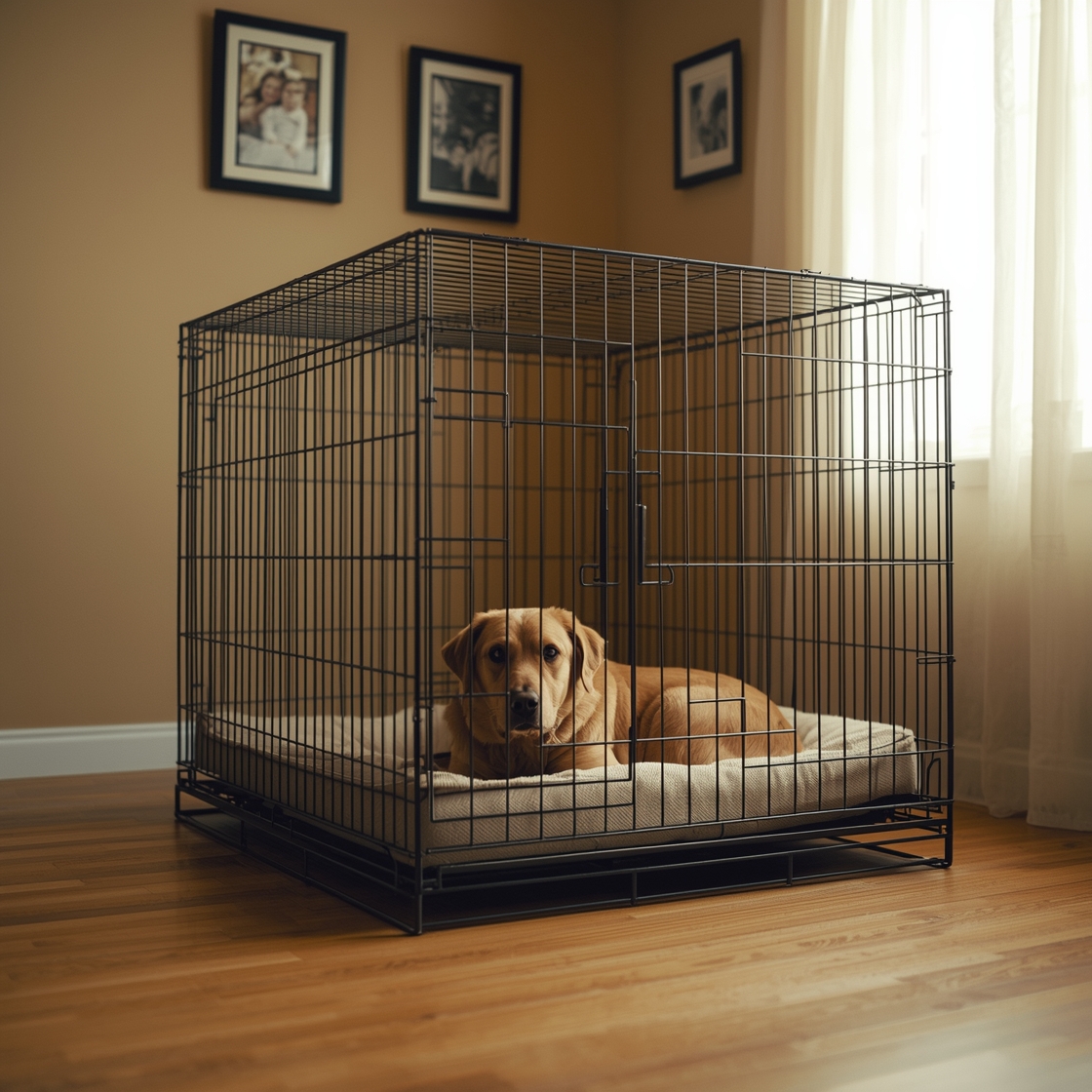
- The job is housetraining or crate rest: a large-dog crate, sized so the dog can stand, turn, and lie — IATA’s sentence, not Saskatchewan’s small-den math.
- The job is a car: a crash-tested travel crate.
- The dog already lives inside: skip weatherproofing and buy floor on orthopedic beds for large breeds.
A yard house can be a rain break for a dog who is outdoors with you. It is not permission to leave a large breed on a chain overnight and call the SKU a home.
The 4 cards on this URL
Specs are from maker pages opened 21 August 2026. Links are open Amazon searches, not locked product pages.
ASL Solutions Dog Palace — printed interior, printed foam
Best for: a climate den when you already measured near the 24-inch withers row.
Interior 24 × 35.5 in = 852 sq in, which is the Saskatchewan floor for about 23.7 in of withers — not the page’s 26.5 in shoulder sentence. Door 15.5 × 18 in; 11 in sill; up to 4 in EPS; winter/summer window panels; heater portal, heaters sold separately.
Honest drawback: the brand’s shoulder line and the printed floor describe two different dogs. A 26 in Lab mix can fail the floor while matching the shoulder copy.
Check ASL Dog Palace listings →
Petmate Indigo Large — offset door, height is the gate
Best for: a wind/rain igloo if this dog’s sitting height plus 1–2 in still fits under 25.75 in.
Offset doorway is a USDA-style break. Interior floor is unpublished. “Warmer in winter” is not a foam-inch spec. X-Large on the same page is 30.000 in tall and 90–125 lb — still a weight band, still a dome. Rooftop vent; raised floor with side moats; tool-free snap assembly; Petmate lists Large at 50.0 lb product weight.
Honest drawback: a tall-sitting 70 lb dog can fail the dome while still matching 50–90 lb. Do not treat 43.75 × 34 exterior inches as sleeping-floor square inches.
Check Petmate Indigo Large listings →
Suncast DH350 Deluxe — resin, door is the test
Best for: a hose-out shell in mild or wet weather, and only if shoulders and withers clear the printed door.
Removable roof, channeled / crowned floor, vents, no-tools assembly, made-in-USA resin on Suncast’s own Deluxe page. Exterior height in the 32 in class looks giant-breed until the dog ducks a ~12–14 × 20 in door. Stake it.
Honest drawback: DH350 and DH351 door numbers diverge across retailer cards (11.75 × 20.5 vs 13.75 × 19.75). Confirm the listing. Interior floor is unpublished. Weight-to-100 lb is not a floor area.
Check Suncast DH350 listings →
Petmate Barnhome III Large — barn plastic, no foam number
Best for: a mild-climate hose-clean barn, not a winter den.
Petmate.com Petbarn 3 Large: 38 × 29 × 30 in, 50–90 lb, rear vent, roof rim, raised floor. Retailer Barnhome III Large cards reprint the same box class. Not an insulated den. Do not treat 38 × 29 exterior inches as 1,102 sq in of sleeping floor.
Honest drawback: no printed foam thickness. A 50–90 lb sticker is not Saskatchewan math.
Check Barnhome III Large listings →
Browse large-breed dog houses on Amazon →
Worked examples: two dogs, two Index rows
Dog A — 65 lb Lab mix, 23.5 in withers, 27 in sitting height, 9 in shoulder, mild Mid-Atlantic winters, sleeps indoors at night. Index row: rain-break igloo or resin. Indigo Large exterior height 25.75 in is tight against sitting height + 1–2 in — measure twice. Suncast door vs 9 in shoulder should clear; still confirm the DH350/DH351 door on the listing. Do not buy ASL “because foam” if the dog already sleeps inside.
Dog B — 85 lb shepherd, 26 in withers, 31 in sitting height, 11 in shoulder, outdoor daytime, indoor nights, real winter. Saskatchewan floor target: 26 × 36 = 936 sq in. ASL’s 852 sq in floor is 84 sq in short. Indigo Large’s 25.75 in exterior height fails sitting height before floor math. Honest answer: indoor crate or bed at night; a shade/rain shell for supervised yard time; do not treat any of the four cards as a 26 in winter den.
Placement, staking, and the first week
Orient the door off the prevailing wind. AVMA and Saskatchewan SPCA both say that. Elevate. Stake or weight light resin so a storm does not walk the house into a fence. Keep a separate shade area in heat — USDA 3.4 wants shade besides the house.
First week: watch whether the dog will enter. A high sill (ASL prints 11 in) plus a deep-chested senior is a skip, not a “they will learn.” A soaked towel is a heat sink; straw or dry shavings, changed, is the public bedding language. If the dog is shivering, panting without shade, or refusing the box, the SKU is not the problem — the plan is.
Do not run a space heater or heat lamp in plastic. AVMA lists burn-and-fire risk. A heater portal on ASL is a cord path, not a recommendation from this desk.
We also will not add a fake “reviewed by a veterinarian” byline. USDA 3.4 and AVMA pages are the credentials. They are public.
How to choose the best dog house for large dogs this month
- Measure four numbers on this dog.
- Run Saskatchewan floor math if the job is a winter den.
- Check sitting height + 1–2 in against published interior (or exterior as a ceiling).
- Check the door against shoulder width.
- Pick a climate package after the inches fit.
- Keep the dog inside on freeze nights.
The best dog house for large dogs is the one whose inches match the dog you measured — not the one whose carton says Large.
What is the best dog house for large dogs on this URL?
The best dog house for large dogs on these four cards is the shell whose inches match this dog. Only ASL prints a usable interior floor (852 sq in ≈ 23.7 in withers). Indigo Large is a 25.75 in height gate. Suncast DH350 is a door test. Barnhome III Large is a mild-climate barn with no foam number. None of them replace the indoor house in a freeze (AVMA).
How big should the best dog house for large dogs be?
Big enough for this dog to sit, stand, lie, and turn (USDA 9 CFR 3.4). For a winter den, Saskatchewan SPCA: 36 sq in of floor per inch of withers, ceiling at sitting height plus 1 to 2 inches. A 26 in dog wants ~936 sq in — 84 sq in more than ASL’s printed floor. A listing that only says Large or 50–90 lb has not answered.
Frequently asked questions
What is the best dog house for large dogs?
The best dog house for large dogs is the shell that clears this dog’s sit / stand / lie / turn, then matches the climate job. On this URL, only ASL prints a usable interior floor (852 sq in ≈ 23.7 in withers). Indigo Large, Suncast DH350, and Barnhome III Large are weight-band shells with unpublished interiors. None of them replace the indoor house in a freeze.
How big should a dog house be for a large breed?
Big enough for this dog to sit, stand, lie, and turn (USDA 9 CFR 3.4). For a winter den, Saskatchewan SPCA: 36 sq in of floor per inch of withers, ceiling at sitting height plus 1 to 2 inches. A listing that only says Large or 50–90 lb has not answered.
Is a bigger house always better?
No. Saskatchewan SPCA: too large and the den stays cold. USDA still forbids a box so small the dog cannot turn. A porch-house can be a summer lounge and a winter failure.
Do large dogs need insulation?
They need a climate package. Cold nights the dog will sleep in: insulated sleeping-area walls, floor, and ceiling plus a vestibule (Saskatchewan SPCA). Mild weather: vented, elevated, drainable shell plus dry bedding — until USDA’s 50 °F bedding line. AVMA still prefers the dog inside.
Can I use a crate as a dog house?
No. IATA CR1 sizes a crate larger so the dog can stand and turn while standing. That air volume is the opposite of a winter den. Crate inside or in the car. Do not park an open wire crate in the yard and call it 3.4-compliant shelter.
Floor size for the best dog house for large dogs?
Use Saskatchewan’s 36 sq in per inch of withers for a winter den — not “dog length plus 6 inches.” An 80 lb dog with 26 in withers wants ~936 sq in of sleeping floor, which is not the same as a 36 × 48 in lounge. Verify published interior. If the maker hid the interior, treat exterior inches as a ceiling.
Related pages
- Best dog crate for large dogs
- Best crash-tested dog crate for car travel
- Best orthopedic dog beds for large breeds
- Best cooling dog beds
How we researched this guide
Desk research. We read current Amazon listing titles and descriptions and scored four current listings on printed interior, door, climate class, and object honesty. We read USDA 9 CFR 3.4, AVMA cold- and warm-weather pages, ASPCA cold-weather tips, Saskatchewan SPCA’s Ideal Doghouse factsheet, IATA CR1, and maker pages for ASL, Petmate Indigo, Petbarn 3 / Barnhome III, and Suncast Deluxe. Nothing here is a veterinary certification.
Limitations: listings clone SKUs (DH350 vs DH351); interiors stay unpublished on three of four cards; prices move. Pain, collapse, abnormal gum color, or a dog left out in a freeze is a clinic and a plan change, not a fourth Amazon house.
Keep a paper log: four measurements, SKU, door inches, first-week entry. Patterns beat a breed chart.
A 90 lb Dane mix and a 55 lb “large” cattle dog are not the same category row. The giant fails most Large plastic shells on sitting height. The 55 lb dog can fail a Suncast door on chest depth. Measure both.
If you still cannot find published interior inches, email the seller or skip the listing. Exterior marketing photos are not a floor.
Sources
- USDA APHIS, 9 CFR § 3.4 Outdoor housing facilities. Sit, stand, lie, turn; roof, four sides, floor; wind/rain break; bedding below 50 °F and extra at 35 °F; shade area; outdoor restrictions for unacclimated, temperature-intolerant (incl. short-haired in cold), sick/infirm/aged/young dogs; unknown acclimation and <50 °F; no barrels/cars/refrigerators. https://www.law.cornell.edu/cfr/text/9/3.4
- Electronic Code of Federal Regulations, 9 CFR Part 3 Subpart A (copy we opened: Title 9 current as of 17 April 2026; last amended 10 April 2026). https://www.ecfr.gov/current/title-9/chapter-I/subchapter-A/part-3/subpart-A
- American Veterinary Medical Association, “Cold weather animal safety.” https://www.avma.org/resources-tools/pet-owners/petcare/cold-weather-animal-safety
- American Veterinary Medical Association, “Warm weather pet safety.” https://www.avma.org/resources-tools/pet-owners/petcare/warm-weather-pet-safety
- ASPCA, “Cold Weather Safety Tips.” https://www.aspca.org/pet-care/general-pet-care/cold-weather-safety-tips
- Saskatchewan SPCA, “Ideal Doghouse” factsheet (May 2017). https://www.saskspca.ca/wp-content/uploads/2021/12/ideal-doghouse.pdf
- IATA, Traveler’s Pet Corner. https://www.iata.org/en/programs/cargo/live-animals/pets/
- IATA Live Animals Regulations, Container Requirement 1, Edition 52, January 2026. https://www.iata.org/contentassets/b0016da92c86449f850fe9560827bbea/pet-container-requirements.pdf
- Suncast, Deluxe Dog House (DH351). https://suncast.com/deluxe-dog-house-vanilla.html
- Petmate, Indigo Dog House. https://www.petmate.com/products/petmate-indigo-dog-house
- Petmate, Aspen Pet Petbarn 3. https://www.petmate.com/products/aspen-pet-petbarn-3-dog-house
- ASL Solutions, Dog Palace insulated dog house. https://www.asldoghouses.com/doghouse-products/dog-palace-doghouse.html