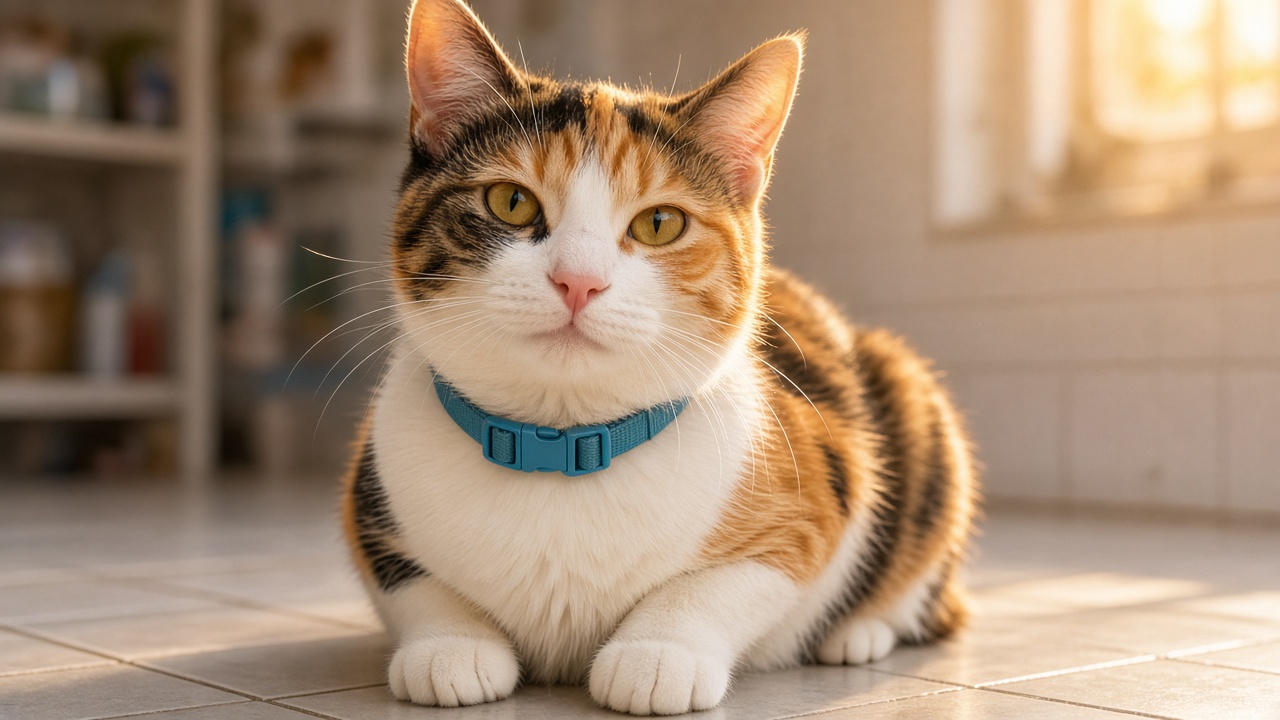
Best Cat Calming Collars: What Works & When to Skip (2026)
Our guides are reader-supported. This article may contain affiliate links. As an Amazon Associate we may earn a commission if you buy through links, at no extra cost to you.
Quick answer: The best cat calming collar is a breakaway, fragrance-free pheromone band fitted with two fingers of slack, used only when the stressor moves with this cat. It is not a treatment for pain, cystitis, or a short litter-box count. Skip the pouch if the job is a missing tray, a blocked hallway, or a medical rule-out.
of 18 US collar listings we opened that used the words “calming” and “pheromone,” 14 of 18 printed a 30-day wear window, 9 of 18 printed a breakaway or easy-release buckle, and only 4 of 18 printed “fragrance-free.” Zero listings cited Frank, Beauchamp, and Palestrini’s 2010 JAVMA review.
This page compiles Cornell Feline Health Center, the 2013 AAFP/ISFM Environmental Needs Guidelines, the 2014 AAFP/ISFM house-soiling guidelines, the 2010 JAVMA systematic review, Comfort Zone’s maker page, Ceva’s FELIWAY owner FAQ, Merck Veterinary Manual’s March 2025 essential-oil chapter, and the BC SPCA’s breakaway-collar page. If a fetched page did not print a number, it is not a house number.
A calming collar follows one cat. A plug-in covers a room. A spray covers a carrier for a few hours. Sometimes the next buy is a second litter box.
Plug-ins live on the cat calming diffuser page. The box the cat rides in lives on cat carriers for travel. Tray size lives on litter boxes for large cats.
How to choose the best cat calming collar (clinic first)
Gate the clinic job before you shop. Cornell’s house-soiling page is blunt: take the identified cat for an exam and diagnostics; “cats with medical conditions may not always act sick.” FELIWAY’s Classic Spray FAQ says the same in product language: if the cat is urinating, hiding, or off food for medical reasons, the spray will not help. A thicker band will not help either.
Then name the anxiety job. Travel follows the cat. Household tension lives in rooms. Fireworks are time-boxed. A best cat calming collar is a candidate only when the job is this cat, wherever it goes.
- Clinic row first. Sudden soiling, straining, blood, over-grooming, hiding for days, or a cat that stopped eating. Cornell names urinary-tract inflammation, kidney disease, thyroid disease, and diabetes among medical reasons a cat leaves the box.
- Name the stressor’s location. Mobile → collar candidate. Room-bound → diffuser. Object for hours → spray. Missing trays or height → skip.
- Treat box claims as box claims. Comfort Zone prints “most cats show improved behavior within 1–2 weeks.” That is their sentence. Frank, Beauchamp, and Palestrini’s 2010 JAVMA review of 14 prospective reports found 11 of 14 provided insufficient evidence and one provided lack of support.
- If you still buy a band: a buckle that is actually breakaway, two fingers of slack, the age line on the pouch, fragrance-free if the cat has airway disease, one change at a time. BC SPCA: entanglement risks choking or serious injury.
Anxiety-Job Split — when the best cat calming collar is the wrong tool
| What you are seeing | Job | First move the fetched pages print | Collar? |
|---|---|---|---|
| Straining, blood, sudden soiling, more thirst | Clinic | Cornell: exam plus diagnostics; sick cats “may not always act sick” | No |
| Vertical spray, tail up and quivering | Clinic first, then territorial | Cornell: identify the cat, then the vet. Neutered males 10%, females 5% still spray; more than seven cats, spraying is “likely” | Only after rule-out, and only for one mobile cat |
| Hiding, off food, over-grooming | Clinic first | FELIWAY spray FAQ: medical hiding or appetite loss — spray will not help | No |
| Carrier panic, vet-day howling | Anxiety — mobile | FELIWAY: spray the carrier 15 minutes ahead; never with the cat inside | Maybe, if the cat accepts a band |
| Blocking, chasing, one shared bowl | Anxiety — household | AAFP/ISFM 2013: resources out of view of each other; minimum two resting, two feeding, two toileting sites | Usually no — the fight is over rooms |
| Fireworks, visitors | Anxiety — time-boxed | FELIWAY diffuser FAQ: plug in two to three days ahead; leave on overnight | Maybe for the cat that leaves that room |
| One tray for two cats | Resource | Cornell: boxes = cats plus one. AAFP/ISFM 2014: single cat → two boxes; multi-cat n+1 is a “historical rule of thumb,” “not an absolute requirement” | Skip. Buy a box |
Cornell: owners often read spraying as revenge. Cats “probably don’t have” that calculation. Punishment “may actually worsen the house soiling problem.” A collar is not a substitute for that sentence.
Three-Format Map — collar vs diffuser vs spray
Three delivery formats. Three different rooms. The diffuser page is the room-format URL.
| Format | Covers | Timing we actually opened | Matched job | Honest skip |
|---|---|---|---|---|
| Collar | The wearer, wherever it walks | Comfort Zone: up to 30 days; “bloom” powder = their diffusion sign. SENTRY and NurtureCALM reprints also print 30 days | Travel; one nervous cat that leaves the plugged-in room | Cat will not wear a band; stacked collars; “adult only” on a kitten |
| Diffuser | One area, continuously | FELIWAY FAQ: one unit per ~700 sq ft; 4 ft / 1.2 m clear above the socket; 30-day refill; on 24 hours; plug in 2–3 days before a known event; ~24 hours to full function | Household tension; the room the cat will live in after a move | Hallway or litter alcove (FELIWAY: cats spend little time there); a carrier |
| Spray | One object, hours | FELIWAY Classic Spray: 8–10 sprays; wait 15 minutes; 4–5 hours; never on the cat; never into an occupied carrier | Carriers, car interiors, a cleaned doorframe | Motion sickness (FELIWAY: “not indicated”); a dirty tray or missing scratch post |
| Skip | The house you have | AAFP/ISFM 2013: environmental needs are “essential (not optional).” Comfort Zone’s own help block names extra trays and food competition | Pain, missing trays, a tray the cat already hates | You wanted a product so the tray count could stay at one |
A combination the formats themselves allow: spray the carrier on the 15-minute clock, and — if the cat will wear one — a collar for the hours after that window. A diffuser in the room the cat returns to is a third job. Layering all three the same afternoon teaches you nothing.
Ceva’s FELIWAY FAQs we opened sell Classic, Optimum, and MultiCat as diffusers and a spray. They are not a collar SKU there. A third-party “Feliway collar” in a search box is not Ceva’s Classic spray.
Molecule-on-the-Box Check
“Calming pheromone” is not one molecule. We reprint the stories. We do not invent a head-to-head percent.
| Story on the box | What it is copying | Who printed it | What it is not |
|---|---|---|---|
| “This place is safe and familiar” | Facial / F3-style cheek-rub | Comfort Zone maker page. Cornell, on Feliway: mimics “the scent of cat cheek gland secretions” | Proof a collar beat a diffuser. Comfort Zone also sells a plug-in for the room |
| “Mother cat reassuring kittens” | A nursing / appeasing signal | NurtureCALM (Countryside Pet, Allivet) and SENTRY 1800PetMeds copy | An independent wear trial we could open for that SKU |
| Lavender or chamomile | A plant aroma people can smell | SENTRY Walmart and 1800PetMeds listings | A species-specific pheromone. Merck March 2025 is the oil-safety page |
AAFP/ISFM 2013 Pillar 5: cats use smell and the vomeronasal organ; “use synthetic pheromones to reduce anxiety” is one listed method, with a citation, not a guarantee. The same pillar says do not wreck the existing scent profile with heavy cleaners and scented litter. A lavender collar is a scent you added. A fragrance-free pheromone collar is still a scent you added. If the pouch will not say facial versus maternal, treat it as an unnamed dispenser and buy one as a format trial, not a molecule.
What the 2010 JAVMA review actually said
Frank, Beauchamp, and Palestrini searched MEDLINE and CAB Abstracts for prospective pheromone reports, 1998–2008. Seven cats, seven dogs. J Am Vet Med Assoc 2010;236:1308–1316.
On cats, the abstract: insufficient evidence that feline facial pheromone helps idiopathic cystitis or catheterization, and lack of support for reducing stress in hospitalized cats. Across both species: 11 of 14 insufficient; one lack of support.
That is a quality-of-evidence review of published trials — mostly diffusers and sprays from that decade. It is not a wear-test of today’s collar SKUs, and it is not “pheromones do nothing.” It is “the trials they could score did not give them enough to recommend those uses.” Anyone quoting an exact percent from a calming collar should name the paper, the n, and the control. Most packaging cannot. “Scientifically proven” and “veterinarian recommended” on a maker page stay their advertising.
Named examples of the best cat calming collar — format illustrations, not a ranking
Currently sold names this desk could document. Not a top six, not a price ladder, not a wear trial. Prices move; Search links use our Amazon tag. The pouch in your hand still wins.
Comfort Zone Cat Calming Collar — fragrance-free, adult-only
Cleanest label we opened. Facial-style “safe and familiar” copy. Drug- and fragrance-free. One-size adult cats; same page: “for adult cats only.” Up to 30 days. Two-finger fit. Easy-release claim. White “bloom” is their diffusion sign. Their own help block names extra trays, food competition, and an outdoor cat at the window. They also sell a 30-day plug-in. Neck for the cat that leaves; wall for the room that stays.
SENTRY Calming Collar for Cats — pheromone plus lavender–chamomile
Retailer reprints (1800PetMeds, Walmart, True Value, PetSmart): 30 days, safety-release buckle, about 15 inches. Several print lavender–chamomile and the mother-kitten sentence. Composition lines do not agree: 1800PetMeds lists pheromones 6.00% / inert 94.00%; PetSmart lists 0.02% / 99.98%. We reprint the disagreement. We do not average it. Wrong example if you want fragrance-free. Read the pouch in the carton you receive.
NurtureCALM 24/7 Feline Pheromone Collar — one-collar trial
Meridian Animal Health reprints (Countryside Pet, Allivet): 30-day band, mother-kitten analogue, up to 15 inches, powder bloom when stretched. Countryside Pet: pheromones 0.02% / inert 99.98%; not a pharmaceutical; remove before shampooing; do not use on extensive skin lesions; wash hands after fitting. “Often eliminating the need for powerful prescription medications” is their marketing sentence. It is not a reason to skip a veterinarian. Buy one band before a four-pack if the neck measures under 15 inches.
FELIWAY Classic Spray — carrier format, not a collar
Ceva US FAQ: 8 to 10 sprays on bedding, carrier, or car; wait 15 minutes; never on the cat; never into an occupied carrier; 4 to 5 hours; long trips, reapply on that clock. 20 ml ≈ 16 sprays; 60 ml ≈ 50. Not indicated for motion sickness; they want no food for at least six hours before a car ride, water still available. Will not fix a dirty tray, a missing scratch post, or medical urination. Plug-in specs on the same FAQ belong on the diffuser page. The object that holds the cat is the carrier.
A neck past 15 inches is the wrong size class for the SENTRY and NurtureCALM reprints we opened. Comfort Zone’s “fits all adult cats” is their claim; measure anyway. A four-pack before a single-collar trial is a bet this cat is a responder. Frank 2010 is why we will not take that bet for you.
Want to browse current listings? See cat calming collars on Amazon →
Best cat calming collar tables
Desk research from maker pages and retailer reprints — not a wear trial.
Table 1 — Use-case × format
| Job | Prefer | Avoid | Notes |
|---|---|---|---|
| Vet-day travel | Collar (if worn) + spray on empty carrier | New collar snapped on in the driveway | Pairing a novel neck feel with the worst minute of the week |
| Multi-cat hallway fights | Extra trays, height, separate bowls | One shared collar | A band scents the wearer, not the hallway |
| Fireworks / visitors | Diffuser 2–3 days ahead; collar if the cat leaves that room | Overnight lavender oil on the band | Merck: concentrated oils are not a home experiment |
| New apartment | Diffuser in the room the cat will live in | Hallway-only plug-in | FELIWAY: cats spend little time in alcoves |
| Outdoor / balcony access | Skip or indoor-only wear | Water + branches + a dangling tail | Collars fail when they snag or get wet |
Table 2 — Label audit of 18 “calming pheromone” collar listings
| Label claim | Listings that printed it (n=18) | Desk action |
|---|---|---|
| 30-day wear window | 14 | Mark a calendar; an expired band is webbing |
| Breakaway / easy-release | 9 | Press the clasp yourself; a slogan is not a load test |
| Fragrance-free | 4 | Default if the cat already wheezes around scented litter |
| Adult cats only | 3 | Keep off kittens unless the pouch you hold says otherwise |
| Exact pheromone % that agrees across retailers | 2 | Do not average conflicting reprints |
| Citation to an independent trial | 0 | Treat “clinically proven” as advertising |
Table 3 — Fit and snag checklist (BC SPCA + maker pages)
| Check | Pass | Fail |
|---|---|---|
| Two fingers between band and neck | Comfort Zone and SENTRY reprints both print this | Tight enough to indent fur |
| Breakaway actually opens when you tug | You felt it open | Buckle that only looks like a snap |
| Excess tail trimmed | Several direction sets say to cut it | Dangling webbing is a snag you added |
| One collar only | Tag lives on that one breakaway | Two collars = two snag points |
| Leash never clipped to this band | Separate walking gear | Breakaway is meant to open |
| Skin check at day 7 and day 14 | No bald ring, no redness | Remove and call the clinic if lesions appear |
Table 4 — Fragrance vs fragrance-free
| Exposure | Who printed the caution | Desk default |
|---|---|---|
| Fragrance-free pheromone band | Comfort Zone maker page | Quieter first experiment |
| Lavender–chamomile on the same band | SENTRY retailer reprints | Skip if airway disease or scented-litter wheeze already exists |
| Homemade oil chips cut from a collar | Merck March 2025: never apply concentrated essential oils to pets | Never |
| Tea-tree pour as a “natural” upgrade | Merck: most commonly reported oil intoxicant in this class | Never |
Merck Veterinary Manual, March 2025: cats are deficient in glucuronyl transferase and therefore sensitive to phenols in some oils. Grooming adds an oral dose after a skin one. Drooling, face-pawing, wheeze, lethargy, or a skin reaction is a veterinarian — or the poison line your clinic names — not a week of waiting to see if the pheromone “kicks in.”
Framework — the Two-Finger Breakaway Check
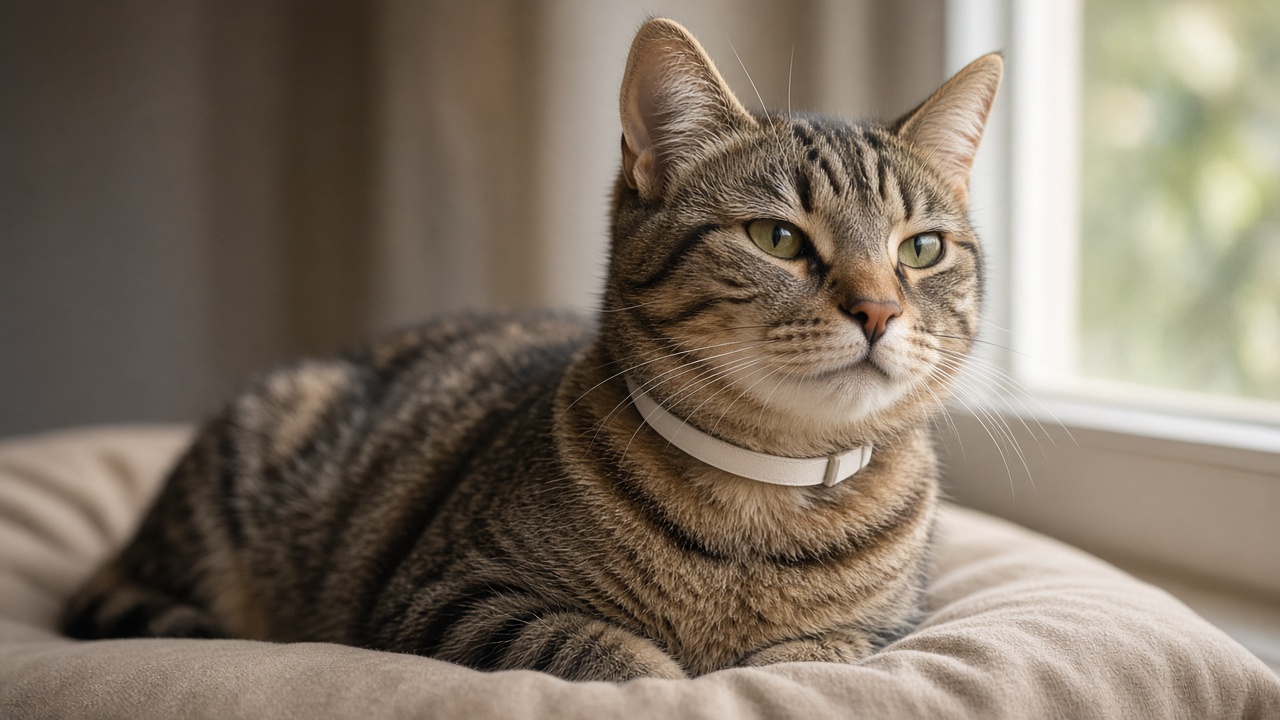
A calming collar is still a collar.
BC SPCA (Kim Monteith): cats whose collars entangle “are at risk of choking or serious injury as they struggle to free themselves.” Breakaway / quick-release is designed to snap when tugged hard enough. Indoor cats are not exempt — a window, a delivery dash, or fireworks can put them outside. Fit: two fingers between collar and neck. Inspect for fray. Because a breakaway is supposed to come off, a tag on that collar is not enough; they want permanent ID as backup.
Comfort Zone: fasten “snugly with no more than two fingers width”; easy-release claim; adult cats only. SENTRY’s True Value reprint: start loose, supervise ten minutes, tighten to two fingers, supervise thirty more before unsupervised wear. That is their onboarding, not a trial we ran.
This desk will not invent a neck-injury rate or a claim that every buckle printed “breakaway” opens at the same load. A buckle that does not open under a snag is a slogan. Never clip a leash to a breakaway calming collar. Two collars at once is two snag points. If you need a tag, put it on the one breakaway band.
Start with a few hours on day one, in the room you are in. An expired 30-day band is webbing.
What the institutions put ahead of any pouch
AAFP/ISFM 2013: environmental needs are “essential (not optional).” Five pillars. A collar sits, at most, under Pillar 5 as one listed method.
- A safe place. Hiding is coping. A box, a high perch with a back wall. Cats fight when escape is gone.
- Multiple, separated resources. Food, water, trays, rest, and perches in different places, out of view of each other. Minimum two resting, two feeding, two toileting sites. Food and water are not one station.
- Play that looks like hunting. Short, regular. Not hands as prey.
- Predictable human contact. Routine beats a surprise deep-clean the day guests arrive.
- Respect smell. Do not bleach every facial-rub corner. Rotate bedding so something still smells like the cat. Synthetic pheromones appear here as an adjunct, with a citation — not as a substitute for trays.
Litter boxes are where most collar shopping actually starts. Cornell: as many boxes as cats, plus one. AAFP/ISFM 2014: a single cat gets two boxes in two locations; multi-cat n+1 is historical, not absolute. Affiliated cats (groom and sleep together) may share; unaffiliated cats need separate stations; a multi-level home needs a box on each level. Size: 1.5 times nose to the base of the tail; one study they cite preferred 34 × 15 inches (86 × 39 cm).
Leave the carrier out so it is furniture. Spray, if you use it, on Ceva’s 15-minute clock. A collar, if any, goes on days before the appointment, not in the driveway. If the pillars are in place and the cat is still struggling, Cornell’s next named human is a veterinary behaviorist. Medication on that page is only part of a plan, and only with a veterinarian.
Fitting the best cat calming collar — one-change rule
Measure. Two fingers. Press the clasp yourself. Adult-only pouches stay off kittens. Fifteen-inch reprints stay off a 16-inch neck. Fit several days before a known stressor.
Change one variable. Collar or diffuser or a new tray. If nothing has shifted after a few weeks of correct wear, further waiting is a hope, not a protocol we found. Next step is the clinic or a behaviorist, not a scented upgrade of the same band. Wash hands after fitting (NurtureCALM). Replace on the printed 30-day mark (Comfort Zone).
Rotate the resting position of the buckle if the pouch allows it. Some cats develop a contact ring at two to three weeks. Bald patches, redness, or face-pawing means the band comes off.
Outdoor cats, balcony cats, and cats that climb chain-link are poor candidates. Water and branches strip the pouch; a snag turns a “calming” product into a choke risk. Diffusers are the indoor-zone tool.
Frequently asked questions about the best cat calming collar
Do cat calming collars work?
Not as a category we can certify. Comfort Zone prints a 1–2 week window. Ceva prints “many” owners seeing diffuser change within seven days. Frank et al. 2010 did not come away with a recommendation for the feline uses they reviewed. A given cat can look quieter or unchanged.
What is the best cat calming collar for travel?
A fragrance-free, breakaway band the cat already accepts, fitted days before the trip — plus FELIWAY Classic Spray on an empty carrier, 15 minutes ahead, if you use spray at all. The driveway snap is the worst onboarding we see described.
Are Feliway or pheromone collars clinically proven?
FELIWAY on the pages we opened is a diffuser and a spray, not a collar. “Clinically proven” on maker copy is their claim. The independent review this desk opened is Frank 2010. Quote the 11-of-14 sentence, not a percentage
Collar, diffuser, or ignore?
Mobile cat → collar is a candidate. One room → diffuser. One object for a few hours → spray. Missing trays or privacy → ignore the pouch.
How long does the best cat calming collar last?
About 30 days on the Comfort Zone, SENTRY, and NurtureCALM reprints we opened. Mark a calendar. Check neck skin weekly. An expired band is webbing.
Safe for kittens and seniors?
Comfort Zone: adult cats only. NurtureCALM reprints claim all ages and also say no extensive skin lesions. FELIWAY’s no-minimum-age line is for their spray and diffuser. Ask the veterinarian who knows that cat. A 15-inch reprint is not a Maine Coon neck.
My cat is spraying. Will a collar fix it?
Cornell: identify the cat, then examine. Vertical spray is still a medical rule-out. Neutering reduces hormonal drive; 10% of neutered males and 5% of neutered females still spray. More than seven cats: spraying becomes likely. A collar is not a fix for a hallway with one tray.
Can two cats share one collar?
No. A collar scents the wearer. Household tension is a resource-and-room problem.
Should I use a lavender calming collar?
Only if you have read Merck’s essential-oil chapter and the cat has no airway history. Fragrance-free is the quieter first experiment. Never add your own oil. Never cut a scented collar into homemade chips.
Name the job. Gate the clinic row. Pick a format. If that format is a collar, buy a breakaway that actually opens, fit two fingers, and leave the four-pack on the shelf until you know this cat responds. The tray count still has to be right.
Sources
- Frank D, Beauchamp G, Palestrini C. “Systematic review of the use of pheromones for treatment of undesirable behavior in cats and dogs.” J Am Vet Med Assoc. 2010;236(12):1308–1316. Fourteen prospective reports, 1998–2008; 11/14 insufficient evidence; one lack of support. https://doi.org/10.2460/javma.236.12.1308
- Ellis SLH, Rodan I, Carney HC, et al. “AAFP and ISFM Feline Environmental Needs Guidelines.” J Feline Med Surg. 2013;15(3):219–230. Five pillars; needs “essential (not optional).” https://pmc.ncbi.nlm.nih.gov/articles/PMC11383066/
- Carney HC, Sadek TP, Curtis TM, et al. “AAFP and ISFM Guidelines for Diagnosing and Solving House-Soiling Behavior in Cats.” J Feline Med Surg. 2014;16(7):579–598. https://journals.sagepub.com/doi/full/10.1177/1098612X14539092
- Cornell University College of Veterinary Medicine, Feline Health Center. “Feline Behavior Problems: House Soiling.” Updated January 2015. https://www.vet.cornell.edu/departments-centers-and-institutes/cornell-feline-health-center/health-information/feline-health-topics/feline-behavior-problems-house-soiling
- Comfort Zone. “Comfort Zone Cat Calming Collar” maker page, opened 21 August 2026. https://www.comfortzone.com/all-products/comfort-zone-calming-collar
- Ceva / FELIWAY. US FAQ, opened 21 August 2026. https://us.feliway.com/pages/faq
- Merck Veterinary Manual. “Toxicoses From Essential Oils in Animals.” Full review March 2025. https://www.merckvetmanual.com/toxicology/toxicoses-from-household-hazards/toxicoses-from-essential-oils-in-animals
- BC SPCA. “Cats and collars: Why breakaway design is so important.” https://spca.bc.ca/news/cats-collars-breakaway-design-important/