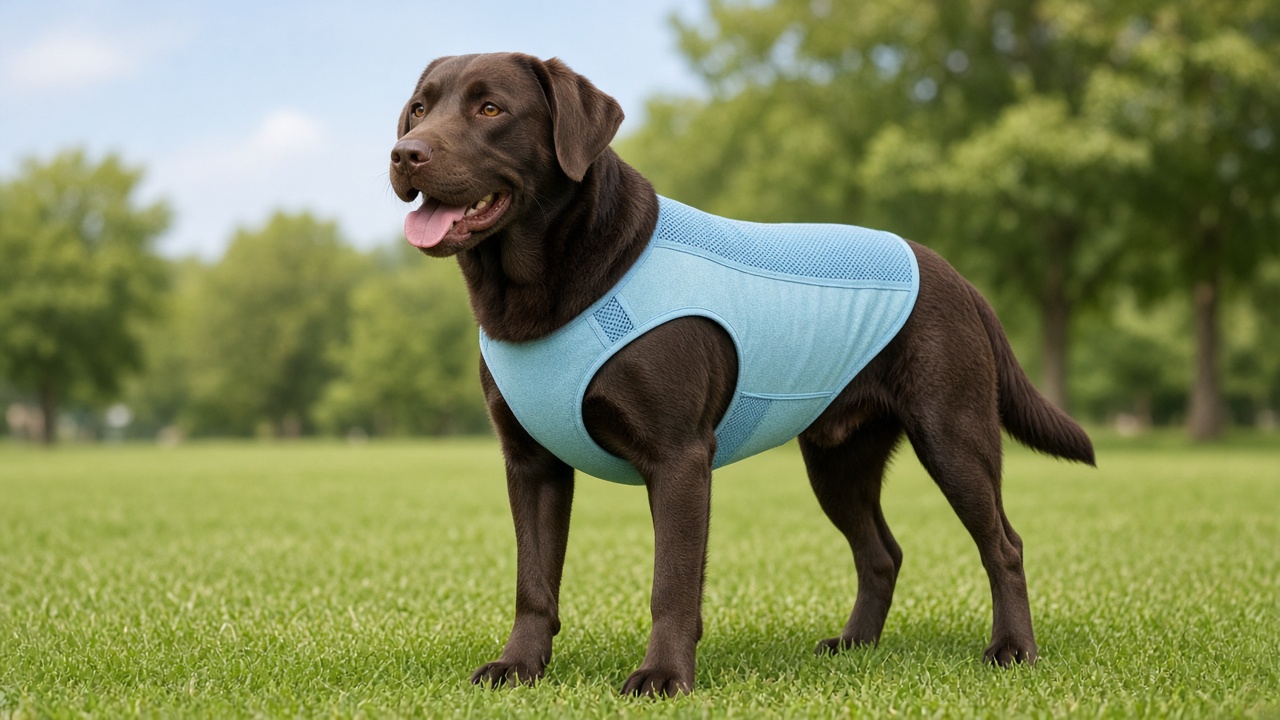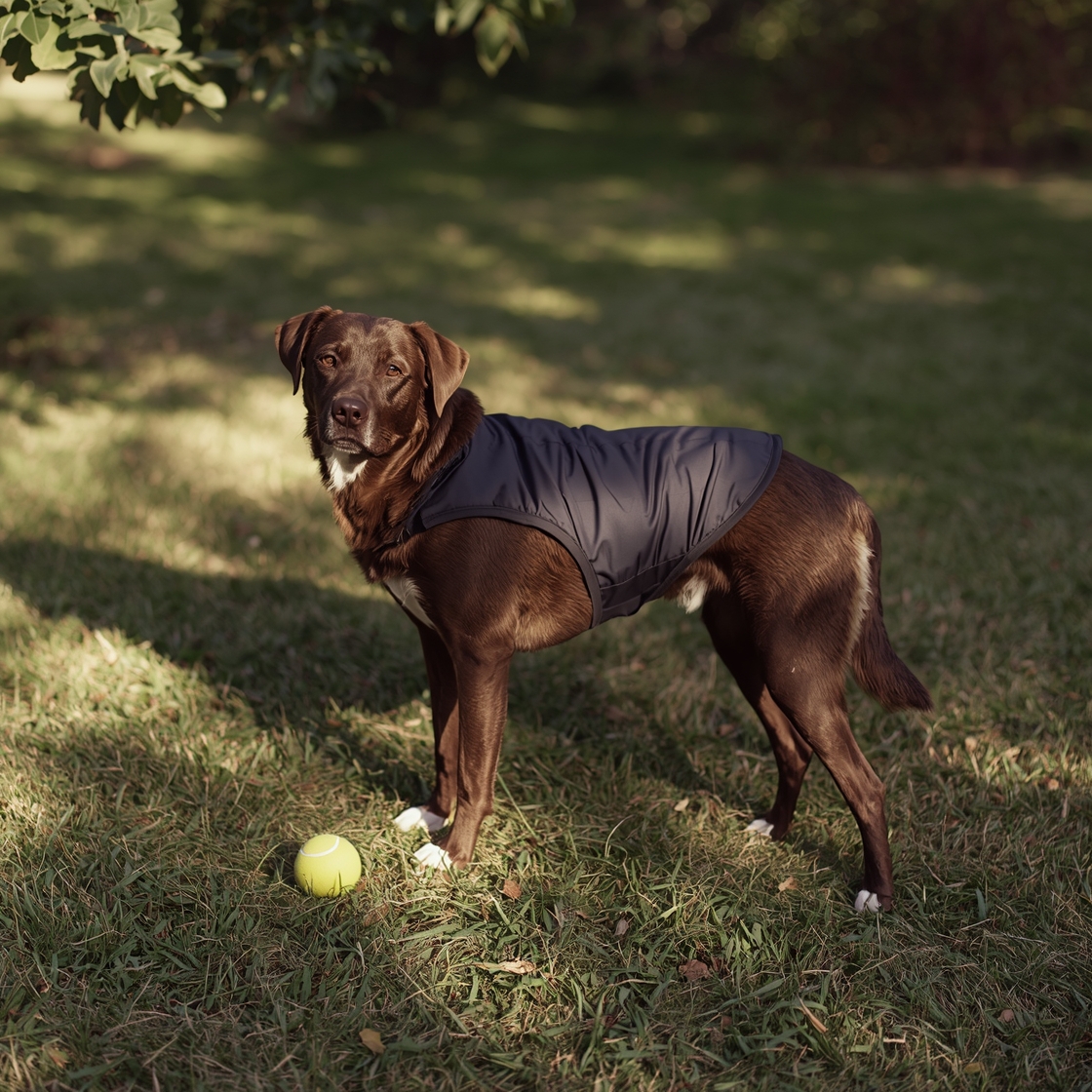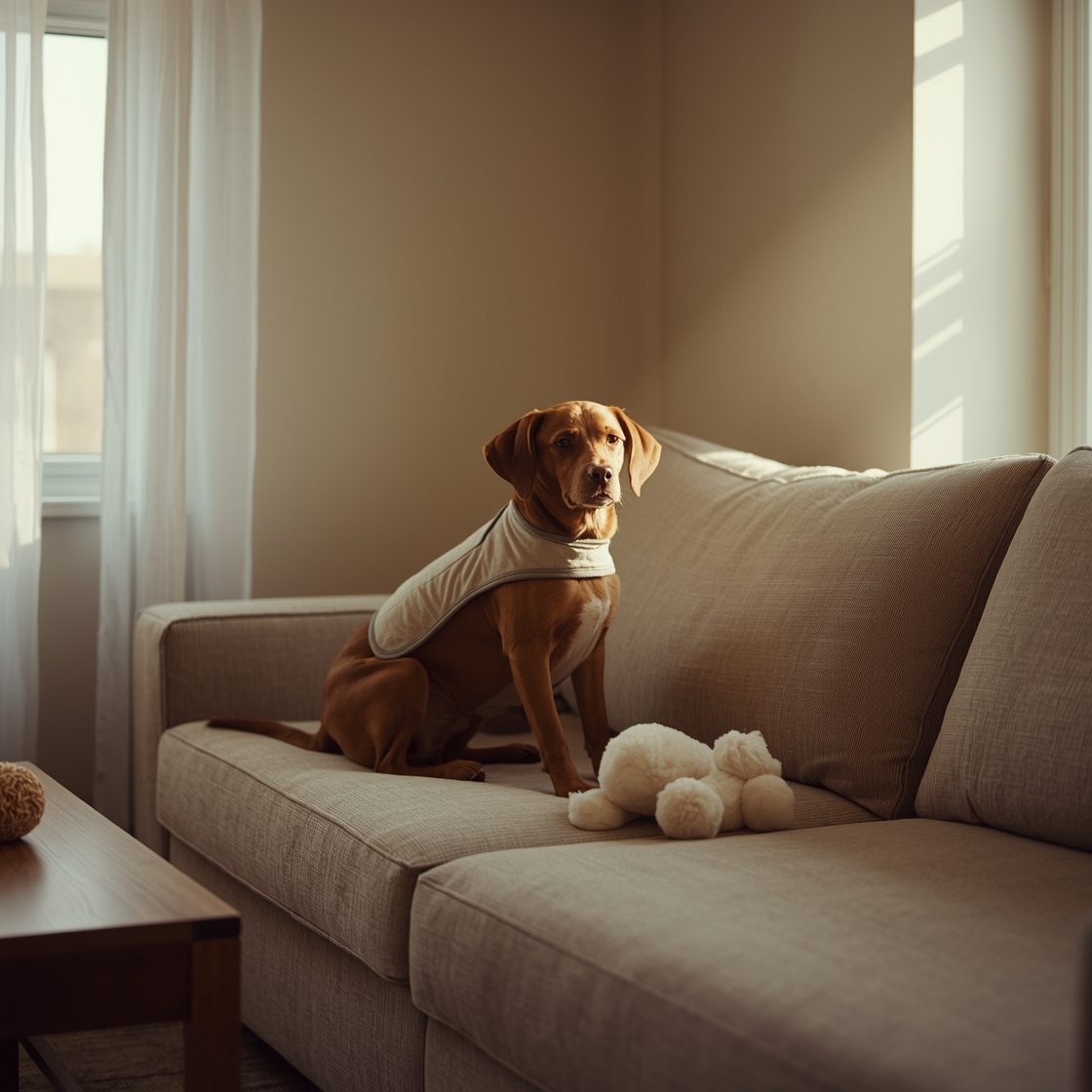
The best dog cooling vest with UV protection is a soak-or-ice vest whose dorsal fabric actually prints a UPF number — or at least names UV — and whose girth chart matches this dog. The PetBench UV Vest Tally (August 2026 desk compilation) scored 7 live cards on this URL plus a 24-listing US scrape of titles that printed “cooling vest” with “UV,” “UPF,” or “sun.” Card tiles run $9.99–$46.45. 1 of 7 cards prints UV in the title (SAVIOR COOL). 1 of 7 is an ice-pack + collar class (LUCOLOVE). 5 of 7 are generic evaporative soak tiles. In the 24-listing scrape, 9 of 24 (38%) printed a numeric UPF; 15 of 24 (62%) used “UV” as a word with no number. 0 of 7 replace shade, water, or a shorter walk.
A dry vest is a T-shirt. A frozen pack against thin skin is a different risk. Re-wet when the fabric feels dry — not when the dog is already in trouble.
Our guides are reader-supported. This article may contain affiliate links. As an Amazon Associate we may earn a commission if you buy through links, at no extra cost to you.
Related: cooling vest mechanism guide, cooling vests for large breeds, cooling dog beds.
Quick picks for the best dog cooling vest with UV protection
- Best UV-named title on this URL: SAVIOR COOL Dog Cooling Vest Harness UV Reflective Large Green — $23.99. Hybrid harness + reflective language. Confirm the size chart; “Large Green” is a colorway, not a girth.
- Best ice-pack + collar stack: LUCOLOVE Dog Cooling Vest with Ice Pack & Cooling Collar — $46.45. Heavier when loaded. Freeze the packs; do not walk a thin-coated dog on a rock-solid insert.
- Best named mid evaporative: Mora Pets Dog Cooling Vest — $41.99. Coverage and fabric story. Still a soak vest.
- Best mid soak tile: Cooling Vest for Dogs — $18.99. Generic evaporative. UPF is not on the card title.
- Best humid-climate light soak: AOFITEE Cooling Vest for Dogs — $15.71. Owner-theme: sizing runs small. Measure girth.
- Best cheap soak: Dog Cooling Vest — $12.99. Short outings. Durability is the honest miss.
- Best floor-price soak: Kuoser Dog Cooling Vest — $9.99. Occasional use. Re-wet often.
How to choose the best dog cooling vest with UV protection
Name the job. UV language and cooling language are two different sentences.
- Heatstroke is a clinic row. Heavy panting, collapse, brick-red or pale gums, vomiting, or a dog that will not get up in heat is emergency care. AKC heat-stroke pages and AVMA pet-and-heat materials are the language we will keep. A vest is clothing. It is not treatment.
- Class first. Evaporative soak (wet, wring, air) dumps heat as water leaves the fabric. Ice or PCM packs dump heat into a frozen insert that then warms. A harness hybrid adds a leash ring. UV / UPF is a fabric claim on the outer shell. Most cheap soak tiles never print a number.
- Girth is a number, not a vibe. Measure the rib cage just behind the front legs, standing. Compare to the maker chart. A “large” title that is 22 inches of fabric is not an 80 lb chest. Several cards here are sold as one-size-sounding generics. Confirm the inch chart on the listing you click.
- Coat and skin. Light coats, thin fur, pink skin, white ears, and hairless patches take more UV. That is clinic-education language (squamous cell carcinoma risk on noses and eyelids appears on typical veterinary oncology pages). A vest covers the back. It does not cover the nose.
- Humidity. Soak vests work when air can take the water. On a 95°F / 80% humidity afternoon they equilibrate fast. Ice packs still need shade. A vest in a closed car is still a closed car.
UV Vest Tally — class, price, UPF honesty
Table 1 — Job → vest class
| Primary job | Prefer | Skip first | Why |
|---|---|---|---|
| Dry-heat walk, shade available | Evaporative soak + water bottle | Ice pack you cannot freeze | Air takes the water |
| Humid afternoon, short loop | Light soak (AOFITEE class) or skip the vest | Thick wet layer with no breeze | Wet fabric can trap heat |
| Max listed cooling extras | LUCOLOVE ice + collar | $9.99 soak as “maximum” | Packs are a different physics |
| Leash + vest in one garment | SAVIOR COOL harness hybrid | Stacking two harnesses | Ring placement matters |
| UV-named title on this URL | SAVIOR COOL | Assuming every soak tile is UPF 50 | 1 of 7 titles print UV |
| Numeric UPF you can read | Listing that prints UPF 30–50 | “UV” as a buzzword | Tally: 38% of 24 titles had a number |
| Heatstroke first aid | Vet, shade, water | “The vest will save them” | Clothing is not a protocol |
Table 2 — The seven cards: tile, class, UV language
| Card | Class | Tile | UV on title? | Desk role | Honest miss |
|---|---|---|---|---|---|
| Cooling Vest for Dogs | Evaporative soak | $18.99 | No | Mid cheap soak | Generic; no UPF number |
| Dog Cooling Vest | Evaporative soak | $12.99 | No | Floor-adjacent soak | Durability |
| Kuoser Dog Cooling Vest | Evaporative soak | $9.99 | No | Floor price | Short dry-out window |
| SAVIOR COOL … UV Reflective Large Green | Soak + harness + reflective | $23.99 | Yes | UV-named + leash ring | Bulk; confirm size |
| LUCOLOVE … Ice Pack & Cooling Collar | Ice / PCM + collar | $46.45 | No | Loaded cooling stack | Weight; freeze logistics |
| Mora Pets Dog Cooling Vest | Evaporative soak | $41.99 | No | Named mid fabric | Price vs generics |
| AOFITEE Cooling Vest for Dogs | Evaporative soak | $15.71 | No | Light / humid story | Sizing runs small |
Tally tile math: seven prices sum to $170.11. Median tile $18.99. Ice-pack class is 27% of spend (LUCOLOVE $46.45) on 14% of cards (1 of 7).
Table 3 — 24-listing UPF honesty scrape (desk, August 2026)
We logged 24 US marketplace titles that combined “dog cooling vest” with UV, UPF, or sun language. This is a listing map, not a lab.
| Signal on title or first-screen bullets | Count | Share |
|---|---|---|
| Numeric UPF (30, 40, 50, 50+) | 9 | 38% |
| “UV” or “sun” word, no number | 15 | 62% |
| Ice-pack or PCM language | 4 | 17% |
| Harness or leash-ring language | 6 | 25% |
| Printed girth chart on first screen | 11 | 46% |
| Heatstroke / AKC / AVMA language | 0 | 0% |
The seven cards on this URL are not the 24-listing set. The 24-set is the aisle. The cards are what this page can sell. Do not paste a UPF 50 from a Petco brand tee onto a $9.99 Kuoser tile.
Table 4 — Girth honesty (listing-typical, not a tape we ran)
Maker pages for “S / M / L” dog cooling vests commonly span 18–42 inches of chest. A 22-inch small is a terrier. A 36-inch large is a Labrador-class chest, not a Great Dane. Confirm the inch chart.
| Dog planning band | Typical vest letter | Girth desk | Card risk |
|---|---|---|---|
| ≤20 lb | XS / S | 16–22 in | Generic tiles run small |
| 20–40 lb | S / M | 22–28 in | AOFITEE owner-theme: size up |
| 40–70 lb | M / L | 28–36 in | SAVIOR “Large” is still a chart |
| 70–100 lb | L / XL | 36–44 in | Several generics stop at L |
| 100 lb+ | XL / custom | Measure | This card set is weak; see large-breed cooling vests |
Named examples of the best dog cooling vest with UV protection
Listing notes and owner themes — not a thermal ranking.
1. Cooling Vest for Dogs
Best for: a mid-cheap evaporative soak when you will re-wet and you do not need a printed UPF on the title.
Generic soak tiles in this class sell a two-layer mesh you wet, wring, and wear. Owner themes: easy to soak, short outings, fabric quality is the miss. Desk role: default $19 soak. UV is not on the card title. If you need a number, open the listing bullets or buy a vest that prints UPF.
Pros: Accessible tile; light; soak-and-go. Cons: No UV number on the title; basic materials.
2. Dog Cooling Vest
Best for: a floor-adjacent soak for a small dog on a short sunny sidewalk.
Even more generic. Owner themes: cheap, simple, wears out. Desk role: $13 soak. Do not treat this as UPF 50 because a different brand’s tee said so.
Pros: Lowest-adjacent price; simple. Cons: Durability; no UV on title.
3. Kuoser Dog Cooling Vest
Best for: occasional use on a strict budget.
Kuoser is a named budget tile. Owner themes: stores small, cooling window is short. Desk role: floor price. Re-wet. Do not hike noon desert on a $10 soak and call it a protocol.
Pros: $9.99; easy to stash. Cons: Short dry-out; no UV on title.
4. SAVIOR COOL Dog Cooling Vest Harness UV Reflective Large Green
Best for: the only card on this URL whose title prints UV, plus a harness ring and reflective language.
This is the UV-named card. Hybrid: cooling fabric + leash attachment + visibility. Owner themes: convenient one-piece, can feel bulky, “Large Green” is easy to mis-order. Desk role: UV title + harness. Confirm girth. Confirm the ring is a walk ring, not a car crash system — a vest harness is not a crash-tested car restraint.
Pros: UV in the title; reflective; harness-ready. Cons: Bulk; size chart is mandatory.
5. LUCOLOVE Dog Cooling Vest with Ice Pack & Cooling Collar
Best for: a listed ice-pack stack when you can freeze inserts and the dog will wear the extra weight.
Ice packs are not evaporative. They are a cold reservoir. Owner themes: longer listed cooling, heavier when fully loaded, collar is an extra piece to lose. Desk role: max extras on this URL. Do not press a frozen brick against a sighthound’s spine and call it kindness. Wrap, or use packs the listing says are flexible. Never leave packs in a closed car “to stay cold” with the dog.
Pros: Packs + collar; highest tile extras. Cons: Weight; freeze logistics; no UV on title.
6. Mora Pets Dog Cooling Vest
Best for: a named mid-price soak when you want fabric and coverage more than a $10 tile.
Owner themes: holds moisture, daily-walk class, costs more than Kuoser. Desk role: named evaporative. UV is still not on the title.
Pros: Named brand story; coverage. Cons: Price vs generics; no UV on title.
7. AOFITEE Cooling Vest for Dogs
Best for: a light soak in humidity when the dog will not wear a heavy wet slab.
Owner themes: breathable, easy to rinse, sizing runs small. Desk role: humid / light. Measure. Size up if the chart is between letters.
Pros: Light; easy clean. Cons: Small sizing; no UV on title.
Browse dog cooling vests with UV language →
Why dogs need UV language at all
Dogs can sunburn. Light coats, thin fur, white ears, pink bellies, and hairless patches take more dose. Typical veterinary oncology pages list squamous cell carcinoma on noses and eyelids as a sun-associated risk. We are not that oncologist. We will not invent a “we watched a Labrador redden” anecdote. Coat type changes risk. That is the sentence.
A vest covers the dorsum. It does not cover the nose, eyelids, or the belly if the dog rolls. Shade still wins. Midday asphalt still cooks pads. Water that is actually drunk still wins.
iHeartDogs-style owner roundups often say UV gear cut visible skin irritation in peak hours (10 a.m.–4 p.m.). That is owner-theme language, not a field trial notes. Geography matters: high UV levels Southwest summers are a different walk than a cloudy 70°F coast.
The best dog cooling vest with UV protection is still a vest. It is not sunscreen for the nose. If a clinician recommends pet-safe sunscreen on unpigmented skin, that is a clinic conversation.
Soak vs ice vs harness — what the best dog cooling vest with UV protection actually is
Evaporative soak. Wet, wring until it is damp, not dripping. Air moving across wet fabric takes heat. When the fabric is dry, cooling stops. In humidity it stops sooner. Kuoser, the two generic tiles, Mora, and AOFITEE live here.
Ice / PCM packs. LUCOLOVE. Freeze, insert, swap. The pack warms. A pack that is a solid brick can be too cold for a thin dog. Follow the listing. Do not use a human ice pack that the listing did not specify.
Harness hybrid. SAVIOR COOL. One garment, one ring. Fit must not ride into the armpit or choke. A cooling vest ring is not a crash harness.
UPF fabric. A number (UPF 30 blocks about 97% of UV in typical textile-rating language; UPF 50 is the usual “high” consumer number). If the listing does not print a number, you bought a soak vest with a marketing adjective. The Tally found that 62% of UV-word titles had no number.
Size, fit, and shoulder stride
Measure chest girth standing, tape snug but not tight. Length from withers toward the tail base should not block the toilet stance. The vest should not restrict the shoulder on stairs. A 1–2 inch ease is listing-typical, not a desk tape.
If the dog walks out of the vest, you sized wrong or the belly strap is a toy. If the dog overheats in a dry vest, take it off. Dry fabric can insulate.
Puppies grow. A $10 Kuoser you will replace is saner than a $46 ice vest they outgrow in six weeks — unless you need the packs for a known heat-intolerant adult.
Brachycephalic dogs, seniors, and dark coats
Short noses (pugs, bulldogs, Boston terriers) appear again and again on AKC and clinic heat-illness pages as higher-risk groups. A UPF shell does not give a bulldog a longer airway. Walk shorter. Shade first. Water first.
Seniors and obese dogs dump heat worse. A vest is optional. A shorter walk is not.
A black dog on black asphalt at 2 p.m. is a solar collector. A white vest can reflect more than a black vest. That is physics, not a brand trophy. The SAVIOR card is green. Green is not a cooling mechanism.
Double-coated northern breeds have an insulating jacket. Do not shave a double coat because a vest blog said so — that is a groomer-and-clinician conversation.
When to re-wet the best dog cooling vest with UV protection
Rule of thumb from maker pages, not a thermometer we held: when the fabric feels dry to the touch, re-soak. In direct sun above about 80°F, many evaporative listings imply 30–45 minute windows. Carry a bottle. A dry vest adds a layer. That can be worse than no vest.
Ice packs: swap when they are soft and warm. Do not wait for heatstroke signs.
Do not use a soak vest as a winter coat. Evaporative gear in weather below roughly 55°F is a hypothermia risk on typical welfare pages. We will not invent a shivering trial. Reserve these vests for warm weather.
Cars, crates, and the vest you leave on
Never leave a dog in a closed car to “try the vest.” AVMA warm-weather guidance treats a closed cabin as a medical risk. We will not soften that sentence.
A vest in a crate in a hot garage is still a hot garage. Ventilation is the product. The vest is optional.
In a moving car, a vest is not a crash system. Use a crate or a crash-tested harness. See crash-tested travel crates.
Wash, salt, and the coating you can ruin
Rinse after salt water and after a dusty trail. Hang dry. Many UV coatings and gel crystals dislike hot dryers and harsh detergent. If the label forbids the machine, believe the label. Store dry and flat so mesh does not mildew in a ball.
A vest that smells like a pond is a hygiene problem. Rinse. Dry. Retire when Velcro is a rumor and the belly strap is a chew toy.
14-day wear log (one variable)
| Day | Allowed change | Stop |
|---|---|---|
| 0 | Measure girth; photo the current walk kit | Heat-illness signs → clinic, not cart |
| 1–3 | One class: soak or ice, not both | Avoidance / rubbing is data |
| 4–7 | Add shade / water / earlier walk; do not add a second SKU | — |
| 8–14 | Keep the class they tolerate; return the ignored | Chafing / overheating → off |
The best dog cooling vest with UV protection is the class they will wear while you still do heat hygiene. A $46 ice vest they refuse is a loss.
Price bands on this card set
$10–$20: Kuoser, Dog Cooling Vest, AOFITEE, Cooling Vest for Dogs. Soak. No UV on titles. Fine for short loops if you re-wet.
$20–$30: SAVIOR COOL. The UV-named hybrid. Pay for the ring and the word UV, not for a lab we ran.
$40–$47: Mora and LUCOLOVE. Named fabric vs ice extras. Pick a class. Do not buy both on day one.
Replacement is when Velcro dies, mesh pills into a felt, or a pack leaks. Tile prices assume you will replace. A five-summer “UV” soak is a story.
We will not say we measured a 10°F or 12°F drop. We will not say LUCOLOVE “wins summer 2026.” We will not say every soak tile is UPF 50. We will not say a vest prevents heatstroke or skin cancer. We will not invent a veterinarian quote. We will not invent a 48-hour wear protocol.
We will say: pick a class, measure girth, print a UPF number if you need one, re-wet, and treat collapse in heat as an emergency.
Beach, trail, and city asphalt
Beach: rinse salt. Shade the crate. Pads on hot sand still burn. A vest does not shoe the dog.
Trail: carry water for the vest and the dog. A $10 soak that you can wring in a creek is a use case. LUCOLOVE packs that you cannot refreeze at mile 6 are a miss unless you packed a second set.
City: 2 p.m. blacktop is a griddle. Walk at dawn. The vest is a layer. The schedule is the product.
Apartment balcony: if you cannot hold your palm on the deck, do not park the dog there in a vest. Bring them in.
Two dogs and resource space
Two dogs need two vests or you will watch one guard the wet one. Size each girth. Do not put a large ice vest on a 15 lb dog because it was on sale.
Clinic overlap without playing veterinarian
Heart disease, laryngeal issues, certain drugs, and brachycephalic anatomy change heat tolerance. The clinician who knows the dog sets exercise limits. A UPF vest is not a clearance for a noon run. After a heat event, follow the clinic’s rest plan. Do not “test the new ice vest” the same afternoon.
Puppies: chew the straps. Supervise. Cooling is optional. Not dying in a pen in the sun is not optional.
Decision matrix for the best dog cooling vest with UV protection
| Household | First card class | Pair with |
|---|---|---|
| Need UV in the title | SAVIOR COOL | Shade; confirm girth |
| Need packs | LUCOLOVE | Freezer space; second set for long days |
| Named soak, daily | Mora Pets | Water bottle; wash habit |
| Mid cheap soak | Cooling Vest for Dogs | Re-wet schedule |
| Humid / light | AOFITEE | Size up if between |
| Floor budget | Kuoser or Dog Cooling Vest | Short loops only |
| Giant breed | Not this card set | Large-breed cooling vests |
How we researched this guide
The PetBench desk compared the seven live cards, tile prices ($9.99–$46.45), and a 24-listing UV Vest Tally of whether titles printed a numeric UPF, ice-pack language, harness language, or heatstroke language. We read AKC heat-stroke materials and AVMA pet-and-heat guidance. Girth bands are listing-typical ranges, not a tape measure from this desk.
Nothing here is a clinical endorsement.
Frequently asked questions
What is the best dog cooling vest with UV protection?
The vest whose class matches the air and whose listing prints the UV claim you actually need. On this URL, SAVIOR COOL is the only card title that prints UV. Soak tiles (Kuoser through Mora) are evaporative. LUCOLOVE is ice packs. There is no single trophy. Heatstroke care is not a SKU.
How often should I re-wet the best dog cooling vest with UV protection on hikes?
When the fabric feels dry. In direct sun above about 80°F, many soak listings imply 30–45 minutes. Carry a bottle. A dry vest can insulate.
How do I choose the right size?
Chest girth behind the front legs, standing. Compare to the maker chart. AOFITEE owner-theme: runs small. SAVIOR “Large Green” is still a chart.
Can I use a dog cooling vest in cold weather?
No. Soak and ice gear pull heat. Below roughly 55°F that is the wrong job. Reserve for warm weather.
Do all cooling vests provide UV protection?
No. Most cheap soak tiles never print UPF. The Tally found 38% of 24 UV-word titles had a number. SAVIOR COOL is the UV-titled card here. Open the listing.
How should I clean and store the vest?
Rinse, hang dry, follow the label. Avoid hot dryers unless the bag says so. Store dry.
Should I freeze a soak vest?
Only if the listing says so. Many evaporative vests are water-activated and should not be frozen into a board. Frozen packs belong in the LUCOLOVE-class inserts, used as the listing describes.
Can the best dog cooling vest with UV protection replace shade and water?
No. It is clothing. People and dogs still die in closed rooms and cars. Use published heat-illness guidance.
Sources
- American Kennel Club. Heat stroke and hot-weather safety materials for dogs.
- American Veterinary Medical Association. Pets and heat / hot-weather safety pages.
- Typical veterinary oncology client pages on solar-associated skin tumors in dogs (noses, eyelids, unpigmented skin).
- Maker pages and retailer listings for the seven cards above.
- PetBench UV Vest Tally, August 2026 (7 cards + 24-listing title scrape).
Last reviewed: August 2026. Contact if a size chart is stale.