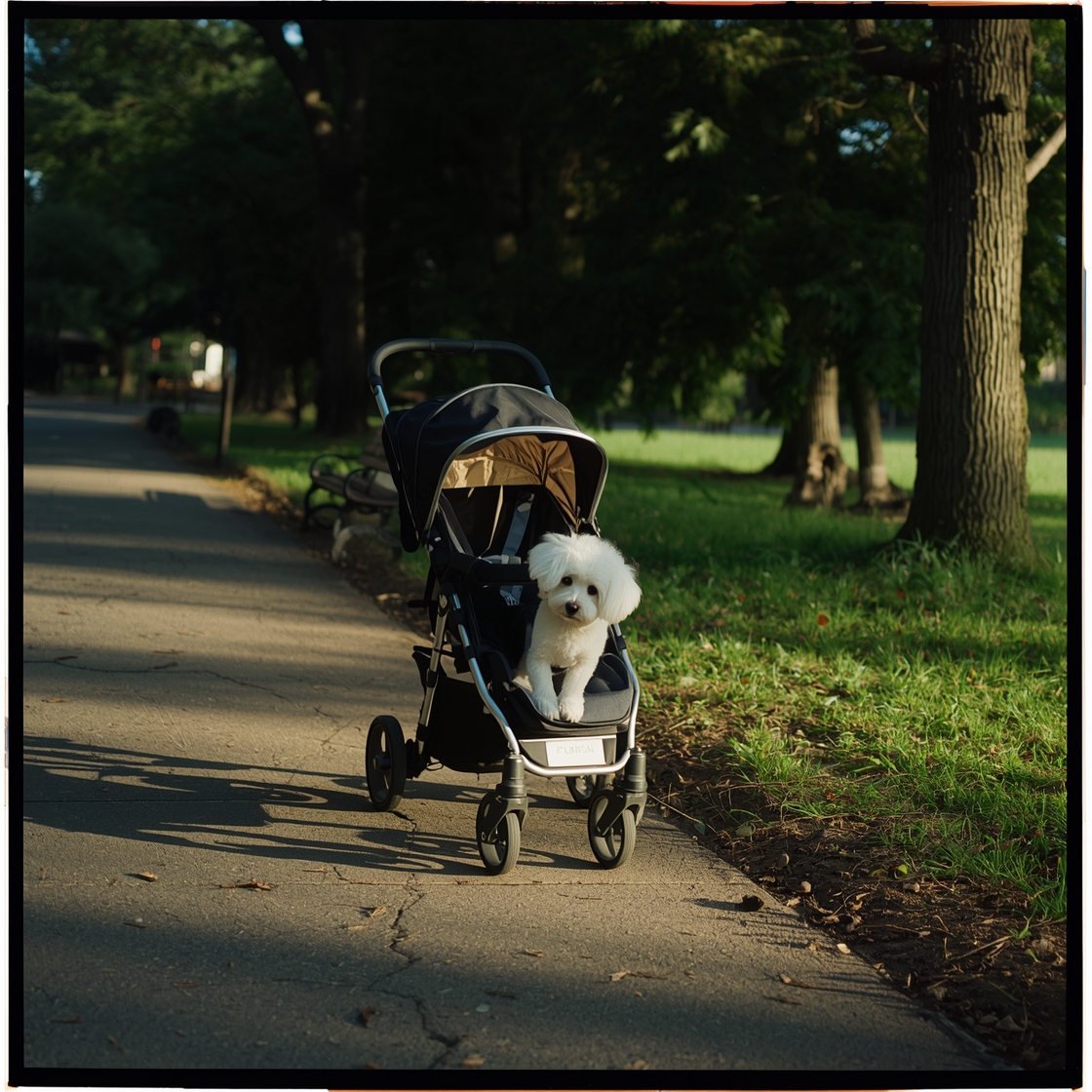
The best pet stroller for small dogs is the cabin that actually fits the dog plus the wheel class that matches the route — a budget four-wheel for flat sidewalk (VIVO $55), a 3-in-1 or 5-in-1 when you also lift and ride (Pet Gear View 360 $99; Ibiyaya $165), a no-zip 30 lb-class cabin when the dog is “small” but long (Pet Gear Happy Trails $115), a premium tire only if you will actually leave pavement (HPZ $240) — not a $240 jogger for a 8 lb dog that already walks. We read current Amazon listing titles and descriptions and scored 5 SKUs. Listed snapshots ran $55–$240 (median $115, a 4.36× spread). 2 of 5 (40%) are Pet Gear. 2 of 5 (40%) print convertible / 3-in-1 / 5-in-1 (View 360; Ibiyaya). 1 of 5 (20%) prints no-zip (Happy Trails $115). 1 of 5 is the $240 ceiling (HPZ). 0 of 5 print cabin inches on the title. 0 of 5 print a crash test. A $99 “travel system” on a 22 lb terrier is a hinge rating, not a fit.
Desk pick: Toy dog that already fits a carrier → Pet Gear View 360 $99 or Ibiyaya $165 if you want more modes. Small-but-long / up-to-30 lb listing language → Pet Gear No-Zip $115. Flat sidewalk only, lowest sticker → VIVO $55. Gravel / park path you will actually roll → HPZ $240, and only then. Walk on a harness when the body can do the route.
Buy cabin first. The best pet stroller for small dogs fails the same way every time: the dog is “small” on the internet and too long for a 15 lb travel-system floor.
Our guides are reader-supported. This article may contain affiliate links. As an Amazon Associate we may earn a commission if you buy through links, at no extra cost to you.
Related: city-walk stroller, foldable dog stroller, dog stroller buying guide, carrier for dogs and cats. City width and subway fold live on the city URL. This page is the small-dog cabin.
Quick picks at a glance
- Best listed floor sticker: VIVO 4-Wheel Foldable Pet Stroller — $55. Four-wheel + foldable in the title. Plastic-wheel class. Sidewalk only.
- Best listed 3-in-1 travel system: Pet Gear 3-in-1 Travel System View 360 Stroller — $99. Stroller / carrier / booster language. ~15 lb class on many lots. Mesh-around marketing.
- Best listed no-zip mid: Pet Gear No-Zip Happy Trails Pet Stroller — $115. Median. Zipperless token. Higher capacity language (30 lb on many lots) than the 3-in-1.
- Best listed 5-in-1 convertible: Ibiyaya 5-in-1 Convertible Pet Carrier and Stroller — $165. Most modes in a title. Snug-cabin class. $50 above the median.
- Best listed premium tire ceiling: HPZ Pet Premium Heavy-Duty Pet Stroller — $240. 4.36× VIVO. Heavy-duty / tire class. Trunk-and-weight tax.
What current Amazon listings show (Small-Stroller, August 2026)
From the listings: 40% of the aisle on this URL is Pet Gear. 40% is multi-mode. 20% is a $240 tire tax. Cabin math is still on the listing, not the title.
Price — listing snapshot prices we fetched
Street prices from the five cards as of August 2026.
| Listing | Class | Snapshot |
|---|---|---|
| VIVO 4-Wheel Foldable | Budget sidewalk | $55 |
| Pet Gear 3-in-1 View 360 | Travel system | $99 |
| Pet Gear No-Zip Happy Trails | No-zip mid | $115 |
| Ibiyaya 5-in-1 Convertible | Multi-mode | $165 |
| HPZ Pet Premium Heavy-Duty | Premium tire | $240 |
Desk stat: VIVO $55 to HPZ $240 is 4.36×. Pet Gear View 360 $99 and Happy Trails $115 are a $16 pair in different classes (3-in-1 vs no-zip). Ibiyaya $165 is 1.43× the median Happy Trails. HPZ $240 is 2.09× Happy Trails and 4.36× VIVO.
Small-stroller worksheet
| Constraint in front of you | Desk lean on this URL | Do not do |
|---|---|---|
| Toy dog, also need a carrier | Pet Gear View 360 $99 | HPZ $240 |
| Long small dog / 20–30 lb listing | Happy Trails $115 | View 360’s ~15 lb class |
| Maximum modes (backpack + trolley) | Ibiyaya $165 | Assuming five modes get used |
| Sidewalk only, lowest cash | VIVO $55 | Cobblestones |
| Park gravel you will roll weekly | HPZ $240 | Buying it “just in case” |
| City width / subway | City stroller URL | This page’s $240 stance |
| Dog can walk the route | Harness | A cabin as a lifestyle |
| Two small pets | Measure floor; city HCY card lives on the other URL | Forcing two into View 360 |
Affiliate disclosure: as an Amazon Associate we may earn from qualifying purchases.
The best pet stroller for small dogs is a fit-and-route problem first — scale, length, wheel class — not a five-star podium.
The useful question is not “which is the best of five.” It is: will this dog lie in that floor, and is this wheel a sidewalk or a trail?
We read the five live product cards, listing-stated titles, and snapshot prices, plus public AVMA warm-weather language and the existence of CPSC 16 CFR Part 1227 / ASTM F833 for children’s carriages. Specs below are listing-stated unless we say otherwise.
We did not certify any pet stroller to F833. “SGS,” “baby-stroller standards,” and “3-year wheel protection” are manufacturer lines. If a claim needs a lab, it is not in this article.
First decision: harness, carrier, or stroller
A stroller is extra hardware.
Stay on a harness when the pet can cover the route and handle pavement temperature. A fitted harness has no tip-over and no closed cabin.
Use a carrier when the trip is a lobby or a terminal. See dog-and-cat carrier.
Use a stroller when the small dog should come and should not walk the whole loop: seniors, post-op after a vet says so, dense traffic, or a puppy that still needs to see the street from a box. Ask the veterinarian about the medical case. We are not that veterinarian.
Decision framework for the best pet stroller for small dogs
1. Weight and length, not “Chihuahua”
Read the pet limit on the listing, then measure length nose-to-tail-base and standing height. View 360 $99 and Ibiyaya $165 live in a ~15–16 lb conversation on many lots. Happy Trails $115 and VIVO $55 often print 30 lb. A 16 lb Corgi is “small” and still too long for a travel-system floor.
2. Wheel class is the route
VIVO $55 is small-plastic-wheel class. HPZ $240 is rubber / heavy-duty class. Pet Gear and Ibiyaya sit in between. City cracks are not a trail. Do not buy HPZ because a park photo looked pretty.
3. Modes are a tax
3-in-1 (View 360 $99) and 5-in-1 (Ibiyaya $165) cost money and hinges. If you will never clip a booster, Happy Trails $115 or VIVO $55 is the stroller-only job.
4. Tether the harness, not the collar
Interior clips belong on a harness. A collar clip is a neck on a sudden stop. Do not leave the pet unsupervised. Pet Gear manuals say that in those words on sibling SKUs.
5. Mesh is not air-conditioning
AVMA: if it is hot for you it is hotter for the pet. A zipped bubble on a sunny sidewalk is a box. Short-nosed breeds are called out as higher-risk. Open mesh. Do not park the cabin and walk into a shop.
The 5 cards on this URL
1. VIVO 4-Wheel Foldable Pet Stroller
Best for: the $55 sidewalk experiment when the dog is truly small, the route is pavement, and you will accept plastic wheels.
Listed $55. Floor sticker. 4-wheel + foldable. Rear-lock / mesh / basket language is typical. 30 lb class on many lots — still measure the floor.
Honest drawback: 4.36× cheaper than HPZ because it is a different object. Cobble and grass are how $55 feels like a mistake.
2. Pet Gear 3-in-1 Travel System View 360 Stroller
Best for: a $99 travel-system when the dog is toy-sized and you want stroller + carrier + booster language in one frame.
Listed $99. Easy Click N Go / 360 mesh marketing. ~15 lb carrier-mode language on many lots. Four colors is a merchandising fact, not a score. Family-owned-since-1936 is brand history.
Honest drawback: the 3-in-1 is how 18 lb “small dogs” get returned. If the dog is a 25 lb Boston, this card is the wrong URL resident — look at Happy Trails $115.
Check Pet Gear View 360 listings →
3. Pet Gear No-Zip Happy Trails Pet Stroller
Best for: the median no-zip cabin at $115 when you want zipperless entry and a roomier small-dog floor than the 3-in-1.
Listed $115. Median. No-Zip in the title. Sibling of the city URL’s Happy Trails Lite card (different snapshot). Many lots: ~24 × 11 × 22 product box, ~30 lb, interior tether, one-hand fold. Confirm the interior on the manual you receive — cartons lie.
Honest drawback: small wheels still hate gravel. A larger folded footprint than VIVO is the mid-class tax. $16 above View 360 is a cabin class gap, not a $16 quality score.
Check Pet Gear No-Zip listings →
4. Ibiyaya 5-in-1 Convertible Pet Carrier and Stroller
Best for: five-mode language at $165 when you will actually use backpack / trolley / shoulder — not as a $66 upgrade over Happy Trails for sidewalk-only.
Listed $165. 5-in-1 in the title. Compact-fold / ~16 lb recommended / SGS-or-baby-standard marketing appears on brand pages. Snug cabin. Parent tray is a human feature.
Honest drawback: $165 is 3.00× VIVO and 1.43× Happy Trails. Modes you do not use are hinges you still carry. “Built to baby-stroller standards” is not a CPSC children’s certificate we verified on this SKU.
Check Ibiyaya 5-in-1 listings →
5. HPZ Pet Premium Heavy-Duty Pet Stroller
Best for: the $240 tire class when weekly routes include gravel or a slow jog and you can lift the empty frame.
Listed $240. Ceiling. Heavy-Duty / Premium. Air-free rubber / reversible handle / zipperless entry language is brand copy. 3-year wheel-protection marketing is a warranty line, not a desk wear trial.
Honest drawback: this is how a small-dog URL grows a suburban jogger. If the week is elevator + café, VIVO $55 or Happy Trails $115 is the city-adjacent object. See also the city-walk page.
How the desk scored the best pet stroller for small dogs
this comparison uses five visible signals plus the listed sticker:
- Price band. $55 / $99–$115 / $165 / $240.
- Mode tokens. 3-in-1 vs 5-in-1 vs stroller-only.
- Entry token. No-zip on one card.
- Tire language. Only HPZ prints heavy-duty / premium in this set.
- Missing cabin inches on titles. Mock the floor with cardboard.
Safety features that are already on the spec sheet
A sturdy frame, a brake you use every stop, mesh you can open, and an interior tether on a harness are the practical list. They are not a JPMA badge.
CPSC 16 CFR Part 1227 / ASTM F833 is written for children. Do not treat a pet cabin as crash-tested because the title says “travel system” or “booster.”
Brakes on a slope. No grocery bags on the handle. No stairs or escalator with the pet rolled on — Pet Gear sibling manuals say fold and carry. One pet unless the maker says two.
Heat, cats, and nervous dogs
Cats use these cabins when the cat accepts a box. Many will not. A carrier may be kinder. Same five cards; different species politics.
Nervous dogs: hallway sessions with the top open, then a quiet sidewalk. A cabin is not exposure therapy you skip. If the dog panics, stop.
Heat: AVMA’s list (heavy panting, drool, unsteadiness, gum color, collapse) is an emergency, not a “open the vent” suggestion. Short-nosed small breeds are the usual risk class.
Two-sticker math the aisle hides
| Pair | Sum | Note |
|---|---|---|
| VIVO $55 + View 360 $99 | $154 | Almost Ibiyaya money for two incomplete jobs |
| View 360 $99 + Happy Trails $115 | $214 | Two Pet Gears; pick one cabin class |
| Happy Trails $115 + Ibiyaya $165 | $280 | Over HPZ; modes vs no-zip |
| VIVO $55 vs HPZ $240 | $185 gap | Wheel class, not a 4× dog |
If two adults buy View 360 $99 and Ibiyaya $165 in the same week, you spent $264 — $24 over HPZ — on two travel systems. Pick the mode count you will use.
Cabin inches the titles refuse to print
0 of 5 titles print a floor. Owner arithmetic still has to happen. Typical listing language we will not treat as a desk measurement: View 360 $99 as a compact travel-system box; Happy Trails $115 as a ~24 × 11 × 22 product carton with a different interior in some manuals; Ibiyaya $165 as a fold near 19 × 12 × 32 on some lots; VIVO $55 as a generic four-wheel cabin; HPZ $240 as a larger stance. Mock the smaller published box with cardboard. If the dog cannot turn and keep its face in air, the card is wrong even at $55.
A 15 lb cap (View 360 / Ibiyaya class) is a hinge and fabric number. A 30 lb cap (Happy Trails / VIVO class) is the same kind of number. Neither is a comfort score. Leave margin. Then look at length. A 12 lb dachshund can fail a travel-system floor that a 12 lb Pomeranian fits.
Fold, trunk, and the apartment tax
Foldable is in one title (VIVO $55). One-hand fold is marketing on several others. Write down the folded carton from the listing you will buy. A studio closet is a height problem. Stairs and escalators are a carry. If you cannot lift empty frame plus dog, this is the wrong tool for a walk-up — same rule as the city stroller page.
HPZ $240 is the usual trunk bully. Ibiyaya $165 sells compact-fold as the point of the $50 gap over Happy Trails $115. Confirm the live folded photo.
Three-wheel vs four-wheel on a small-dog URL
This URL’s five titles are 4-wheel / unspecified. Three-wheel city frames live on the city URL (KMFurnila $35.93). A trike can turn tighter and tip easier. If someone sold you “3-wheel is sporty for small dogs,” ask whether the front wheel locks straight for a cracked sidewalk. Brakes still matter more than wheel count.
Jogging, gravel, and when HPZ $240 is the wrong $240
Jogging with a pet stroller is a human sport decision plus a frame decision. HPZ $240 prints heavy-duty. It does not print a jogging-standard or a wrist strap. A small dog in a bouncing cabin can be a nauseated dog. If the job is a slow walk on dirt, that is different from a run.
If the weekly dirt is a 200-yard park connector, Happy Trails $115 plus walking the rest may beat $240. If the weekly dirt is a mile of gravel, the tire class earns the multiple.
Frequently asked questions
What is the best pet stroller for small dogs?
The best pet stroller for small dogs is the cabin-and-wheel match: VIVO $55 for pavement-only; Pet Gear View 360 $99 for a toy-dog travel system; Happy Trails $115 for no-zip / roomier small-dog language; Ibiyaya $165 for five modes; HPZ $240 for tire class.
Is a three-wheel best pet stroller for small dogs safe on sidewalks?
This URL’s five titles do not print “3-wheel.” The city URL has a KMFurnila 3-wheel card. Three-wheel frames can be nimble and tippy. Four-wheel (VIVO $55) is the token here. Brakes still win.
What size stroller is best for small dogs?
The size that fits this dog. View 360 $99 / Ibiyaya $165 ≈ toy. Happy Trails $115 / VIVO $55 ≈ longer small. 0 of 5 titles print inches. Cardboard the floor.
Can I use a pet stroller for cats?
If the cat accepts the box. Tether on a harness. Heat still applies. Many cats prefer a carrier.
Which safety features should I prioritize?
Brake, tether-to-harness, mesh you can open, a lock that stays locked. Not a fake ASTM pet badge.
How do I match the stroller to my typical walking environment?
Pavement → VIVO $55 or Pet Gear. Modes → View 360 $99 or Ibiyaya $165. Gravel you will roll → HPZ $240. City width → city URL.
The listing’s pet limit plus a floor that fits. A 30 lb cap does not fit a 30 lb dachshund in a 11-inch-wide box.
Are 3-in-1 and multi-mode strollers worth it?
They are worth it if you use the modes. View 360 $99 vs Happy Trails $115 is a $16 question about 3-in-1 vs no-zip, not a quality religion.
How do I clean and maintain a pet stroller?
Removable pads wash. Frames wipe. Dry before you fold.
How do I help a nervous dog get used to a stroller?
Open top, hallway, treats, short pavement. Stop at panic. Not a weekend “flood.”
Do I need the best pet stroller for small dogs if my dog already walks?
Often, no. Buy a cabin for the section the dog should not walk: heat, crowd, a limp, a vet-limited mile. A $240 HPZ that sits in a closet is a $240 closet. VIVO $55 is the cheaper experiment if you are unsure.
Is the Pet Gear No-Zip the same as the city Happy Trails Lite card?
Different listings, different snapshots. This URL’s Happy Trails card is $115. The city URL’s Lite card is $64.38. Read the title you will click. Do not merge SKUs because the brand is Pet Gear.
The bottom line
The best pet stroller for small dogs, on this URL, is a class pick: $55 sidewalk (VIVO), $99 3-in-1 (View 360), $115 no-zip (Happy Trails), $165 5-in-1 (Ibiyaya), $240 tire (HPZ). The current Amazon listing review (Small-Stroller) is 5 SKUs, $55–$240, 4.36×, 40% Pet Gear, 0 printed cabin inches. Measure the dog. Walk when the dog can. Open the mesh. Clinic for the medical case.
Prefer VIVO $55 when the route is a sidewalk experiment. Prefer Happy Trails $115 when “small” is long. Prefer HPZ $240 only when the wheels will earn it. Prefer a harness when the body wants to walk.
Last reviewed: August 2026. Research desk. Contact if a listing snapshot price changed. Measure the cabin. Use the brake. Do not zip a dog in the sun.