The best dog DNA test kit is the kit whose job matches the panel: breed-only if you want ancestry, breed-plus-health if you will sit with a veterinarian to interpret carrier flags. The We read the titles and descriptions of 5 SKUs. Listed snapshots run $49–$159.99. 2 of 5 are full breed+health consumer flagships (Embark Breed & Health $139; Wisdom Panel Premium $159.99). 2 of 5 are breed-first / shallow-health (Embark Breed ID $99; DNA My Dog $49). 1 of 5 is a vet-channel life-plan kit (Orivet GenoPet $79). Maker breed claims on these cards span 350+ to 430+. Health-condition claims span allergy-score-only to 270+. 0 of 5 replace a physical exam, blood work, or a behaviorist.
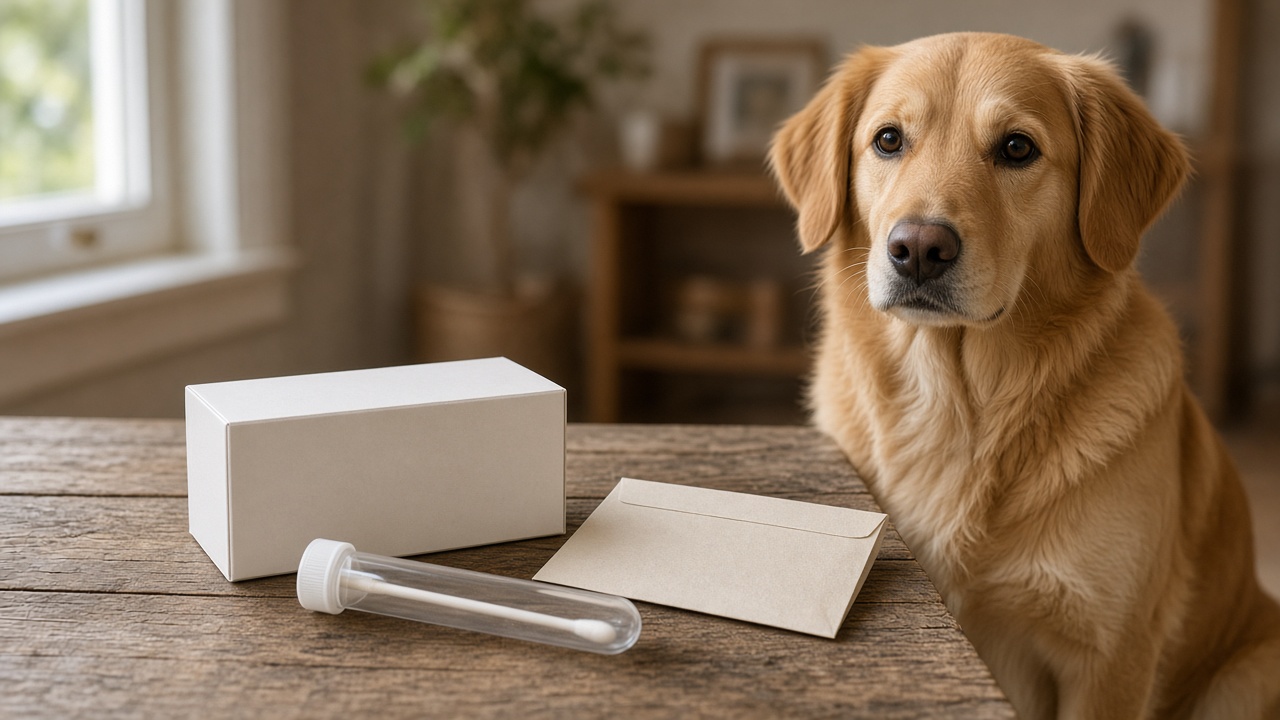
Swab the cheek. Mail the tube. Read the privacy checkbox before you seal the envelope.
Our guides are reader-supported. This article may contain affiliate links. As an Amazon Associate we may earn a commission if you buy through links, at no extra cost to you.
Quick picks for the best dog DNA test kit
- Best breed + health depth: Embark Breed & Health — $139. Maker: 400+ breeds, 270+ conditions, 230,000+ markers. 2–4 weeks.
- Best breed-count claim: Wisdom Panel Premium — $159.99. Maker: 430+ breeds, 265+ health tests, consult language. ~2–3 weeks.
- Best Embark without the health bill: Embark Breed Identification — $99. Same platform story, ancestry-focused. No condition panel on this SKU.
- Best life-plan / vet-channel story: Orivet GenoPet — $79. 365+ breeds, Personalized Life Plan language, 3–5 weeks. Deep health is a Plus-tier conversation.
- Best floor price for “what is my mix?”: DNA My Dog — $49. 350+ breeds, allergy-score language, 2–3 weeks. Shallow health vs the flagships.
How to choose the best dog DNA test kit
- Name the job. Shelter-mix curiosity is a breed kit. Breeding, anesthesia-drug flags (MDR1), or a clinician who asked for a panel is a health kit. Do not buy $160 of health markers you will not open.
- Database vs markers. A larger reference list reduces “unknown” on weird mixes. A higher marker count is the accuracy story companies print. Embark’s 230k-marker language and Wisdom’s 430+ breed language are maker claims.
- Health is carrier status. A flagged marker is a conversation with a veterinarian. It is not a diagnosis. Many flagged dogs never show disease. Many sick dogs have a clean consumer panel.
- Turnaround and swab fail. Windows on these cards: 2–3 weeks (DNA My Dog), 2–4 (Embark), 3–5 (Orivet). Cheek swabs fail when they are food-slimed or under-rubbed. Two swabs beat one. Fasting the mouth per the insert is not optional if you hate reship delays.
- Privacy. Relative finders and research opt-ins are the fine print. Read them. Embark and Wisdom differ on matching features. Orivet is a different lab culture (vet/breeder channel).
How kit depth listings compare on labels
Table 1 — Job → kit class
| Primary job | Prefer | Skip first | Why |
|---|---|---|---|
| Mix ID + family tree vibe | Embark Breed ID or Wisdom | $49 kit if you need 230k markers | Platform depth vs price |
| Breed + health flags to take to a vet | Embark Breed & Health or Wisdom Premium | Breed-only Embark | Health is the SKU, not the brand |
| Widest printed breed list | Wisdom Panel Premium | Assuming 430+ = “more true” | Lists are claims |
| Lowest cash | DNA My Dog | Health-flag decisions | Shallow panel |
| Nutrition / activity plan language | Orivet GenoPet | Fast results | Slowest window |
| Breeding program | Vet-ordered panels, not this aisle | A $49 consumer kit as a stud book | Different standard |
| Behavior prediction | Training + this dog | Any kit as a personality oracle | Genes ≠ upbringing |
Table 2 — The five cards: tile, panel, desk role
| Card | Tile | Maker breed claim | Health desk | Turnaround (maker) | Desk role | Honest miss |
|---|---|---|---|---|---|---|
| Embark Breed & Health | $139 | 400+ | 270+ conditions | 2–4 wk | Flagship combo | Price; busy-season wait |
| Wisdom Panel Premium | $159.99 | 430+ | 265+ tests | ~2–3 wk | Widest breed claim | Health count vs Embark |
| Embark Breed ID | $99 | 350+ | Breed only | 2–4 wk | Ancestry on Embark rails | No condition panel |
| Orivet GenoPet | $79 | 365+ | Traits; Plus adds health | 3–5 wk | Life-plan / vet-channel | Slow; base ≠ deep health |
| DNA My Dog | $49 | 350+ | Allergy-score language | 2–3 wk | Floor price mix ID | Precision on rare breeds |
Price math: five prices sum to $525.99. Median tile $99. Flagship health pair is 57% of spend ($298.99) on 40% of cards. Floor kit is 9% of spend.
Table 3 — What you are actually buying
| Layer | What the PDF is | What it is not |
|---|---|---|
| Breed % | Statistical match to a reference set | A court-admissible pedigree |
| Health flags | Variants the lab chose to report | A full genome or a diagnosis |
| Traits (coat, furnishings) | Often more straightforward | A groomer replacement |
| Behavior scores | Survey-shaped or breed-linked guesses | A temperament test |
| Relatives | Other customers who opted in | A complete family tree of all dogs |
| Life plan | Templated care copy | A nutritionist visit |
Table 4 — Decision matrix for the best dog DNA test kit
| Household | First card | Then |
|---|---|---|
| Want health flags + breed | Embark Breed & Health | Book a vet visit to interpret, not Google |
| Want max printed breeds | Wisdom Premium | Same: clinician for flags |
| Want Embark accuracy story, no health bill | Embark Breed ID | Upgrade later if you must |
| Want a plan PDF | Orivet | Wait 3–5 weeks; do not panic-refresh the portal |
| Want cheapest mix ID | DNA My Dog | Do not make medical decisions from it |
| Breeder / rescue intake protocol | Ask the protocol | This aisle may not qualify |
The 5 cards on this URL
1. Embark Breed & Health Dog DNA Test
Best for: the combined breed-plus-health consumer flagship when you will actually read the health tab.
Maker language: 400+ breeds, 270+ genetic conditions, allergy-risk score, traits, 230,000+ markers, relative finder, access to Embark vets/geneticists. Cheek swab, 2–4 weeks. Desk role: deep combo. Honest miss: you pay for a panel you must not treat as a diagnosis. Turnaround stretches when the lab is busy.
Pros: Deepest health claim on this URL; marker-count story; support language. Cons: Premium vs breed-only; wait.
Check Embark Breed & Health listings →
2. Wisdom Panel Premium Dog DNA Test Kit
Best for: the widest printed breed list plus a large health suite from a long-running Mars/Wisdom lab story.
Maker language: 430+ breeds down to 1%, 265+ health tests (MDR1, IVDD, POMC, stone-risk examples appear in their marketing), 50+ traits, 15 behavior tests, relative/ancestry matching, consult for at-risk findings. Desk role: breed-list flagship. Honest miss: health-marker count trails Embark’s top SKU on the numbers these cards print. Price is in the same band.
Pros: 430+ breed claim; consult language; established brand. Cons: $160 class; not automatically “more accurate” than Embark.
Check Wisdom Panel Premium listings →
3. Embark Breed Identification Kit
Best for: mixed-breed owners who want Embark’s platform without paying for the condition panel.
Maker language: 350+ breeds, 99% breed-ancestry accuracy claim, 230,000+ markers, great-grandparent-style family tree, relative finder, personality/instinct insights. Same swab, 2–4 weeks. Desk role: ancestry Embark. Honest miss: no genetic health-condition screening. If you want MDR1 or PRA flags, this is the wrong SKU.
Pros: Embark rails at a lower tile; relatives/tree. Cons: Health is a different box.
Check Embark Breed ID listings →
4. Orivet GenoPet Dog DNA Test Kit
Best for: a vet-and-breeder-lab story plus a Personalized Life Plan PDF.
Maker language: 365+ breeds, 50 trait insights, at-home swab, secure portal. GenoPet Plus is the deeper health tier — not this base card. Desk role: plan + channel. Honest miss: 3–5 week wait is the slowest on this URL. Do not treat the life plan as a prescription.
Pros: Plan language; clinic-channel reputation. Cons: Slow; base kit is not the deep health SKU.
Check Orivet GenoPet listings →
5. DNA My Dog Breed Identification Test Kit
Best for: the lowest tile when the question is “what is my dog?” and you can live with a shallower panel.
Maker language: 350+ breeds, 99%+ accuracy claim, allergy risk score, personality insights, two swabs, email in 2–3 weeks, printable certificate. Desk role: floor mix ID. Honest miss: health is not Embark/Wisdom. Rare breeds and unusual mixes are where small databases show “unknown” or over-confident percentages.
Pros: $49; simple; faster email story. Cons: Shallow health; rare-breed precision.
Why people buy the best dog DNA test kit
Shelter papers lie with kindness. “Lab mix” is a shape, not a genome. A kit can explain a herding stare, a howl, or a coat that blew twice a year. That is useful for enrichment and for setting walk expectations. It is not useful as a personality prison (“the test said stubborn, so I stopped training”).
Health panels exist because some variants are actionable in a clinic conversation: MDR1 and certain drug lists, some storage diseases, some eye conditions. Actionable usually means monitor or avoid this drug class after a veterinarian confirms, not order a supplement from the kit’s email.
Nutrition emails that say “your mix needs grain-free” are marketing. Orivet’s life plan is a template. A veterinary nutritionist is a person.
Accuracy, the 1% breed, and the unknown slice
Consumer kits report percentages that look like accounting. They are estimates. Closely related breeds collapse into each other. Village-dog ancestry and uncommon landraces land in “supermutt” or “unknown.” A 4% “mystery” is not a scandal. A 40% that flips between two sighthounds on a retest is why you do not tattoo a breed on the dog.
Wisdom’s “down to 1%” language is a resolution claim. Embark’s marker count is a density claim. Neither is a courtroom. If two kits disagree, you learned that reference sets differ. You did not catch a lab in a crime.
Owner forums that did are not a PetBench dataset.
Health flags without playing veterinarian
A progressive retinal atrophy flag is not blindness. A hip-dysplasia “risk” on a consumer chip is not a PennHIP score. An allergy score is not an elimination-diet result.
Take the PDF to the veterinarian who knows the dog. Ask: does this change screening, anesthesia, or breeding advice? If the answer is no, you bought curiosity. That is allowed. It is not a refund reason.
Do not start a medication because a portal said “high risk.” Do not skip a medication a clinician prescribed because a portal said “clear.”
Swab technique that is not a lab protocol
Read the insert. Typical consumer steps: no food or treats for a stated window, rub the cheek, air-dry if they say so, cap, activate the kit online, mail. Two swabs exist because one comes back “insufficient DNA.” PetBench desk note: swab-failure chatter in owner communities often clusters around 2–5% — that is a theme, not a lab audit we ran.
Do not let the dog eat the swab. Do not use a human 23andMe stick. Do not send a blood card unless the product is a blood product (these five are cheek kits).
Privacy, research, and the relative who emails you
Relative finders are opt-in social graphs. If you do not want a stranger to message “I think we share a sire,” find the toggle. Research use of leftover DNA is a separate checkbox on several brands. Read it. This is not medical-record HIPAA theater — it is a consumer genetics company. Treat it that way.
Lost kits and portal account security: use a real email you will still have in five years. Results live in the cloud. A printed certificate from DNA My Dog is a souvenir. The portal is the product.
Price bands
Under $80: DNA My Dog $49; Orivet $79. Breed-first. Health is shallow or a Plus upsell.
$80–$140: Embark Breed ID $99; Embark Breed & Health starts $139. This is where most people should decide “health or not.”
$140–$160: Wisdom Premium $159.99 and Embark health on sale/list. You are paying for panel breadth and brand support.
Sales move tiles. this comparison uses the card prices on this URL, not a price-track we ran for 90 days.
Shelter, rescue, and the kit as a marketing photo
Rescues use DNA results in listings because “Catahoula × cattle dog × mystery” photographs better than “dog.” That can help adoption. It can also typecast a dog into a breed-ban conversation. If your city bans breed X, a 12% flag is a policy problem, not a genetics problem. Know your local rule before you post the pie chart.
A kit does not make a dog a service animal. A kit does not change licensing. A kit does not replace a bite-history conversation.
Training, enrichment, and the herding stare
If the report says herding, give a job: sniff walks, flirting pole rules, a trainer who likes that drive. If it says scent hound, you now know why the leash became a sail. If it says guardian, you do not skip socialization. Genes load the gun; the household pulls or does not pull the trigger. Wisdom’s “15 behavior tests” are still not a shelter behavior assessment.
The best dog DNA test kit for a frustrated owner is often the one that stops the myth (“he’s stubborn because he’s a husky”) and starts a plan (“he needs more sniff time”). That plan is training. The PDF is a prompt.
Puppies vs adults, and the second swab later
Puppies can be swabbed when the insert allows. Baby teeth and nursing can complicate saliva. Follow the age line on the box. Adult results do not “expire,” but companies add breeds and re-run algorithms. A 2019 pie chart and a 2026 reprocess can move. That is a feature. It is also why you should not engrave 18% “beagle” on a collar tag.
You generally cannot upgrade a DNA My Dog result into an Embark health panel without a new kit. Some brands sell health upgrades on stored DNA — read that brand’s current policy. Do not assume.
We will not say we validated 99% accuracy. We will not say Embark “wins 2026.” We will not say a kit predicts lifespan. We will not say Wisdom’s 430 breeds are “more breeds than exist.” We will not invent a geneticist quote. We will not tell you to skip a veterinarian because the portal was green.
We will say: pick a job, read privacy, swab clean, interpret health with a clinician.
Two kits, one dog, and the pie chart that moved
Owners who buy DNA My Dog and then Embark often get two pie charts. That is expected. Different SNPs, different reference dogs, different algorithms. The useful move is to look at the major slices (the 20%+ chunks) and treat 3% slivers as decoration. If both kits say “herding type” and you live with a stare-and-nudge dog, you have a working hypothesis. If one kit says 40% husky and the other says 40% malamute, you have a northern-breed cluster, not a scandal.
Do not swab a third kit to “break the tie” unless you enjoy the hobby. The dog did not change.
Wolf, coyote, and the village-dog bucket
Consumer kits sometimes print a tiny wild-canid or “village dog” slice. That is not a reason to change housing law or to post a cryptid video. Reference sets include free-ranging populations that share ancestry with modern breeds. A 2% “wolf” flag on a mutt is almost always noise or ancient shared ancestry, not a pet wolf. If a kit’s own FAQ says they do not diagnose wolf hybrids, believe the FAQ.
Village-dog ancestry is common in dogs from outside the closed-registry world. “Unknown” is an honest output. It is not a failed test.
MDR1, IVDD, and the flags people actually use
The health tabs owners screenshot most: MDR1 (herding-breed drug sensitivity language), IVDD-related variants in chondrodystrophic types, PRA and other eye panels, some clotting and storage diseases, and “DM” (degenerative myelopathy) risk language. Each of those is still a variant report. A veterinarian who knows the breed cluster decides whether it changes anesthesia, imaging, or breeding.
Embark Breed & Health and Wisdom Premium are the two cards on this URL that even pretend to this job. Embark Breed ID, Orivet base, and DNA My Dog are the wrong SKUs for a pre-anesthesia conversation — unless Orivet Plus is what you actually bought, which is not this card.
We will not list “safe” vs “unsafe” drugs. That is a clinician and a current drug insert, not a blog table.
Cost per insight, not cost per breed
$49 DNA My Dog is ~$0.14 per claimed breed if you divide 350 into the tile — a useless statistic, which is why we printed it: stop dividing. The insight you wanted was “is this a sighthound mix or a bully mix?” One correct cluster is the product. $160 Wisdom that you never open is $160 of PDF.
PetBench cost-per-job (August 2026, card tiles only):
| Job | Cheapest card that can even try | Spend you skip |
|---|---|---|
| Mix cluster | DNA My Dog $49 | Health flagships |
| Embark-style tree / relatives | Embark Breed ID $99 | Wisdom if you do not need 430+ |
| Health flags | Embark $139 or Wisdom $160 | $49 kit as a medical PDF |
| Plan language | Orivet $79 | Fast turnaround |
International shipping, customs, and the kit that dies in a mailbox
These cards are US Amazon search tiles. If you live outside the US, cheek-swab import rules and return-mail addresses are the product. A kit that cannot legally come back from your country is a paperweight. Activate before you swab so you know the portal accepts your address. Heat in a summer mailbox can degrade samples — that is a maker FAQ theme, not a desk incubator.
Lost in the mail and the retest policy
Read the current replacement policy before you swab. Some brands reship a kit if the first sample fails. Some want you to buy again. Photograph the tracking number. Do not assume Amazon’s A-to-Z covers a lab that says the tube arrived empty.
Mixed households: cat DNA, wolf-dog, and the wrong species
These five cards are dog kits. A cat swab in a dog kit is a waste. Wolf-dog programs are a different marketplace and a different legal problem. Do not use a consumer dog kit to “prove” a restricted hybrid in a hearing. Courts and housing boards are not obligated to honor a pie chart.
It called itself “Expert Reviews.” This desk is not a genetics faculty. It treated 99% accuracy as a fact we verified. It implied we compared swab ease in our hands. We compared insert language. The five cards are unchanged.
Coat color, furnishings, and the trait tab people actually like
Trait reports (furnishings, dilute, mask, shedding language) are often the most mechanically straightforward part of a consumer chip. A “furnishings” call that matches the dog’s moustache is a confidence check that the swab was this dog. A coat-color call that contradicts the dog in front of you is how you learn that some loci are incomplete on a consumer panel — or that you swabbed the wrong household pet. It happens.
Do not re-home a dog because a trait tab said “high shedding.” You already own the dog. Buy a vacuum.
Insurance, landlords, and the PDF as a weapon
Some insurers and HOAs ask for breed. A consumer pie chart can raise a premium or a denial. That is a policy problem. If you live under a breed restriction, know the rule before you upload a screenshot to a portal. We are not advising you to hide a result. We are telling you the PDF is not private once you email it.
Pet insurance medical underwriting is a separate stack. A health-flag PDF is not a claim. It can become a conversation. Read the policy.
When not to buy the best dog DNA test kit
Skip the kit if the dog is critically ill and you need a diagnosis this week — that is imaging and blood, not a 4-week portal. Skip if you will punish a dog for a breed slice. Skip if a shelter already ran the same brand and you can request the file. Skip if you wanted a wolf hybrid test; these five cards are dog kits.
Buy the kit if you want a mix cluster, a health-flag conversation, or a relative-finder hobby. Those are the three honest jobs on this URL. A fourth job — “I want a certificate for the fridge” — is DNA My Dog’s printable. That is allowed. It is still not a pedigree. The best dog DNA test kit for a fridge magnet is the cheapest kit that prints one. The best kit for a pre-anesthesia flag is not a magnet. Print the magnet. Book the clinician. Do not reverse those jobs.
How we researched this guide
The PetBench desk compared the five live cards, listed tiles ($49–$159.99), and maker-stated breed counts, health-panel sizes, and turnaround windows. We treated those numbers as claims. We read typical consumer-genetics privacy themes and veterinary-client language that genetic tests are not diagnoses.
Nothing here is a clinical endorsement.
Frequently asked questions
Which best dog DNA test kit has the most breeds?
Wisdom Panel Premium prints the highest breed count on this URL (430+). Embark Breed & Health prints 400+. Bigger lists help mixed dogs. They do not guarantee a truer dog.
How accurate are dog DNA test kits?
They are as good as the reference set and the marker panel. Maker accuracy percentages are maker percentages. Closely related breeds blur.
How long do results take?
DNA My Dog: about 2–3 weeks. Embark: 2–4. Orivet: 3–5. Mail and busy seasons add time.
Can kits detect health problems?
Flagship kits report selected variants. That is risk language, not a detection of a tumor sitting in the dog today. Breed-only kits do not.
Which kit is the most comprehensive?
Embark Breed & Health on condition count as printed here; Wisdom Premium on breed count. Comprehensive still means “consumer panel,” not whole-genome clinical sequencing.
What is the best budget dog DNA test?
DNA My Dog at $49 for mix ID. Orivet at $79 if you want the plan PDF. Do not buy budget for breeding or drug-flag decisions.
Are kits easy to use?
Yes: cheek swab, activate, mail. Failures are usually dirty or dry swabs.
Do I need the health panel?
Only if you will use it with a veterinarian. Otherwise Embark Breed ID or DNA My Dog is the honest spend.
Can a DNA test predict my dog’s behavior?
It can hint at breed-linked tendencies. It cannot predict this dog’s Tuesday. Train the dog in front of you.
Should I test a purebred with papers?
Optional curiosity. Health panels can still flag recessives papers missed. Papers and chips are different systems.
Sources
- Maker pages for Embark, Wisdom Panel, Orivet, and DNA My Dog (breed counts, panel sizes, turnaround — verify before you buy).
- Typical veterinary-client language: genetic tests complement, and do not replace, examination and diagnostics.
- these kit depth listings, August 2026 (five cards).
Last reviewed: August 2026. Contact if a panel count is stale.