Our guides are reader-supported. This article may contain affiliate links. As an Amazon Associate we may earn a commission if you buy through links, at no extra cost to you.
The best dog travel backpack for hiking rates load to 25–30% of hiker body weight, uses ventilated panels, and includes sternum plus hip belt—shoulder-only carry fails on 3-mile ascents.
The useful question is not “which is the best of five.” It is: should this dog walk unladen, wear saddlebags, ride in a pack on your back, roll, or stay home?
We read public manufacturer pages and size charts for products that are actually sold in 2026 as dog-worn hiking packs: Ruffwear (Approach, Palisades, Front Range Day Pack, Trail Runner), Outward Hound DayPak, Kurgo Baxter, Mountainsmith K9, and Non-stop Dogwear Trail Quest. We also read Ruffwear’s pack-chooser page, Non-stop’s published FAQ on load, and the AVMA’s public warm-weather page. Dimensions, volumes, empty weights, and load lines below are maker-stated unless we say otherwise.
We did not hike with a pack. ” If a claim needs a lab, a veterinarian, or a loaded walk up a grade, it is not in this article.
A different URL covers the object people often buy by mistake: a hiking backpack you wear, with the dog inside. This page is the other object. The dog walks. The dog wears the bags.
First decision: walk empty, pack the dog, carry the dog, or leave the dog home
Buy a saddlebag for a job an empty harness cannot do. Most day hikes do not need that job.
The dog should walk with nothing on its back when it can cover the route, handle the surface, stay under control, and still look like itself at the end. A pack is extra heat, extra mass, and extra strap edges. If the dog already finishes the loop panting hard, adding water bottles to its ribs is not help.
AVMA’s warm-weather page is about the walk itself: go out in cooler hours, skip hot asphalt that can burn paws, bring water for both of you, take breaks, and treat short-nosed and overweight animals as higher-risk on warm days. A saddlebag does not cancel heat. It can make heat worse by covering the back and adding work.
Use a dog-worn pack when the dog fits the maker’s girth chart, is sound enough to carry a load, is fully grown (Ruffwear and Non-stop both say wait), and has a reason to haul water, food, or waste bags that would otherwise sit on your back. That is the job this URL is for.
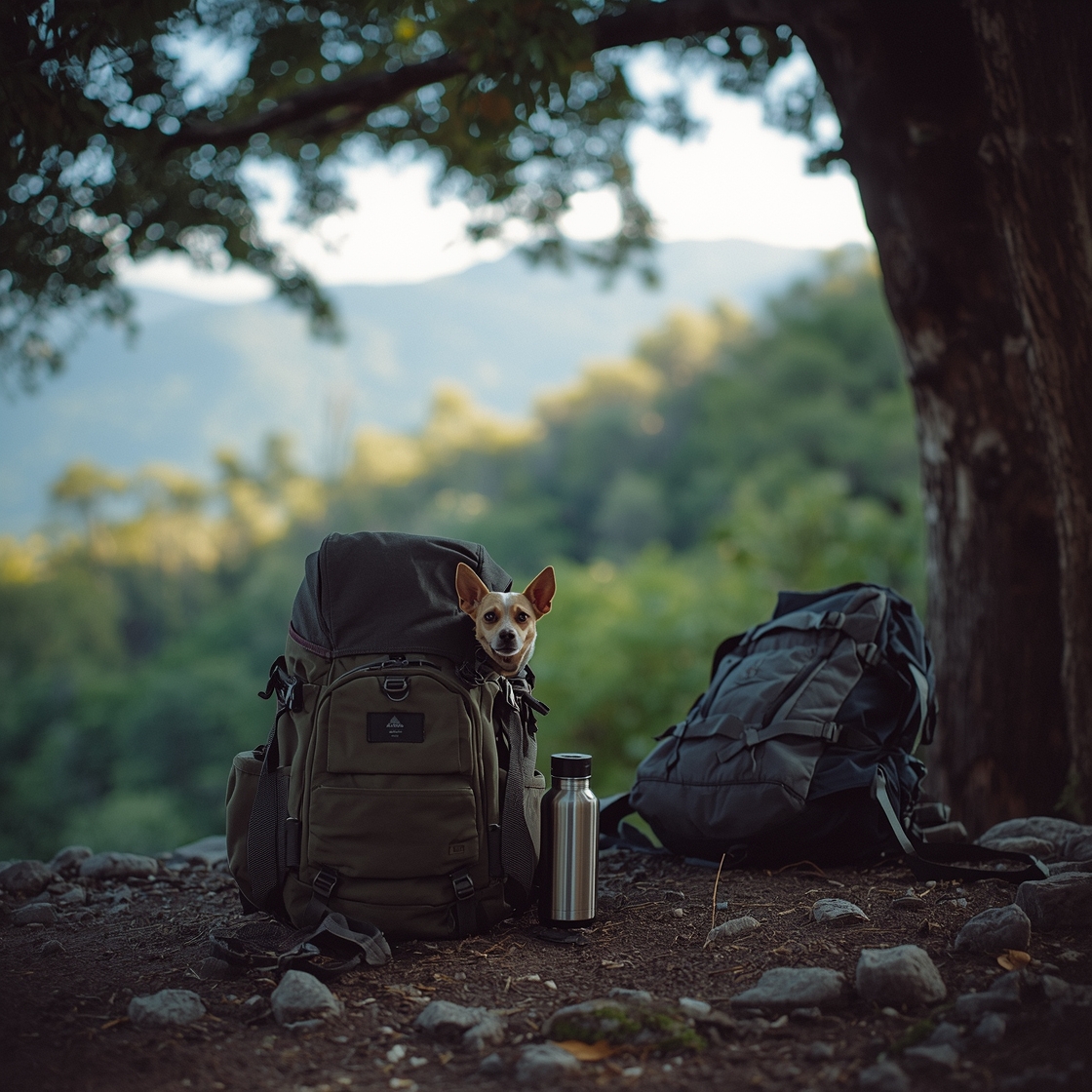
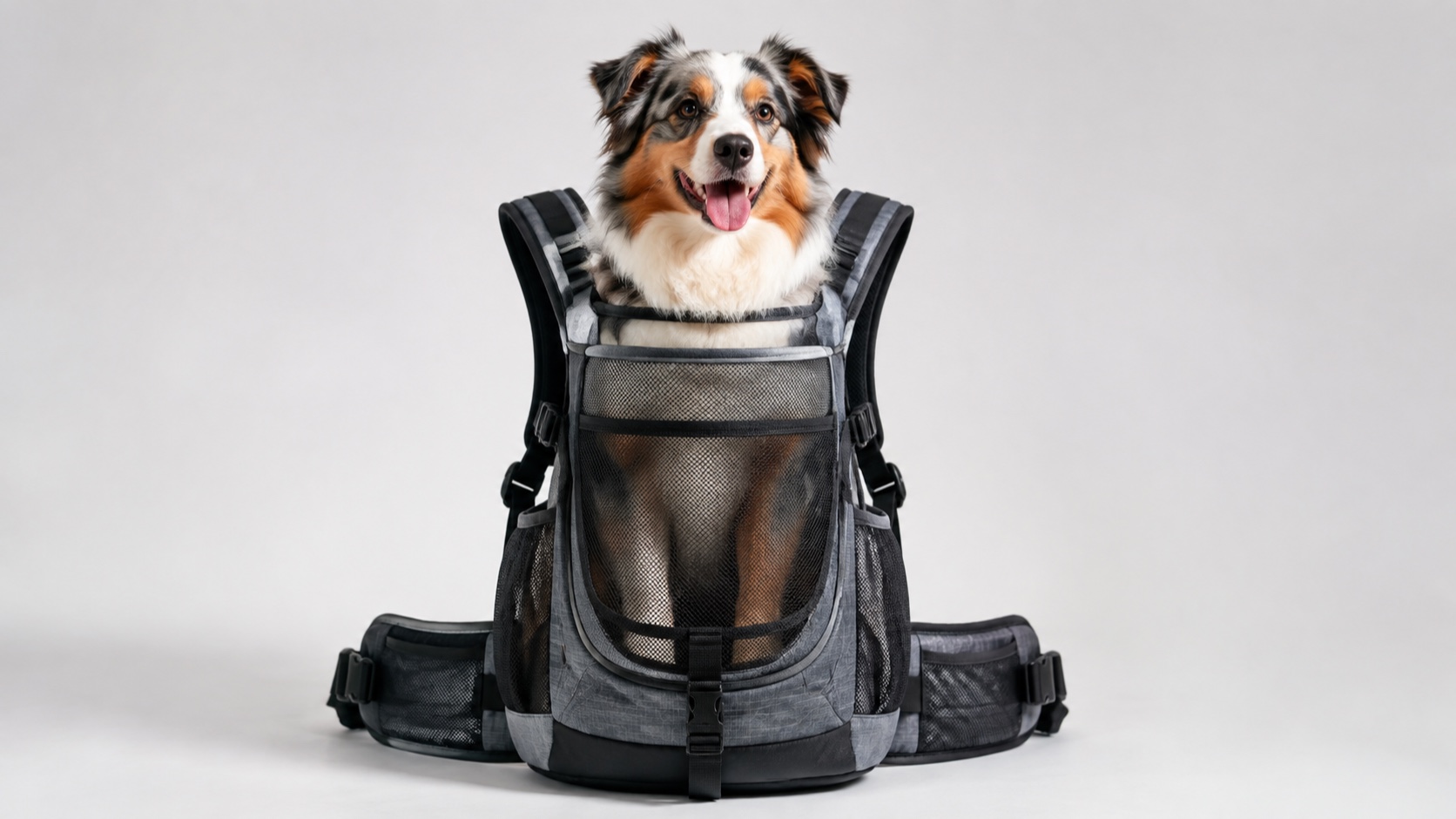
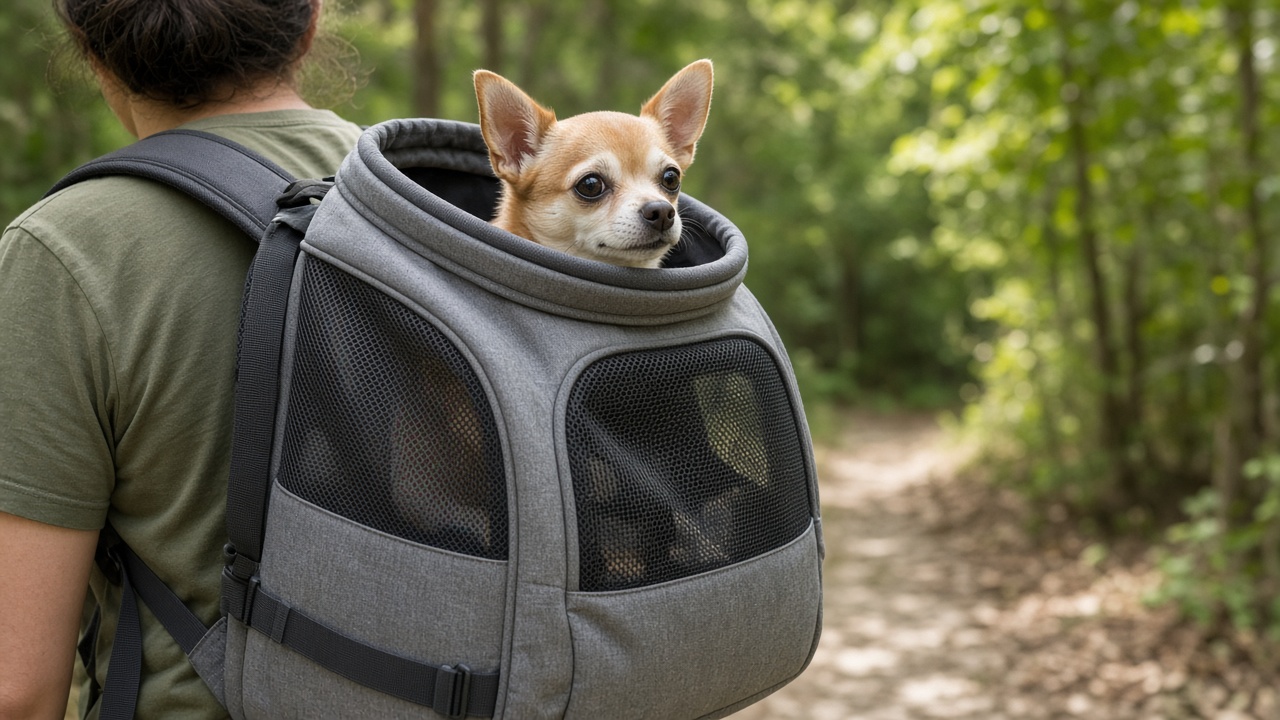
Use a carrier backpack (you wear it; the dog rides) when the dog cannot do a stretch of trail and you can actually carry the loaded weight. That is a small-dog hiking backpack or a hiking carrier backpack. Do not buy saddlebags for a dog that needs to be carried.
Use a stroller on sidewalks and trailhead roads, not roots. See the city stroller and small-dog stroller pages. Use a regular carrier for a car, lobby, or terminal — a dog-and-cat carrier or a wheeled travel carrier. Leave the dog home when the forecast is the constraint. AVMA: if it is hot for you it is hotter for the pet; never leave a pet in a parked car, even in the shade or with windows cracked.
Two objects named “dog hiking backpack”
1. Dog-worn saddlebag pack. The dog walks. Two pockets sit over the ribs. A harness chassis holds them on. This is Ruffwear Approach, Ruffwear Palisades, Ruffwear Front Range Day Pack, Outward Hound DayPak, Kurgo Baxter, Mountainsmith K9, and Non-stop Trail Quest. The load is the dog plus whatever you put in the pockets, including the empty pack.
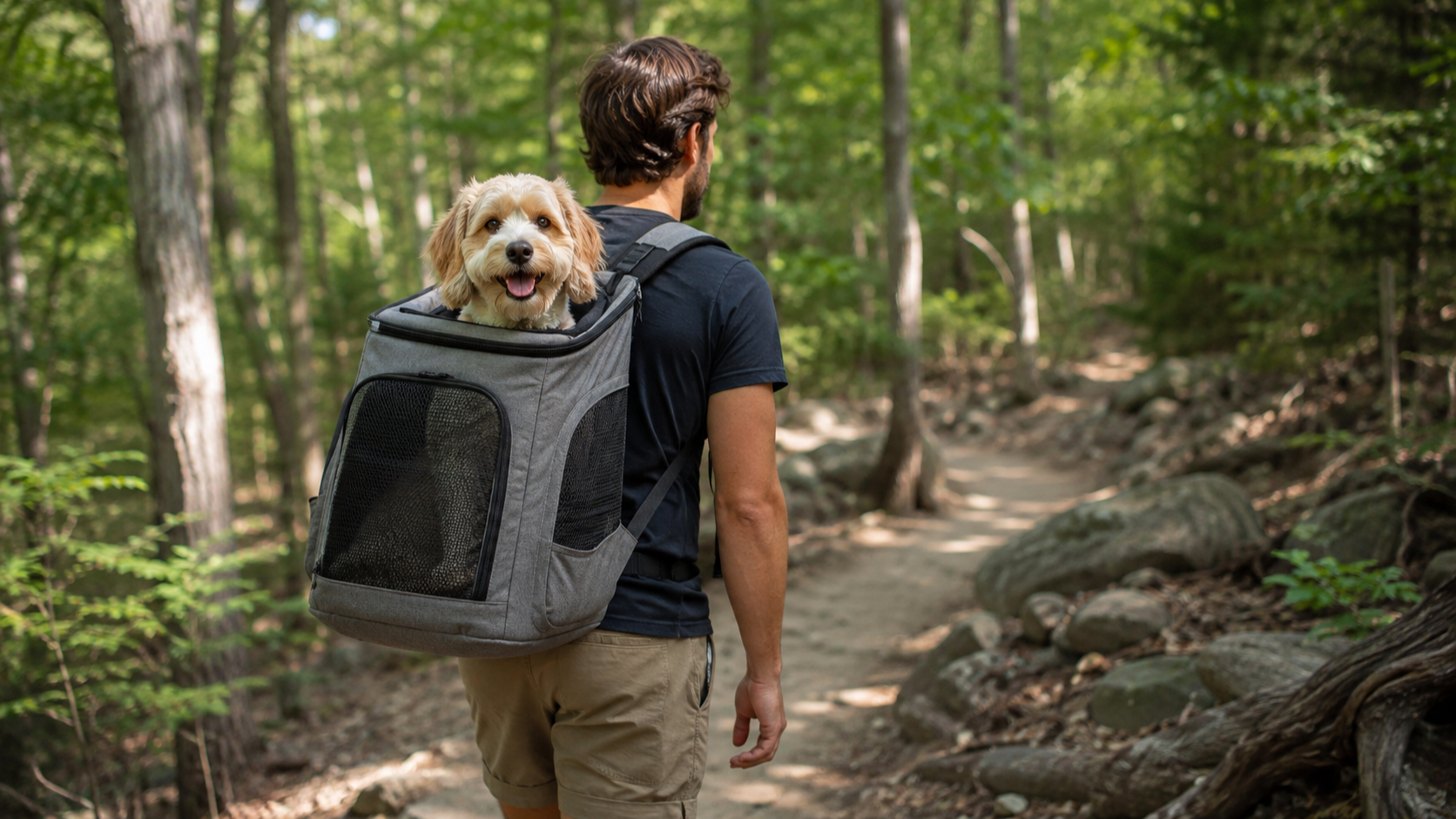
2. Human-worn carrier backpack. You put the dog in a bag. Leg holes or a sit-in cabin. Mesh sides. Shoulder straps on a person. That is a different article.
If the listing photo shows a dog wearing panniers, you are in category 1. If it shows a person’s chest with a dog’s head sticking out, you are in category 2. Do not mix the spec tables. A human-worn carrier weight cap is not a dog-worn load percentage.
Ruffwear’s Trail Runner is a third, narrower object: a running vest that carries two soft flasks, not a weekend’s food.
Decision framework (do this before you shop)
Hiking use has six hard edges. Match the pack to the dog and the route, not to a “best of” list.
1. Load — a ceiling is not a target
There is no lab score on this page. There are published manufacturer lines, and they do not all say the same thing.
Ruffwear prints the same sentence on Approach and on Palisades: the dog should carry no more than 25% of body weight, including the pack and its contents. The chooser page repeats 25% as a starting rule of thumb, then says fitness and breed affect how much a dog can carry, first-time pack dogs and seniors may want to go lighter, and puppies should wait until they are fully grown before carrying weight. An empty pack is how they suggest getting a young dog used to the straps.
Treat 25% as a published ceiling, not a comfort number, and not a number owner reports describe. A 40 lb dog at 25% is 10 lb total — pack plus contents. An Approach in size Medium already weighs 1.1 lb empty. A Palisades in size Medium on the current product page weighs 1 lb 6.4 oz empty. Those empty ounces count. Water is heavy. Food is heavy. A “light overnight” volume chart is not a license to fill every liter.
Work the bathroom-scale math before you buy liters.
- Weigh the dog.
- Write 25% of that weight if you are using a Ruffwear chart. Write 5–15% if you are using Non-stop’s occasional-dog line. Use the lower of any two numbers you are willing to believe.
- Weigh the empty pack of the size you will actually buy.
- Subtract. What is left is contents — water first.
A Medium Approach holds 13 L. Thirteen liters of water would be far past any of those percentages. Volume is not the limit. Mass is the limit. Buy the pack for the weight the dog can carry, then leave space empty.
2. Fit is girth, not breed name
Dog-worn packs are sized by rib-cage girth — the widest part of the chest, behind the front legs — unless the maker also asks for neck. Ruffwear Approach, Palisades, Front Range Day Pack, and Trail Runner all use the same girth bands:
| Pack size | Dog girth |
|---|---|
| XS | 17–22 in (43–56 cm) |
| S | 22–27 in (56–69 cm) |
| M | 27–32 in (69–81 cm) |
| L/XL | 32–42 in (81–107 cm) |
Ruffwear says if you are between sizes, size down on Approach and Palisades, and size up on Front Range Day Pack. Trail Runner says choose the smaller size if you are between. Same brand. Three opposite notes. Read the chart on the listing you buy.
The XS floor is 17 inches of girth. A lot of true toy dogs live under that number. They do not get a hiking saddlebag from this chart. They walk unladen, or they ride in a carrier.
Kurgo Baxter uses neck, chest, and a weight band that starts at 30 lb. Mountainsmith K9 uses overlapping weight bands (Small 20–50, Medium 40–90, Large over 80) and does not print girth inches. Non-stop Trail Quest wants neck and chest; those chest ranges overlap. Outward Hound DayPak is Medium and Large only and does not print inch ranges in the copy we fetched. Charts for each sit in the product sections below.
Measure standing, soft tape, after the dog exhales. Two fingers under a snug girth strap. If the bags rotate when the dog shakes, it is too loose — or the load is one-sided.
3. Balance both sides — or the pack becomes a lever
Every maker that bothers to write a load note says the same mechanical thing: even left and right. Non-stop is explicit: place the heaviest items toward the front, then compress. Ruffwear’s Approach and Palisades use radial-cut, weight-forward saddlebags and “flopper stoppers” to keep the bags against the body. Those are design claims.
What you can do at home:
- Put the same mass in each bag. Use a kitchen scale.
- Heavy items (water, food) close to the ribs, not out at the zipper.
- Soft items (jacket, waste bags) fill voids so contents do not slosh.
- Walk the hallway. Watch for rotation, a shortened stride, or a sudden sit.
If one bottle is full and the other is empty, you built a lever. some listings' “internal mesh divider distributes weight evenly” line was attached to a North Face pack we could not find. A divider does not fix a one-sided load.
4. Heat is the stop rule, not a mesh-panel count
A pack covers the back. Ruffwear’s Approach and Palisades chassis are laminated mesh and perforated foam. Mountainsmith prints mesh panels and perforated EVA foam against the body. Trail Runner’s main body is polyester air mesh because the job is running. Mesh is a hole in fabric. It is not a fan.
AVMA’s heat-stress list is the stop rule: anxiousness, excessive panting, restlessness, excessive drooling, unsteadiness, abnormal gum or tongue color, collapse. Those signs mean emergency veterinary care. Short-nosed and overweight animals are higher-risk on warm-weather exercise. If the dog is already panting on the walk to the car, do not add a loaded pack. You can carry the water. The dog does not have to.
5. Who should not wear a pack
Skip the saddlebag if the dog is not fully grown (Ruffwear: wait; Non-stop: about two years), is lame or has a named back/hip/shoulder problem, is short-nosed on a warm day, sits under the girth chart, panics in a harness, or is about to swim or scramble through brush that will catch the bags. Palisades can drop the bags and keep the harness; other packs come all the way off. “Let her feel useful” is Kurgo’s Baxter line. Usefulness is optional. Soundness is not.
6. Volume is a job, not a ranking
Ruffwear’s chooser maps four current objects:
- Front Range Day Pack — day hike
- Trail Runner — day hike and run (hydration)
- Approach — day hike and overnight
- Palisades — modular, multi-day
A Medium Trail Runner holds 1.2 L. A Medium Approach holds 13 L. A Medium Trail Quest holds 16 L. A Medium Mountainsmith holds 5 L per pannier (10 L total). Filling the largest number is how you blow the percentage.
Examples mapped to a job (not a ranking)
The products below exist on a 2026 manufacturer page with usable specs. They are not a top 5.
Day hikes and light overnights
Ruffwear Approach — day hike and light overnight
Where verified: Ruffwear’s current Approach product page and the pack-chooser page.
| Pack size | Dog girth | Empty pack | Capacity |
|---|---|---|---|
| XS | 17–22 in (43–56 cm) | 0.73 lb (0.33 kg) | 305 in³ (5 L) |
| S | 22–27 in (56–69 cm) | 0.94 lb (0.43 kg) | 610 in³ (10 L) |
| M | 27–32 in (69–81 cm) | 1.1 lb (0.50 kg) | 793 in³ (13 L) |
| L/XL | 32–42 in (81–107 cm) | 1.3 lb (0.59 kg) | 1,281 in³ (21 L) |
Between sizes: size down. Load line: no more than 25% of body weight, including the pack, and start lighter on a new pack dog. Maker list price on the page we read: $99.99 (sale price was also printed; prices move).
Trade-off: a real girth chart, a printed 25% ceiling, and a day-to-overnight volume — saddlebags are not removable. If you want the harness without the bags at camp, that is Palisades.
Ruffwear Front Range Day Pack — frontcountry day hike
Where verified: Ruffwear’s current Front Range Day Pack page.
This is the day-hike pack built on the Front Range harness platform. Radial-cut saddlebags, internal stretch-mesh pockets, five points of adjustment, three leash points (aluminum V-ring, chest webbing loop, tow loop), low-profile padded handle, foam-padded construction. Shell listed as 300D polyester ripstop, 100% recycled, nonfluorinated DWR and PU coating. Hand wash, air dry.
Between sizes: size up — the opposite of Approach. Do not assume one Ruffwear chart fits every SKU.
| Size | Girth | Empty pack | Capacity |
|---|---|---|---|
| XS | 17–22 in | 0.7 lb (0.32 kg) | 274 in³ (4.5 L) |
| S | 22–27 in | 0.95 lb (0.43 kg) | 488 in³ (8 L) |
| M | 27–32 in | 1.05 lb (0.48 kg) | 640 in³ (10.5 L) |
| L/XL | 32–42 in | 1.35 lb (0.61 kg) | 1,129 in³ (18.5 L) |
Maker price on the page we read: $79.99. The chooser calls this a day-hike pack, not an overnight pack. The Medium is 10.5 L against Approach’s 13 L. That is the job difference on paper.
Trade-off: the harness platform many dogs already wear, with less volume than Approach and a size-up note that will surprise you if you just bought an Approach.
Ruffwear Trail Runner — running vest, not a weekend pack
Where verified: Ruffwear’s current Trail Runner vest page.
Trail Runner is a running and hydration vest, not a weekend pack. Two zippered side pockets hold the included Hydrapak flasks (2 × 360 ml in XS; 2 × 500 ml in S–L/XL). Published capacity is 0.8–1.3 L. Same girth bands as the other Ruffwear packs; between sizes, choose the smaller size. Maker price on the page we read: $99.99. Wrong object if you wanted two nights of food.
Trade-off: the lightest published Ruffwear carry in this set — and almost no volume once the flasks are in.
Multi-day and high volume
Ruffwear Palisades — modular multi-day (read the listing you buy)
Where verified: Ruffwear’s current Palisades product page (palisades-pack) and a second live Palisades URL (palisades-pack-50203) that prints a different volume table.
On the current Palisades page this is the modular multi-day pack: removable saddlebags on a standalone harness, six adjustment points, three leash points, flopper stoppers. Same 25% including the pack sentence as Approach. Price on the page we read: $149.99.
Current-page size chart:
| Pack size | Dog girth | Empty pack | Capacity |
|---|---|---|---|
| XS | 17–22 in | 15 oz (0.43 kg) | 305 in³ (5 L) |
| S | 22–27 in | 1 lb 3 oz (0.54 kg) | 610 in³ (10 L) |
| M | 27–32 in | 1 lb 6.4 oz (0.64 kg) | 793 in³ (13 L) |
| L/XL | 32–42 in | 1 lb 11 oz (0.77 kg) | 1,281 in³ (21 L) |
Those liter numbers are the same as Approach. The job difference on this page is removable bags and a heavier chassis, not extra liters. The maker still calls Palisades its highest-volume pack. The printed table does not show a higher number than Approach. We are not resolving that marketing line.
Trade-off: the only Ruffwear pack in this set with bags you can take off at camp — and two live spec sheets that do not agree.
Non-stop Dogwear Trail Quest — high volume, bags stay on
Where verified: Non-stop Dogwear’s current Trail Quest product page.
Trail Quest is a hiking and weekend pack with an integrated Y-shaped harness. Head through the opening, four buckles, two neck adjustments, four chest straps, compression straps, handle, two leash points (neck and rear). Compartments are not removable; the FAQ says use compression to shrink volume. Outer: 100% polyester ripstop, water-repellent, not waterproof. Machine wash at 30 °C in a bag, or hand wash; no tumble dry. Price on the page we read: $139.99.
| Size | Neck | Chest | Volume | Empty weight |
|---|---|---|---|---|
| XS | 11.4–14.2 in | 15.7–22.0 in | 2 L | 9.6 oz (272 g) |
| S | 14.2–18.9 in | 17.7–23.6 in | 4 L | 11.6 oz (330 g) |
| M | 16.9–23.6 in | 22.8–33.1 in | 16 L | 19.5 oz (553 g) |
| L | 20.1–27.2 in | 28.3–40.2 in | 22 L | 23.6 oz (670 g) |
| XL | 23.6–33.1 in | 29.1–42.5 in | 36 L | 29.2 oz (827 g) |
The jump from Small 4 L to Medium 16 L is the number to stare at. A dog that fits Medium on chest can be asked to carry a lot of empty space. Empty space gets filled. Non-stop’s own FAQ: occasional dogs 5–15%; a strong, trained dog up to 30%; start empty; wait until about two years old. We are repeating the FAQ, not endorsing 30%.
Trade-off: the largest printed volumes in this set, on a pack whose bags do not come off.
Budget and mid-price saddlebags
Outward Hound DayPak — light saddlebag, Medium and Large only
Where verified: Outward Hound’s current DayPak page.
DayPak is a saddlebag-style pack with breathable mesh, adjustable straps, four expandable pockets (two per side), bright colors, reflective piping, and a D-ring for a leash. MSRP $39.99; the page we read also printed $20.00. Care: hand wash, warm water, mild soap, air dry. Sizes: Medium and Large, “based on girth.” The official page does not print the inch ranges in the copy we fetched. We are not guessing them.
The same page puts DayPak under toy-safety language: no toy is indestructible; do not leave toys with unsupervised pets; replace if damaged; intended for dogs only; keep out of reach of children. That is the maker’s own framing. Treat this as a light, cheap saddlebag, not a backcountry chassis.
Trade-off: the lowest printed price here — and no published girth inches, no published empty weight, no published load percentage, and toy-safety copy on a hiking SKU.
Kurgo Baxter — two sizes, weight bands start at 30 lb
Where verified: Kurgo’s current U.S. Baxter product page.
Baxter is a two-saddlebag pack with eight adjustment points, a padded handle, rear-mounted leash hook, reflective trim, and what Kurgo calls ergonomic spine support. Care: machine wash gentle or hand wash; air dry. Price on the page we read: $44.96.
| Size | Neck | Chest | Dog weight |
|---|---|---|---|
| Baxter | 17–24 in (43–61 cm) | 27–40 in (69–102 cm) | 30–85 lb |
| Big Baxter | 21–33 in (53–84 cm) | 30–48 in (76–122 cm) | 50–110 lb |
The U.S. page we fetched does not print a liter number. Retailer listings often do. We are not importing those liters. Kurgo also does not print a 25% line on this page. Use a veterinarian’s number, or stay inside the more conservative maker line you already have from Ruffwear or Non-stop. Do not fill the bags because they look empty.
A dog under 30 lb is outside both bands. That dog is not a Baxter dog.
Trade-off: a real neck-and-chest chart at a mid price — with a 30 lb floor and no printed volume on the official U.S. page.
Mountainsmith K9 — panniers sized by overlapping weight bands
Where verified: Mountainsmith’s current K9 product page.
K9 is a two-pannier pack: 4-point chest harness, independently adjustable back harness, single belly strap, padded grab handle, metal D-ring, mesh and perforated EVA foam against the body. List price $79.95. Mountainsmith calls the torso “vet approved” by a local Colorado veterinarian. That is a maker story, not a certification.
| Size | Maker weight band | Empty weight | Volume (each pannier) | Pannier box |
|---|---|---|---|---|
| Small | 20–50 lb, small girth | 16 oz / 0.45 kg | 183 in³ / 3 L | 9.5 × 8.25 × 2.25 in |
| Medium | 40–90 lb, medium girth | 19 oz / 0.55 kg | 305 in³ / 5 L | 12.25 × 8.25 × 3 in |
| Large | over 80 lb, large girth | 22.5 oz / 0.63 kg | 549 in³ / 9 L | 13.5 × 9 × 3.25 in |
Two panniers means Small is 6 L total, Medium 10 L, Large 18 L. The weight bands overlap. A 45 lb dog sits in Small and Medium. Mountainsmith does not print girth inches. Measure, then use the return.
Trade-off: printed pannier liters and empty weights at a mid price — overlapping bands and no tape-measure girth table.
How to fit, load, and take it off
This is process, not a product score.
Empty first. Loosen every strap. Approach and Palisades usually need a leg through the chassis; Non-stop goes over the head, then four buckles. If the dog freezes, stop.
Fit. Two fingers under the girth strap. Bags over the ribs, not the hips or the neck. The handle is for a boost over a log, not for dangling a loaded dog.
Load. Even left and right. Heavy items inboard and forward. Walk the block empty, then with a bottle’s worth of weight, then with the real load on a short outing. Ruffwear: start light. Non-stop: add weight over several weeks.
On the trail. If the stride shortens, the pack rotates, or the dog sits and stares, strip weight or take the pack off. AVMA heat-stress signs beat your pace.
After. Ruffwear and DayPak: hand wash, air dry. Baxter: gentle cycle or hand wash, air dry. Trail Quest: 30 °C in a bag or hand wash, no tumble. Mountainsmith’s page we read did not print a wash cycle.
Pockets hold the dog’s water (only what still sits under the percentage), a trail portion of food, waste bags, and a first-aid roll your veterinarian told you to carry. Not your stove. Not some listings' “15 lb of food, water, and gear.” Approach does not list included bladders. The Palisades-50203 page does. Trail Runner includes flasks. Read the carton.
Frequently asked questions
Can a small dog wear a hiking backpack?
Only if the girth chart says yes. Ruffwear’s floor is 17 in. Non-stop XS chest starts at 15.7 in. Baxter starts at 30 lb. DayPak is Medium and Large only, inches unpublished. Most small dogs that match the other hiking-backpack URL should walk unladen or ride in a carrier you wear.
Does my dog need a backpack if it already hikes?
Often, no. Bring the pack when there is a real shared load — water on a dry ridge, the dog’s own food on an overnight — and the dog has already worn the empty chassis at home. Do not put a fit, sound dog in bags for the photo.
The bottom line
Measure girth. Weigh the dog. Weigh the empty pack. Stay under the maker ceiling you are willing to use — Ruffwear’s 25% including the pack, or Non-stop’s tighter occasional line — and under whatever your veterinarian says. Prefer the walk when the body can do the route. Prefer a carrier you wear when the dog cannot. Prefer a stroller when the ground is a sidewalk. Prefer the house when the day is the constraint.
Believe the spec table — 17-inch girth, 30 lb Baxter floor, 5 L versus 13 L versus 16 L, bags that come off versus bags that do not — not a style name, and not a test
Looking for current listings in this category?
SOURCES
Manufacturer product pages (body uses brand names only):
- Ruffwear Approach: https://ruffwear.com/products/hiking-dog-pack-approach
- Ruffwear Palisades (current modular page): https://ruffwear.com/products/palisades-pack
- Ruffwear Front Range Day Pack: https://ruffwear.com/products/front-range-day-pack
- Ruffwear Trail Runner: https://ruffwear.com/products/trail-runner-vest
- Ruffwear pack chooser: https://ruffwear.com/pages/choosing-the-right-dog-pack
- Outward Hound DayPak: https://outwardhound.com/daypak-saddleback-dog-backpack/
- Kurgo Baxter: https://www.kurgo.com/p/baxter-dog-backpack/K01587
- Mountainsmith K9: https://mountainsmith.com/products/k9-dog-pack-2019
- Non-stop Dogwear Trail Quest: https://www.nonstopdogwear.com/products/trail-quest-dog-backpack
Safety / weather (not product scores):
- AVMA warm-weather pet safety: https://www.avma.org/resources-tools/pet-owners/petcare/warm-weather-pet-safety
Load Rating vs. Dog Weight: Best Dog Travel Backpack for Hiking
| Hiker fitness | Max dog load | Pack rated | Vent panels |
|---|---|---|---|
| Casual | 15–20 lb dog | 25 lb | 3 mesh sides |
| Regular | 20–25 lb | 30 lb | Full back mesh |
| Athletic | 25–30 lb | 35 lb | Frame + mesh |
Dog sitting height plus 2 in must clear dome—ears should not fold against neck.
Best Dog Travel Backpack for Hiking — Feature Desk
| Feature | Trail need | Skip if | Price band |
|---|---|---|---|
| Hip belt | Mandatory | — | $80–150 |
| Hydration sleeve | Long hikes | Urban carry | +$15 |
| Collapsible bowl | Yes | Day trip <2 mi | $10 add |
| Padded base | Rocky terrain | Smooth paths | $90–180 |
Practice 30-minute home wears before summit day—zipper placement matters for one-hand treat access.