
The best pet first aid kit is the pouch you can reach that actually contains gauze, cohesive bandage, saline or wipes, tweezers, gloves, and a written card with your vet plus ASPCA Animal Poison Control (888) 426-4435 — not expired human ibuprofen. The We read the titles and descriptions of 7 SKUs. Listed snapshots ran $22.68–$99.99 (median $34.99, a 4.4× spread). 1 of 7 is the trail floor (Adventure Medical Kits Trail Dog $22.68). 4 of 7 sit $27–$36 (RHINO RESCUE $27.89; Dog First Aid Kit $34.95; EVERLIT 95-pc $34.99; ARCA PET car $35.90; GPUSFAK $36.09 is the fifth in that band). 1 of 7 is the thermometer bundle (PetVet Medic $99.99). 0 of 7 legally let you “vet-approve” a drug at home. A $23 trail kit you carry beats a $100 thermometer kit that lives in a hall closet you pass on the way to the ER.
The job is bleeding control, poison numbers, and transport. Buy class. Add the card. Leave human NSAIDs out.
Our guides are reader-supported. This article may contain affiliate links. As an Amazon Associate we may earn a commission if you buy through links, at no extra cost to you.
Wound care at home after the ER is a different conversation. Everyday ear wipes are a different object — pet ear cleaning wipes for cats. .
Quick picks at a glance
- Best listed lightest trail pouch: Adventure Medical Kits Trail Dog Medical Kit — $22.68. Pack weight. Smaller dressings.
- Best listed rugged outdoor pouch: RHINO RESCUE Dog First Aid Kit — $27.89. Weather-resistant story. Instructions can be thin.
- Best listed generic home pouch: Dog First Aid Kit — $34.95. Labels / compartments. Bag may be soft.
- Best listed piece-count: EVERLIT Pet Medic 95 Pcs — $34.99. Count marketing. “Vet-Approved” is the title. Bulk.
- Best listed car-shaped: ARCA PET Cat & Dog First Aid Kit for Car — $35.90. Glove-box job. Not an ICU.
- Best listed mid pouch: GPUSFAK Dog First Aid Kit — $36.09. Starter band. Tool quality varies.
- Best listed thermometer bundle: PetVet Medic with Thermometer & Bandages — $99.99. Highest sticker. Confirm you will use a rectal thermometer.
What each kit is actually for
Four jobs. A 95-piece bag you cannot unzip in the dark is a junk drawer. A trail kit without a phone number card is a bandage collection.
| Job | What actually works | Category | Fail if you skip it |
|---|---|---|---|
| Day hike, limited ounces | Light trail pouch + your own card | AMK Trail Dog $22.68 | Leaving the kit in the car at the trailhead |
| Road trip / glove box | Car-shaped case that stays in the vehicle | ARCA PET $35.90 | Human Advil “for the dog” |
| Home closet, two species | Organized pouch + thermometer if you will use it | Dog kit $34.95; PetVet $99.99 | Expired saline from 2019 |
| Piece-count / “fully stocked” feel | High SKU count | EVERLIT $34.99 | Count without gauze that fits a paw |
Before you shop: (1) gauze + cohesive wrap + gloves must be in the bag — count the pieces yourself, (2) add a laminated card: regular vet, 24-hour ER, ASPCA APCC 888-426-4435, (3) no human ibuprofen, naproxen, or acetaminophen for dogs or cats, (4) the kit stabilizes for transport — it does not treat shock, GDV, or toxin at home. Fail gate 3 and this checklist is how you shop for a second emergency.
AVMA and AAHA public materials treat first aid as bridge care. Best Friends Animal Society publishes a pet-kit checklist many owners reuse. This desk reprints the idea of a checklist.
What the best pet first aid kit can and cannot do
A good kit lets you apply pressure, cover a wound, rinse debris, pull a visible tick or splinter, and call the right number. It does not replace fluids, surgery, oxygen, or antivenom. It does not make you a veterinarian.
Human medicine in a pet kit is how owners poison dogs and cats. Ibuprofen and acetaminophen are classic toxicology cases. The ASPCA APCC exists because people guess. Put the number on the card. Do not put the pills in the pouch.
“Vet-Approved” on EVERLIT’s card title stays on the card. It is not a review by a veterinarian hired by Thepetbench.
We only recommend matching kit class to where the pouch will live. We are not saying we timed seven bleeds.
Disclosure: this article contains affiliate links. If you buy through them we may earn a commission at no extra cost to you.
How the desk scored a pet first aid kit
this comparison uses four visible signals plus the listed sticker:
- Class. Trail / car / generic pouch / piece-count / thermometer bundle.
- Core contents you can verify. Gauze, wrap, rinse, gloves, tweezers — not just “95 pcs.”
- Where it lives. Pack, glove box, or hall closet. A kit in the wrong room is a zero.
- Instruction honesty. A card beats a QR code that needs signal on a canyon trail.
Price is not a quality grade. AMK $22.68 on the hike is the honest kit. PetVet $99.99 in a closet you forget is a $100 paperweight.
Want current listings? See pet first aid kits on Amazon →
How these products compare on labels and price
| Tool (this URL) | Listed price | Class | Lives where | Honest limit |
|---|---|---|---|---|
| Adventure Medical Kits Trail Dog | $22.68 | Trail pouch | Pack | Dressing size |
| RHINO RESCUE Dog First Aid Kit | $27.89 | Rugged pouch | Pack / camp | Thin instructions |
| Dog First Aid Kit | $34.95 | Generic organized | Home | Soft bag |
| EVERLIT 95 Pcs Vet-Approved | $34.99 | Piece-count | Home / car | Bulk; title language |
| ARCA PET Car Kit | $35.90 | Car case | Vehicle | Not wilderness-light |
| GPUSFAK Dog First Aid Kit | $36.09 | Mid starter | Home | Tool grade varies |
| PetVet Medic + thermometer | $99.99 | Thermometer bundle | Home | Price; you must use it |
Desk kit math: AMK $22.68 if ounces matter. ARCA $35.90 if the car is the only reliable location. EVERLIT $34.99 or Dog First Aid Kit $34.95 if you will inventory the bag twice a year. PetVet $99.99 only if a thermometer is the missing tool and you already know how your veterinarian wants you to take a temperature. RHINO $27.89 if weather is the pouch job. GPUSFAK $36.09 if you need a starter and will upgrade gauze yourself.
The 7 cards on this URL
1. ARCA PET Cat & Dog First Aid Kit for Car
Best for: a vehicle-shaped kit that stays in the glove box or trunk for road trips.
Listed $35.90. Cat and dog in the title. Compact is the pitch. Wound-care basics in owner notes.
Honest drawback: not a backpack. Heat in a parked car ages adhesives and liquids. Inventory in spring and before a long drive. Not an “advanced medical” bag.
2. Dog First Aid Kit
Best for: a labeled home pouch when you want compartments more than a brand story.
Listed $34.95. Generic title. Organization is the owner cluster.
Honest drawback: vague SKU name — confirm the listing photo matches the bag you receive. Soft fabric can tear on a zipper. Still add your ER card. Not a cat-specific muzzle story.
Check Dog First Aid Kit listings →
3. PetVet Medic Cat & Dog First Aid Kit with Thermometer & Bandages
Best for: a higher-sticker bundle when a digital thermometer is the tool you were missing.
Listed $99.99. Thermometer and bandages in the title. “Professional-grade” is marketing.
Honest drawback: price vs $35 pouches. A thermometer you will not use is waste. Rectal temps on a painful animal can be a bite. Ask your veterinarian what number means “go now” for your pet. This desk will not publish a universal fever cutoff as a house measurement.
4. EVERLIT Pet Medic First Aid Kit | 95 Pcs Vet-Approved Medical
Best for: a high piece-count bag when you will inventory and discard junk items.
Listed $34.99. 95 pcs in the title. “Vet-Approved” is brand language on the card — we do not repeat it as our credential.
Honest drawback: bulk and filler. Count is not quality. Open it the day it arrives. Pull anything you would not use. Add the phone card. Confirm gauze sizes vs a cat paw vs a mastiff pad.
5. Adventure Medical Kits Trail Dog Medical Kit
Best for: a named outdoor-medicine brand in a light trail pouch.
Listed $22.68. Lowest sticker. AMK is a known wilderness-kit family. Weight-to-utility is the owner cluster.
Honest drawback: smaller dressings. A large laceration needs more gauze than a day-hike pouch. Pair with the car kit (ARCA) for the drive home. Not a snake-bite “cure.”
Check AMK Trail Dog listings →
6. RHINO RESCUE Dog First Aid Kit
Best for: a tougher outer bag when camp and weather are the pouch job.
Listed $27.89. Water-resistant / rugged language in owner notes. Access pouches.
Honest drawback: instruction card can be thin. Print your own. A tough bag with mystery packets is still a mystery. Inventory on arrival.
7. GPUSFAK Dog First Aid Kit
Best for: a mid-price starter when you will upgrade scissors and gauze yourself.
Listed $36.09. Basics in the owner cluster. Accessible price vs PetVet.
Honest drawback: tool grade. Cheap tweezers bend. Replace. Still no human NSAIDs. A starter is a start, not a field hospital.
Contents / location / legal
| Class on this URL | Must-add yourself | Location fail | Legal / safety fail |
|---|---|---|---|
| Trail (AMK $22.68) | Phone card; extra gauze | Kit left in car | Treating rattlesnake at camp |
| Rugged (RHINO $27.89) | Printed steps | Soaked unlabeled packets | Same |
| Home generic ($34.95) | ER + APCC card | Closet behind holiday bins | Human pills |
| Piece-count (EVERLIT $34.99) | Cull filler; card | Unopened bag | Title ≠ credential |
| Car (ARCA $35.90) | Heat-check dates | Summer dash | Same pills |
| Starter (GPUSFAK $36.09) | Better tweezers | Never opened | Same |
| Thermometer (PetVet $99.99) | Know the use rule | Closet ornament | “Treating fever” at home |
A class without a card is a silent bag. A class without an inventory date is expired tape. This checklist is both columns.
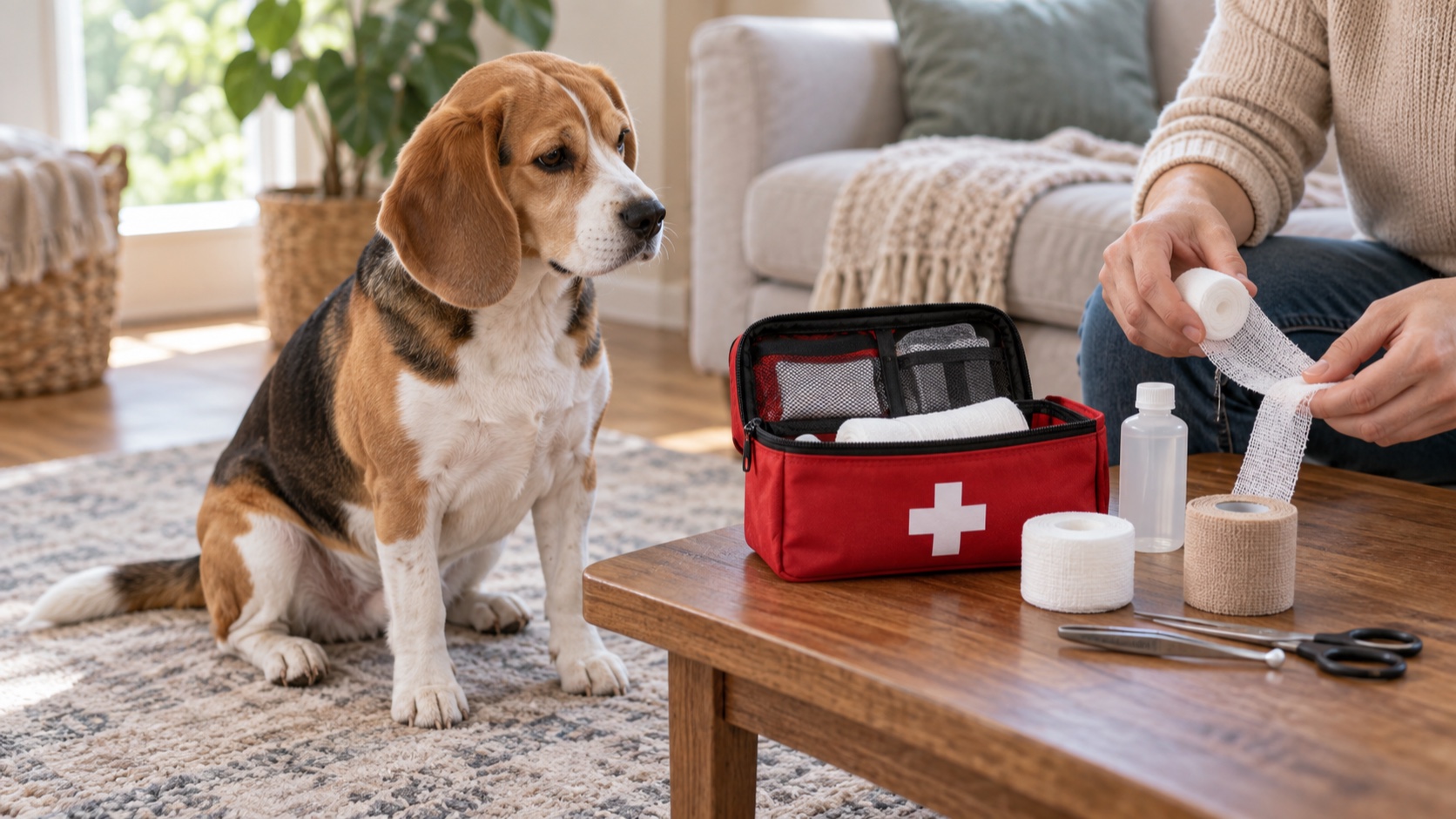
Core contents (checklist, not a house test)
Public checklists (Best Friends, many ER handouts) converge on:
- Sterile gauze pads (more than one size)
- Gauze roll
- Self-adhesive / cohesive wrap (the kind that sticks to itself, not necessarily to fur)
- Saline flush or clean rinse
- Antiseptic wipes that are not a mystery alcohol bomb on open tissue if the listing is harsh — when unsure, saline first
- Nitrile gloves
- Tweezers / tick tool
- Blunt scissors
- Instant cold pack (optional)
- Muzzle or a necktie plan for a painful dog (cats: towel, not a guess)
- Digital thermometer only if you will use it as taught
- Your medications the veterinarian already prescribed for this animal
- The card: vet, ER, APCC, your name, pet name, weight, allergies
This desk did not open seven factory bags. Open yours. Photograph the contents. Restock what you use.
The first five minutes (bridge care, not a protocol you invent)
- You are safe. A bitten owner is a second patient.
- Move off the road / away from the other dog.
- Gloves.
- Pressure on bleeding with gauze. Add more; do not peel the clot to “look.”
- Call the ER or APCC while someone else drives if you can.
- Transport. Keep the animal warm, quiet, and restrained. Do not give food or a “just in case” pill.
Heatstroke, bloating, seizures, collapse, labored breathing, pale gums, known toxin, eye trauma, and snakebite are go now patterns owners describe. This page will not triage your living room.
Vet-labeled meds, legal limits, and what not to pack
Prescription drugs belong in the kit only if they are this pet’s, in date, and your veterinarian told you when to use them (e.g., a seizure rescue your clinic already prescribed). Do not share.
Do not pack:
- Human ibuprofen, naproxen, aspirin “for dogs” without a current veterinary order
- Acetaminophen (especially cats)
- Mystery essential oils
- Chocolate, raisins, xylitol gum you “might need to identify” — take the wrapper to the ER instead of tasting it
Hydrogen peroxide for “induced vomiting” is a call APCC / veterinarian first problem. Wrong toxin + vomit can make things worse. This desk will not publish a home dose.
Worked example: three households, three pouches
Household A — apartment, one cat, one car. ARCA $35.90 in the trunk plus a tiny home pouch (Dog First Aid Kit $34.95 or EVERLIT $34.99) by the carrier. Card on both.
Household B — weekend trail, 40 lb dog. AMK $22.68 in the pack. RHINO $27.89 if the pack already takes weather. Gauze refill from a pharmacy. ER address in the phone offline.
Household C — senior dog, clinic already watching temperature. PetVet $99.99 if the thermometer is the gap. Still the card. Still the ER plan. A number on a screen is not treatment.
How to choose the best pet first aid kit this month
- Name the job: trail, car, home, piece-count, or thermometer.
- Open the listing photos. Find gauze and wrap.
- Plan the room the bag will live in.
- Print the card the same day.
- Set a calendar reminder every 6 months to check dates.
- Stop if you were shopping for a kit so you could avoid an ER you already need.
The useful best pet first aid kit purchase is the class you can grab.
Frequently asked questions
What is the best pet first aid kit?
The best pet first aid kit on this URL is class-matched: AMK Trail Dog $22.68 for a light pack; ARCA PET $35.90 for the car; EVERLIT $34.99 or Dog First Aid Kit $34.95 for a home inventory bag; PetVet Medic $99.99 if a thermometer bundle is the actual gap. There is no single winner. There is a location job.
What should be in a pet first aid kit?
Gauze, cohesive wrap, saline or gentle rinse, gloves, tweezers, scissors, and a card with vet / ER / ASPCA APCC (888) 426-4435. Add this pet’s prescribed meds only. Skip human NSAIDs and acetaminophen.
Can I use a human first aid kit for a dog or cat?
Some gauze is gauze. The failures are the drugs, the lack of a muzzle plan, and the lack of pet ER numbers. A human kit plus a card can be a start. These seven cards exist because owners want a pet-shaped pouch. Inventory either way.
Are “vet-approved” pet first aid kits actually approved?
EVERLIT’s card title includes “Vet-Approved.” That is marketplace language. This desk did not verify a veterinary board approval. Treat it as a 95-piece bag at $34.99.
Should I induce vomiting at home?
Not from this page. Call ASPCA APCC or your veterinarian. Some toxins get worse if vomited. Some animals cannot protect their airway.
Do I need a thermometer in a pet first aid kit?
Only if you will use it the way your veterinarian taught and you know when the number means “drive.” PetVet $99.99 is the thermometer-class card. A $23 trail kit without one is still a valid trail kit.
Related pages
- Best pet ear cleaning wipes for cats
- Best dog tick mosquito repellent spray
- Best enzymatic cleaner for pet stains
How we researched this guide
Desk research. The We read the titles and descriptions of seven current listings on listed price, class (trail / car / home / count / thermometer), and whether a owner must still add a phone card. We pointed at AVMA/AAHA bridge-care framing, Best Friends-style checklists, and ASPCA APCC. ” Nothing here is a veterinary emergency credential.
Limitations: factory fills vary by lot; liquids expire; prices move. Shock, toxin, GDV, and airway emergencies are a hospital — not a fourth Amazon pouch.
Keep a simple log: purchase date, inventory date, what you used, what you restocked. Patterns beat a second PetVet you never unzip.
A 4 lb cat and a 90 lb dog are not the same category row. The cat needs a carrier plan and a towel. The dog may need a muzzle plan. Gauze sizes differ. One $34.99 EVERLIT can serve both if you add the right extras.
If the household’s real complaint is “we live 90 minutes from an ER,” a kit is not an ER. Map the 24-hour clinic. Practice the crate in the car. The $22.68 AMK does not include a surgeon.
Show every adult in the house where the bag is. That is setup. A kit behind the snow boots is a hide.
Wet, muddy trail + a puncture: rinse what you can, cover, drive. Do not pack the wound with ointment because a YouTube said so. The ER will thank you for a cleaner field.
If you also wanted oxygen, a staple gun, or prescription antibiotics, those are not on these seven cards. Do not rename GPUSFAK into a field hospital.
Extra desk notes: kits that fail on a Tuesday
Heat in the car. Glue melts. Saline cooks. Rotate the ARCA bag.
Kids find scissors. High shelf at home. Car kits stay in a locked trunk if that is your household.
QR-only instructions. Print a page. Canyons do not have LTE.
One gauze left. Restock the day you use it.
Tick tool without a plan. Save the tick in a bag if your veterinarian wants it. Do not twist folklore if the clinic said otherwise.
Cat in a dog muzzle. Wrong tool. Towel.
Returns. “Missing the thermometer” on a $23 AMK is the class. “95 pieces of junk” is why you inventory EVERLIT day one. “Bag melted” is the car-heat story.
Keep spare cohesive wrap in the same bin as leashes. This checklist fails when the last wrap is a dried rubber band.
Emergency-shaped notes (still not triage)
Bleeding you cannot stop with pressure. Drive. Call ahead.
Toxin. APCC + packaging. Do not wait for “symptoms.”
Heat. Cool water on the body as you go — follow current veterinary first-aid pages, not ice-water shock folklore. This desk is not your cooler protocol.
Cold / hypothermia. Insulate. Drive.
Eye. Do not rub. Cover loosely. Drive.
Seizure. Time it. Do not put hands in the mouth. Drive if clustered or first-time — your veterinarian’s rule wins.
Bite from another animal. Wound + rabies / legal story. Clinic, not a wipe.
When a pet first aid kit is the wrong buy
- You needed an ER visit an hour ago.
- You wanted a kit so you can dose human painkillers.
- You will never open the bag to see what is in it.
- You wanted a cat carrier, not gauze.
- You thought 95 pieces replaced a veterinarian.
Buy class. Buy the card. Buy the inventory habit. That is the checklist.
Training, neighbors, and the human half
A 10-minute family walkthrough beats a 95-piece mystery. Point at the gauze. Point at the card. Point at the carrier.
If you travel, AMK $22.68 in the backpack and ARCA $35.90 in the car is a two-kit stack. Leave PetVet $99.99 at home unless the thermometer is the trip job.
Night-time: a flashlight in the bag earns its pocket. Phone light dies. You already knew that.
A dog who only “needs first aid” because the yard is full of foxholes is a fence problem. The kit is the layer. The yard is the product.
Neighbors who watch the pet should know the ER name. A sticky note on the fridge is a better “kit” than a $99 bag they cannot find.
Insurance / wellness plans do not change the checklist. They change the ER bill. Still go.
Two-kit homes and the $35 band
Look at the $34–$36 cluster: Dog First Aid Kit $34.95, EVERLIT $34.99, ARCA $35.90, GPUSFAK $36.09. That is four cards within about a dollar. the listing review difference is shape and story, not a quality score this desk invented. Buy the car shape for the car. Buy the count bag for the closet. Do not buy all four hoping one is “the winner.”
RHINO $27.89 and AMK $22.68 are the outdoor pair. One weather bag, one brand-trail bag. Pick the pack you already carry.
PetVet $99.99 is the outlier. Pay it for the thermometer bundle, not for a feeling of “more medical.”
Muzzle, towel, and the bite you did not expect
Painful animals bite people they love. A basket muzzle that the dog already wears at the groomer is better than a first-time wrestle. Practice when nobody is bleeding. For cats, a thick towel and a second pair of hands beat a dog muzzle.
This is not a dominance lecture. It is how you still have fingers to drive.
Poison, plants, and the number on the card
ASPCA Animal Poison Control is (888) 426-4435. A consultation fee may apply. Your veterinarian or a local ER may also call a toxicologist. Put both numbers on the card. Lily plants (cats), xylitol, grapes, rodenticides, and human antidepressants are the stories that fill those phone lines. A kit does not contain an antidote for those. The phone does.
If you hike, know whether you are in rattlesnake country. A kit does not contain antivenom. A plan to reach a clinic that does is the product.
Inventory calendar (desk method, not a lab)
January: check car kit after holiday travel. June: check trail kit before heat. October: check home kit before holiday cooking (bones, chocolate, guests who feed). Photograph contents each time. That is the only “trial” this desk will endorse — a camera and a date.
Expired sterile water is water you do not trust in an eye. Expired gloves still beat skin if that is all you have; restock anyway.
Breed- and body-shaped notes (still go to the ER)
Brachycephalic. Heat and airway. The kit is a ride, not a tracheostomy.
Sighthounds. Thin skin tears. More gauze.
Giant breeds. GDV is a clock. The kit is not a trochar you learned on a video.
Toy breeds. Hypoglycemia / heat / cold. Karo on the gums is a veterinarian-taught move for some diabetics — do not invent it.
Cats. Hide pain. A “fine” cat after a fall is still a radiograph candidate. The kit gets you to the car.
When two emergencies happen
A bleeding dog and a bitten human: human ER can be the first 911. The pet still needs the other adult and the card. Do not be a hero in a parking lot.
Closing the loop
The best pet first aid kit is the one in the room you are standing in, with gauze you have seen, and a number you have tested by reading it out loud. AMK $22.68, ARCA $35.90, EVERLIT $34.99, and PetVet $99.99 are different rooms. Buy the room.
We compiled stickers and classes. Your veterinarian and the ER write the rest.
Carriers, leashes, and the kit that cannot walk
A first aid pouch without a carrier (cat) or a leash you can grab (dog) is a kit that stays on the floor while the animal hides. Park the carrier next to the home bag (EVERLIT $34.99 or Dog First Aid Kit $34.95). Park a slip lead next to the car bag (ARCA $35.90). the listing review assumes you can move the patient.
Practice loading the carrier on a calm Tuesday. An emergency is a bad first lesson. This is not a training credential. It is why $99 PetVet thermometers sit unused while the cat is under the bed.
Flashlight, gloves, and the night yard
A puncture at 10 p.m. needs light. Phone lights die. A cheap headlamp in the AMK $22.68 pocket or the RHINO $27.89 pouch earns its grams. Extra gloves go in the same zip. Blood on your hands is how you drop the keys.
Wildlife, livestock, and the “just a scratch”
Fox, raccoon, and unknown-dog bites are rabies and legal stories in many counties. Clean what you can. Drive. Report what your local rules require. A $36 GPUSFAK does not include a titer.
Livestock disinfectant from the barn is not a pet wound protocol. Saline first. Clinic next.
Water, boats, and the near-drowning
A trail kit is not a life jacket. If the household boats, the life-jacket URL is a different page. After a water incident: airway, warmth, ER. Do not pack the AMK with “drowning remedies.”
Bandage mistakes that waste the drive
Wrapping too tight kills a paw. Cohesive wrap should admit a finger. Do not wrap a whole limb like a mummy because the bag had 95 pieces. Cover the wound, stabilize a obviously deformed limb as you were taught in a Red Cross / vet-office class if you took one, and go. This desk did not splint seven dogs.
Tape in fur is a shave at the ER. Cohesive wrap is the kinder class. If you only have tape, use the least you can.
Kids, babysitters, and the note on the fridge
A sitter should know: where the bag is, where the carrier is, which ER, and “do not give human pills.” A photo of the card on their phone is the backup. EVERLIT $34.99 in a labeled bin beats PetVet $99.99 in an unlabeled hall closet.
After the ER: restock the same night
Used gauze is gone. Buy more before you sleep if the store is open. A kit you emptied on Saturday is empty on Sunday. The $22.68 AMK is cheap to refill compared with a second puncture and nothing to cover it.
What this URL is not
It is not a wilderness EMT course. It is not a drug list. It is not a ranking of “5 Best” with three phantom brands. It is seven cards, four jobs, and a phone number.
The useful best pet first aid kit is still the pouch in the room plus gauze you have seen plus ASPCA APCC 888-426-4435. Buy AMK $22.68, ARCA $35.90, EVERLIT $34.99, or PetVet $99.99 for the room you actually stand in. Then inventory. Then go when you should have gone.
Weight on the card, not in your head
Write the pet’s last clinic weight on the card. Dose stories and crate sizes fail when you guess “about fifty.” Update after the next visit. A kit without a weight is a kit that makes the ER do extra work. That is free and it is not on any of these seven stickers.