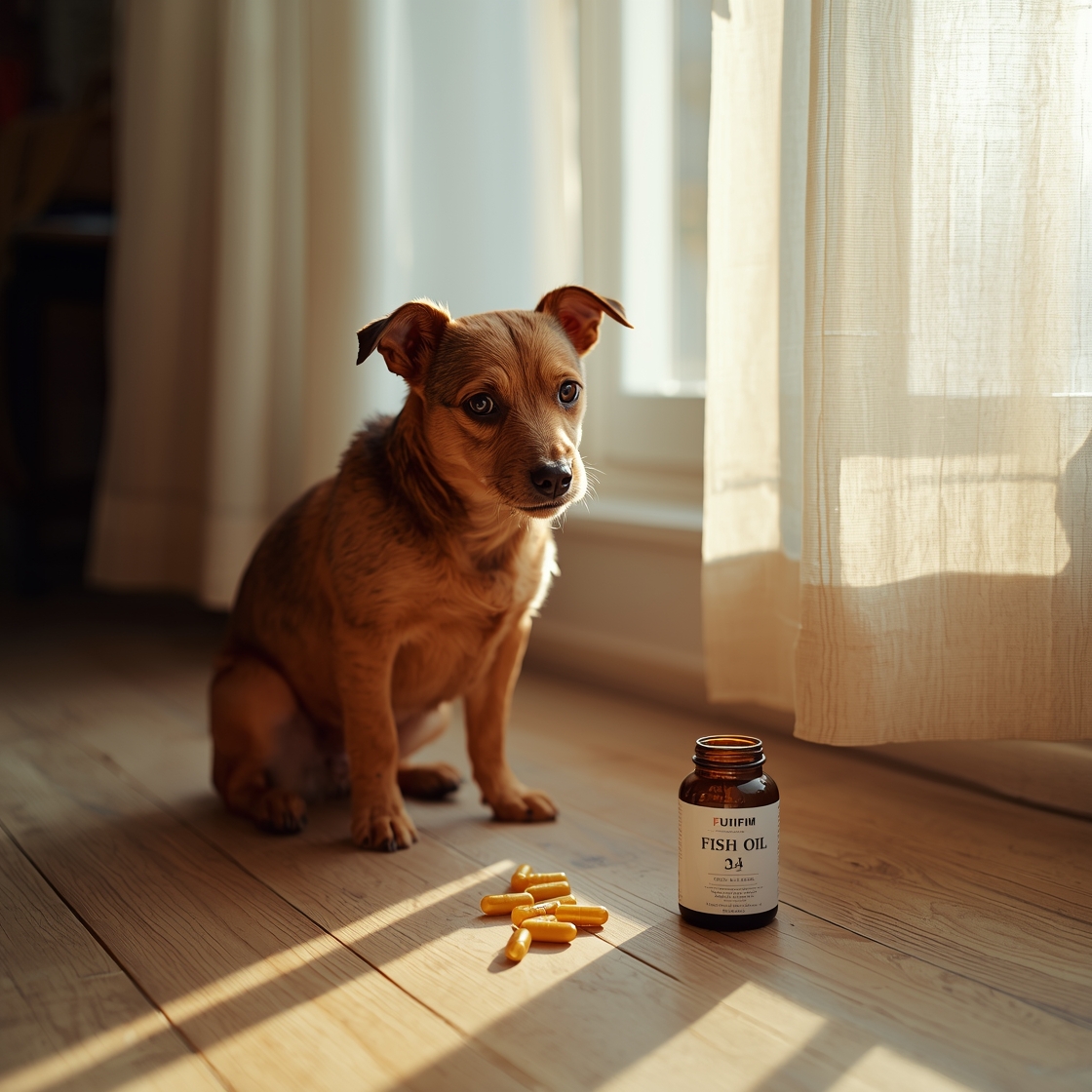
The best fish oil for dogs is a bottle that prints EPA and DHA in milligrams per pump or teaspoon, from a named marine source, with a weight chart you will actually follow — a purity-positioned pet oil when you will pay for a published split (Nordic Naturals Omega-3 Pet, $39.91; one distributor panel this desk opened listed 736 mg EPA / 460 mg DHA per teaspoon on a 5 mL serving — SKUs vary, read your bottle), a named wild-salmon brand when source copy is the purchase (Natural Dog Company, $28.95), a named-brand dual-species pump when cats and dogs share a kitchen (Zesty Paws, $16.97; Native Pet, $16.99), a budget first bottle when the job is “will this dog eat oil” (Salmon Oil for Dogs, $9.98; Wild Alaskan dual, $13.59), a generic bulk listing only after you confirm the panel (Fish Oil for Dogs, $49.95) — not a flax-only “omega” and not a human capsule emptied onto kibble. We read current Amazon listing titles and descriptions and scored 7 named SKUs. Listed snapshots ran $9.98–$49.95 (median $16.99, a 5.01× spread). Printed snapshots sum to $176.34. 4 of 7 (57%) sit under $17. 3 of 7 (43%) are dual-species titles. 2 of 7 (29%) are generic search titles with no brand on the card. 1 of 7 (14%) is the purity-positioned Nordic card. 0 of 7 is a prescription diet. Oil can support skin lipids and is discussed in veterinary nutrition texts for joints. It cannot treat hypothyroidism, flea allergy, or a torn CCL.
Desk pick: Readable published split → Nordic Naturals $39.91 (4.00× the $9.98 card) when you will follow the teaspoon chart on that bottle. Named wild salmon → Natural Dog Company $28.95. Everyday dual-species pump → Zesty Paws $16.97 or Native Pet $16.99 (those two sit $0.02 apart — pick form and ingredient list, not a 2-cent medal). Budget first bottle → Salmon Oil $9.98 or Wild Alaskan dual $13.59. Bulk / large-dog spend → Fish Oil for Dogs $49.95 only after the panel prints EPA and DHA you can photograph. Do not start three oils the week a flea comb still finds dirt.
Oil has jobs: coat lipids, itch adjunct, joint adjunct, multi-pet convenience, budget first bottle. Buy the job. Confirm the dose with your veterinarian.
Our guides are reader-supported. This article may contain affiliate links. As an Amazon Associate we may earn a commission if you buy through links, at no extra cost to you.
Skin-and-coat constraint page: best fish oil supplement for dogs skin and coat. Itch that is not a bottle problem: best supplement for itchy dog. Food-side omega story: best dog food for skin and coat. Joint food-side: best senior dog food for joint health. .
Quick picks at a glance
- Best listed everyday pump: Zesty Paws Salmon Oil for Dogs & Cats — $16.97. Dual-species pump; leak is the owner-theme drawback.
- Best listed purity-positioned card: Nordic Naturals Omega-3 Pet — $39.91. Highest transparency story; highest mid-premium sticker.
- Best listed named wild-salmon brand: Natural Dog Company Wild Alaskan Salmon Oil — $28.95. Source story; aroma is the trade.
- Best listed budget first bottle: Salmon Oil for Dogs — $9.98. Lowest sticker; weakest printed sourcing story.
- Best listed dual-species value: Wild Alaskan Salmon Oil for Dogs + Cats — $13.59. One bottle, two species on the title.
- Best listed clean-label dual card: Native Pet Omega 3 Fish Oil for Dogs & Cats — $16.99. Minimalist marketing; smaller bottle class.
- Best listed bulk / large-dog spend: Fish Oil for Dogs — $49.95. Generic title; confirm EPA/DHA on the label in the cart.
What current Amazon listings show (Oil-Panel, August 2026)
| Job | What actually works | Category | Fail if you skip it |
|---|---|---|---|
| Dull coat / dry skin (non-medical) | Complete diet + printed EPA/DHA you will dose | Everyday pump | Fail if fleas are the itch |
| Joint comfort adjunct | Clinician-set EPA/DHA, not “a pump looks healthy” | Higher-transparency oil | Fail if you skip the orthopedic exam |
| Multi-pet convenience | Dual-species label you will not over-dose | Dog + cat cards | Fail if the cat gets a dog-size pump |
| Budget trial | Lowest sticker with a real marine oil | $9.98 class | Fail if the label hides EPA/DHA |
Before you shop: (1) the diet is already complete-and-balanced, (2) you can read EPA and DHA on the bottle, (3) a veterinarian has not flagged pancreatitis, clotting drugs, or a calorie ceiling, (4) itch with sores, sudden limp, or weight loss goes to a clinic first. Fail gate 2 and this checklist is decorative.
What the best fish oil for dogs can and cannot do
EPA (eicosapentaenoic acid) and DHA (docosahexaenoic acid) are the marine omega-3s veterinary nutrition texts actually discuss. They are not the same as “flax for dogs” (ALA, which dogs convert poorly) and not the same as a chicken-fat kibble with a shine banner. NRC and AAFCO talk about essential fatty acids on complete foods. A pump is an extra. Extra fat is extra calories.
Published roles, not our assays: skin-barrier lipids; modulation of inflammatory pathways; retinal and neural DHA in growth diets; adjunct language around osteoarthritis in clinical literature. Merck Veterinary Manual public nutrition and dermatology pages treat fatty-acid supplements as adjuncts — not as a substitute for a workup.
What a bottle can do: add EPA/DHA you can count if the label prints them; add calories you must subtract from kibble if the dog is overweight.
How the desk scored the best fish oil for dogs
this comparison uses five label-visible signals plus the listed sticker:
- Printed EPA and DHA. “Fish oil 1,000 mg” without a split can be mostly carrier. Read the milligrams of each.
- Named fish. Salmon, sardine, anchovy, pollock beat “marine oil” as a vibe word.
- Antioxidant / dark bottle story. Vitamin E or mixed tocopherols plus opaque packaging is how brands slow oxidation. Heat still wins if you leave the pump in a car.
- Species and dose chart. Dual-species cards need two charts. A cat is not a small dog.
- Transparency spend. Third-party testing language (Nordic Naturals class) is a purchasing reason. It is not a certificate we issued.
Form (pump vs capsule vs chew) is compliance, not potency. This URL’s cards are oil listings, not a chew trial.
How these products compare on labels and price
| Product | List | Title class | What the desk could source | Listing note |
|---|---|---|---|---|
| Salmon Oil for Dogs | $9.98 | Generic salmon | Weakest sourcing-certificate story | Lowest sticker |
| Wild Alaskan Salmon Oil for Dogs + Cats | $13.59 | Dual-species salmon | Shared-household title | Budget dual |
| Zesty Paws Salmon Oil | $16.97 | Named brand pump | Dual-species; leak is owner theme | Everyday pump |
| Native Pet Omega 3 | $16.99 | Dual-species omega | Sardine/krill-class copy on typical cards | +$0.02 vs Zesty |
| Natural Dog Company Wild Alaskan | $28.95 | Named wild salmon | Source story; aroma trade | Mid-premium |
| Nordic Naturals Omega-3 Pet | $39.91 | Purity / third-party story | Distributor panels print EPA/DHA per tsp; SKUs vary | Transparency spend |
| Fish Oil for Dogs | $49.95 | Generic bulk title | No brand on the card | Volume — verify panel |
Desk kit math: Nordic $39.91 vs Salmon Oil $9.98 is a 4.00× sticker jump. You are not buying a 4× shine score from this desk. You are buying a brand that publishes a split on typical pet pages. Fish Oil for Dogs $49.95 is 5.01× the budget card and 1.25× Nordic — highest sticker, weakest title. Zesty $16.97 and Native Pet $16.99 are a $0.02 / 0.1% gap. That is not a quality grade. Natural Dog Company $28.95 sits 71% above Zesty for a named wild-salmon story. Four sub-$17 cards ($9.98 + $13.59 + $16.97 + $16.99 = $57.53) are 33% of the $176.34 sum and 57% of the catalog. The two premium/generic-high cards (Nordic + bulk = $89.86) are 51% of the dollar sum.
The 7 cards on this URL
1. Zesty Paws Salmon Oil for Dogs & Cats
Best for: a household that wants a named-brand pump for both species and will wipe the nozzle.
Listed $16.97. Brand copy: salmon oil, pump dispenser, dogs and cats. Owner-report themes: palatability, occasional leak. Dual-species is convenience; it is also how a Labrador pump lands in a cat bowl.
Honest drawback: pump hardware. Recap. Wipe. Do not store on its side in a hot pantry.
Check Zesty Paws salmon oil listings →
2. Nordic Naturals Omega-3 Pet
Best for: a household paying for published purity and potency language rather than the lowest sticker.
Listed $39.91. Second-highest spend on this URL. Brand and distributor pages this desk opened: pet-specific omega-3, wild small-fish (anchovy/sardine) sourcing on typical Nordic pet cards, third-party contaminant testing program the company advertises, nitrogen-flushed processing language. A Valley Vet–hosted product sheet for Omega-3 Pet prints a guaranteed analysis per teaspoon (~5 mL): EPA (min) 16%, DHA (min) 10%, with a footnote of 736 mg EPA, 460 mg DHA, 1,380 mg total omega-3s in triglyceride form. That is one SKU’s published panel, not an assay we ran, and not every bottle size on Amazon. Read the chart on the bottle you receive.
Honest drawback: price per ounce. A 15 lb dog and a 70 lb dog are not the same monthly burn. Confirm the teaspoon or pump chart — SKUs vary. Owner-report themes: itch and mobility language. Those are anecdotes, not our scores.
Check Nordic Naturals Omega-3 Pet listings →
3. Natural Dog Company Wild Alaskan Salmon Oil for Dogs
Best for: a source-first shopper who wants “wild Alaskan salmon” on a named brand, not a generic title.
Listed $28.95. Brand copy: wild-caught Alaskan salmon, rich omega story, strong aroma as a freshness tell in owner reports. Aroma is not an assay.
Honest drawback: smell in small kitchens. Refrigerate after opening if the label says so. Oxidation is how a “premium” oil becomes a GI event.
Check Natural Dog Company listings →
4. Fish Oil for Dogs
Best for: a large-dog or multi-dog house that will read the panel on a generic $49.95 listing before they click.
Listed $49.95. Highest sticker. The card title is only “Fish Oil for Dogs.” That is a search class, not a guaranteed potency. Marketplace titles this thin are how households buy a huge bottle with a weak EPA/DHA line.
Honest drawback: bulky storage; oxidation risk on a bottle that lasts four months. Buy a size you will finish. Confirm species, dose, and third-party language on the actual label.
Check Fish Oil for Dogs listings →
5. Salmon Oil for Dogs
Best for: a first bottle when the job is “see if the dog will eat oil” without a $40 commitment.
Listed $9.98. Lowest sticker. Simple ingredient story on typical budget cards. Weakest sourcing-certificate story on this set.
Honest drawback: you must still read EPA/DHA. Cheap oil that is rancid is not a bargain. If the dog refuses food, the trial failed for compliance, not for “science.”
Check Salmon Oil for Dogs listings →
6. Wild Alaskan Salmon Oil for Dogs + Cats
Best for: one bottle on a counter used for both species — if you keep the doses separate.
Listed $13.59. Dual-species title. Easy mix-in language. Plastic recyclability varies by municipality — an owner theme, not a health grade.
Honest drawback: shared bottles get over-pumped. Write the cat dose on tape. Cats have different calorie and fat tolerances.
Check Wild Alaskan dual-species listings →
7. Native Pet Omega 3 Fish Oil for Dogs & Cats
Best for: a short ingredient list when the household is already managing a sensitive gut — still not a GI prescription.
Listed $16.99. Brand copy: sardine/krill blend language on typical Native Pet omega cards, dogs and cats, pump or dropper depending on SKU. Smaller bottle class.
Honest drawback: you finish it faster. Cost-per-day can exceed the $9.98 card even if the sticker looks similar to Zesty. Owner-report themes: palatability, itch.
Check Native Pet omega listings →
EPA, DHA, and how to read the best fish oil for dogs
| Label phrase | What it usually means | Desk caution |
|---|---|---|
| EPA xx mg / DHA yy mg per tsp or pump | The only split that matters | Photograph this lot |
| “Fish oil 1,000 mg” | Often total oil, not EPA+DHA | Carrier can be the majority |
| “Salmon oil” | Species story | Still need the split |
| “Wild Alaskan” | Source marketing | Not a heavy-metal assay we ran |
| “Third-party tested” | Brand program | Ask: which lab, which lot? |
| Flax / ALA only | Plant omega-3 | Dogs convert ALA poorly |
EPA is the fatty acid most joint- and itch-adjunct conversations lean on. DHA is the growth / neural / retinal conversation. Puppy and adult charts differ. A label that says only “fish oil” without a split can be a minority active fraction.
Triglyceride-form oils are discussed in human and some comparative absorption literature as easier to absorb than ethyl esters. Nordic’s Valley Vet sheet names TG form on that SKU. That is published chemistry, not a lab result from this desk.
We will not print a fake leaderboard for bottles Compare the panel on the SKU you hold.
Interaction notes for the best fish oil for dogs
Omega-3s can affect platelet function. Dogs on anticoagulants, scheduled for surgery, or with bleeding disorders need a veterinarian before high-dose oil. Pancreatitis history changes fat targets. Do not guess.
Soft stool, fish burps, and greasy coats are the common owner-report start-up themes. Cut the dose. Mix into food. If vomiting or itch explodes, stop and call the clinic — oil is not automatically the cause, but it is a variable.
Store sealed, cool, dark. Many labels want refrigeration after opening. Heat above a hot kitchen windowsill is how vitamin E loses the oxidation fight. Discard oil that smells sharp, paint-like, or “off” versus a clean marine smell.
A reliable sequence (desk method, not a clinic protocol)
- Triage. Sores, yellow crust, sudden limp, weight loss, bloody stool → clinic. Not a pump.
- Diet first. Complete-and-balanced food stays put for 8–10 weeks. Oil on a rotating kibble is noise.
- Read the panel. EPA + DHA + dose for this weight. Photograph it.
- One bottle. Not three stacked “joint + coat + omega” SKUs.
- Log 4 weeks: stool, itch spots, body-condition score. Coat lipids are slow.
- Stop if stools turn greasy-painful or the dog refuses food.
Worked example: two dogs, two kits
Dog A — 25 lb adult, dull coat, fleas controlled, veterinarian said a marine oil is fine. Kit: Zesty Paws $16.97 or Salmon Oil $9.98 if you want a cheap compliance test. Do not also add Native Pet the same week.
Dog B — 70 lb, orthopedic workup already done, clinician named an EPA+DHA target. Kit: Nordic $39.91 so you can show the teaspoon split, or Natural Dog Company $28.95 if the clinic did not name a brand. Do not swap to the $49.95 generic because the sticker looked “more serious.”
When to stop shopping
- Itch with sores, ear smell, or hairless patches
- Sudden non-weight-bearing limp
- Pancreatitis history and a free-pour pump
- Surgery this month and a high-dose oil you started on Reddit
- You are stacking four omega SKUs
Oil will not treat hypothyroidism, a torn CCL, or flea-allergy dermatitis. Those are clinics.
How to choose the best fish oil for dogs this month
- Rule out emergencies and fleas.
- Read EPA + DHA on the label you will buy.
- Pick a form the dog will eat.
- Change one variable.
- Log a month.
- Recheck the clinic if the log goes the wrong way.
The best fish oil for dogs is the one whose panel you can defend and whose pump leaves the bottle.
What is the best fish oil for dogs on this URL?
The best fish oil for dogs on these seven cards is Nordic Naturals $39.91 when you want a published EPA/DHA split, Natural Dog Company $28.95 for a named wild-salmon brand, Zesty Paws $16.97 or Native Pet $16.99 for a dual-species pump, Salmon Oil $9.98 or Wild Alaskan dual $13.59 for a first bottle, Fish Oil for Dogs $49.95 only after you photograph the panel. 1 of 7 is the only card whose distributor sheet gave this desk a teaspoon split we could cite (Nordic; SKUs vary).
How should you read a label for the best fish oil for dogs?
Look for EPA mg and DHA mg per pump or teaspoon, a named fish, and a weight chart. “Fish oil 1,000 mg” without a split can be mostly carrier. Nordic’s public pet panels (example: Valley Vet sheet, 736 mg EPA / 460 mg DHA per 5 mL on that SKU) are a readability reason — not a Thepetbench assay. Photograph the bottle. Show the veterinarian that photo, not this ranking.
Frequently asked questions
What is the best fish oil for dogs?
The best fish oil for dogs on this URL are the seven cards: Nordic ($39.91) for a published split, Natural Dog Company ($28.95) for named wild salmon, Zesty ($16.97) and Native Pet ($16.99) for dual-species pumps, Salmon Oil ($9.98) and Wild Alaskan dual ($13.59) for budget, Fish Oil for Dogs ($49.95) as a generic bulk title.
Can I give my dog human fish oil?
Do not use this page as a yes. Flavorings (including xylitol in some human products), dose, and rosemary extracts differ. Nordic’s pet line is sold without some human flavorings on typical pet pages. Ask the veterinarian. Do not empty a human capsule onto kibble because the milligram number is bigger.
How long before I see a coat change?
Brand pages talk about weeks. This desk will not promise three. Lipid turnover in skin is slow. If sores appear, do not wait on a pump.
Does the best fish oil for dogs help joints?
Veterinary nutrition texts discuss EPA+DHA as adjuncts in some osteoarthritis plans. That is literature, not a limp we scored. The orthopedic exam still happens first.
What if the oil smells strong?
A clean marine smell is common. Paint, varnish, or “off” is oxidation. Discard. Refrigerate if the label says so.
Can cats share the best fish oil for dogs?
Only if that label is dual-species and you use the cat chart. Three cards here print dogs and cats (Zesty, Native Pet, Wild Alaskan dual). A Labrador pump in a cat dish is how you invent a fat load.
Is Nordic Naturals the best fish oil for dogs because it prints EPA/DHA?
It is the most readable published split this desk could open on a distributor sheet. That is not a 2026 kennel ranking and not a heavy-metal assay we ran. It is a reason the $39.91 sticker exists.
Related pages
- Best fish oil supplement for dogs skin and coat
- Best supplement for itchy dog 2026
- Best dog food for skin and coat
- Best senior dog food for joint health
How we researched this guide
Desk research. We read current Amazon listing titles and descriptions and scored seven current listings on listed price, title tokens, dual-species language, and whether we could open a printed EPA/DHA split (Nordic: yes on a Valley Vet–hosted sheet for one SKU; others: read your lot). Nothing here is a veterinary certification or a clinic-stamped pick.
Limitations: bottle sizes change; EPA tables hide; prices move; Amazon titles clone. Bloody stool, sores, and a painful limp are a clinic.
Keep a simple log: product, dose, stool, itch spots, food that day. Patterns beat a once-a-month brand swap.
A 90 lb Lab and a 12 lb senior are not the same category row. The giant can steal three pumps. The senior can lose more from a greasy-stool week. Dose the bottle. Hide the bottle.
If the household’s real complaint is “the food is junk,” a $40 oil will not fix an elimination diet. See skin-and-coat food URLs after this page’s job is honest.
Show the veterinarian the label photo, not this ranking. They may want zero oil while they run thyroid or cytology. That is a better plan than our table.
Extra desk notes: calories, stacking, and the month you actually log
Calories. Oil is fat. Fat is calories. A shine pump on a BCS 7 dog is a weight job. Subtract from the cup. See best dog food for weight loss if the rib check already failed.
Stacking. Joint chew + coat oil + “omega kibble” + leftover human capsules is four fat stories. Soft stool after that stack is not proof the oil “does not work.” It is proof you changed the calorie load. Pick one marine bottle.
Puppies. DHA shows up in growth-diet conversations. A puppy with a dull coat and diarrhea is still a clinic, not a $9.98 experiment.
Cats. Wrong dose on a dog-only card. Use dual-species charts or a cat product.
Surgery. Platelet effects are a veterinarian conversation. Stop dates are theirs, not a blog’s.
Travel. Pumps leak in checked bags. Caps or tape the nozzle. Heat in a parked car is how vitamin E loses.
Subscriptions. Auto-ship is how you own three unopened $49.95 jugs. Pause if the log is already boring.
Cost per bottle (desk sticker math, not a feeding trial). Salmon Oil $9.98 is the floor. Nordic $39.91 is 4.00×. Bulk $49.95 is 5.01×. Zesty vs Native Pet is $0.02. Buy the panel, not the multiplier.
Coat vs this URL. If the only job is itch and shine, the sister page best fish oil supplement for dogs skin and coat swaps Nordic for a generic “Omega 3 for Dogs” $19.90 card. Do not import a phantom SKU across URLs.
Nail the log before you nail a second SKU. A $16.97 Zesty used daily with one food beats a $49.95 jug you opened once. That is not a lab result. It is how supplements work when they leave the drawer.
Sources
- Nordic Naturals Omega-3 Pet guaranteed analysis as reproduced on a Valley Vet product sheet (EPA min 16%, DHA min 10%; 736 mg EPA / 460 mg DHA / 1,380 mg total omega-3s per teaspoon on that SKU; TG form). https://www.valleyvet.com/Library/50116L1.pdf
- AAFCO, Understanding Pet Food (complete-and-balanced / essential fatty acids on foods). https://www.aafco.org/consumers/understanding-pet-food/
- Merck Veterinary Manual, public nutrition / dermatology overviews (adjunct language; diagnostics first). https://www.merckvetmanual.com/
- AVMA, pet-owner guidance (when itch, limp, or GI signs need a veterinarian). https://www.avma.org/resources-tools/pet-owners