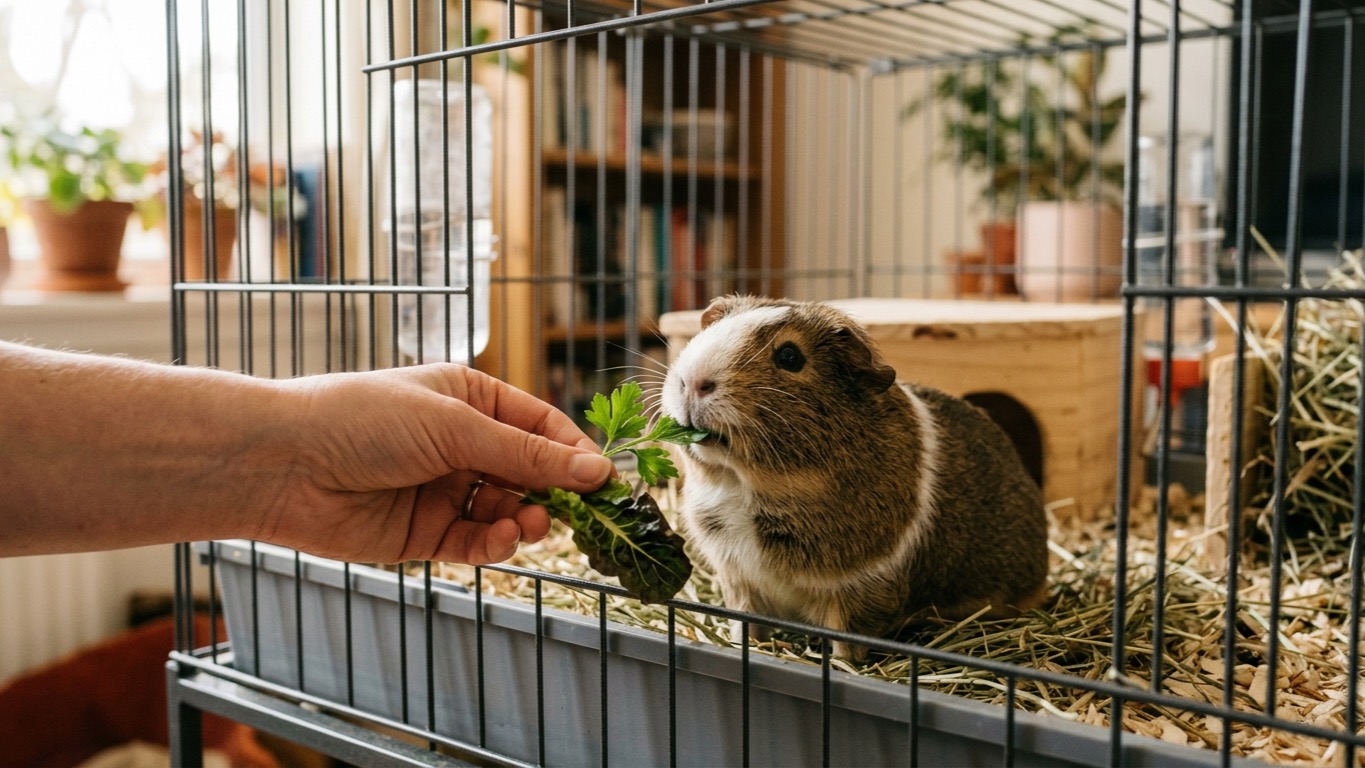
The best guinea pig cage is a single-level floor that meets published welfare minimums — 7.5 sq ft for one, 10.5 sq ft for two (RSPCA-class numbers keepers treat as the floor, not a trophy) — with ≤1 inch bar spacing, a solid base (no wire floor), and a lid if cats or dogs share the house. The We read the titles and descriptions of 7 SKUs. Listed snapshots ran $39.97–$159.99. Spread is $120.02. Median list is $79.98. 2 of 7 are MidWest canvas-class (Habitat Plus $73.99; Deluxe XL $99.74). 1 of 7 is a starter plastic tray (Ferplast Cavie 80, $69.95) that is often below pair minimum. 1 of 7 is a 48" open-top (Kaytee, $79.98). 1 of 7 is a C&C-style acrylic (GuineaLoft 4x2, $39.97 — confirm it is a complete 4×2, not panels only). 2 of 7 are rolling cages (Prevue $159.99; PawHut 35" $99.74). The 35" PawHut fails the 7.5 sq ft gate if 35" is the long side. 0 of 7 replace hay, pellets, or a clinic. 0 of 7 make a multi-level rabbit hutch a cavy home.
Guinea pigs are ground herd animals. Height is a photo. Floor is the welfare variable. Ramps are a fall class.
Our guides are reader-supported. This article may contain affiliate links. As an Amazon Associate we may earn a commission if you buy through links, at no extra cost to you.
What goes in the cage: best bedding for guinea pigs and bedding for smell. Food objects: hay and pellets. .
Quick picks at a glance
- Best listed pair-capable MidWest: MidWest Deluxe XL — $99.74. Larger canvas/wire footprint. Latch-top. Canvas chew watch-out.
- Best listed fold-flat daily driver: MidWest Guinea Habitat Plus — $73.99. Divider. PVC-canvas base. ~47" class — measure; one pig is the honest default unless the footprint clears 10.5 sq ft.
- Best listed starter tray (one pig, tight): Ferplast Cavie 80 — $69.95. Accessories in the box. Floor often ~5–6 sq ft class — pair fail. Playpen required if you keep two.
- Best listed 48" open-top: Kaytee Open Living 48" — $79.98. Access. Lid story if you have predators.
- Best listed C&C-style budget: GuineaLoft Acrylic 4x2 — $39.97. 4×2 C&C math is the reason this card exists. Confirm contents. Open-top + cats = no.
- Best listed rolling premium: Prevue Pet Rolling — $159.99. Highest sticker. Confirm solid floor area, not a pretty stand.
- Do not use as a sole home if 35" is the long side: PawHut 35" Rolling — $99.74. Rolling is not square footage.
How cavy cage listings compare on labels
Four jobs. A $160 roller that is 35" long is a piece of furniture. A $40 4×2 that is actually 4×2 is more cage.
| Job | What actually works | Category | Fail if you skip it |
|---|---|---|---|
| One adult, minimum welfare | ≥7.5 sq ft continuous floor | Habitat Plus if the tape says so; 4×2 C&C | Cavie 80 as a forever home |
| Bonded pair | ≥10.5 sq ft | Deluxe XL; honest 4×2 / 2×4 C&C | Two pigs in a 5.5 sq ft starter |
| Cat/dog in the house | Latch lid or closed room | Deluxe XL / Prevue if the top latches | Open Kaytee / open GuineaLoft in a free-roam cat house |
| Apartment move / storage | Fold-flat canvas | Habitat Plus | Buying small instead of folding |
Before you shop: (1) you multiplied length × width and divided by 144, (2) the number is ≥7.5 (one) or ≥10.5 (two), (3) the floor is solid, (4) not eating, crusty eyes, or labored breathing is a clinic, not a prettier loft. Fail gate 4 and this checklist is how you shop past an emergency.
The 7.5 / 10.5 numbers (what they are)
RSPCA-class housing pages print 7.5 square feet as a minimum for one guinea pig and 10.5 for a pair. US keeper communities treat the same numbers as the floor. They are not “deluxe.” A pet-store starter that looks like a barn in the photo is often 4–6 sq ft.
| Pigs | Min floor (sq ft) | Rough rectangle | C&C shorthand |
|---|---|---|---|
| 1 | 7.5 | 30×36 in | 2×3 grids (14" grids ≈ 28×42) — still verify |
| 2 | 10.5 | 30×50 in | 2×4 (28×56 ≈ 10.9) |
| 3 | 13+ | 30×62 in | 2×5 |
Guinea pigs popcorn on the flat. They do not use a second story the way rats do. A loft with a steep ramp is a fracture class. A hide, a hay pile, and a long run beat a balcony.
Bar spacing: ≤1 inch for adults. Babies need tighter. Wire floors: no — bumblefoot / pododermatitis is the wet-wire story. Solid base + bedding: bedding guide.
How this desk scored the best guinea pig cage
this comparison uses four published signals:
- Floor math. Listing inches vs 7.5 / 10.5. If the listing will not print both dimensions, the card cannot pass the gate on photos.
- Base class. Canvas PVC, plastic tray, coroplast/acrylic, wire (fail).
- Lid class. Open vs latch-top vs “rolling hutch.”
- Honesty about accessories. A hide in the box does not add square feet.
How to measure before you click
- Tape the interior floor, not the exterior photo.
- Subtract a huge plastic loft if it steals run length.
- Write
L × W / 144. - Compare to 7.5 or 10.5.
- If you have cats, write “lid” on the same sticky note.
A 47×24 Habitat Plus is 47 × 24 / 144 ≈ 7.8 sq ft — one pig territory unless MidWest’s exact SKU is wider/longer than that class. A 4×2 C&C at 14" grids is 56 × 28 / 144 ≈ 10.9 sq ft — pair territory if the walls are real.
The seven cards on this URL
1. MidWest Guinea Habitat Plus Cage
Best for: a fold-flat, wipe-base cage when the taped interior clears 7.5 sq ft and you will wash the canvas.
Listed $73.99. Divider for intros or a vet-separation afternoon. PVC-canvas bottom is the reason people like weekly resets. Determined chewers open the canvas. Coroplast or a spare liner is a common keeper add-on — not included in our trial, because
Honest drawback: canvas odor if you stretch cleans. Sides may be short enough that bedding flies. Pair only if the tape says 10.5+. Do not believe “1–2 pigs” on a box against arithmetic.
Check MidWest Habitat Plus listings →
2. MidWest Deluxe XL Guinea Pig Cage
Best for: a larger MidWest when you are housing a pair and want a latch-top.
Listed $99.74. This is the MidWest card This comparison treats as the pair-capable sibling if the listing dimensions clear 10.5. Wire top vs open Kaytee is the predator story.
Honest drawback: QC stories (bent grids, extra hardware) show up in owner threads. Check latches after every clean. Canvas/chew issues can still apply depending on the exact XL SKU — read the photos.
Check MidWest Deluxe XL listings →
3. Ferplast Cavie 80 Guinea Pig Cage
Best for: a complete starter tray for one young pig when you already planned floor time and an upgrade path.
Listed $69.95. Hide, bowl, bottle, hay feeder in many cartons. Deep plastic base beats canvas for chew. Cavie 80 is an ~80 cm class — often ~5–6 sq ft. That is a pair fail and a tight adult-one.
Honest drawback: dripping bottles are a recurring owner theme. Multi-level cousins in the Ferplast family are still a ramp risk. Do not keep two adults in this footprint.
Check Ferplast Cavie 80 listings →
4. Kaytee Open Living 48" Guinea Pig Cage
Best for: open access and a 48" run when you can close the room to cats and dogs.
Listed $79.98. 48" is one dimension. You still need the depth. 48×24 ≈ 8.0 sq ft (one pig / tight pair). 48×18 ≈ 6.0 sq ft (fail). Measure the listing.
Honest drawback: open-top. Bedding kick-out. Not a predator house.
Check Kaytee Open Living 48" listings →
5. GuineaLoft Acrylic 4x2 C&C Style Cage
Best for: C&C-class floor at the lowest listed sticker when the carton is a real 4×2, not a panel teaser.
Listed $39.97. That price is why we say confirm contents. A true 4×2 at 14" grids is the pair math above. Acrylic scratches. Open-top same as Kaytee.
Honest drawback: $40 for a finished 4×2 is cheap enough that some listings are grids only or a smaller footprint. If the tape is not ~56×28, it is not this comparison's 4×2.
Check GuineaLoft 4x2 listings →
6. Prevue Pet Rolling Guinea Pig Cage
Best for: casters + a latch story when the floor panel still clears the gate after you ignore the stand height.
Listed $159.99. You are paying for mobility and furniture vibes. Many rolling “small animal” cages steal floor for a cute upper. Measure the pig floor only.
Honest drawback: highest sticker can still fail 10.5. Wheels do not add square feet. Wire stands can mean a small tray.
Check Prevue rolling listings →
7. PawHut 35" Rolling Guinea Pig Cage
Best for: not a sole home if 35" is the long axis.
Listed $99.74. 35×20 ≈ 4.9 sq ft. 35×24 ≈ 5.8 sq ft. Both fail 7.5. Rolling is a convenience for a cage that is already legal. This card is on the URL; the Index will not pretend it is a pair palace.
Honest drawback: marketing photos look like a loft apartment. Arithmetic is the review.
Card math
| Card | Listed | Floor class (desk) | Pair? | Lid story |
|---|---|---|---|---|
| Habitat Plus | $73.99 | ~8 sq ft if 47×24 class | Only if tape ≥10.5 | Often open / short walls |
| Deluxe XL | $99.74 | Pair-capable if listing says so | Maybe | Latch-top class |
| Cavie 80 | $69.95 | ~5–6 sq ft class | No | Enclosed tray |
| Kaytee 48" | $79.98 | ~8 sq ft if 24" deep | Tight / no | Open |
| GuineaLoft 4×2 | $39.97 | ~10.9 sq ft if real 4×2 | Yes if real | Open |
| Prevue rolling | $159.99 | Unknown until taped | Tape | Often yes |
| PawHut 35" | $99.74 | Fail 7.5 if 35" long | No | Rolling ≠ safe |
Are C&C cages worth the effort?
Cubes-and-coroplast is the keeper gold standard because you pick the rectangle. A 2×4 (about 10.9 sq ft) is the pair default. A 2×5 is the trio conversation. You also buy:
- 1" or smaller grids (storage-cube 1.5" grids are a head-trap class).
- Coroplast walls ≥6 inches so bedding stays and edges get less chew.
- Time. First build is an evening. Habitat Plus is 15 minutes.
The GuineaLoft card is the “I want C&C floor without a hardware-store run” tile — if the carton matches the name.
Safety: listed plastic from a chewed coroplast flap is a blockage class. Trim clean. Hide edges.
Bar spacing and bedding (same cage, two failures)
| Variable | Pass | Fail |
|---|---|---|
| Bars | ≤1 in adults | Decor cages with wide gaps |
| Floor | Solid plastic / coroplast / canvas+liner | Wire grid they stand on |
| Bedding depth | 2–3 in in the wet third (bedding URL) | Scented pine dust |
| Fleece | Washer cadence you will keep | Fleece with no absorbent pad |
Spot wet corners daily. Full change about weekly for paper in a legal cage. Fleece often wants 3–4 day laundry. Ammonia smell = you are late. Airways are not a branding exercise.
Cedar and aromatic pine stay off the bedding page. This cage page will not re-open them.
Cleaning rhythm (desk, not a lab)
Daily: wet spots, soggy veg, hay dust piles. Every few days: fleece swap if that is your system. Weekly-ish: full paper dump + wipe. MidWest canvas: wash the canvas or it becomes a smell sponge. Never: ammonia “until next weekend” because the cage “looks fine.”
A legal floor is easier to keep clean because pigs are not sitting in a soaked postage stamp.
Lids, kids, and other pets
Guinea pigs are not hamster escape artists. They can haul onto a hide and meet a cat. Open-top is a closed-room privilege. Deluxe XL / Prevue-class latch tops exist for the other kind of house.
Kids: they can sit on the floor during supervised floor time. They should not carry a pig like a football. Falls from kid-height are the same spine class as ramps.
Introductions and the divider
Habitat Plus includes a divider. That is a short tool for vet rest or a look-but-don’t-bite intro. It is not two apartments in 7.8 sq ft. Two pigs need 10.5+ without a wall down the middle as the forever plan.
Boars together are a keeper-skill problem (bonding, neuter conversations with a cavy-savvy vet). This desk will not write a pairing protocol. Space still comes first.
Price bands
Under $50. GuineaLoft $39.97 if complete. DIY grids + coroplast often land here plus your time.
$70–$100. Habitat Plus, Cavie 80, Kaytee 48", PawHut 35", Deluxe XL. This is where most people land — and where floor math separates a home from a crate.
$160. Prevue rolling. Pay it for casters and a lid, not for a free pass on inches.
Hidden costs: bedding, a second hide, a bottle that does not drip, a playpen if the cage failed the gate. Cavie 80 “complete” still needs space.
Worked households
Home A — two sows, first pigs, no cats. Real 4×2 (GuineaLoft if the carton is honest, or DIY C&C). Paper bedding. Hay in a rack that does not steal half the run.
Home B — one pig, apartment, must fold. Habitat Plus if ≥7.5. Plan a friend or a larger upgrade; guinea pigs are social. A single pig is a welfare conversation with a cavy vet / rescue, not a product medal.
Home C — pair + free-roam cat. Deluxe XL or another latch-top that still clears 10.5. Not Kaytee open. Not open acrylic.
Home D — “the cute 35" rolling cage is on sale.” PawHut fails the gate. Spend the $99 on a 4×2 and a cheap moving dolly if you need wheels under a table.
Home E — Cavie 80 already in the living room, two adults. You own a starter. Add a playpen measured to bring total daily space up, then replace the cage. Do not add a ramp loft and call it done.
Troubleshooting table
| What you see | Likely cause | Desk move |
|---|---|---|
| Constant popcorn into walls | Too small | Tape the floor; upgrade |
| Chewed canvas puddle | Habitat Plus class + chewer | Liner / coroplast; do not “tape and pray” forever |
| Ammonia at day 3 | Small wet floor | Bigger cage + bedding depth |
| Pig stuck in bars | Spacing >1 in or a baby | Different grids; this is urgent |
| Ignoring a loft | They are cavies | Remove the ramp theft of floor |
| Cat sitting on the open top | Open cage + cat | Lid or closed room today |
We will not invent a 13 sq ft measurement we taped on a Deluxe XL in a warehouse. We will not invent a chew trial. We will not put a fake DVM on this URL. RSPCA-class minima, a tape measure, and a solid floor are the method.
If a listing says “perfect for 2–3 pigs” on a 35" roller, believe the tape.
FAQ
What is the best guinea pig cage for two females?
10.5 sq ft continuous floor, ≤1 in bars, solid base. On this URL that is a real 4×2 (GuineaLoft if complete) or a Deluxe XL after you confirm inches. Not Cavie 80. Not PawHut 35".
Can guinea pigs live in multi-level cages?
As a home, no. They are ground animals. Ramps and balconies are a fall and joint class. A very shallow step is still stealing floor. Buy length.
How often should I clean the cage?
Spot daily. Full paper change about weekly in a legal cage; faster if it smells. Fleece: more laundry. Canvas: wash the fabric. See the bedding URLs.
What is the best bedding for these cages?
Unscented paper or a fleece stack you will wash — best bedding for guinea pigs. Not cedar. Not a perfume tile.
Do I need a lid on my guinea pig cage?
If cats, dogs, or toddlers can reach the top: yes. Open-top is a closed-room privilege (Kaytee, GuineaLoft).
Is the Ferplast Cavie 80 the best guinea pig cage for beginners?
It is the easiest box. It is not the best home. Beginners still owe the pig 7.5 sq ft. Use it as a starter only with a dated upgrade plan.
Why is the PawHut on this page if it fails the gate?
It is a live card. this comparison's job is to say no when the inches fail — not to hide the SKU.
Floor time is not a substitute for a legal cage (and vice versa)
A playpen in the evening is enrichment. It is not a license to keep two adults in a Cavie 80 “because they get floor time.” Welfare minimums are about the home they sleep in, where they eat, poop, and hide at 2 a.m.
If the cage failed the gate, floor time is damage control while you order a 4×2. Date the order. Do not let damage control become the plan.
Floor time rules that belong on a sticky note:
- Supervised if there are cords, recliner mechanisms, or other pets.
- No lofted sofas as “gyms.”
- Hay and water in the pen so it is not a starvation hallway.
- A hide in the pen. Open space only is not enrichment for a prey species.
Hides, hay stations, and stolen floor
Two pigs need two hides with two doors or two exits so a bully cannot trap. Those hides sit on the floor and reduce run length. A legal 10.5 sq ft cage with two igloos and a hay hut can feel like 8. Buy the extra foot if you can. Do not fill a 7.8 sq ft Habitat Plus with three plastic barns.
Hay should be available always — best hay for guinea pigs. A rack that hangs inside the footprint is better than a rack that forces pigs to stand in the wet corner to eat. Pellets are a measured object: best pellets for guinea pigs.
Water: bottles drip (Cavie 80 owner theme). Bowls spill. Many keepers run both. Check daily. A dry bottle on a hot day is a clinic.
Temperature, drafts, and where the cage sits
Guinea pigs do not handle heat the way a dog does. Public care sheets often talk about staying out of direct sun and out of the path of an AC blast. This desk will not invent a °F “ideal” as if we logged a barn. We will say: if you are sweating, the cage is not a sunroom. If you are shivering, do not park them on a concrete floor in a vent wind.
Up off a winter floor can help. A Prevue roller’s height is not automatically climate control. It can also be a fall if a kid pulls a caster.
Kitchens: grease and shouting. Laundry rooms: dryer lint and detergent. Both are common “where do we put the cage” mistakes.
Bonding, boars, sows, and space
Space does not fix a bad pair. Lack of space makes a bad pair worse. Introductions belong in a neutral, large area, not a 5 sq ft tray with a divider forever.
Sow pairs are the usual “two females” FAQ. Boar pairs are a different skill — scent, dominance, sometimes a vet conversation about neuter timing. We will not write a pairing protocol. We will say: 10.5 sq ft is the floor, not a magic peace treaty.
A singleton is a welfare problem for a herd species. Rescues and cavy-savvy vets talk about bonded partners. Buying a second pig into a failed cage is how you get two stressed animals. Upgrade first or at the same time.
C&C build notes (so the $40 card has a sibling path)
If GuineaLoft is panels-only or you want bigger than 4×2:
- Buy small-pet grids (1" or 9-grid squares), not closet cubes with 1.5" holes.
- Count grids: 2×4 = eight on the long walls if you are counting the standard way — verify with a tape after assembly because connectors add width.
- Coroplast: score, fold, tape the outside. 6 in walls. No raw flaps inside.
- Optional lid: extra grids hinged if you have a cat.
- Do not use chipboard as a floor. Moisture + particle board is a mold story.
First-timer time: an evening. Habitat Plus time: a coffee. That is the trade.
Rescue intake vs forever home
A too-small cage for a weekend intake while you build a 4×2 is a confession you should date. A too-small cage as a Facebook “starter” for a kid’s birthday is how rescues get November surrenders.
If you are fostering, ask the rescue what they count as legal. Many will not place into a PawHut 35" as a forever home. Believe them.
Kids’ chores and the weekly reset
A child can dump poops into a bag. An adult should still own the weekly wash of a MidWest canvas and the “does this smell like ammonia” check. Canvas that never hits a washing machine is the Habitat Plus failure mode.
Write the clean day on the fridge. Pigs do not negotiate.
Travel, vet, and temporary boxes
A legal home stays at home. A carrier to the vet is a carrier. Do not keep a pig in a Cavie 80 “because travel.”
Hotel: most are a bad plan. If you must, a 4×2 does not fly as luggage. That is a reason not to travel, not a reason to own only a 35" roller.
More worked homes
Home F — upstairs apartment, downstairs neighbors, fleece system. Bigger floor + fleece + laundry. Open Kaytee on a bare floor will drum. A solid-base MidWest or C&C on a rug helps. Smell: bedding for smell.
Home G — one pig, grieving a partner, waiting on a rescue match. Keep the cage at 7.5+ anyway. A small cage does not “comfort” a singleton. Floor time and a hide do more than a loft.
Home H — three sows, experienced keeper. 2×5 C&C or larger. Deluxe XL only after the tape. Not two Cavie 80s taped together as a personality.
Home I — classroom. Lids, weekend coverage, a teacher who owns the clean. A 35" roller is still a fail. Schools that cannot hit 7.5 sq ft should not keep pigs.
Home J — you inherited a multi-level rabbit hutch. Remove the loft as the home. Use the big floor. If the big floor is still 4 sq ft, replace it. Rabbits and cavies are not the same housing SKU.
Health signs that end the shopping trip
Not eating (especially hay), pea-sized poops going tiny, crusted eyes, clicking breaths, a head tilt, blood in urine, or a pig sitting hunched in a corner: exotic or cavy-experienced veterinarian. Same day if they stop eating. this checklist will not sell you a hide as treatment.
Pododermatitis (bumblefoot) is wet + wire + obesity + small floor. Solid dry bedding and enough run are prevention class, not a cream we prescribe.
FAQ additions
Can I stack two small cages and call it 15 sq ft?
No. They need continuous floor to run. Two crates is two crates.
Do guinea pigs need a lid if I have no other pets?
Optional if the room is closed and walls are high enough. Still useful for kids and for kicked bedding. Open Kaytee / GuineaLoft remain open.
Is a 2×3 C&C enough for one pig?
2×3 at 14" grids is about 28×42 = 8.2 sq ft — one pig if the walls are real. Not a pair.
Should I put the cage on a table?
Only if the table is stable, the pigs cannot fall, and you can still clean. Height is for your back, not their welfare. Casters (Prevue) are for your floors.
What about outdoor hutches?
Weather, predators, and local law. This URL’s cards are indoor Amazon listings. An outdoor hutch that fails 7.5 sq ft is still a fail.
Accessories that do not add square feet
Hide, bowl, bottle, hay rack, loft, wheel (they do not need a hamster wheel — do not add one), fleece forest, stuffed toys. All of them sit on the floor. A Cavie 80 “complete kit” is still ~5–6 sq ft of complete kit.
A kitchen scale for pellets is useful. A second story is not.
Chew toys: best chew toys for guinea pigs if you need that object. They do not replace run length.
Noise, smell, and apartments (longer)
Pigs talk. A legal cage in a studio is still a legal cage. Neighbors hear popcorn at 6 a.m. That is husbandry, not a SKU.
Smell is bedding + size + cadence. A 35" roller will smell faster because the wet zone is the whole home. Upgrade the rectangle before you upgrade the candle.
Fleece vs paper is the bedding URL. Canvas MidWest: wash the canvas. “Wipe only” for three weeks is how Habitat Plus gets a reputation.
Step-by-step: tape a listing before you pay
- Open the dimensions table, not the hero photo.
- Write interior L and W in inches. If only exterior is printed, subtract wall thickness or skip the listing.
- Divide by 144.
- Compare to 7.5 (one) or 10.5 (two).
- Look at the floor photo: wire? Fail. Plastic tray? Pass class. Canvas? Pass class, chew watch.
- Look at the top: open + cat = fail for your house.
- Then look at price. $39.97 that passes beats $159.99 that fails.
Do this on a phone in the cart. It is the entire review method.
What a “7.5 sq ft” sticker on a box is worth
Some boxes print welfare numbers they do not meet. Believe your division. A “spacious 47 inch” Habitat Plus is ~7.8 sq ft at 24" depth — honest for one, marketing for two. A “deluxe XL” that does not print the second dimension is a screenshot, not a home.
Extra pair layouts (desk rectangles)
| Goal | Rectangle | Approx sq ft | Notes |
|---|---|---|---|
| One adult | 36×30 | 7.5 | Minimum |
| Comfortable one | 48×24 | 8.0 | Kaytee 48" if 24" deep |
| Pair minimum | 50×30 | 10.4 | Close enough to 10.5 — prefer more |
| Pair C&C | 56×28 | 10.9 | 4×2 / 2×4 |
| Trio talk | 70×28 | 13.6 | 2×5 class |
| Fail | 35×20 | 4.9 | PawHut-class long side |
These are geometry, not SKUs we assembled.
Buying used vs buying the Amazon cards
A used 2×4 C&C from a local keeper is often the best dollar-per-foot on earth. Wash grids. Replace chewed coroplast. Check bar spacing. Used MidWest canvas: assume you will replace the base.
Used rabbit hutches: same loft warning. Used PawHut 35": still 35".
The seven cards exist because people shop Amazon. the listing review still applies to Facebook Marketplace.
Assembly and the first night
Habitat Plus: unfold, check every clip, wash the canvas before first bedding if it smells like warehouse. Cavie 80: assemble the tray, test the bottle over the sink. C&C: do not put pigs in until the coroplast corners are taped and there are no grid gaps at the floor.
First night: two hides, hay, water, pellets, a towel over part of an open-top if the room is bright and new. Watch eating by morning. Not eating is a vet, not a second hide.
Long-term: expand, do not stack accessories
Pigs grow. Pairs happen. The honest path is a cage you can lengthen (C&C, some MidWest stories) rather than a pretty roller you cannot. GuineaLoft 4×2 that is real can become a 2×5 later if you buy matching grids. Cavie 80 cannot.
Write the expansion SKU on the receipt. Future you will thank present you.
Wheel, loft, and other “enrichment” that steals the run
Guinea pigs do not use a hamster wheel. Do not add one. A loft with a steep ramp steals floor and adds a fall. A fleece forest that fills 4 sq ft of a 7.8 sq ft cage is a pillow fort, not a habitat.
Leave a lap track. If you cannot see a clear rectangle they can run, you over-decorated.
Bottles, bowls, and the first-week leak
Put a towel under a new bottle for 24 hours. Cavie 80 kits are famous for drips in owner threads. A bowl as backup means the cage still has water if the nipple fails at 2 a.m. Check both.
Hay storage next to the cage
Hay in a wet corner molds. Keep the rack above the wet third. Paper or fleece under the rack still gets crumbs — that is normal. Moldy hay is not. See the hay URL for the food object.
A second hay pile on the dry end encourages movement. That is enrichment that does not steal a loft’s worth of floor.
When to replace the cage, not the bedding
Chewed-through canvas that you have patched twice. Bent grids with a gap a head can enter. A 35" roller you outgrew on week one. Those are cage replacements. Another bag of paper will not fix inches.
Photo vs tape: a short gallery of lies
Hero photos use wide lenses. A pig looks small; the cage looks huge. Ignore the pig-to-sofa ratio. Find the spec table.
“Holds 2–3 pigs” on a 35" listing is aisle language. “Starter kit” means accessories, not floor. “XL” means larger than the seller’s other SKU, not 10.5 sq ft.
If two listings share a photo, they may not share inches. Read the one you are buying.
Night checks for the first 72 hours
New cage, new home: look at 10 p.m. and again in the morning. Eating hay. Poops in the normal range (ask a cavy vet if you do not know “normal” yet). Water level down a little. No leg in a bar. No canvas puddle.
Then you can go back to weekly math. The first three days are how you catch a bad assembly.
Second pig, same week
If you are adding a friend, do not add them into a cage that already failed 7.5. Build or buy the pair rectangle first. Neutral-space introductions, then the legal home. A divider in a Habitat Plus is a short look, not a two-flat.
Rescues will ask for photos with a tape in the frame. That is the correct homework. The best guinea pig cage on a form is the one you can prove with inches.
Veggies and fruit are other URLs (daily veggies, fruit). They do not change the floor math. A pepper in a 4.9 sq ft roller is still a 4.9 sq ft roller.
Shampoo and handling are also other URLs (shampoo). A bath does not shrink the need for 10.5 sq ft. Most pigs should not be bathed on a schedule anyway — ask a cavy vet if the skin is actually dirty vs oily vs ill.
If you only remember one number from this page, remember 10.5 for two. Everything else is commentary. One pig still owes 7.5. A cute 35" roller owes you a refund conversation, not a second pig.
Timothy vs orchard hay, pellet brand, and fruit sugar are other pages. This URL stays on the rectangle. Measure twice. Order once. If the listing will not print both interior inches, wait or buy a C&C you can tape after it lands. A mystery “XL” is not a pair home until the division says 10.5.
How to shop the best guinea pig cage without a ranked medal
Ignore “7 best” photos. Run the Floor Gate. If two cards pass, pick the one that matches lid need and canvas-vs-tray. Price is last. That is the whole shop. Do not add a loft to “win” a too-small listing. Length is the product. Height is a photo. The tape is the reviewer. Buy the inches you can prove with a tape on the living-room floor tonight, not a glossy lifestyle catalog photo.
The best guinea pig cage is the rectangle that clears the welfare floor. A $39.97 4×2 that is actually 4×2 beats a $159.99 roller that is a loft photo. A $73.99 Habitat Plus that you measured beats a ranked listicle title. Buy the tape. Then buy the cage.
Last reviewed: August 2026. If something is stale, contact us.