The best rabbit cage for indoor use is the floor the rabbit can actually use — a pen or rabbit-proofed room that approaches welfare-group minima — not a 36-inch hutch sold as a forever home. The We read the titles and descriptions of 7 SKUs. Listed snapshots ran $55.99–$165.99 (median $109.99, a 2.96× spread). 1 of 7 names 36 inches of length (Gowoodhut $79.99) — too small as sole housing. 1 of 7 names 48 inches at the same $79.99 (Ketive, 12 inches longer on the title). 1 of 7 is a guinea pig cage ($109.99) — wrong species; see guinea pig cage. 1 of 7 is Living World at $165.99 with no size word in the title. 1 of 7 is VNE at $55.99, the cheapest compact. 0 of 7 print RWAF’s 3 m × 2 m × 1 m on the card. 0 of 7 replace daily exercise. A $79.99 36-inch hutch as the only floor is how “indoor cage” becomes a crate.
Buy floor. Use this URL’s cards as a hutch / leftover ladder. Pair with hay (pellets), greens (lettuce), and a coat plan (grooming brushes). Name the rabbit later (names).
Hero stat (August 2026): the seven cards sum to $771.93 if you bought every tile. That is 13.8× the cheapest single (VNE $55.99) as a cart, and still $0 of a 3 m × 2 m floor. Living World at $165.99 is 2.96× VNE $55.99. Gowoodhut and Ketive tie at $79.99 — same money, 12 inches of named length apart. The guinea pig leftover sits at the median $109.99.
Our guides are reader-supported. This article may contain affiliate links. As an Amazon Associate we may earn a commission if you buy through links, at no extra cost to you.
Related: pellets, lettuce, grooming, names, guinea pig cage. A rabbit who cannot hop, cannot stretch, or sits in wet urine is a welfare and clinic problem. We are not that clinic.
What is the best rabbit cage for indoor use?
A continuous floor large enough to hop, stretch fully, and keep a litter zone separate from a rest zone — plus daily out time if the enclosure is still smaller than welfare-group minima. On this URL: none of the seven titles claim 3 m × 2 m × 1 m. Gowoodhut names 36" L. Ketive names 48" L at the same $79.99. VNE $55.99 is compact with a shelf and wheels. Living World $165.99 is a brand search. The guinea pig cage $109.99 is the wrong species leftover.
RWAF (rabbitwelfare.co.uk housing chapters) still uses 3 m × 2 m × 1 m as the minimum single enclosed area for a rabbit — length × width × height, not “two stories added together.” A loft does not convert a 36-inch rectangle into three meters. Wisconsin HRS still tells adopters that store-bought cages are too small, to use a 30-inch ex-pen class, and to provide 3–6 hours of exercise daily. Indiana HRS still uses 4 ft × 4 ft as an adopt-pen floor. Those three public bars disagree in shape. They agree that a pet-store cube is not the job.
Browse the keyword on Amazon →
Quick picks at a glance
- Best listed longer $79.99 nameplate: Ketive 48" L 2-Story Rabbit Hutch — $79.99. Same sticker as Gowoodhut. 12 inches more named length. Still not 3 m. Still not sole housing if that is all the rabbit gets.
- Best listed 36-inch caution: Gowoodhut 36" L Rabbit Hutch — $79.99. Too small as sole housing. Overnight or travel-adjacent at best, plus a pen.
- Best listed two-room wood title: 2 Story Solid Wood Rabbit/Bunny Hutch with 2 Large Main Rooms — $129.99. Rooms are a layout word. Floor is still the job.
- Best listed caster / waterproof title: Bunny Cage Indoor and Outdoor Rabbit Hutch with Casters Waterproof — $149.99. Indoor/outdoor + casters + waterproof are title words. Outdoor weather is a separate welfare chapter.
- Best listed compact / cheapest: VNE Rabbit Cage with Storage Shelf & Wheels — $55.99. Floor sticker. Compact class. Shelf is not floor.
- Honest leftover (wrong species): Guinea Pig Cage Indoor with Chew-Proof Edges — $109.99. Median price. Guinea pig job. See guinea pig cage.
- Honest leftover (brand-only, most expensive): Living World — $165.99. No size word. Open the listing before you spend 2.96× the VNE.
How floor job listings compare on labels
Four real housing jobs — then the aisle leftovers this URL actually lists.
| Job | What actually works | Category | Fail if you skip it |
|---|---|---|---|
| Daily living floor | Pen / proofed room toward RWAF 3×2×1 m or Indiana 4×4 ft | Mostly off these seven | Gowoodhut 36" as the only home |
| Named extra length at $79.99 | The longer title if you insisted on this aisle | Ketive 48" $79.99 | Paying $79.99 for 36" when 48" is the same sticker |
| Compact / wheels / shelf | A small unit you will open into a pen | VNE $55.99 | Treating $55.99 as RWAF |
| Two “rooms” | Layout, not square meters | 2 Story … 2 Large Main Rooms $129.99 | Counting a loft as floor |
| Move the box | Casters | Indoor and Outdoor … Casters $149.99 | Casters as a size upgrade |
| Guinea pig | A guinea pig enclosure | $109.99 leftover → GPC page | A rabbit in a pig cage as a plan |
| Brand curiosity | Open the listing | Living World $165.99 | Assuming expensive = 3 m |
| Daily exercise | 3–6 hours (Wisconsin HRS theme) | Off the cards | A clean tray as a substitute for hopping |
Before you shop: (1) you can name floor vs loft before you name a brand, (2) the 36-inch title is not the only enclosure, (3) the guinea pig tile is not a rabbit plan, (4) wire floors that let hocks drop are a no, (5) no eat / no poop / wet hocks that will not dry is a clinic, not a new hutch. Fail gate 5 and this checklist is how you shop past an emergency.
Why the best rabbit cage for indoor use is a floor worksheet
- Length on a title is not area. Gowoodhut says 36" L. Ketive says 48" L. Neither card prints width or a square-foot number we will treat as taped. If the other side of a 36-inch hutch is 20–24 inches on a typical listing photo, the rectangle is a few square feet.
- RWAF’s 3 m × 2 m × 1 m is 6 m² of plan — about 64.6 square feet of one enclosed rectangle, 1 m high. A 36-inch (0.91 m) length is 30% of one RWAF length. A 48-inch (1.22 m) length is 41% of one RWAF length. Neither is the standard.
- Indiana’s 4 ft × 4 ft is 16 square feet. Still smaller than RWAF. Still larger than a 36-inch crate-class box. Wisconsin’s 30-inch ex-pen in an 8-panel square is a pen class, not a pet-store cube. Panel count changes the area. We will not invent your panel math; we will say “pen, not cube.”
- Two stories are vertical. Rabbits need to hop forward. A loft can add a hide. It does not multiply the ground the way a marketing photo implies.
- Exercise hours. Wisconsin HRS: 3–6 hours daily out. A spotless 36-inch tray is not those hours.
- Wrong species. Guinea pigs need different floor and hide rules. The $109.99 tile belongs on the guinea pig URL.
The seven Amazon cards sit in a seventh bin: named hutches and leftovers. Useful as a hide, a night box, or a leftover warning. $0 of a 3 m floor.
How this desk scored the seven cards (and refused to score “roomy”)
We grouped listings by the seven attached cards on class honesty:
- Does the title name a length? 2 of 7 (36" Gowoodhut; 48" Ketive). Same $79.99.
- Does the title name guinea pig? 1 of 7 ($109.99). Wrong species.
- Does the title name only a brand? 1 of 7 (Living World $165.99). Most expensive.
- Is it the cheapest compact? 1 of 7 (VNE $55.99).
- Does any title claim 3 m × 2 m or 4 ft × 4 ft? 0 of 7.
Want current box shopping? browse the keyword on Amazon →
How these products compare on labels and price
| Tool (this URL) | Listed price | Class | Honest job |
|---|---|---|---|
| VNE Rabbit Cage with Storage Shelf & Wheels | $55.99 | Compact + shelf + wheels | Cheapest; not sole housing |
| Gowoodhut 36" L Rabbit Hutch | $79.99 | 36-inch length | Too small as sole housing |
| Ketive 48" L 2-Story Rabbit Hutch | $79.99 | 48-inch length, 2-story | Same money, 12" more named length |
| Guinea Pig Cage Indoor … Chew-Proof | $109.99 | Wrong species | Median leftover |
| 2 Story Solid Wood … 2 Large Main Rooms | $129.99 | Two-room wood | Layout word, not 3 m |
| Bunny Cage Indoor and Outdoor … Casters Waterproof | $149.99 | Indoor/outdoor + casters | Move + weather words |
| Living World | $165.99 | Brand search | Most expensive; no size word |
Desk kit math: Compact stack = VNE $55.99. Same-price length fork = Gowoodhut $79.99 or Ketive $79.99 — $159.98 if you buy both is two hutches. Wrong-species = $109.99. Two-room = $129.99. Caster = $149.99. Brand = $165.99. All seven = $771.93.
If you only needed one $79.99 hutch as a hide next to a pen, Ketive’s 48" title is the longer named length at the same sticker. The extra $0.00 from Gowoodhut to Ketive buys 12 inches of title. It does not buy RWAF.
The 7 cards on this URL
1. Gowoodhut 36" L Rabbit Hutch
Best for: the honesty tile — 36 inches of named length, too small as sole housing.
Listed $79.99. Ties Ketive. $23.99 over VNE $55.99.
Honest drawback: 36" L is 0.91 m. RWAF wants 3 m on one axis of the enclosed area. Wisconsin HRS still calls store-bought cages too small. Use this as a hide / overnight box plus a 30-inch ex-pen or a proofed room, not as the only floor.
2. 2 Story Solid Wood Rabbit/Bunny Hutch with 2 Large Main Rooms
Best for: a $129.99 two-room wood title when you wanted layout words and you still have a pen.
Listed $129.99. $50.00 over the $79.99 pair. $36.00 under Living World $165.99.
Honest drawback: “2 Large Main Rooms” and “2 Story” are marketing geometry. A loft is not a second 4×4. Solid wood can be chewed; rabbits treat wood as food. Outdoor-style hutches indoors still need a litter plan and a floor that does not soak.
Check 2 Story Solid Wood listings →
3. Ketive 48" L 2-Story Rabbit Hutch
Best for: the same $79.99 as Gowoodhut with 12 inches more named length.
Listed $79.99. 48" L is 1.22 m. Still 1.78 m short of RWAF’s 3 m length if you treat the title number as the long axis.
Honest drawback: 2-story is vertical. If you were going to spend $79.99 on this aisle as a hide, this is the longer title. If you were going to spend $79.99 as the only home, both $79.99 tiles fail the Floor Gate.
4. Guinea Pig Cage Indoor with Chew-Proof Edges
Best for: the honesty tile — wrong species.
Listed $109.99. Median of the seven. Same sticker neighborhood as a real guinea pig shop.
Honest drawback: guinea pig bars, hides, and floor plans are not rabbit plans. A rabbit’s kick and chew will treat a pig cage as a toy. If you have a guinea pig, leave this URL: best guinea pig cage. If you have a rabbit, do not use the median price as a quality signal. $109.99 is 1.97× VNE $55.99 and still the wrong animal.
Check Guinea Pig Cage listings →
5. Bunny Cage Indoor and Outdoor Rabbit Hutch with Casters Waterproof
Best for: the title that stacks indoor, outdoor, casters, waterproof when your actual job is moving a box.
Listed $149.99. Second-highest. $14.00 under Living World $165.99. $70.00 over the $79.99 pair.
Honest drawback: outdoor housing is a weather, predator, fly-strike, and heat chapter. RWAF and HRS-style pages do not treat a waterproof badge as a backyard plan. Casters help you clean a room. They do not add meters. Waterproof is a listing word; Indoor use still needs a pen.
Check Indoor and Outdoor Casters listings →
6. VNE Rabbit Cage with Storage Shelf & Wheels
Best for: the cheapest compact when you needed wheels and a shelf and you already have a floor.
Listed $55.99. Floor sticker. 2.96× cheaper than Living World $165.99.
Honest drawback: shelf is storage, not rabbit floor. Wheels are a move class. Compact is the honest word. This is the tile people buy because it looks like a “real cage” in a studio. Pair it with a 30-inch ex-pen (Wisconsin HRS theme) or it fails the Index as sole housing.
7. Living World
Best for: the honesty tile — brand-only title, most expensive.
Listed $165.99. Highest sticker. No length, no story count, no caster word.
Honest drawback: Living World is a Hagen-family habitat brand on other aisles. This card is a brand search. Open the live listing. If it is a small habitat, $165.99 is a lot of money for a cube. If it is a large pen-class product, judge the floor, not the logo. We will not invent a SKU under a brand title. $165.99 is $86.00 more than Gowoodhut/Ketive and $109.99 more than VNE — 2.96× the cheap tile.
Floor worksheet (the part a 36-inch title cannot finish)
Write these in a notes app before you add a second $79.99 hutch:
- Rabbit: breed or mix, adult weight class, bonded or not, age.
- Room: which room can be proofed (cords, baseboards, houseplants, dogs, toddlers).
- Floor plan: tape a 4 ft × 4 ft square (Indiana adopt bar) and a 3 m × 2 m rectangle (RWAF) in painter’s tape so you can see the gap vs a 36-inch box.
- Litter: one large litter box with hay on top (HRS-style pairing). Tray liners are not a habitat.
- Floor surface: solid, non-wire for hocks. Resting mats if the listing is grate. Sore hocks are a clinic.
- Out time: Wisconsin HRS 3–6 hours. Calendar it. A weekend deep-clean is not those hours.
- Stop rule: wet hocks, no eat, no poop, heat panting, fly eggs — clinic. Not Ketive $79.99.
This desk will not fill in a brand winner. Those move by seller photo.
Length / price / welfare bar (named SKUs)
| Public bar or title | Number we can print | vs Gowoodhut 36" (0.91 m) | vs Ketive 48" (1.22 m) |
|---|---|---|---|
| Gowoodhut title | 36" L at $79.99 | — | 12" shorter |
| Ketive title | 48" L at $79.99 | 12" longer | — |
| Indiana HRS adopt pen | 4 ft × 4 ft (1.22 m × 1.22 m) | Ketive’s length matches one side; area is still a square you must build | Same |
| Wisconsin HRS pen class | 30" panel height; store cages too small | Height class, not a 36" home | Same |
| RWAF single area | 3 m × 2 m × 1 m | 36" is 30% of 3 m | 48" is 41% of 3 m |
| VNE $55.99 | No length on title | Compact class | Compact class |
| Living World $165.99 | No length on title | Unknown until listing | Unknown |
Desk length math (title numbers only): 48 − 36 = 12 inches. $79.99 − $79.99 = $0. That is the only clean comparison on this URL. 3 m = 118.1 inches. 118.1 − 36 = 82.1 inches short on that axis if the title is the long side. 118.1 − 48 = 70.1 inches short.
Cage vs pen vs hutch vs room
| Object | What it is | How this URL’s cards map | Fail mode |
|---|---|---|---|
| Pet-store cage | Small cube / rectangle | VNE $55.99; Gowoodhut 36" | Sole housing |
| Hutch | Wood + wire, often outdoor styling | Gowoodhut; Ketive; 2 Story $129.99; Casters $149.99 | Weather + tiny floor |
| Ex-pen | Panel fence, 24" or 30" typical | Off these cards; Wisconsin HRS 30" theme | Too-short panels for a jumper |
| Proofed room | The actual RWAF-shaped answer for many apartments | Off these cards | Cords, dogs, toxic plants |
| Guinea pig cage | Different species | $109.99 leftover | Rabbit in a pig box |
A hutch photo looks like “a rabbit home” because that is how the aisle is shot. Welfare groups have been saying the opposite for years.
Worked jobs (desk, not a carpenter)
Job A — first indoor rabbit, studio apartment. Tape Indiana’s 4×4. Buy a 30-inch ex-pen (off these cards) plus VNE $55.99 or Ketive $79.99 as a hide/litter nook. Do not buy Gowoodhut 36" as the only floor. Do not buy the guinea pig leftover.
Job B — you already clicked Gowoodhut $79.99. Keep it as a hide if it is paid for. Add a pen. Do not add Ketive $79.99 as a second sole-home theory. $159.98 is two boxes.
Job C — same $79.99 budget, you have not bought yet. Ketive 48" is the longer named length. Still add a pen. Still not RWAF.
Job D — two bonded rabbits. Floor grows. RWAF-style pages treat pairs as more area, not a loft. 2 Story $129.99’s “2 rooms” is not a pair plan by itself. Bonding is a clinic/rescue skill.
Job E — guinea pig on the same invoice. $109.99 belongs on that URL. A rabbit is a different chew and floor.
Job F — you want the best rabbit cage for indoor use and also zero out-time. This checklist fails you. Wisconsin HRS 3–6 hours is the public bar we reprint.
Job G — outdoor “just for sunshine.” Casters $149.99 names outdoor and waterproof. Predator, heat, fly-strike, and overnight temperature are why HRS-style pages prefer indoor housing.
Job H — no droppings this morning. Clinic. Not Living World $165.99.
Job I — Living World because it is the most expensive. Open the listing. Brand search. $165.99 / $55.99 = 2.96×. Price is not meters.
Job J — kids, wheels, storage. VNE $55.99 has wheels and a shelf. Shelf is human storage. Kids still need an adult to proof the room. Name the rabbit on names after the floor exists.
Job K — sore hocks on a wire tray. Soft solid floor. Clinic. None of these titles print a hock rating.
Job L — you want every tile. $771.93. Two $79.99 hutches, one pig leftover, one brand search. Still $0 of 3 m × 2 m.
Job M — hay and housing on the same weekend. Change one variable. See pellets. A new hutch plus a new bag is how you will not know which failed.
Job N — you already have a 30-inch 8-panel pen. You may need $0 of these seven, or only VNE $55.99 as a litter hut.
Job O — heat wave, western window. Shade and water. A waterproof badge is not HVAC. MSD / VCA-style pages treat heat as an emergency.
Job P — rescue adopt checklist says 4×4. Indiana HRS-style. Build that. Then shop a hide. Gowoodhut 36" alone will fail the checklist.
Using the best rabbit cage for indoor use without treating a hutch as a life
Place the box against a wall, not in a draft or on a heater. Litter in the corner the rabbit already chooses. Hay in the litter zone (HRS theme: eat while they toilet). Water that cannot empty when the box is bumped. A hide the rabbit can turn around in.
Proof the out-area: cords, houseplants (many are toxic), other pets, chewing baseboards. A hands-free dog leash is a dog object; a loose dog plus a rabbit pen is a predation story. We will not write a “they will be friends” script.
Clean urine daily from the box; deeper clean on a schedule you can keep. Ammonia is a respiratory irritant on public care pages.
Placement, noise, and apartments
Rabbits are crepuscular. Night zoomies next to a bedroom wall is a household fact. Casters $149.99 help you roll a box for vacuuming; they do not make a 36-inch hutch quiet. VNE $55.99 wheels are the same class.
Do not park a hutch in a garage that hits summer heat or winter freeze and call it “indoor-adjacent.” Indoor means the climate-controlled living space.
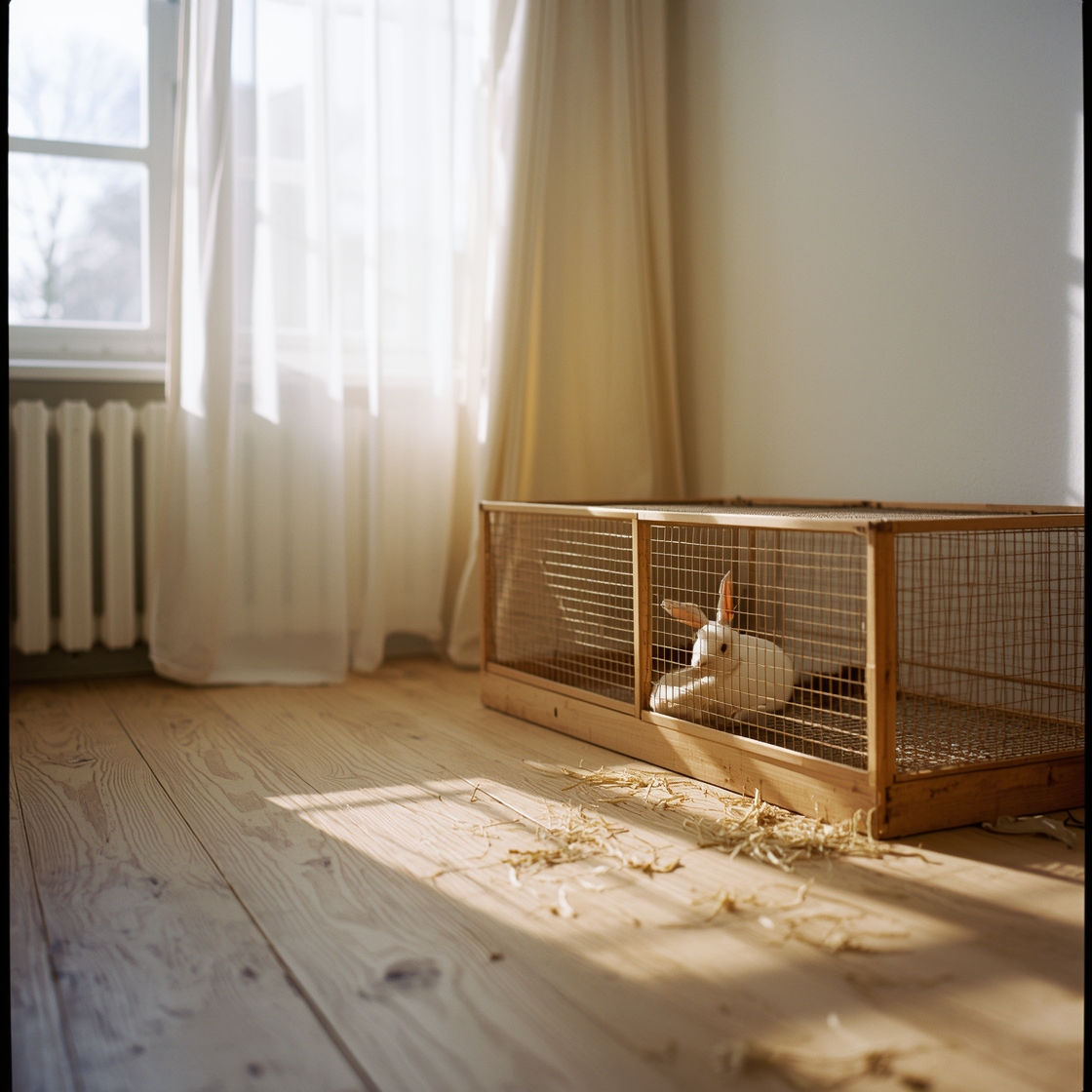
A sunny window photo (this URL’s hero image) is a lighting mood. Direct summer sun through glass is a heat box.
Chew, bars, and “chew-proof”
The guinea pig leftover names chew-proof edges. Rabbits chew wood, plastic, and soft metal. “Chew-proof” is a listing hope. Electrical cords in the out-area are the real chew emergency.
Solid wood hutches (2 Story $129.99; the $79.99 pair) will show tooth marks. That is a rabbit, not a defective SKU.
Litter, trays, and the pullout fantasy
Many cage photos show a pullout tray. A tray is a clean convenience. It is not a reason to keep the floor tiny. If the rabbit lives in the tray, you have a litter box, not a home.
Paper-based or kiln-dried wood pellets are common bedding classes on public pages. Clumping cat litter is a no on those same pages (dust, listing snapshot). We reprint the fork.
Bonded pairs, unneutered fights, and “two rooms”
2 Story $129.99’s two rooms will not fix an unbonded pair. Housing two intact adults together is a clinic/rescue conversation. Spay/neuter is welfare, not a hutch upgrade. We are not that clinic.
If you have one rabbit now and plan a pair, grow the floor first. Do not buy Living World $165.99 as a pair theory.
Exercise pen arithmetic (desk, not a panel brand)
Wisconsin HRS points at a 30-inch ex-pen. An 8-panel pen folded into a square uses two panels per side. Panel width is often 24 inches in the pet aisle — 8 ft perimeter / 4 = 2 ft per side if you used 24-inch-wide panels? Wait: 8 panels × 24" = 192" perimeter. A square would be 48" per side = 4 ft × 4 ft = Indiana’s adopt floor. That is listing-typical panel math, not a tape we ran on your living room. 16-panel setups get closer to a RWAF-shaped rectangle. Height: a 24-inch panel is a jump-out class for many rabbits; 30-inch is the HRS number we reprint; some jumpers need taller or a covered pen.
None of the seven cards are that pen.
FAQ
What is the minimum size for the best rabbit cage for indoor use?
Public bars, not a house tape: RWAF 3 m × 2 m × 1 m as a single enclosed area; Indiana HRS 4 ft × 4 ft as an adopt-pen floor; Wisconsin HRS — store-bought cages too small, 30-inch ex-pen, 3–6 hours exercise. On this URL, Gowoodhut’s 36" L is too small as sole housing. Ketive’s 48" L is longer and still not 3 m.
What size cage do I need for my rabbit?
More floor than a 36-inch hutch. Prefer a pen or room. If you buy from this aisle, treat VNE $55.99 / Gowoodhut $79.99 / Ketive $79.99 as hides, not as the habitat.
How often should I clean an indoor rabbit cage?
Daily urine/poop from the box; deeper clean when it smells to a human or the rabbit is wet. Ammonia is the reason. We will not invent a “every 3 days” house rule.
Should I choose a cage, a pen, or a hutch for indoor use?
A pen or proofed room is the housing class welfare groups describe. A hutch (Gowoodhut, Ketive, 2 Story $129.99, Casters $149.99) is a box with a photo. A cage (VNE $55.99) is a compact box. Pair box + pen.
What safety features matter in an indoor rabbit cage?
Solid rest floor (not open wire), latches a rabbit cannot open, no sharp edges, no toxic wood finish you cannot name, cords out of reach. “Chew-proof” on the guinea pig leftover is a pig title.
Is a two-story hutch the best rabbit cage for indoor use?
No as a floor substitute. Ketive $79.99 and 2 Story $129.99 name stories/rooms. Vertical ≠ RWAF’s 3 m × 2 m.
Can I keep a rabbit in the guinea pig cage on this page?
Not as a plan. $109.99 is the wrong species. Use guinea pig cage if that is your animal.
Is Living World worth $165.99?
Unknown until you open the brand-search listing. It is 2.96× VNE $55.99. Price is not a 3 m claim.
Do wheels and casters make a better indoor cage?
They make moving easier (VNE $55.99; Casters $149.99). They do not add floor.
Does a waterproof hutch mean I can leave the rabbit outside?
No. Outdoor is predators, flies, heat, and cold. HRS-style pages prefer indoor housing. Casters $149.99 is a title stack.
How does housing connect to diet and grooming?
Hay motility (pellets), wet greens (lettuce), and molt (grooming) still apply in a palace. A 36-inch box plus unlimited pellets is two wrong objects.
Label math examples (desk arithmetic)
Gowoodhut $79.99 vs Ketive $79.99 — $0. 12 inches of named length.
VNE $55.99 vs Living World $165.99 — 2.96×. Compact vs brand search.
Two $79.99 hutches = $159.98. Duplicate home theory.
Guinea pig $109.99 is the median. Three cheaper, three dearer.
Casters $149.99 − Ketive $79.99 = $70.00 for indoor/outdoor + caster + waterproof words.
All seven = $771.93. Spread 2.96×. One wrong species, one brand leftover, two same-price lengths.
RWAF 3 m vs 36" (0.91 m): 3 / 0.91 ≈ 3.3× longer on that axis than Gowoodhut’s title.
RWAF 3 m vs 48" (1.22 m): 3 / 1.22 ≈ 2.5× longer than Ketive’s title.
Indiana 4×4 = 16 ft². RWAF 3×2 m = 6.0 m² ≈ 64.6 ft². 64.6 / 16 ≈ 4.0× the adopt-pen floor. Both beat a 36-inch crate class.
When to stop shopping and go to a clinic
- No food, no fecal pellets, wet sore hocks, heat, fly eggs, a rabbit who cannot hop.
- A $165.99 brand search is not a treatment.
Pay the exam. Fight the pen later.
Sources this desk actually used
- Live Amazon card snapshots (titles, listed prices, class) on this URL, August 2026.
- RWAF — housing / why housing matters — 3 m × 2 m × 1 m minimum single enclosed area (rabbitwelfare.co.uk housing chapters).
- Wisconsin House Rabbit Society public adopt/housing themes: store-bought cages too small; 30-inch ex-pen; 3–6 hours daily exercise.
- Indiana House Rabbit Society adopt theme: minimum 4 ft × 4 ft pen.
- House Rabbit Society — housing and houserabbit.org indoor-housing themes.
- House Rabbit Society — Diet (hay in the living space).
- VCA — housing your rabbit (public owner page).
- MSD Veterinary Manual — rabbits (housing/care themes).
- The . We did none of that testing.
If a listing updates a length, believe the listing.
Wire floors, urine guards, and the photo that lies
A listing photo shot from above can hide a grate. Hocks on wire are a public sore-hock story (VCA / MSD-style pages). If you can see light through the standing floor, add a solid rest or pick a different object. Urine guards help your baseboards; they do not enlarge a 36-inch box.
You will.
Kids, dogs, and the living-room pen
Kids sit on pens. Dogs jump pens. A 30-inch panel is a height class, not a babysitter. The puppy harness URL is how you walk the dog away from the rabbit, not how you introduce them.
Name tags and crate plates live on best rabbit names. A plate does not add floor.
Heat, cold, and the “outdoor” word
Casters $149.99 names outdoor. Rabbits do not sweat like dogs. Heat stroke is an ER. Frozen water bottles are a household hack some owners use; they are not a desk protocol. Winter drafts on a window hutch are a respiratory story. Indoor climate is the reason HRS-style pages want the rabbit in the house.
Last reviewed: August 2026. If something is stale, contact us.
One more floor check before you click $165.99
Write the room width, the doorway, and the hours out. If you cannot name the run, do not buy Living World $165.99 on a two-word title. Buy pen panels, or Ketive $79.99 as a hide, or VNE $55.99 as a hold. The best rabbit cage for indoor use is the floor you can actually open every day — not a second 36-inch roof.