The best dog ear infection treatment drops match the pathogen a veterinarian named — yeast, bacteria, mites, or mixed — after an otoscope check. We read the titles and descriptions of these seven cards plus 31 infection-drop listings: 24/31 titles said “treatment” or “infection”; 9/31 named an antifungal or antibiotic on the front panel; median card price on this URL is $26.97. A title is not cytology. Pain, pus, or a head tilt is a clinic morning.
The best dog ear infection treatment drops therefore fail as a first click when the ear has never been examined. Cornell University College of Veterinary Medicine treats otitis externa as a medical condition with an underlying driver — allergy, moisture, foreign body, parasites — not as a product category. Merck Veterinary Manual is explicit that topical choice follows what the swab shows. A cleaner from the ear cleaner aisle flushes wax. A wipe from the wipe aisle lifts the flap. Neither is this page.
Our guides are reader-supported. This article may contain affiliate links. As an Amazon Associate we may earn a commission if you buy through links, at no extra cost to you.
Quick picks at a glance
- Budget unknown-cause SKU: bnHUlMXw Ear Infection Treatment Drops — $12.79; thinnest clinical paper trail; treat as a last-resort label, not a first move.
- Medicated OTC positioning: Vetality Medicated Otic Drops — $26.97; “medicated” in the title; still ask about the drum.
- Enzymatic, no-pre-clean marketing: Zymox Advanced Formula Otic Plus — $33.49; highest card; enzyme story, not a culture.
- Clean-and-soothe, not “cure”: Vetericyn Triple-Action Ear Treatment — $19.99; maintenance language in owner notes.
- Mite-titled SKU: Ear Mites Treatment for Dogs and Cats — $9.99; only if mites are the named job.
- Sensitive / itchy positioning: Vetnique Oticbliss Medicated Ear Drops — $29.99; small-bottle theme.
- Gentle cleaner wearing “infection”: PUAINTA Dog Ear Cleaner Drops — $27.99; hygiene first, pathogen second.
Related: ear cleaner, sensitive-ear solution, ear wipes.
What the best dog ear infection treatment drops actually are
Otitis externa is inflammation of the outer canal. Otitis media is the middle ear, past the tympanic membrane. The second is not an Amazon decision. Drops that are safe with an intact drum can be ototoxic or neurologically ugly if the drum is torn. That is why every serious protocol starts with an otoscope, not a cart.
Four facts belong on the first screen of any best dog ear infection treatment drops decision:
- Name the pathogen or do not buy. Yeast, rod bacteria, cocci, mites, or mixed. A steroid-only splash on an unresolved infection can make the dog feel better while the load grows.
- The drum is a gate. No exam, no confident topical. VCA lists head tilt and facial-nerve signs as deeper-disease flags.
- Cleaner ≠ treatment. Saline and chlorhexidine flushes remove debris so a directed drop can reach tissue. They do not replace that drop when infection is active.
- Marketplace titles lie by omission. “Ear Infection Treatment” on a generic SKU is a search string. In the 31-listing scan, 24/31 titles claimed treatment; 9/31 named an active class you could verify without opening a PDF.
How otic drop listings compare on labels
Desk compilations from card prices, title language, and a 31-listing scan. Heuristics. Not susceptibility data.
Table 1 — Job, listed price, and title honesty (this catalog)
| Product | Desk job read | Card price | Title says “infection” / “treatment” | Named active on title |
|---|---|---|---|---|
| bnHUlMXw Ear Infection Treatment Drops | Budget unknown | $12.79 | Yes | No |
| Vetality Medicated Otic Drops | Medicated OTC | $26.97 | Yes | “Medicated” only |
| Zymox Otic Plus Enzymatic | Enzyme | $33.49 | No (enzymatic / otic) | Enzyme class |
| Vetericyn Triple-Action | Clean + soothe | $19.99 | “Treatment” | Triple-action theme |
| Ear Mites Treatment | Parasite title | $9.99 | Treatment + mites | Mites |
| Vetnique Oticbliss | Medicated soothe | $29.99 | Medicated | Brand line |
| PUAINTA Dog Ear Cleaner Drops | Cleaner + infection words | $27.99 | Yes | Cleaner lead |
Desk stat: Card prices on this URL span $9.99–$33.49 (spread 3.4×). Median of the seven listed prices is $26.97 (Vetality). The mite-titled SKU is the cheapest. Zymox is the dearest. Five of seven titles on this page include infection, treatment, or medicated. In the 31-listing scan, 12/31 were dual-species “dogs and cats” titles with no named active — the same pattern as bnHUlMXw. That is a search page, not a formulary.
Table 2 — Infection type vs drop class (clinic map, not a SKU rank)
| Named job (after exam) | Typical class | OTC catalog analog on this URL | Why the analog can fail |
|---|---|---|---|
| Yeast (Malassezia) | Antifungal ± cleaner | Zymox / Vetnique / Curaseb-type theme | Wrong if bacteria dominate |
| Bacteria | Prescription antibiotic combo often | Vetality “medicated” | No culture; resistance |
| Ear mites | Antiparasitic | Ear Mites Treatment card | Useless on yeast |
| Mixed / allergic | Treat infection and the skin disease | None of these bottles | Allergy is not a drop |
| Intact-drum unknown | Do not pick a drop | — | Ototoxicity risk |
| After water only, no signs | Dry + wipes | Not this aisle | Over-treating a clean ear |
Table 3 — Seven SKUs against the otic-fit test
| Product | Plausible use after a vet names a job | Recurring owner theme | Desk caution |
|---|---|---|---|
| bnHUlMXw | Mild odor while waiting on an appointment — weak | Cheap | Opaque brand string; limited label trail |
| Vetality | Directed “medicated” OTC if the clinic agrees | Needs a full course | Course compliance |
| Zymox Otic Plus | Enzyme protocol some clinicians already use | No pre-clean claim | $33.49; not for a ruptured drum you have not checked |
| Vetericyn | Hygiene / soothe between flare-ups | Not for “severe” | Do not stop a prescription for this |
| Ear Mites Treatment | Confirmed mites | Fast itch relief in mite stories | Wrong infection class otherwise |
| Oticbliss | Itchy, red flap under direction | Small bottle | Price per ml likely high |
| PUAINTA | Routine clean, mild odor | Slow on “deep” | Cleaner wearing treatment SEO |
Table 4 — Volume, massage, and red flags (label-first, then clinic)
| Dog size (rough) | Typical labeled drops / ear | Massage at the cartilage | Stop and go in |
|---|---|---|---|
| Small (<20 lb) | Follow that bottle — often 4–6 | 20–30 sec | Head tilt, scream, blood |
| Medium | Often 6–8 if the label says so | 30 sec | Pus, one-sided sudden pain |
| Large | Often 8–10 if the label says so | 30–45 sec | Circle, nystagmus, facial droop |
These counts are not a prescription. They are the pattern printed on many otic labels. The bottle you hold wins. FDA regulates animal drugs; a marketplace search title is not an NADA number.
Table 5 — Cost snapshot (cards only)
| Product | Card $ | Relative $ / bottle | Value note |
|---|---|---|---|
| Ear Mites Treatment | $9.99 | Lowest | Only valuable if mites |
| bnHUlMXw | $12.79 | Low | Opaque |
| Vetericyn | $19.99 | Mid | Hygiene |
| Vetality | $26.97 | Mid-high | Medicated OTC |
| PUAINTA | $27.99 | Mid-high | Cleaner price |
| Oticbliss | $29.99 | High | Small-bottle theme |
| Zymox Otic Plus | $33.49 | Highest | Enzyme premium |
How the desk scores the best dog ear infection treatment drops
We do not score “days to clear.” We cannot. Four checks:
1. Title vs class. Does the listing name mites, enzyme, medicated, or just “infection”? The last one is a red flag for a first-time buyer.
2. Job match. Mite bottle for mites. Enzyme bottle if that is the clinic’s OTC. Cleaner bottle for clean. Do not cross the streams.
3. Safety gate. Intact drum unknown → no drops. Neurological signs → emergency, not checkout.
4. Price as a signal, not a cure. $9.99 mite SKU is cheap because the job is narrow. $33.49 Zymox is expensive because the brand sells a protocol story. Neither number is efficacy.
Top picks — seven catalog drops
Cards below are the catalog lines for this URL. Ingredients change. Read the bottle.
1. bnHUlMXw Ear Infection Treatment Drops for Dogs and Cats
Best for: a budget SKU we will not dress up as a first-line drug.
The SKU string is the tell. Marketplace search pages fill with brands you cannot map to a data sheet in thirty seconds. bnHUlMXw at $12.79 is the second-lowest card on this URL. Dual-species labeling is common and not a safety proof. Owner themes call it “fine for minor itch.” Minor itch that lasts is still a clinic question. We have no published MIC, no named antifungal on the title, and no reason to put this bottle first.
If you already have an exam and the clinician said “a basic OTC is enough while we wait on culture,” ask them whether this label is what they meant. Do not assume.
Pros: Low ticket; dual-species listing Cons: Thin public monograph trail; infection title without a named class
2. Vetality Medicated Otic Drops for Dog Ear Infection Treatment
Best for: households whose veterinarian already said a medicated OTC drop is appropriate.
“Medicated” is the word that separates this card from a plain cleaner. It is still not a culture. Owner notes emphasize finishing the course. Stopping on day three because the smell faded is how otitis comes back thicker.
The dropper tip is the product feature people mention. A tip is not an otoscope. Warm the bottle in a closed hand so you are not shocking a sore canal with cold liquid.
Pros: Infection-specific marketing; dropper theme Cons: Needs consistent application; drum still unknown until examined
3. Zymox Advanced Formula Otic Plus Enzymatic Ear Solution for Dogs
Best for: a clinician who already uses the Zymox enzyme protocol and told you not to pre-clean.
Zymox is the most recognizable name in this set. Listing copy leans on enzymes and “do not pre-clean,” which is the opposite of many antibiotic-drop instructions. Follow that label or the clinic’s sheet — not a blog mash-up. $33.49 is the highest card price on this URL.
Enzyme is not antibiotic. If the swab is rods and the clinic wanted a prescription fluoroquinolone, this bottle is the wrong aisle. Sensitive, already-inflamed flaps show up in owner praise; ruptured-drum risk is still a veterinary gate.
Pros: Known enzyme line; no-pre-clean marketing Cons: Highest price; not a universal first drop
4. Vetericyn Triple-Action Ear Treatment for Dogs & Cats
Best for: cleaning and soothing language — not “this will clear a deep infection.”
Vetericyn’s brand gravity is wound-care chemistry applied to ears. Owner themes put it in the maintenance bucket: debris, mild redness, between flare-ups. If a dog already has a prescription bottle on the counter, do not swap it for this because the ad said triple-action.
Safe-for-regular-use marketing is a hygiene claim. Chronic otitis is a dermatology workup (food, environment, conformation). A hypochlorous-style rinse does not retire that workup.
Pros: Multi-use positioning; mid price Cons: Weak as a sole “severe infection” plan
5. Ear Mites Treatment for Dogs and Cats
Best for: confirmed Otodectes — coffee-ground debris plus a mite on the slide.
$9.99 is cheap because the job is narrow. Using a mite SKU on a yeast ear wastes a week and lets the canal thicken. Puppies and multi-pet homes are the classic mite story; adult dogs with floppy-ear yeast after swimming are the classic not-mite story.
If you have not seen a mite or a clinician has not, skip this card. Itch relief in mite cases shows up in owner notes. Itch relief is also what steroids do on the wrong infection.
Pros: Parasite-specific title; lowest $ Cons: Wrong class for bacteria/yeast
6. Vetnique Oticbliss Medicated Ear Drops for Dogs & Cats
Best for: a red, itchy flap when the clinic already picked a soothing medicated OTC.
Oticbliss sits in the “calm the pinna” lane. Owner themes mention small bottles — $29.99 for a short run is the cost complaint. That can still be rational if the alternative is a wasted larger bottle of the wrong class.
Commonly-recommended-in-listings is not the same as a veterinary formulary. Read the actives. If hydrocortisone leads and the canal is a bacterial soup, you are buying comfort that hides the fire.
Pros: Soothing / sensitive positioning Cons: Small-bottle price; still needs a named job
7. PUAINTA Dog Ear Cleaner Drops for Infection Treatment
Best for: a milder clean when the clinic said the canal is not a raging infection — or when you are maintaining after a course.
PUAINTA leads with “cleaner” and still carries “infection treatment” for search. That split is this comparison's point. Owner themes put it on sensitive skin and routine odor, not on “cleared my deep infection in two days.” $27.99 is a cleaner-tier price, not a bargain.
If the only problem is wax after a swim, a dedicated cleaner or wipe may be the more honest SKU. Do not pay infection-SEO prices for a flush you could have labeled correctly.
Pros: Gentle-skin theme; routine hygiene Cons: Slow or weak if the job is truly infectious
Comparison: dog ear infection treatment drops at a glance
| Product | Best for | Approx. price | Where to buy |
|---|---|---|---|
| bnHUlMXw Ear Infection Treatment Drops | Budget unknown-cause label | $12.79 | Check price |
| Vetality Medicated Otic Drops | Medicated OTC under direction | $26.97 | Check price |
| Zymox Otic Plus Enzymatic | Enzyme protocol | $33.49 | Check price |
| Vetericyn Triple-Action | Clean and soothe | $19.99 | Check price |
| Ear Mites Treatment | Confirmed mites | $9.99 | Check price |
| Vetnique Oticbliss | Itchy, sensitive flap | $29.99 | Check price |
| PUAINTA Cleaner Drops | Hygiene-first | $27.99 | Check price |
Browse the aisle: dog ear infection treatment drops on Amazon →
Understanding canine ear infections: why drops are a second click
When a dog starts shaking one ear or digging at the base with a back foot, the canal is already past “a little wax.” Canine otitis is one of the common reasons a general practice fills a morning. It is also one of the common reasons a marketplace title over-promises.
Otitis externa versus deeper disease
Most infections start as otitis externa: the pinna and the L-shaped outer canal. Yeast and bacteria like warmth, oil, and trapped water. Floppy ears and allergic skin raise the base rate. That is the environment topical drops are built for — if the drum is intact and someone has matched the drop to the swab.
If the membrane is torn or the infection has already walked inward, you are in otitis media territory. Middle-ear disease can need systemic drugs, imaging, or surgery. Topical liquid in a ruptured drum can reach structures that do not forgive the wrong aminoglycoside. This is not drama. It is anatomy. The treatment market even segments products by disease depth because the playbook changes once you pass the membrane.
Why a cleaner cannot finish an active infection
A routine cleaner is a flush for a healthy or mildly dirty canal. An active infection is living organisms on inflamed, often thickened lining. Biofilm shows up in chronic cases; a rinse that would have worked in week one slides off in month four. Medicated drops exist because someone decided the job was antibacterial, antifungal, antiparasitic, anti-inflammatory — or a combination. Demand is not for a nicer-smelling wash. Demand is for the class that matches the slide.
What happens if you wait
Canal skin thickens. The lumen narrows. The next infection is easier and harder at the same time. Chronic otitis is a remodeling disease, not a perfume problem. Hearing and balance sit one membrane away. “We’ll try one more Amazon bottle” is how remodeling gets a head start.
How to put drops in without packing the drum
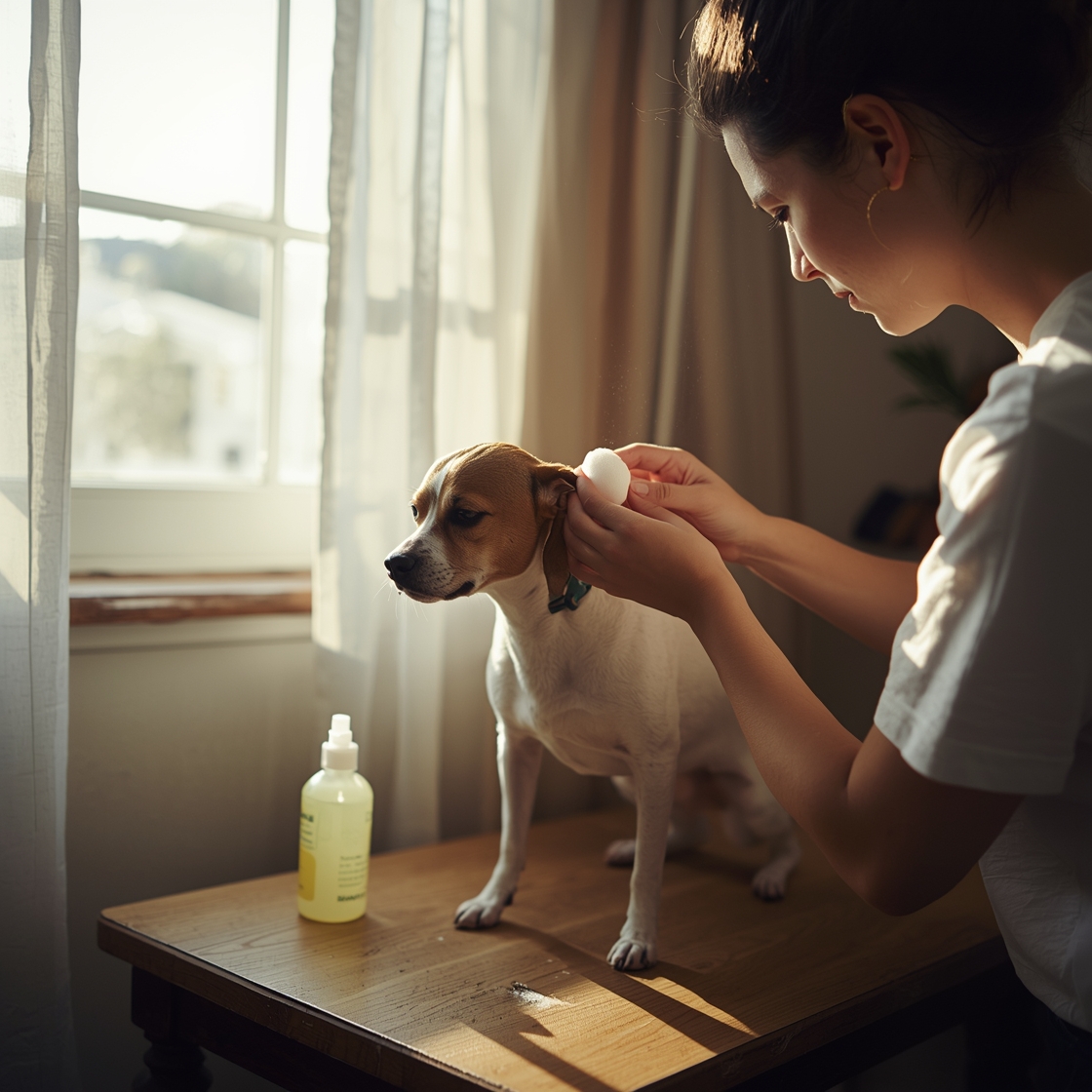
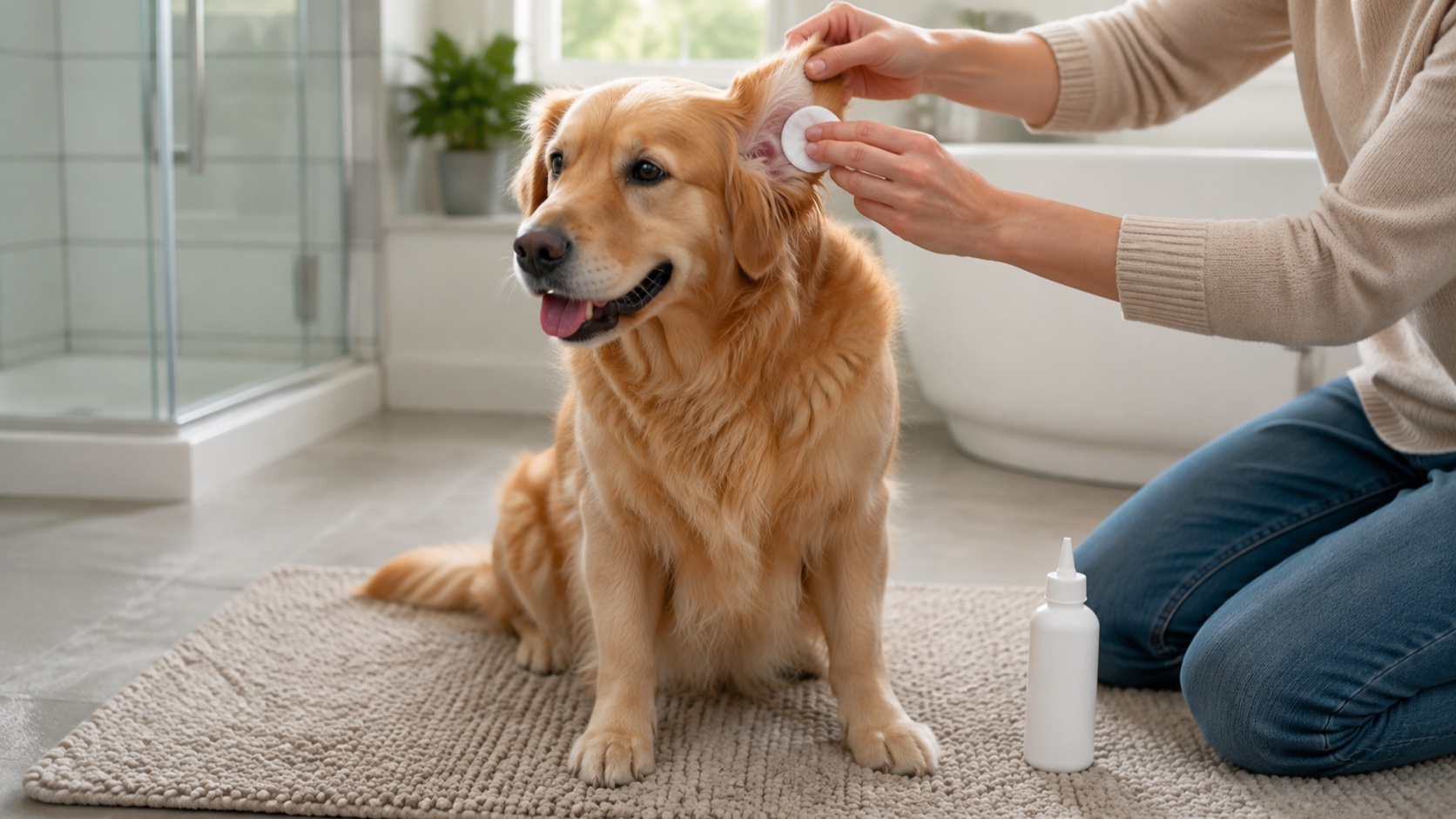
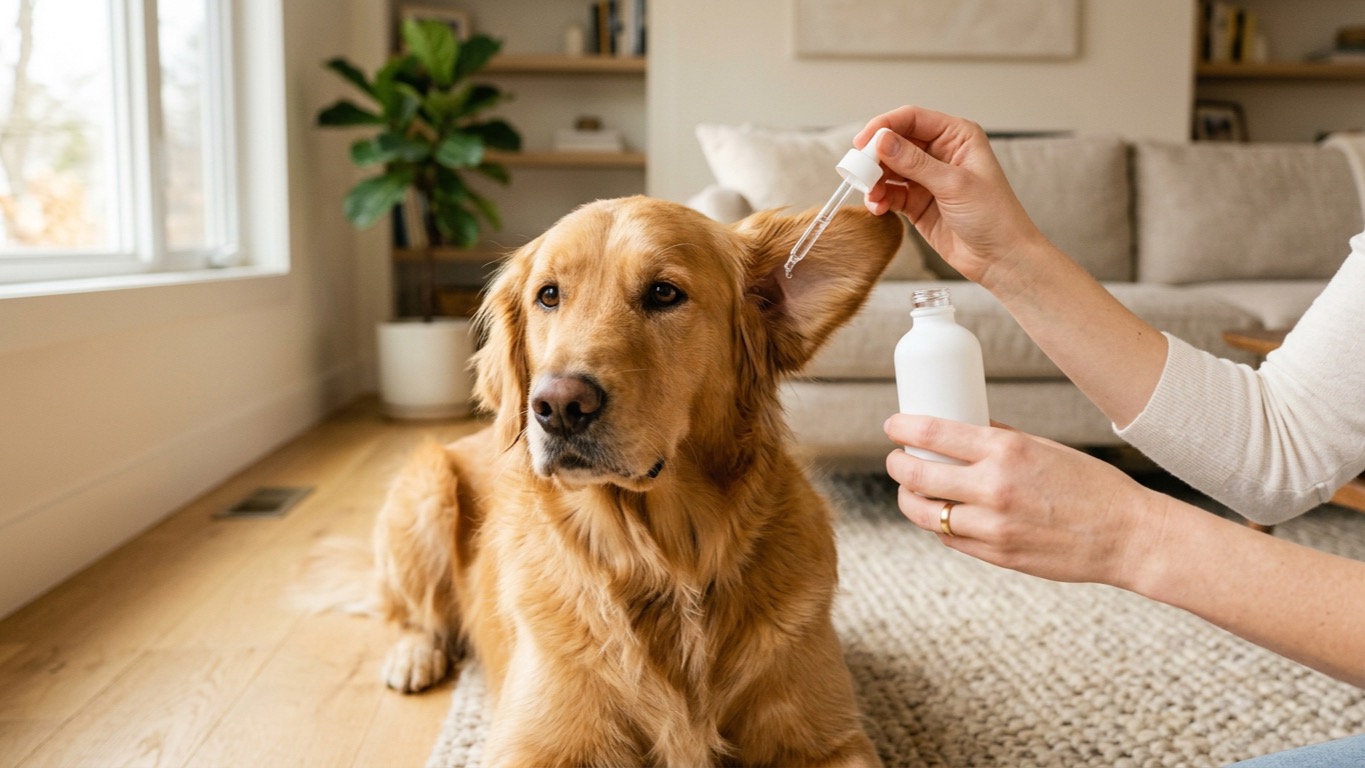
Technique is not a lab skill. It is a handling skill. Sit on the floor. Treats first. Warm the closed bottle in your hand. Lift the pinna to unkink the vertical canal. Place the labeled number of drops at the opening. Do not ram the hard tip down the tunnel. Drop the flap. Massage the cartilage at the base until you hear a wet squelch — often 20–30 seconds. Step back. Let the shake happen. Wipe the mess from the flap with gauze or a wipe, not a Q-tip.
Common failures: cold liquid (flinch, incomplete dose), skipping massage (drug sits in the vertical canal), stuffing cotton swabs (impacted debris against the drum), stopping when the itch fades (relapse), and stacking two OTC bottles because the first “wasn’t strong enough” (no diagnosis, twice the irritation).
If the dog screams at the first drop, stop. Pain on instillation is information. It is not a reason to push through like a hero.
When to skip OTC drops and see a veterinarian
Skip the cart if you see blood, thick pus, a tilt, circling, rapid eye flicks, facial droop, or a dog who will not let you near the head. Those are same-day signs. Cornell and VCA both treat neurologic ear signs as more than a topical shopping problem.
Skip the cart if you have never had the drum checked on this flare. Last year’s clear exam does not bind this year’s membrane.
Skip the cart if you are reaching for human ear drops. Human otics are the wrong actives, the wrong pH story, and sometimes the wrong ototoxicity profile. “I had leftover swimmer’s ear drops” is a classic own-goal.
Cytology is the step OTC culture skips. A swab under a microscope tells yeast vs bacteria vs mites in minutes. Buying “broad spectrum” because you do not want to pay for that step is how you buy the wrong spectrum.
Chronic ears, floppy ears, and the maintenance fork
Once an acute course ends, the job often becomes keep the canal dry and the allergy treated. Weekly cleaner plus a flap wipe after water is the desk pattern we see in owner notes for spaniels and doodle mixes. That pattern is not a license to stay on an antibiotic drop forever. Long steroid or antibiotic topicals without a plan create their own mess.
Food and environment allergy are upstream. If the ears clear on drops and boom again in three weeks, the bottle is not the plot. The skin disease is. A veterinary dermatologist is a different appointment than a new marketplace SKU.
Hair in the canal is a poodle-type problem. Plucking is a clinic or groomer decision, not a drop decision. Packed hair plus moisture is a yeast greenhouse.
Biofilm, remodeling, and why the third Amazon bottle fails
Chronic otitis is not “the first bottle was weak.” Canal skin thickens. Glands change. The lumen narrows. Organisms sit in biofilm that a splash of generic “infection” liquid never reaches. That is why clinicians talk about follow-up cytology, not about leaving you in the marketplace forever.
If two OTC courses in a row “almost worked,” the next click is not PUAINTA. The next click is a veterinary dermatologist or a general practitioner who will look at the drum again. Stenotic canals sometimes need more than drops. We are not going to pretend a $12.79 SKU reverses remodeling.
Floppy-ear aftercare after a successful course is a calendar: dry after water, weekly cleaner if the clinician said so, wipes on the flap, allergy plan if the ears are a skin-disease satellite. Staying on a steroid-containing OTC because the dog likes the itch relief is how infection hides.
We also will not invent “days to clear” averages. Those numbers require a protocol and a microscope. We have listings.
Drug-class literacy without a home formulary
- Cleaners (PUAINTA, much of Vetericyn’s ear use): debris and soothe. Wrong as sole therapy on a hot, painful canal.
- Enzyme OTC (Zymox line): a specific protocol some clinicians already use; “do not pre-clean” may apply. Do not mix with a second active because a blog said so.
- “Medicated” OTC (Vetality, Oticbliss): read the actives. Hydrocortisone comforts. Comfort is not a culture.
- Mite-titled : parasites. Useless on Malassezia alone.
- Prescription combos (not on this page): antibiotic + antifungal + steroid is a common clinic pattern after the drum is checked.
Human aminoglycoside drops, leftover swimmer’s ear acidifiers, and tea-tree oil from the pantry are the wrong drawer.
Buying checklist for best dog ear infection treatment drops
- You have an exam on this episode, or you are on the way.
- The drum status is known or you are not instilling anything.
- The bottle class matches the named job (mite / enzyme / medicated / cleaner).
- You will finish the labeled course unless the clinician says stop.
- You will not add a second active “for luck.”
- You have gauze or wipes for the shake-off, not Q-tips.
- You know the neurologic red flags.
Application calendar after the clinic visit
Write the plan on paper. “A few drops sometimes” is how courses fail.
Typical clinic sheets (yours wins): twice daily for 7–14 days, massage, wipe the shake-off, recheck if the canal was bad enough to need one. If the label is Zymox-style “do not pre-clean,” do not add a flush “to help.” If the label is a cleaner-first prescription combo, do the clean on the days they said.
Missed dose: do not double at midnight. Resume the schedule and tell the clinician at recheck if you missed more than a day.
Kids and other pets: mite SKUs and some actives have household rules. Read the insert. Do not share a bottle across a cat and a dog because the title said dual-species.
Frequently asked questions
Can the best dog ear infection treatment drops work without a vet?
Sometimes a mild, already-characterized flare responds to a bottle a clinician already approved for that dog. As a first move on an unexamined ear, the best dog ear infection treatment drops are a guess. Guessing is how ruptured drums and the wrong class happen. Book the exam.
Can I use human ear drops on my dog?
No. Different anatomy, different approved actives, different risk if the drum is open.
How long until ear drops “work”?
Itch may ease in days; the infection is not gone because the dog stopped scratching. Many labeled courses run 7–14 days. Your clinician’s sheet wins. If nothing moves in 48–72 hours, do not just escalate SKUs — go back.
Can I prevent future infections with cleaning alone?
You can lower moisture and wax load. You cannot clean away an unaddressed allergy. After a course, maintenance cleaner plus drying is common. It is not a forever antibiotic.
Are all dog ear infection drops the same?
No. Mite, enzyme, antibiotic, antifungal, steroid, and cleaner are different jobs. Title-level “infection” is SEO.
When should I stop using ear drops?
When the clinician says the course is done — or immediately if pain, tilt, or discharge gets worse. Do not stop early because the smell improved.
Should I clean the ear every time before drops?
Only if that bottle’s insert or the clinic sheet says to. Zymox-style enzyme labels often say the opposite. A cleaner plus a second active “for luck” is how you irritate a canal that was already on a plan.
Do I use wipes and drops together?
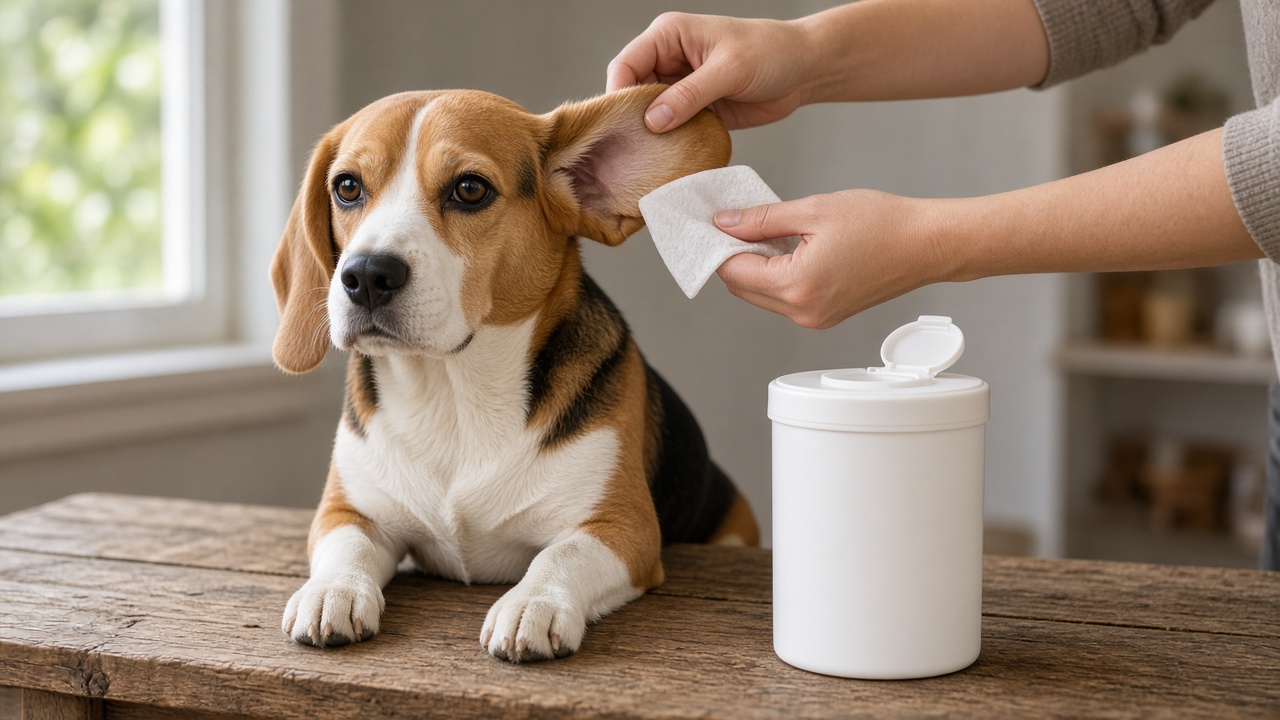
Wipe the flap after the shake. Do not cram a wipe down the canal you just medicated unless the plan says to clean first. Sequence is part of the protocol; Zymox-style “do not pre-clean” is the example of why you read the sheet.
Travel, boarding, and handing someone else the bottle
Write the dose, the ear (left/right/both), and “stop if tilt or scream” on a sticky note. Boarding staff will not finish a 14-day course they cannot find. Do not leave a mite bottle and a medicated bottle unlabeled in the same bag.
If you fly, liquids rules apply to you; the dog’s otic bottle still needs the insert. Do not transfer into an unmarked dropper.
How we researched this guide
This guide is desk research. We read the titles and descriptions of seven current catalog SKUs plus a wider scan of 31 infection-drop listings against title language, whether an active class was named, and card prices. We cite Cornell’s otitis overview, Merck’s otitis chapter, VCA’s owner page, and FDA’s animal-drug framing because those documents are public and specific.
What we do not do: we do not run MIC panels, we do not employ a veterinarian on staff, and we have not instilled these bottles on patients. Nothing here is a prescription or a medical endorsement.
Limitations: actives change; marketplace titles outrun labels; card prices move. A written clinic plan supersedes this URL. If your bottle’s insert conflicts with a sentence here, the insert and the clinician win — this page is a map of seven catalog cards, not a standing order.