A dog stroller is a cabin whose floor can take this dog’s loaf plus a little spare — plus a stated weight limit, a brake you can lock, and a mesh that still lets air move — not a ranked aisle of seven “ultimate” carts. We read current Amazon listing titles and descriptions and scored 7 SKUs. Sticker sum is $605.75. 1 of 7 titles prints a weight (MoNiBloom up to 33 lbs, $57.99). 2 of 7 titles say 3 Wheel (KMFurnila $35.93; ROODO $96.98). 1 of 7 says Large Dogs (Zoosky $169.99 — highest sticker, 28.1% of the sum). 1 of 7 is ZENY Foldable ($26.99 — lowest sticker, 4.5%). 0 of 7 print interior floor inches. 0 of 7 replace a tape from nose to tail-base. 0 of 7 replace a leash walk a veterinarian already cleared. We grouped listings by jobs, not a sidewalk trophy.
We grouped listings by floor versus title, not a breed podium. If the dog is already in respiratory distress, cannot rise, or the cabin is a sauna, that is a clinic, not a new colorway.
Our guides are reader-supported. This article may contain affiliate links. As an Amazon Associate we may earn a commission if you buy through links, at no extra cost to you.
Related: small-dog strollers, cat stroller with removable carrier. Heatstroke, a collapse, or a dog that cannot stand after “rest” is a clinic tonight. We are not that clinic.
What is a dog stroller?
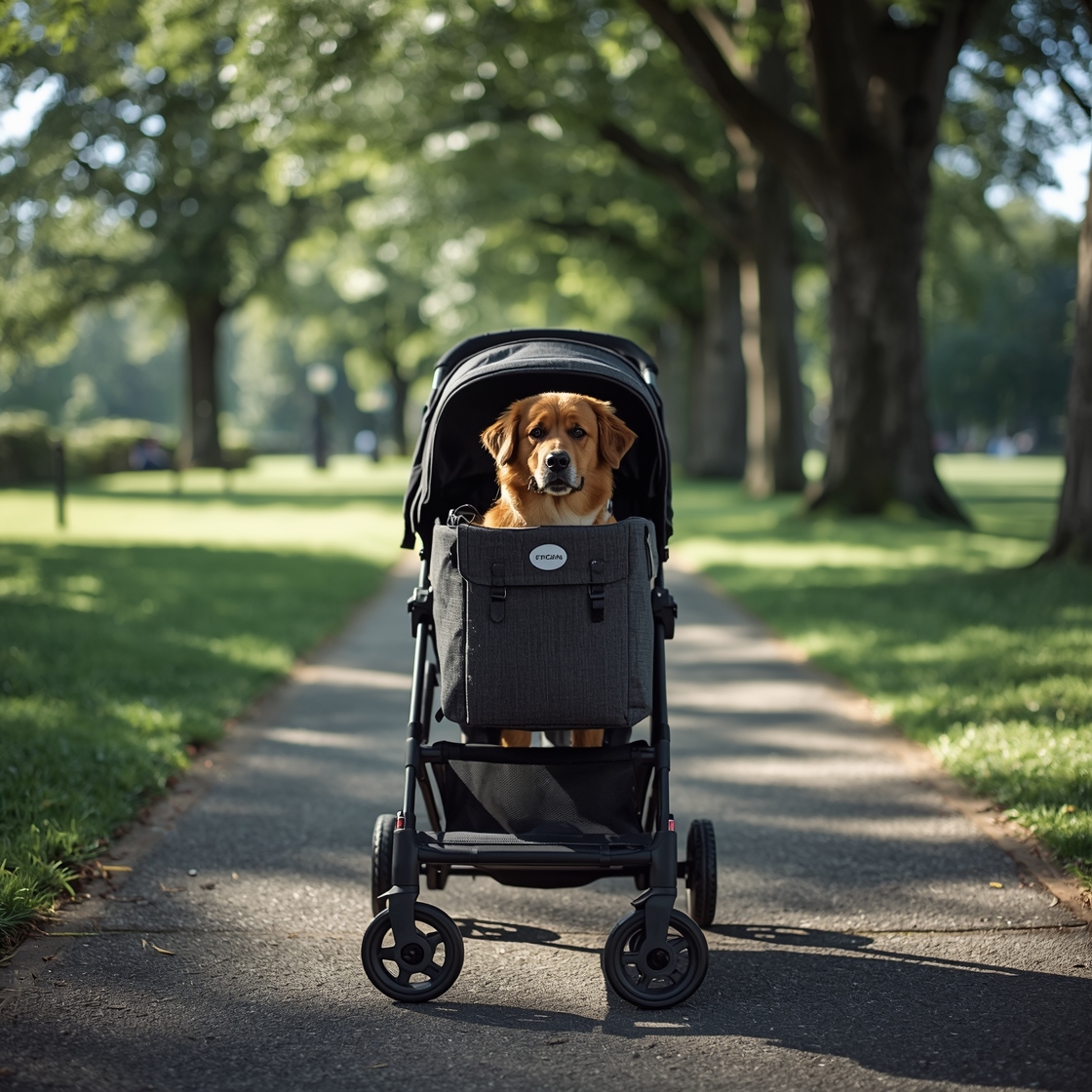
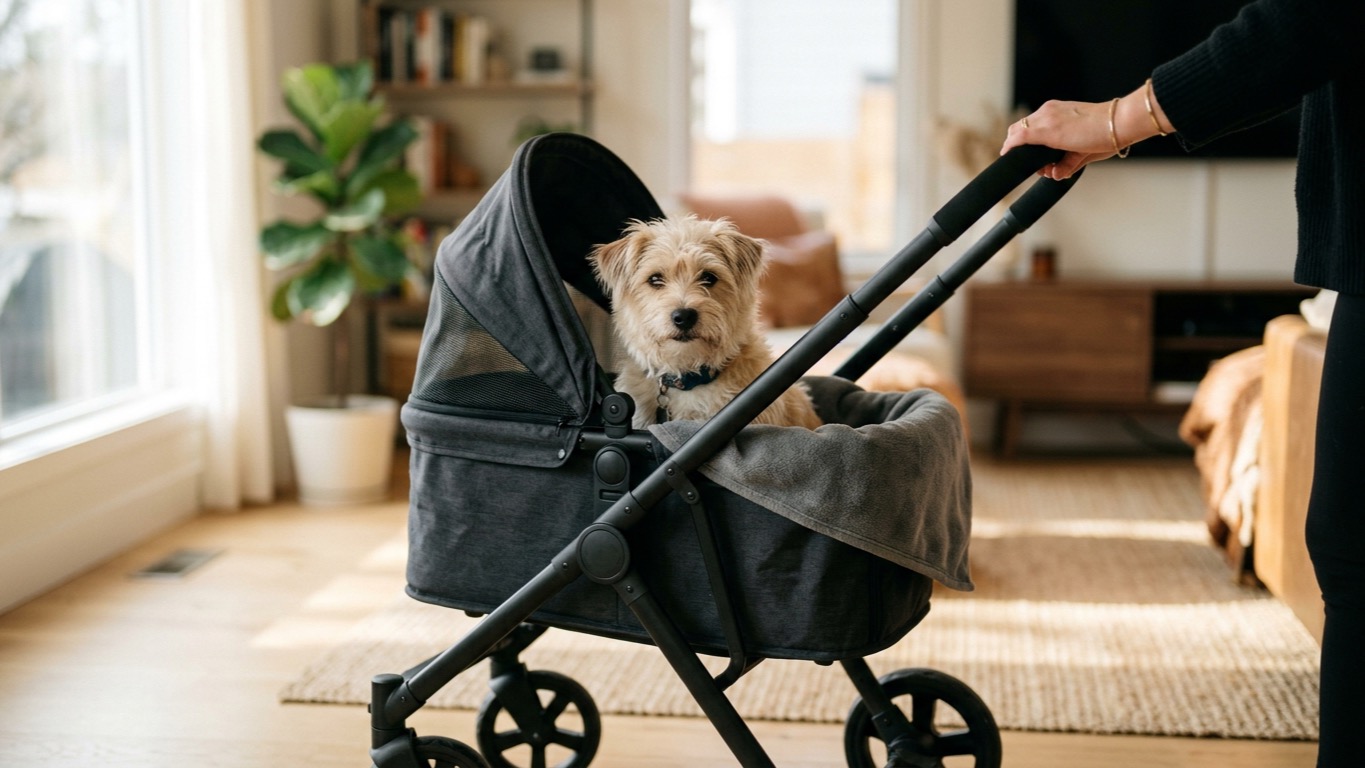
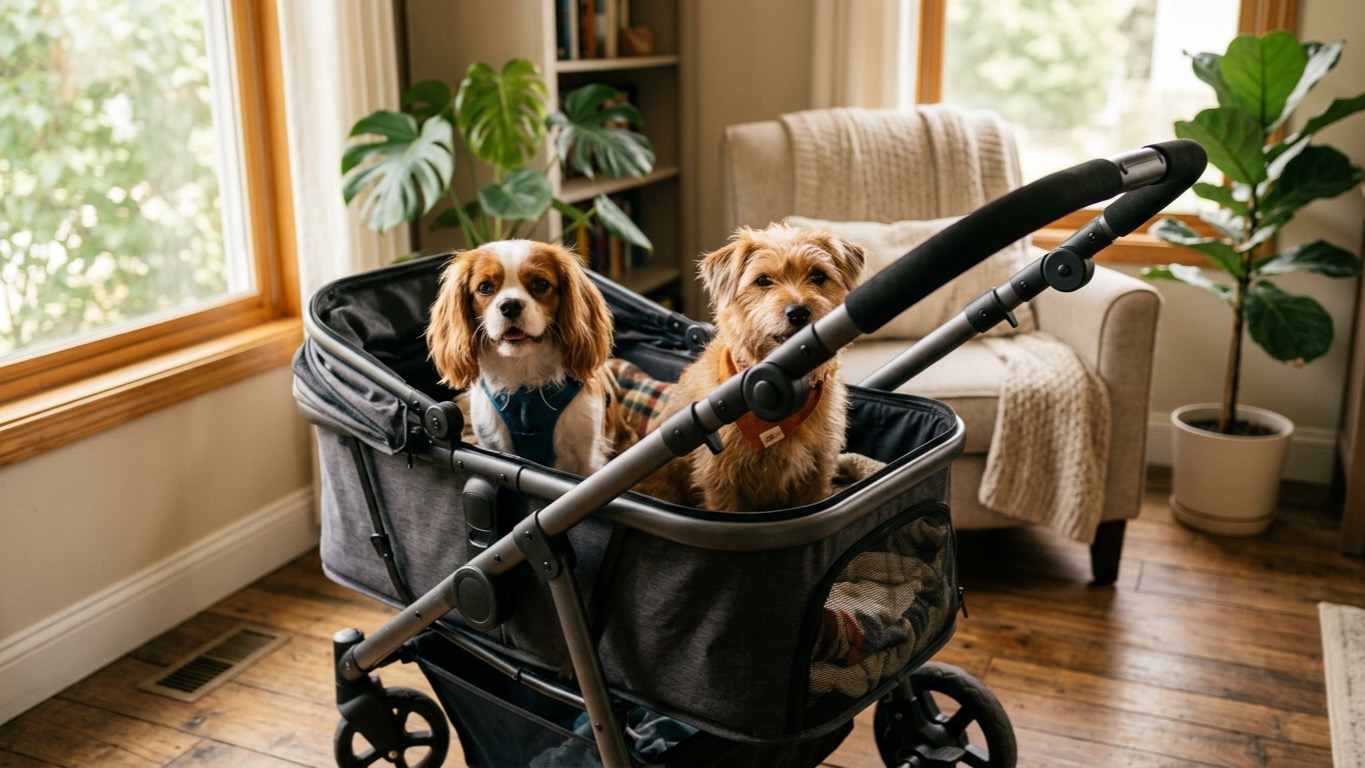
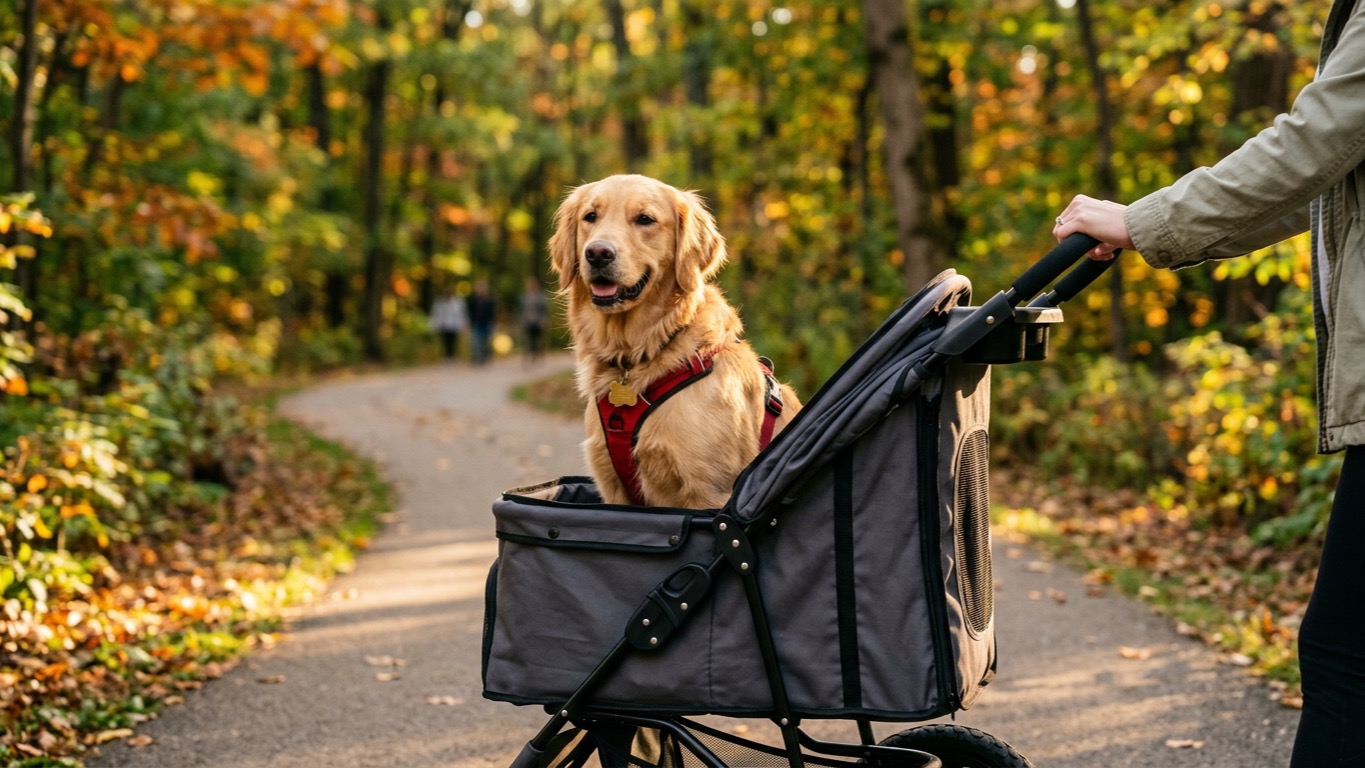
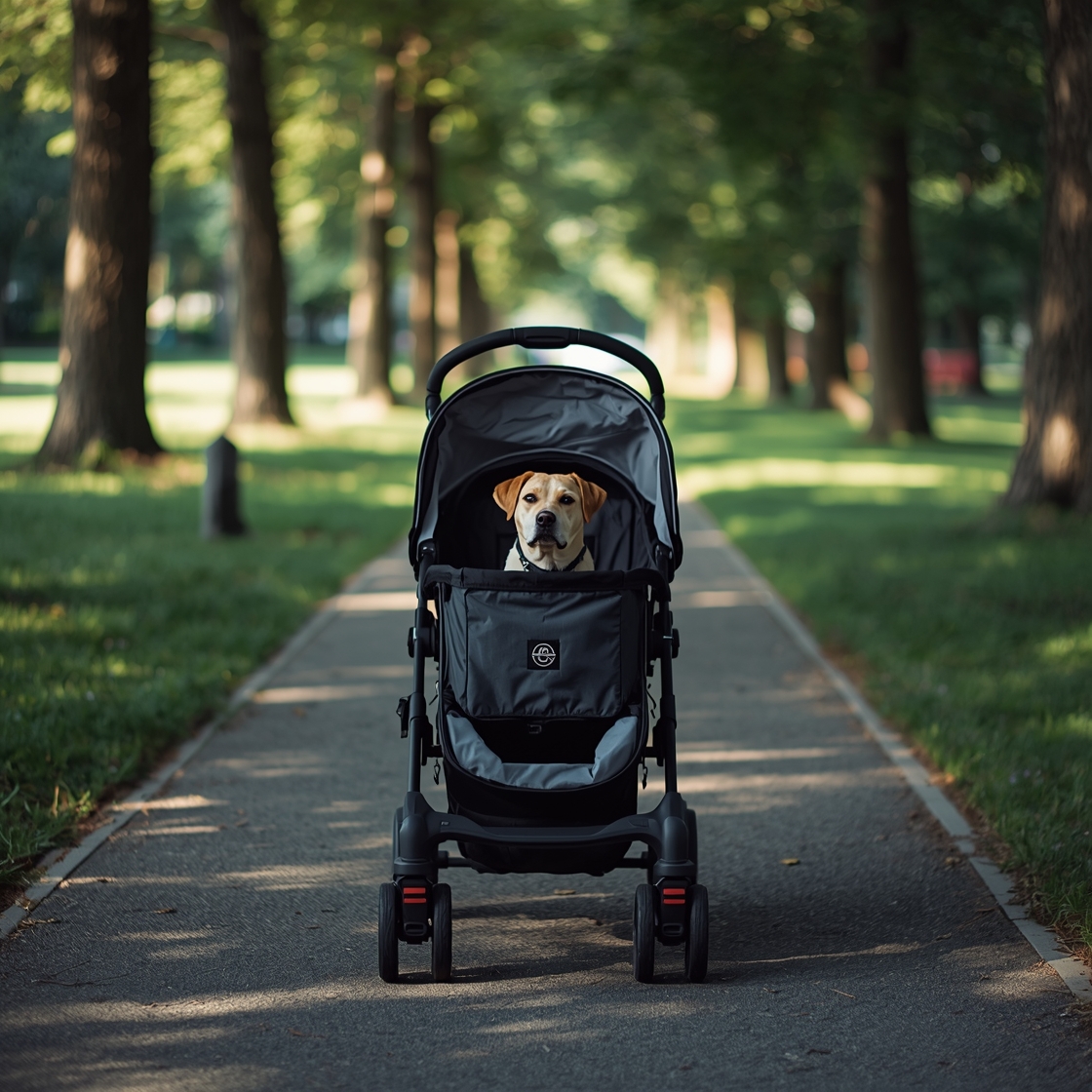
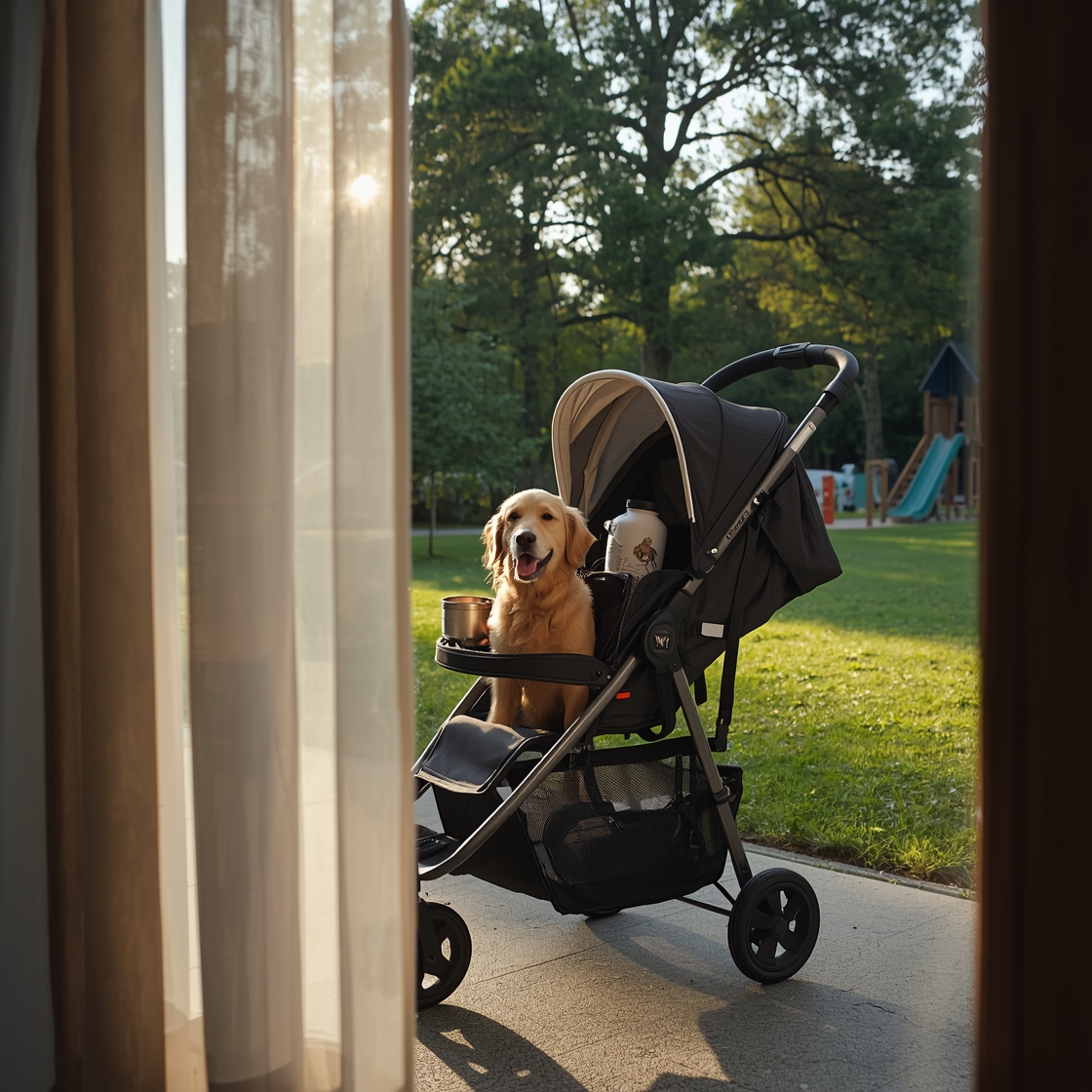
A dog stroller is a wheeled cabin with a floor, mesh or windows, a way to zip a dog in, and a handle for a human. It is a rest and transport object. It is not a substitute for the walks a veterinarian has already said this dog can still do. It is not a crate. It is not a car seat unless the maker prints that job.
Jobs that actually show up: senior joints on a long sidewalk, a post-op week the clinic already described, a small dog in a crowd, a second dog while you manage the first, a travel fold into a trunk. Jobs that do not: replacing daily movement on a healthy adolescent, cooling a brachycephalic face in July with the vents half-zipped, “large breed” as a title without a floor inch.
Browse dog stroller on Amazon →
Quick picks at a glance
- Only measurement that clears this checklist: loaf length (nose to tail-base, or the curl this dog actually uses) versus the inside floor, plus the maker’s pound limit.
- Highest sticker: Zoosky Medium Dog Stroller for Large Dogs — $169.99. “Large” is a title. Tape the floor.
- Lowest sticker: ZENY Foldable — $26.99. Foldable is a title. Wheels and limit still live on the carton.
- Only title with a pound number: MoNiBloom up to 33 lbs — $57.99. Confirm the live listing. Weigh the dog.
What current Amazon listings show (Cabin-Job, August 2026)
| Job | What actually works | Category | Fail if you skip it |
|---|---|---|---|
| Floor vs loaf | Tape inside L × W vs this dog | Off every title until the tape wins | A curled neck as “he fits” |
| Weight vs limit | Scale vs maker pounds | MoNiBloom 33 lb as the only printed title limit | Two dogs in a 33 lb cabin |
| Air and heat | Mesh open, shade, water, short sits | All seven as listings | July, vents closed, brachycephalic |
| Stop and stay | Brake, tether, never unattended | None of the seven print a brake inch | A slope and a “he’ll be fine” |
Before you shop: (1) you wrote inside floor inches, (2) you compared pounds, (3) you can lock a wheel, (4) glaze, vomit, or a fight in the cabin is stop. Fail gate 4 and this checklist is how you walk past an emergency.
Why a dog stroller is a floor worksheet
The seven Amazon cards sit in a sixth bin: named cabin classes attached to a buying-guide URL. Useful as a tally. $0 of taped interiors.
How this desk scored the seven cards (and refused to score “ultimate”)
”
We grouped listings by the seven attached cards on class honesty:
- 3-wheel titles: 2 of 7. Foldable / compact words: ROODO, ZENY. Large-dog word: 1 of 7. Pound number: 1 of 7.
- Prices on cards: 7 of 7. Sum $605.75. Median among the seven is $89.99 (Carlson). Mean is $86.54.
- Printed interior floor on cards: 0 of 7.
- Yes. Deleted.
Want current SKU shopping? Tape the floor you can return. Then: browse dog stroller on Amazon →
How these products compare on labels and price
| Tool (this URL) | Card price | Honest job |
|---|---|---|
| KMFurnila 3 Wheel Pet Stroller for Dogs and Cats | $35.93 | 3-wheel entry class — 5.9% of sum |
| MoNiBloom … up to 33 lbs | $57.99 | Only title with a pound number |
| ROODO 3 Wheel … Lightweight Foldable Compact | $96.98 | 3-wheel + fold words — 16.0% |
| Zoosky Medium Dog Stroller for Large Dogs | $169.99 | Highest sticker — large is a title |
| ZENY Foldable Pet Stroller | $26.99 | Lowest sticker — fold word |
| Carlson Pet Products Stroller | $89.99 | Median sticker — brand word, no inches |
| Dog Cat Stroller for Small/Medium Pets | $127.88 | Small/medium title — 21.1% |
No rank column. The old glance table sold “best for.” This table is the tally.
The 7 cards on this URL
KMFurnila 3 Wheel Pet Stroller for Dogs and Cats — $35.93
3-wheel word. Dogs and cats in the title. 5.9 percent of $605.75. Entry sticker class. Three wheels are a turn story on a smooth path and a chatter story on brick. Confirm limit and floor on the live listing.
MoNiBloom Pet Stroller for Small/Medium Dogs and Cats up to 33 lbs — $57.99
Only card title with a pound number. 9.6 percent of the sum. Small/medium + 33 lb is a limit, not a floor. Weigh the dog with the after-breakfast gut. Two cats that “look small” can still exceed 33. Assembly complaints are listing folklore we will not adopt as a house assay. Open the manual PDF if you need a fold diagram.
ROODO 3 Wheel Dog Pet Cat Stroller Best Lightweight Foldable Compact — $96.98
Title jobs: 3 wheel, lightweight, foldable, compact, and the word Best — a listing adjective, not a PetBench award. 16.0 percent. Travel-class marketing. Small wheels versus a curb is a geometry problem.
Zoosky Medium Dog Stroller for Large Dogs — $169.99
Highest sticker. 28.1 percent. The title contains both Medium and Large. That contradiction is the honest sentence. Cabin class until the floor tape and the pound limit agree. A larger footprint is a store-aisle and elevator job.
ZENY Foldable Pet Stroller — $26.99
Lowest sticker. 4.5 percent. Foldable is the title job. Occasional-use marketing is how people put a 50 lb dog in a $27 cabin. Read the limit.
Carlson Pet Products Stroller — $89.99
Median sticker. 14.9 percent. Brand word, no inches, no pounds on the card title. “Trusted” is not a category label. Confirm the live cabin.
Dog Cat Stroller for Small/Medium Pets — $127.88
Small/medium title. 21.1 percent. Second-highest sticker. Urban-maneuver marketing lives on other pages; this card does not print a wheel diameter. Confirm lock and floor.
Dog stroller — the four jobs in order
Job 1 — Tape the loaf, then the floor
A dog that must sit upright because the floor is short is not “cozy.” That is a too-small cabin.
Job 2 — Pounds and one dog
MoNiBloom’s title 33 lb is the only number on these seven titles. Every other tile still has a limit on the carton. Two pets in one cabin is two weights. A water bowl in the basket is not in the cabin limit unless the maker says so — but the frame still feels it.
Job 3 — Wheels, brake, fold
Three-wheel titles (KMFurnila, ROODO) turn easier and shimmy more if the front swivel is unlocked on a loaded cabin. Four-wheel listings (open the ones that are) track differently. Pneumatic versus EVA is a listing word; Lock the brake on a slope before you zip. Fold dimensions matter for a trunk and a walk-up. ROODO and ZENY advertise fold. Measure the folded box.
Job 4 — Air, tether, never unattended
Mesh open. Shade. Water. A clip or harness inside if the maker provides one — still not a crash-tested car seat unless the listing says that job. Never leave a dog in a closed cabin in a car or a sun patch. Brachycephalic faces overheat first. A stroller is not a crate-and-errand plan.
AAHA / veterinary rehab themes treat assisted mobility as a clinic-named plan for some seniors. This URL will not prescribe a cart versus a stroller versus a sling. Ask the veterinarian which object matches the diagnosis.
Those are not cards.
A Rank 1–7 table with fan brakes and 7 lb backpacks. Not this URL’s tiles. Deleted.
Price bands under $50 / $50–$100 / over $100 as durability science. The cards happen to sit at $26.99, $35.93, $57.99, $89.99, $96.98, $127.88, $169.99. That is a sticker tally, not a warranty we verified.
Frequently asked questions
Can any dog stroller replace leash exercise?
No. A stroller is rest and transport. Muscle and mind still need the ground work a veterinarian has cleared. That sentence is the whole FAQ.
What is the best dog stroller for large breeds?
There is no best on this URL. There is a floor inch and a pound limit. Zoosky’s title says Large and costs $169.99. That is a listing, not a giant-breed assay. Tape. Weigh. If the dog is a true large, many “pet” cabins are still small. Confirm or walk.
Can I use a dog stroller for small dogs?
Yes if the floor is not a cavern they slide in, and the mesh is not a paw trap. A compact cabin can be the right object. See also small-dog strollers.
How do I clean a dog stroller?
If the liner zips off, wash what the maker allows. Wipe the frame. Clear hair from axles. Do not invent a silicone-lube schedule as a house protocol. Removable-carrier sisters live on the cat stroller URL when that is the job.
How do I keep a dog safe in a dog stroller?
Tether if provided. Brake on stops. Head at an opening that actually moves air. No unattended cabin. No closed car. No two unstable dogs in one zip.
Does “3 Wheel” on a dog stroller mean trail-ready?
No. It means three wheels. Curb and gravel are still a listing and a judgment.
Why is Zoosky both Medium and Large?
Because the title is a search string. This comparison treats that tension as the fact. The floor tape ends the argument.
- We will not call a stroller a workout.
Desk arithmetic (no SKU assay)
$169.99 + $26.99 = $196.98. That pair is 32.5 percent of the sum and opposite title jobs (large vs foldable). Buying both does not create a floor inch.
$605.75 / 7 = $86.54 mean. Carlson at $89.99 sits on the mean. That is a coincidence, not a quality score.
33 lb on MoNiBloom: if the dog is 34 lb, the title already said no. Do not “he’s fluffy.”
If a loaf is 22 in and the inside floor is 20 in, you are short 2 in. The dog will curl a neck. That is a fail, not a “medium.”
If you add a 5 lb bag under the basket and the cabin limit is 33, you still have a frame story. Believe the worst number on the carton.
Using a dog stroller as a weekly habit
Monday: brake check, empty the crumbs. Wednesday: ten minutes, vents open, tongue check. Sunday: wash the pad if it smells. That notebook is more original than another “all breeds and budgets” podium.
A first-cabin week: treats in a parked stroller, then a roll down the hall, then the sidewalk. A first outing that is also a parade is how people invent “he hates the stroller.”
Travel: the fold you measured, not a hope. Airline rules are a carrier job, not these seven tiles.
Sources this desk actually used
- AAHA — senior-care and mobility themes
- AVMA — heat and outdoor-safety owner resources
- The seven card titles and stickers on this URL (August 2026 snapshot)
- Maker limits on the carton you actually open
If a listing updates pounds or inches, believe the listing.
A closing kit you can assemble without a podium: a floor tape, a scale, the maker’s pound line, a brake you have clicked, a clip inside, water, and the veterinarian’s last word on how much this dog should still walk. If that kit is empty, a $169.99 “Large” title is not the missing piece. If that kit is full, you have already done dog stroller. The next dollar is a cabin that tapes out or a clinic, not a Rank 1.
Children need one rule: do not push a loaded cabin down a curb for fun. That is a frame and a neck.
If you only open one related guide after this URL, open small-dog strollers when the dog is actually small. Do not open both and buy both the same hour. One job. One checkout.
Seven cabins on a buying-guide URL means this page is a worksheet with a tally, not a catalog of winners. A reader who came for a podium and leaves with a taped floor and a locked brake has used the page correctly. We wrote the first path on purpose.
A last arithmetic pass: Zoosky is 6.3× ZENY on sticker ($169.99 / $26.99). That multiplier is not a 6.3× floor. Open both listings and read inches, or open neither and keep walking if the veterinarian said walk.
Entry-height math: a senior who cannot step a 10-inch lip needs a ramp, a lower entry, or a lift you can actually do. None of the seven cards print entry height. Ask the listing. Do not invent a “low-step” win from a lifestyle photo.
Swivel-lock math: a loaded cabin on asphalt with the front wheel unlocked is a shimmy. Lock for the long straight. Unlock for the corner. That is a handling habit, not a brand score.
Heat math: a black cabin, a noon sidewalk, and a closed rain cover is an oven. this comparison's job 3 is air. If you cannot see a tongue, you cannot use this object.
The sister head-protection URL is a face job. Do not put a cone and a closed stroller on a post-op dog unless the clinic said that exact stack. A cone plus a short cabin is a crash.
Empty printed-inch count means every “large” and “compact” adjective on this page is a hypothesis until you tape. The seven stickers are real. The floors are not, not on the cards. We scored the stickers. You score the floor.
Worked cabin examples (desk arithmetic, no SKU)
Example A — dog loaf 19 in, weight 31 lb. MoNiBloom’s title says 33 lb. The pound job passes if the scale is honest. The floor job is still unknown until you tape the inside. If the floor is 17 in, you fail by 2 in even though 31 < 33.
Example B — dog 48 lb, owner eyeing ZENY at $26.99. The lowest sticker is not a 48 lb class unless the carton says so. Assume no until the PDF says yes.
Example C — two cats, 12 lb and 11 lb, plus a 20 lb dog. 43 lb in one cabin. MoNiBloom’s 33 already said no. A “small/medium” $127.88 title does not add a second limit.
Example D — Zoosky at $169.99 for a dog whose loaf is 28 in. “Large” in the title is a hope. If the inside floor is 24 in, you bought a medium cabin with a large adjective.
Example E — ROODO fold that the listing says is 28 × 18 × 8 in folded, and your trunk is 26 in at the lip. The compact word lost. Measure the trunk.
These numbers are teaching arithmetic. They are not a PetBench garage.
What people file as a dog stroller and should not
- A human umbrella stroller with a dog in the seat. No tether, no mesh, no limit that names a pet.
- A wagon with no zip. A jump is a street.
- A bike trailer you have not confirmed as a pet SKU. Speeds and straps differ.
- A car seat that is “the stroller for the car.” Crash jobs are a different listing class.
- A closed cabin as a summer crate in a parked car. That is a clinic.
First-week introduction that is not a protocol
Parked cabin, treats, door open. Then a roll in the hallway. Then a block with vents open. Then a sit in shade while you drink water and watch the tongue. If any step is panic, stay on that step. Do not add a parade and a closed rain cover on day one.
Brake every stop. That habit is the product.
Internal links that are different jobs
- Best pet stroller for small dogs — when the dog is actually small.
- Cat stroller with removable carrier — when the object must lift out.
- Harness size guide — the tether sit inside the cabin.
- Head protection — do not stack a cone and a short cabin unless the clinic said so.
One job. One cabin. One tape.
A written form for dog stroller
Seven lines:
- Dog weight today.
- Loaf length (or curl + spare).
- Inside floor L × W on the listing or the unit you can return.
- Maker pound limit.
- Folded L × W × H versus the trunk.
- Brake: you clicked it.
- Air plan: mesh, shade, water, max minutes this week.
If line 3 is blank, you are shopping a title. If line 4 is blank, you are shopping a hope. this comparison's originality is $605.75 of stickers and zero printed floors. A reader who came for a Top 7 and leaves with a taped floor has used dog stroller. A reader who bought ZENY for a 60 lb dog because a rank table said “budget” has used a catalog. We wrote the form on purpose.
If the dog is already down, already glazed, or already fighting the zip, close the cabin. The clinic is the next object. We are not that clinic. We are the floor inch.