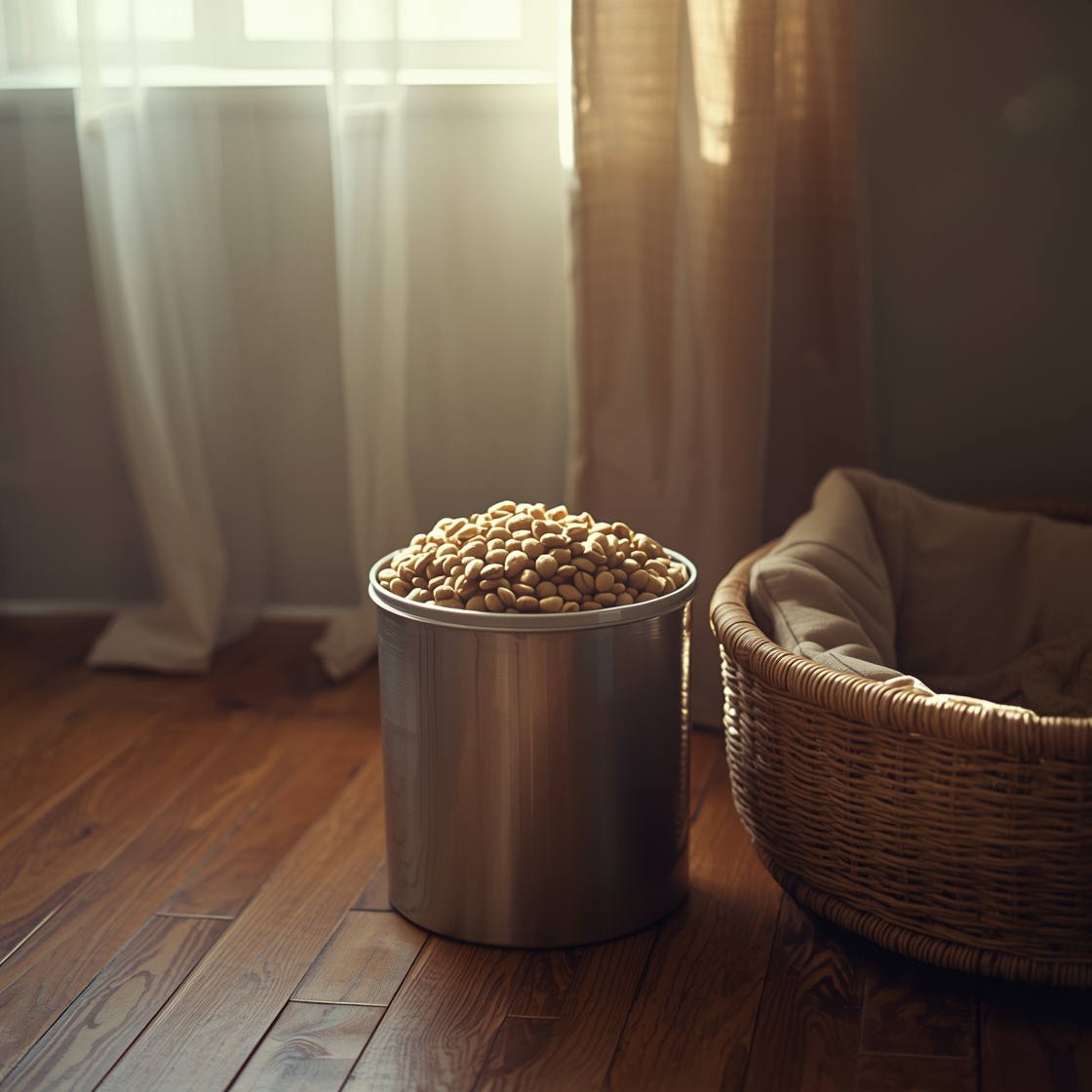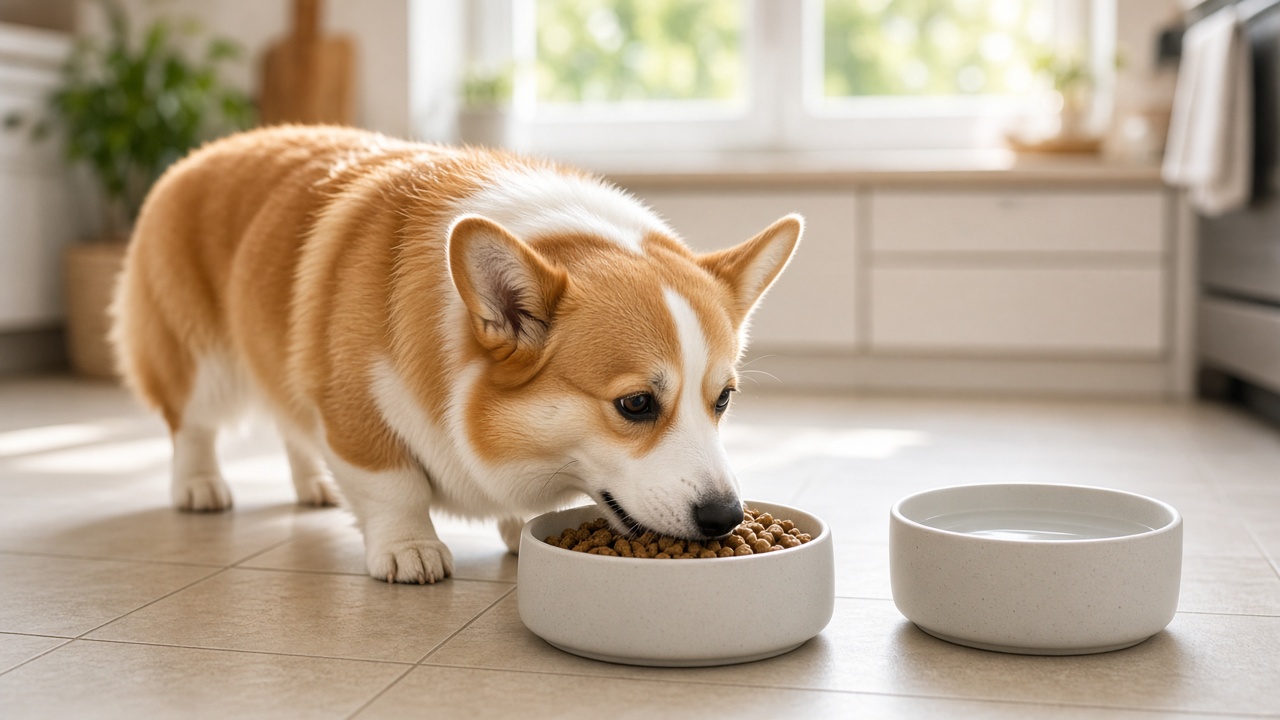
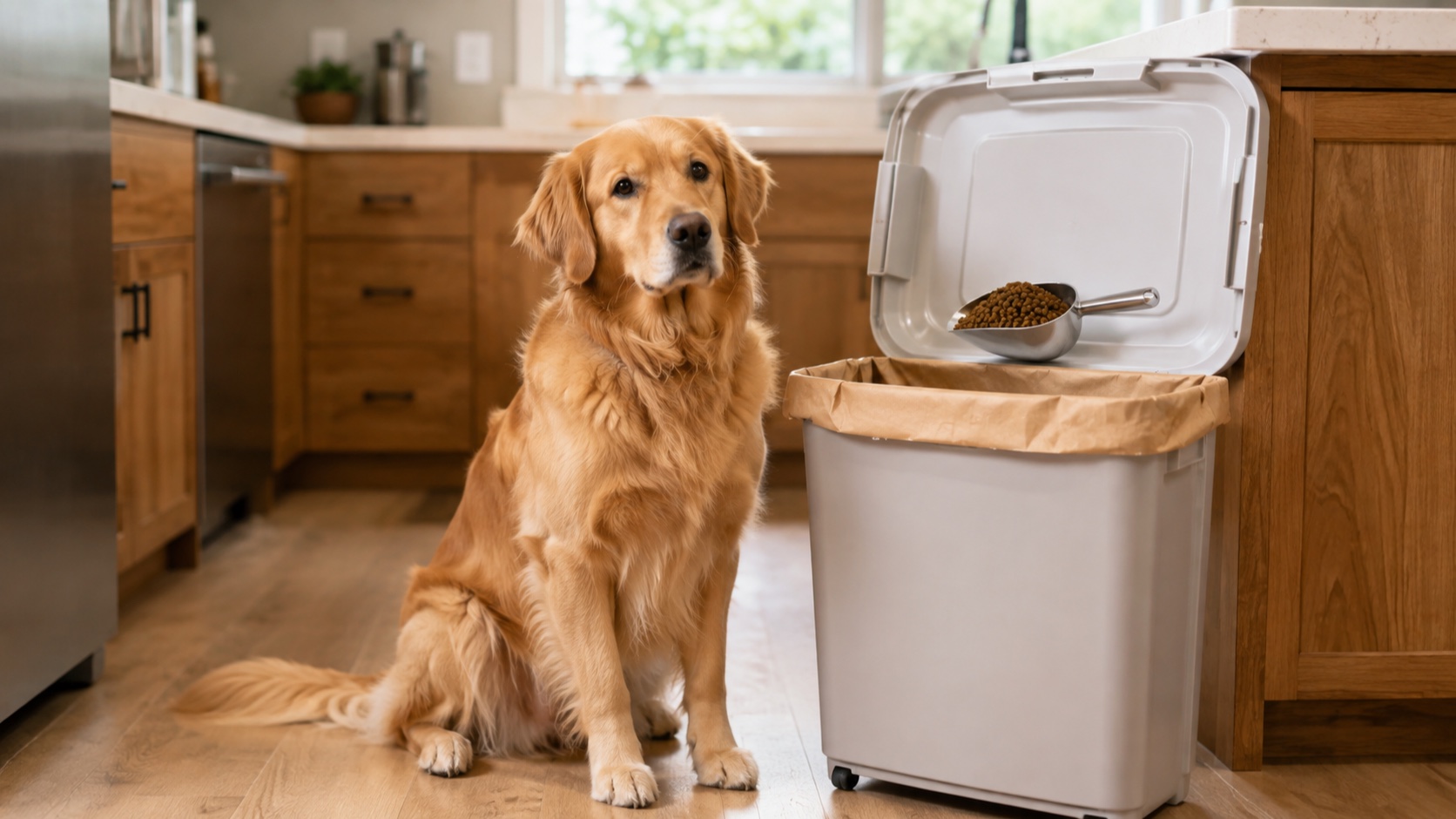
Quick answer: Match the bin to the bag you already buy. Keep that bag inside an airtight dog food storage container, then close the lid after every scoop. Skip any bin whose printed range is smaller than the bag.
A dog food storage container must fit your bag and close after every scoop. This page is a buying guide that compares published specs from seven bins. Our research team did not leak-test seals, rate freshness, or score nutrition.
A storage bin isn’t a food-nutrition lookup, and it won’t fix a rancid bag or a recall lot. The FDA still wants the original bag nearby for the lot number and the “best by” date.
This article may contain affiliate links.
Match the bin to the bag you already buy
Name the bag weight on your receipt before you shop for a lid.
That single number decides the purchase, because a 40 lb cycle needs a bin that can take 40 lb. A 20 lb bag doesn’t need a 50 lb pail of unused air.
Our research team analyzed seven listings sold as dog food storage containers. Only one title prints a 40–50 lb range, and only one title prints a 20–23 lb range. Five of those seven titles print no pound range at all.
Treat those printed words as a gate, not a wish list for later bags.
- If you buy 40–50 lb bags, start with the ZOMISIA 40-50lbs Dog Food Storage Container.
- If you buy 20–23 lb bags, start with the DDMOMMY 20-23 Lbs Dog Food Storage Container.
- If you want wheels under a mid-size bag, IRIS USA lists its rolling bin at up to 30 lb.
- If you want two sizes in one purchase, Amazon Basics prints a 30 lb bin and a 10 lb bin.
Don’t pour a 40 lb bag into a 20–23 lb title. Leftover kibble will sit in a rolled sack, and that sack is the pest path the lid was meant to close.
Gamma2’s Vittles Vault line lists separate sizes at up to 20 lb, 40 lb, 50 lb, and 80 lb on the maker’s site. Pick the size that covers the bag you actually open each month.
The OXO Good Grips Pet POP Container is a daily-portion jar. OXO lists 4.4 qt as up to 4 lb of dog food, so it isn’t a month of bulk kibble.
What airtight means for a dog food storage container
“Airtight” on a listing is a lid claim, not a lab score from our research team.
Two of these titles print the word airtight, and several other listings use it in the body copy. None of the seven printed a gasket thickness, so a lid you can see, wipe, and close is the working part.
The FDA’s storage page is plain about the next step. If you use a second vessel, put the entire bag inside it. If you must pour the kibble out, use a clean, dry bin with a lid that fits snugly.
The AVMA gives the same bag-in-bin rule for dry food. Keep kibble in the original bag, then place that bag in a clean, dedicated, airtight container when you can.
An airtight dog food container still fails in a hot garage. The FDA says store dry pet food in a cool, dry place under 80 F, because excess heat or moisture can break nutrients down.
A pretty lid doesn’t cool a shed, so cool and dark storage beats a showpiece bin.
Pests are the third job after air and heat. A rolled bag on the floor invites moths and ants, while a lid that clicks or spins shut is the barrier, not a vacuum chamber.
Which bins made this comparison
We used one Bag-Fit Rule, then stopped adding products.
A listing stayed in only if it is sold as a dog food storage container and names a lid style or a bag-weight range. We left out food-nutrition databases, recall dashboards, and fridge-only vessels. We also left out any bin that cannot cover the bag printed on its own title.
That rule is why these seven names appear. Two of the seven titles say Vittles Vault, one title says Rolling, and one title says 40–50 lb. One title says 20–23 lb, one says Set, and one says POP.
- IRIS USA Airtight Pet Food Storage Rolling Container: wheels plus an airtight-word lid. IRIS USA prints up to 30 lb and a 2-cup scoop.
- Vittles Vault Airtight Pet Food Storage Container + Scoop: screw-lid family with a scoop named in the title.
- ZOMISIA 40-50lbs Dog Food Storage Container: the only 40–50 lb title. The maker also lists 7 lb to 50 lb as density shifts.
- DDMOMMY 20-23 Lbs Dog Food Storage Container: the only 20–23 lb title. DDMOMMY prints up to 23 lb unfolded.
- Gamma2 Vittles Vault Pet Food Storage Containers: a second Vittles name for a second food or a second dog.
- Amazon Basics Pet Food Storage Container Set: two printed sizes, 30 lb and 10 lb.
- OXO Good Grips Pet POP Container: counter scoop jar, not a 50 lb vault.
How the seven bins differ
Compare seal style and printed bag range, not a ranked “top” list.
Our research team compared published specs only. The table has no rank column and no prices.
| Product | Seal style as printed | Printed bag range | Job it can cover |
|---|---|---|---|
| IRIS USA Airtight Pet Food Storage Rolling Container | Airtight seal, snap-lock latches, wheels | Up to 30 lb (IRIS USA) | Mid-bag you can roll |
| Vittles Vault Airtight Pet Food Storage Container + Scoop | Airtight screw lid; scoop in the title | No pound range on this title | Tight lid plus a dedicated scoop |
| ZOMISIA 40-50lbs Dog Food Storage Container | Four buckles; maker calls it airtight | 40–50 lb title; maker also lists 7–50 lb | Large grocery-bag cycle |
| DDMOMMY 20-23 Lbs Dog Food Storage Container | Double seals; four side locks | 20–23 lb; up to 23 lb unfolded | Small bag or tight shelf |
| Gamma2 Vittles Vault Pet Food Storage Containers | Gamma Seal twist-on lid | Line lists 20, 40, 50, and 80 lb sizes | Second formula or second pet |
| Amazon Basics Pet Food Storage Container Set | Lid-seal latches; two bins | 30 lb (33 qt) and 10 lb (11 qt) | Two foods or food plus treats |
| OXO Good Grips Pet POP Container | POP button lid | OXO lists 4.4 qt as up to 4 lb of dog food | Daily portion on a counter |
IRIS USA prints the rolling bin at 16.13 in long, 10.63 in wide, and 18.50 in high. That’s a closet footprint, not a garage vault.
ZOMISIA prints 16.97 in by 13.07 in by 23.78 in. Four buckles and a clear lid are the seal story on that listing.
DDMOMMY prints the open size as 16.54 in by 10.15 in by 12 in. Folded to 5.5 in high, the maker says it holds about 6.5 lb.
Amazon Basics prints 33 qt for the 30 lb bin and 11 qt for the 10 lb bin. Two vessels beat one mixed bowl of two formulas.
Gamma2’s site lists food-grade, BPA-free HDPE and a twist-on Gamma Seal lid. Use that line when you want a screw lid you will actually spin shut.
OXO’s 4.4 qt Pet POP holds up to 4 lb of dog food or 3.5 lb of cat food. The maker includes a 1/2-cup scoop on that size.
The Vittles Vault + Scoop listing is the scoop-in-title twin of the Gamma2 name. They share a lid family, not two nutrition scores.
How to store kibble the way FDA and AVMA describe
Keep the bag, keep the lot code, then close the lid after every scoop.
The FDA asks you to store pet food in the original bag. That bag holds the UPC, lot number, product name, maker, and “best by” date. The agency says less than half of the pet food complaints it receives include the lot number.
Tape that panel to the bin if you pour kibble out, then change the panel when you open a new bag.
The AVMA repeats the bag-in-bin method. Save the manufacture date, lot number, and expiration or best-by date if the bag won’t fit inside.
Wash and dry the bin between bags. The FDA wants residual fat and crumbs off the walls, because old oil on plastic is a rancid smell, not a freshness feature.
Wash bowls and scoops after each use, and use them only for pet food. The FDA also says wash water bowls daily.
Keep leftover wet food cold. The FDA says set the refrigerator to 40 F or below.
That rule applies to leftover cans and to homemade meals you cooked at home. None of these seven dry bins replace a fridge.
Close the lid after every scoop. An expensive screw lid left open is the same air leak as a cheap snap lid left open.
When a container cannot save the food
A bin cannot repair rancid fat, a recall, or a food that already fails the dog.
If the kibble smells like paint, or the dog refuses a bag that was fine last week, stop feeding that bag. The FDA says a foul odor is a problem to report, so stop that product and call your clinician.
A storage bin doesn’t rewrite the food’s adequacy statement, because that sentence lives on the bag. Shop the food first if the dog has a sensitive stomach. Then pick a bin that fits that bag.
Don’t mix two formulas in one vessel, because fat from food A coats food B and you lose the lot code for both. Use the Amazon Basics set, or a second Vittles Vault, when two dogs eat two recipes.
Don’t treat the OXO POP as a 40 lb warehouse. Four pounds is a few days for a large dog, so keep the bulk bag in a larger sealed bin.
Don’t park a sealed bin in a hot car or a sunlit porch. The FDA’s ceiling of under 80 F still applies after the lid clicks.
Medical, fresh, or refrigerated food follows the label on that food, and none of these seven listings is a fridge.
Vomiting, black stool, or a dog that won’t eat is a clinic visit. We’re a research team comparing published specs, and we aren’t your veterinarian.
FAQ
These answers cover bag size, airtight lids, and the storage steps FDA and AVMA already publish.
What size dog food storage container do I need?
Buy the size that covers the bag you already purchase. A 40 lb bag needs a 40–50 lb title or a measured interior that large.
A 20–23 lb bag fits the DDMOMMY range. IRIS USA’s rolling bin is printed at up to 30 lb.
Should I pour kibble out of the bag?
The FDA prefers the whole bag inside the bin, so pour only if the bag won’t fit. Then save the lot number and “best by” date on the outside, and wash and dry the bin before the next bag.
Do the best dog food storage containers stay airtight forever?
No lid stays perfect without care, so “airtight” is a lid you close, wipe, and replace when the seal cracks. None of these seven listings printed a gasket spec, and our research team did not leak-test any lid.
Can I keep two foods in one airtight dog food container?
No, use two vessels instead of one mixed bin. Amazon Basics prints a 30 lb bin and a 10 lb bin for that split. Gamma2’s Vittles Vault line is the other two-vessel path.
Where should I keep the container?
Keep it cool, dry, and out of the dog’s reach. The FDA and the AVMA both set the dry-food ceiling at less than 80 F.
A sealed bin in a hot garage still cooks fat.
When should I throw the food out?
Throw it out if it smells foul, the bag is past the “best by” date, or the lot is recalled. The FDA also flags swollen or leaking cans and foreign objects.
A new lid doesn’t make that food safe.
Is a rolling bin better than a screw-lid vault?
Neither style wins as a group. Wheels help if you won’t lift a 30 lb bin, and a screw lid helps if you’ll spin it shut every scoop.
Pick the habit you’ll keep.