Our guides are reader-supported. This article may contain affiliate links. As an Amazon Associate we may earn a commission if you buy through links, at no extra cost to you.
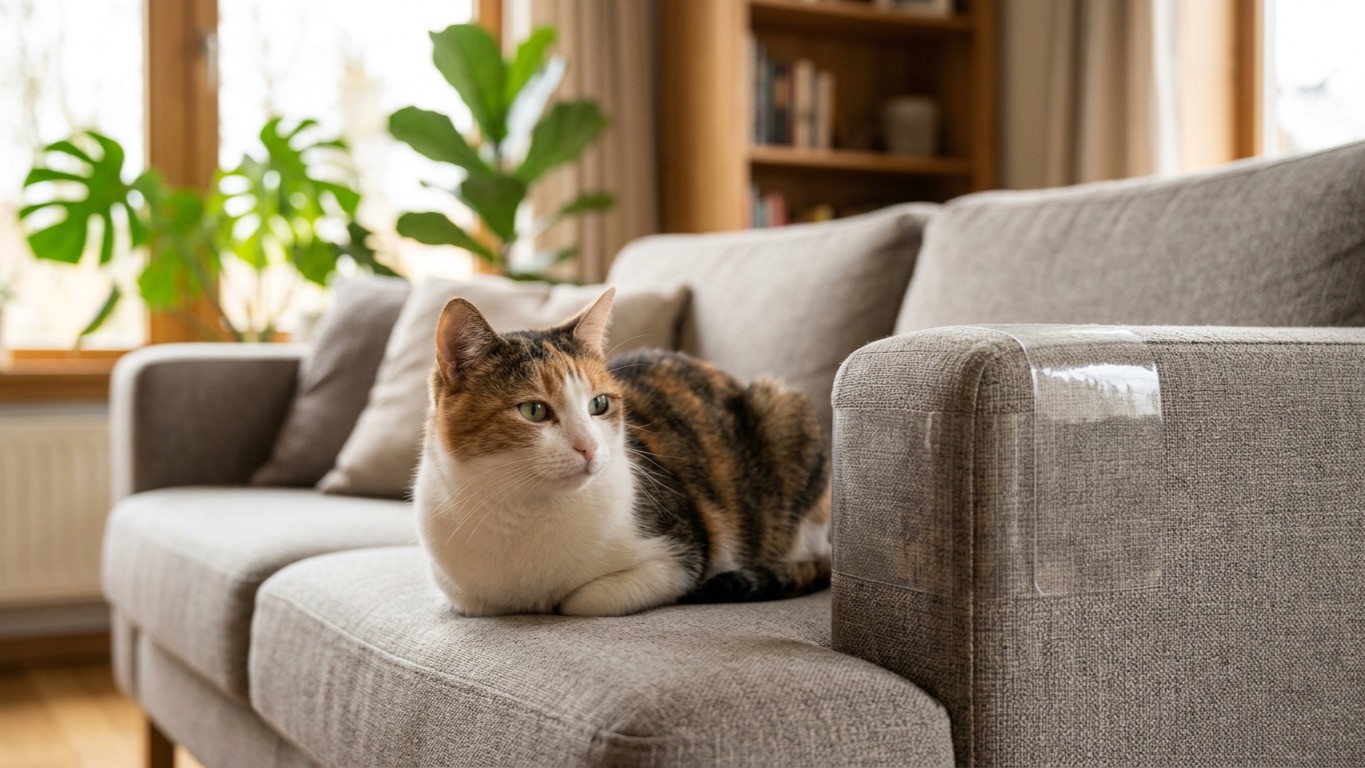
Quick answer: The best cat scratch deterrent tape for furniture is a clear, pet-labeled barrier on the strike zone (usually 12–24 in of vertical sofa arm or corner), paired with a sisal post within about 24 in of that same zone. Double-sided training tape (Sofisti-Cat, Karaseno, Polarduck, Chuangseed) is the default on sealed fabric and painted wood you have patch-tested. Pin-reinforced kits (FixZilla) are for corners that peel. Single-sided vinyl sheets (TOOSOFt, pre-cut packs) are the gentler class on finishes that hate aggressive adhesive. Tape is not a substitute for a post. AVMA: scratching “conditions the claws”; punishment is “not an effective deterrent.”
of 7 named SKUs on this page, 4 of 7 are double-sided roll tapes, 2 of 7 are sheet / vinyl protectors, 1 of 7 is a pin-reinforced corner kit, street snapshots run $10–$26, and 0 of 7 were claw-scored, residue-scored, or “week-of-daily-use” trialled in a PetBench home.
We compared current marketplace listings, maker safety copy (leather / velvet / microfiber exclusions), AVMA’s public scratching guidance, and the 2013 AAFP/ISFM Environmental Needs Guidelines. If a fetched page did not print a width or yardage, this page says so.
The outlet for the behavior lives on best cat scratching post for furniture. A pheromone diffuser is an adjunct for stress-driven scratching, not a tape replacement.
How to choose the best cat scratch deterrent tape for furniture (five checks)
- Name the strike zone. Vertical sofa arm, horizontal ottoman, door jamb, or wall corner. Cats typically work a 12–24 in vertical patch, not a 4 in sticker in the middle of a cushion. Short patches miss the stretch.
- Name the substrate. Sealed fabric and many painted woods tolerate clear double-sided tape after a hidden patch test. Leather, velvet, and microfiber are the usual “do not” list on double-sided cartons. Unsealed wood and fresh lacquer lift. When the carton says no, believe the carton.
- Pick a class, not a medal. Training roll (narrow, 10–15 ft) for one armchair. Wide 30-yard rolls for a sectional. Pin kit for a corner that cats pry. Vinyl sheet for a finish you will not trust with aggressive adhesive.
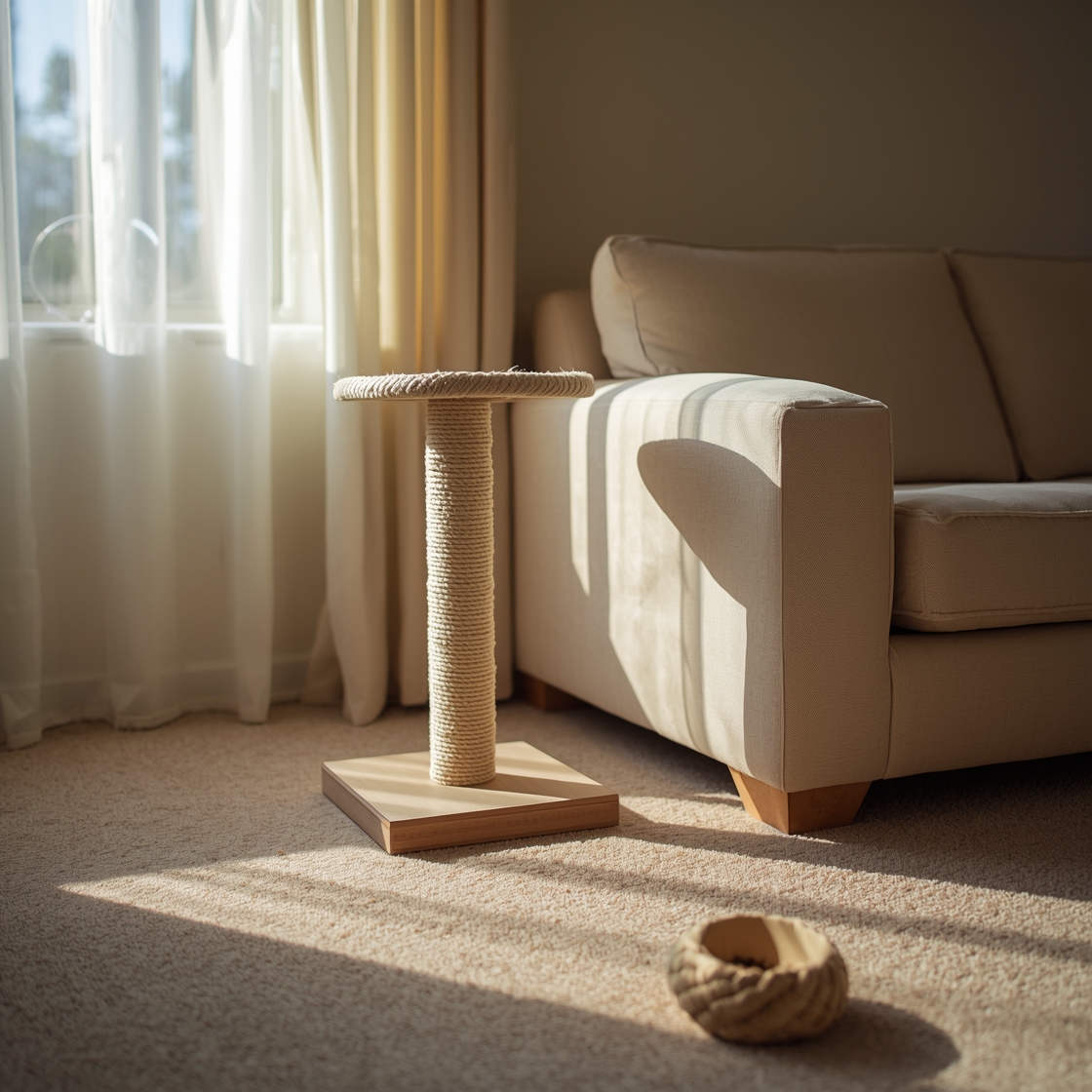
- Place a legal surface first. AAFP/ISFM: scratching is a normal need. A post or cardboard pad within about 24 in of the blocked zone is the redirect. Tape without a post trains the cat to walk six feet and scratch the next unprotected arm.
- Gate the clinic job. Sudden, frantic scratching plus hiding, soiling, or a cat off food is not a tape problem. Cornell’s house-soiling page still applies when the “scratch” is a stress mark. We are not diagnosing that.
AVMA’s public language treats scratching as claw conditioning and territory marking. Declawing is not a furniture strategy on this desk. Tape is a temporary texture change. It is not a behavior diagnosis.
Class Map — best cat scratch deterrent tape for furniture by job
| Job you can describe | Class to match | Kits on this page | Honest skip |
|---|---|---|---|
| One sofa arm, sealed fabric | Narrow double-sided roll | Sofisti-Cat | A 4 in wide roll you cannot wrap a leg with |
| Whole sectional / multiple rooms | 30-yard-class wide roll | Karaseno; Polarduck; Chuangseed | One pre-cut sheet pack |
| Corners that cats peel | Tape + twist pins | FixZilla | Pins in drywall you cannot patch |
| Delicate finish / antique | Single-sided vinyl, patch test | TOOSOFt; sheet packs | Aggressive double-sided on lacquer |
| Leather / velvet / microfiber | Usually none of the double-sided rolls | Vinyl only after a hidden test | “It says pet-safe so it is sofa-safe” |
| No post in the room | Not a tape job yet | Buy the post first | Covering every surface and hoping |
Named kits — currently sold hardware, not a medal table
Street prices below are listing snapshots from the live cards (Aug 2026), not a finding they will hold. Search links use our Amazon tag.
1. FixZilla Anti Cat Scratch Furniture Protector
Best for: sofa corners and baseboards that cats pry after plain tape lifts.
Pin-reinforced protector class. Snapshot ~$20. Twist pins add a mechanical hold that adhesive alone does not have on a corner the cat works daily. The honest cost is holes: fabric, and especially drywall, will show pin marks if you relocate. This is a corner kit, not a whole-sofa wrap. Do not pin leather.
Pros: Mechanical + adhesive hold on high-pry corners Cons: Pins are not reversible on every surface
2. Sofisti-Cat Training Tape
Best for: a first armchair or a narrow armrest you can fully cover.
The default “training tape” name on US marketplaces. Snapshot ~$10. Narrower, shorter roll than the 30-yard class — enough for one or two strike zones, not a sectional. Double-sided sticky texture is the whole mechanism: unpleasant under the paw, not a scent. Textured fabric is the usual failure mode in owner copy (edges lift, cat works the gap). Pair with a post. Do not treat the brand name as a protocol.
Pros: Lowest snapshot; sized for one piece of furniture Cons: Roll length is the limit; textured weave lifts edges
3. Karaseno Anti Cat Scratch Tape
Best for: covering more linear feet than a 15 ft training roll.
Wide, long, clear double-sided class. Snapshot ~$13. Marketplace reprints commonly sell this as a 3 in × 30 yard-class roll — enough to do a sectional if you cut to the strike zone instead of wallpapering the room. Stronger adhesive is a two-way street: it stays, and it can lift finish on painted wood if you yank. Hidden patch test. Slow peel. Low heat from a hair dryer is the usual owner-removal trick, not a desk lab method we ran.
Pros: Coverage per dollar on this card set; clear film Cons: Too sticky for some painted woods; not a leather tape
4. Polarduck Anti Cat Scratch Tape
Best for: extra-wide strike zones (ottoman faces, carpet edges you are allowed to tape).
Same double-sided transparent class, typically sold wider (4 in-class reprints) and long. Snapshot ~$16. Extra width helps a horizontal stretch; it looks bulky on a slim mid-century arm. “Pet and kid safe” on a listing is a toxicity claim class, not a finish-safety claim. Still patch-test. Still keep loose edges away from a kitten that chews.
Pros: Wide coverage; long roll Cons: Thick look on delicate furniture; same leather/velvet skip as other double-sided rolls
5. TOOSOFt Anti Cat Scratch Furniture Protector
Best for: large flat or gently curved faces when you want single-sided vinyl, not a sticky two-face.
Snapshot ~$26 — highest on this card set. Thick vinyl class. The sell is coverage and a less aggressive face than double-sided training tape. The failure mode in owner copy is peel on a high-traffic arm if the adhesive is the “gentle” kind. This is the SKU you consider when the carton on a double-sided roll already said no to your finish — after a hidden test, not instead of one.
Pros: Thick vinyl; large-area class Cons: Highest snapshot; may lift on a favorite arm if the bond is light
6. Cat Scratch Furniture Protector Tape Sheets
Best for: a few pre-cut patches on end tables, sills, or a first test square.
Snapshot ~$21. Pre-cut sheet class — you are buying convenience, not yardage. Several listings in this class print “not for leather, velvet, or microfiber.” Humid rooms and dust under the sheet are the usual lift reasons. Use sheets to learn a surface, then buy a roll if the cat actually stopped using that patch.
Pros: No cutting; good for a hidden test Cons: Less linear coverage per dollar; adhesive can fade faster than a fresh roll
7. Chuangseed Anti Cat Scratch Tape
Best for: another 30-yard-class clear roll when you want a warranty line on the listing.
Snapshot ~$15. Double-sided, thicker-feel reprints; some cartons print a one-year warranty. A warranty is manufacturer confidence in the film, not a promise the cat will convert to a post. Residue on removal is the honest con on many thick double-sided SKUs. Slow peel. Citrus-style adhesive removers are a last resort on finishes that tolerate them — test first.
Pros: Long-roll class; warranty language on some listings Cons: Texture more visible; residue risk on removal
Want to browse current rolls? See cat scratch deterrent tape on Amazon →
Best cat scratch deterrent tape for furniture tables
Listing audit — not a claw trial.
Table 1 — Class × kit
| Kit | Class | Snapshot | Desk job |
|---|---|---|---|
| Sofisti-Cat | Narrow double-sided training roll | $10 | One armchair / first zone |
| Karaseno | Wide long double-sided roll | $13 | Sectional / multi-zone |
| Polarduck | Extra-wide long double-sided | $16 | Wide faces, carpet edges if allowed |
| Chuangseed | Thick long double-sided | $15 | Same class as Karaseno, warranty line |
| FixZilla | Tape + twist pins | $20 | Pry corners only |
| Tape sheets | Pre-cut patches | $21 | Test squares, small furniture |
| TOOSOFt | Thick single-sided vinyl | $26 | Large faces, gentler-adhesive class |
Table 2 — Width and coverage (desk planning numbers, not a lab)
| Furniture zone | Width class to shop | How much film | Replace / inspect |
|---|---|---|---|
| Sofa arm (vertical stretch) | 2–4 in | 2 parallel strips, 12–24 in tall | 4–8 weeks or when an edge lifts |
| Chair / sofa leg | 1–2 in or spiral wrap | Full wrap, no gap at the top | 6–10 weeks |
| Door jamb | 3–4 in | One vertical strip through the stretch | 8–12 weeks |
| Corner of a sectional | Pin kit or overlapping squares | Cover the exact pry point | After any peel |
| End table / sill | Pre-cut sheet | One hidden test, then one visible patch | When dusty or humid |
A 6 in decorative square in the middle of a cushion is decoration. The cat’s stretch is longer than that.
Table 3 — Surface safety (carton rules + desk caution)
| Surface | Double-sided roll? | Vinyl / sheets? | Removal |
|---|---|---|---|
| Sealed synthetic upholstery | Often yes after a hidden test | Yes | Slow peel |
| Canvas / tight weave | Often yes | Yes | May leave residue |
| Leather | Usually no on carton | Only if the carton allows, test | High residue / finish risk |
| Velvet / microfiber | Usually no | Test or skip | Fiber pull |
| Painted / lacquered wood | Caution | Prefer vinyl | Low-heat slow peel; yank lifts finish |
| Unsealed wood | No | No | You will stain or peel |
| Drywall (pins) | Pins are a hole | N/A | Patch required |
Table 4 — Tape vs post vs diffuser (do not stack blindly)
| Tool | What it does | Clock | Sister page |
|---|---|---|---|
| Deterrent tape | Makes this surface unpleasant | Weeks, then fade the tape | This URL |
| Scratching post / pad | Legal outlet | Permanent furniture | Scratching posts |
| Pheromone diffuser | Room signal for stress-driven marking | 30-day vial, 24-hour run | Pheromone diffuser |
| Nail trim | Shortens the hook | Recurring | Cat nail clippers |
Tape without a post is a delay. A post without tape can still work if the post is closer, taller, and more satisfying than the sofa. Start with the post.
Why cats scratch (and why tape is a last layer)
Cats scratch to shed outer claw sheaths, stretch the spine and shoulders, and deposit scent from paw glands. AAFP/ISFM treats this as an environmental need, not a vice. A sofa arm is a tall, stable, textured vertical — the same geometry a good sisal post is supposed to copy.
Deterrent tape works by changing the tactile outcome: sticky or slick film instead of satisfying resistance. It does not teach “never scratch.” It teaches “not this patch.” If the legal patch is farther, shorter, or wobbly, the cat will find the next sofa.
Punishment — yelling, spray bottles, taping the cat — is the method AVMA’s public pages reject as ineffective. We will not recommend it.
Install rules we will actually stand behind
These are listing + common-sense rules.
- Clean first. Dust and hair kill adhesive. Vacuum the weave. Wipe sealed wood. Let it dry.
- Hidden patch, 24 hours. Inside an arm, under a cushion, back of a leg. If finish lifts or residue stays, that SKU is wrong for that piece.
- Cover the stretch, not the button. 12–24 in vertical on the face the cat already uses. Overlap seams so there is no claw-width gap.
- Burnish. Press the film down. A lifted corner is an invitation.
- Post the same day, same room. Sisal within about 24 in. Rub a little of the cat’s used scratching surface or a catnip product on the post, not on the sofa, if you use a scent lure.
- One variable. Do not also change litter, food, and a diffuser the same Saturday if you want to know whether the tape did anything.
- Inspect weekly. A lifted edge is how kittens listing snapshot film. Trim or replace.
Humidity, direct sun, and a cat that lodges claws under the film are the usual early failures. That is a placement problem or a class problem, not a reason to buy a fourth brand.
How long to leave the best cat scratch deterrent tape for furniture
Owner copy and training common sense converge on weeks, not days. A weekend experiment teaches you nothing. A 30-day continuous cover, with a post in use, is the shortest window this desk will repeat. After the cat consistently uses the post, fade the tape in sections — top third first — so you can see a relapse before the arm is bare.
If the cat simply moves six inches left, you under-covered. Extend the film. If the cat ignores the post entirely, the post is the wrong height, texture, or location. That is a scratching-post problem.
Leather, rentals, and “I cannot put holes in this”
Renters: pin kits and drywall are often a deposit problem. Use tape on your furniture, not the landlord’s untested lacquer, unless a hidden patch is clean. Vinyl sheets are the usual “I need it gone Saturday” class.
Leather: most double-sided cartons already said no. A “clear” film can still print the grain and leave adhesive in the pores. If the piece is expensive, a throw, a fitted cover, or moving the piece away from the launch spot is cheaper than a ruined hide.
Microfiber: fibers lift. Skip double-sided unless the carton explicitly allows it and a hidden test is clean.
Price bands (snapshots, not a value medal)
| Band | What we opened | What you are buying |
|---|---|---|
| ~$10 | Sofisti-Cat | One-zone training roll |
| ~$13–16 | Karaseno, Chuangseed, Polarduck | Yardage — the actual product for a sectional |
| ~$20–21 | FixZilla, sheet packs | Pins or convenience patches |
| ~$26 | TOOSOFt | Thick vinyl coverage |
A $10 roll that does not reach the stretch is a wasted $10. A $26 vinyl that you put on leather against the carton is a ruined sofa. Shop the class.
Owner themes we keep seeing (not a survey we ran)
- “The cat scratched next to the tape.” You covered a badge, not the stretch.
- “It ruined the paint.” Yank removal on lacquer. Slow peel, or you picked the wrong class.
- “It did nothing.” No post, or the post is in another room.
- “The kitten ate a corner.” Lifted edge. Inspect. This is a safety issue, not a brand issue.
- “I used it on leather.” The carton already told you not to.
Frequently asked questions about the best cat scratch deterrent tape for furniture
Does the best cat scratch deterrent tape for furniture ruin wood?
On sealed finishes, a quality clear tape often releases if you peel slowly. Unsealed wood and fresh lacquer are a no. Hidden patch. Never yank.
Will tape ruin a leather or microfiber couch?
Often yes for double-sided rolls — many cartons exclude leather, velvet, and microfiber. Vinyl sheets are the class people try after a hidden test, not a guarantee. A cover may be the honest product.
How long should I keep tape on?
Plan on at least 30 days of continuous cover plus a used post. Fade in sections. Relapse means the post is still losing.
Are these tapes safe for kittens?
Listings often say pet-safe adhesives. Loose film is still a choke / GI foreign-body risk. Smooth application, no curling edges, supervise the first days. Pins are a puncture and a swallow risk if they loosen.
Can I use tape on carpet or walls?
Some wide rolls are sold for carpet edges and walls. Paint lift and carpet fiber pull are real. Patch test. Pins in drywall leave holes.
Do I need tape forever?
No. Tape is a bridge. The permanent product is a post the cat prefers. If you need tape for years, the legal surface is still wrong.
Is tape enough without a scratching post?
No. AAFP/ISFM still wants a legal outlet. Tape without a post just moves the damage.
Double-sided or vinyl?
Double-sided for sealed fabric you have tested. Vinyl when the carton or the finish says the aggressive adhesive is a bad idea. Pins for pry corners only.
What if the cat ignores the tape?
Cover more of the stretch, check for lifted edges, and move the post to within two feet. If scratching is new, frantic, or paired with soiling, that is a veterinarian, not a wider roll.
Internal links if the job is not a roll of film
- Legal outlet: best cat scratching post for furniture
- Stress-driven marking: best cat pheromone diffuser
- Claw length: best cat nail clippers
- Home grooming cluster: how to groom a cat at home
The best cat scratch deterrent tape for furniture is the class that matches the strike zone and the finish, left on long enough for a nearby post to win. If you cannot name the finish and the stretch, you are not ready to check out.
Room-by-room coverage math for the best cat scratch deterrent tape for furniture
A sectional is not “one sofa.” It is three or four strike zones that a cat already voted for. Desk planning — not a lab — looks like this when you open a 30-yard-class roll (Karaseno / Polarduck / Chuangseed reprints):
- Left arm vertical: two 3 in strips × 20 in = about 10 ft of film if you include wrap onto the inner face.
- Right arm: same again.
- Corner pry: a 6–8 in overlapping square, or a FixZilla-class pin kit instead of more film.
- Chaise face (horizontal stretch): one 4 in-class strip × 24 in.
That is still well under 30 yards. The leftover is for the next room the cat opens after you close the first. People run out of a $10 Sofisti-Cat roll because they tried to wrap a sectional with a training-length SKU. That is a class error, not a brand failure.
A studio with one armchair and one door jamb can live on Sofisti-Cat plus a sheet-pack test square. A two-cat, two-sofa house should budget two long rolls or one long roll plus a pin kit. We do not sell a “whole-home pack” because cats do not scratch whole homes. They scratch the same four inches until you move the legal surface.
Table 5 — Linear-feet planning (desk, Aug 2026)
| Household | Zones to cover first | Roll class to buy | What we would not buy first |
|---|---|---|---|
| One cat, one armchair | 1 vertical arm | Sofisti-Cat training roll | A $26 vinyl for a single 18 in patch |
| One cat, sectional | 2 arms + 1 corner | 30-yard 3–4 in roll | Only pre-cut sheets |
| Two cats, two sofas | 4+ zones | Two long rolls or long roll + pins | One $10 roll “to try” |
| Rental, landlord sofa | Your throw / your chair only | Sheets for a hidden test | Pins in their drywall |
| Leather-only living room | Usually no double-sided | Cover or move the piece | “Clear so it is safe” |
How to fade tape without a relapse
Fading is the part most pages skip. The cat did not “unlearn the sofa” in 10 days. They learned that this patch feels wrong while a post is winning. If you rip every strip on day 31, you often get a weekend of old habits.
Desk fade, compiled from training common sense — not a house protocol we ran:
- Week 4–5: peel the top third of each vertical (the stretch they use last). Leave the mid-stretch, which is the money zone.
- Week 5–6: peel one arm entirely if the post in that room is scuffed. Leave the other arm.
- Week 6+: peel the last arm. Keep a spare strip in a drawer. Relapse on one corner is a 10-minute re-cover, not a new brand.
If they relapse on a new piece of furniture, you under-built legal surfaces, not tape. Buy another post, not a third adhesive chemistry.
Humidity, sun, and why “it peeled in a week” is usually physics
Adhesive is a temperature-and-dust product. A west-facing window heats a vinyl sheet. A litter-adjacent wall collects grit. A damp basement sofa never dries after you wipe it. Those are not “weak brands.” They are application conditions the carton cannot see.
- Sun-baked arms: vinyl and thick double-sided both crawl. Recheck weekly. A sun shade is cheaper than monthly re-wrap.
- Humid rooms: dust under the film. Clean, dry, wait. If the room is always damp, a washable throw may be the honest product.
- HVAC blast: a register that hits the arm can lift an edge. Move the airflow or start the strip below the blast.
If a listing prints “UV resistant,” treat it as maker language and still inspect.
Kittens, seniors, and multi-cat politics
Kittens chew edges. That is a foreign-body risk. Use shorter strips you can see in one glance. Pin kits are a swallow risk if a pin backs out — check pins the way you check a collar buckle.
Seniors with arthritis still scratch, often lower and more horizontal. A tall vertical wrap on an arm they no longer use is decoration. Cover the current stretch, and offer a low cardboard lounge as the legal surface.
Two cats: one may use the post and one may keep the sofa. You need two legal surfaces and tape on both favorite arms. A single Sofisti-Cat roll will not referee a resource fight. AAFP/ISFM still wants duplicate resources.
A new cat introduction that includes sudden scratching on new verticals is also a pheromone and clinic rule-out, not a reason to wallpaper the hallway.
What “pet-safe” on a listing actually means
Pet-and-child-safe copy is usually about the chemistry of the adhesive if licked briefly, not about finish safety, not about a swallowed strip, and not about a pin in a paw. This desk will not treat that phrase as a pass.
Safe-enough-for-this-URL means:
- The carton allows the substrate.
- A hidden patch did not lift finish.
- Edges are burnished so there is nothing to peel and eat.
- Pins are counted when you take them out.
If a kitten is a known pica / wool-sucker, tape may be the wrong class. A fitted cover and a post are the less ingestible pair.
Common shopping mistakes on this keyword
- Buying width for looks. A 4 in roll on a 2 in chair leg looks like a cast. Wrap a narrower roll.
- Buying pins for leather. Pins punch hide. That is damage you paid for.
- Buying sheets to do a sectional. You will tile seams. Cats work seams.
- Buying tape because the post is ugly. Put the post next to the sofa and live with it. Ugly that works beats invisible that fails.
- Buying a fourth brand after three application errors. Same class, better prep.
When tape is the wrong product entirely
- The cat is scratching and soiling. Cornell still wants a medical rule-out.
- The cat is over-grooming bald patches and also shredding. That is a behavior/medical cluster, not an adhesive cluster.
- The only damaged object is a landlord’s untested lacquer and you cannot patch-test. Use a cover you own.
- Someone in the house will be harmed by any residue remover you would need later. Skip aggressive double-sided.
The best cat scratch deterrent tape for furniture in those cases is “none,” plus a post, plus a veterinarian if the cluster is medical.
A 15-minute install checklist (no folklore)
- Photograph the strike zone so you remember the stretch after you clean.
- Vacuum, wipe, dry. Wait until the fabric is not damp.
- Cut strips longer than you think — you can trim, you cannot easily patch a gap mid-stretch.
- Hidden test on the same finish. Twenty-four hours if the piece is expensive; one hour if it is a $40 chair you accept losing.
- Burnish. Run a fingernail or a plastic card along every edge.
- Place or confirm the post within about 24 in.
- Write the date on a calendar. Do not peel on day four because “it looks ugly.”
That checklist is housekeeping, not a trial. If you skip the post step, you installed a sticker, not a plan.
Sources
- AVMA, public scratching / declawing and behavior pages (scratching conditions claws; punishment is not an effective deterrent). https://www.avma.org/
- Ellis SLH et al. AAFP/ISFM Feline Environmental Needs Guidelines. J Feline Med Surg. 2013. https://pmc.ncbi.nlm.nih.gov/articles/PMC11383066/
- Cornell Feline Health Center, house soiling and related behavior topics. https://www.vet.cornell.edu/departments-centers-and-institutes/cornell-feline-health-center
- Maker listings opened August 2026 for the seven named SKUs on this page (widths, exclusions, pin kits).