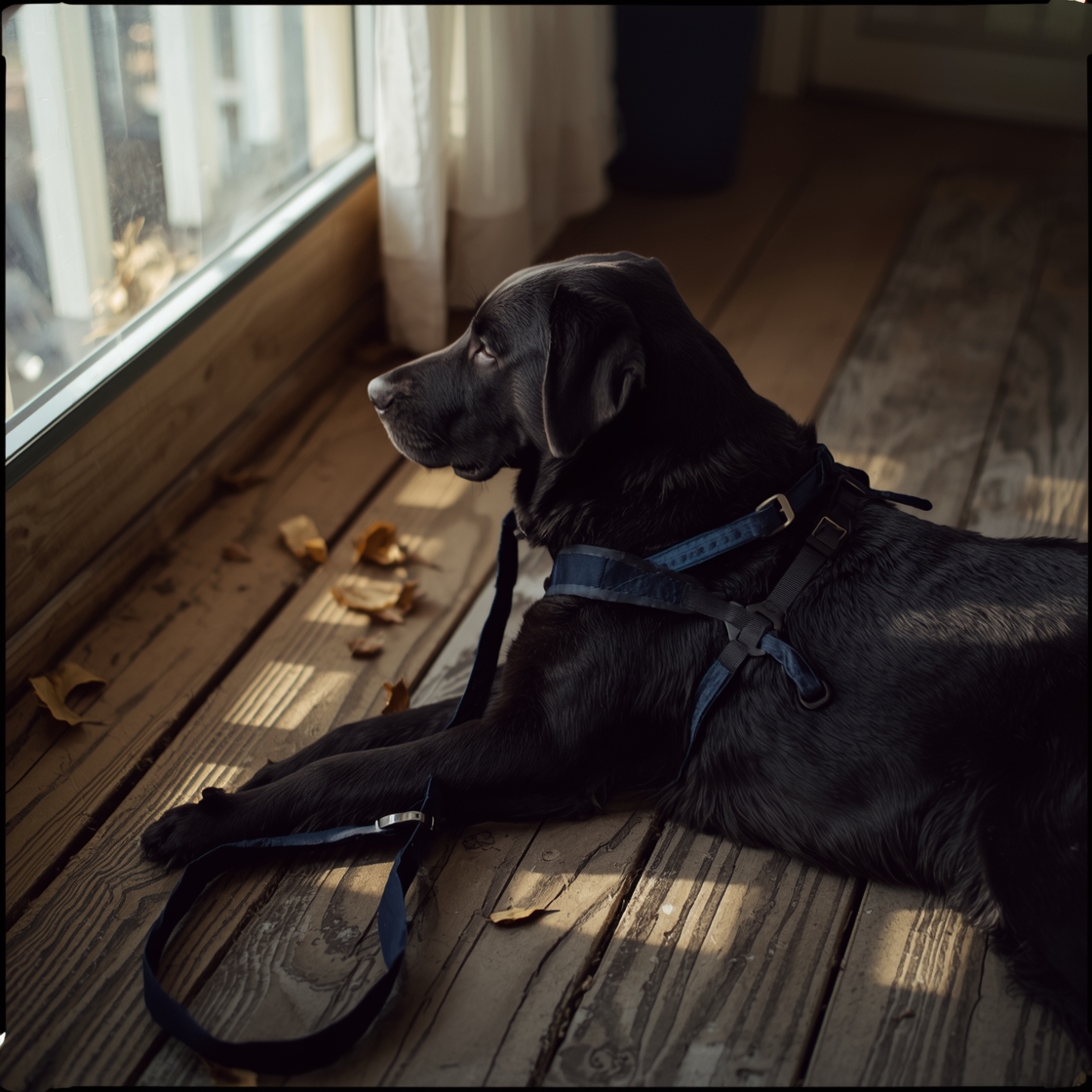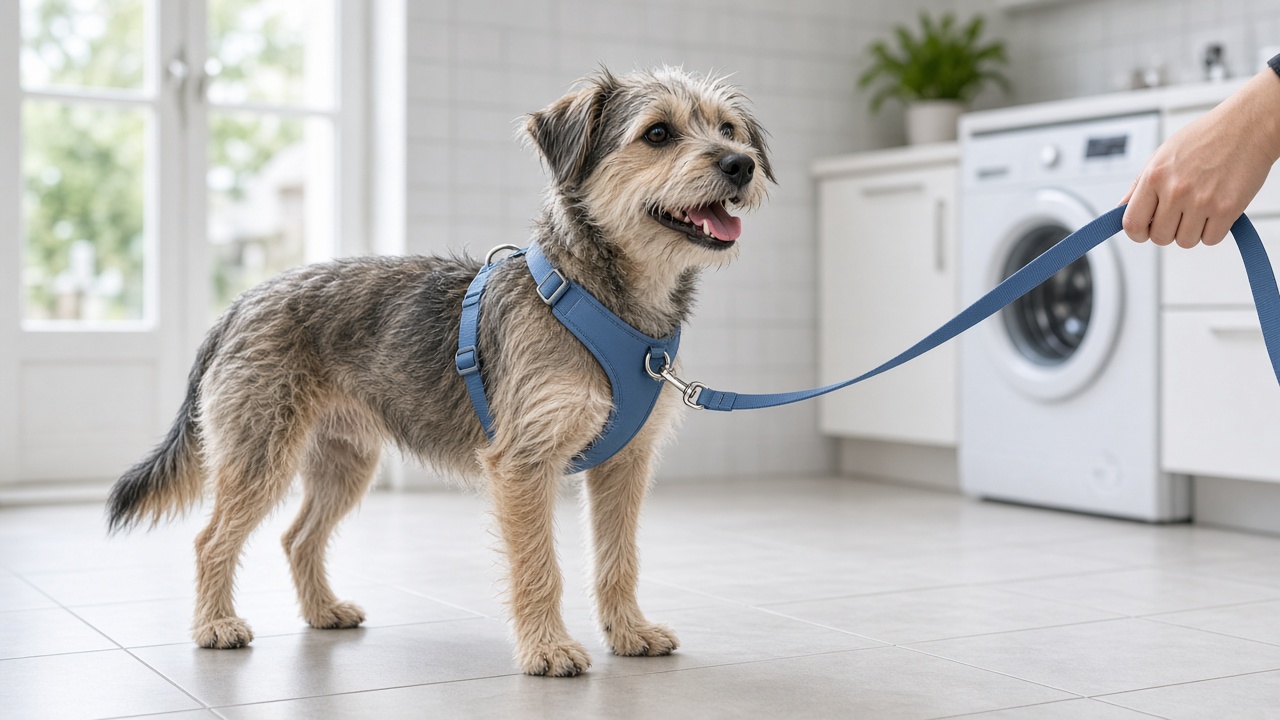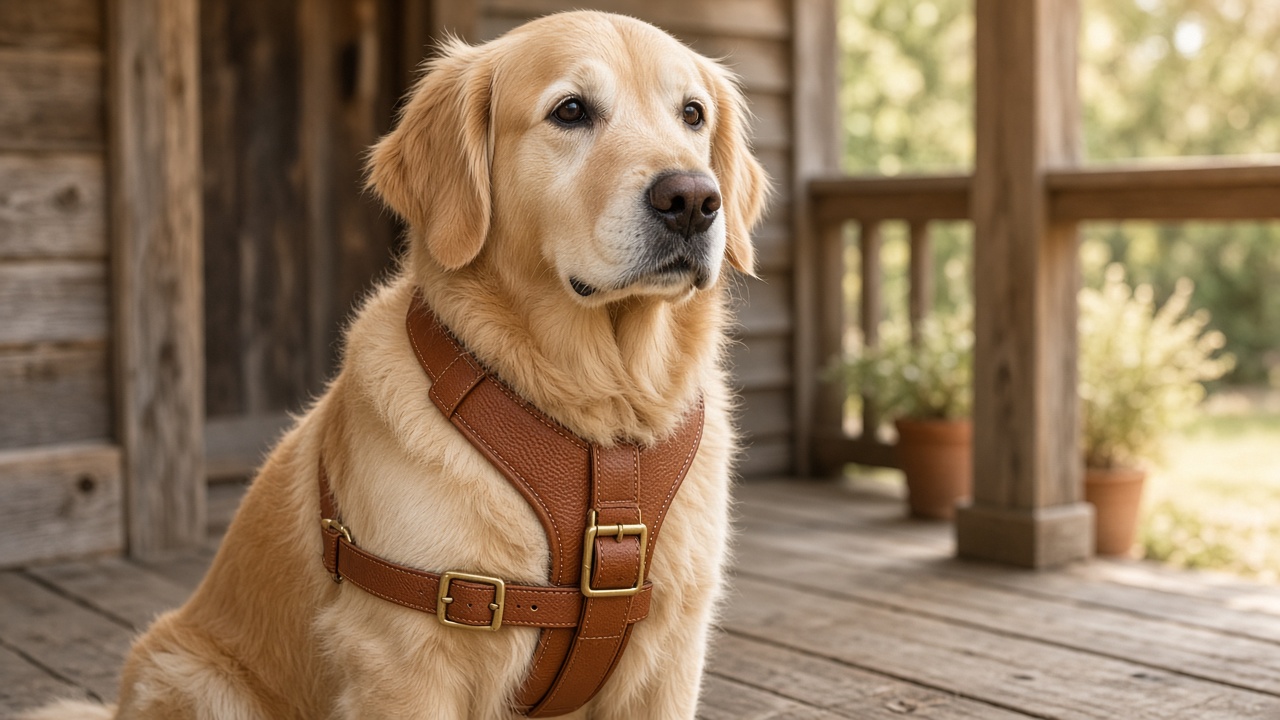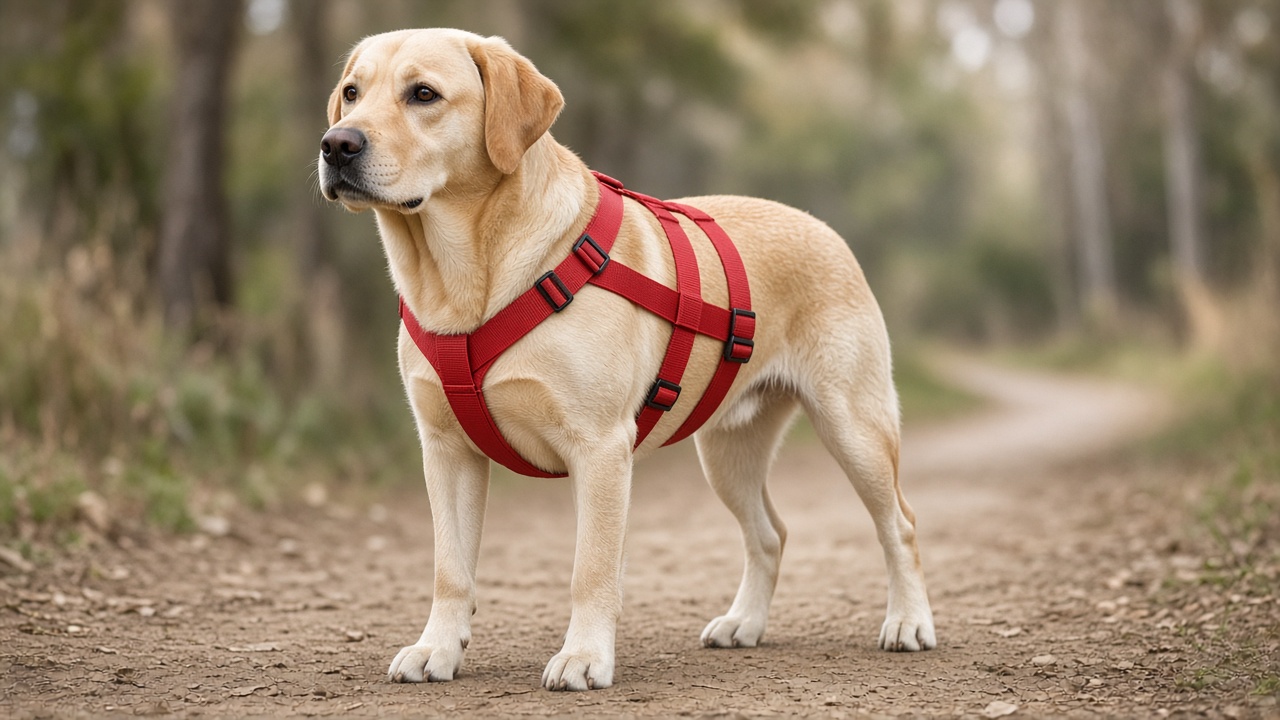
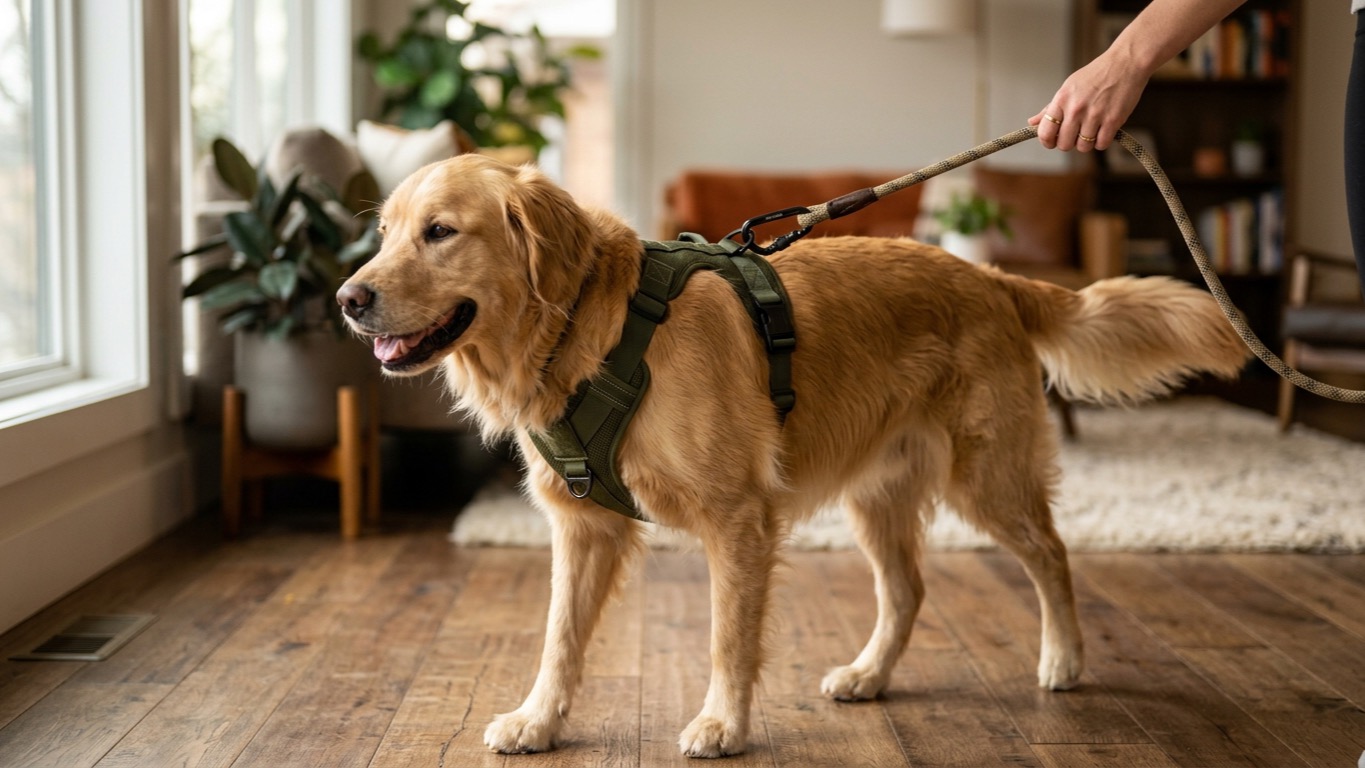
A big dog harness is a control vest sized to chest girth on dogs roughly 70 pounds and up — not a scaled-up toy-breed vest and not a collar with extra webbing. On the , the seven SKUs on this page run $15.97–$45.86, median $23.39, mean $24.42. Six of seven sit under $25. Only two titles name large or large-breed dogs. One title names small dogs. Buy from the printed girth chart, not the word “tactical.”
| SKU on this URL | Listed price | Title class | Clip language |
|---|---|---|---|
| rabbitgoo Dog Harness No Pull with 2 Leash Clips | $15.97 | Size-silent | Dual clips |
| PHOEPET Reflective Dog Harness Large Breed Adjustable No Pull Vest | $17.76 | Large breed | No-pull vest |
| tobeDRI No Pull Dog Harness Adjustable Reflective Oxford Easy Control | $19.99 | Size-silent | No-pull + reflective |
| WINGOIN Tactical Dog Harness for Large Dogs | $23.39 | Large dogs | Tactical / extra rings |
| SlowTon No Pull Dog Harness | $23.99 | Size-silent | Front-loop no-pull |
| Beebiepet Heavy Duty Tactical Dog Harness for Small Dogs | $23.99 | Small dogs | Tactical — wrong class |
| Carhartt Nylon Duck No Pull Dog Harness | $45.86 | Size-silent | Duck nylon + no-pull |
Desk stat: 2 of 7 titles (29%) name the large-dog job. 1 of 7 (14%) names small dogs. The Carhartt is 1.96× the $23.39 median and $21.90 above the next-highest sticker.
Our guides are reader-supported. This article may contain affiliate links. As an Amazon Associate we may earn a commission if you buy through links, at no extra cost to you.
What to buy for a big dog harness on this page
If you want the short version of what to buy:
A collar still carries ID. A harness carries the walk. They are complementary, not alternatives.
What a big dog harness has to do that a small-dog vest does not
The phrase big dog harness is used in listings to mean three different products: a no-pull vest with a large size on the chart, a tactical-styled harness with MOLLE webbing, and whatever happens to be in an extra-large bag. Those are not the same job.
A dog over about 70 pounds changes the failure modes. The leash load is higher. The chest is deeper. The armpit gap is wider. A strap that sits fine on a 25-pound dog will ride into the axilla of a barrel-chested mastiff and chafe within a mile. A plastic side-release buckle that is merely annoying on a terrier is the part that opens when an 90-pound dog lunges at a squirrel.
Our desk uses four properties that are visible in listing photographs and specification blocks.
Girth range, not weight class. Weight is a marketing shortcut. Chest girth behind the front legs is the measurement that decides whether a harness is a big dog harness or a vest that will rotate. Manufacturer charts that print an inch range are usable. Charts that say “fits large dogs” without inches are not.
Hardware in the load path. Look at the D-ring and the buckles that close the girth. Metal in the load path is the listing claim worth checking in the product photographs. Plastic hardware with a metallic finish is a different claim. We cannot verify a tensile rating from a search card, and we will not repeat one as if we had.
Clip geometry that matches the walk. A front clip is a training aid: it turns a forward lunge into a sideways arc. A back clip is everyday walking and a car-tether point on some designs. Dual-clip vests cover both jobs. A handle on the spine is a control assist, not a lifting rating, unless the listing shows the handle stitched into the frame.
Strap width and padding at the chest. On a deep-chested dog, a one-inch strap concentrates pressure on a smaller patch of skin. Listings that describe 1.25–1.5 inch webbing and a padded chest panel are describing the geometry that matters. Mesh that is sold as “breathable” can still cut if the edge is narrow.
A harness that clears those four is a candidate. A product that clears none is a costume. Most of this page sits between the two, which is why the tables exist.
How large breed harness listings compare on labels
These tables are desk compilations from the public listing fields of the seven SKUs on this page plus recurring owner-report themes. They are buying heuristics, not measured outputs from any test we performed. Prices are listing cues recorded in August 2026 and they move.
Table 1 — Price bands for a big dog harness on this page
| Band | Price range | SKUs on this page | What the money is actually buying | Honest limit |
|---|---|---|---|---|
| Entry no-pull vest | $15.97–$19.99 | rabbitgoo, PHOEPET, tobeDRI | Dual clips or reflective fabric at the low end of the page | Padding and hardware quality are listing claims, not measurements |
| Mid no-pull / tactical | $23.39–$23.99 | WINGOIN, SlowTon, Beebiepet | The cluster around the $23.39 median | Beebiepet is titled for small dogs; ignore the cluster price and read the size chart |
| Fabric premium | $45.86 | Carhartt Nylon Duck | Heavier duck nylon and metal hardware language | 1.96× the median is a material premium, not a certified load rating |
Desk stat: Six of seven SKUs (86%) sit under $25. The Carhartt is the only listing that breaks the cluster, and it does so by $21.90 above the next-highest price ($23.99). If you are deciding whether the duck-nylon premium is worth it, that $22 gap is the number — not a story about “premium work-grade durability” with no measurement behind it.
Table 2 — Who the title is actually written for
| Product | Title says | Usable as a big dog harness? | Why |
|---|---|---|---|
| rabbitgoo No Pull, 2 clips | No size class | Maybe — if the chart’s large/XL girth covers your dog | Dual clips are the useful claim; size is on the chart, not the title |
| Beebiepet Heavy Duty Tactical | Small dogs | No | — |
| WINGOIN Tactical | Large dogs | Yes, as a candidate | One of two titles that name the job |
| tobeDRI Reflective Oxford | No size class | Maybe — evening-walk fabric, chart must clear girth | Reflective Oxford is a visibility claim, not a strength claim |
| SlowTon No Pull | No size class | Maybe — owner reports on this listing often mention a tight size run | Measure twice; the front loop is the useful claim |
| PHOEPET Large Breed Vest | Large breed | Yes, as a candidate | The other title that names the job; $17.76 is the cheapest large-breed-titled option |
| Carhartt Nylon Duck | No size class | Maybe — fabric is the claim | Confirm the size chart includes your girth; duck nylon does not invent inches |
Desk stat: 2 of 7 titles (29%) name large or large-breed dogs. 1 of 7 titles (14%) names small dogs. 4 of 7 titles (57%) are size-silent. Size-silent is the most common pattern on this page, which is why a tape measure is the first tool, not a brand name.
Table 3 — Clip, fabric, and the walk they match
| Feature | Minimum we will treat as a walking harness | Worth paying toward | Red flag on a big dog |
|---|---|---|---|
| Leash attachment | At least one metal-looking D-ring on a webbing loop | Dual clips: front for training, back for a steady walk | A single plastic ring on a mesh vest sold for a puller |
| Closure | Buckles that photograph as load-bearing, not decorative | Metal or acetal buckles on the girth | Side-release plastic on a 90-pound lunger with no backup strap |
| Chest geometry | A panel that sits on the sternum, not the throat | Y-front or wide padded plate that clears the shoulders | A strap that crosses the trachea when you lift the handle |
| Strap width | Described webbing, not string | 1.25 inch or wider on dogs over 80 pounds | Narrow fashion webbing on a deep chest |
| Visibility | Optional | Reflective piping or Oxford (tobeDRI, PHOEPET) | Dark mesh, no reflective element, night walking |
| Handle | Optional | Frame-stitched grab handle if you need a traffic stop | A thin fabric loop that pulls the vest into the armpits |
Table 4 — Sizing thresholds a big dog harness has to clear
| Dog weight (rough) | Typical chest girth to measure | Clip preference on this desk | What to refuse |
|---|---|---|---|
| 70–90 lb | 28–34 inches behind the elbows | Front or dual if the dog pulls; back if the walk is already loose | A “large” bag with no inch range |
| 90–120 lb | 32–38 inches | Dual-clip; wide straps | Toy-breed tactical vests and step-ins with a shallow chest plate |
| 120 lb and up | 36–44 inches, often a long-strap or XL/XXL chart | Dual-clip plus a handle you have rehearsed | Anything that maxes out at 34-inch girth |
These inch bands are starting points compiled from manufacturer charts that print ranges, not a PetBench tape-measure study. Measure the individual dog. A 95-pound sighthound and a 95-pound mastiff do not share a chest.
How we assessed these seven products
Our method was to read each listing’s construction and size language, record the stated price, and cross-read owner reports for recurring, specific failure descriptions rather than star averages.
Three filters shaped the assessment. Size-class honesty — a listing titled for small dogs is not a big dog harness, full stop. Clip geometry — we weighted dual-clip and front-clip language because that is the control claim the category is sold on. Claim density — listings that describe fabric, strap width, or a printed girth range scored as more usable than listings that describe how the product makes you feel.
Prices are listing cues recorded in August 2026 and they move.
The 7 big dog harness listings, reviewed
1. rabbitgoo Dog Harness No Pull with 2 Leash Clips
Best for: the cheapest dual-clip vest on this page, if the size chart’s large or XL band covers your dog’s girth.
At $15.97 this is the floor of the these large-breed harness listings. The useful claim is in the title: two leash clips. That is the geometry a big dog harness needs if you are still teaching a loose leash — front clip to redirect, back clip once the walk is quiet. Mesh that is sold as breathable is a summer convenience, not a strength rating.
Buying at this price means you do the verification the listing will not. Open the size chart and find the chest range in inches. If your dog sits at the top of a band, size up; mid-band is where the straps still have travel. Run the twenty-minute indoor rehearsal below before the first sidewalk. Owner reports on entry-price mesh vests consistently describe two failure modes: the girth strap creeps loose, and the chest pad is thin on a heavy puller. Neither is a reason to skip the vest if it fits. Both are reasons not to treat $16 as a finished control system.
This is not a working-dog harness. It is a walking vest. For a calm 75-pound dog on a neighborhood loop, that is the correct object. For a 110-pound lunger, read the hardware in the photographs and have a plan for the loose-leash training problem that a vest cannot finish alone.
Pros
- Dual clips at the lowest price on the page
- Mesh language suits warm-weather walking if the edges do not cut
- Easy to replace if the size chart was wrong
Cons
- Padding and hardware are listing claims at $15.97
- Size class is not in the title; the chart has to do that work
2. Beebiepet Heavy Duty Tactical Dog Harness for Small Dogs
At $23.99 this listing sits on the median price of the page and uses the words “heavy duty” and “tactical.” The rest of the title is the whole review: for small dogs. A big dog harness page that sells a small-dog vest is how shoppers buy the wrong object and then blame the category.
We are keeping the product card exactly as stored. We are not recommending it for any dog over the maker’s small-dog chart. If you landed here with a Chihuahua, Pomeranian, or similar, leave this URL and use the small-breed harness guide. If you landed here with a Labrador, this SKU is a miss. MOLLE webbing on a small frame does not become large-breed hardware because the photograph is coyote brown.
The honesty move on a research desk is to leave the card, name the mismatch, and spend the word count on the five listings that can actually take a large chest.
Pros
- Title is unusually honest about size class
- Same price band as the large-dog WINGOIN, which makes the contrast useful
Cons
- Not a big dog harness
- Tactical styling on a small-dog chart is how this URL got confused in the first place
3. WINGOIN Tactical Dog Harness for Large Dogs
Best for: the cheapest listing on this page whose title admits the dog is large.
At $23.39 this is $0.00 from the page median and one of two SKUs that say “large dogs” in the title. If you have been bouncing between size-silent no-pull vests, this is the first listing to read. Tactical styling here means a structured chest, extra D-rings, and the usual MOLLE-panel photograph. Whether the webbing laces a pouch or is sewn flat is a photograph check, the same check we use on the tactical gear page.
A large-dog title is not a fit. Measure girth. Structured tactical cuts run narrow on deep, barrel chests and long on skinny sighthounds. The twenty-minute rehearsal matters more on a rigid panel than on a floppy mesh vest, because a rigid panel that is one size off will rotate as a unit.
Owner-report themes on budget tactical harnesses are consistent: hardware looks metal in the hero shot and turns out mixed in hand; the handle is useful if it is stitched through the panel and useless if it is tacked on. Look at the close-up images before you order, and keep the box through the return window.
Pros
- Title matches the keyword
- Median price, so you are not paying a costume premium
- Extra D-rings are useful if you actually clip a light or a second lead
Cons
- “Tactical” is a style word until you confirm hardware in the photos
- Rigid cuts punish a wrong size faster than mesh vests do
4. tobeDRI No Pull Dog Harness Adjustable Reflective Oxford Easy Control
Best for: dusk and night walking, if the Oxford shell’s size chart covers the chest.
At $19.99 this listing is buying visibility as much as control. Reflective Oxford is a fabric you can assess in a photograph: it throws light back. On a large dark-coated dog walked at 6 a.m. or after dinner, that is a real job. The no-pull and “easy control” language is the same claim every vest on this page makes. Treat the front clip as a training aid, not a finished behavior plan.
Multiple adjustment points are a feature and a burden. More sliders mean a better chance of fitting an awkward chest — and a better chance of putting it on crooked. The first fitting should happen in the kitchen with a second person if you have one. Photograph the strap positions. Oxford fabric does not stretch the way mesh does, so a too-small size will announce itself as soon as the dog sits.
This is a walking vest with a night-safety argument. It is not a substitute for a light on the collar or a reflective band on you. If the dog is a strong puller, confirm the front-ring stitching in the listing images the same way you would on any other no-pull vest.
Pros
- Reflective Oxford is a concrete visibility claim
- Price sits between the $16 mesh and the $23 cluster
- Adjustable language suits odd chest shapes if you take time on the first fit
Cons
- More sliders mean more ways to fit it wrong
- Size class is silent in the title
5. SlowTon No Pull Dog Harness
Best for: a front-loop training vest, with a hard check on the size chart because this listing runs small in owner reports.
At $23.99 this is a median-cluster no-pull vest. The useful claim is the front leash loop plus a padded chest panel. That is the classic “redirect the lunge” geometry. It works as a mechanical hint. It does not teach the dog to walk politely by itself. Pair it with the training work, or you will own a vest the dog leans into.
The recurring owner theme on this specific listing is sizing: the vest runs tighter than the chart suggests. On a big dog harness that is a buying rule, not a footnote. If your girth sits in the upper third of a size band, go up a size and use the sliders to take it in. A tight girth strap on a deep chest is how you get armpit rub and a dog that starts refusing the harness.
Padding on the chest is there to spread load. Padding that packs down or shifts off the sternum is just bulk. After the first week, look at the coat under the panel. Pink skin or missing hair is a fit problem, not a “break-in” period.
Pros
- Front-loop language matches the no-pull job
- Padded chest is the right idea for a heavy dog
- Priced with the rest of the usable cluster
Cons
- Owner reports on this listing often say it runs small
- Tight sizing on a big chest is a chafe machine
6. PHOEPET Reflective Dog Harness Large Breed Adjustable No Pull Vest
Best for: the budget large-breed-titled vest — $17.76, and the title does the size work the others skip.
This is the second of two listings that say “large breed” out loud, and it is $5.63 cheaper than the WINGOIN. If your decision rule is “the title must match the dog, and the price should stay in the entry band,” this is the row to start with. Reflective strips are the secondary claim. Adjustable vest is the third. None of those replace a tape measure.
Durability language on sub-$20 large-breed vests is where owner reports get specific. The pattern is fray at the D-ring box and stretch in the girth webbing after a season of a strong puller. That is not a reason to skip the vest for a moderate walker. It is a reason to inspect the stitching monthly and to retire the vest when the webbing at a junction starts to fuzz. At $17.76, replacing a worn vest is cheaper than arguing with a $45 vest that does not fit.
If the dog is a determined lunger, read this as a walking vest you may replace, not as the last harness you will own. Combine it with training. A vest is not a behavior plan.
Pros
- Large-breed title at the second-lowest price on the page
- Reflective strips are a concrete extra
- Cheap enough to treat fit as an experiment inside a return window
Cons
- Sub-$20 large-breed vests are where webbing stretch shows up in owner reports
- Not a hardware-forward tactical cut
7. Carhartt Nylon Duck No Pull Dog Harness
Best for: the fabric upgrade if your dog already fits a Carhartt size chart and you want duck nylon rather than mesh.
At $45.86 this is 1.96× the page median and the only listing that leaves the sub-$25 cluster. What you are paying for, on the listing’s own terms, is Carhartt nylon duck and metal-looking hardware. Duck nylon is a work-wear fabric: it resists abrasion better than fashion mesh in the way canvas resists abrasion better than t-shirt knit. That is a material class, not a certified harness rating.
The no-pull claim is the same claim as the $16 rabbitgoo. Do not buy the Carhartt to solve a training problem the cheap vest also claims to solve. Buy it if you want a heavier shell that will take brush, kennel gates, and daily buckle cycles, and if the size chart includes your dog without sitting on an edge band.
The honest limit is price-to-fit. A $46 harness that is one size off is a more expensive mistake than a $16 vest you return. Do the kitchen rehearsal. If the duck shell sits on the shoulders instead of behind them, send it back. Brand heritage does not move a strap.
Pros
- Heaviest fabric language on the page
- Metal-hardware language matches a large-dog job better than fashion mesh
- The one listing where a material premium is at least visible in the name
Cons
- Nearly 2× the median for the same no-pull job statement
- Size-silent title; the chart still has to clear a giant chest
Big dog harness options compared at a glance
| Product | Class | Best for | Approx. price | Where to buy |
|---|---|---|---|---|
| rabbitgoo No Pull, 2 clips | Dual-clip mesh vest | Cheapest two-clip walk | $15.97 | Check price |
| Beebiepet Tactical, small dogs | Small-dog tactical | Not this keyword | $23.99 | Check price |
| WINGOIN Tactical, large dogs | Large-dog tactical | Title matches the job | $23.39 | Check price |
| tobeDRI Reflective Oxford | Reflective walking vest | Dusk and night loops | $19.99 | Check price |
| SlowTon No Pull | Front-loop vest | Training redirect; watch sizing | $23.99 | Check price |
| PHOEPET Large Breed Vest | Large-breed vest | Budget title match | $17.76 | Check price |
| Carhartt Nylon Duck | Duck-nylon vest | Fabric upgrade | $45.86 | Check price |
Browse the wider category: See big dog harness listings on Amazon →
Fitting a big dog harness: the twenty-minute indoor rehearsal
More large-breed harnesses fail on geometry than on fabric, and geometry problems are free to detect if you look before the first outing.
Measure chest girth with a soft tape around the widest part of the ribcage, just behind the front legs, with the dog standing. Write the number down. Compare it to the inch range on the listing, not to “large.” Then fit the harness indoors and adjust so you can slide two fingers flat under every strap. Let the dog move for twenty minutes — walking, sitting, lying down, shaking off, and turning tightly in both directions. You are watching for four specific things.
Armpit intrusion. The girth strap should sit behind the elbow with clearance. If it rides into the armpit when the dog extends a front leg, it will chafe within a mile. Padding does not fix a strap that is in the wrong place.
Rotation under load. Ask the dog to move away from you at the end of a lead and watch from behind. If the back panel twists off-centre, the girth is too loose or the harness is the wrong width for that ribcage. A big dog harness that rotates is how a front clip ends up beside the shoulder instead of on the chest.
Handle and throat geometry. If there is a handle, lift gently. The load should spread across the chest and ribs. If the vest climbs into the throat, do not use the handle as a traffic stop.
Shoulder travel. Watch the front legs at full extension. A strap crossing the shoulder blade shortens the stride. On a large dog that walks several miles a week, that is a soundness issue rather than a comfort one.
Photograph the fitted harness from above and from the side. Straps creep. A reference photograph makes creep obvious. Keep the packaging until the return window closes.
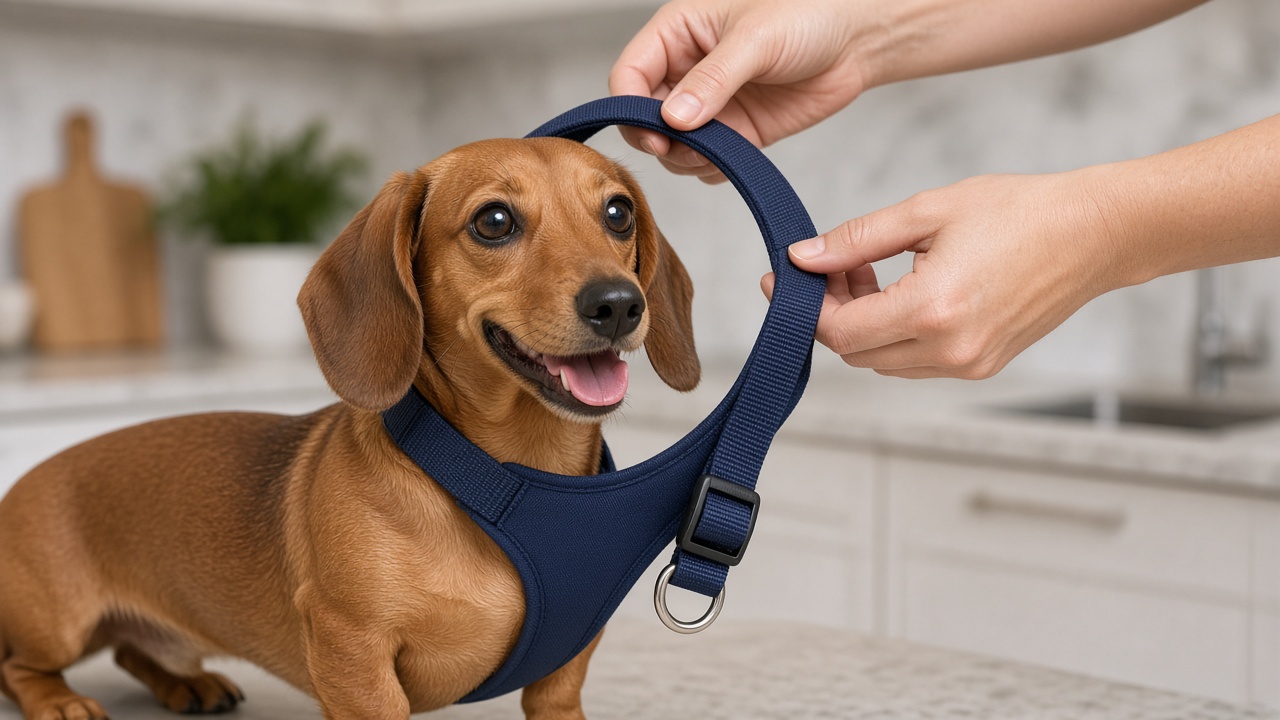
How to put a big dog harness on without a wrestling match
Large dogs can brace. A vest that goes on as a fight will be a vest the dog starts to dodge. The desk sequence is boring and it works.
- Let the dog sniff the harness on the floor. Do not chase.
- If it is a step-in, hold the vest open on the ground and lure both front feet in with food, then lift and buckle behind. If it is over-the-head, slide the neck hole on while the dog is eating from your other hand, then buckle the girth.
- Fasten loosely first. Get all the buckles clicked. Then tighten to two-finger fit, starting at the girth, then the chest, then the neck if there is a neck strap.
- Feed again. Take three indoor steps. Feed. That is the whole first session if the dog is sensitive.
- Only then do the twenty-minute rehearsal.
If the dog freezes, yawns, or tries to back out, stop and loosen. A freeze is information. Forcing the last buckle is how you get a dog that hides when the vest appears. A second person helping on a 100-pound dog is not a luxury.
Maintenance, storage, and when to retire a big dog harness
Nylon and mesh fail in storage and at stitch junctions more often than they fail in a dramatic buckle snap. Three habits cover most of it.
Dry it fully before it goes away. Webbing holds water in the weave. Stored damp it mildews and the stitching weakens. Air dry. Direct heat stiffens synthetic webbing.
Rinse grit, do not grind it in. Sand and road grit in webbing act as an abrasive from the inside. A rinse and full dry after a beach or dusty trail costs five minutes.
Inspect the D-ring box and buckle stitches monthly. On a big dog harness this is the load concentration. Look for fuzzed webbing, a ring that has started to oval, a buckle that no longer clicks positively, or a chest pad that has packed into a ridge.
Retire the harness when webbing frays at a load point, when stitching at a junction has opened, when a buckle will not lock, or when you cannot get a two-finger fit without the vest sitting on the throat. “It still mostly holds” is the sentence that precedes a loose dog. At a $23 median, replacing early is cheap against a lost 90-pound animal.
Take the harness off between walks. A walking vest is not an all-day garment. Continuous wear hides chafe and wears the coat at the strap lines. The collar is the all-day ID. If you need a handle in the house for a mobility dog, that is a clinician conversation, not a product-card conversation.
Where the money is best spent
If you are building a large-dog walking kit from nothing, the desk sequence is: tape measure, then a dual-clip vest that fits, then a leash you can hold, then a collar for tags, then lights.
The tape measure comes first because every other purchase is conditional on girth. The vest comes second because it is the control device. Around $23 buys the median of this page. The PHOEPET at $17.76 and the WINGOIN at $23.39 are the two titles that already admit the dog is large. Start there unless you have a specific night-walking or duck-nylon reason to deviate.
The leash is the other half of the system. A six-foot flat leash is enough for most neighborhood walks. A traffic handle on the leash is often more useful than a traffic handle on a cheap vest. Retractable leads and a strong puller are a separate safety problem; that conversation belongs on the retractable-leash safety page.
What we would not spend money on: a second vest in a different colour before the first one has survived a month, a small-dog tactical harness because it photographed well, or a $46 shell to fix a training problem. Redundancy in a spare leash and a spare ID collar beats variety in unused vests.
When to involve your veterinarian
This page covers gear selection and fit, not health. Contact a licensed veterinarian if you find persistent chafing or hair loss at strap lines, if the dog develops a limp or gait change after starting a harness, if coughing or gagging appears when the vest is on, or if you are using a harness because of a diagnosed tracheal, spinal, or orthopedic condition. Those are clinical questions. A product listing cannot answer them.
Nothing here has been reviewed by a veterinarian on our behalf. A front-clip vest is not a treatment for collapsing trachea, and a handle is not a mobility aid we have cleared for lifting a large dog.
Frequently asked questions about a big dog harness
What makes a harness a big dog harness rather than a large size of a small vest?
A printed girth range that actually covers a 28-inch-plus chest, strap width and hardware that can take a large-dog load path, and a chest panel that sits on the sternum instead of the throat. A bag marked XL on a toy-breed pattern is still a small vest. Two of seven titles on this page name the large-dog job. The rest require you to read the chart.
Can a big dog harness stop pulling on its own?
No. A front clip changes the direction of a lunge. It does not teach a heel. Use the vest as a mechanical hint and do the training. If pulling is the whole problem, read the loose-leash guide instead of buying a third vest.
How do I measure for a big dog harness?
Soft tape around the widest ribcage, behind the front legs, dog standing, tape snug but not tight. Compare that number to the listing’s inch range. Ignore weight-only charts when an inch range exists. If the dog is between sizes, prefer the size that leaves slider travel in both directions.
Is a tactical big dog harness better than a no-pull vest?
Only if you need a handle, extra D-rings, or a structured panel, and only if the hardware in the photographs is in the load path. Tactical is a style word on most consumer listings. The WINGOIN is the tactical row that at least names large dogs. The Beebiepet is tactical styling on a small-dog chart.
Do I need a handle on a big dog harness?
Need: no. Useful: yes, for a traffic stop, a curb assist, or a second of extra control around a trigger, if the handle is stitched into the frame and you have rehearsed a gentle lift. A thin loop that pulls the vest into the throat is worse than no handle.
How often should I replace a big dog harness?
On damage, not on a calendar. Frayed load-point webbing, an opening stitch, a buckle that will not lock, a D-ring that has ovalled, or a fit you can no longer make without throat pressure. Under daily use by a strong dog, owner reports on entry-price vests often describe a season or two. Inspect monthly.
Are harnesses safer than collars for large breeds?
For walking and training, a chest-distributed harness moves leash force off the neck. That is geometry, not a PetBench medical study. The American Veterinary Medical Association’s pet-ownership guidance treats appropriate restraint and training as part of responsible care; it does not crown a brand. Keep a collar on for ID tags. Do not walk a strong puller on a collar alone if you have a harness that fits.
Sources and method
PetBench desk compilation, August 2026. Specifications and prices are reprinted from public Amazon listing fields as recorded in August 2026 and are listing cues that change without notice. Hardware and construction assessments are based on listing descriptions and product photographs, not physical inspection. Failure-mode descriptions are synthesized from recurring themes in publicly visible owner reports.
Welfare and restraint context: American Veterinary Medical Association, Pet Ownership Guidelines. Size bands in Table 4 are desk starting points from manufacturer charts that print inch ranges, not a clinical sizing study.
Verify price, size chart, and hardware on the live listing before purchase.
- August 2026 — . Replaced the . Named the Beebiepet small-dog mismatch instead of selling it as a large-dog pick. Product cards and the live slug are unchanged.