This is not veterinary advice. We are not licensed veterinarians. dB and RPM below are reprinted from maker pages or from the number the maker printed in the SKU name. If that number is missing, this page says so.
The best cat nail grinder runs 6,000–7,000 RPM with whisper-quiet motor, diamond bit head, and USB recharge—guillotine fear sends cats under bed faster than gradual grind sessions.
Decide the tool first — grinder, clipper, or the veterinarian — then treat quiet as a printed dB, not a ranking.
That is the selection rule for this URL. A carton that says “whisper-quiet” without a printed decibel is advertising. It is not quiet on this page. A motor the cat will not accept is the wrong class, however low the box number is. A claw already in the pad is not a shopping problem.
Our guides are reader-supported. This article may contain affiliate links. As an Amazon Associate we may earn a commission if you buy through links, at no extra cost to you.
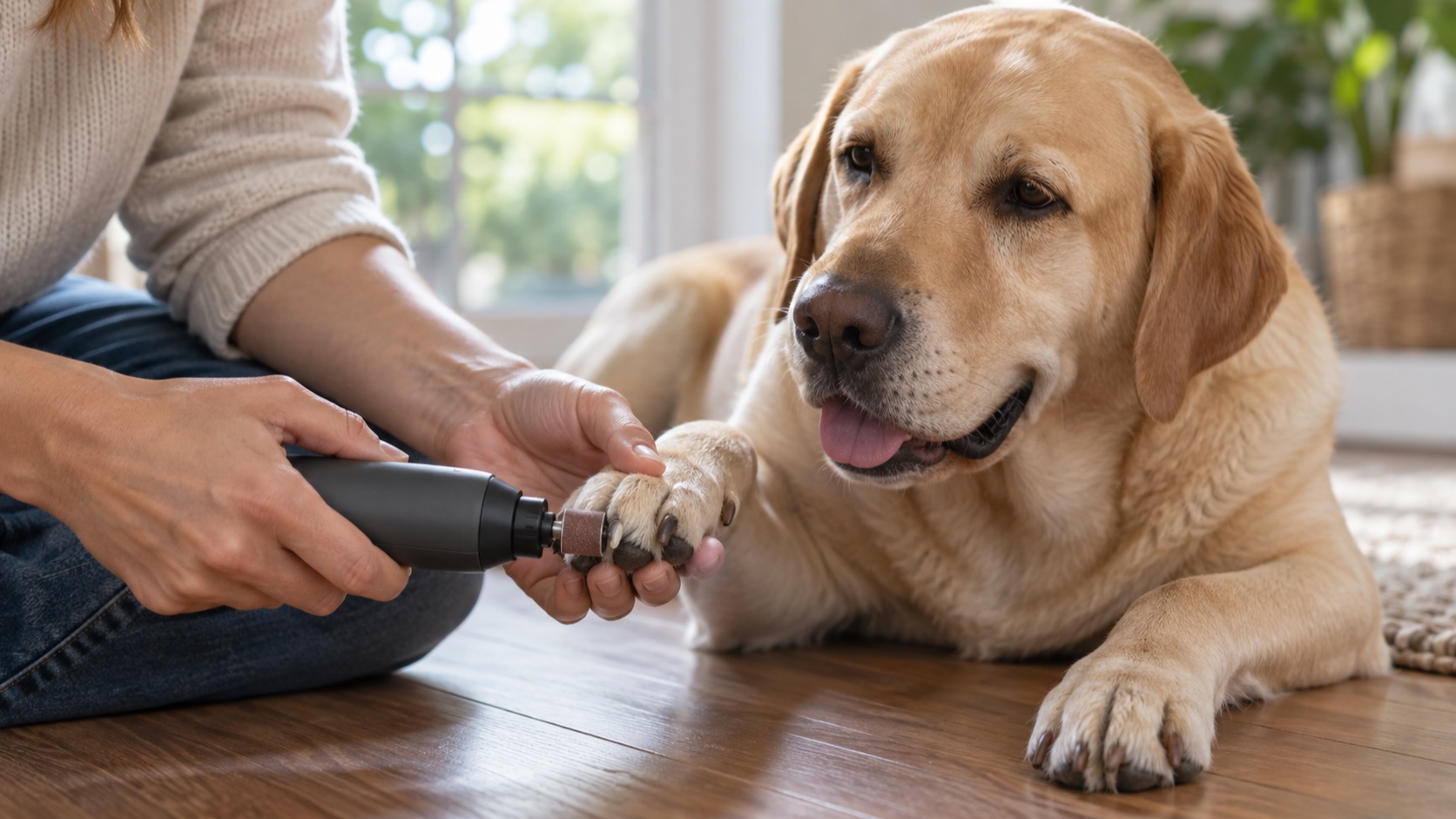
The session method lives on how to use a cat nail grinder. Clippers: cat nail clippers. Posts: scratching posts for furniture. Coat work: how to groom a cat at home. Thick dog nails are a different object: dog nail grinders for thick nails.
Quick answer
A quiet electric cat nail grinder is optional equipment for one job: file the hooked, dead tip and leave the pink core — the quick — alone. It is not quieter than a clipper. A clipper makes no motor sound. It is not safer than a veterinarian if the cat will not let you hold a paw.
- Name the door. Veterinarian or groomer if the cat fights, the nail is broken or in the pad, or you cannot see the hook. Clipper if you want a silent snip — that is the tool VCA, ASPCA, and Cornell walk through. Grinder if you and the cat can accept a motor and you want to stop mid-nail.
- Treat “quiet” as a printed dB on that SKU. Casfuy prints 45 dB in the N65 product name. Dremel’s 7760-PGKD page and 7760-PGK manual print RPM and a guard — no dB. Hertzko’s HNG-31 listing says low noise and does not print a dB.
- Prefer a small port or a recessed guard that stays on. Start on the lowest speed that still files.
- Keep clippers and styptic (or flour or cornstarch) in the room. ASPCA and VCA both want a clotting product before the first pass.
- Stop early. ASPCA’s first real sitting is one or two tips. VCA: if the cat resists restraint, stop.
The three-door rule: veterinarian, clipper, then grinder
Door 1 — the veterinarian or a groomer. VCA: if the cat resists restraint, stop and contact the veterinarian; the clinic may prescribe calming medication. ASPCA: if the cat fights grooming and someone may get hurt, book a groomer or a veterinarian. VCA: older, less active cats can grow a nail so long it “curve[s] around and grow[s] into the paw pads, causing an infection.” A claw in the pad, a hanging sliver, pus, a limp, or bleeding that will not stop is Door 1.
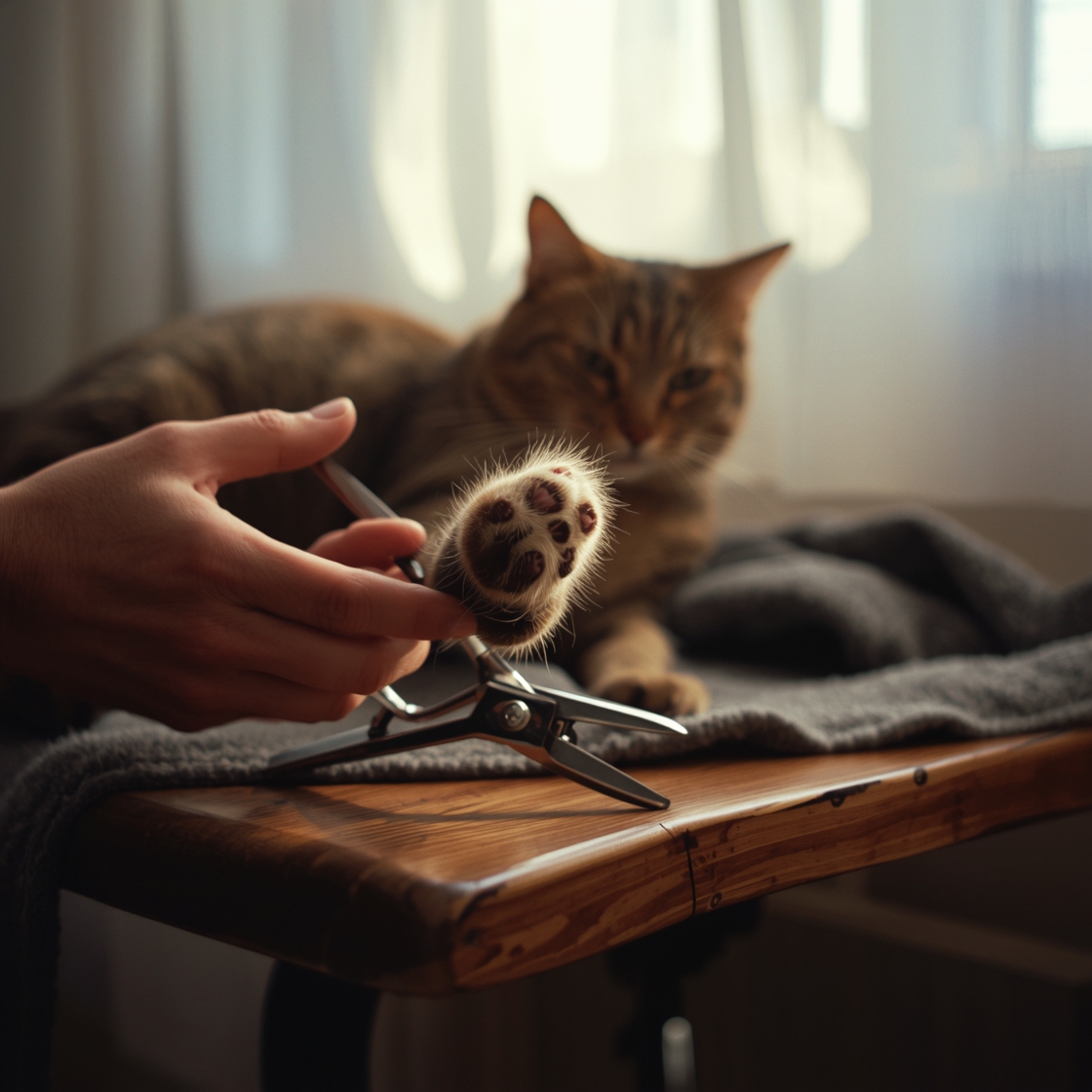
Door 2 — a cat clipper. VCA describes guillotine-style and scissors-style pet clippers, and says human nail clippers can be used if they stay reserved for the cat. ASPCA’s desensitization script is written around clippers and uncooked spaghetti. Cornell’s brief points to a trim of the hook after you press the pad. Institution how-tos are clipper pages. A clipper is silent. That is the honest noise comparison.
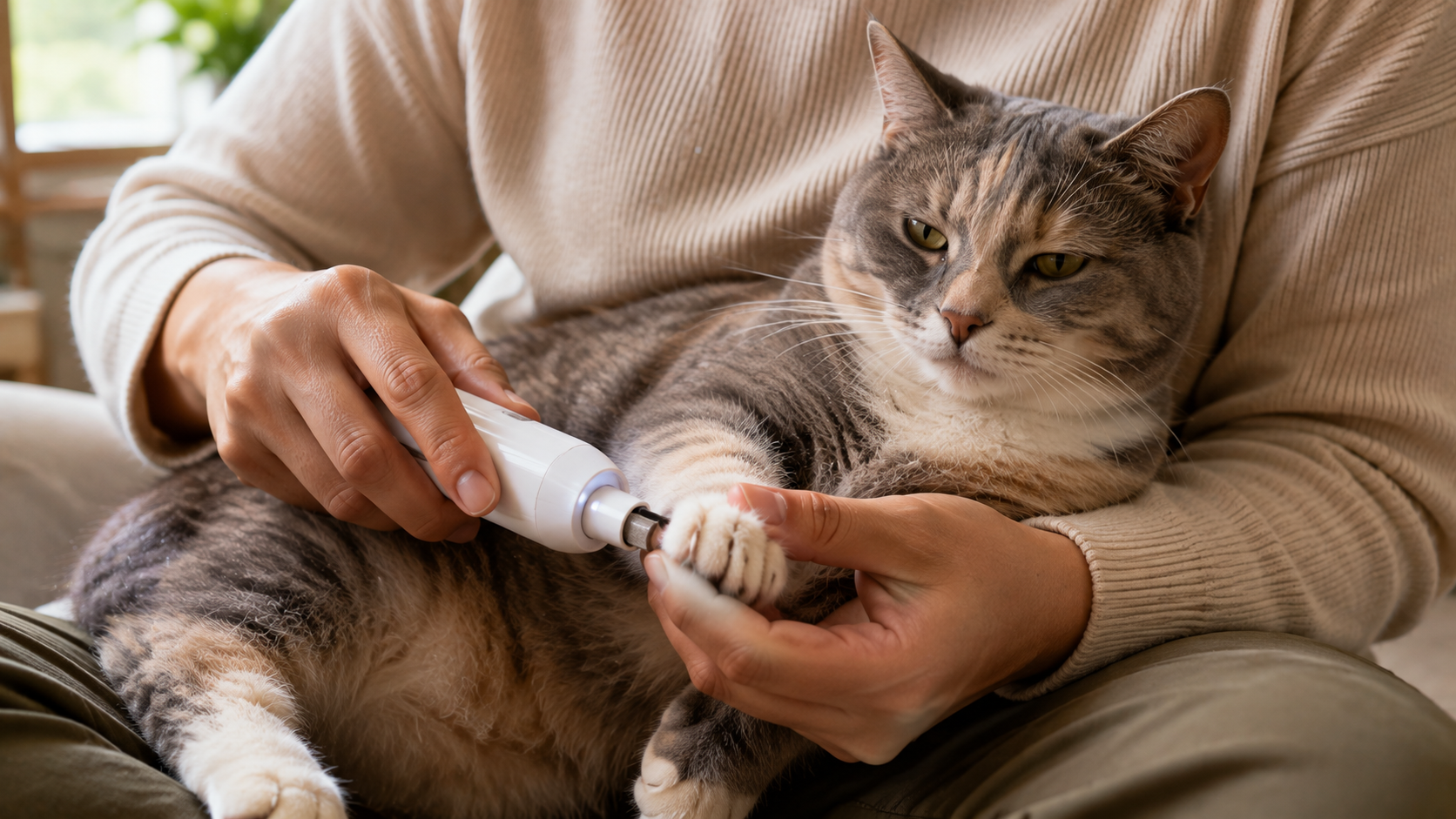
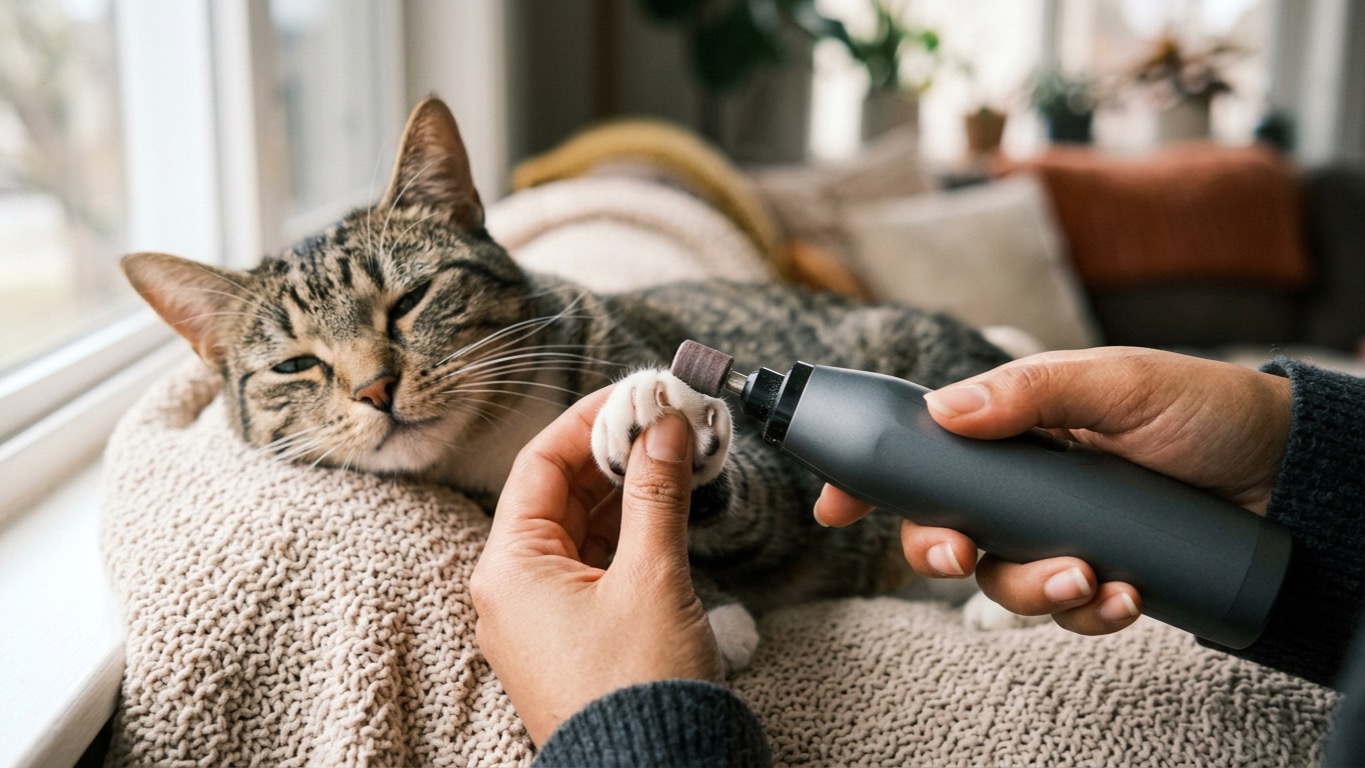
Door 3 — a small pet nail grinder. A rotary bit files the same hook a clipper would snip. You can lift off mid-nail. You also add sound, vibration, heat if you linger, dust, and a spinning surface that can catch fur. A human workshop rotary tool is not Door 3. A pet kit with a nail guard is a different object from a shop motor you “turn down.”
| Decision | Veterinarian / groomer | Cat clipper | Pet nail grinder |
|---|---|---|---|
| What it does | Clinic or salon trim | One cut through the hooked tip | A spinning bit files the same tip |
| What the fetched cat pages teach | VCA and ASPCA send a fighting cat here | VCA, ASPCA, Cornell | No cat-specific owner protocol from those pages |
| Noise | Not a home motor | A snip | A motor the cat has to learn |
| Wrong door when | Never, if Door 1 signs are present | Dull blades that crush | The cat will not accept the sound; a workshop rotary tool |
Quiet is a filter you apply after Door 3 is the right door.
What the tool is filing
Merck Veterinary Manual’s owner chapter (reviewed May 2025): cats have sharp, curved, retractable claws; they scratch to keep those claws sharp and to shed old layers; the pink “quick” has blood vessels and “can bleed a lot if nicked.”
VCA’s working landmark: press the middle pad so the claw extends. On a light nail, you should be able to see the quick; do not cut too close to it. On a dark nail, “aim to cut at the point where the nail curves or hooks downward,” then make several small cuts rather than one ambitious first attempt.
ASPCA: the pink part is the quick, “where the nerves and blood vessels are.” “Do NOT cut this sensitive area. Snip only the white part of the claw.” It is better to cut less than to risk the pink. Keep styptic powder or a styptic stick nearby.
Cornell: squeeze the paw so the nail extends, then take the hook. Scratching is marking and sheath-shedding, not revenge.
A grinder does not skip that map. Filing the keratin tip should not hurt. Exposing the core does. An LED can help you see a hook. It does not X-ray a dark quick. We are a research desk. This is a reprint of owner-facing landmarks, not a demonstration.
How often — only the numbers institutions print
some listings' FAQ said “every 4–6 weeks” with no source. We are not repeating it.
- AVMA (alternatives to declawing): “Frequent nail trims — every 1 to 2 weeks.”
- ASPCA (Cat Grooming Tips): “A nail-trimming every ten days to two weeks is recommended.”
- VCA (cat-trim page): indoor cats, “every two to four weeks.” Outdoor cats often wear nails down climbing and may need that length to escape. Older cats may need more help because they use a post less.
Those ranges do not agree on one calendar. They agree on “often,” not “once a season.” If you cannot see a hook, skip the session. If the hook is catching carpet, do not wait.
AVMA’s nail-cap interval is every 4 to 6 weeks. Cornell’s is every six to 12 weeks, and only on cats that already allow paw handling. Caps are a cover, not a grinder, and not some listings' unsourced trim calendar.
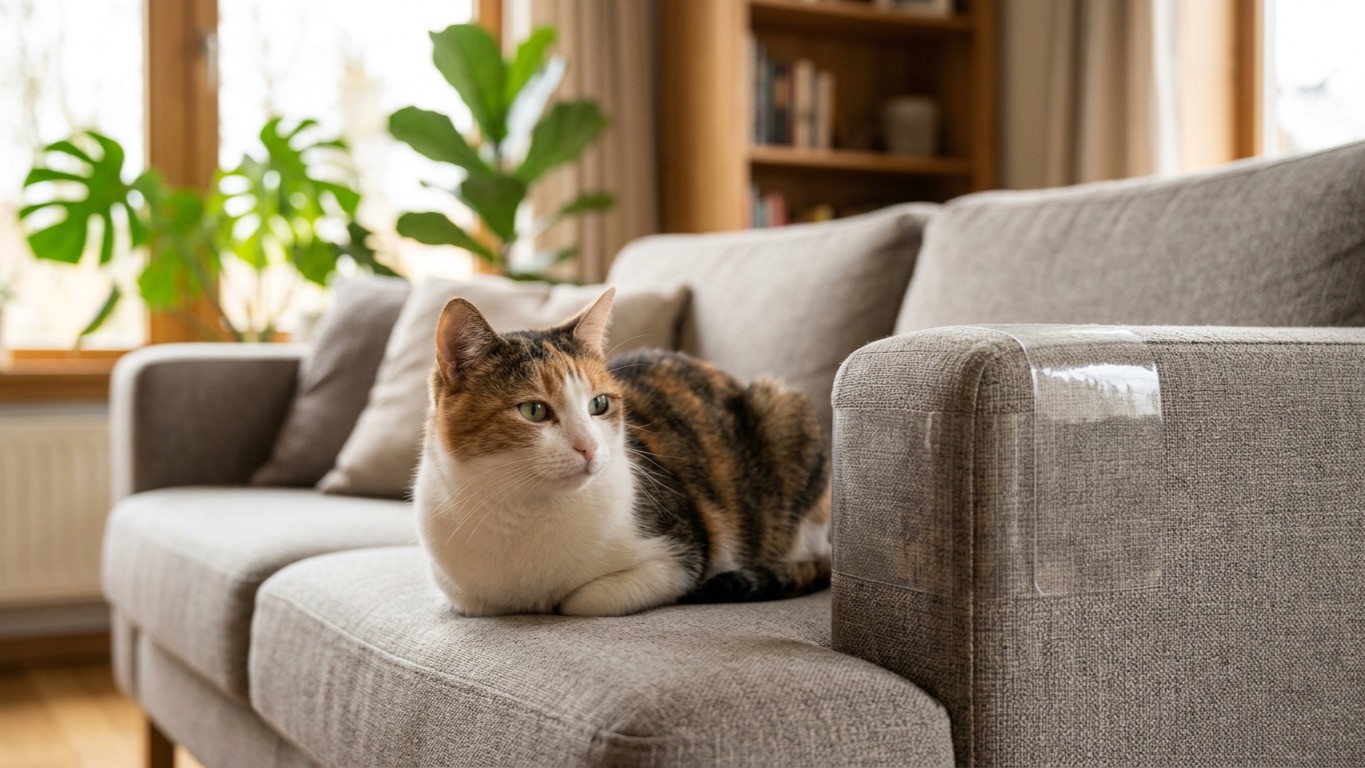
Scratching posts are the first wear method, not a substitute for a trim. AVMA: scratching “conditions the claws”; punishment is “not an effective deterrent.” Buy the post on the scratching-post page. Do not buy a motor because the sofa is losing.
What “quiet” means on this page
Quiet is a printed number, or it is not a claim we will write. ” some listings' 20 dB, 25 dB, and 32 dB “readings” are gone.
Printed dB. Casfuy’s N65 ships as “Dog Nail Grinder Quiet - (45db).” That 45 is theirs. It is a manufacturer claim on the carton name, not a PetBench measurement.
RPM and a guard, no dB. Dremel’s 7760-PGKD product page prints a 4 V lithium-ion pack, a nail-guard attachment, a 45-degree angled paw guide, 7.5 × 1.5 inches, and a two-year warranty. The 7760-PGK manual we opened prints rated speed 8,000–25,000/min, 3.6 V / 4 V Max, a 2.0 Ah pack, and a charge time of 2 hours 45 minutes. Those pages do not print a decibel.
“Low noise,” no dB. Hertzko’s HNG-31 listing copy says a quiet, low-vibration motor, a diamond bit, three ports, and up to 2.5 hours on a micro-USB charge. We opened no Hertzko page that prints a dB or an RPM.
If the cat leaves the room when the tool spins, Door 3 is closed. Teach the sound first — ASPCA’s clipper-and-spaghetti game, translated to a motor across the room — or buy the clippers, or book Door 1.
Feature classes, not ranks
- A small port, guard on. Casfuy’s dog page: do not pull the guard off unless you already know the tool. The unprotected bit is their large-dog option.
- A speed you can keep low. Casfuy prints 7,000–12,000 RPM. Dremel’s manual starts at 8,000/min and runs to 25,000/min. Higher RPM is not a better cat tool.
- A shape you can hover in one hand. If the tool is too heavy to hover, you will press. An LED can help you see; it does not find a dark quick.
- A charge before the cat is on your lap. Casfuy listing: up to four hours. Hertzko listing: up to 2.5 hours. Dremel manual: charge about 2 hours 45 minutes. Keep clippers in the room; a bit cannot replace a snip on a nail the guard will not reach.
Named grinders — examples, not a ranking
Specs are copied from manufacturer pages or from the number the maker printed in the listing title.
Casfuy Dog Nail Grinder Quiet N65 — printed 45 dB in the SKU name
Casfuy sells this unit as “Dog Nail Grinder Quiet - (45db).” The same listing copy prints six speeds at 7,000–12,000 RPM, three ports, two LED lights, a dust sheath, a diamond bit, and “up to 4 hours” on a full charge.
Casfuy’s own dog-grinder page is handling copy for dogs, not a cat protocol: teach the sound first; start on low; hold the bit “a second or two at a time”; not more than 5 seconds on one hold; keep hair off the tip; leave the guard on if you are not already practiced.
Honest trade-off: 45 dB is a printed claim, not a meter reading from this desk. For a cat, the small port is the class. If the cat will not accept the sound, the printed 45 does not matter.
Dremel 7760-PGKD Deluxe Pet Nail Trimming Kit — official RPM and a guard, no printed dB
Dremel’s US product page for the 7760-PGKD is a pet kit, not a shop rotary sold as a hack. It prints a nail-guard attachment, a 45-degree angled paw guide, a rechargeable 4 V lithium-ion battery, variable speed, 7.5 × 1.5 inches, and a two-year warranty.
The 7760-PGK manual we opened prints the speed the product page leaves as “variable”: rated speed 8,000–25,000/min, 3.6 V / 4 V Max, Li-ion 2.0 Ah, charge time 2 hours 45 minutes. The top of that range is a lot of motor for a cat hook. The useful number is the bottom step. The useful part is the guard that stays on.
Honest trade-off: first-party page and a manual, and no printed dB. We will not call it quiet. A workshop Dremel from a garage kit is still the tool we are not blessing.
Hertzko Electric Pet Nail Grinder HNG-31 — “low noise” on the listing, no printed dB
Hertzko’s current product copy for model HNG-31 describes a diamond-stone bit, three ports, a low-noise / low-vibration motor, and a pack that “lasts up to 2.5 hours” on micro USB.
We opened no Hertzko page that prints a decibel or an RPM. “Quiet motor” is a phrase, not a number. We will not write 30 dB, 45 dB, or 6,500 RPM next to this name.
Honest trade-off: three ports and a small-hole start are the useful class. If printed quiet is why you are on this URL, this row does not clear the selection rule.
Blank means the opened page did not print that number.
| Tool | Maker-stated noise | Maker-stated speed | Guard / ports | Power, as printed |
|---|---|---|---|---|
| Casfuy N65 | 45 dB in the SKU name | 7,000–12,000 RPM, 6 speeds | 3 ports + dust sheath | Listing: up to 4 hours |
| Dremel 7760-PGKD | Not printed | Manual: 8,000–25,000/min | Nail guard + 45° paw guide | 4 V Li-ion; manual 2.0 Ah, ~2 h 45 min charge; 2-year warranty |
| Hertzko HNG-31 | Not printed | Not printed | 3 ports (listing) | Listing: up to 2.5 hours, micro USB |
Buying checklist
Print this before you open a carton.
- Door check. If the cat already fights a paw hold, or a nail is broken, split, or in the pad, stop shopping. That is Door 1.
- Class check. If you want silence, you want a clipper, not a motor. If you want to stop mid-hook and the cat will learn a sound, you want a pet grinder.
- Printed quiet. Does this exact SKU print a dB? If no, do not write “quiet” on your notes. “Whisper,” “silent,” and “super mute” do not count.
- Small port, guard on. If the only way to reach the nail is to pull the sleeve off, that SKU is a large-nail tool.
- A low speed you can stay on. Two or more speeds, or a dial that starts low — not a shop motor.
- One-hand hover. You can hold the running tool steady without resting the bit on the nail.
- LED is optional. Useful. Not a dark-quick scanner.
- Charge, clippers, clotting product, treats. ASPCA and VCA both want styptic — or flour or cornstarch — in the room before you start.
- A post already in the house. AVMA, ASPCA, and Cornell all start with a scratching surface. A grinder does not replace it.
If you cannot tick 1, 2, and 3, you are choosing a different door.
When to stop
Put the tool down if any of the following is true. Compiled from the fetched pages, not from a house rule.
- The cat is pulling away, freezing, hissing, swatting, or trying to leave. VCA: if the cat resists restraint, stop. ASPCA: do not punish, and do not start when the cat is already agitated.
- You cannot see whether you are still on the hook. VCA’s dark-nail rule is the curve. ASPCA: cut less rather than risk the pink.
- You see pink on a light nail, a wet or shiny center, or blood.
- The bit has touched skin, or fur is wrapping the bit.
- The nail feels hot, or the cat flinches as if burned. We do not have a cat-specific temperature limit from an institution. Heat is a reason to stop, not a reason to “finish the nail.”
- You are angry or “just getting the last two.” ASPCA: never clip when you or the cat is upset.
- The claw is already broken, split, or curled into the pad. VCA: a nail in the pad can infect it.
See a veterinarian the same day if bleeding does not stop after pressure and a clotting product (VCA: styptic, or flour or cornstarch); the cat limps or cries; you see pus, swelling, or an unusual odor; a nail has grown into the pad; or the cat will not let you handle the feet and the nails are already long.
After a nick, that nail is done. The step list is how to use a cat nail grinder.
First-session drawer checklist
Print this. Do not add a second cat or a new bit mid-session.
- Charge the grinder. Lowest speed works. Bit seated. Guard on. Clippers, styptic (or cornstarch or flour), gauze, and treats in reach.
- Quiet room. No bird window. No other pets.
- If this is a new sound, stop here. ASPCA’s clipper game is the template: sniff the quiet tool, treat; sound across the room, treat; sound nearer, treat; running tool in your hand while you hold a paw, no contact.
- Press the pad until the claw extends (VCA; ASPCA; Cornell). Light nail: white hook only. Dark nail: the downward curve (VCA). File the tip — not into fur, not into the pad. Lift off. If the center changes color or sheen, that nail is done.
- Release. Treat. ASPCA: one nail, then another only if the cat did not notice. Two claws is a legal first day.
Coat work is home grooming, not a longer grind.
A short word on declawing
A quieter motor is not a surgical “permanent trim.” AVMA: declawing is “a major surgery involving amputation” and “not medically necessary for the cat in most cases.” ASPCA: “Do NOT declaw your cat. This surgery involves amputating the end of a cat’s toes.” Cornell: it is “an amputation of the bones at the tips of the paws”; declawed cats “should never be allowed outside.” Merck: it is “not usually necessary.” Posts, trims or files, caps, and a veterinarian are the alternatives those pages name.
Common questions
Is a quiet grinder safer than clippers for a nervous cat?
Safer only in the sense that you can stop mid-hook. It is not safer if the motor is the thing the cat is fleeing. A clipper is silent. ASPCA’s training script is a clipper script.
My cat has black nails. Should I buy a grinder with an LED?
An LED can help you see the outline of the hook. It does not show the quick through a dark nail. VCA’s instruction is still the curve, then several small passes.
Can I use a human nail grinder or a workshop Dremel?
Not on the pages we fetched. VCA’s cat-trim page describes clippers. A pet kit with a nail guard is a different object.
How often should I grind, and can I do every nail in one sitting?
Use the institution calendars, not some listings' unsourced 4–6 weeks. AVMA: every 1 to 2 weeks. ASPCA: every ten days to two weeks. VCA, indoor cats: every two to four weeks. ASPCA: until the cat is comfortable, two claws is the printed ceiling for a sitting. VCA: several weeks to a full trim is “perfectly normal.”
A post that does not wobble, a sleepy cat, a tool the cat has already heard, one hook, a treat, and a stop that comes too early. Quiet is a printed dB on the SKU you actually buy — or it is not a claim this page will make.
Grinder Spec Matrix: Best Cat Nail Grinder
| Spec | Cat-friendly | Avoid | Price |
|---|---|---|---|
| RPM | 6,000–7,500 | >10,000 scare | $20–35 |
| Noise | <65 dB | High whine | $25–45 |
| Bit | Diamond drum | Sandpaper slip | $18–30 |
| Guard | Optional slot | None on novice | +$5 |
Grind 2 seconds per nail, treat, next paw—full four paws rarely in one sitting early on.
Best Cat Nail Grinder — Nail Color Desk
| Nail type | Grind depth | Light | Frequency |
|---|---|---|---|
| Clear | Stop at pink | Backlight helps | 2–3 week |
| Black | Multiple micro passes | Bright LED | 2–3 week |
| Thick senior | Slower RPM | — | 3–4 week |
Introduce grinder off before touching paw—week one is sound desensitization only.
Frequently Asked Questions
Is best cat nail grinder safer than clippers for black nails?
Gradual grind reduces quick-cut panic—still stop at pulp warmth; black nails hide quick, so micro passes beat single clip.
Sources
- AVMA, “Alternatives to declawing.” Trims every 1 to 2 weeks; caps every 4 to 6 weeks; declawing is amputation. https://www.avma.org/resources-tools/animal-health-and-welfare/animal-welfare/alternatives-declawing
- ASPCA, “Cat Grooming Tips.” Quick is pink; styptic nearby; every ten days to two weeks; two claws until comfortable; do not declaw. https://www.aspca.org/pet-care/cat-care/cat-grooming-tips
- Cornell Feline Health Center, “Feline Behavior Problems: Destructive Behavior.” Scratching as marking and sheath removal; caps every six to 12 weeks. https://www.vet.cornell.edu/departments-centers-and-institutes/cornell-feline-health-center/health-information/feline-health-topics/feline-behavior-problems-destructive-behavior
- VCA Animal Hospitals, “How to Trim a Cat’s Nails” (Barnes; Barnette; updated March 19, 2025). Indoor cats every two to four weeks; light vs dark nails; styptic or flour or cornstarch; stop if the cat resists. https://vcahospitals.com/know-your-pet/how-to-trim-a-cats-nails
- Merck Veterinary Manual, “Physical Description of Cats,” May 2025. Retractable claws; quick bleeds if nicked. https://www.merckvetmanual.com/cat-owners/introduction-to-cats/physical-description-of-cats
- Dremel 7760-PGKD product page. 4 V Li-ion; nail guard; 45-degree paw guide; 2-year warranty; no dB. https://www.dremel.com/us/en/p/7760-pgkd-f0137760dc
- Dremel 7760-PGK manual. 8,000–25,000/min; 2.0 Ah; charge 2 hours 45 minutes. https://www.dremel.com/storage/en-us/7760-pgk-202219-original%24pdf-246656-en-us.pdf
- Casfuy dog-grinder tips. Guard on; 1–2 seconds per contact; max 5 seconds. https://www.casfuy.com/grinder.html
- Casfuy N65 listing title and feature copy, fetched 21 August 2026. “Quiet - (45db)”; 7,000–12,000 RPM; 3 ports; up to 4 hours.
- Hertzko HNG-31 listing copy, fetched 21 August 2026. 3 ports; low noise; up to 2.5 hours; no dB or RPM printed.