Our guides are reader-supported. This article may contain affiliate links. As an Amazon Associate we may earn a commission if you buy through links, at no extra cost to you.
Quick answer: The best cat treat puzzle feeders for enrichment are the ones that stretch a session to about 8–15 minutes without the cat walking away: a rolling ball (PetSafe Slimcat) for week one, a Nina Ottosson Level-2 board (Rainy Day, Melon Madness, Buggin’ Out) once the cat will paw a slider, and a fabric cube or 3-in-1 station when you need a different motion. Faster solves mean harder layout or less food per hole, not a more expensive brand. Dry kibble or treats ≤12 mm fit most sliders; wet food belongs only in puzzles the maker says can be washed. AAFP/ISFM 2013 treats play / predatory opportunity as an environmental need, not a toy aisle luxury. A puzzle is not a diet, not insulin, and not a diagnosis of “environmental deprivation syndrome.”
We compared current marketplace listings, Nina Ottosson / Catstages difficulty language, PetSafe Slimcat copy, and the 2013 AAFP/ISFM Environmental Needs Guidelines. If a fetched page did not print a level, this page does not invent one.
Bowl-fed cats finish fast. That is the whole job. A puzzle that the cat ignores is storage.
How to choose the best cat treat puzzle feeders for enrichment (six checks)
- Name the food. Dry kibble / crunchy treats → almost any board or ball. Sticky wet food → only a design you can fully wash, and only if the maker allows it. Dental sticks and large treats jam sliders. If the piece does not fit the hole, you bought a jammer.
- Name the skill, not the breed. Never used a puzzle → ball or one open cup. Already flips lids → Level-2 board. Empties a Level-2 in under three minutes → add pegs, shrink openings, or rotate to a different motion (cube, tower). “Bengal / Siamese” is marketing, not a prescription.
- Time the session, don’t worship the SKU. Desk target: 8–15 minutes of working, not staring. Under 3 minutes → too easy or too much food visible. Walk-away at 30 seconds → too hard, or the cat is not hungry.
- Washability is a keep/kill spec. Boards with deep wells need a dishwasher-safe or fully separable design. Fabric cubes need a machine-wash story. A stinky puzzle is a retired puzzle.
- Stability and swallow risk. Lightweight balls go under sofas. Tiny loose parts are a foreign-body risk. Supervise the first five sessions. AAFP/ISFM wants safe play, not a new obstruction.
- Calories still count. A puzzle is a delivery method. Treats still sit inside a common teaching cap of about 10% of daily calories. Using the whole dinner in a ball is fine if the ball is dinner. Adding a board of extras on top of a full bowl is how weight creeps.
Ellis et al. (AAFP/ISFM 2013) list opportunity for play and predatory behavior among the five environmental pillars. A puzzle is one way to buy that opportunity indoors. It does not replace a second tray, a high perch, or a veterinarian if the cat stops eating.
Level Map — best cat treat puzzle feeders for enrichment by job
| Job you can describe | Level / motion | Kits on this page | Honest skip |
|---|---|---|---|
| First puzzle, timid or senior | Roll / wobble, wide opening | PetSafe Slimcat | A four-station board on day one |
| Will paw a lid, needs variety | Multi-station Level 2 | Rainy Day; Melon Madness; Buggin’ Out | Leaving all stations filled so they only use one |
| Wants to hunt a box | Fabric / openings | Kitty Cube | Using it as the only dinner if they shred and swallow fabric |
| Wants a tower + track in one footprint | 3-in-1 station | CGBD; Pet Prime | Expecting one SKU to occupy two cats without resource fights |
| Multi-cat, food-guarding | One puzzle each, or take turns | Two Slimcats cheaper than one tower | A single board in a doorway |
| Wet-food only household | Washable well, maker-approved | Check each listing | Forcing pâté into a peg board |
Named kits — currently sold hardware, not a medal table
Street prices are live-card snapshots (Aug 2026). Search links use our Amazon tag.
1. Catstages Nina Ottosson Buggin’ Out Puzzle & Play Cat Puzzle Feeder
Best for: a cat that already understands “paw the bug / slider” and needs a sequential board.
Snapshot ~$15.99. Nina Ottosson / Catstages insect-themed board: sliders, covers, and a layout that is more than one motion. Outward-facing copy usually sits at an intermediate / Level-2-to-3 story — confirm the current package. This is a sit-down board, not a chase toy. Fill every well the first session so the cat wins, then leave some empty so they search. Dishwasher / top-rack claims are listing language — if the current carton says hand-wash, believe the carton.
Pros: Multiple motions on one board; mid snapshot Cons: Easy to overfill; not a beginner ball
2. Catstages by Nina Ottosson Rainy Day Puzzle & Play Cat Puzzle Feeder
Best for: the default Level-2 board when you want several challenge stations in one tray.
Snapshot ~$21.19 — highest on this card set. Rainy Day is the multi-station board (sliding lids, rotating pieces, flip covers, a center well on typical reprints). That variety is why people repurchase it: the cat cannot memorize one trick. Polypropylene / dishwasher-safe language appears on many Catstages pages; still read your carton. If the cat only works the easiest well, tape or leave that well empty. This is not “best overall” as a medal. It is the densest board on this list.
Pros: Four-motion class; durable plastic story Cons: Price; intimidating if you start here
3. PetSafe Slimcat Slow Feeder Ball for Cats
Best for: the first puzzle and for turning dinner kibble into a rolling session.
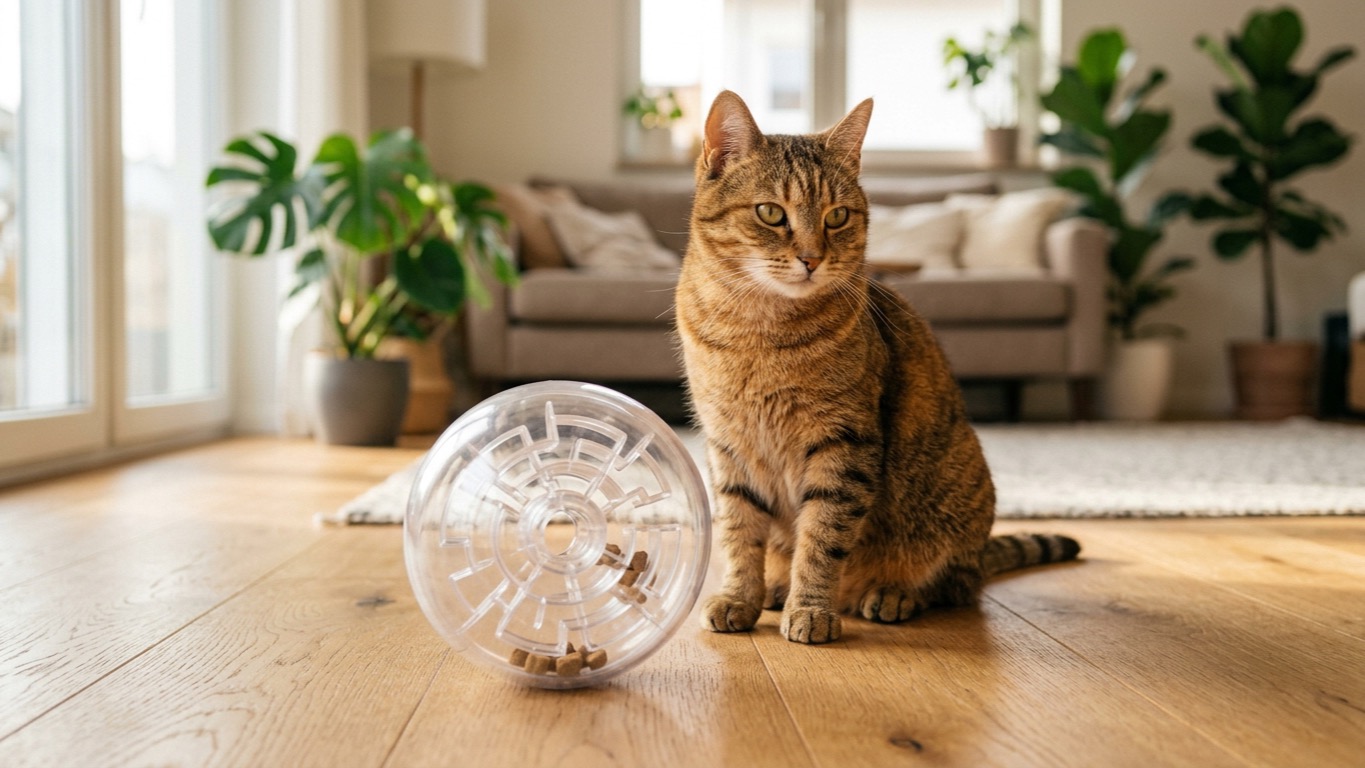
Snapshot ~$7.45 — lowest on this page. Hollow ball, adjustable opening, twist-apart clean. Cause-and-effect is one nudge → one kibble. That is Level 1. Close the opening as the cat speeds up. Hardwood and carpet both work; stairs and chewed plastic are the failure modes. Two-piece design means fewer lost micro-parts than a peg board. This is the SKU this desk would start with if we could only buy one object for a naive cat. We still did not “test” it in a home.
Pros: Cheapest honest on-ramp; adjustable hole; washable Cons: Clever cats empty it fast; can vanish under a sofa
4. Catstages Kitty Cube Interactive Treat Puzzle Cat Toy
Best for: a fabric “box hunt” and a different motion than a hard board.
Snapshot ~$8.04. Cube with openings, flaps, and hidden pockets on typical copy. Collapses; many listings say machine-washable. This is enrichment texture, closer to a cardboard box than a peg puzzle. Swallowing loose threads is the safety watch. Not a full dinner for a large cat unless you use many pieces and accept a fabric object in the food path. Good rotation piece once a Slimcat is boring.
Pros: Low snapshot; washable-fabric story; box-hunt motion Cons: Fabric chew / thread risk; not a kibble-volume dinner
5. Catstages Nina Ottosson Melon Madness Puzzle & Play Cat Puzzle Feeder
Best for: sliding / spinning motions when Rainy Day’s layout is more board than you need.
Snapshot ~$16.69. Melon-themed Ottosson board: tracks, sliders, a fruit geometry that is still Level-2 class on typical reprints. Paw-focused cats who like to push rather than flip often prefer this motion set. Same fill/empty rules as Buggin’ Out. Same wash rules. Do not run Melon and Rainy Day in the same afternoon if you are trying to learn which motion this cat likes — one variable.
Pros: Slider-forward layout; mid price Cons: Still a sit-down board; jams on oversized treats
6. CGBD 3 in 1 Cat Treat Puzzle Feeder
Best for: a single footprint that mixes a treat well with track / teaser hardware.
Snapshot ~$15.19. Marketplace 3-in-1 class: treat compartment plus moving parts (track balls, teasers on typical listings). Useful when you want play and food in one object. Assembly and a larger footprint are the cons. Two cats on one tower is a resource fight unless you add a second station. Feather teasers wear out; that is a consumable, not a defect.
Pros: Mixed motions; mid snapshot Cons: More parts to lose; not a clean “level” label
7. Pet Prime Cat Puzzle Feeder Interactive Enrichment Toys for Indoor
Best for: another indoor multi-function station when Ottosson boards feel too “school desk.”
Snapshot ~$17.49. Marketplace enrichment station. Treat it as hardware volume: confirm BPA-free / food-contact language on the listing you open, confirm you can wash every food path, confirm there are no sharp print edges. Indoor-cat copy is marketing. The desk job is the same: match motion to skill, time the session, count calories.
Pros: Station class; mid-high snapshot Cons: Underspecified level; inspect parts
Want to browse current puzzles? See cat puzzle feeders on Amazon →
Best cat treat puzzle feeders for enrichment tables
Listing audit — not a stopwatch trial.
Table 1 — Class × kit
| Kit | Class | Snapshot | Desk on-ramp |
|---|---|---|---|
| PetSafe Slimcat | Rolling slow ball | $7.45 | Week one / dinner kibble |
| Kitty Cube | Fabric hunt cube | $8.04 | Rotation / box motion |
| Buggin’ Out | Ottosson sequential board | $15.99 | After the ball |
| CGBD 3-in-1 | Tower + track + well | $15.19 | Mixed play/food |
| Melon Madness | Ottosson slider board | $16.69 | Push-motion cats |
| Pet Prime | Indoor station | $17.49 | Second station |
| Rainy Day | Multi-station Level-2 board | $21.19 | Default board once skilled |
Table 2 — Session design (desk planning numbers)
| Stage | Food load | Time you want | If it fails |
|---|---|---|---|
| Intro | 8–12 kibbles, all easy holes | 3–5 min of working | Open more holes; show one piece |
| Building | 15–20 pieces, some hidden | 8–12 min | Hide more; shrink Slimcat hole |
| Maintenance | A meal fraction or a treat budget | 10–15 min | Rotate SKU; do not add calories |
| Too fast (<3 min) | Same calories, harder layout | — | Pegs in, openings down |
| Walk-away | Fewer obstacles, smellier food | — | Hunger, flavor, or pain — rule out clinic |
Dry pieces ≤12 mm fit most Ottosson sliders. Large dental chews jam.
Table 3 — Material and wash
| Material class | Kits | Wash story to confirm | Chew / pinch watch |
|---|---|---|---|
| Hard plastic board | Buggin’ Out, Rainy Day, Melon | Top-rack vs hand-wash on your carton | Whisker pinch in tight slots |
| Hollow ball | Slimcat | Twist open, wash both halves | Cracks on stairs |
| Fabric | Kitty Cube | Machine-wash if the label says so | Threads, stuffing |
| Mixed station | CGBD, Pet Prime | Every food-contact piece must come out | Loose teasers, small balls |
Supervise the first five sessions. A cat that flips a rigid board can pinch a whisker or a claw. That is a design + supervision issue, not a breed issue.
Table 4 — Puzzle vs bowl vs automatic feeder
| Format | Job | Not the job | Sister / cluster |
|---|---|---|---|
| Treat puzzle | Hunt / work for food, stretch time | Medical weight-loss protocol | This URL |
| Slow bowl | Mechanical slowdown, no puzzle | Enrichment | Feeder pages if you need a bowl |
| Automatic feeder | Schedule when you are out | A 15-minute hunt | Automatic cat feeder cluster |
| Play wand | Predatory sequence without calories | Dinner | Grooming / play cluster |
A cardboard box with holes is also a puzzle. AAFP/ISFM wants predatory opportunity, not a brand. Buy a Slimcat when the box already works and you want dinner kibble to last; buy Rainy Day when you need a second motion. Do not skip the box because a listicle sold seven SKUs.
Frequently Asked Questions
How often should I use the best cat treat puzzle feeders for enrichment?
Daily is the point if the puzzle is part of dinner. A weekend-only board is a novelty. Rotate so the same SKU is not the only motion for months.
How do I train my cat to use a puzzle feeder?
Show a visible piece, start at Level 1 (Slimcat or open wells), stay in the room, end on a win. Do not skip to Rainy Day because a listicle said “best overall.”
Can I use these for wet food or just dry treats?
Dry by default. Wet only if the maker allows it and you can wash every well the same day.
How often should I rotate puzzles?
Weekly motion swap is enough for most households. If they still finish in two minutes, change difficulty, not just color.
My cat stares and walks away. What am I doing wrong?
Usually: not hungry, too hard, or the food is the wrong smell. Rule out dental pain and nausea. Then open the puzzle until they win.
Are puzzle feeders safe to leave out when I am not home?
A simple Slimcat with large kibble is the usual “I’m at work” object. Peg boards, fabric cubes, and teasers are supervised-first. Anything that can trap a claw stays put away.
Will a puzzle help my cat lose weight?
Only if total calories drop or stay at a vet-set target and the cat actually works instead of you dumping the leftovers in a bowl. Ask the veterinarian for the calorie number. We will not invent one.
What size treats fit the best cat treat puzzle feeders for enrichment?
Aim for ≤12 mm dry pieces unless the listing prints a larger opening. When in doubt, drop one piece through the tightest slider before you fill the board.
Do I need a Level-3 puzzle for a “smart” breed?
No. You need a session that lasts 8–15 minutes. A Slimcat with a tiny hole can do that. A Rainy Day with every well stuffed will not.
Why indoor cats get a puzzle (without a fake syndrome)
Domestic cats retain a hunt–catch–consume–groom–sleep cycle. A bowl collapses “consume” into under a minute. AAFP/ISFM 2013 calls out the need for play and predatory opportunity. A puzzle is one legal way to put work back in front of calories.
This desk will not diagnose “environmental deprivation syndrome.” Over-grooming, spraying, and aggression have medical and social causes. A board is an adjunct. Cornell and AAFP still want a veterinarian when behavior changes suddenly.
Wild / feral time-budget numbers (hours of hunting) appear in popular articles. They are not a house stopwatch we ran on your apartment. Use them as a direction: more work, not as a citation of a PetBench field study.
Weight: APOP and veterinary nutrition groups have published that a large share of US pet cats are overweight or obese — open their current survey. A puzzle can slow intake if you do not add a second meal of treats. It is not a weight-loss drug.
Diabetes: feeding strategy is a veterinarian’s protocol. If your cat is diabetic, ask the clinician who set the insulin whether a puzzle meal is compatible with the timing they already chose.
Matching difficulty — the only ranking that matters
Level 1 — roll, wobble, see-the-food
PetSafe Slimcat. Wide opening. You may need to roll it yourself once so the first kibble appears. Seniors and flat-faced cats often stay here; that is success, not failure. A “genius” cat that empties it in ninety seconds has graduated, not “broken” the toy.
Level 2 — two motions (slide then lift)
Rainy Day, Melon Madness, Buggin’ Out. Load the easy wells first. When the cat only uses one station, starve that station. When they finish in three minutes, add pegs or leave more lids closed.
Level 3 — search, sequence, or fabric hunt
A fully pegged Ottosson board, or the Kitty Cube as a different search problem. If the cat stares and leaves, you skipped a level. Frustration is not enrichment. Go back down for a week.
CGBD and Pet Prime do not print a clean Ottosson level. Treat them as mixed stations: start with the treat well open, teasers later.
How to introduce the best cat treat puzzle feeders for enrichment
- Hunger helps. A puzzle after a full bowl is homework nobody assigned.
- Show the food. Leave a piece on top of a closed lid for the first session.
- One new object. Do not debut a board, a new flavor, and a new room together.
- Stay in the room for the first five sessions. Rescue if they walk away; do not shake the puzzle in their face.
- End on a win. If they get three pieces, stop. Tomorrow, four.
- Wash before it smells. Smell aversion is how puzzles die.
Clicker / treat for interacting with the object is optional. The food in the puzzle is the reinforcer if you designed the session.
Multi-cat and resource rules
AAFP/ISFM wants enough resources that cats do not block each other. One Rainy Day in a hallway is a fight. Two Slimcats in two rooms is a plan. If one cat is a thief, feed the timid cat in a closed room with the easy puzzle.
A 3-in-1 tower does not count as two cats’ worth of food puzzles. It counts as one object with extra toys.
Wet food, raw, and “can I put pâté in this?”
Most Ottosson boards and the Slimcat are dry-piece objects. Wet food smears, spoils, and turns a dishwasher-safe claim into a hygiene project. If you must use wet food, use a shallow lick mat or a puzzle the maker explicitly allows, and wash the same day. Raw diets have their own handling rules — this desk is not a raw-feeding protocol.
Freeze-dried pieces that crumble can clog sliders. Use whole pieces that fit.
Rotation so the best cat treat puzzle feeders for enrichment stay interesting
Desk habit, not a trial: keep two puzzles in play and one in a closet. Swap weekly. Same calories. Different motion. Rainy Day Monday / Slimcat dinner / Cube Thursday is a rotation. Buying a seventh Ottosson because Thursday was boring is how you fund a landfill.
If every puzzle is ignored, the cat may be in pain, nauseated, or simply not food-motivated. A wand toy session (hunt) then a puzzle (consume) matches the cycle better than a puzzle in a silent room.
Safety we will stand behind
- No puzzles with sharp flash on cheap plastic — inspect.
- No string / elastic the cat can swallow.
- No leaving a fabric cube with a known fabric-eater unsupervised.
- No using a puzzle to hide medication the cat will spit in a well and leave.
- Kittens: size the holes so a jaw cannot trap. Supervise.
- Stop if a claw or tongue is caught. That puzzle is the wrong geometry.
Price bands (snapshots)
| Band | What we opened | What you are buying |
|---|---|---|
| ~$7–8 | Slimcat; Kitty Cube | On-ramp ball or fabric hunt |
| ~$15–17 | Buggin’ Out; CGBD; Melon; Pet Prime | Boards and stations |
| ~$21 | Rainy Day | Densest board on this page |
A $7 ball that gets nightly dinner use beats a $21 board that sits in a cabinet. Start cheap.
Owner themes we keep seeing (not a survey we ran)
- “They just stare.” Too hard, not hungry, or the food is boring.
- “They flip the whole board.” Light board on a slick floor — mat underneath, or a heavier class.
- “They only use one hole.” Leave that hole empty.
- “They gained weight.” You added treats on top of dinner.
- “The ball is under the fridge.” Play in a gated room or use a board.
Longer desk notes — session math without a fake lab
A typical indoor adult on a 180–220 kcal/day teaching range (confirm your cat’s number with a veterinarian or the food’s kcal/cup) cannot absorb an extra 40 kcal of “training treats” on top of a full bowl. If the puzzle is dinner, weigh the kibble that used to go in the bowl and put that weight into the Slimcat or the easy wells. If the puzzle is a snack, count it inside the ~10% treat budget that nutrition teaching pages repeat.
Session length is a behavior clock, not a metabolic clock. Eight minutes of pawing is the enrichment. Eight minutes of staring at a closed lid is not. We will not convert minutes into a “cognitive score.”
For a two-cat household, do not average their skills. The thief gets a harder object in a separate room or eats first from a bowl and then gets a toy without food. The timid cat gets the Slimcat behind a door. A shared Rainy Day in the open is how one cat learns to guard plastic.
For a single cat that works nights, a Slimcat with breakfast kibble left down is closer to a foraging bout than a 7 a.m. bowl you watch. That is a schedule choice, not a medical protocol.
Failure modes that look like “the cat is dumb”
- The opening is packed. One kibble per well. Packed wells become a brick.
- The treat is too smelly or not smelly enough. Freeze-dried fish dust can be a lure on the lid; a stale grocery kibble may not be worth the work.
- The board slides. Rubber mat. A moving target is not a higher level.
- The cat is nauseated. A puzzle will not fix that. Clinic.
- You helped too much. If you open every lid, you bought a serving tray.
How this page relates to feeders and play
Automatic feeders solve when food appears. Puzzles solve how much work sits in front of each piece. You can use both: timed meals into a bowl for a diabetic protocol the veterinarian already set, and a puzzle for a separate enrichment snack — only if the calories still add up.
Wand play before a puzzle is the hunt-then-consume sequence many behavior pages describe. A puzzle alone in a dead-quiet room is still better than a 30-second gulp. A puzzle plus a two-minute wand is closer to the cycle.
Internal links
- Timed meals / cameras: best automatic cat feeder with camera
- Multi-cat bowls: best cat feeder for two cats
- Treat calories: best cat food and treats
- Indoor stress adjunct: best cat pheromone diffuser
The best cat treat puzzle feeders for enrichment are the ones that match this cat’s current skill, this food’s size, and an 8–15 minute working clock — washed, rotated, and counted in the calorie budget. If you cannot name level and food type, you are not ready to check out.
A week-one script for the best cat treat puzzle feeders for enrichment
This is a desk script, not a trial we ran. Adjust if the cat is a kitten, a senior, or already food-obsessed.
Day 1–2. PetSafe Slimcat, opening wide, 10 pieces of the kibble they already eat. You may roll it once. Stop when they have four or five. Put the rest in the bowl so they do not decide puzzles mean hunger.
Day 3–4. Same ball, opening one click smaller or the same opening and 15 pieces if they finished in under three minutes. Still in the room.
Day 5. If they hunt the ball, graduate a few pieces onto an Ottosson well with the lid open (Melon or Buggin’ Out). Leave the Slimcat as dinner. Do not retire the ball the day the board arrives.
Day 6–7. Close one lid on the board. If they walk away, reopen. If they finish the board in three minutes, you overfilled or under-hid.
Week two is Rainy Day or more Slimcat dinner, not both plus a cube plus a tower. One new motion per week.
Apartment physics: sofas, fridges, and stairs
A Slimcat under a fridge is a $7 donation to the dust. Gate the room or use a board on a mat. Stairs crack hollow balls — play on one level. Hardwood + a light Ottosson board = a sliding tray; add a mat before you call the cat “too rough.”
Open-plan studios: the puzzle can become a hallway hockey puck. That looks like enrichment and is often just noise for a roommate. A sit-down board (Rainy Day / Melon) is the apartment-friendly class. The cube is quiet if they do not throw it.
Building a two-SKU kit without buying the whole aisle
If this desk could put two objects in a cart for a naive adult indoor cat, it would be Slimcat + Rainy Day (or Slimcat + Melon if you want sliders only). The ball is dinner. The board is a 10-minute skill session three days a week. The Kitty Cube is the third object when you want a box-hunt on Thursday. CGBD / Pet Prime are the “I want a tower in the footprint of a side table” buy, not the first buy.
A household that already has a cardboard box with holes has a puzzle. Spend the $7 on the Slimcat before the $21 board if the box already occupies 10 minutes.
Night workers, cameras, and automatic feeders
If you work nights, a morning Slimcat with breakfast kibble is closer to a foraging bout than a bowl you dump at 7 a.m. and never see. That is a schedule choice. It is not a reason to skip the automatic feeder if the veterinarian already set timed meals for a medical reason. Do not stack a puzzle snack and a full auto-feeder meal and treats without adding the calories.
Cameras are for “did they eat,” not for scoring puzzle IQ. If the camera shows staring and walking away, the puzzle is too hard or the cat is unwell.
Breed marketing versus the 8–15 minute clock
Bengal, Siamese, and Abyssinian copy sells Level-3 boards. The clock does not care. A Slimcat with a pin-hole opening can occupy a food-motivated cat for 15 minutes. A stuffed Rainy Day can be empty in two. Shop the clock you observe, not the breed word on a blog.
Hairless and longhair cats have the same brains and the same calorie math. Coat is not a puzzle spec. Flat faces are a geometry spec (open cups, no deep pinch slots).
Hygiene that keeps the best cat treat puzzle feeders for enrichment in rotation
Wash when you smell it, not when you remember in a month. Slimcat halves come apart — wash both. Ottosson wells collect grease from treats; a toothbrush you retired from the dental kit is a fine well brush if you never put paste in the food path. Fabric cubes: wash on the label’s cycle; inspect seams after.
A slimy well is how cats decide the board is “broken.” It is not broken. It is dirty.
Do not put a wet board away in a closed bin. Mold is a clinic visit you can avoid.
We will not claim 60–80% slower eating as a house result. We will not claim 15–20% less insulin. We will not claim indoor cats spend “less than 5% of waking hours hunting” as a PetBench measurement. We will not name a deprivation syndrome. We will not rank a medal table.
Open AAFP/ISFM 2013 for the pillar. Open APOP for weight-survey context. Open your carton for dishwasher language.
Treat size, jam, and a desk caliper rule
Before you fill Rainy Day or Melon Madness, drop one piece through the tightest slider. If it wedges, break it or pick a smaller SKU. Greenies-class dental chews and large freeze-dried minnows are bowl treats, not peg-board treats. Slimcat openings can take slightly larger kibble than a peg well — still not a whole stick.
If a piece jams, do not pry with a knife toward the cat. Empty the board. That jam is how claws and tongues get pinched.
A “variety pack” of treats is a jam pack. One size per session.
When the bowl stays (and that is fine)
Some cats will never work. Pain, nausea, age, or a history of food insecurity can make a puzzle feel like a threat. A bowl plus a wand-toy hunt is still an AAFP-shaped day. Do not starve a cat to force a $21 board. If they lose interest in food work they used to love, that is a clinic flag before it is a shopping flag.
The best cat treat puzzle feeders for enrichment include “none this month” when the cat is sick. The cards stay on this page for the month they are well.
A last desk note on leftovers: if they abandon a half-full board, do not dump those pieces on top of dinner as a “win.” That teaches walking away. Count the leftovers as eaten calories or as tomorrow’s Slimcat load — one or the other, not both. If leftovers pile up three days running, the puzzle is too hard or the food is the wrong smell. Drop a level before you buy another SKU. The cheap next step is a wider Slimcat opening, not a fourth marketplace tower. Save the receipt; if the cat never works, you still have a ball for a future well week.
Play sequences, senior cats, and “they only eat from a bowl”
A senior with arthritis may not crouch over a low board. Raise the board onto a non-slip tray, or stay with a Slimcat they can bat from a loafed position. Sudden disinterest in food work is a dental or nausea flag before it is a toy flag. See the toothbrush kit page if the mouth is the limiter — a painful mouth will not hunt kibble through a peg.
Kittens: short sessions, large openings, no small parts. A Kitty Cube with stuffing is a supervise-only object around a kitten that still swallows string.
Blind or low-vision cats: scent the lid, use high-contrast food, prefer a ball that makes a sound. Do not assume a complex board is “stimulating.” It may be opaque.
Deaf cats: same as anyone else. Puzzles are tactile and olfactory.
We will not claim a puzzle replaced insulin. We will not claim a 60–80% slowdown as a PetBench result. We will not claim a fabric cube is “Level 3 hunting.” We will not claim marketplace stations are BPA-free unless the carton in your hand says so. We will not claim Nina Ottosson boards are the only ethical enrichment. A cardboard box with holes is a puzzle. These seven SKUs are the live cards on this URL.
Sources
- Ellis SLH et al. AAFP/ISFM Feline Environmental Needs Guidelines. J Feline Med Surg. 2013. https://pmc.ncbi.nlm.nih.gov/articles/PMC11383066/
- Association for Pet Obesity Prevention, published US survey pages (confirm current year). https://petobesityprevention.org/
- Cornell Feline Health Center, behavior and appetite-change topics. https://www.vet.cornell.edu/departments-centers-and-institutes/cornell-feline-health-center
- Catstages / Nina Ottosson product education (difficulty language). Maker sites opened August 2026.
- PetSafe Slimcat product copy, opened August 2026.
- Maker listings for the seven named SKUs on this page, August 2026.