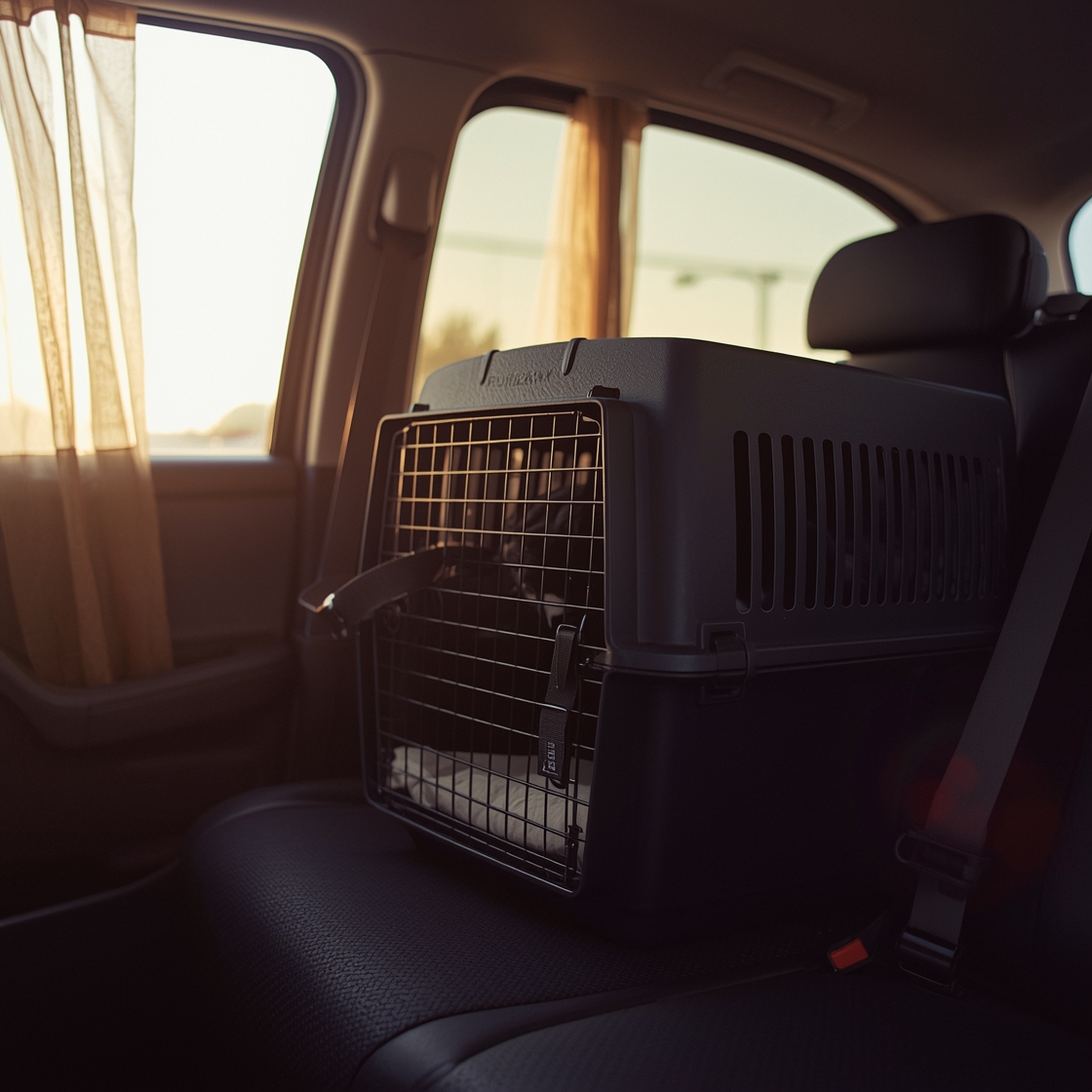
The best crash tested dog crate for car travel is a CPS-listed travel crate in the size that actually fits the dog and the hatch, bolted with the strength-rated straps the certificate names — not a wire house crate with a “crash tested” badge and a $12 ratchet strap. The We read the titles and descriptions of seven named SKUs on this URL: Gunner G1 Small / Medium / Intermediate, Lucky Duck Medium / Intermediate / Large, Cabela’s GunDog Intermediate. 3 of 3 brands on that CPS fetch are size-specific. Gunner Large did not inherit Medium’s certificate on the brand pages we read. MIM Variocage is a different scoreboard (European ECE marketing) and was not on the CPS Travel Crates list we fetched.
Buy the certificate that matches the carton. Then buy the straps that match the certificate. Then measure the hatch.
Our guides are reader-supported. This article may contain affiliate links. As an Amazon Associate we may earn a commission if you buy through links, at no extra cost to you.
Size math that is not crash math lives on our crate size by breed chart. Soft cabin bags live on how to choose a pet carrier. Everyday road bags that are not crash kennels live on road-trip carriers. House crates for puppies live on best dog crate for puppies.
Quick picks at a glance
- CPS-listed Gunner, small dog: Gunner G1 Small — rotomolded, certificate tied to Gunner’s strength-rated tie-downs on brand pages.
- CPS-listed Gunner, mid dog: Gunner G1 Medium — historically the size Gunner publicized early for CPS 5-star with those straps.
- CPS-listed Gunner, next shell: Gunner G1 Intermediate — still inside the CPS-listed Gunner set as of our fetch. Large is a different sentence.
- CPS-listed Lucky Duck, mid: Lucky Duck Lucky Kennel Medium — same CPS list, different shell family.
- CPS-listed Lucky Duck, next: Lucky Duck Intermediate — confirm size on CPS + maker anchors.
- CPS-listed Lucky Duck, large dog: Lucky Duck Large — hatch geometry and human lift fail more often than brochure copy.
- CPS-listed Cabela’s, mid-large: Cabela’s GunDog Intermediate — CPS also lists GunDog Large; shop the carton, not the brand name.
The title on this URL says “7.” The seven cards are seven size SKUs across three CPS-listed brand lines.
: what “crash-tested” has to mean
Three different sentences get sold as the same badge. This comparison treats them as three jobs. Mixing them is how a hatch full of wire becomes a story.
| Label class | What it actually is | Useful when | Fail mode |
|---|---|---|---|
| CPS Certified travel crate | Named nonprofit program; public product list | You want a U.S. scoreboard you can open | Buying a size that is not on the list |
| Manufacturer crash marketing | Brand video / “tested to X” | You can name protocol + exact SKU + hardware | Tile says “crash tested,” no lab, no date |
| European automotive language | ECE / similar frameworks (MIM Variocage marketing) | Your buying rule is that rulebook | Pasting a CPS logo onto a non-CPS list item |
CPS says participation means independently developed standards, quality monitoring, and truth-in-marketing commitments — and that CPS does not take manufacturer funding for that program. Their public Travel Crates list is the scoreboard this article uses for U.S. “CPS crate” language. Re-check CPS Certified products before you pay; lists change.
If a listing only says “crash tested” with no lab, no date, and no strap callout, treat it as advertising copy. That is the whole checklist.
How to pick the best crash tested dog crate for car travel (job, then size, then straps)
Crash hardware does not fix a kennel that is the wrong size or sitting free in the cargo area. Do these four steps before you fall in love with a colorway.
- Measure the dog — nose to base of tail, standing height, sitting ear height, shoulder width, weight — and the vehicle opening. Use the house / car / air split on dog crate size by breed. IATA cargo formulas are for air crates, not a substitute for CPS car protocol.
- Confirm the dog can stand, turn, and lie in the closed kennel for the trip length you actually take. A crate shorter than sitting height plus about 2 in of ear clearance forces a crouch. A crouch is not a crash posture you want to invent.
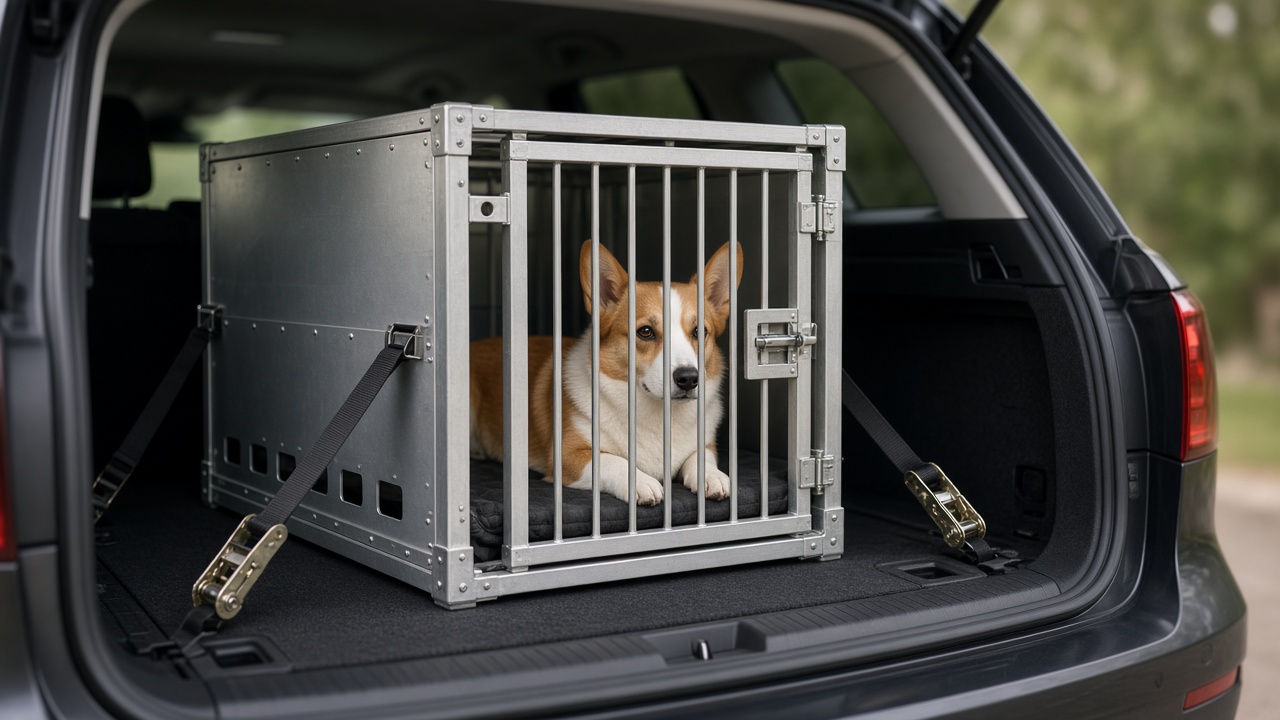
- Plan the maker’s specified anchor pattern to vehicle latch points. Buy the strength-rated straps the certificate names, not a random ratchet strap from a hardware aisle. A CPS rating that names straps is not a promise for a kennel bouncing loose in a hatch.
- Heat is a separate emergency. AVMA warm-weather guidance treats a closed cabin in a parked car as a medical risk. We are not that veterinarian. We will not soften that sentence.
Interior length starting point used on this desk: dog nose-to-tail plus about 4 in. Height: sitting ear top plus about 2 in. Those are fit heuristics, not a sled result.
Size-and-shell worksheet
Prices move. This comparison does not print a fake street price as a certificate.
| Kennel (CPS fetch 21 Aug 2026) | On CPS Travel Crates list? | Strap note from brand / CPS discipline | Typical shopper failure |
|---|---|---|---|
| Gunner G1 Small | Yes | Brand pages tie 5-star language to strength-rated tie-downs | Buying Small, using hardware-store straps |
| Gunner G1 Medium | Yes | Same strap rule as Small | Assuming Medium’s cert covers Large |
| Gunner G1 Intermediate | Yes | Same strap rule | Assuming Intermediate’s cert covers a different shell |
| Lucky Duck Medium | Yes | Confirm that size on CPS + maker anchors | Shopping “Lucky Duck” as if all sizes share one cert |
| Lucky Duck Intermediate | Yes | Size-specific | Hatch too short |
| Lucky Duck Large | Yes | Size-specific | Human cannot lift the loaded kennel |
| Cabela’s GunDog Intermediate | Yes (Large also listed) | Confirm carton vs Intermediate vs Large | Buying Intermediate, needing Large |
| Not a seventh “winner” | Status on our fetch | What to do |
|---|---|---|
| Gunner G1 Large | Not treated as CPS in Gunner copy we read | Do not inherit Medium’s certificate |
| Cabela’s GunDog Large | Yes on CPS list; no eighth card on this URL | Shop Large if the dog needs Large |
| MIM Variocage | No on CPS Travel Crates list we fetched | Different scoreboard — read MIM’s current test pages yourself |
Vehicle-fit matrix for the best crash tested dog crate for car travel
A CPS kennel in the wrong orientation is still a loose object.
| Vehicle zone | Crate orientation | Tie-down | Ventilation watch |
|---|---|---|---|
| SUV cargo | Lengthwise, door facing a side you can open | Maker straps to cargo anchors | Two+ vented sides; do not bury against a sealed wall |
| Wagon | Lengthwise if hatch allows; otherwise confirm cross is in the maker manual | Cargo hooks that match strap rating | Rear-window gap is not a cooling plan |
| Sedan | Rear seat + vehicle belt path only if the maker documents that install | Seat-belt loop the kennel was designed for | Door cracked is not a protocol |
| Truck cab | Usually the wrong job | If it does not latch, it does not count | Heat cooks faster in glass boxes |
Never block the driver’s mirror sightline. Cargo-height limits apply. Wedge or strap so the kennel cannot become a rebound projectile. Physics does not need our sled.
CPS-listed travel crates (named examples, not a lab podium)
Below are the travel-crate names on CPS’s public certified list as of 21 August 2026, grouped so you can shop the certificate you actually need. Order is alphabetical by brand, then size — not a ranking we earned on a sled.
1. Gunner G1 Kennel — Small
Best for: Smaller dogs when you need a CPS-listed Gunner size and will buy Gunner’s strength-rated tie-downs with it.
Gunner’s own crash-rating pages describe CPS 5-star certification for Small / Medium / Intermediate with their strength-rated anchor straps. Confirm the Small certificate still matches the SKU in your cart on CPS Certified products and on Gunner’s current size chart before you pay for rotomolded shipping weight you cannot lift.
The honest drawback is mass. Double-wall rotomolded plastic is the point of the product. It is also a two-person lift when you add a dog and a wet floor mat. If you cannot get the empty kennel into the hatch without scraping the bumper, the certificate will not help.
Check current Gunner G1 Small listings →
2. Gunner G1 Kennel — Medium
Best for: Mid-size dogs in the Gunner CPS set; historically the size Gunner publicized early for CPS 5-star with strength-rated straps.
Same rule: certificate + straps + vehicle latch points. Double-wall rotomolded weight is a real lift — measure the hatch and your back, not only the dog. Medium is the size people buy when they “might get a bigger dog.” That is how Medium becomes a loose large-dog problem two years later. Size the dog you have.
Check current Gunner G1 Medium listings →
3. Gunner G1 Kennel — Intermediate
Best for: Dogs that outgrow Medium but still fit Intermediate on Gunner’s chart — still inside the CPS-listed Gunner sizes as of our fetch.
Gunner marketing states Intermediate is CPS 5-star with their tie-downs. Large is a different question. Do not assume Intermediate’s certificate covers a different shell. If the dog is between Intermediate and Large on the chart, read Gunner’s own tie-break. We are not inventing a third rule.
Check current Gunner G1 Intermediate listings →
4. Lucky Duck Lucky Kennel — Medium
Best for: Shoppers who want a CPS-listed Lucky Duck size rather than Gunner’s rotomolded shell.
Lucky Duck Medium / Intermediate / Large appear on CPS’s travel-crate certified list as of 21 Aug 2026. Confirm current CPS listing and the maker’s anchor instructions for that size — certificates are size-specific. Lucky Duck is not “Gunner but cheaper.” It is a different kennel family that happens to share a scoreboard on the date we fetched.
Check current Lucky Duck Medium listings →
5. Lucky Duck Lucky Kennel — Intermediate
Best for: Mid-to-large dogs on Lucky Duck’s CPS-listed intermediate shell.
Same discipline: CPS page + maker strap kit + vehicle points. If the hatch opening is the constraint, Intermediate vs Large is a tape-measure problem, not a brand-loyalty problem.
Check current Lucky Duck Intermediate listings →
6. Lucky Duck Lucky Kennel — Large
Best for: Larger dogs when Lucky Duck Large is still on the CPS list and still fits the vehicle.
Large kennels fail more often on hatch geometry and human lift than on brochure copy. Measure twice. A Large that lives in the garage because nobody can lift it is not a travel crate. It is furniture.
Check current Lucky Duck Large listings →
7. Cabela’s GunDog Kennel — Intermediate
Best for: Buyers comparing a CPS-listed Cabela’s GunDog Intermediate against Gunner / Lucky Duck for the same dog length.
CPS’s list (fetched 21 Aug 2026) also includes Cabela’s GunDog Kennel — Large. Intermediate is the seventh named example in this title-locked guide; Large is the same brand line — verify which certificate matches the SKU on the carton. Shop Large on the search URL below if the dog needs Large.
Check current Cabela’s GunDog Intermediate listings →
Check Cabela’s GunDog Large on Amazon →
What about Gunner Large and MIM Variocage?
If you need Large capacity, either wait for a CPS listing you can open on centerforpetsafety.org, or accept you are buying outside that certificate.
MIM Safe Variocage. Brand pages emphasize European crash frameworks and adjustable steel cages. As of 21 August 2026, Variocage does not appear on CPS’s public Travel Crates certified list we fetched. That is a protocol mismatch, not a claim that ECE tests are fake. If your buying rule is “must be CPS Certified,” Variocage does not meet that rule today. If your buying rule is “European automotive test language,” read MIM’s current test pages yourself — we are not reprinting a sled result
Soft “airline” bags and plastic airline kennels are a different product family — see pet carriers for dogs and cats.
Cost, weight, and the 2026 shopping failure
A CPS kennel is a system: shell + straps + vehicle points + a human who can lift it. People under-buy the straps and over-buy the colorway. The these crash label listings treats a kennel without its named tie-downs as incomplete, the same way a house crate without a divider is incomplete for a puppy.
Listed rotomolded prices move with season and seller. What does not move: shipping weight, hatch width, and whether Large inherited Medium’s certificate (it did not, on the Gunner pages we read). If the empty kennel is a two-person lift, plan that before the dog is late for a vet lobby.
Wire house crates remain the right object for indoor training. They are not automatically the best crash tested dog crate for car travel. If a wire crate is not on the CPS Travel Crates list (or another protocol you accept in writing), do not invent crash performance because the listing photo shows a car.
How we sourced this page
- Center for Pet Safety — Certified products (Travel Crates filter), fetched 21 August 2026
- Center for Pet Safety — program description on the same certified-products page (independence / no manufacturer funding claim)
- Gunner Kennels public pages on CPS 5-star rating and size coverage (Small / Medium / Intermediate vs Large)
- MIM Variocage public crash-tested marketing pages (ECE language) — cited only to separate protocols
- Internal size chart: dog crate size by breed
What We are not veterinarians and this is not medical or legal advice for after a collision.
Frequently Asked Questions
What is the best crash tested dog crate for car travel if I only want CPS?
A size-matched kennel that is on the CPS Travel Crates list the day you buy, plus the straps that certificate names. On our 21 August 2026 fetch that meant Gunner G1 Small / Medium / Intermediate, Lucky Duck Medium / Intermediate / Large, and Cabela’s GunDog Intermediate (Large also listed). Re-open the CPS list before you click.
How do I pick the best crash tested dog crate for car travel size?
Match the maker chart for this dog, then the hatch. Desk heuristic: interior length ≈ nose-to-tail + 4 in; height ≈ sitting ear top + 2 in. A crate smaller than standing / sitting height forces a crouch. Confirm the dog can stand, turn, and lie for the trip you actually take.
Is a CPS-certified crate the same as “crash-tested” on Amazon?
No. CPS Certified is a named program with a public product list. Marketplace badges can mean anything.
Do I need the brand’s straps?
If the certificate or maker page names strength-rated / specific tie-downs, yes — the kennel alone is not the tested system.
Can I use a wire house crate in the car?
A house crate is not automatically a CPS travel crate. If it is not on the CPS list (or another protocol you accept in writing), do not invent crash performance.
What about Gunner Large?
Do not inherit Medium’s certificate. Shop Large only if you can open a CPS listing for that size, or accept you are outside the CPS sentence Gunner printed for Small / Medium / Intermediate.
Where do cabin flight bags fit?
Different job. Start with how to choose a pet carrier.
Does a crash kennel replace a parked-car heat plan?
No. AVMA warm-weather guidance treats a closed cabin in a parked car as a medical risk. A CPS crate does not change that.
Related pages
- Dog crate size by breed
- Best pet carrier for dogs and cats
- Best pet carrier for road trips
- Best dog crate for puppies
Sources
- Center for Pet Safety — Certified products (Travel Crates): https://www.centerforpetsafety.org/certified-products/
- Gunner — crash-tested / 5-star CPS pages on gunner.com (brand)
- MIM Variocage — crash-tested marketing pages on mimvariocage.com (brand; non-CPS scoreboard)