Our guides are reader-supported. This article may contain affiliate links. As an Amazon Associate we may earn a commission if you buy through links, at no extra cost to you.
No harness is escape-proof. The useful question is not “which of seven won.” It is: walk, balcony, or travel — then H-style versus vest versus a self-tightening pad — then which escape mode you are actually trying to block.
We read public pages from the ASPCA, the AVMA (indoor-cat welfare, September 2025; 2026 free-roaming-cats resolution), VCA Animal Hospitals, East Bay SPCA’s 2024 harness handout, and current maker fit pages for PetSafe Come With Me Kitty, Kitty Holster, OutdoorBengal Houdini, Voyager Step-In Lock, and Hepper. Specs and prices below are maker-stated unless we say they come from a retailer carton.
We did not put a harness on a cat, film a back-out, or certify any product as escape-proof. Makers who use those words are marketing. rabbitgoo and Supet have no manufacturer spec sheet we fetched this pass; they are dropped.
The cat harness guide and the safest-cat-harness page are the shopping cluster. This URL is the decision page.
First decision: walk, balcony, travel — or stay inside
Buy the job. One harness can cover two jobs if you are honest about the third.
The default, from the institutions we fetched, is indoors plus enrichment, not a sidewalk. The ASPCA’s general cat-care page: keep the cat indoors; outdoor cats do not live as long; cars, other cats, raccoons, free-roaming dogs, and coyotes are named risks, plus fleas, ticks, and infectious disease. If a cat goes outdoors, the ASPCA wants a safety collar with an elastic panel and an ID tag, plus a microchip either way. That collar is identification. It is not a leash anchor.
The AVMA’s September 2025 indoor-cat piece, reporting the Feline Veterinary Medical Association’s updated position, is the other half. Safety alone is not welfare. Indoor cats need a safe place, separated resources, play and predatory behavior, predictable human contact, and a house that respects smell. The same story cites the 2024 AVMA Pet Ownership and Demographic Sourcebook: about 32 percent of U.S. households had at least one cat — roughly 73.8 million pets. Most of those cats never need a sidewalk.
AVMA’s 2026 free-roaming-cats resolution lists three confined options for owned cats: an enriched indoor environment, an outdoor enclosure, or exercising leash-acclimated cats. Vehicles, other animals, cruelty, poisons, traps, weather, wildlife hunting, and zoonotic disease are still named. A microchip helps if the cat is lost. Local law may already require a yard stay or a harness-and-leash walk.
VCA’s indoor-enrichment page matches both: free-roaming cats meet cars and predators, pick up parasites, and can meet feline leukemia, FIP, or FIV. The safe outdoor tools VCA names are a cat-safe harness and leash, after the cat is comfortable walking indoors, in a quiet yard — or a catio. A carrier is still the object that goes to the vet.
1. Stay inside. East Bay SPCA’s 2024 handout: if the cat is fearful of new people and new places, even a back garden can be too much. Do not buy a vest to solve boredom a wand toy would solve.
2. Balcony, patio, or enclosed yard. Short, supervised, a door you can retreat through. First outdoor job that actually needs a harness. The cat does not go over a rail.
3. A walk. Quiet pavement or a yard loop. VCA wants the cat to set the pace. East Bay SPCA: do not expect a heel; keep walks about 10 to 15 minutes; bring a “traveling home base” — a backpack or a city stroller — so a panicking cat has a box, not your forearms.
4. Travel. A harness can tether a cat inside a carrier if the bag has a ring. It does not replace the box. Vet lobby, cabin, and car are carrier jobs. A loose cat in a lobby is an escape, not a walk.
If the cat is not vaccinated, not on parasite prevention, or not microchipped, VCA wants that handled before the first outdoor step. That is a veterinarian conversation.
Decision framework (do this before you shop)
Five hard edges. Match the object to the body and the job, not to a “best of seven.”
1. Geometry — H-style, vest, or a self-tightening pad
East Bay SPCA names two classes worth buying: an H-type harness or a walking jacket. It is the only institution page we fetched that names a class to skip: figure-eight harnesses are not secure.
H-style (PetSafe Come With Me Kitty) is two loops — neck and girth — joined on the chest and back. Light. Fast. Easy for a slim cat to reverse out of if the neck hole is slack. PetSafe says the shoulder straps tighten on the bungee leash and a rubber stopper fights a flexible feline. Maker mechanism, not a certificate we issued.
Vest / walking jacket / step-in (Kitty Holster; Voyager Step-In Lock; Hepper) covers more chest and shoulder. Harder to fold a shoulder through. Heavier. Warmer. Kitty Holster’s FAQ is the honest vest sentence: it is very difficult to remove a well-fitting Holster, and some cats can get out of any harness.
Self-tightening pad (OutdoorBengal Houdini) cinches on a reverse. The product page says backing out is the common escape, and — in the same FAQ — never leave the cat alone in it and do not tether, because the mechanism that fights a reverse can tighten around the neck. The maker also prints “vet-approved.” We found no named veterinary review. We are not adopting the line.
A small-dog harness is a last resort East Bay SPCA allows for a large cat, not a first purchase. Shop the ribcage.
2. Escape modes — the Petbench Escape-Mode Matrix (August 2026)
| Escape mode | What it looks like | What usually fails | What the fetched pages say |
|---|---|---|---|
| Back-out | Cat reverses; harness slides over the ears | Slack neck hole; thin H-style; taut tie-out | Kitty Holster: reverse against a taut leash, especially a tie-out they do not recommend. OutdoorBengal: backing out is the common escape; pad is built to tighten. |
| Wriggle / shoulder fold | Shoulder walks through a gap | Vest too wide; step-in not cinched | Voyager copy: wider shape and rounded neckline. Fit does the work. |
| Buckle fail or peel | Snap opens, or Velcro lifts | Single buckle; fur-packed loops | Kitty Holster: two wide closures; lint-roll. Hepper names breakaway buckles as a “quick exit” — useful on a fence, also a failure mode. |
| Ride-up to the throat | Chest plate becomes a collar | Slide too high; girth too far back | PetSafe: chest slide on the breastbone, not the throat; O-ring on the ribcage; rubber stopper on the shoulders. |
| Leash geometry | Long line becomes a yank or a ladder | Retractable; tie-out; collar clip | VCA: harness, not collar; no retractable or long leash. East Bay SPCA: never clip to the collar; 6- to 8-foot leash; never drag. OutdoorBengal: leash toward the tail, maker’s “SAFE ZONE.” |
If you cannot name the mode, you are shopping a slogan. A vest two sizes large fails the back-out column. A self-tightening pad on a porch rail fails the maker’s own FAQ.
3. Fit — the Petbench Four-Number Tape (August 2026)
Do this on paper. “Fits most cats” is not a size.
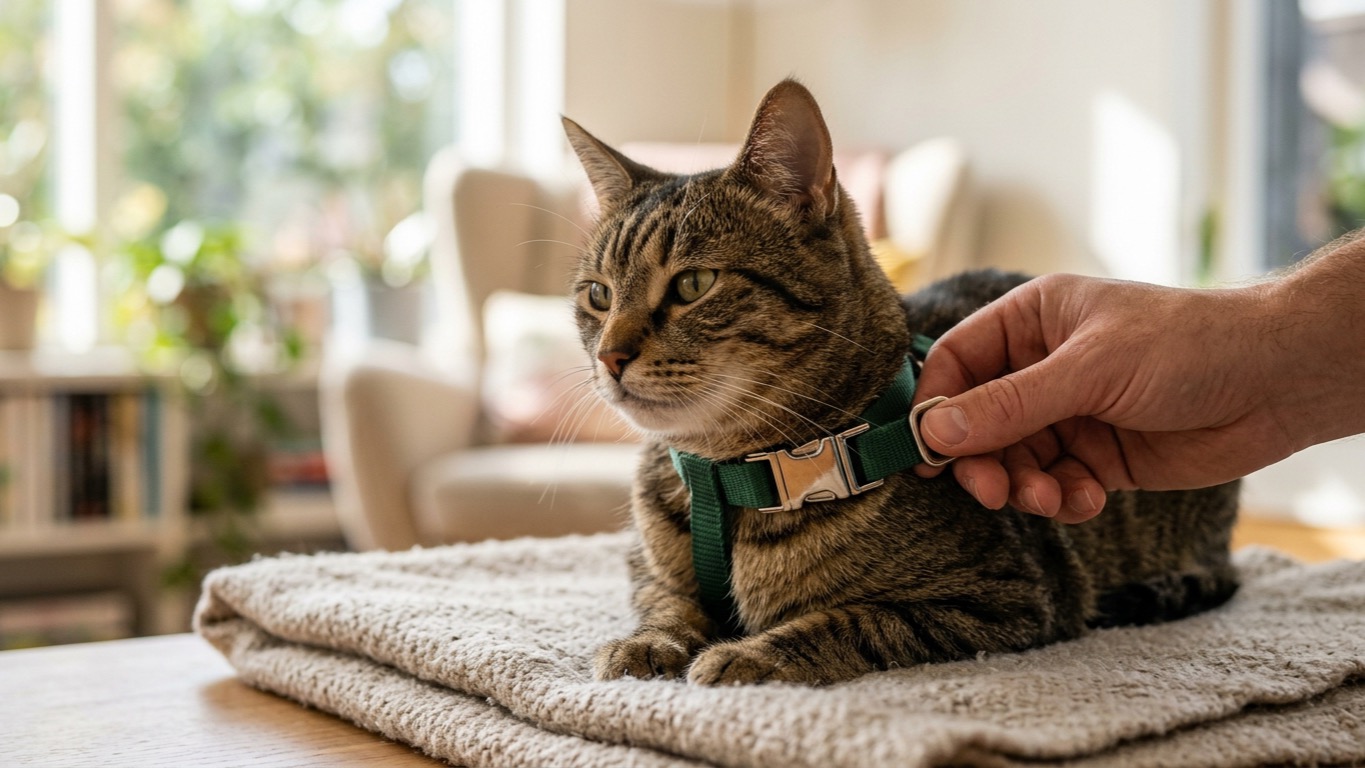
1. Girth. Soft tape, snug, around the ribcage just behind the front legs. PetSafe, Kitty Holster, and OutdoorBengal all ask for this. OutdoorBengal is girth-only; the neck opening is the self-adjusting part.
2. Neck. Base of the neck, snug. Kitty Holster prints neck and girth. Voyager retailer tables list both. PetSafe does not ask for a neck number; it asks you to place a neck loop, then move a chest slide.
3. Weight, on a scale. Kitty Holster maps S/M to about 8–13 lb and M/L to about 12–20 lb. Starting points. A long 9 lb cat and a compact 9 lb cat do not share a torso.
4. The finger rule this maker printed. The rules disagree. Write down which one you used.
| Source | What they tell you to measure | Fit rule they print |
|---|---|---|
| PetSafe Come With Me Kitty | Girth behind the front legs | Snug girth; chest slide on the breastbone; rubber stopper on the shoulders; do not leave the harness on when it is not in use |
| Kitty Holster | Neck + torso behind the front legs | “Like a glove.” For a cat that reverses on a taut leash, not one-finger’s width |
| Voyager Step-In Lock | Neck and chest on the size chart | Official 317 instructions: two fingers between the pet and any part of the harness |
| OutdoorBengal Houdini | Girth behind the front paws | Stopper snug below the neck, over the ribcage; chest pad not on the throat; never unattended |
| East Bay SPCA | — | Two fingers; H-type or walking jacket; no figure-eight |
| Hepper | Official page we fetched did not print an inch chart | “Adjust the straps”; 5 sizes; 150 cm leash. Retailer cartons list centimeter bands. Confirm the carton. |
If a measurement sits on a boundary, read that maker’s chart. OutdoorBengal: 90 percent of cats take M-L (12–20 in); kitten 7–11 in; XL 21 in+ (Maine Coons or obese cats). PetSafe: Small 9–11 in, Medium 10.5–14 in, Large 13–18 in. Those bands overlap. Measure twice.
4. Clip, leash, and ID — three objects
Walking load belongs on the harness D-ring. VCA and East Bay SPCA both refuse a leash on a neck collar. Cats slip collars.
Leash is short and light. VCA: no retractable, no long line. East Bay SPCA: 6 to 8 feet. OutdoorBengal ships 6 ft. Hepper lists 150 cm. PetSafe’s bungee flexes and tightens the shoulder straps — give, and extra length if you were trying to keep a cat off a fence.
ID is a third object. ASPCA: elastic-panel safety collar plus tag if the cat goes outdoors; microchip either way. East Bay SPCA: tags and a current microchip. Kitty Holster: a tag collar sits on top of the Holster neck straps.
5. When to stop shopping — and when to throw it out
Stop when the cat is frozen, screaming, or climbing you in the doorway. East Bay SPCA: if the cat consistently fights harnessing, call a trainer; if a dog comes around the corner, pick the cat up — do not drag. OutdoorBengal: a cat that fights hard has developed sensitivity; discontinue, wait. VCA: some cats refuse the front door. That is an allowed outcome.
Job-mapped examples (not a ranking)
Verified maker harnesses, grouped by job. Not a top 7.
Everyday H-style — PetSafe Come With Me Kitty Harness and Bungee Leash
Job: a light H-harness for a cat that already accepts straps, on a short yard walk, when you want a printed girth chart.
Where verified: PetSafe’s product page and the official “How to Fit” article. Maker-stated as of August 2026: nylon, quick-snap buckles, different-color belly strap, rubber stopper, matching bungee leash, six colors, three sizes. Official price on the page we fetched: $16.95. Small 9–11 in girth, Medium 10.5–14 in, Large 13–18 in. Fit: girth behind the front legs; neck loop over the head; snug the girth; O-ring on the ribcage; chest slide on the breastbone, not the throat; set the rubber stopper. Same page: do not wear it when it is not in use. A 12-inch girth sits on the Medium/Large overlap. Not a tie-out. Not a vest for a known reverse artist.
Wrap vest — Kitty Holster Cat Harness
Job: a cotton walking jacket for a cat that backs out of thin straps, when you will supply your own leash and cinch it like a glove.
Where verified: Kitty Holster’s official FAQ. Maker-stated: 100% cotton exclusive of decoration, metal D-ring, wide hook-and-loop at neck and abdomen, made in the USA. Matching leash sold separately. Official table: XS neck 5–9 in / girth 10–14 in; S/M 9–12 / 13–17 in (about 8–13 lb); M/L 10–13 / 16–20 in (about 12–20 lb); XL 11–15 / 19–23 in. Most cats wear S/M or M/L.
A well-fitting Holster is very hard to remove. Some cats still get out of any harness. The move they describe is a reverse against a taut leash, front legs toward the head. No tie-out. For a reverse-prone cat they want glove-snug, not a one-finger gap — a vest rule, not Voyager’s or East Bay SPCA’s two-finger rule. Follow the maker you bought.
Self-tightening pad — OutdoorBengal Houdini
Job: a back-out-resistant pad for a cat that has already reversed out of an H-style, used only while you are holding the leash.
Where verified: OutdoorBengal’s Houdini page and harness-training guide. Maker-stated as of August 2026: neck-strap system that tightens on a reverse, chest mesh, neoprene pad, side buckles, matching 6 ft leash. Official price on the page we fetched: $29.99. Girth: Kitten 7–11 in; M-L 12–20 in; XL 21 in+. The maker says 90 percent of cats take M-L. Fit: stopper only large enough for the head, then snug below the neck over the ribcage; chest pad not on the throat.
We will not repeat “escape-proof,” “vet-approved,” or “actually works” as results. The useful lines are the restrictions: never leave the cat alone in it, do not tether, and if the cat fights, stop. Wrong object for a porch rail.
Layered step-in — Voyager Step-In Lock Cat Harness
Job: a mesh step-in for a cat that hates a pullover, when you want a buckle plus D-rings and you will use the two-finger rule.
Where verified: Voyager’s official 317 Step-In Lock instructions. Maker-stated setup: loosen everything, place, buckle, even the chest straps, even the neck straps, two fingers at every contact point. The official instructions page we fetched did not print an inch table. A current U.S. retailer table for the same family (Target, August 2026) lists XXXS chest 10.5–13 in through XL 23–28 in, and says sizing does not follow breed or weight. Confirm the carton. Layered closures help only if every layer is closed.
Step-in vest with a matching leash — Hepper Cat Harness and Leash Set
Job: a velvet-and-mesh step-in set when you want the leash in the carton and you will read the buckle language twice.
Where verified: Hepper’s official harness-and-leash page. Maker-stated: velvet, air mesh, cushioning, reflective stripes, Velcro, quick-release buckles, aluminum D-rings, five sizes, leash 150 cm. The materials block says machine-washable; the FAQ on the same page says hand wash cold. Believe the more conservative care line. The safety paragraph names breakaway buckles as a “quick exit.” Useful on a fence. The opposite of a locked buckle if the snap opens.
Acclimation — institution steps, not a fake protocol
East Bay SPCA, 2024: start 1–2 minutes; do not leave the cat unsupervised in a harness; once the cat wears it five minutes or more and acts normally, add a leash; comfortable for 10 to 15 minutes before leash work; 6- to 8-foot lightweight leash on the harness; you follow the cat; never drag; first locations are a garden, alley, or hallway; walks 10 to 15 minutes with a retreat home; ID and a current microchip; plan a backpack or stroller as a traveling den.
VCA: harness, not collar; no retractable or long leash; harness then leash indoors; never drag; first outdoor step is the driveway or front yard, short. Some cats refuse the door. Do not go outdoors until the cat is completely comfortable walking indoors.
OutdoorBengal, if you bought that pad: park the harness where the cat sleeps; short indoor sessions; indoor leash first; if the cat still fights, stop.
ASPCA handling: one hand behind the front legs, one under the hindquarters; never by the scruff or the front legs. If you have to pick a panicking cat up, that is the lift. FelineVMA’s indoor pillars still apply if the walk never happens.
Frequently asked questions
Is any cat harness truly escape-proof?
No. Kitty Holster and OutdoorBengal both say some cats can get out of any harness. Name the escape mode, cinch that maker’s fit, keep the leash short. “Escape-proof” on a carton is advertising.
Should I walk my cat on a collar?
No. VCA: collars slip; walk on a harness. East Bay SPCA: never attach the leash to the collar. ASPCA still wants a safety collar with ID if the cat goes outdoors. Two objects.
H-style or vest?
H-style is lighter and fails first on a reverse if the neck hole is slack. Vest or walking jacket is what East Bay SPCA names next to H-type. Self-tightening pads need supervision. Figure-eight is not secure.
How tight is tight?
No one finger rule. Voyager and East Bay SPCA print two fingers. Kitty Holster prints glove-snug for a reverse artist. PetSafe prints landmarks (breastbone, ribcage, stopper). Use the rule on the card you bought.
Can I tie the cat out in the yard?
Not with the products we fetched. Kitty Holster does not recommend a tie-out. OutdoorBengal forbids tethering Houdini and leaving the cat unattended in it. East Bay SPCA: no unsupervised harness.
Does a harness replace a carrier?
No. Travel and the vet lobby are box jobs — cat carrier and dog-and-cat carrier. A harness inside a carrier is a tether.
The bottom line
An escape-resistant cat harness is a job, a geometry, and a tape measure. Decide walk, balcony, or travel first — or stay inside and enrich the house, which is what the ASPCA, the AVMA, and VCA treat as the default. Then pick H-style, vest, or a self-tightening pad for the escape mode you can describe. Then measure girth, and neck if that maker asks, and apply that maker’s fit rule. Believe the spec table and the institution pages, not a “7 Tested Picks” list, and not a test
Fit Check Desk: Best Escape Proof Cat Harness
| Point | Test | Fail sign | Fix |
|---|---|---|---|
| Neck | 2 fingers | Head backs out | Tighten + vest style |
| Girth | 2 fingers | Elbow tuck | Shorter chest piece |
| Back | No twist | Spin 90° | Re-thread straps |
Indoor acclimation 3–5 days before first outdoor clip—panic backing defeats any harness design.
Best Escape Proof Cat Harness — Style Comparison
| Style | Escape resistance desk | Walk comfort | Price |
|---|---|---|---|
| Vest mesh | High | Warm weather | $18–28 |
| H-strap nylon | Medium-high | Light cats | $12–20 |
| Butterfly | Medium | Fashion | $15–25 |
Leash clip on back D-ring only—front clips on cats are rare and can twist vest panels.
Additional Guidance on Best Escape Proof Cat Harness
Our research desk compiled this section from manufacturer specifications, published welfare guidance, and recurring owner themes or veterinary endorsement. Adjust any routine to your individual pet's health history with professional guidance when symptoms appear.
Practical monitoring beats guesswork: note appetite, stool quality, energy level, and behavior changes whenever you adjust food, housing, or care tools. Reversible trials with one variable at a time make cause and effect clearer than changing multiple products simultaneously.
Sources
Manufacturer / official fit pages:
- PetSafe Come With Me Kitty: https://www.petsafe.com/p/come-with-me-kitty-harness-and-bungee-leash/CWMK-S-BLK/
- PetSafe, How to Fit Come With Me Kitty: https://support.petsafe.net/articles/how-to-fit-your-come-with-me-kitty-cat-harness-and-bungee-leash/
- Kitty Holster FAQ: https://www.kittyholster.com/FAQs.html
- Kitty Holster homepage: https://www.kittyholster.com/
- OutdoorBengal Houdini: https://www.outdoorbengal.com/products/extra-safe-cat-harness
- OutdoorBengal harness-training guide: https://www.outdoorbengal.com/pages/harness-training-guide
- Voyager 317 Step-In Lock instructions: https://voyagerharness.com/pages/317-step-in-lock-cat-harness-instructions
- Hepper Cat Harness and Leash Set: https://www.hepper.com/products/harness-and-leash-set/
Institutions:
- ASPCA, General Cat Care: https://www.aspca.org/pet-care/cat-care/general-cat-care
- AVMA, indoor-cat wellbeing, 23 September 2025: https://www.avma.org/news/indoor-cats-wellbeing-requires-more-physical-safety
- AVMA HOD Resolution #4, 2026, Free-roaming Cats: https://www.avma.org/sites/default/files/2026-06/2026A_Resolution4_Free-Roaming_Cats.pdf
- VCA, Enrichment for Indoor Cats: https://vcahospitals.com/know-your-pet/cat-behavior-and-training-enrichment-for-indoor-cats
- VCA, Train your cat to walk on a leash: https://vcahospitals.com/resources/behavior-cat/training/train-your-cat-to-walk-on-a-leash
- East Bay SPCA, Harness Training for Your Cat, 2024: https://eastbayspca.org/wp-content/uploads/2024/05/Harness-Training-for-Your-Cat.pdf
Retailer carton used only where Voyager’s official instructions omitted inches (Target size table, fetched August 2026): https://www.target.com/p/voyager-step-in-lock-adjustable-dog-cat-harness-for-all-breeds-breathable-mesh-black-s/-/A-89181628
Not fetched this pass: Humane Society walk-your-cat page (404); FelineVMA 2024 indoor-outdoor page (404). Indoor-welfare claims use the AVMA news write-up instead.