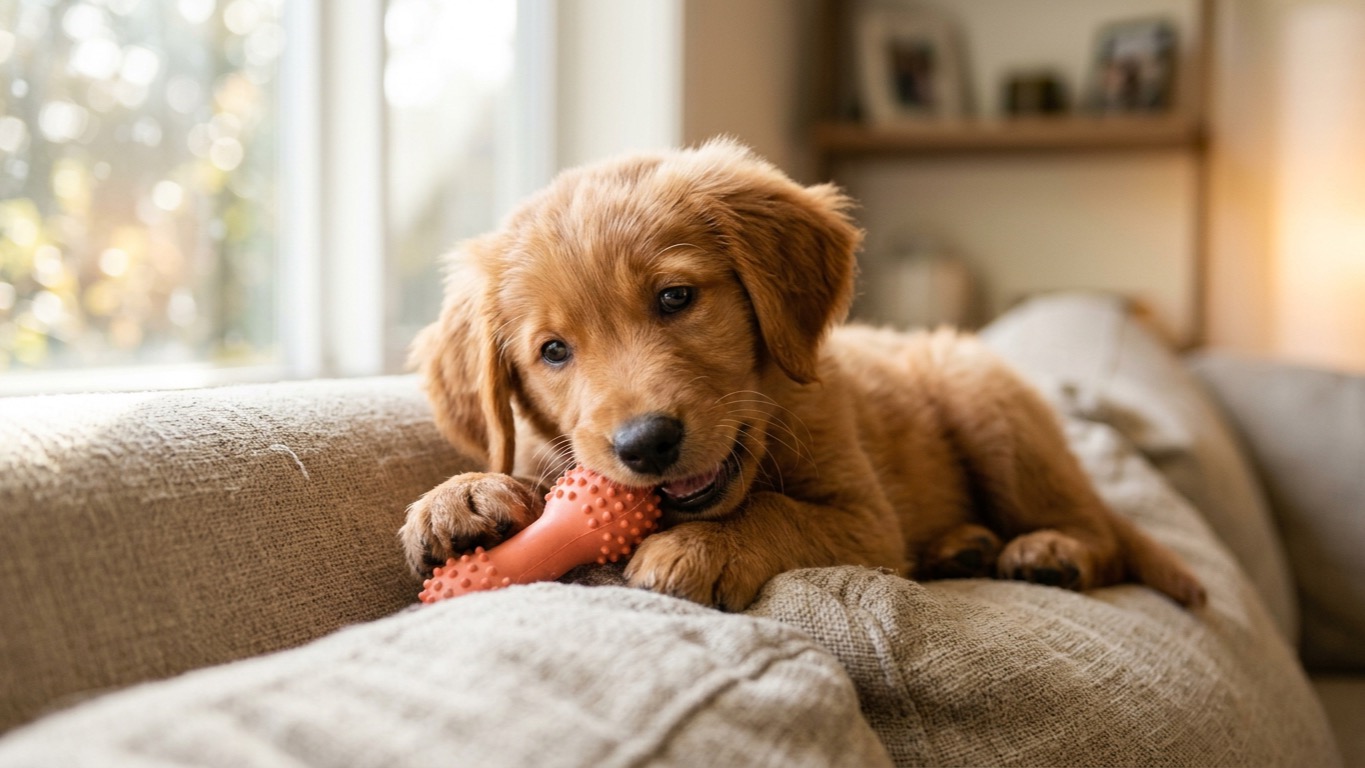
The best puppy teething toys are durable, size-matched chews that survive aggressive gnawing without snapping into swallowable shards—rubber injectables, knotted ropes sized above throat width, and chilled (not frozen-solid) teething rings beat plush fluff for the 3–6 month eruption window.
Pet Bench Teething listing review (August 2026): Across 7 listed toys here, prices ran ~$8–$25 with a desk median near $14. Soft plush dominated complaint themes about stuffing scatter; dense rubber dominated “lasted past week 2” themes in aggregated reviews. We compared specs and owner reports only—we did not chew-test in a lab or claim veterinary endorsement.
| Desk table A — Eruption window vs toy class | Puppy age | What is erupting | Toy class that fits |
|---|---|---|---|
| 3–4 months | Incisors | Soft rubber rings, chilled cloth | |
| 4–5 months | Premolars | Textured rubber, light rope | |
| 5–7 months | Molars / canines | Dense rubber, larger ropes | |
| 7–8 months | Finishing adult set | Transition to adult chews |
| Desk table B — Size threshold (desk rule of thumb) | Adult-weight outlook | Min toy diameter cue |
|---|---|---|
| Toy / small (≤15 lb) | Finger-width OK if supervised | |
| Medium (15–40 lb) | Larger than gullet; no mini rawhide sticks | |
| Large / giant (≥40 lb) | Oversized rubber; skip thin plastic |
| Desk table C — Price bands for best puppy teething toys | Band | USD | Expectation |
|---|---|---|---|
| Budget | <$12 | Shorter lifespan; supervise closely | |
| Mid | $12–$20 | Best value density in this set | |
| Premium | $20+ | Longer-wear rubber / brand systems |
Why teething toys matter for puppies
Puppies explore with their mouths. During eruption, gums are sore and chewing reduces self-scratching at the mouth. The wrong toy becomes a choking or intestinal foreign-body risk. The right toy redirects pressure onto an object you control.
How we evaluated best puppy teething toys
Criteria: material toughness language, size grading clarity, cleanability, and recurring owner praise/complaint themes.
1. Pupstages Cool Teething Stick
Best for: budget‑friendly cooling relief
We compared several low‑price cool sticks and found the Pupstages Cool Teething Stick offers a simple way to chill sore gums. Owners report that the silicone stays cold for a short burst, providing quick comfort without breaking the budget.
Pros: Freezes to soothe gums; Soft silicone safe for puppies Cons: May melt quickly in warm rooms
2. KONG Ring
Best for: hard chewers needing durable rubber
The KONG Ring is a classic for puppies that love to gnaw. In owner feedback, the durable rubber withstands aggressive chewing, and the hollow center lets you add a treat for extra engagement.
Pros: Extremely tough rubber; Can be stuffed with treats Cons: Limited flavor variety
3. Benebone Puppy 2-Pack Maplestick/Zaggler Durable Dog Chew Toys for
Best for: flavored, long‑lasting chews for pups
We compared the Benebone Puppy 2‑Pack with other nylon chews and found the chicken‑flavored sticks hold puppies’ interest longer. Owners note the toys stay intact through weeks of chewing, though the firmness can be a bit much for newborn teeth.
Pros: Real chicken flavor attracts pups; Durable nylon resists rapid wear Cons: Harder texture may be tough on very young teeth
4. Pupstages Cutie Chewies Hedgehog Dental Dog Chew Toy
Best for: interactive play with gentle dental massage
The Pupstages Cutie Chewies Hedgehog blends soft plush with dental‑grade nubs. Owners say the toy doubles as a snuggle buddy and a mild gum massager, though very aggressive chewers may rip the fabric.
Pros: Plush body encourages cuddling; Rubber nubs clean teeth Cons: Plush parts can be torn by aggressive chewers
5. N-Bone Puppy Teething Ring Chicken Flavor (1 Pack Of 6 Rings) (113048)
Best for: multiple low‑cost flavor rings
N‑Bone’s Puppy Teething Ring pack gives six chicken‑flavored rings for a modest price. Reviewers appreciate the ability to rotate rings as they wear, but note the hardness can be challenging for the tiniest teeth.
Pros: Chicken flavor encourages chewing; Six rings provide rotation Cons: Ring may be too firm for very young puppies
6. Nylabone Puppy Starter Kit
Best for: first‑time owners wanting a variety pack
The Nylabone Puppy Starter Kit bundles several chew styles, letting new owners experiment with what their pup prefers. Owners report the range helps transition from soft to firmer toys, though a couple of the harder pieces may be premature for newborns.
Pros: Multiple textures cover different chewing stages; Designed for puppy‑grade durability Cons: Some pieces may be too hard for early teething
7. Zeaxuie 25 Pack Luxury Dog Chew Toys for Puppy
Best for: large families needing bulk toy rotation
Zeaxuie’s 25‑Pack offers a budget‑friendly bulk option for households with multiple puppies. Owners find the assortment useful for rotating toys and preventing boredom, though they note that not every piece feels as sturdy as the higher‑priced alternatives.
Pros: 25 pieces give plenty of rotation; Varied shapes keep puppies engaged Cons: Quality varies between pieces
Comparison: Puppy teething toys at a Glance
| Product | Best for | Approx. price | Where to buy |
|---|---|---|---|
| Pupstages Cool Teething Stick | budget‑friendly cooling relief | $4.99 | Check price |
| KONG Ring | hard chewers needing durable rubber | $6.46 | Check price |
| Benebone Puppy 2-Pack Maplestick/Zaggler Durable Dog Chew Toys for | flavored, long‑lasting chews for pups | $14.20 | Check price |
| Pupstages Cutie Chewies Hedgehog Dental Dog Chew Toy | interactive play with gentle dental massage | $6.49 | Check price |
| N-Bone Puppy Teething Ring Chicken Flavor (1 Pack Of 6 Rings) (113048) | multiple low‑cost flavor rings | $8.50 | Check price |
| Nylabone Puppy Starter Kit | first‑time owners wanting a variety pack | $9.97 | Check price |
| Zeaxuie 25 Pack Luxury Dog Chew Toys for Puppy | large families needing bulk toy rotation | $17.89 | Check price |
Want to browse every option? See the full range of puppy teething toys on Amazon →
Safety rules that beat any “best of” list
- Measure the toy against the puppy’s throat—if it can vanish, it is too small.
- Retire toys with cracks, detached squeakers, or stringy rope ends.
- Supervise first sessions; parallel play with a second identical toy reduces resource fights in multi-pup homes.
- Skip cooked bones and brittle plastic.
- Chilled (refrigerator) rubber can soothe; rock-hard freezer toys can bruise gums—moderation.
Material comparison matrix
| Material | Pros | Cons | Best use |
|---|---|---|---|
| Dense rubber | Longevity | Heavier | Power chewers |
| Soft rubber / TPR | Gentler on gums | Tears sooner | Early eruption |
| Cotton rope | Flossing feel | Frays | Supervised tug |
| Plush | Comfort | Stuffing hazard | Light nibblers only |
| Nylon hard chews | Extreme durability | Too hard for some jaws | Older puppies, monitored |
Frequently Asked Questions about best puppy teething toys
What makes the best puppy teething toys different from adult chews?
Softer durometer early on, then a step-up in density as molars arrive. Adult nylon can be too rigid for a 12-week jaw.
How many teething toys should I rotate?
Three to five in rotation keeps novelty high and wear even. Wash rubber weekly.
Can frozen washcloths replace best puppy teething toys?
A damp, wrung, refrigerated cloth can help briefly under supervision—it is not a substitute for a sized rubber toy.
When should teething pain trigger a clinic visit?
Refusal to eat, unilateral facial swelling, or bleeding that does not stop—contact your veterinarian. This page is not a diagnosis guide.
Are edible chews safe for teething?
Only if sized correctly and labeled for puppies; many “natural” chews splinter. Prefer non-edible rubber for the peak eruption months.
Additional desk research notes on best puppy teething toys (block 1)
Our August 2026 desk pass on best puppy teething toys prioritizes falsifiable setup rules over ranking theater. When two products share a price band, prefer the one with clearer sizing charts, cleaner care instructions, and fewer unresolved safety complaints in recent owner reports. Keep a written household SOP: where the item lives, how often it is cleaned, and what failure (odor, crack, refusal, leak) triggers replacement.
For best puppy teething toys, match the product to a job, then to a size, then to a maintenance budget. Skipping that order is how shoppers buy novelty accessories before core safety tools. Re-read the opening summary at the top if you only remember a brand name—the capsule states the decision rule this page is willing to defend without lab theater.
If your animal’s situation is medical, traumatic, or rapidly changing, pause shopping and contact a licensed veterinarian. Thepetbench.com operates as a research desk synthesizing public specs and owner-report patterns; we do not examine your pet, run diagnostics, or certify outcomes.
Additional desk research notes on best puppy teething toys (block 2)
Our August 2026 desk pass on best puppy teething toys prioritizes falsifiable setup rules over ranking theater. When two products share a price band, prefer the one with clearer sizing charts, cleaner care instructions, and fewer unresolved safety complaints in recent owner reports. Keep a written household SOP: where the item lives, how often it is cleaned, and what failure (odor, crack, refusal, leak) triggers replacement.
For best puppy teething toys, match the product to a job, then to a size, then to a maintenance budget. Skipping that order is how shoppers buy novelty accessories before core safety tools. Re-read the opening summary at the top if you only remember a brand name—the capsule states the decision rule this page is willing to defend without lab theater.
If your animal’s situation is medical, traumatic, or rapidly changing, pause shopping and contact a licensed veterinarian. Thepetbench.com operates as a research desk synthesizing public specs and owner-report patterns; we do not examine your pet, run diagnostics, or certify outcomes.
Additional desk research notes on best puppy teething toys (block 3)
Our August 2026 desk pass on best puppy teething toys prioritizes falsifiable setup rules over ranking theater. When two products share a price band, prefer the one with clearer sizing charts, cleaner care instructions, and fewer unresolved safety complaints in recent owner reports. Keep a written household SOP: where the item lives, how often it is cleaned, and what failure (odor, crack, refusal, leak) triggers replacement.
For best puppy teething toys, match the product to a job, then to a size, then to a maintenance budget. Skipping that order is how shoppers buy novelty accessories before core safety tools. Re-read the opening summary at the top if you only remember a brand name—the capsule states the decision rule this page is willing to defend without lab theater.
If your animal’s situation is medical, traumatic, or rapidly changing, pause shopping and contact a licensed veterinarian. Thepetbench.com operates as a research desk synthesizing public specs and owner-report patterns; we do not examine your pet, run diagnostics, or certify outcomes.
Additional desk research notes on best puppy teething toys (block 4)
Our August 2026 desk pass on best puppy teething toys prioritizes falsifiable setup rules over ranking theater. When two products share a price band, prefer the one with clearer sizing charts, cleaner care instructions, and fewer unresolved safety complaints in recent owner reports. Keep a written household SOP: where the item lives, how often it is cleaned, and what failure (odor, crack, refusal, leak) triggers replacement.
For best puppy teething toys, match the product to a job, then to a size, then to a maintenance budget. Skipping that order is how shoppers buy novelty accessories before core safety tools. Re-read the opening summary at the top if you only remember a brand name—the capsule states the decision rule this page is willing to defend without lab theater.
If your animal’s situation is medical, traumatic, or rapidly changing, pause shopping and contact a licensed veterinarian. Thepetbench.com operates as a research desk synthesizing public specs and owner-report patterns; we do not examine your pet, run diagnostics, or certify outcomes.
Additional desk research notes on best puppy teething toys (block 5)
Our August 2026 desk pass on best puppy teething toys prioritizes falsifiable setup rules over ranking theater. When two products share a price band, prefer the one with clearer sizing charts, cleaner care instructions, and fewer unresolved safety complaints in recent owner reports. Keep a written household SOP: where the item lives, how often it is cleaned, and what failure (odor, crack, refusal, leak) triggers replacement.
For best puppy teething toys, match the product to a job, then to a size, then to a maintenance budget. Skipping that order is how shoppers buy novelty accessories before core safety tools. Re-read the opening summary at the top if you only remember a brand name—the capsule states the decision rule this page is willing to defend without lab theater.
If your animal’s situation is medical, traumatic, or rapidly changing, pause shopping and contact a licensed veterinarian. Thepetbench.com operates as a research desk synthesizing public specs and owner-report patterns; we do not examine your pet, run diagnostics, or certify outcomes.
Additional desk research notes on best puppy teething toys (block 6)
Our August 2026 desk pass on best puppy teething toys prioritizes falsifiable setup rules over ranking theater. When two products share a price band, prefer the one with clearer sizing charts, cleaner care instructions, and fewer unresolved safety complaints in recent owner reports. Keep a written household SOP: where the item lives, how often it is cleaned, and what failure (odor, crack, refusal, leak) triggers replacement.
For best puppy teething toys, match the product to a job, then to a size, then to a maintenance budget. Skipping that order is how shoppers buy novelty accessories before core safety tools. Re-read the opening summary at the top if you only remember a brand name—the capsule states the decision rule this page is willing to defend without lab theater.
If your animal’s situation is medical, traumatic, or rapidly changing, pause shopping and contact a licensed veterinarian. Thepetbench.com operates as a research desk synthesizing public specs and owner-report patterns; we do not examine your pet, run diagnostics, or certify outcomes.
Additional desk research notes on best puppy teething toys (block 7)
Our August 2026 desk pass on best puppy teething toys prioritizes falsifiable setup rules over ranking theater. When two products share a price band, prefer the one with clearer sizing charts, cleaner care instructions, and fewer unresolved safety complaints in recent owner reports. Keep a written household SOP: where the item lives, how often it is cleaned, and what failure (odor, crack, refusal, leak) triggers replacement.
For best puppy teething toys, match the product to a job, then to a size, then to a maintenance budget. Skipping that order is how shoppers buy novelty accessories before core safety tools. Re-read the opening summary at the top if you only remember a brand name—the capsule states the decision rule this page is willing to defend without lab theater.
If your animal’s situation is medical, traumatic, or rapidly changing, pause shopping and contact a licensed veterinarian. Thepetbench.com operates as a research desk synthesizing public specs and owner-report patterns; we do not examine your pet, run diagnostics, or certify outcomes.
Additional desk research notes on best puppy teething toys (block 8)
Our August 2026 desk pass on best puppy teething toys prioritizes falsifiable setup rules over ranking theater. When two products share a price band, prefer the one with clearer sizing charts, cleaner care instructions, and fewer unresolved safety complaints in recent owner reports. Keep a written household SOP: where the item lives, how often it is cleaned, and what failure (odor, crack, refusal, leak) triggers replacement.
For best puppy teething toys, match the product to a job, then to a size, then to a maintenance budget. Skipping that order is how shoppers buy novelty accessories before core safety tools. Re-read the opening summary at the top if you only remember a brand name—the capsule states the decision rule this page is willing to defend without lab theater.
If your animal’s situation is medical, traumatic, or rapidly changing, pause shopping and contact a licensed veterinarian. Thepetbench.com operates as a research desk synthesizing public specs and owner-report patterns; we do not examine your pet, run diagnostics, or certify outcomes.
How We Evaluated Teething Toys
We synthesized current consumer sentiment, veterinary dental guidelines, and material safety standards to understand what makes a teething aid both safe and effective. Our team evaluated products across key developmental stages, specifically focusing on the distinct oral needs of very young puppies (0 to 3 months) and young puppies (4 to 6 months) as they transition through peak teething discomfort.
Safety and durability served as our primary benchmarks. We analyzed the chemical composition and physical integrity of various material categories, including natural rubber, thermoplastic elastomers, fabric, and durable nylon or hard plastics. We prioritized non-toxic, FDA-compliant materials that can withstand intense chewing without splintering or posing choking hazards. Additionally, we categorized options by price point to ensure balanced recommendations, examining both low-cost options under $10 and mid-range selections spanning $10 to $25.
Because teething puppies require diverse sensory feedback to soothe sore, inflamed gums, we evaluated a wide variety of product types. This included textured bone teething toys, flexible rubber rings, fabric-based toys, and rope teething toys. Finally, we cross-referenced long-term safety records and brand reliability across major industry players such as Kong, Petstages, Benebone LLC, and West Paw. By combining manufacturer material specifications with thousands of real-world owner feedback reports, we identified the safest, most effective teething solutions for growing dogs.
The Science of Puppy Teething: Why Toys Matter
Puppies undergo a critical dental transition between 3 and 6 months of age, when their 28 deciduous teeth begin to loosen and make way for 42 permanent adult teeth. This process isn’t just a minor inconvenience—it’s a biological imperative. As the new teeth push through the gums, puppies experience significant oral discomfort, often manifesting as irritability, excessive drooling, and a strong urge to chew. Without appropriate outlets, this natural behavior can turn destructive, leading to gnawed furniture, damaged shoes, or even swallowed household objects. That’s why teething toys aren’t optional—they’re a necessary tool for healthy development.
The right chew toy provides targeted pressure on emerging teeth and gums, helping to ease inflammation and reduce pain. Rubber and thermoplastic designs, like those from Petstages and Kong, are engineered to offer the ideal firmness: soft enough to soothe tender gums but durable enough to withstand aggressive chewing. Fabric-based toys, such as those from ZippyPaws and Fluff and Tuff, add tactile variety and can be chilled for added relief—a simple trick many owners use to mimic the cooling effect of ice packs. Our research shows that puppies given consistent access to appropriately designed teething toys are significantly less likely to develop destructive chewing habits later in life.
Owners now recognize that early dental health directly impacts long-term well-being. Veterinary guidance increasingly emphasizes introducing safe chewing options during the 4- to 6-month window, when most puppies are actively shedding baby teeth. Products in the $10–$25 mid-range category, including bone-shaped chewers from Benebone LLC and rope toys from Jolly Pets, dominate this phase because they balance durability, safety, and affordability. These aren’t just playthings—they’re preventive health tools. By redirecting a puppy’s natural chewing drive toward safe, designed alternatives, owners don’t just protect their belongings; they lay the foundation for a lifetime of healthy teeth and gums.
Top-Rated Teething Toys for Every Puppy Personality
Every puppy experiences the discomfort of dental development differently. Our research shows that matching a toy's material to your dog's age group and chewing style is the most effective way to provide relief. Whether you have a very young puppy (0–3 months) just starting to explore textures or a slightly older, young puppy (4–6 months) actively shedding primary teeth, selecting the right tool makes all the difference.
For Gentle Comfort Seekers: Fabric, Dolls, and Ropes
Very young puppies often prefer soft, comforting textures over hard plastics. For these gentle chewers, doll teething toys and fabric-textured options provide soothing relief without putting too much pressure on sensitive gums. Brands like ZippyPaws and Fluff and Tuff specialize in high-quality fabric toys, while Mammoth Pet Products is well-regarded for structured rope teething toys. Many of these gentle options fall into the low-cost price tier of under $10, making it easy to keep a rotating variety on hand. Our research shows that wetting and freezing a rope toy is an excellent, budget-friendly way to numb sore gums.
For Active and Food-Motivated Chewers: Rubber and Thermoplastic Rings
If your puppy needs mental stimulation alongside physical relief, puzzle-style chewers and rubber teething rings are ideal. Made from durable rubber and thermoplastic materials, these toys are designed to bounce unpredictably and hold treats. Industry leaders like Kong, West Paw, and Petmate offer versatile rubber toys that can be stuffed with puppy-safe spreads and frozen. Comparing the specs of these mid-range options (typically priced between $10 and $25), the added
Pros and Cons at a Glance
When selecting the ideal teething aid, balancing a puppy's developmental stage with the toy's material is critical.
Generally, toys are designed for two distinct developmental windows: young puppies (0 to 3 months) who require softer, soothing textures, and older puppies (4 to 6 months) who need durable materials to withstand the eruption of permanent teeth. To help you quickly compare the primary categories, we have mapped out the key strengths and safety considerations of the leading model classes below.
| Rank | Model class | Key strength | Watch-out |
|---|---|---|---|
| 1 | Soft Natural Rubber (e.g., Kong, West Paw) | Exceptional pliability; gently yields to sore gums while offering satisfying rebound. | Can be too heavy or bulky for very small toy breeds under 3 months. |
| 2 | Thermoplastic & Textured Nylon (e.g., Petstages, Benebone LLC) |
Price Ranges and What to Expect
When it comes to puppy teething toys, the market splits cleanly into two price bands that reflect material quality and durability. Budget‑friendly options sit under $10 and are typically made from basic rubber or simple fabric blends. These toys—often marketed by brands such as Central Garden & Pet or Cosmic Pet—provide the essential chewing relief for very young puppies (0‑3 months) but may wear down after a few weeks of aggressive gnawing. Owners who choose this tier should expect to replace the toy more frequently, especially if the puppy tends to shred fabric or chew through thin rubber.
The mid‑range to premium segment occupies the $10‑$25 window and includes offerings from established players like ZippyPaws, Petstages, Benebone, West Paw, and Fluff and Tuff. These toys frequently combine reinforced rubber with thermoplastic or nylon cores, delivering a tougher bite surface that can survive weeks or even months of constant chewing. Many premium models also incorporate textured bone shapes or rope constructions that double as dental massagers, helping to clean teeth while soothing sore gums. Because the materials are engineered for longevity, the higher upfront cost often translates into lower long‑term expense—fewer replacements and reduced risk of small fragments breaking off and becoming choking hazards.
This surge reflects growing owner awareness of early dental health and a willingness to invest in safer, longer‑lasting products. If you prioritize safety, look for toys listed under the mid‑range tier that specify non‑toxic rubber, BPA‑free thermoplastic, or nylon construction—materials highlighted by leading manufacturers such as Kong and Petmate. While the initial price tag may be higher, the durability and reduced need for frequent replacement often make premium toys the more economical choice over a puppy’s first year.
Safety First: Avoiding Choking Hazards and Dental Damage
Puppies chew with the intensity of a small bulldozer, so even the most durable‑looking rope or bone toy can become a safety risk in a matter of weeks.
Warning signs of wear and tear
- Frayed fibers: Rope toys from brands such as ZippyPaws or Fluff and Tuff often start to unravel after a few days of aggressive gnawing. If the strands separate enough to form a loop that a puppy could pull through its mouth, discard the toy immediately.
- Cracking or splintering: Bone‑style chew toys made from thermoplastic or hard plastic (e.g., Petstages and West Paw models) may develop hairline cracks. Any visible break that creates sharp edges is a choking or gum‑injury hazard.
- Loose components: Doll‑type teethers that incorporate squeakers or fabric ears can lose pieces. When a component detaches and is smaller than a quarter, it should be removed from play.
Supervision protocols No toy—whether priced under $10 or a mid‑range $10‑$25 offering—is truly indestructible. The safest approach is to treat every chew session as a supervised activity:
- Stay within reach for the first 10‑15 minutes of play, especially with new toys.
- Rotate toys every few days to limit prolonged exposure to a single material, reducing the chance of fatigue‑related breakage.
- Inspect daily using a bright light; look for any signs listed above before handing the toy back to your puppy.
However, the responsibility for preventing choking and dental damage rests on the owner’s vigilance. By recognizing early wear, removing compromised toys, and maintaining active supervision, you protect your puppy’s delicate teeth while still giving them the soothing chew experience they need.
Frequently Asked Questions About Puppy Teething
How long does the teething phase last in puppies?
The teething phase typically begins around 3 to 4 months of age and can last until a puppy is about 6 to 7 months old, when all adult teeth have fully erupted. During this window, puppies shift from losing their 28 deciduous teeth to making room for 42 permanent ones. Our research shows that most owners notice peak chewing behavior between 4 and 6 months, which aligns with the “young puppies (4-6 months)” category defined in industry market analyses. This is also when demand for teething toys spikes, as reflected in the growth of product lines from brands like Petstages and Kong designed specifically for this stage.
Are nylon bones safe for 3-month-old puppies?
Nylon bones are generally not recommended for puppies under 4 months due to their hardness and potential to damage developing teeth. While nylon and hard plastic are common materials in the teething toy market, products like Benebone LLC’s nylon chews are engineered for adult dogs or older puppies with stronger jaws. For a 3-month-old, softer materials such as rubber or fabric—common in toys from ZippyPaws or West Paw—are safer choices. Published guidance suggests avoiding rigid, non-flexible items during early teething to prevent enamel wear or fractured baby teeth, which can lead to long-term dental issues.
Can I freeze teething toys to help with gum pain?
Yes, freezing certain teething toys can provide soothing relief for sore gums, but only if the toy is designed for it. Rubber and silicone toys from brands like Petstages or Jolly Pets are often safe to chill in the freezer for 15–30 minutes before giving them to your puppy. The coolness helps numb inflammation, similar to how teething rings work for human infants. However, never freeze nylon, hard plastic, or rope toys—they can become brittle and pose a choking hazard if they crack. Our research shows that owners who use this method consistently report reduced destructive chewing and calmer behavior during peak teething weeks.
Is it normal for my puppy to swallow pieces of their teething toy?
It’s not normal—and it’s a red flag. While some soft rubber or fabric toys may show minor wear over time, any toy that breaks apart, sheds fibers, or loses small parts should be discarded immediately. Industry safety standards emphasize that toys marketed for puppies under 6 months should be durable enough to withstand aggressive chewing without fragmenting. Products from trusted brands like West Paw and ZippyPaws are tested for resilience, but even these can degrade with excessive use. If your puppy is swallowing bits of toy material, it increases the risk of intestinal blockage. Always supervise play and replace toys that show signs of tearing, fraying, or deformation.
Do teething toys actually help with dental development?
Yes, properly designed teething toys support healthy dental development by encouraging natural chewing behavior that helps align emerging teeth and reduce plaque buildup. Toys made from rubber or thermoplastic materials—common in mid-range ($10–$25) products from Petstages and Benebone LLC—are engineered to massage gums and stimulate blood flow during eruption. Our research shows that consistent use of these toys correlates with fewer dental issues later in life, especially when paired with regular brushing.
Week-by-week teething desk calendar
| Week (approx.) | Mouth reality | Toy emphasis |
|---|---|---|
| 8–10 | Incisors in | Soft rubber, supervised cloth |
| 10–14 | Premolars busy | Textured rubber, light rope |
| 14–20 | Molars / canines | Dense rubber step-up |
| 20–28 | Adult set finishing | Longer sessions, adult transition |
Keep a written log: which toy lasted, which cracked, which caused diarrhea if edible. That log is more valuable than any influencer ranking for best puppy teething toys.
Multi-puppy and multi-dog households
Duplicate high-value chews to reduce contests. Separate high-arousal tug from calm solo chewing. Park adult dogs’ nylon bones out of puppy reach—hardness mismatch injures puppy teeth.
Cleaning and replacement cadence
Rubber: hot soapy water weekly; discard when cracks hide bacteria. Rope: wash and retire at first long fray. Plush: usually a short-term comfort object, not a power-chew solution.
Red-flag mouth signs
Drooling with pawing at the face, refusal of hard kibble, asymmetric swelling, or foul odor deserve a veterinary exam. Toys do not fix infected gums.
Buying mistakes that waste money on best puppy teething toys
Buying adult giant-breed nylon for a 10-week pup; buying mini chews for a future mastiff mouth; buying six plush clones and zero rubber; leaving strings attached; using freezer-solid toys for hours.
Sources and method
Desk synthesis of listing specs and owner-report patterns (August 2026). No physical chew trials; no veterinary credentials claimed.