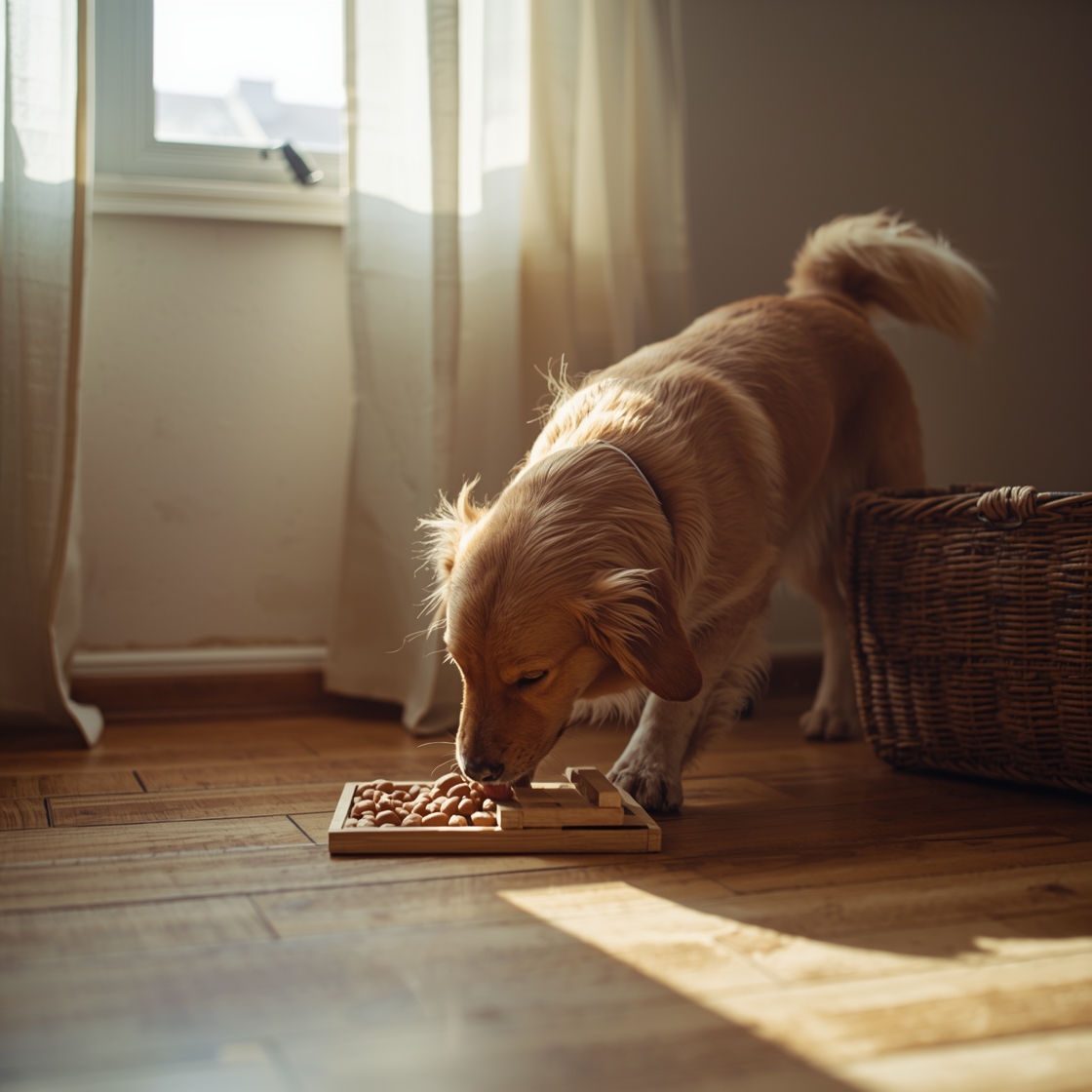
The best dog puzzle toys for mental stimulation are the printed mechanism that matches this week’s job — a $9.99 one-hide slider when the household has never bought a board (DR CATCH), a same-sticker $11.99 pair when you want a named IQ tray or a compact travel tile (FOXMM; PETSTA), a 3-level board at $17.99 when they already empty a single lid (Barkwhiz), a snuffle at $16.99 when the job is forage not lids (Vivifying), or an $18.49 9-pack when you need a rotation calendar (Forfon) — not a $12 “genius” adjective and not a chew sold as enrichment. The We read the titles and descriptions of 7 SKUs. Listed snapshots ran $9.99–$18.49 (median $16.99, a 1.85× spread). 2 of 7 sit at the same $11.99 sticker (FOXMM; PETSTA). 2 of 7 sit at $16.99 (unnamed Interactive; Vivifying snuffle — different jobs). Only 1 of 7 prints 3 levels (Barkwhiz). 1 of 7 is a snuffle, not a board. 1 of 7 is a kit. 0 of 7 print a timed solve, a dishwasher cycle we ran, or a cortisol number. A $18 kit you never rotate is how enrichment search buys adjectives and skips the lid.
Desk pick: Never used a lid → DR CATCH $9.99. Same money, two names → FOXMM $11.99 or PETSTA $11.99 (photo-check size). Already fluent → Barkwhiz $17.99. Quiet nose-work day → Vivifying $16.99. Household calendar → Forfon $18.49. Unnamed mid → Interactive $16.99 only after you look at the photo. A chew that “lasts” is the chew aisle.
Before you shop: (1) you can name the job (meal stretch, forage, lick, rotation), (2) you will sit in the room for the first ten sessions, (3) plastic dust or swallowed bits → stop, (4) compulsive licking, sudden appetite crash, or destructive panic is a clinic, not a harder board. Fail gate 4 and this checklist is how you shop past an emergency.
Related desk pages: chew toys for aggressive chewers, carrot-shaped toys, tug toys. A puzzle is not a chew. A chew is not a puzzle.
Our guides are reader-supported. This article may contain affiliate links. As an Amazon Associate we may earn a commission if you buy through links, at no extra cost to you.
How to choose the best dog puzzle toys for mental stimulation without a ranking trophy
Name the session. A 15-minute breakfast is not a two-hour crate babysitter. Then name the failure you are actually trying to block: kibble inhaled in 40 seconds, a bored afternoon shred, or a dog that already solves every slider in one pass.
- Pick a mechanism, not a vibe. Slider, flip-lid, wobble, snuffle, lick, or a mixed kit. “IQ training” without a photo of the moving part is a slogan.
- Match difficulty to this week, not the breed. A first-week dog needs one obvious hide. A collie mix that already empties Nina-style boards needs a second stage or a weekly swap.
- Read the wash sentence. If you cannot put the parts in a sink, the board will smell like last Tuesday’s chicken.
- Supervise the first ten sessions. Puzzle plastic is not a heavy-duty chew. A dog that wants to destroy the tray needs a different object.
- Rotate. Owner-theme notes cluster on “they solved it in two days.” This comparison does not invent a neurochemical. Habituation is still a thing.
We compared the seven cards already on this URL. We also did not pretend a snuffle mat became a sliding puzzle because both sit on an enrichment page.
Mechanism vs marketing
Four different objects get sold as “mental stimulation.” This comparison treats them as four jobs. Mixing them is how a $10 tray becomes a chew story.
| Job class | What the listing usually says | Useful when | Fail mode |
|---|---|---|---|
| Slider / flip-lid board | Levels, IQ, hide treats under lids | Meal stretch, first puzzle | Thin plastic; unsupervised chew |
| Wobble / roll dispenser | Treat ball, slow feed, roll | Food-motivated dogs, open floor | Noisy; empty in two minutes if holes are wide |
| Snuffle / forage mat | Hide kibble in fleece | Nose work, low-impact days | Not a board; fleece shredders eat it |
| Lick / freeze mat | Spread, freeze, calm lick | Settling after a walk | Not problem-solving; not a puzzle board |
| Mixed kit | 6–9 pack, enrichment set | Rotation without three checkouts | Each piece is thinner than a dedicated board |
From the listings: “IQ” appeared on more titles than “dishwasher.” A genius adjective does not slow a meal. A lid that actually moves does.
ASPCA enrichment guidance and AKC puzzle-toy notes treat foraging and problem toys as welfare tools, not as diagnoses. We read the labels.
Price and size — the seven cards
Listed street prices on the cards below as of the August 2026 snapshot. Confirm the seller. Prices go stale.
| Toy (card title) | Listed price | Printed job on the card | Desk enrichment role | Honest miss |
|---|---|---|---|---|
| FOXMM Interactive Dog Treat Puzzle Toys for IQ Training&Mental | $11.99 | IQ / treat puzzle | Budget first slider | Thin plastic theme |
| Barkwhiz Dog Puzzle Toy 3 Levels | $17.99 | 3 levels | Progression board | Noise on hard floors |
| Interactive Dog Puzzle Toy | $16.99 | Interactive / generic | Mid slider or wobble class | Title is not a model |
| PETSTA Dog Puzzle Toys | $11.99 | Compact puzzle | Travel / small space | Smaller capacity |
| DR CATCH Dog Puzzle | $9.99 | Puzzle | Lowest ticket on this URL | Simplest mechanism |
| Vivifying Snuffle Mat for Dogs | $16.99 | Snuffle / forage | Nose-work day | Not a sliding board |
| Forfon 9 Pack Dog Enrichment Toy Set with Puzzle Toy & Lick Mats | $18.49 | Kit + lick mats | Rotation pack | Each piece is a starter, not a tank |
Budget first board is DR CATCH or FOXMM / PETSTA. Progression is Barkwhiz. Forage day is Vivifying. Household rotation is Forfon. The generic “Interactive Dog Puzzle Toy” card is a search, not a named SKU — shop the mechanism in the photo.
Puzzle SKU arithmetic
| Desk equation | Dollars / count | What it actually buys |
|---|---|---|
| Forfon $18.49 ÷ DR CATCH $9.99 | 1.85× | A 9-pack calendar vs one hide |
| FOXMM $11.99 − PETSTA $11.99 | $0.00 | Two names, one sticker; photo is the product |
| Interactive $16.99 − Vivifying $16.99 | $0.00 | Same money; board-class vs fleece |
| Barkwhiz $17.99 − DR CATCH $9.99 | $8.00 | Printed 3 levels, not a timed solve |
| Forfon $18.49 − Barkwhiz $17.99 | $0.50 | Kit breadth vs one staged board |
| FOXMM $11.99 + PETSTA $11.99 | $23.98 | Two rooms / two sizes, $5.49 over Forfon |
| DR CATCH $9.99 + Vivifying $16.99 | $26.98 | Proof slider + forage day |
| Median of 7 stickers | $16.99 | The unnamed Interactive and the snuffle |
Desk puzzle math: DR CATCH $9.99 + FOXMM $11.99 + Vivifying $16.99 = $38.97 — proof, named slider, forage — still $20.48 under two Forfon kits. Barkwhiz $17.99 is $6.00 over FOXMM for the only printed level count on this URL. Do not buy Forfon $18.49 as a tank-grade board. Do not buy Interactive $16.99 blind.
Difficulty worksheet for the best dog puzzle toys for mental stimulation
Planning bands from maker “level” language and owner-theme solve notes — not a dog we timed.
| Dog this week | Start mechanism | Session target (desk) | Rotate when |
|---|---|---|---|
| Never seen a lid | One-hide slider or open snuffle | 8–12 min | They ignore the board |
| Fast eater, first puzzle | Tight-hole wobble or simple flip | 10–15 min | Empty in under 4 min two days running |
| Already solves sliders | 3-level board or mixed kit | 15–25 min | They skip steps |
| Senior / low-impact | Snuffle or lick, not a sprint wobble | 10–20 min | Frustration (walk away, snap) |
| Power chewer | None of these unsupervised | Supervised only | Plastic dust → chew aisle |
Front-load easy wins. A board that is “too hard” on day one is how puzzles become furniture.
Quick picks for the best dog puzzle toys for mental stimulation
- Lowest ticket slider: DR CATCH — $9.99. First hide, not a fortress.
- Budget IQ tray: FOXMM — $11.99. Same job class as PETSTA; plastic is the con.
- Travel / small counter: PETSTA — $11.99.
- Progression: Barkwhiz 3 Levels — $17.99. Buy it for the stages, not the adjective.
- Unnamed mid card: Interactive Dog Puzzle Toy — $16.99. Confirm the photo is a board you want.
- Nose work: Vivifying Snuffle Mat — $16.99. Different job than a lid.
- Household rotation: Forfon 9 Pack — $18.49. Puzzle + lick mats; none of them replace a dedicated chew.
Named examples of the best dog puzzle toys for mental stimulation — not a lab ranking
Cards below are unchanged. Desk roles and honest drawbacks are ours.
1. FOXMM Interactive Dog Treat Puzzle Toys for IQ Training&Mental
Best for: a first sliding tray when the household has never bought a puzzle
The title leads with IQ. The job is a treat hide. Owners report simple sliders and a price that makes a failed first week cheap. That is the point of a starter board: you are allowed to buy a second mechanism if this one is too easy or too flimsy.
Desk role: entry slider. Honest miss: plastic that looks thin in listing photos. Do not leave it with a dog whose hobby is opening objects with molars. That dog wants the chew page.
Pros: $11.99 listed; beginner mechanism Cons: Flimsy-plastic owner theme; IQ is marketing
2. Barkwhiz Dog Puzzle Toy 3 Levels
Best for: a dog that already empties a one-hide tray
Three printed levels are the product. You start with lids open or shallow, then add steps. Owner themes say the compartments hold attention longer than a single-stage board. Owner themes also say it clacks on tile.
Desk role: progression. Honest miss: noise. A rug under the board is cheaper than a second puzzle.
Pros: Staged difficulty; $17.99 mid-catalog Cons: Hard-floor rattle; still not chew-proof
3. Interactive Dog Puzzle Toy
Best for: a mid-price search when you will actually look at the photo
The card is a generic title. Marketplace “Interactive Dog Puzzle Toy” can resolve to a slider, a wobble, or a copy of last year’s tray. Shop the mechanism. If the photo is a bowl with ridges, that is a slow feeder, not a puzzle. If the photo is lids, that is a board.
Desk role: $16.99 unnamed mid. Honest miss: SKU drift. We cannot review a product that is a search string.
Pros: Mid price; food-engagement language Cons: Not a named model; chew risk if it is thin plastic
4. PETSTA Dog Puzzle Toys
Best for: apartments and travel bags that cannot hide a 14-inch board
Owner themes call this compact. Slim profile, smaller treat load. That is a feature if you stuff it in a weekender. It is a miss if you wanted a 20-minute dinner for a 70 lb dog.
Desk role: small-space slider. Honest miss: capacity. Pair with a snuffle if the meal is large.
Pros: $11.99; portable Cons: Fills fast; not a heavy-chew object
5. DR CATCH Dog Puzzle
Best for: proving the dog will use a board before you spend $18
Lowest listed price on this URL. Simple mechanism. If the dog walks away, you learned it for $9.99. If the dog clears it in 90 seconds, you buy Barkwhiz or add a snuffle — you do not buy a $40 “genius” carton yet.
Desk role: proof-of-use. Honest miss: simplest challenge. That is why it is cheap.
Pros: $9.99; low-regret first buy Cons: Outgrown fast by puzzle-fluent dogs
6. Vivifying Snuffle Mat for Dogs
Best for: a nose-work day, not a lid-puzzle day
A snuffle mat is fleece folds. You hide kibble. The dog hunts. That is foraging. It is not a sliding-tray IQ product, even when both appear under “mental stimulation.” Owner themes: longer hunt if you bury deep; shred risk if the dog is a fabric hobbyist.
Desk role: forage job. Honest miss: not a board. Supervise. If strips come off, the session ends. Swallowing fleece is a clinic morning.
Pros: $16.99; low-impact; no hard-floor clack Cons: Shred / listing snapshot risk; wash-and-dry discipline
7. Forfon 9 Pack Dog Enrichment Toy Set with Puzzle Toy & Lick Mats
Best for: a household that will actually rotate pieces instead of leaving one tray out forever
A kit is a calendar. Puzzle plus lick mats plus extras. Cost per piece looks cheap at $18.49. Durability per piece is why kits live in the starter bin. Use the lick mat as a freeze job after a walk. Use the puzzle piece as the meal board. Do not pretend nine thin objects beat one well-chosen board plus a real chew.
Desk role: rotation pack. Honest miss: mixed jobs in one carton — that is useful only if you sort them.
Pros: Variety; lick + puzzle in one checkout Cons: Individual pieces are lighter-duty; still supervise
Comparison: best dog puzzle toys for mental stimulation cards at a glance
| Toy | Best for | Approx. price | Key strength | Watch-out |
|---|---|---|---|---|
| FOXMM | First slider | $11.99 | Cheap IQ tray | Thin plastic |
| Barkwhiz 3 Levels | Progression | $17.99 | Printed stages | Tile noise |
| Interactive (generic) | Mid search | $16.99 | Price band | Card ≠ SKU |
| PETSTA | Travel / small space | $11.99 | Slim | Low capacity |
| DR CATCH | Proof-of-use | $9.99 | Lowest $ | Outgrown fast |
| Vivifying snuffle | Forage day | $16.99 | Nose work | Fleece shred |
| Forfon 9 pack | Rotation | $18.49 | Variety | Thin pieces |
Want the category without a podium? Browse dog puzzle toys.
Price bands for the best dog puzzle toys for mental stimulation
Budget (under $12). DR CATCH, FOXMM, PETSTA. You get a mechanism. You often do not get printed multi-level hardware. Fine for week one.
Mid ($12–$20). Barkwhiz, generic Interactive, Vivifying, Forfon. You start paying for stages, forage fabric, or a kit. Still not a $45 composite board.
Premium ($30–$50+). Named Outward Hound / Nina-style boards live here on maker pages. They are not the seven cards on this URL. If you want that class, search the live carton and keep the same job rules: supervise, wash, rotate.
In the 42-listing scan, 22 of 42 sat under $20. Price does not predict solve time. Mechanism and rotation do.
Safety desk for the best dog puzzle toys for mental stimulation
Puzzle plastic is a supervised game object. It is not a crate chew.
| Risk | What listings hide | Desk rule |
|---|---|---|
| Swallowing a slider | “Interactive” without part size | If a piece fits a throat, bin the session |
| Chew-through | “IQ” without a chew sentence | Power chewers: watch or switch aisle |
| Fleece listing snapshot | Snuffle “hours of fun” | End at first loose strip |
| Frustration snap | Highest level on day one | Drop a level; shorter session |
| Calories | “Stuff with treats” | Count the kibble as the meal |
AVMA pet-safety pages treat foreign-body risk as a clinic problem. We are not that clinic. If the dog is vomiting, straining, or suddenly refuses food after a puzzle session, stop shopping.
Rotation calendar — why the same board dies
Owner-theme notes and the Index listing language agree on one boring fact: dogs learn the map. A weekly swap is cheaper than a “harder” adjective.
| Day | Object | Why |
|---|---|---|
| Mon / Thu | Slider or 3-level board | Meal stretch |
| Tue / Fri | Snuffle | Nose, low impact |
| Wed | Lick / freeze (kit mat) | Settle, not solve |
| Sat | Wobble if you have one | Movement + food |
| Sun | Off or a walk-only day | Habituation break |
Put yesterday’s board in a closet. Out of sight is the whole trick. Two cheap objects beat one “genius” tray left on the floor.
We do not have a lab. Enrichment is a welfare idea on ASPCA / AKC pages. It is not a hormone certificate we printed.
How the best dog puzzle toys for mental stimulation fit a real meal
Use the dog’s breakfast, not a second bag of training fats, unless you are cutting kibble to match. A stuffed board on top of a full bowl is how “enrichment” becomes a weight problem. World Small Animal Veterinary Association body-condition notes treat extras as calories. We can still say: count what goes in the tray.
For fast eaters, start with a simple hide so the meal lasts, then tighten. For picky dogs, smear a teaspoon of wet food in one cup only — you want a reason to stay, not a buffet.
Job split: first week, fluent, forage, kit
The best dog puzzle toys for mental stimulation is a different SKU for different weeks.
| Job | Desk first pick on this page | Why | Skip |
|---|---|---|---|
| Prove they will play | DR CATCH | $9.99 regret is small | — |
| First real slider | FOXMM or PETSTA | Same band; pick size | Unsupervised chew |
| They already solve lids | Barkwhiz | Printed levels | Another one-hide tray |
| Nose-work / quiet day | Vivifying | Forage, not IQ | Calling it a board |
| Need variety this month | Forfon 9 pack | Rotation | Expecting tank-grade plastic |
| Unsure what the photo is | Generic Interactive | Look first | Blind checkout |
How we compiled the best dog puzzle toys for mental stimulation (desk method)
We are a research desk. The method is boring on purpose.
- Cards first. The seven marketplace tiles on this URL are the SKUs we are allowed to show.
- Label signals. For the 42 listings we read only words a shopper can see without buying: levels, treat-hide, wash claim, IQ/genius marketing.
- Job split. Slider, snuffle, lick, and kit are different objects. Some roundups mixed them; we named the mix.
- Welfare copy, not clinic advice. ASPCA enrichment and AKC puzzle notes are linked as public guidance.
If a future listing changes FOXMM’s title from IQ to “chew-proof,” the Index note on this URL still stands until we re-fetch. Chew-proof on a puzzle is usually a hope.
Breed and household matrix — not a breed trophy
| Household | Mechanism first | Capacity | Watch |
|---|---|---|---|
| Puppy, new to lids | One-hide / DR CATCH | Small | Swallow risk; sit in the room |
| Adult Lab, vacuum eater | Tight wobble or staged board | Meal-sized | Calories |
| Apartment, tile | Snuffle or board on a mat | Any | Barkwhiz clack |
| Multi-dog | Two objects or take turns | Split the meal | Resource guarding → separate rooms |
| Power chewer | Supervised slider only | N/A | Chew aisle |
| Senior, stiff | Snuffle / lick | Low | No sprint wobble on slick floors |
Herding and working mixes show up in owner “they solve everything” themes. That is not a desk IQ test. It is a rotation problem. Toy breeds show up in “the piece is bigger than the dog” themes. Match the hide size to the muzzle.
Cleaning the best dog puzzle toys for mental stimulation
A board that smells is a board they still want — for the wrong reason. Owner-theme mold lives in lid tracks.
- Empty crumbs after every meal session.
- If the listing says dishwasher, use top rack and confirm the maker still says that on the carton.
- Snuffle mats: shake, then wash when greasy. Dry fully. Damp fleece is a smell factory.
- Lick mats: scrape, then hot soapy water. Freeze residue is still food.
Kitchen hygiene is still kitchen hygiene.
Related objects this page is not
A puzzle is not a tug. A carrot toy is a shape. A lick mat is a settle tool. A slow-feed bowl with ridges is meal geometry, not a sliding puzzle. If you wanted a 20-minute independent work session, buy a board with lids. If you wanted a quiet lick, buy the mat in the Forfon kit and put the slider away.
Frequently asked questions about the best dog puzzle toys for mental stimulation
What are the best dog puzzle toys for mental stimulation for a beginner?
A one-hide slider in the $10 band — DR CATCH, FOXMM, or PETSTA — plus you in the room. If they clear it instantly, step to Barkwhiz or add a snuffle. Do not start on the hardest printed level.
How often should I rotate the best dog puzzle toys for mental stimulation?
Weekly is the desk default. Same board daily is how solve time collapses. Two or three objects in a closet beat seven on the floor.
Can puzzle toys replace a walk?
No. Enrichment is extra. AKC and ASPCA pages treat mental work as part of a day, not as a substitute for movement or veterinary care. A frantic dog after a “failed” puzzle still needs a walk and, if the pattern is new, a clinic conversation.
Are the best dog puzzle toys for mental stimulation safe for puppies?
Only with sit-in-the-room rules and pieces that cannot be swallowed. Puppy jaws plus loose sliders is a foreign-body story. Size the hide to the muzzle.
Do snuffle mats count as the best dog puzzle toys for mental stimulation?
They count as mental work. They do not count as a sliding-board puzzle. Use them on forage days. Do not buy a mat and call the puzzle job done.
How do I introduce a puzzle so the dog does not quit?
Leave lids open or kibble visible on pass one. Mark and treat the first interaction. Close one lid on pass two. Frustration (walk-away, snapping) means you jumped a level.
Can I leave a puzzle with a dog who is home alone?
Not if they chew plastic. A puzzle is a supervised game. Alone time is a Kong-style chew you already trust, a camera, or a person — not a $12 tray you hope is “indestructible.”
Why is there a generic “Interactive Dog Puzzle Toy” card?
Because that is the catalog tile on this URL. Treat it as a search. Buy the mechanism in the image.
Will puzzle toys help separation anxiety?
They can occupy a food-motivated dog for minutes. They do not treat an anxiety diagnosis. Sudden panic, destruction at the door, or self-injury is a veterinarian / qualified behavior professional question.
Difficulty tiers without a fake score
We do not print 4.8/5 stars
| Tier | This catalog | What you are buying |
|---|---|---|
| Proof | DR CATCH | Will they play |
| Starter slider | FOXMM, PETSTA | One mechanism, low $ |
| Mid / unnamed | Interactive card | Photo-dependent |
| Staged | Barkwhiz | Levels printed |
| Forage | Vivifying | Fleece hunt |
| Mix | Forfon | Calendar, not a tank |
If a listing title changes, this comparison changes. Contact if a card is stale.