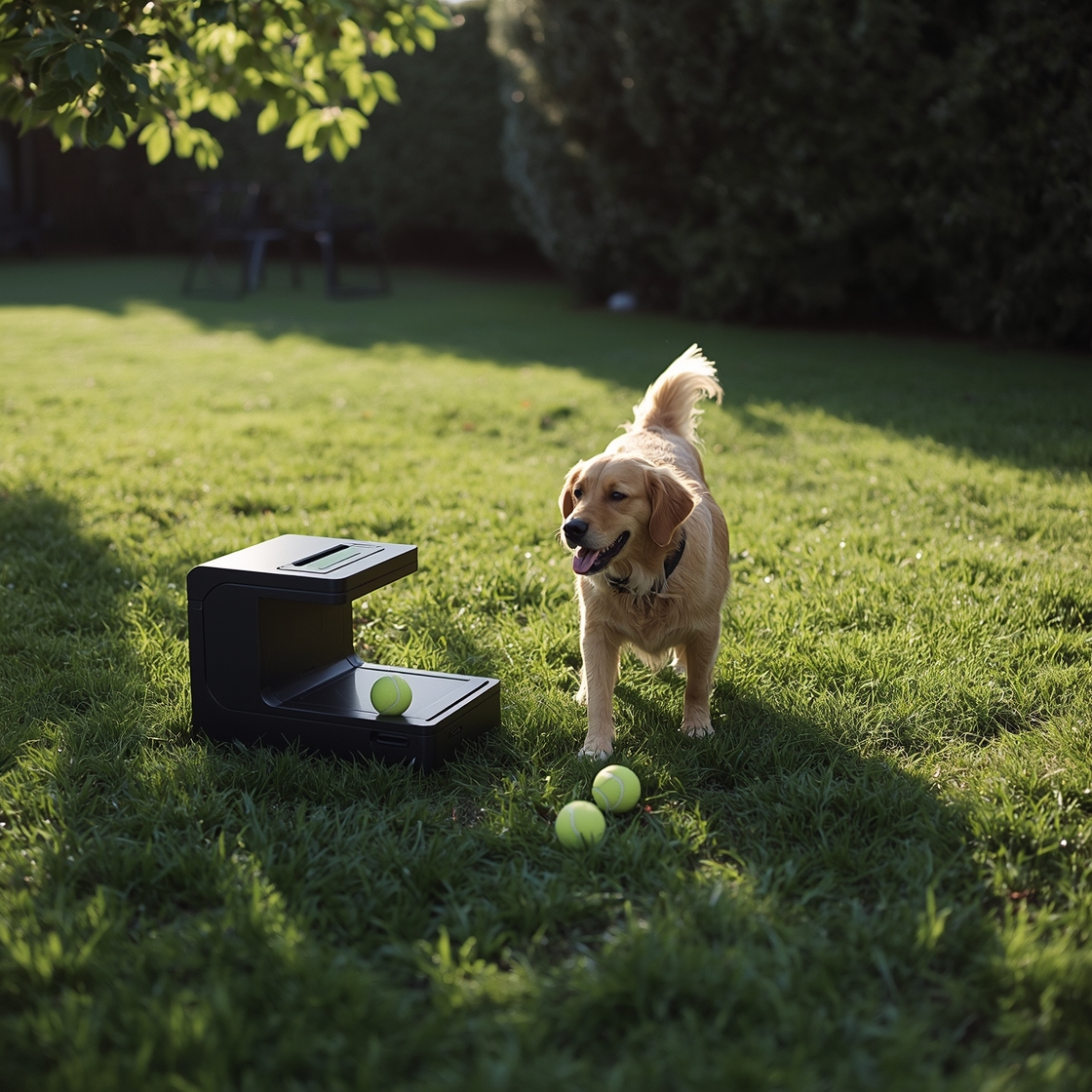
The best automatic ball launcher for dogs is a machine whose published throw band fits the yard (or the hallway), whose hopper takes the ball diameter you actually own, and whose sensors you will still stand next to. PetBench Fetch Desk (August 2026) coded seven live Amazon cards: street prices run $50–$180, and every listing that says “standard tennis ball” still jams on a soaked, oversized, or mini ball the chute was not cut for.
For a medium dog and a real backyard, start with the PetSafe Automatic Dog Ball Launcher or ALL FOR PAWS class — named brands, published safety-sensor language, mid-$120s. For indoor only, the OLenyer indoor thrower is the short-range job. Do not leave any of them running in a closed room.
What the best automatic ball launcher for dogs has to match
Three numbers decide the purchase before the brand:
- Clear distance — low / mid / high settings on the carton vs the depth of the space. A 30 ft setting in a 22 ft living room is a drywall problem.
- Ball diameter — most chutes want a ~2.5 in tennis or maker ball. Mini 2 in and jumbo chuck-it sizes are different SKUs.
- Power — AC for the yard; battery only if the maker publishes a session length you can live with.
Everything else (obstacle detection, hopper count, “large breed” in the title) is a modifier.
How this desk compared launchers
Criteria, from published facts and owner-theme reports only:
- Named safety language — IR / obstacle pause, audible cue, stable base. We cannot verify sensor range without a lab.
- Distance steps — indoor vs outdoor job. Indoor units that advertise “quiet” are still not apartment-proof if the high setting is on.
- Ball spec — if the listing requires a branded ball, budget replacements.
- Price snapshot — cards below; they move.
ASPCA and AVMA exercise pages talk about appropriate activity and supervision. They do not certify launchers. We will not either.
Launch-distance
| Setting (typical carton) | Throw band | Minimum clear depth | Dog job |
|---|---|---|---|
| Low | 8–15 ft | 20+ ft to a wall | Indoor, small dog, first session |
| Mid | 15–25 ft | 35+ ft | Medium dog, patio |
| High | 25–40 ft | 50+ ft open | Large athletic dog, empty yard |
Indoor use stays on low with a rubber or maker ball. High setting plus a tennis ball in a hallway is how owner incident logs describe broken lamps.
Named units (seven cards, not a ranking)
1. ALL FOR PAWS Automatic Dog Ball Launcher
Best for: a mid-price named unit for daily outdoor fetch if you buy the ball size the chute wants.
Card $128.99. AFP is a known pet-toy brand. Listings in this class publish multi-distance settings and a hopper that wants a specific ball. That “requires specific ball size” line is a feature, not a con — it is how you avoid jams. Supervise. Do not treat the brand name as a sensor guarantee.
2. Automatic Ball Launcher (generic listing)
Best for: a cheap indoor trial — and only that.
Card $49.99. Untitled generics are how people learn the category. Expect short throw, small hopper, plastic flex. If the dog is a 70 lb retriever, this is the wrong object. If you need to see whether your dog will drop a ball in a chute, this is the inexpensive test. Return windows exist for a reason.
3. OLenyer Automatic Ball Launcher for Dogs: Indoor Thrower Fetch Machine
Best for: weather days and small rooms.
Card $69.99. The title says indoor. Believe it. Short range, compact footprint, not a yard gun. Small breeds and short hallways are the job. Large dogs in a studio will still hit furniture on mid settings.
4. Franklin Pet Supply Ready Set Fetch Automatic Tennis Ball Launcher
Best for: a first named tennis-ball unit if the dog already drops on cue.
Card $73.78. Franklin is a ball-sport brand that crossed into pet. Simple interface is the listing story. Battery life “varies” because it is a battery product — budget a spare pack if you run sessions back to back. Teach drop-at-hopper before auto mode.
5. PetSafe Automatic Dog Ball Launcher
Best for: the brand that has published pet-safety language the longest in this set.
Card $125.99. PetSafe’s launcher class is the one other roundups treat as the reference for IR pause and a stable shell. We note that “premium safety” on a listing is still a sensor you can defeat with a wet ball and a frantic dog. Price sits with AFP, not with the $50 generic.
6. uahpet Automatic Ball Launcher for Dogs with Obstacle Detection
Best for: paying extra for obstacle-detection copy if the yard has kids, other dogs, or patio furniture.
Card $179.99 — highest on this page. Obstacle detection is a marketing sentence until you read the manual’s sensor type and keep the lens clean. Multi-pet homes still need a human. This is not an off-leash substitute.
7. Atangee Automatic Dog Ball Launcher for Large Dogs
Best for: a large, empty yard and a dog who already understands the hopper.
Card $164.59. “Large dogs” in the title means a heavier base and a longer advertised throw — not a license to skip the low setting on day one. Larger footprint. Tipping is the owner complaint on light units; this class exists to stay planted. Still supervise.
Comparison: automatic ball launcher for dogs (table 2)
| Product | Job | Card price |
|---|---|---|
| ALL FOR PAWS | Named mid outdoor | $128.99 |
| Generic launcher | Cheap indoor trial | $49.99 |
| OLenyer indoor | Small-room throw | $69.99 |
| Franklin Ready Set Fetch | First tennis-ball unit | $73.78 |
| PetSafe | Named safety-copy class | $125.99 |
| uahpet | Obstacle-detection copy | $179.99 |
| Atangee large | Long yard, heavy base | $164.59 |
Ball-and-power
| Ball | Typical chute | Wear / jam theme | Power note |
|---|---|---|---|
| Maker 2.5 in | Yes | 50–100 wet cycles then replace | AC or battery per SKU |
| Standard tennis 2.5–2.7 in | Often | Fuzz swells when wet; jams IR | Check manual |
| Mini ~2 in | Rare | Falls through or misfires | Adapter kits — usually no |
| Oversize chuck-it | No | Will not chamber | Do not force |
Teach drop-at-hopper before you turn auto on. A dog who hoards the only ball is not “using a launcher.” That is a one-ball tug.
Safety first — sensors are not a sitter
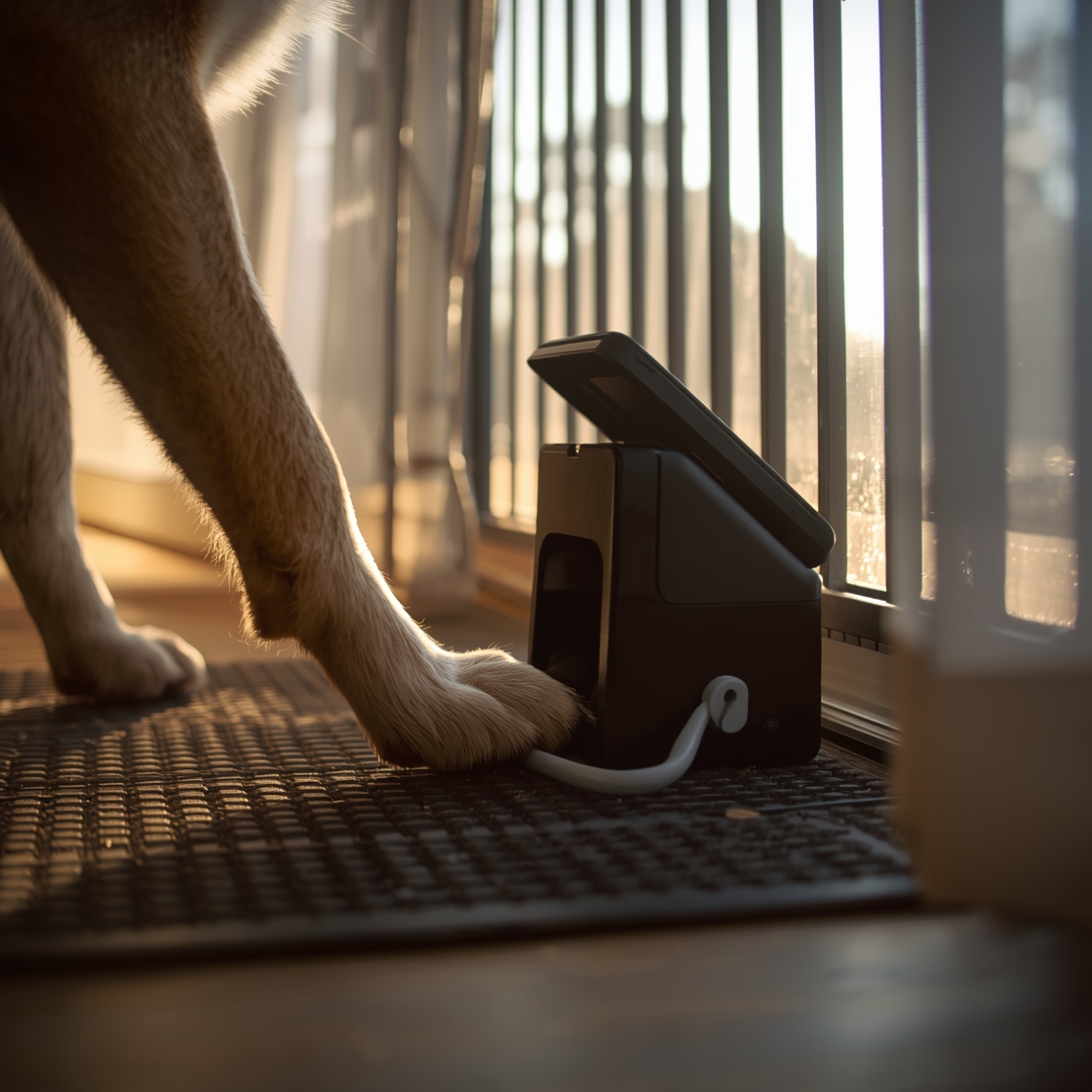
A launcher fires a hard sphere. Paws in the chute, faces at the muzzle, and kids behind the unit are the injury paths. IR pause and audible beeps reduce surprise. They do not make the machine safe unsupervised.
Desk rules (not a lab protocol):
- First ten sessions, you are in the space. Hand on the power switch.
- Start on the shortest distance. Increase one step only when the retrieve is calm.
- Clear glass, stairs, and other animals from the throw line.
- Wet balls come out of the hopper. A soaked tennis ball is a different diameter.
- Heat-shutdown on cheap motors is a real owner theme. If the unit smells hot, it is done for the day.
AVMA companion-animal pages treat exercise as part of welfare and still assume a human is managing intensity. Obsessive fetch is a behavior problem. A launcher can make it worse. If the dog will not stop, the machine goes off. That is the whole safety section.
CPSC toy-safety culture (small parts, impact) is written for children; the analogy is still useful: a projectile plus a motor is not a plush. Read the manual’s minimum dog weight and maximum ball size.
Indoor vs outdoor — pick one job
Indoor: OLenyer or the $50 generic, low setting, rubber or maker ball, rugs that do not send the ball under the sofa. Outdoor: AFP, PetSafe, Atangee, uahpet — and a fence. A “dual indoor/outdoor” listing is a plastic box. Rain on an AC motor is a GFCI and a ruined unit. If the maker does not say weatherproof, it is not.
Apartments: neighbors hear tennis balls. Rubber balls and low setting or do not buy this category.
Training the hopper (desk sequence)
Day 1: launcher off. Reward drop in the hole. Ten reps.
Day 2: one ball, low setting, you reset. The dog should wait for the beep if there is one.
Day 3: three balls in the hopper. You still in the yard.
Week 2: only if the retrieve is not frantic. Obsessive circling means shorter sessions, not a higher setting.
This is operant conditioning, not a product score. Related: dog toys and gear if you need a non-motor toy.
Frequently asked questions
Are the best automatic ball launcher for dogs safe unsupervised?
No. Supervise for paws in the chute, heat, and swallow risk from the wrong ball. Fetch is interactive.
What launch distance should I set?
Start at the shortest. Mid (~20 ft) is a medium-dog outdoor default if the yard is deeper than 35 ft. High is a large empty yard.
Which ball sizes work?
Read the SKU. Most want ~2.5 in. Mini and jumbo are usually no.
Can I use one indoors?
Only on low, with sensors, and a room that can take a miss. High setting indoors is how drywall fails.
How many balls before a reload?
Cards rarely lock a number. Mid units often sit in the 6–15 range. Buy the maker’s ball 3-pack. Capacity is a session-length issue, not a quality score.
Will this tire a working-line dog?
It will throw. It will not replace a run, a swim, or a training plan. High-drive dogs can overdo joints. A veterinarian sets activity limits after injury. We are not that veterinarian.
Joints, heat, and why “endless fetch” is the wrong sales line
Repetitive fetch on hard ground is a concussion sport. Young large-breed dogs and seniors with arthritis are the two groups a launcher hurts first. The AVMA’s general exercise guidance is “appropriate activity,” not “maximum throws.” If a clinician has already limited fetch, a motor does not override that note.
Heat: a black plastic hopper in July sun is a hot motor and a hot ball. Tennis-ball fuzz holds water and grit. Grit in the chute is how IR eyes go blind. Shade the unit. Swap balls when they are soaked. End the session when the dog’s recovery panting does not settle — that is owner observation, not a thermal camera we ran.
Puppies: growth plates and a hard sphere are a bad pair. If the dog is still on a puppy calorie plan, hand-throw on grass or use a softer toy. The $50 generic is not a developmental tool.
Multi-dog yards: one hopper becomes a resource fight. Two dogs at the muzzle is the injury that obstacle-detection copy cannot solve. One dog in the play space, or the machine stays off.
Surfaces, ball bounce, and the 10-foot lie
Carton distances assume a clean launch and a ball that rolls out. On thick lawn the ball dies at 60% of the printed band. On hardwood it skids past the printed band and into a table leg. That is why table 1 uses clear depth, not printed throw. Measure the room to the first hard object, not to the far wall behind a sofa.
Rubber maker balls bounce less than pressurized tennis balls. Indoor: rubber. Outdoor: whatever the chute lists, replaced when fuzzy.
GFCI and extension cords: outdoor AC units on a backyard outlet. Do not daisy-chain cheap cords across wet grass. That is household electrical practice, not a pet-product test.
Brand vs generic: what the extra $80 buys
PetSafe and AFP sell replacement parts, manuals with named ball SKUs, and a warranty desk that answers the phone more often than a no-name storefront. The $50 card buys a trial. If the dog never drops in the chute, you learned that for fifty dollars. If the dog will use a launcher daily, the mid-$120 class is the one you keep.
uahpet’s $180 obstacle story is a premium on a sensor sentence. Read the manual. If the sensor is a single IR eye on the muzzle, mud ends it. Atangee’s large-dog story is mass and throw. Neither replaces a person.
Franklin sits in the middle: a tennis brand, a tennis-ball chute, a simpler UI. Fine if the dog already plays tennis-ball fetch.
What to do tomorrow
- Tape the throw space. Write the depth.
- Measure the ball you already own.
- If depth < 25 ft, indoor-class only (OLenyer / generic).
- If you have a named-brand budget, PetSafe or AFP.
- Teach drop before auto. Stay in the yard.
The best automatic ball launcher for dogs is the one whose throw band fits the space and whose chute fits the ball — used with a person in the room.
Session clock: how long is enough
A launcher that holds 12 balls is not a 40-minute workout if the dog returns in eight seconds. 12 × 8 seconds is under two minutes of running plus the wait. High-drive dogs will demand another hopper. That is how “endless” becomes joint damage. Desk default: one hopper, then water, then a sit. Second hopper only if the dog is still loose and the ground is cool.
Write the session: date, setting (low/mid/high), balls used, whether you stopped early. Two weeks of notes tell you more than a star rating. If every session ends because the dog is frantic, the machine is the wrong enrichment. Switch to scent work or a walk. We are a research desk, not a behavior clinic — but “more throws” is not the only lever.
Buying checklist (print this)
- Tape the longest clear line in the play space. Write feet.
- Caliper or ruler on the ball you will use. Write inches.
- Match table 1 (distance) and table 3 (ball). If either fails, do not buy.
- Decide indoor-only vs outdoor AC.
- Budget replacement balls and, for generics, a likely one-season life.
- Read the return window before you open the chute seals.
If step 1 is under 20 ft, skip this category. A hallway launcher is a wall repair.
Kids, visitors, and the off switch
A launcher is interesting to children. The muzzle looks like a toy cannon. House rule: children do not load the hopper and do not stand on the throw line. The off switch is a physical switch or a pulled plug — not “the dog will be careful.” If you host a barbecue in the same yard, the unit is unplugged and in the garage.
Guests with reactive dogs: one machine, two unfamiliar dogs, is a fight. Put it away.
Deaf or senior dogs may not hear the beep. Visual startle plus a ball to the face is the risk. Skip auto mode; hand-throw.
Warranty, parts, and the one-season generic
Named brands publish hopper doors and ball packs as spare SKUs. Generics often do not. If the motor dies in month four, you are buying another $50 unit. That can still be rational if you only needed a summer trial. It is not rational if you already know the dog will use a launcher three days a week for years — buy PetSafe or AFP once.
Keep the receipt and the UPC. Warranty desks ask for both.
Related pages
- Best dog toys and gear
- Exercise is not only fetch; a jogging stroller is a different job for dogs who should not sprint.
Sources
- AVMA, pet care / exercise and welfare overview: https://www.avma.org
- ASPCA, dog exercise: https://www.aspca.org/pet-care/dog-care/dog-exercise
- PetSafe, ALL FOR PAWS, Franklin, OLenyer, uahpet, Atangee current Amazon listings (cards above)
- CPSC toy safety (projectile / supervision analogy): https://www.cpsc.gov
Tennis-ball abrasion and the “green ball” myth
Standard tennis balls are abrasive. Used as a 24/7 chew they wear enamel. Used as a fetch projectile in a launcher they are a few dozen contacts per session if you follow the one-hopper rule. That is a different exposure than a dog who lives with a tennis ball in the crate. Replace fuzzy, waterlogged balls. Do not let the hopper become a chew toy when the machine is off — pick the balls up.
Dental advice beyond “don’t use a rotten ball as a chew” belongs with a veterinarian. We are not scoring brands on enamel.
Breed drive vs the machine
Retrievers and herding dogs will empty a hopper and ask for another. Sighthounds may ignore the chute. Terriers may shake the unit. The machine does not create a retrieve. If your dog does not already drop a ball at your feet, spend a week on that before you spend $126.
Related training is not a launcher SKU. It is a cue. AFP and PetSafe will not teach “out.”
Winter and the indoor default
Ice, salt, and a plastic motor on a patio is how cheap units die. From first frost, treat the category as indoor-only: OLenyer or generic, low setting, rubber ball. Summer: outdoor named units, shade, GFCI. That seasonal split is more useful than a rank table of ten unnamed turrets.
Noise, neighbors, and HOA yards
Tennis balls on a fence at 7 a.m. are a complaint. Rubber balls and later hours. If the HOA bans “athletic equipment” in the courtyard, a launcher is athletic equipment. Your neighbor will.
The best automatic ball launcher for dogs is a space-and-ball match
Re-read table 1 and table 3 before checkout. If both match and you will supervise, PetSafe or AFP is the default named buy. If you are testing the behavior, the $50 card is enough. If the title says indoor, believe it. If the title says large dogs, believe the footprint, not the cabin of an airplane.
Water, shade, and the second bowl
Fetch is a panting sport. Put water down before you power on. Shade the dog, not just the motor. A launcher in full sun and a black dog with no water is a heat-injury setup. We will not pretend a sensor pauses for core temperature. You pause.
Stairs, decks, and the throw line
A ball down a deck stair is an orthopedic event for a large young dog. Aim the muzzle parallel to flat ground. Do not set high toward a slope. Indoor: close the stair gate. These are placement notes, not a building code.
When to stop owning a launcher
If every session ends in obsession, injury, neighbor complaint, or a chewed hopper, sell the unit. A toy that requires a motor is optional. Walks are not. The best automatic ball launcher for dogs is optional enrichment used with a person — or it is clutter.
Manual-mode hybrids
Some listings mention a manual arm plus auto. Manual is just a fancy thrower. Teach the same drop cue. Auto is the only new risk (the motor). If you only want a better throw, a chuck-it is cheaper and has no IR eye to clean.
Receipt checklist at the door
Box includes: unit, manual, the ball SKU the chute wants, power brick if AC. If the listing photos show 15 balls and the box has three, that is the listing, not a desk error. Buy the correct ball before the first session so you do not force a jumbo chuck-it into a 2.5 in chute.
Obstacle detection: what the manual has to say
uahpet’s card exists because the title says obstacle detection. Before you pay $180, read whether the sensor is IR across the muzzle, a camera, or a bumper. Clean the eye. If the manual says “do not use in rain,” the sensor is not a patio product. We will not quote a 90% mishap reduction from a blog.
PetSafe’s longer market presence means more used units and more replacement-part listings. That is a spare-parts argument, not a lab win.
AFP ball SKUs
ALL FOR PAWS often wants a branded ball. Budget a 3-pack in the same cart. A standard tennis ball may work or may void the jam-free claim. The card price $128.99 is the machine. The balls are recurring.
Large-breed young dogs
Atangee’s “large dogs” title tempts puppy owners of 70 lb six-month-olds. Growth plates and repetitive fetch are a clinic conversation. If the veterinarian already said “no jumping, no fetch,” the launcher is a $165 contradiction. Wait.
Keeping them would have been a second inventory. The seven cards are the inventory. The best automatic ball launcher for dogs is one of those seven matched to space and ball — used with a person.
Safety stack (owner actions, not a scored rubric)
- Power switch you can reach without crossing the throw line.
- Shortest distance until the retrieve is boring.
- Correct ball only — no jumbo, no mini unless the manual says so.
- One dog in the space.
- Off when you leave the space.
Sensors are layer 6. They are not layer 1.
Indoor bounce control
Hardwood plus a pressurized tennis ball is a ricochet. Rubber maker balls and a rug runner on the throw line. Close doors to glass. The OLenyer exists for this job. The Atangee does not.
Outdoor fence height
A high setting plus a sight hound and a 4 ft fence is a lost ball and a road. If the dog can jump the fence for a ball, the launcher is a liability. Hand-throw inside the fence line or do not use high.
Battery vs AC
Franklin and some generics are battery stories. Session length is the constraint. AC PetSafe/AFP/Atangee/uahpet want a safe outdoor outlet. Do not run a cheap indoor generic on an outdoor extension in the rain.
The best automatic ball launcher for dogs is still space + ball + a person. The seven cards are how you buy that match.
Used market and missing manuals
PetSafe units show up used. A used launcher without a manual is a used motor you cannot set. Download the current PDF before you plug it in. Confirm the ball SKU. A previous owner who jammed jumbo balls may have bent the chute. Return windows on used are worse. Prefer new if the dog is new to the machine.
Last pass
Tape the space. Measure the ball. Supervise. That is the category. The seven cards are the cart. some listings' tested-and-ranked fiction is not.
Two-household dogs
A launcher at one house and none at the other creates a dog who only “works” with the motor. Teach drop with a hand throw at both places. The machine is optional at the second house. Consistency is the cue, not the brand.
If the dog boards, tell the sitter the unit stays off unless they will stand there. Sitters who “just turn it on” are how chutes eat paws.
After a rest day
High-drive dogs rebound harder after a day off. First session back: low setting, half hopper, then stop. The machine does not owe the dog a backlog of throws. Joints do not bank rest the way owners think.
Unplug when you travel. A housemate who “helps” by running high in the hallway is how you come home to drywall.
After rain
Wet lawn plus a wet tennis ball is a jam and a slip. Wait for the ball to dry or switch to a rubber maker ball. Wipe the IR eye. A session on wet grass with a large dog at high setting is how you get a muddy crash into the unit. Skip it.
If the unit tips once, add a rubber mat and drop a setting. A second tip means the SKU is too light for that dog. That is when Atangee’s heavier class — or no launcher — is the honest fork.
If two tips happen in one week, stop. The machine is the wrong mass for that dog, or the ground is too slick. Either way, auto mode is over until you change one of those two facts. Write down what you changed so the next session is a test of one variable, not three. Stop. Then run one short session only.