The best dog car seat for small dogs is the restraint whose label you can name: a CPS-certified harness, an independently sled-tested cradle, or a tethered booster that you treat as a view nest, not a crash cell. The We read the titles and descriptions of the five catalog SKUs on this page on four buyer-visible signals: published crash protocol (CPS vs maker sled vs none), listed weight ceiling, install path (LATCH / seat belt / tether), and card price. Card snapshots on this URL sum to $510. Only 2 of 5 cards publish a named crash protocol. The other three are boosters.
A window view is not a crash rating. Clip the dog to a harness, never a collar. Put the seat in the back. Disable a passenger airbag if a front install is the only option your vehicle manual allows.
Our guides are reader-supported. This article may contain affiliate links. As an Amazon Associate we may earn a commission if you buy through links, at no extra cost to you.
Related desk pages: crash-tested car crates, dog car hammocks, SUV car barriers, car seat covers.
Quick picks at a glance
- Named maker sled, rear-facing cradle: PupSaver Original Crash-Tested Dog Car Seat — $195.
- CPS 5-star harness, no booster: Sleepypod Clickit Sport (Small) — $80.
- Budget elevated view: K&H Pet Products Bucket Booster (Small) — $50.
- Plush lookout nest: Snoozer Lookout I (Small) — $110.
- Packable commuter booster: Kurgo Skybox — $75.
What the best dog car seat for small dogs actually means
The aisle sells “crash-tested” on every foam bucket. The desk sells three different jobs. Mixing them is how a $50 booster becomes a story.
- A named crash protocol. CPS certification, or a maker sled you can name (lab, speed, orientation). A marketplace badge with no lab is advertising.
- A weight and length that match this dog. Breed name is a rumor. Snoozer Small is ~18 lb. PupSaver Original and Kurgo Skybox list 30 lb. Those are not the same product.
- A harness clip, not a collar. Neck hardware in a stop is a trachea problem.
- A back-seat install. Front airbags and 8-lb dogs do not share a job.
Four facts belong in the first screen of any best dog car seat for small dogs decision:
- CPS and “crash-tested” are not synonyms. Center for Pet Safety publishes a product list. Sleepypod’s Clickit Sport is the CPS-named object on this page. PupSaver publishes a 30 mph MGA Research sled story for the Original. K&H, Snoozer, and Kurgo do not claim that protocol on the cards we compiled.
- A 2015 CPS pilot flagged booster rotation. Public CPS write-ups of that era noted that some seats can rotate on impact. Pair any cradle with a snug harness. Do not treat a foam nest as a child seat.
- Unrestrained pets are cabin objects. AVMA pet-travel notes treat restraint and heat as welfare issues, not shopping flavor.
- Heat is a separate emergency. A crash-rated harness does not cool a parked car. AVMA warm-weather guidance treats a closed cabin as a medical risk.
What
How small dog seat restraint listings compare on labels
These tables are desk compilations from listed prices, maker safety language, and the August 2026 card snapshots on this URL. Prices move. Heuristics, not lab output.
Table 1 — Card price, job, and crash language
| Product | Card price | Desk job | Crash language on file |
|---|---|---|---|
| PupSaver Original | $195 | Rear-facing sled cradle | Maker: 30 mph sled at MGA Research; rear-facing |
| Sleepypod Clickit Sport Small | $80 | CPS harness, no nest | CPS 5-star certified harness |
| K&H Bucket Booster Small | $50 | Elevated view + two leashes | None — seat belt + tethers |
| Snoozer Lookout I Small | $110 | Plush lookout nest | None — tether + seat belt |
| Kurgo Skybox | $75 | Packable commuter booster | None — seat belt + included tether |
Desk stat: Across the five cards, 40% (2 of 5) publish a named crash protocol. 60% are boosters. If your search is best dog car seat for small dogs and you only sort by “looks like a baby seat,” you will buy foam.
Table 2 — Weight ceiling vs typical small-breed class (desk heuristic)
| Breed class (examples) | Typical weight | Card that can fit on listed ceiling | Watch-out |
|---|---|---|---|
| Chihuahua, Yorkie, Pom | 4–8 lb | All five if the interior is not a cave | Loose harness on a CPS vest |
| Maltese, Shih Tzu, Min Pin | 8–15 lb | All five; Snoozer Small is tight at the top | Snoozer Small ~18 lb ceiling |
| Frenchie, Pug, Boston | 15–25 lb | Sleepypod Small ~25 lb; PupSaver / Kurgo 30 lb | Wide chest vs booster rim |
| Mini Dachshund | 8–15 lb long | Need length, not just weight | Square booster that folds the spine |
| Growing puppy | Moving target | Recheck every 4–6 weeks | Yesterday’s Small is today’s ejector |
This is a desk heuristic from common manufacturer bands. Always use the SKU’s own chart. A Pug at 22 lb is not a Yorkie at 6.
Table 3 — Install path vs stability (why headrest-only fails)
| Method | Stability theme | Compatible seats | Desk note |
|---|---|---|---|
| Seat belt through base | Good | Most buckets | Default for K&H, Snoozer, Kurgo |
| LATCH / metal J-hooks + belt | Better | Rear seats with LATCH | PupSaver’s listed path |
| Vehicle belt is the restraint | Best if CPS harness | Any belted seat | Sleepypod Clickit Sport |
| Headrest strap only | Poor | Avoid as sole anchor | Listing photos lie |
| Console perch, no belt | Fail | None | Fashion, not a seat |
Remove loose bedding bumpers that compress under weight and cancel the elevation you paid for.
Table 4 — Job vs product (comfort is not a protocol)
| Job | Buy | Do not buy |
|---|---|---|
| Named crash protocol | Sleepypod (CPS) or PupSaver (maker sled) | Any “crash-tested” tile with no lab |
| Motion-sick lookout | Snoozer or K&H elevated nest | A flat harness if the dog needs a horizon |
| Two-car household | Kurgo Skybox (collapses) | A 15-lb foam sculpture you will not move |
| Puppy under 10 lb | Petite / Small chart, then recheck | One 30-lb cave “to grow into” |
| After a wreck | Clinic + insurer | This shopping page |
Table 5 — Card math (August 2026 snapshots)
| Stack | Example SKUs | Snapshot total | Who it is for |
|---|---|---|---|
| CPS-only | Sleepypod | $80 | Belt-to-seat, no nest |
| View on a budget | K&H | $50 | Errands, calm dog |
| Packable view | Kurgo | $75 | City commute, two cars |
| Plush nest | Snoozer | $110 | Anxious lookout, ≤~18 lb |
| Maker sled cradle | PupSaver | $195 | Safety-first, ≤30 lb |
| All five | Collection | $510 | A closet, not a plan |
How the desk scores the best dog car seat for small dogs
We do not run sleds and we do not score “vet energy.” Four checks:
1. Can you name the protocol? CPS list, or a maker sled with a lab and a speed. If you cannot name it, you bought a bed with a seat-belt slot.
2. Does the weight ceiling match the dog today? Small seats are size-specific. Snoozer Small is not PupSaver Original.
3. Will you clip a harness, not a collar? Every card on this page assumes a body harness. Collar clips are a neck injury waiting on a hard brake.
4. Will you install it in the back? Front airbags and toy breeds share a cabin. They should not share a seat unless the vehicle manual says to disable that bag.
Top picks — five catalog restraints
Cards below are the catalog lines for this URL. Specs are the maker’s. They change.
1. PupSaver Original Crash-Tested Dog Car Seat (up to 30 lbs)
Best for: owners who want the best dog car seat for small dogs as a rear-facing cradle with a named maker sled, and will pay the premium ticket.
Card price $195. PupSaver states the Original was sled-tested at 30 mph at MGA Research, rear-facing, for dogs up to 30 lb (Petite to 10 lb; a 45-lb sibling exists off this card). Ballistic-nylon shell. Metal J-hooks to rear LATCH. A seat-belt harness tether inside. That is the product.
The honest con: it is the highest card on this URL. Public CPS 2015 pilot notes said some seats can rotate on impact — treat the harness as mandatory, not optional.
Pros: Named sled; rear-facing geometry; LATCH hardware Cons: Price; still pair with a snug harness
2. Sleepypod Clickit Sport Crash-Tested Car Safety Dog Harness (Small)
Best for: small dogs that ride better belted to the seat than perched in foam.
Card price $80. This is a Center for Pet Safety certified harness with a 5-star crash-test rating on Sleepypod’s public materials. Small is listed around 25 lb. Infinity Loop webbing is the brand’s force-distribution pitch. It threads onto the vehicle seat belt. No separate seat to buy.
The trade-off is the whole point: no elevated view, no plush bed. A loose vest is not a CPS result. Measure the chest. Recheck CPS certified products before you pay — lists change.
Pros: Named CPS program; any belted seat; doubles as a walk vest Cons: No booster geometry; sizing errors cancel the certificate
3. K&H Pet Products Bucket Booster Dog Car Seat (Small)
Best for: value buyers who want an elevated window line and will accept no crash protocol.
Card price $50. Firm foam bolster. Two safety leashes. Vehicle seat belt through the base. Quilted fleece cover that the listing calls removable and washable. Small drops into a bucket seat.
Be clear: this is not independently crash-tested on the materials we compiled. It is a nest plus tethers. Active dogs climb rims. That is a management problem, not a firmware update.
Pros: Lowest card; known brand; washable cover Cons: No named sled; climb-out risk on a busy dog
4. Snoozer Lookout I Dog Car Seat (Small)
Best for: anxious or car-sick small dogs when the horizon is the job and the dog is under the Small ceiling.
Card price $110. Maker language: high-density foam (listings cite a 1030-rated base and 1360-rated sidewalls). Elevated lookout. Small is commonly listed around 18 lb; Medium around 25 lb. Exterior about 19 × 15 × 17 in on brand pages we read. Harness / seat-belt strap. Sherpa-lined cover. Assembled in the USA on Snoozer’s copy.
It is not crash-tested on the files we compiled. Measure first. An 19-lb dog in Small is a return.
Pros: Plush nest; lookout geometry; washable cover Cons: No named protocol; Small is very size-specific
5. Kurgo Skybox Dog Booster Seat (up to 30 lbs)
Best for: commuters who will move the booster between cars and will supply a real harness.
Card price $75. Listed about 16 × 12 × 8 in. Collapses flat. Waterproof exterior. Removable liner. Zippered side pockets. Included seat-belt tether. Kurgo publishes a lifetime warranty on much of its travel line — read the current card, not this sentence, at checkout.
Same honesty as K&H: not crash-tested on our compile. The tether only works if a harness exists. A collar clip is still a neck.
Pros: Packable; two-car friendly; warranty theme Cons: No named sled; you bring the harness
Price bands — what $50 vs $195 actually buys
Budget (under $60). K&H at $50. You buy elevation, a bolster, two leashes, and a washable cover. You do not buy a sled.
Mid ($60–$130). Sleepypod $80 (protocol), Kurgo $75 (packable foam), Snoozer $110 (plush nest). This band is where people confuse comfort with certificate. Read the row, not the photo.
Premium (over $130). PupSaver $195. You are paying for a rear-facing cradle and a named maker sled, plus LATCH hardware. You are not paying for a CPS harness — that is the Sleepypod row.
Hidden cost: two wrong sizes and a front-seat airbag. Measure once. Read the vehicle manual once.
How to install a small-dog car seat without inventing a protocol
- Weigh and measure the dog. Chest, length, height. Open that SKU’s chart.
- Pick the rear bench unless the vehicle manual forbids it.
- Thread the belt or clip the LATCH hooks the maker names. Pull slack. Push the base. If it walks, it is not installed.
- Harness on the dog, clip to the tether. Short enough that the dog cannot reach a door or the driver’s elbow.
- Driveway reps. Engine off, then around the block. Drooling and swallowing hard is a motion-sickness clinic question, not a tighter strap.
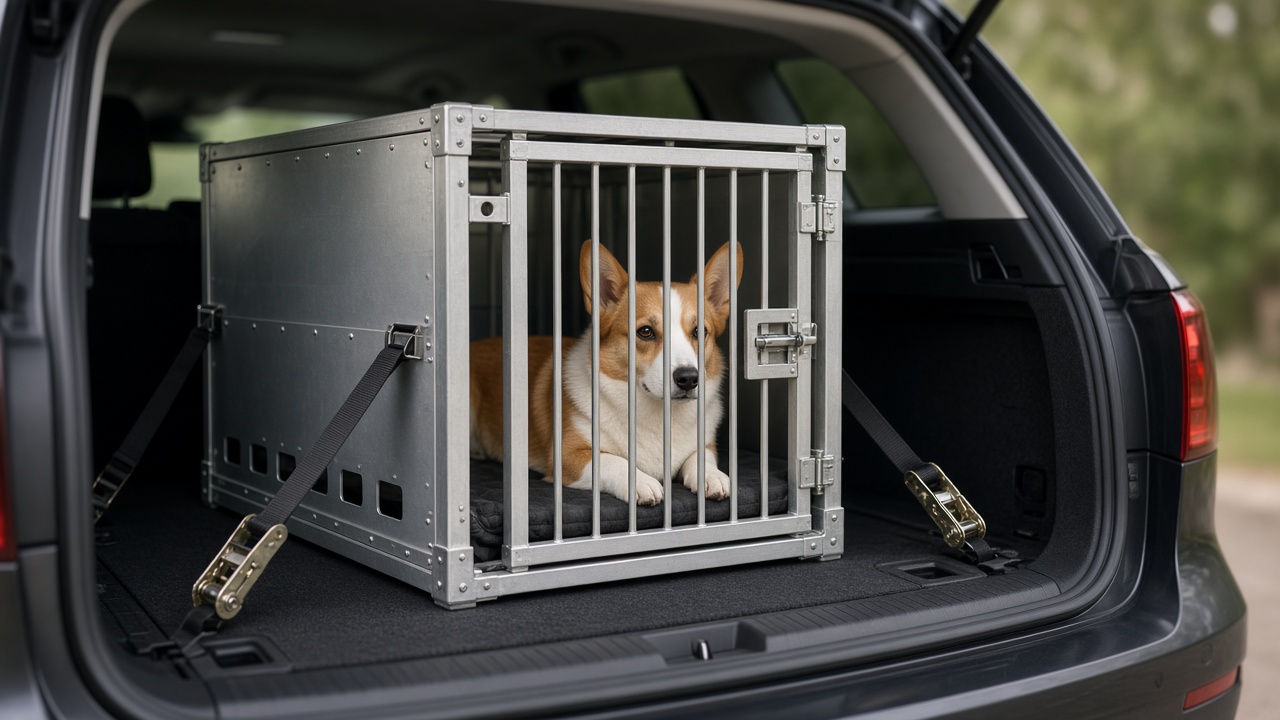
Never block the driver’s mirror. Never leave a dog in a parked cabin because the booster “looks safe.” A crate conversation for cargo lives on the crash-tested crate page. A hammock that is a cover, not a seat, lives on car hammocks.
Seven buying mistakes the Seat Restraint we keep seeing
Buying “crash-tested” from a photo. No lab, no date, no orientation.
Clipping the tether to a collar. Neck first, then the ER.
Front seat + live airbag. Toy-breed math.
One 30-lb cave for a 6-lb dog. The dog becomes a rattle.
Skipping the harness on a booster. You bought a launch pad.
Headrest strap as the only anchor. Listing lifestyle shot.
Treating a booster as a child seat. CPS does not work that way.
When a car-seat question is a clinic or legal question
Collapse, vomiting that will not stop, a dog that cannot stand after a stop, or a collision of any speed. Book the clinic. Photograph the install for insurance if you must. Nothing on this page has been reviewed by a veterinarian on our behalf.
A dog that cannot ride without screaming may need a behavior plan, not a third colorway. A dog that cannot regulate heat in summer needs shade and water, not a fleece booster cover.
What this five-card catalog is not
It is not a CPS Travel Crates list. Rotomolded kennels live on the crate page. It is not a barrier for an 80-lb dog in an SUV — that is the barrier page. It is not a seat cover. It is not infant gear scaled down. Human baby seats have FMVSS labels. These five cards do not.
How we researched this guide
The We read the titles and descriptions of five current catalog SKUs against published crash language, listed weight ceilings, install path, and card price. We cite CPS because it is a public U.S. scoreboard. We cite AVMA travel and heat pages because those documents are specific.
What we do not do: we do not run “tested” highway rotations, we do not employ a crash dummy program, and we do not award stars. Limitations: listed prices move; card prices are August 2026 snapshots; CPS lists change. A written clinic plan or a police report supersedes this URL.
Vehicle types and the best dog car seat for small dogs
A booster that sits well in a sedan bucket can walk in a 60/40 bench. A LATCH cradle that loves a rear ISOFIX pair can fail in a two-seater with no rear bench. Match the car, not the Instagram cabin.
Sedan / hatch, rear bench. Default. Seat belt through the base or LATCH J-hooks. Sleepypod belts to any seating position that has a belt. Keep the dog off the driver’s elbow.
SUV middle row. Often the easiest LATCH story. Watch the seat-belt path if a human booster already occupies the outboard. Do not stack a dog nest under a human child’s legs.
Truck crew cab. Rear belts exist; space does not. A tall Snoozer lookout can block a rear passenger. Kurgo’s lower profile wins on paper. Measure the seat cushion depth.
Two-door / no rear seat. This is a front passenger + airbag off conversation with the vehicle manual, or a “this car is the wrong car” conversation. We will not soften that.
Rideshare / second car. Packable Kurgo or a CPS harness you can carry in a tote. A 15-lb foam sculpture you leave at home is not a restraint.
Motion sickness vs anxiety vs “wants the window”
Owners mix three jobs. this comparison splits them.
Motion sickness. Drool, swallow, vomit, green-gills after five minutes. Elevation sometimes helps owner-theme notes. A lookout nest (Snoozer, K&H) is the experiment. A crash harness lying flat may be worse for that dog. A clinic can discuss motion meds. We do not.
Noise / storm anxiety in the car. A nest is not a ThunderShirt. See the small-breed anxiety vest page if the problem is the world, not the road. Do not tighten a car tether to “calm” a panic.
Window tourism. The dog wants height. That is a booster job. It is not a crash protocol. Clip the harness short enough that the head is not out the window — flying debris and leash-around-neck stories are real.
Driver distraction. An unrestrained small dog in a lap is a crash and a ticket in some places. The best dog car seat for small dogs is also the one that keeps paws off the wheel.
Cleaning, heat, and the fleece-cover trap
Washable covers are why K&H and Snoozer stay in the mid band. Mud pellets in foam are a smell you will not remove. Follow the label. Do not machine-destroy a ballistic-nylon PupSaver shell because a forum said “just wash it.”
Summer: a fleece lookout in a parked driveway is a heat box even with the door open. Shade the cabin. Crack is not a protocol. AVMA still treats a closed car as an emergency. A cooling vest is a walk object — see best dog cooling vest — not a cabin AC replacement.
Winter: a small dog in a harness on a cold seat can shiver. A thin pad under the dog is fine. A mountain of blankets that prevent the tether from holding is not.
Cost per year, not cost per listing
Sleepypod at $80 plus one K&H at $50 is $130 — protocol for highway days, nest for errands — if both fit. Five cards at $510 is a closet. Buy the job.
Replacement: foam that pancakes is retired. A harness that will not snug is retired. A faded CPS listing you cannot open on centerforpetsafety.org is a re-check, not a forever badge.
A used booster with an unknown crash history is like a used infant seat: if you cannot name the prior life, skip it. Buy new hardware for a living dog.
Frequently asked questions
Can the best dog car seat for small dogs go in the front seat?
Back seat is the desk default — airbag risk in front. If the vehicle forces a front install, disable the passenger airbag per the vehicle manual, not a forum post. The best dog car seat for small dogs still needs a harness clip.
What does a crash-test certification mean for a dog car seat?
A dynamic sled with a weighted dummy, a named lab or program, and a result you can open. CPS is the best-known U.S. program for harnesses. Sleepypod Clickit Sport is the CPS object on this page. PupSaver publishes a 30 mph MGA sled for the Original. K&H, Snoozer, and Kurgo are tether-and-belt boosters on our compile.
Is a crash-tested harness or a booster better for a small dog?
Harness if the job is a named protocol and the dog will lie on the seat. Booster if the job is a horizon for a motion-sick dog — and you accept no sled. Cradle (PupSaver) if you want a nest and a maker sled. Match the job.
How do I install a dog car seat?
Rear bench. Belt or LATCH the maker names. No slack. Harness on the dog. Clip the tether. Push-test the base.
Do I need a harness with a dog car seat?
Yes. Sleepypod is the harness. The four seats assume a body harness on the tether. Never a collar.
What size dog car seat should I buy for my small dog?
Weight and length vs that chart. Snoozer Small ~18 lb. Sleepypod Small ~25 lb. PupSaver Original and Kurgo Skybox list 30 lb. Recheck a growing puppy.
Where is the safest place to put a dog car seat?
Rear seat, away from an active front airbag, with the dog tethered so it cannot reach a door or the driver.
Can I use a dog car seat for a puppy?
If today’s weight fits and the harness is snug. Recheck often. An oversized cave is not “room to grow.” It is a rattle.
Does a booster replace a crash-tested crate in the cargo area?
No. Different object. See crash-tested crates.
Will a seat keep a dog cool in a parked car?
No. AVMA treats a closed cabin as a medical risk. Open the vest aisle on a different day. This page is restraint.
Related pages
- Best crash tested dog crate for car travel
- Best dog car hammocks
- Best dog car barrier for SUV
- Best dog car seat cover
Sources
- Center for Pet Safety — Certified products: https://www.centerforpetsafety.org/certified-products/
- AVMA — Traveling with your pet: https://www.avma.org/resources-tools/pet-owners/petcare/traveling-your-pet
- Manufacturer size and safety pages for PupSaver, Sleepypod, K&H, Snoozer, and Kurgo (brand; confirm at purchase)
Last reviewed: August 2026. If something is stale, contact us.