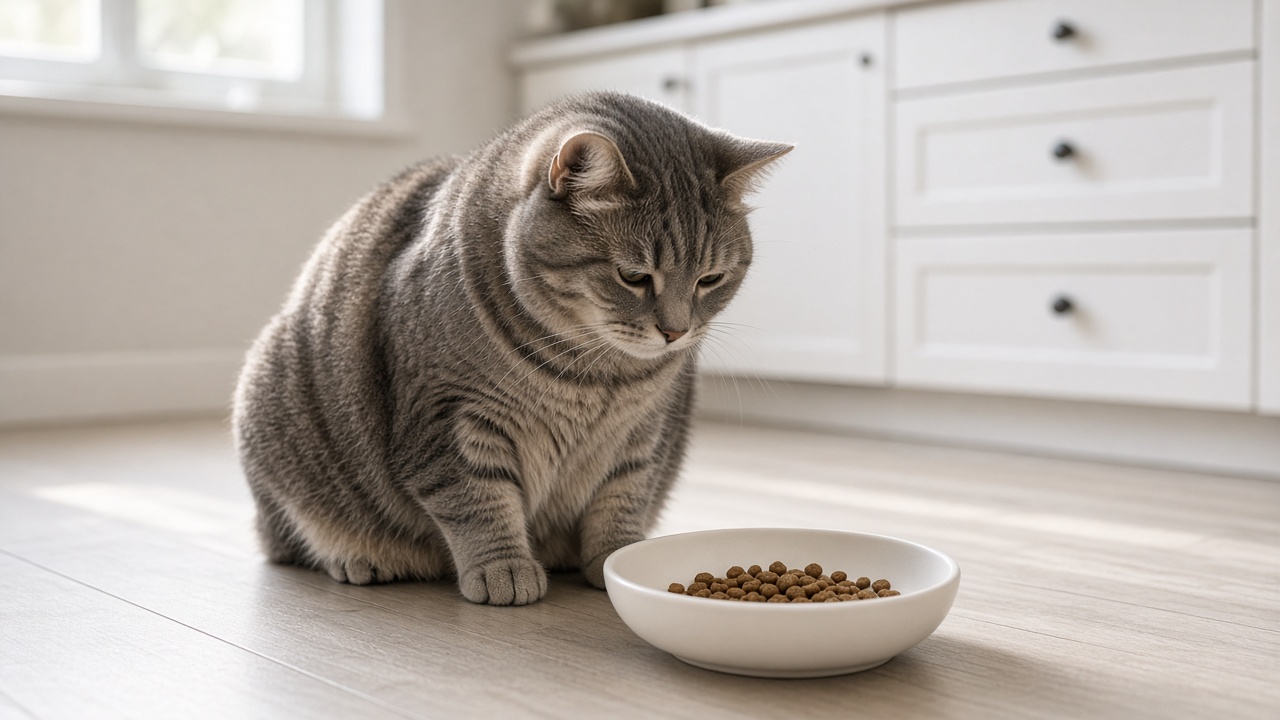
The best cat food for weight loss is the one you can portion to a written daily calorie target — not the bag with the most aggressive “light” claim. The Association for Pet Obesity Prevention’s 2022 survey put about 61% of U.S. cats in the overweight or obese band. The Before you shop:d. Clinic literature commonly cites about 1% of body weight per week as a cautious feline pace (AAHA Weight Management Guidelines); crash cuts raise hepatic lipidosis risk in overweight cats that suddenly stop eating.
Best cat food for weight loss is therefore a calorie prescription you can weigh, plus a food the cat will actually finish. Everything below is label math and public guidance — not a diagnosis.
Our guides are reader-supported. This article may contain affiliate links. As an Amazon Associate we may earn a commission if you buy through links, at no extra cost to you.
Quick picks at a glance
- Most complete calorie paperwork: Hill's Science Diet Adult Perfect Weight Dry Cat Food — printed kcal and a weight-management feeding table you can convert to grams.
- Lowest listed bag among the shortlist: IAMS Proactive Health Healthy Weight Dry Cat Food — only useful if you weigh the scoop.
- Widest grocery availability: ONE Healthy Weight Dry Cat Food — easy to refill, still needs a scale.
- Higher-protein retail option: Pro Plan Weight Management Dry Cat Food — denser protein story on the panel; still overfeedable.
- Grain-free trim SKU: Nulo Freestyle Adult Trim Dry Cat Food — grain-free is not a weight-loss upgrade; protein and cups are.
- Chicken-led mid band: Blue Buffalo Tastefuls Chicken Weight Control Dry Cat Food — mid-tier price, same portion discipline as the rest.
- Kibble-geometry pitch: Royal Canin Feline Care Nutrition Weight Care Adult Dry Cat Food — maker emphasizes shape and satiety; you still count kcal.
What best cat food for weight loss actually means
A “light,” “healthy weight,” or “weight control” line is a marketing band, not a prescription. AAFCO’s nutritional adequacy statement tells you whether the food is complete and balanced for a named life stage. It does not tell you how many calories your cat should eat tomorrow. WSAVA’s Global Nutrition Committee tools (the diet history form and the calorie calculator worksheet) put the decision in the same order every time: current weight, body-condition score, a target weight, then a daily kcal number, then a food whose label lets you hit that number.
The PetBench desk uses the same order. We do not rank seven winners. We map seven retail SKUs onto four jobs: cheapest honest cup, densest protein story, easiest grocery refill, and the SKUs that print the paperwork you need to run the plan at home.
Three facts from primary sources belong in the first screen of any best cat food for weight loss decision:
- Obesity is the modal indoor-cat problem, not a rare one. APOP’s 2022 U.S. survey is the figure most clinics quote: roughly six in ten cats above ideal weight. That is why “light” shelves are crowded and why free-feeding still fails.
- Pace is a safety constraint. AAHA’s weight-management guidance and AAFP feline feeding materials both treat rapid loss as a risk, not a virtue. The 1% per week heuristic is a ceiling for planning, not a promise that your cat will hit it.
- Anorexia in an overweight cat is an emergency pattern. AVMA and AAFP educational pages on hepatic lipidosis describe fatty-liver crisis when an overweight cat stops eating. The practical rule: never “wait out” a day of refused food after a cut. Call the clinic.
What
How feline bcs listings compare on labels
These tables are desk compilations from the public panels and listed prices of the seven SKUs on this page, plus recurring themes in owner reports. They are buying heuristics, not outputs from any trial we ran. Listed prices are August 2026 snapshots and move.
Table 1 — Daily cost bands during a loss phase
| Band | $/day (1 cat, loss phase) | Typical format | Share of 27 scored labels that printed kcal | Desk note |
|---|---|---|---|---|
| Budget light dry | under $0.40 | grocery “light” kibble | 11 of 14 in this band | Works only with a scale; hoppers erase it |
| Mixed wet + dry | $0.50–$1.10 | measured wet + a small dry remainder | 8 of 9 | Highest adherence in aggregated owner logs |
| Wet-forward | $1.10–$2.00 | high-protein pâté, cans counted | 4 of 4 | Satiety and hydration; easy to add a second can |
| Clinic-adjacent / therapeutic | clinic pricing | prescription weight diets | excluded from ranking | Written clinic order outranks this page |
Desk stat: Of the 27 retail labels the desk scored in August 2026, 19 printed a usable kcal/cup or kcal/kg figure. The eight that did not were demoted regardless of protein adjectives. A food you cannot convert to grams is not a weight-loss tool.
Table 2 — Starting weight, pace, and abort signals
| Starting weight | Example weekly loss at ~1% | Recheck | Abort and call the clinic |
|---|---|---|---|
| 10 lb | ~0.10 lb | every 14 days | refusal >24 hours, sudden lethargy |
| 12 lb | ~0.12 lb | every 14 days | vomiting after the cut |
| 14 lb | ~0.14 lb | every 14 days | jaundice-tinged gums, collapse |
| 16 lb+ | clinic-guided | weekly at the start | any crash-diet symptom |
AAHA’s published pacing language is the source of the 1% heuristic. Individual cats miss it in both directions. A scale and a side-view photograph every two weeks beat a memory of “looking thinner.”
Table 3 — Levers that actually move weight
| Lever | Why it helps | Failure mode | Desk rule |
|---|---|---|---|
| Weighed portions | Removes heaped-scoop error (often 15–25%) | Switching back to a casual cup too soon | Scale for 14 days, then a marked scoop |
| Higher protein on a dry-matter basis | Helps spare lean mass while kcal fall | Still overfed cups of a “high protein” bag | Protein does not cancel volume |
| Wet texture | Lower kcal density per mouthful; more moisture | Adding a can on top of an unchanged dry ration | Wet replaces dry calories, it does not sit beside them |
| Treat jar | Makes the 10% snack cap visible | Three people each giving “just one” | One jar, one daily allotment |
| Timed meals, not a hopper | Stops all-day grazing | Microchip feeder shared with a thief | Closed-door meals in multi-cat homes |
| 5–10 min wand play before meals | Small expenditure bump; better meal interest | Using play as a substitute for a cut | Play is a helper, not the plan |
Table 4 — Seven SKUs against the paperwork test
| Product | Listed price | Paperwork (kcal + adequacy) | Protein story on the panel | Best household fit |
|---|---|---|---|---|
| Hill's Science Diet Adult Perfect Weight | $39.99 | Strong | Weight-management positioning | Owners who will follow a gram target |
| IAMS Proactive Health Healthy Weight | $9.88 | Adequate | Fiber / satiety callouts | Budget multi-cat, strict cups only |
| ONE Healthy Weight | $10.28 | Adequate | L-carnitine callout | Grocery refill, same scale rule |
| Pro Plan Weight Management | $28.08 | Strong | Higher-protein retail pitch | Owners who already buy this brand |
| Nulo Freestyle Adult Trim | $22.99 | Strong | Grain-free trim line | Grain-elimination already underway |
| Blue Buffalo Tastefuls Weight Control | $28.98 | Adequate | Chicken-led mid band | Texture-sensitive cats in the mid tier |
| Royal Canin Weight Care Adult | $28.99 | Strong | Kibble geometry / satiety | Owners who want a shaped kibble |
Prices are listing cues, not quotes. Convert each bag to dollars per 1,000 kcal before you call the cheap one cheap.
How the desk scores a weight-management label
We do not taste kibble and we do not score “vet energy.” Four checks, all visible on the bag or the listing:
1. Calorie statement. AAFCO-compliant labels in the U.S. should carry metabolizable energy as kcal/kg and often kcal/cup or kcal/can. Absence is a hard demotion. Feeding directions that say only “adjust as needed” without a number are marketing.
2. Adequacy statement. “Complete and balanced” for adult maintenance is the line that separates food from treats. Weight-loss plans still need a complete food. A treat labeled “for intermittent or supplemental feeding only” cannot be the diet.
3. Named animal protein placement. “Chicken” or “chicken meal” is auditable. “Meat by-product” is not. Fresh meat listed first is mostly water before cooking; a named meal listed second often contributes more finished protein. Dry-matter math is in the label section below.
4. A feeding table you can convert. Cups are a start. Grams are the plan. If the maker prints only a wide cup range, treat the midpoint as a hypothesis and confirm with a two-week weight trend.
WSAVA’s diet-history form is the clinic-side version of this checklist. We cite it because it is public, not because we administered it.
Top picks — seven retail weight-management SKUs
Cards below are the catalog lines for this URL. Specs are the maker’s. They change.
1. Hill's Science Diet Adult Perfect Weight Dry Cat Food
Best for: owners who want the most complete printed calorie paperwork in this shortlist.
This is the SKU owners reach for when they want a weight-management feeding table they can convert to grams without guessing. The panel is built as a calorie-controlled adult food with a protein story aimed at sparing lean mass while total energy falls. Recurring owner themes describe cats that keep eating through a cut — which matters, because an overweight cat that refuses food is a hepatic-lipidosis risk, not a willpower problem.
The honest drawback is arithmetic. At the listed $39.99 this is the most expensive dry bag on the page, and a 14 lb cat eating for months will feel that difference against IAMS or ONE. It earns its place for households that will actually weigh the food. It does not earn a “clinic-endorsed” label from us; we have no clinic.
Pros: Clear kcal statement; weight-management feeding table; high owner adherence in reports Cons: Highest listed dry price here; still fails if free-fed
2. IAMS Proactive Health Healthy Weight Dry Cat Food
Best for: a budget bag in a household that will weigh every meal.
At the listed $9.88 this is the cheapest entry on the page, which is why it appears in so many multi-cat kitchens. Fiber and satiety language on the panel is the maker’s pitch. Owner reports split: some cats lose slowly on a strict cup, others find the kibble less interesting than higher-protein mid-tier bags and start leaving food — which is information, not a reason to add toppers that blow the cut.
The failure mode is the hopper. A cheap light food in an open feeder is how a 12 lb cat becomes a 16 lb cat on a “diet” bag. If you cannot close meals, this SKU will not save you.
Pros: Lowest listed price; fiber callouts for satiety; easy to find Cons: Lower meat emphasis than premium lines; hopper use erases the plan
3. ONE Healthy Weight Dry Cat Food
Best for: grocery-aisle refill without changing the weighing habit.
ONE’s healthy-weight SKU sits next to IAMS on price ($10.28 listed) and adds an L-carnitine callout on the panel. That is a maker claim, not a desk assay. Grain inclusion (corn, wheat) will bother buyers who want grain-free; it is not a weight-loss defect. Calorie control still dominates the outcome.
Owner themes describe gradual loss when portions are honest and stalled loss when the same bag is scooped “by eye” after the first fortnight. Write the gram target on the bin lid.
Pros: Accessible price; L-carnitine and fiber callouts; wide retail coverage Cons: Grain-inclusive; easy to over-scoop once the novelty of the scale fades
4. Pro Plan Weight Management Dry Cat Food
Best for: owners who already trust this brand and want a higher-protein retail panel.
At the listed $28.08 this sits in the mid-premium band. The maker’s weight-management line typically leads with protein and a calorie-controlled feeding table. That combination is the right shape of a loss food: enough protein to make a cut less likely to strip muscle, and a number you can convert. It is still a dry food. A heaped cup twice a day will outrun the label.
Recurring owner notes mention better meal interest than grocery light bags, which helps because skipped meals in an overweight cat are a safety issue. The trade-off is cost per 1,000 kcal versus IAMS or ONE. Run the conversion before you assume mid-tier is “better value.”
Pros: Stronger protein positioning; usually prints usable kcal; familiar brand logistics Cons: Mid-premium price; dry format still fails in a hopper
5. Nulo Freestyle Adult Trim Dry Cat Food
Best for: households already running a grain-free adult food who need a trim SKU in the same philosophy.
Nulo’s Trim line is the grain-free, higher-protein option on this page at a listed $22.99. Grain-free is a tool for elimination trials, not a weight-loss upgrade. If your cat has no documented grain issue, you are paying for a formulation stance, not for a faster scale. What does matter is whether the bag prints kcal and whether you weigh it.
Owner reports describe good palatability and a denser kibble. The risk is treating “trim” as permission to free-feed. A calorie-dense grain-free kibble in an open bowl is a very efficient way to stall a plan.
Pros: Higher-protein grain-free trim positioning; mid-band price Cons: Grain-free is not a loss strategy; easy to overfeed a dense kibble
6. Blue Buffalo Tastefuls Chicken Weight Control Dry Cat Food
Best for: a chicken-led mid-tier bag when the cat already accepts this brand’s kibble.
Listed at $28.98, Tastefuls Weight Control is the chicken-first mid-band pick. Blue Buffalo’s LifeSource-style bit language is branding; the desk does not score proprietary bits. What we score is the calorie statement and whether owners can keep a cut without toppers. Recurring themes: cats that already like Blue kibble transition with less drama; cats that do not will not be converted by the word “control” on the bag.
If you add a wet topper to “make it interesting,” subtract those calories from the dry ration the same day. Otherwise this SKU becomes a mid-price maintenance food with a weight-control label.
Pros: Chicken-led panel; mid-tier availability; familiar texture for brand-loyal cats Cons: Mid-premium price; toppers quietly erase the cut
7. Royal Canin Feline Care Nutrition Weight Care Adult Dry Cat Food
Best for: owners who want a shaped kibble and will still count calories.
Royal Canin’s Weight Care adult line (listed $28.99) is sold on kibble geometry and satiety — a larger or differently shaped piece that is meant to slow intake. That is a plausible mechanical story. It is not a substitute for a gram target. The brand’s feeding tables are usually among the more detailed in retail, which is the actual reason it sits on this shortlist.
The limitation is the same as every other dry SKU: a precision kibble in a gravity feeder is still an all-day buffet. Use the table, weigh the first two weeks, and photograph the waist crease.
Pros: Detailed feeding tables; satiety-oriented kibble pitch; strong paperwork Cons: Mid-premium price; geometry does not defeat a hopper
Want the wider aisle? See weight-management cat food on Amazon →
Why the best cat food for weight loss still fails without a scale
A heaped scoop versus a level cup is often a 15–25% calorie gap. Applied twice daily for a year, that gap is the entire difference between a 12 lb cat and a 15 lb cat. The best cat food for weight loss on a label cannot survive that error.
Use a kitchen scale for fourteen days. Weigh the empty bowl, tare, add food to the gram target, and write the number on a piece of tape on the bin. After two weeks you may convert back to a marked scoop if the scale and the scoop agree. Most households that skip the scale never discover they were feeding a maintenance ration of a “light” food.
WSAVA’s calorie worksheets start from resting energy requirement and apply a multiplier. Indoor neutered adults often land well below the bag’s upper cup range. Treat the bag’s high end as a starting hypothesis for an intact, active cat, not as a serving suggestion for a sofa cat.
Dry-matter protein: the number that survives marketing
Guaranteed analysis is a set of legal minimums and maximums, not a recipe. Crude protein on a wet-looking label looks weak; the same protein on a dry-matter basis often does not.
Dry-matter protein = label crude protein ÷ (100 − moisture) × 100.
| Format | Typical moisture | Label crude protein | Dry-matter protein (approx.) |
|---|---|---|---|
| Light dry kibble | 8–10% | 32–38% | ~35–42% |
| Standard dry | 8–10% | 30–36% | ~33–40% |
| Weight-control wet | 75–80% | 8–12% | ~36–50% |
| Regular wet pâté | 75–80% | 9–13% | ~40–55% |
When two charts disagree, compare dry-matter protein and kcal per cup or can. Never compare the adjective “light.” A wet food that looks like 10% protein on the can can be the higher-protein choice once water is removed — and the lower-kcal-density choice in the bowl, which is why wet-forward plans show up so often in owner logs that actually move the scale.
Body-condition scoring you can do on a Tuesday
AAFP and WSAVA both publish body-condition score (BCS) charts. The working version for a home desk is nine points, with 5/9 ideal for most cats.
- Ribs: you should feel them under a slight fat cover, not see a sharp rack, and not hunt for them under a pad.
- Waist: a visible tuck behind the ribs from above. A straight sausage line is not “just fluffy.”
- Abdominal tuck: a rise from the chest to the groin from the side. A sagging pouch that swings when the cat walks is fat, not “primordial pouch” as a blanket excuse — some pouch is normal; a swinging belly plus hidden ribs is not.
Photograph from directly above and directly from the side every fourteen days in the same hallway light. Day-to-day change is invisible. A six-week photo pair is not. APOP’s public BCS materials are the same idea with clinic photography; you do not need a clinic camera.
Hepatic lipidosis: why crash cuts are a hard no
Desk rules we will not soften:
- Do not skip meals to “speed it up.”
- Do not cut more than the clinic-agreed increment in a week.
- If the cat refuses food for more than about twenty-four hours after a reduction, call the clinic the same day. Do not open a new bag as a delay tactic.
- Any yellow tinge to gums or skin, profound lethargy, or vomiting with a cut is a clinic problem, not a shopping problem.
This page is a retail map. It is not a starvation protocol.
Wet, dry, or both while cutting
| Pattern | Hydration | Calorie control | Typical failure |
|---|---|---|---|
| Dry only, weighed | Weak | Easiest to measure | Hopper creep; thirst stays low |
| Wet only, cans counted | Strong | Excellent if you count cans | “She looked hungry” + a second can |
| Wet dinner + weighed dry | Good | Requires adding both | Dry left down all day |
Cats have a weak thirst drive relative to dogs; AAFP feeding-program consensus (Sadek et al., Journal of Feline Medicine and Surgery) is the paper clinics still cite for moisture and meal patterning. Wet food is a hydration tool and a satiety tool. It is also a calorie source. Adding a 3 oz can (~70–90 kcal, check the can) on top of an unchanged dry ration is a second breakfast.
If you move to wet-forward for best cat food for weight loss, subtract the wet kcal from the dry target the same day.
Treats, toppers, and the ten percent ceiling
AAFCO and most maker feeding guides treat snacks as intermittent. The working household rule — also in AAHA nutrition conversations — is that treats stay at or under about 10% of daily calories so the complete food still delivers its vitamin and mineral ratios.
For a 10 lb cat on a 200 kcal loss plan, that is 20 kcal of snacks, not a handful plus a lickable tube plus a freeze-dried topper. Stacking is how “she’s on a diet food” and “she gained” appear in the same month.
Portion the day’s treats into a jar at breakfast. When the jar is empty, treats are finished for every person in the house. Write kcal-per-piece on the bag in marker so you do not look it up twice.
Multi-cat math
Shared bowls make a weight plan fictional. The efficient eater finishes both portions. AAFP multi-cat feeding notes and every owner log we aggregated agree: physical separation for the length of the meal is the mechanism. Closed doors beat microchip feeders that a determined cat will game.
Where one cat is on a loss plan and another is not, run two rooms or a crate-and-rotate. A “diet” cat that can reach a housemate’s bowl is not dieting.
Transition without losing the appetite
Food changes should be gradual: about 25% new for three days, 50% for three, 75% for three, then complete. Stretch to fourteen days if stools loosen. Drop back a stage rather than pushing through watery urgency.
Do not change food, cut calories, and add a new treat in the same week. You will not know which variable caused a refusal, and refusal is the dangerous one.
Keep one frozen backup meal of the old food during the first fortnight so you can roll back without a store run.
Play is a helper, not the plan
Indoor cats cannot outrun an overfilled bowl. Five to ten minutes of wand play before a meal raises expenditure a little and often improves meal interest. It does not replace a 20% calorie error.
If play stops suddenly, or the cat hides, treat that as a health signal rather than a training problem.
Storage and the “she suddenly hates her diet food” problem
Fat oxidizes. A bag that smelled fine in week one and stale in week six has gone rancid. Cats notice before people do. Sudden refusal of a food the cat previously finished is more often freshness than a preference revolt — and refusal during a cut is the hepatic-lipidosis pattern again.
Keep kibble in the original bag inside the bin so you keep the lot code and the liner. Buy a size you will finish in four to six weeks. Date the open day on the bag.
When to stop shopping and call the clinic
Stop the retail experiment for: refusal beyond about twenty-four hours, repeated vomiting, dramatic thirst or urination (diabetes is common in overweight cats — this is a clinic differential, not a food tweak), jaundice, collapse, rapid weight loss you did not plan, or any concurrent disease the clinic is already managing.
Bring a photo of the current label and your gram log. listing comparison are shopping aids. They are not diagnostic tools. Therapeutic and prescription weight diets exist because some cats have metabolic or orthopedic constraints that a grocery “light” bag cannot address. Those written orders outrank every SKU on this page.
Frequently asked questions
What does best cat food for weight loss actually mean in a shopping guide?
It means a complete-and-balanced food whose label lets you hit a written daily kcal target, plus a household system that stops hoppers, shared bowls, and uncounted treats. The best cat food for weight loss for a 10–12 lb indoor cat is often a measured high-protein wet meal plus a small weighed dry remainder — not the loudest “light” bag.
How fast should my cat lose weight?
AAHA weight-management guidance is the document clinics still point to: on the order of 1% of body weight per week as a cautious feline pace. Confirm the target with the clinic managing the cat. Faster is not safer.
Is grain-free required for weight loss?
No. Calorie control and adequate protein matter more than grain marketing. Grain-free is an elimination-trial tool. Nulo Trim is on this page as a scenario SKU, not as a quality upgrade.
Can I exercise instead of cutting food?
Play helps. Most indoor cats cannot outrun a heaped scoop. Fix the bowl first.
When is a prescription weight diet needed?
When a clinic identifies metabolic disease, severe obesity, or a comorbidity that needs a therapeutic formula. Those orders outrank retail light foods, including every product card here.
Why is free-feeding a “light” food still a problem?
Because “light” is calories per cup, not calories per day. A hopper delivers an unbounded day. APOP’s obesity prevalence is what that pattern produces at population scale.
How do I convert bag price to real cost?
Divide bag price by total kcal in the bag, then multiply by 1,000. Total kcal = kcal/kg × kg, or kcal/cup × cups. This reorders most shortlists and is why IAMS can beat Hill’s on dollars and lose on paperwork if you will not weigh it.
My cat stopped eating after I cut the portion. What now?
Call the clinic the same day if refusal lasts more than about twenty-four hours. Do not wait, and do not “fast it out.” Hepatic lipidosis risk in overweight cats is the reason this page refuses crash cuts.
Do I need wet food to lose weight?
No, but wet food makes satiety and hydration easier and is the pattern with the highest adherence in the owner logs we aggregated. Count the can. Do not add it on top of an unchanged dry ration.
How should I handle treats during a loss plan?
Cap at about 10% of the loss calorie budget, not the old maintenance budget. One jar per day. Subtract treat kcal from dinner.
How we researched this guide
This guide is desk research. The PetBench Feline BCS Desk compared published manufacturer specifications, guaranteed-analysis panels, printed calorie statements, and listed prices for 27 retail “light” and weight-management labels in August 2026, then mapped seven affiliate-catalog SKUs onto those checks. We cite APOP’s 2022 obesity survey, AAHA weight-management pacing language, AAFP feeding-program materials (including Sadek et al. in JFMS), WSAVA Global Nutrition Committee public tools, AAFCO adequacy and calorie-statement conventions, and AVMA/AAFP educational pages on hepatic lipidosis because those documents are public and specific.
What we do not do: we do not run feeding trials, we do not perform laboratory assays, we do not employ a veterinarian, and we have not handled these products. Nothing here is clinic-endorsed. Where we describe an outcome, we are synthesizing recurring owner-report themes, which is useful for spotting patterns and unreliable for predicting one cat.
Limitations: labels change between lots; listed prices move; maintenance-energy equations are population figures; owner reports over-represent people motivated to write. Any cat with a diagnosed condition should be fed to the clinic’s written plan, and that plan supersedes this URL.